
Carbohydrates: types, how much you need and which ones are healthy
Bread, potatoes, sugar: carbohydrates are in almost every meal and still have a bad reputation. But it's not the amount that matters, it's the source. Which types there are, how much you need a day and which ones are actually healthy.


Aktualisiert 15 October 2026 · 13 Min. Lesezeit · 36 Quellen

The key points in 30 seconds
That's what each gram of carbohydrate delivers: the same as protein and less than half of fat. Fibre provides only 2 kcal.
of your energy should come from carbohydrates, which at 2,000 kcal means more than 250 g. EFSA gives 45 to 60%. Most people in Germany are below that.
is what the DGE recommends. In reality, the average is 23 to 25 g. This is exactly where it's decided whether carbohydrates are healthy or not.
Wholegrains, pulses, vegetables and fruit lower the risk of disease, while sugar-sweetened drinks raise it. The total amount, on the other hand, hardly matters.
What are carbohydrates?
Carbohydrates are the group of nutrients the body prefers to get its energy from: sugar, starch and fibre, all built from the same building blocks. One gram provides 4 kcal, the same as protein. They're in bread, pasta, rice, potatoes, fruit, pulses and milk, but also in soft drinks and sweets. This very range explains their mixed reputation: the group is too big to be simply good or bad.
What does the body need carbohydrates for?
Mainly as a quickly available source of energy. Muscles, brain and red blood cells use glucose, which comes from digestible carbohydrates. Whatever isn't needed ends up as glycogen in the liver and muscles, or in fat tissue if there's a lasting surplus. Fibre isn't digested, but it feeds your gut bacteria. Strictly speaking, carbohydrates aren't essential: the body can make glucose from protein itself. Even so, being convenient, cheap and easy to tolerate, they're the main energy source for almost everyone. By the way, for glucose to become energy, your metabolism needs vitamin B1.
Are sugar and carbohydrates the same thing?
No, sugar is just one part of carbohydrates. That's why the label says “carbohydrates, of which sugars”: the first number covers all digestible carbohydrates, the second only the single and double sugars, i.e. glucose, fructose, table sugar and milk sugar. A slice of wholegrain bread has 16 g of carbohydrates, but only 1 g of that is sugar. A glass of cola has 26 g of carbohydrates, all of it sugar. For blood sugar, teeth and how full you feel, that makes a big difference, even if the calories are the same.

What types of carbohydrates are there?
Chemically, carbohydrates are classified by the number of sugar units they contain: single sugars consist of one, double sugars of two, and multiple sugars of ten or more units; in between are the oligosaccharides with three to nine. The classification tells you how quickly the gut can break a carbohydrate down, but not whether it's healthy. The table shows all the groups with examples.
Single sugars (monosaccharides)
Single sugars are the smallest carbohydrates and the only ones the gut absorbs into the blood without breaking them down first. The three most important: glucose (dextrose), the standard currency of metabolism; fructose (fruit sugar) in fruit and honey, which is processed in the liver first; galactose, a component of milk sugar. In their pure form they occur in honey, fruit and many sweets. All single sugars count as “sugars” on the label.
Double sugars (disaccharides)
Double sugars consist of two linked single sugars. Sucrose, the table sugar from beet or cane, is glucose plus fructose; lactose, the milk sugar, is glucose plus galactose; maltose, the malt sugar, consists of two glucose units and is formed when starch is broken down, for example in beer. The bond is split by enzymes in the small intestine. If the enzyme lactase is missing, milk sugar stays undigested: that's lactose intolerance.
Types of carbohydrates at a glance
Classification by chain length, as recommended by FAO and WHO since 1998. Starch and fibre are the two multiple sugars (polysaccharides); sugars and oligosaccharides are commonly called short-chain, polysaccharides long-chain.
| Units | Examples | Found in | In the body | |
|---|---|---|---|---|
| Single sugars | 1 | Glucose, fructose, galactose | Fruit, honey, soft drinks | Goes straight into the blood |
| Double sugars | 2 | Sucrose, lactose, maltose | Table sugar, milk, malt | Split in the small intestine, then into the blood |
| Oligosaccharides | 3 to 9 | Raffinose, fructo-oligosaccharides, maltodextrin | Pulses, onions, sports drinks | Partly indigestible, food for gut bacteria |
| Starch | 10 or more | Amylose, amylopectin | Cereals, potatoes, pulses | Broken down into glucose, speed depends on processing |
| Fibre | 10 or more | Cellulose, pectin, beta-glucan | Wholegrain, vegetables, fruit, pulses | Indigestible, 2 kcal per gram, filling |
Classification according to FAO/WHO 1998 (degree of polymerisation). Sugar alcohols such as sorbitol and xylitol legally count as carbohydrates (2.4 kcal per gram); glycogen is the storage form in the body.
Multiple sugars (polysaccharides)
Multiple sugars are long chains of glucose: starch in plants, glycogen in the body, cellulose in cell walls. Starch from bread, rice, pasta, potatoes and pulses provides most of our carbohydrates. Enzymes break it back down into glucose, quickly with white flour, more slowly with whole grains and pulses. The small intestine can't break down cellulose, pectin and other fibre. It travels on to the large intestine, where bacteria partly use it, and it provides only 2 kcal per gram.
Complex and simple carbohydrates: what's behind it?
In everyday use, complex carbohydrates means starch and fibre, simple means sugar, and the rule of thumb is: complex good, simple bad. Expert bodies such as the FAO and WHO advise against these terms because they're misleading. White bread is made of complex starch and still pushes your blood sugar up faster than an apple full of simple fructose. What matters isn't the chain length but the whole package: fibre, how processed it is, and free sugar. Long-chain and short-chain are just other words for the same blurry scheme.
What happens to carbohydrates in the body
Three stages from plate to cell. Once you know them, you'll understand why not every carbohydrate turns into sugar and why the scales drop so fast after a week without bread.
Digestion: breaking it down
Enzymes in saliva and the small intestine break starch and double sugars down into single sugars, which enter the blood. Fibre stays intact and travels on to the large intestine. The liver converts only around 40% of fructose into glucose; the rest is burned directly or turned into lactate.
Blood sugar and insulin
Glucose makes your blood sugar rise, and the pancreas responds with insulin. This hormone moves glucose into muscle, liver and fat cells. How steep the curve gets depends on the amount, the fibre and the companions fat and protein, not on chain length alone.
Storage: glycogen
Around 100 g of glycogen fits in the liver and about 400 g in the muscles, with every gram bound to 3 to 4 g of water. When the stores are full, the liver converts the excess into fat. When they're empty, the body gets glucose from protein or switches to ketone bodies.
How many carbohydrates do you need per day?
The DGE recommends getting more than 50% of your energy from carbohydrates, while the European authority EFSA gives 45 to 60%. At 2,000 kcal, that's more than 250 g, or 225 to 300 g a day. How much that is for you depends on your energy needs: the calculator uses the DGE reference values for adults aged 25 to 50 and your daily routine.
Is 100 g of carbohydrates a day a lot?
No, 100 g is little: it provides 400 kcal, which at a need of 2,000 kcal is a fifth of your energy and well below all reference values. In Germany, the median is 220 g (women) and 270 g (men). A day with 100 g looks like this: 40 g porridge oats with milk and berries, chicken with broccoli and a small potato at lunch, an apple, and egg, a slice of wholegrain bread and vegetables in the evening. That works, but it largely rules out pasta, rice and bread in normal portions. You can find your total needs in the calorie calculator.
Carbohydrates and sport
If you train, you need more, and it depends on your body weight: 3 to 5 g per kilogram for light training, 5 to 7 g for about an hour of moderate exercise a day, 6 to 10 g for one to three hours of endurance training. For 70 kg, that's 210 to 700 g a day, depending on your workload. When it's best to eat them is covered in the article Eating before exercise.

Carbohydrates in foods: the table
How many carbohydrates a food has is printed on every label, but not on potatoes, fruit and bread from the baker. The table below contains 155 foods with available carbohydrates per 100 g and per portion, plus fibre and, where measured, the glycaemic index. The values come from the German Federal Food Code (Bundeslebensmittelschlüssel) 4.0, with cooked foods listed as cooked, just as they are on your plate.
How many carbohydrates do potatoes have?
Boiled potatoes have around 16 g of carbohydrates per 100 g, or 19 g when boiled with the skin on; a 200 g portion therefore provides 32 to 38 g. That's less than boiled rice (25 g per 100 g) or pasta (29 g), because potatoes are about 78% water. They also contain 2 g of fibre and plenty of potassium. Cooked the day before, they contain about 10% less digestible starch, because some of it becomes resistant as it cools: a few kilocalories per 100 g, no reason to treat potato salad as a diet food.
Rice, pasta or potatoes?
Per portion, the three are close: 150 g of cooked rice gives you 37 g of carbohydrates, 200 g of pasta 57 g, and 200 g of boiled potatoes 32 g. Per 100 kcal, all three are practically the same at around 21 g; the difference lies in water content and portion size. None of the three is healthier across the board: potatoes bring potassium and vitamin C, wholegrain pasta and brown rice more fibre, and white pasta has the lowest GI. What matters most is what else is on your plate.
Foods without carbohydrates
Practically free of carbohydrates are meat, fish, eggs, cheese, butter and oils. Most vegetables stay under 5 g per 100 g: spinach, asparagus, lettuce, cucumber, courgette, broccoli, mushrooms, tomato. Nuts come in at 2 to 5 g, with cashews at 26 g as the exception. Fruit is never carbohydrate-free, but berries and citrus fruits, at 5 to 9 g, are the most frugal. What this means for a week of low carb is explained in our dedicated article.

Good and bad carbs: which are healthy?
You can't spot good carbohydrates by their name, only by the package they come in. The DGE guideline found no clear link between the total amount of carbohydrates and disease risk, but it did find one for fibre and wholegrain (they lower it) and for sugar-sweetened drinks (they raise it). Since 2023, the WHO has explicitly recommended looking at sources rather than amounts: wholegrain, vegetables, fruit, pulses.
How to spot good carbohydrates
Look at four things: fibre (at least 3 g per 100 g in bread, flakes and side dishes), degree of processing (whole grain rather than refined flour), free sugar (little or none) and accompanying nutrients (protein, vitamins, minerals). In an analysis of 185 studies, people with the highest fibre intake had a 15 to 30% lower risk of heart attack, stroke, type 2 diabetes and bowel cancer; the greatest benefit was at 25 to 29 g a day. Wholegrain, pulses, vegetables and whole fruit tick all four boxes.
More often and less often: carbohydrates in everyday life
- +Wholegrain bread, oats, wholewheat pasta, brown rice: fibre and B vitamins stay in the grain
- +Pulses: lentils, beans and chickpeas bring protein and up to 16 g of fibre per portion
- +Boiled potatoes or jacket potatoes: lots of water, potassium, few calories per 100 g
- +Whole fruit and vegetables: the sugar comes with fibre and water, and keeps you full
- +Milk and plain yoghurt: milk sugar plus protein, low GI
- −Sugar-sweetened drinks: cola, iced tea and energy drinks deliver sugar without filling you up
- −Fruit juice and smoothies: count as free sugars, one glass is like a cola
- −White flour: toast, rolls, pale pasta and pastries with almost no fibre
- −Sweets, cake, cereal bars: sugar and fat in one package
- −Cornflakes, instant porridge, rice cakes: highly processed, high GI
Classification based on the DGE guideline on carbohydrates 2011, DGE recommendations 2024 and WHO 2023. Less often doesn't mean never.
Which carbohydrates should you avoid?
No food group entirely, but sugar-sweetened drinks as far as possible. They are the only carbohydrate source for which professional bodies see a direct link with being overweight and type 2 diabetes, because liquid sugar doesn't fill you up. Next come products with lots of free sugar and little else: sweets, pastries, sweetened breakfast cereals, fruit juice in large amounts. White flour isn't poison, but it's the poorer choice when wholegrain is available. In 2022, the EFSA found no safe upper limit for added sugar and advises keeping it as low as possible.
Most people who ask me about low carb would have got further with a different question: where do my carbohydrates come from? If you swap white bread for wholegrain and cut out soft drinks, you've done the most important thing, without counting a single gram.
Joerg Hauke, Nutrition expert, technical review of this article
What are the healthiest carbohydrates?
Pulses, wholegrain, vegetables and whole fruit, when you look at fibre, nutrient density and effect on blood sugar together. Lentils and beans deliver 11 to 17 g of fibre per portion, have a GI between 16 and 40 and plenty of protein. Oats bring beta-glucan, which is proven to lower cholesterol levels. Vegetables are the richest source of fibre per calorie. Fruit is healthy despite its fructose, because sugar, water and fibre come together; the same doesn't apply to juice.
“Carbohydrates, of which sugars” counts all single and double sugars, including the natural ones from milk and fruit. Whether sugar has been added is shown in the ingredients list: sugar, glucose syrup, fructose, dextrose, honey, fruit juice concentrate. Fibre is listed underneath on a voluntary basis; if it's missing, that's rarely a good sign.
A main meal of pasta, pizza or rolls with jam delivers 34 to 82 g of carbohydrates, with almost a third of that as sugar in the case of jam rolls. If you still want to eat a balanced meal on the go, you can replace one meal with a drinkable meal: 400 kcal with 18 to 21 g of carbohydrates, of which 1.0 to 1.5 g is sugar, plus 7.3 to 7.7 g of fibre and 36 g of protein. It doesn't replace a wholegrain meal, but it keeps the sugar content low.

Drinkable meal: a complete meal in a bottle
400 kcal, 36 g protein and 26 vitamins and minerals per bottle. Carbohydrates: 18 to 21 g, of which 1.0 to 1.5 g sugar, plus 7.3 to 7.7 g fibre. For days when there's no time to cook.
Glycaemic index: what it tells you about carbs
The glycaemic index (GI) measures how much 50 g of carbohydrates from a food raise your blood sugar, compared with 50 g of glucose (GI 100). Up to 55 counts as low, 56 to 69 as medium, and 70 or above as high. The values come from tests with at least ten people following an ISO standard, and they still vary widely depending on variety, ripeness and preparation.
Glycaemic index of common foods (glucose = 100)
Averages from Atkinson et al. 2021, wide range: boiled potatoes 38 to 103 depending on variety, 49 on average once cooled; rice from 60 (basmati) to 89 (jasmine). Wholemeal wheat bread isn't lower than white bread. Its advantage is the fibre.
Glycaemic load: why watermelon is harmless
Glycaemic load (GL) takes the portion size into account: GI times available carbs per portion, divided by 100. A slice of watermelon (250 g) has a GI of 50 but only 17 g of carbs, so a GL of 9. A portion of pasta has a GI of 47 and 57 g of carbs, so a GL of 27. As a rule, a GL up to 10 counts as low and 20 or above as high. GL describes everyday eating better than GI does, but both are still lab values for individual foods. The WHO makes no GI or GL recommendation because the evidence is weak.
Why GI varies
The same rice can have a GI of 60 or 89 depending on the variety, and boiled potatoes range from 38 to 103. What lowers the value: firm structure (whole grains, pulses), acidity (vinegar, sourdough), fat and protein in the same meal, and cooling potatoes, rice and pasta. What raises it: fine milling, long cooking, mashing, puffing (instant oats, cornflakes, rice cakes). In everyday life, the whole meal counts: wholemeal bread with cheese and tomato has a different effect from wholemeal bread on its own.
If you have diabetes, you count carbs in carb units (KE, 10 g) or bread units (BE, 12 g) and agree amounts and insulin with your diabetes care team. Since 2025, the German Diabetes Society no longer names a fixed amount of carbs and instead recommends wholegrain foods, pulses and nuts as sources. This article is no substitute for medical advice.
Carbohydrates and weight loss
Hardly any nutrient is linked to weight as closely as carbs, and hardly any so unfairly. The big studies of recent years are clear: what matters is your energy balance, not your share of carbs. If you like low carb, you'll lose weight that way. If you like bread and pasta, you'll lose just as much weight with less fat. How to do it healthily is covered in the article Weight loss. Here are the three most common questions.
Do carbs make you fat?
Not more than fat or protein at the same calorie count. In the DIETFITS study, 609 adults lost 6.0 kg over twelve months on low carb and 5.3 kg on low fat, which is statistically no difference. A Cochrane analysis of 61 studies found “little to no difference” for up to two years. The idea that insulin stores fat regardless of calories is a model that direct tests haven't confirmed so far. What makes you gain weight is the surplus, and it often comes from soft drinks and snacks that just happen to be carbs. A structured approach is a meal replacement.
Carbs in the evening: yes or no?
Yes, if they fit into your daily balance. There's no solid evidence that carbs in the evening make you gain more than carbs at lunchtime. In a controlled study of 30 people with overweight, participants with a big breakfast and participants with a big dinner lost the same amount of weight on the same calories. The difference was in hunger, which was lower with the big breakfast. If you skip bread in the evening and so eat less overall, you lose weight, but because of the calories, not the time of day.
What happens if you don't eat carbs?
Your body switches over within a few days. First, your glycogen stores empty, and the water bound to them goes with them: the scales drop fast, but that's hardly fat. Below about 50 g of carbs a day, your liver starts making ketone bodies as a substitute fuel. In the first week, many people report headaches, tiredness and irritability, the so-called keto flu. There's no deficiency syndrome as long as you get enough energy and protein. What's missing is fibre from wholegrains and pulses, so if you cut carbs for longer, you'll need to get it from vegetables. How the keto diet works is covered in its own article.
Without carbs: the first four weeks
-
Days 1 to 3
Stores empty
Around 500 g of glycogen in your liver and muscles is used up, and with every gram goes 3 to 4 g of water. The scales show noticeably less, but almost none of it is fat.
-
Days 3 to 7
Switching over
Your liver makes ketone bodies, and your muscles and brain learn to use them. Typical: headache, tiredness, cravings, trouble concentrating. Salt, water and sleep help.
-
Weeks 2 to 4
Ketosis stable
The symptoms usually fade, and for many people hunger drops. From now on, the calorie deficit counts, not ketosis. Wholegrains and pulses are missing as fibre sources.
-
Afterwards
Go back or stay
If you eat carbs again, you refill your stores and regain the bound water. Fat only comes back with a calorie surplus. In the long run, low carb doesn't do better than a balanced diet.
How many calories do carbohydrates have?
4 kcal per gram, the same as protein; fat provides 9 kcal. Fibre counts as 2 kcal per gram, and sugar alcohols such as sorbitol as 2.4 kcal. So 100 g of carbs is 400 kcal, about a fifth of an average daily requirement.
Are all carbohydrates converted into glucose?
No. Starch, maltose, table sugar and lactose all provide glucose. Only about 40% of fructose is converted to glucose in the liver, and the rest is burned directly or turned into lactate. Fibre isn't digested at all, and gut bacteria break it down in the large intestine.
Do boiled potatoes from the day before have fewer carbohydrates?
A little. As it cools, part of the starch becomes resistant and indigestible, about 10% of the starch according to health insurers, which is roughly 3 to 4 kcal per 100 g. The figure on the label hardly changes. But your blood sugar rises measurably more gently after cooled potatoes.
How many carbohydrates are in a slice of bread?
A 50 g slice has 16 to 25 g depending on the type: wholemeal wheat bread 16 g, wholemeal rye bread 16 g, mixed rye bread 21 g, white bread 25 g. Wholegrain bread gives you fewer carbs and more fibre per slice, but its GI isn't automatically lower.
How do I know if I'm eating too few carbohydrates?
There's no real deficiency syndrome as long as you get enough energy and protein. On very low carbs, the first days typically bring headaches, tiredness, irritability and a dip in sports performance, often with constipation from missing fibre. If symptoms persist, see a doctor.
Do bananas contain complex carbohydrates?
A ripe banana is almost all sugar: 16 g of carbs per 100 g, of which 14 g is fructose, glucose and sucrose, plus 2 g of fibre. Green bananas still contain resistant starch. The GI is 47 to 57, and the riper the banana, the higher it is. They're still healthy: potassium, water, fibre.
Are oats complex carbohydrates?
Yes, in everyday terms: 53 g of carbs per 100 g, almost all starch and only 0.7 g of sugar, plus 11 g of fibre including beta-glucan, which lowers cholesterol. Porridge has a medium GI of 58, instant oats 82. 40 g of oats provides 21 g of carbs.
Which fruits are low in carbohydrates?
Berries and citrus fruits: strawberries 6 g, raspberries 5 g, lemon 3 g, watermelon 7 g, orange 9 g, blueberries 10 g per 100 g. Avocado has just 1 g. Banana (16 g), grapes (12 g) and dried fruit (44 to 79 g) are much higher.
Sources · 36 sources anzeigen
- German Nutrition Society (Deutsche Gesellschaft für Ernährung, DGE): Reference values for nutrient intake, carbohydrates (derived 2000; 3rd edition 2025).
- German Nutrition Society (Deutsche Gesellschaft für Ernährung, DGE): Reference values for nutrient intake, dietary fibre (derived 2021).
- German Nutrition Society (Deutsche Gesellschaft für Ernährung, DGE): Guideline values for energy intake from carbohydrates and fat. DGE position paper, January 2011.
- Hauner H. et al.: Evidence-based guideline on carbohydrate intake and the prevention of selected diet-related diseases, chapter 10, summary. DGE, Bonn 2011.
- German Nutrition Society (Deutsche Gesellschaft für Ernährung, DGE): Carbohydrate guideline, revision (ongoing project, accessed 14 October 2026).
- German Nutrition Society (Deutsche Gesellschaft für Ernährung, DGE): Eating and drinking well, the DGE recommendations (2024).
- German Nutrition Society (Deutsche Gesellschaft für Ernährung, DGE): Reference values for energy intake (derived 2015), guideline values by age, sex and PAL.
- European Food Safety Authority (EFSA): Dietary Reference Values for nutrients, Summary report, Table 3 (Reference Intake Ranges: carbohydrates 45 to 60 % E, fibre 25 g). Version 4, 2017.
- EFSA Panel on Nutrition (NDA): Tolerable upper intake level for dietary sugars. EFSA Journal 2022; 20(2): e07074.
- World Health Organization (WHO): Guideline: Sugars intake for adults and children. Geneva 2015.
- World Health Organization (WHO): Carbohydrate intake for adults and children: WHO guideline. Geneva 2023.
- Ernst J. B. et al.: Quantitative recommendation on sugar intake in Germany. Consensus paper of DAG, DDG and DGE, December 2018.
- Slavin J., Engstrom A.: Carbohydrates. Advances in Nutrition 2024; 15(11): 100311 (IOM reference values 130 g/day, AMDR 45 to 65 %).
- Reynolds A. et al.: Carbohydrate quality and human health: a series of systematic reviews and meta-analyses. Lancet 2019; 393(10170): 434–445.
- Regulation (EU) No 1169/2011 (Food Information Regulation), Annexes I and XIV: definitions and conversion factors. Consolidated version of 1 April 2025.
- FAO/WHO: Carbohydrates in human nutrition. Report of a Joint FAO/WHO Expert Consultation. FAO Food and Nutrition Paper 66, Rome 1998.
- Cummings J. H., Stephen A. M.: Carbohydrate terminology and classification. European Journal of Clinical Nutrition 2007; 61(Suppl 1): S5–S18.
- Sun S. Z., Empie M. W.: Fructose metabolism in humans: what isotopic tracer studies tell us. Nutrition & Metabolism 2012; 9: 89.
- Hearris M. A. et al.: Regulation of muscle glycogen metabolism during exercise: implications for endurance performance and training adaptations. Nutrients 2018; 10(3): 298.
- Kreitzman S. N., Coxon A. Y., Szaz K. F.: Glycogen storage: illusions of easy weight loss, excessive weight regain, and distortions in estimates of body composition. American Journal of Clinical Nutrition 1992; 56(1 Suppl): 292S–293S.
- Max Rubner-Institut: German Nutrient Database (Bundeslebensmittelschlüssel, BLS), version 4.0, Karlsruhe 2025. Nutritional values per 100 g.
- Atkinson F. S., Brand-Miller J. C., Foster-Powell K., Buyken A. E., Goletzke J.: International tables of glycemic index and glycemic load values 2021: a systematic review. American Journal of Clinical Nutrition 2021; 114(5): 1625–1632.
- Sonia S., Witjaksono F., Ridwan R.: Effect of cooling of cooked white rice on resistant starch content and glycemic response. Asia Pacific Journal of Clinical Nutrition 2015; 24(4): 620–625.
- Techniker Krankenkasse: Resistant starch: why reheated potatoes have fewer calories. As of 10 March 2025.
- Gardner C. D. et al.: Effect of low-fat vs low-carbohydrate diet on 12-month weight loss in overweight adults and the association with genotype pattern or insulin secretion: the DIETFITS randomized clinical trial. JAMA 2018; 319(7): 667–679.
- Naude C. E. et al.: Low-carbohydrate versus balanced-carbohydrate diets for reducing weight and cardiovascular risk. Cochrane Database of Systematic Reviews 2022; 1: CD013334.
- Hall K. D. et al.: The energy balance model of obesity: beyond calories in, calories out. American Journal of Clinical Nutrition 2022; 115(5): 1243–1254.
- Ludwig D. S. et al.: The carbohydrate-insulin model: a physiological perspective on the obesity pandemic. American Journal of Clinical Nutrition 2021; 114(6): 1873–1885.
- Ruddick-Collins L. C. et al.: Timing of daily calorie loading affects appetite and hunger responses without changes in energy metabolism in healthy subjects with obesity. Cell Metabolism 2022; 34(10): 1472–1485.
- Caturano A. et al.: Ketogenic diets: mechanisms, clinical applications and safety. Nutrients 2026; 18(17): 2933.
- Bostock E. C. S. et al.: Consumer reports of keto flu associated with the ketogenic diet. Frontiers in Nutrition 2020; 7: 20.
- Skurk T. et al.: Nutrition recommendations for people with type 2 diabetes mellitus. DDG practice recommendation, Diabetologie und Stoffwechsel 2025; 20(Suppl): S259–S277.
- Thomas D. T., Erdman K. A., Burke L. M.: Position of the Academy of Nutrition and Dietetics, Dietitians of Canada, and the American College of Sports Medicine: Nutrition and Athletic Performance. Journal of the Academy of Nutrition and Dietetics 2016; 116(3): 501–528.
- diabetesDE, Deutsche Diabetes-Hilfe: Carbohydrate unit (KE), glossary.
- Max Rubner-Institut: National Food Consumption Survey II, results report part 2. Karlsruhe 2008 (survey conducted 2005/06).
- Regulation (EU) No 432/2012 establishing a list of permitted health claims made on foods (beta-glucans, carbohydrates). Consolidated version of 20 August 2025.
Has been writing for Saturo since 2019 about nutrition, nutrients and how to get good nutrition in practice in everyday life.
Hat diesen Artikel am 15. Oktober 2026 auf fachliche Richtigkeit geprüft. This content doesn't replace medical advice.
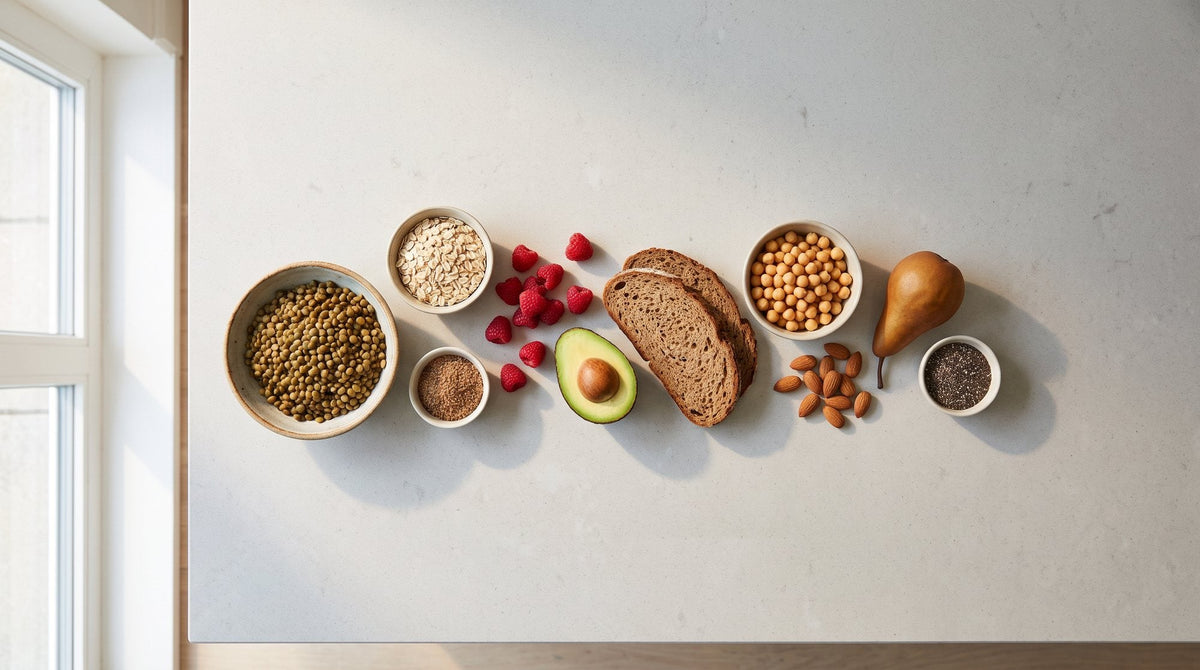
Fibre: how much you need, what it does and high-fibre foods
The carbohydrates that aren't digested decide the quality of all the others: 30 g a day, and how you get there.
Weiterlesen · 15 Min

Latest from the guide
New articles, updates and tips straight to your inbox. Easy to understand, expert-checked, no spam.
Danke! Bitte bestätige die Anmeldung in deinem Postfach.