
Natriummangel: Symptome, Ursachen und Behandlung
Kopfschmerzen, Übelkeit, Schwindel, plötzlich Gangunsicherheit? Ein Natriummangel entsteht fast nie durch zu wenig Salz, meist ist zu viel Wasser im Körper. Welche Symptome typisch sind, welcher Blutwert zählt und warum Salztabletten oft das Falsche sind.


Aktualisiert 24. September 2026 · 16 Min. Lesezeit · 43 Quellen

Das Wichtigste in 30 Sekunden
Darunter sprechen Ärzt:innen von Hyponatriämie, normal sind 135 bis 145. Gemessen wird im Blut. Ob es gefährlich ist, entscheidet weniger die Zahl als das Tempo des Abfalls.
So viele Klinikpatient:innen haben laut europäischer Leitlinie einen zu niedrigen Natriumwert, außerhalb der Klinik etwa 5 %, ab 65 Jahren mehr als jede:r Fünfte. Meist bleibt es unbemerkt.
Median laut Urinmessung, Frauen und Männer. Empfohlen sind höchstens 6 g. Ein Natriummangel durch zu wenig Salz ist der Deutschen Gesellschaft für Ernährung nicht bekannt.
Fast jeder Natriummangel ist ein Wasserüberschuss: Medikamente, Herz, Leber, Niere oder das Hormon ADH halten Wasser fest, oder es wird mehr getrunken, als die Niere ausscheiden kann.
Natriummangel Symptome: Woran du ihn erkennst
Ein Natriummangel, medizinisch Hyponatriämie, liegt vor, wenn die Natriumkonzentration im Blut unter 135 mmol/l sinkt. Das Wort führt in die Irre: Es fehlt fast nie Salz, meist ist zu viel Wasser da. Die Hyponatriämie ist die häufigste Elektrolytstörung: bis zu 30 % im Krankenhaus, außerhalb etwa 5 %, ab 65 mehr als 20 %. Die Beschwerden entstehen im Gehirn und werden oft für Alter, Stress oder einen Infekt gehalten.
Erste Anzeichen: Kopfschmerzen, Übelkeit, Müdigkeit
Die ersten Anzeichen sind unspektakulär: Müdigkeit ohne Grund, Antriebslosigkeit, Schwindel beim Aufstehen, ein unsicherer Gang. Die Leitlinie nennt Übelkeit, Verwirrtheit und Kopfschmerzen mittelschwer, Erbrechen, tiefe Schläfrigkeit, Krampfanfälle und Koma schwer. Wie stark die Beschwerden sind, hängt weniger von der Zahl ab als vom Tempo: Sinkt der Wert innerhalb von Stunden, schwillt das Gehirn an, und schon 130 mmol/l können gefährlich sein. Sinkt er über Wochen, passt sich das Gehirn an, und selbst 125 fühlen sich nur wie Erschöpfung an. Die stille Form ist die häufigere.

Natriummangel Symptome Frau
Die Symptome sind bei Frauen und Männern dieselben, das Risiko ist bei Frauen höher: Sie haben weniger Körperwasser, etwa 50 statt 60 %, und reagieren empfindlicher auf das Wasserhormon ADH. In einer schwedischen Studie mit 159.000 Menschen entwickelten 1,04 % der Frauen, aber nur 0,57 % der Männer innerhalb von zwei Jahren nach Beginn einer Thiazid-Entwässerungstablette einen schweren Natriummangel. In der Schwangerschaft liegt der Wert von Natur aus 3 bis 5 mmol/l niedriger, unter der Geburt kann Oxytocin mit viel Trinken den Wert drücken. Auch beim Marathon und unter Ecstasy sind Frauen häufiger betroffen.
Natriummangel Symptome Psyche
Das Gehirn spürt den Natriummangel als Erstes, deshalb sehen viele Symptome psychisch aus: Antriebslosigkeit, Reizbarkeit, Konzentrationsprobleme, eine Verlangsamung. Bei älteren Menschen kommt eine neue Verwirrtheit dazu, die leicht mit Demenz verwechselt wird, aber nach Ausgleich des Wertes wieder verschwindet. In einer belgischen Studie reagierten Menschen mit leichtem Natriummangel in Aufmerksamkeitstests so langsam wie nach 0,6 Promille Alkohol. Oft ist der Auslöser ein Medikament, das wegen der Psyche verordnet wurde: Wer seit dem Start eines Antidepressivums müder und verwirrter statt besser wird, lässt Natrium messen.
Neue Verwirrtheit, Gangunsicherheit oder ein Sturz im Alter, Kopfschmerz mit Übelkeit nach einem neuen Medikament, einem langen Lauf oder sehr viel Trinken: zeitnah Natrium messen lassen. Notruf 112 bei Krampfanfall, Bewusstseinsstörung, Erbrechen mit Verwirrtheit oder tiefer Schläfrigkeit.
Salzmangel Symptome: Ist Salzmangel dasselbe wie Natriummangel?
Fast: Speisesalz ist Natriumchlorid, 1 g Natrium steckt in 2,5 g Salz, und wer „Salzmangel“ googelt, meint den Natriummangel mit denselben Symptomen. Ein Salzmangel am Teller kommt in Deutschland praktisch nicht vor: Die Deutsche Gesellschaft für Ernährung nennt einen Natriummangel durch geringe Zufuhr „nicht bekannt“, und laut Urinmessung essen Männer im Median 10 g Salz am Tag, Frauen 8,4 g, empfohlen sind höchstens 6 g. Ist der Natriumwert niedrig, kam fast nie zu wenig Salz rein, sondern zu viel Wasser, oder Salz und Wasser gingen zusammen verloren.
Natriummangel Ursachen: Woher der Mangel kommt
Es gibt drei Wege in den Natriummangel, und keiner führt über den Salzstreuer. Erstens zu viel Wasser, das die Niere nicht schnell genug loswird. Zweitens Salz und Wasser gehen zusammen verloren, durch Erbrechen, Durchfall, Schwitzen oder Entwässerungstabletten, und nur Wasser kommt nach. Drittens Hormone und Organe halten Wasser fest: Herzschwäche, Leberzirrhose, Nierenschwäche oder das SIADH. Immer kippt das Verhältnis von Salz zu Wasser. Wie viel Natrium du brauchst, ist fast nebensächlich.
Zu viel Wasser: Die Verdünnung
Die Niere schafft grob einen Liter Wasser pro Stunde, mehr nicht. Wer in kurzer Zeit mehrere Liter trinkt, überfordert sie. Dasselbe passiert, wenn fast nichts gegessen wird: Um einen Liter loszuwerden, braucht die Niere 50 bis 100 mmol gelöste Teilchen, vor allem aus Eiweiß und Salz. Wer tagelang von Tee und Toast lebt oder von Bier, behält das Wasser im Körper. Der häufigste Fall aber ist ADH: Fließt das Wasserhormon, obwohl genug Wasser da ist, verdünnt jedes Glas den Wert weiter, etwa nach Operationen oder unter Medikamenten.
Wasservergiftung: Wie viel Wasser ist zu viel?
Eine feste Grenze gibt es nicht. Was über etwa einen Liter pro Stunde hinausgeht, sammelt sich an: Vier Liter über den Tag verteilt sind für gesunde Nieren kein Problem, vier Liter in zwei Stunden sind es. Dokumentiert sind Todesfälle nach Trinkwettbewerben und bei krankhaftem Durst. Bei Säuglingen reichen kleine Mengen, etwa verdünnte Milch oder pures Wasser: Bei Babys unter sechs Monaten mit unerklärtem Krampfanfall war in einer Studie in 70 % der Fälle ein Natriummangel die Ursache.
Salz- und Wasserverlust: Erbrechen, Durchfall, Schwitzen, Sport
Der zweite Weg: Der Körper verliert Salz. Bei Erbrechen und Durchfall gehen Natrium und Wasser zusammen verloren, die Konzentration bleibt zunächst normal. Der Mangel entsteht erst, wenn nur Wasser nachkommt: Der Volumenmangel schüttet ADH aus, der Wert sinkt. Deshalb gilt bei Magen-Darm-Infekten: Elektrolytlösung statt nur Wasser (Kapitel 6). Schweiß enthält 10 bis 180 mmol Natrium pro Liter, das Essen deckt normale Verluste locker. Beim stundenlangen Ausdauersport ist nicht das Schwitzen das Problem, sondern das Überdrinken: Wer beim Marathon mit Natriummangel ankommt, hat mehr getrunken als verloren.
Natriummangel durch Medikamente: Thiazide, Antidepressiva, Antiepileptika
Die häufigste Ursache sind Medikamente. An erster Stelle stehen Thiazid-Entwässerungstabletten wie Hydrochlorothiazid gegen Bluthochdruck: Nach zwei Jahren haben knapp 9 % der Neubeginner:innen einen Wert unter 135, symptomatische Fälle treten im Mittel 19 Tage nach dem Start auf. An zweiter Stelle Antidepressiva: Bei über 65-Jährigen entwickeln 8 % unter SSRI oder SNRI einen Natriummangel, meist in Woche zwei bis vier. Carbamazepin und Oxcarbazepin senken den Wert bei 26 bzw. 46 % der Behandelten. Weitere Kandidaten: Ibuprofen, Tramadol, Protonenpumpenhemmer, Chemotherapeutika, Desmopressin und Ecstasy.
Hormone und Organe: SIADH, Herz, Leber, Niere, Nebenniere
Der dritte Weg läuft über das Wasserhormon. Beim SIADH fließt ADH, obwohl der Körper kein Wasser sparen müsste; laut Arzneimittelkommission die häufigste Ursache. Auslöser sind Medikamente, Lungen- und Hirnerkrankungen, Operationen und Tumoren, vor allem das kleinzellige Lungenkarzinom. Bei Herzschwäche und Leberzirrhose lagert der Körper Wasser ein, und trotzdem meldet der Kreislauf „zu wenig Volumen“: ADH steigt, das Natrium wird verdünnt. Bei Nierenschwäche kann die Niere den Urin nicht mehr verdünnen. Bei Nebennierenschwäche (Morbus Addison) fehlt das Salzhormon Aldosteron, die Niere verliert Natrium, hohes Kalium ist oft der erste Hinweis.
So hält der Körper das Natrium im Gleichgewicht
Drei Stationen vom Salzstreuer bis zum Gehirn. Wer sie kennt, versteht, warum der Blutwert ein Verhältnis ist und kein Vorrat, warum die Niere die Hauptrolle spielt und warum ein schneller Abfall gefährlicher ist als ein tiefer.
Ein Verhältnis, kein Vorrat
Im Körper stecken etwa 1,3 bis 1,5 g Natrium pro Kilo, bei 70 kg rund 100 g, viel davon in Knochen, Haut und Muskeln. Das Blut hält nur die Konzentration konstant: 135 bis 145 mmol pro Liter. Der Wert sagt also nicht, wie viel Natrium du hast, sondern wie viel Wasser daneben steht. Und die Niere spart Natrium, wenn wenig reinkommt: Ein Mangel durch Essen kommt bei Gesunden nicht vor.
ADH und die Niere
Gesteuert wird nicht das Salz, sondern das Wasser. Sensoren im Gehirn messen die Konzentration und regeln Durst und das Hormon ADH, das die Niere Wasser sparen lässt. Ist das Blut zu dünn, fällt ADH ab, und die Niere scheidet Wasser aus, grob einen Liter pro Stunde; dafür braucht sie 50 bis 100 mmol gelöste Teilchen je Liter, vor allem Harnstoff aus Eiweiß und Salze. Wer viel trinkt und wenig isst, hat davon zu wenig. Und fließt ADH ohne Grund, nach OP, unter Medikamenten, beim SIADH, hält die Niere Wasser fest, egal wie viel getrunken wird.
Das Gehirn und die Zeit
Sinkt das Natrium schnell, strömt Wasser in die Hirnzellen, das Gehirn schwillt im festen Schädel an: Kopfschmerz, Übelkeit, Krampfanfall. Sinkt es langsam, schleust das Gehirn innerhalb von 24 bis 48 Stunden eigene Teilchen aus den Zellen und passt sich an; darum ist die 48-Stunden-Grenze zwischen akut und chronisch so wichtig. Der Preis der Anpassung: Wird ein chronisch niedriger Wert zu schnell angehoben, mehr als 8 bis 10 mmol/l am Tag, nimmt die Nervenhülle Schaden. Deshalb behandeln Ärzt:innen langsam, und deshalb sind Salztabletten auf eigene Faust keine gute Idee.
Natriumwert: So wird ein Natriummangel festgestellt
Der Natriumwert wird aus dem Blutserum bestimmt. Normal sind 135 bis 145 mmol/l. Wie dringend ein Wert darunter ist, hängt an zwei Fragen: Gibt es Beschwerden, vor allem vom Gehirn? Und wie schnell ist er gesunken? 128 seit Monaten unter einer Entwässerungstablette ist etwas anderes als 128 nach einem Marathon. Die Leitlinie unterscheidet drei Stufen nach der Zahl und zusätzlich akut (unter 48 Stunden) von chronisch: akut ist gefährlicher, chronisch tückischer.
Die drei Stufen des Natriummangels
-
1
Leicht130–135 mmol/l
Häufigster Befund, oft ohne spürbare Beschwerden. Trotzdem nicht harmlos: Schon hier steigen Sturz- und Bruchrisiko. Ursache klären, Medikamente prüfen, Trinkmenge und Essen anschauen. Keine Therapie nur, um die Zahl zu heben.
-
2
Mittel125–129 mmol/l
Übelkeit, Kopfschmerz, Verwirrtheit und Gangunsicherheit sind wahrscheinlich. Ärztlich behandeln, meist mit Trinkmengenbegrenzung und Ursachentherapie, bei deutlichen Beschwerden im Krankenhaus mit einer einmaligen Kochsalzinfusion.
-
3
Schwer< 125 mmol/l
Erbrechen, tiefe Schläfrigkeit, Krampfanfälle und Koma sind möglich. Notfall, Behandlung im Krankenhaus mit hypertoner Kochsalzlösung unter engmaschiger Kontrolle, langsam, weil eine zu schnelle Korrektur das Gehirn schädigt.
Einteilung nach der europäischen Leitlinie (Spasovski et al. 2014) und der österreichischen Konsensusempfehlung 2024. Bei Krampfanfall, Erbrechen oder Bewusstseinsstörung zählt das Symptom, nicht die Stufe. Labore setzen teils eigene Normgrenzen, dann gelten die des Befunds.
Natriumwert 133 oder 130: Was heißt das?
133 ist die Zone der meisten Befunde: kein Notfall, aber ein Befund, dem nachgegangen wird. Ab 129 abwärts spricht die Leitlinie von einem moderaten Mangel, der behandelt wird. Zwei Fallen kennt jedes Labor: Die Pseudohyponatriämie, bei der sehr hohe Blutfette oder Eiweiße den Wert zu niedrig erscheinen lassen, und der Blutzucker, der Wasser aus den Zellen ins Blut zieht; pro 100 mg/dl Glukose über 100 rechnen Ärzt:innen 2,4 mmol/l dazu. Deshalb wird die Osmolalität des Serums gemessen: Nur unter 275 ist der Mangel echt.
Hyponatriämie: Die drei Formen
Derselbe Blutwert, drei verschiedene Situationen: Das Labor unterscheidet sie an Urin-Osmolalität, Urin-Natrium und Volumenstatus, und die Behandlung ist jeweils eine andere.
| Zu wenig Volumen (hypovoläm) | Normales Volumen (euvoläm) | Zu viel Volumen (hypervoläm) | |
|---|---|---|---|
| Was passiert | Salz und Wasser gehen verloren, nur Wasser kommt nach | ADH hält Wasser fest, obwohl genug da ist | Körper lagert Wasser ein, Kreislauf meldet trotzdem Mangel |
| Typische Ursachen | Erbrechen, Durchfall, Thiazide, Nebennierenschwäche, Schwitzen | SIADH durch Medikamente, Lunge, Gehirn, Tumor, OP; zu viel Trinken | Herzschwäche, Leberzirrhose, Nierenschwäche |
| So sieht es aus | Trockene Schleimhäute, niedriger Blutdruck, Schwindel im Stehen | Unauffällig, keine Schwellungen | Geschwollene Beine, Bauchwasser, Atemnot |
| Urin-Natrium | unter 30 mmol/l (Niere spart), bei Diuretika höher | über 30 mmol/l | unter 30 mmol/l |
| Erste Maßnahme | Salz und Wasser ersetzen, Infusion mit Kochsalzlösung | Trinkmenge begrenzen, Auslöser absetzen | Grunderkrankung behandeln, Trinkmenge begrenzen |
| Was falsch wäre | Nur Wasser trinken | Salz essen, mehr trinken | Salz essen, Salztabletten |
Nach der europäischen Leitlinie 2014 und der Arzneimittelkommission der deutschen Ärzteschaft 2016. Weil der Volumenstatus auch für Ärzt:innen schwer einzuschätzen ist, entscheiden Urin-Osmolalität und Urin-Natrium mit; dazu Cortisol, TSH, Kalium und die Medikamentenliste.
Natriummangel Test: Wer den Wert bestimmen lassen sollte
Natrium wird bei fast jeder Blutabnahme mitgemessen, gezielt in drei Situationen. Nach dem Start eines Medikaments: nach einer Thiazid-Entwässerungstablette Kontrolle nach ein bis zwei Wochen, bei Antidepressiva und Carbamazepin ist das Risiko in Woche zwei bis vier am höchsten. Bei neuen Beschwerden im Alter: Verwirrtheit, Gangunsicherheit, Stürze und Müdigkeit werden zu oft als normales Altern abgetan. Bei Erkrankungen von Herz, Leber, Niere, Lunge oder Tumoren. Einen Heimtest gibt es nicht, Urinstreifen messen keinen Serumwert. Zum Termin gehört die Medikamentenliste, auch Kombinationspräparate gegen Bluthochdruck; vorher keine Salztabletten auf Verdacht.

Natriummangel beheben: Was wirklich hilft
Die Behandlung hat zwei Teile: die Ursache abstellen und den Wert vorsichtig zurück in den Normbereich bringen. Bei einem leichten, chronischen Mangel ohne Beschwerden empfiehlt die Leitlinie keine Therapie, die nur die Zahl heben soll, sondern: Auslöser stoppen, Grunderkrankung behandeln. Bei Verdünnung und SIADH heißt das Trinkmenge begrenzen, meist auf unter einen Liter am Tag, was bei 59 % genügt. Bei Verlust bekommt der Körper Salz und Wasser zurück.
-
Stunde 0
Messen, einordnen, Ursache
Natrium, Osmolalität im Blut und Urin, Urin-Natrium, Medikamentenliste. Akut oder chronisch? Bei schweren Symptomen sofort hypertone Kochsalzlösung unter Überwachung, Ziel plus 5 mmol/l in der ersten Stunde.
-
Tag 1–3
Langsam anheben
Nicht mehr als 10 mmol/l in den ersten 24 Stunden, danach höchstens 8 mmol/l pro Tag, bis 130 erreicht sind. Kontrolle alle sechs Stunden. Auslöser stoppen: Trinkmenge, Thiazid, Antidepressivum in Rücksprache.
-
Woche 1–2
Ursache behandeln
SIADH: Trinkmenge unter einen Liter, bei Bedarf Harnstoff oder Salz plus Schleifendiuretikum. Verlust: Salz und Wasser ersetzen. Herz, Leber, Niere: Grunderkrankung einstellen. Wert nachmessen.
-
Danach
Halten und kontrollieren
Bei Dauermedikation Natrium bei jeder Blutkontrolle mitmessen. Trinken nach Durst, regelmäßig essen. Ab 70 den Wert kennen. Bei SIADH durch Tumor oder Lunge läuft die Therapie so lange wie die Ursache.
Was hilft schnell bei Natriummangel?
Bei schweren Symptomen (Erbrechen, Krampfanfall, tiefe Schläfrigkeit, Koma) hilft nur eines schnell: eine Infusion mit dreiprozentiger, hypertoner Kochsalzlösung im Krankenhaus, bis der Wert um 5 mmol/l gestiegen ist. Bei allen anderen hilft schnell vor allem, das Falsche zu lassen: nicht weiter literweise trinken bei Verdünnung, kein Salz nachladen, wenn Herz oder Leber Wasser festhalten, das auslösende Medikament in Rücksprache pausieren. Bei echtem Verlust hilft eine Elektrolytlösung oder Brühe innerhalb von Stunden. Salztabletten aus dem Regal helfen bei unbekannter Ursache nicht, beim SIADH verstärken sie den Mangel meist.
Bei einem niedrigen Natriumwert ist die erste Frage nicht, was man essen soll, sondern wo das Wasser herkommt. Wer das nicht klärt und einfach Salz nachlegt, macht es in den meisten Fällen schlimmer.
Joerg Hauke, Ernährungsexperte, fachliche Prüfung dieses Artikels
Natriummangel Tabletten: Salztabletten, Elektrolyte, Tolvaptan
Es gibt keine Tablette, die man bei Natriummangel einfach nimmt. Kochsalztabletten sind bei der Verlustform und manchen Fällen von SIADH eine Option, dann verordnet und mit Kontrolle; bei Verdünnung, Herzschwäche und Leberzirrhose verschlechtern sie den Zustand. Elektrolyt-Brausetabletten liefern wenige hundert Milligramm Natrium und viel Wasser, bei Durchfall ist die WHO-Lösung besser. Tolvaptan blockiert ADH an der Niere, ist in der EU nur beim SIADH zugelassen und wird im Krankenhaus begonnen, weil der Wert zu schnell steigen kann. Die Leitlinie setzt stattdessen auf Trinkmengenbegrenzung und Harnstoff.
Wie lange dauert es, bis der Natriummangel behoben ist?
Mindestens Tage, weil das Tempo begrenzt ist: Von 120 auf 135 dauert es zwei bis drei Tage, pro Tag sind höchstens 8 bis 10 mmol/l erlaubt. Nach dem Absetzen einer Entwässerungstablette erholt sich der Wert in Tagen bis Wochen, unter Harnstoff oder Tolvaptan über zwei bis sieben Tage. Eine Trinkmengenbegrenzung beim SIADH braucht oft länger. Bleibt die Ursache, etwa Tumor, Herzschwäche oder ein Medikament ohne Alternative, wird der Mangel nicht behoben, sondern gemanagt: stabiler Wert um 130, Kontrollen, feste Trinkmenge.
Drei Dinge nicht tun bei einem niedrigen Wert: Salztabletten oder Elektrolytpräparate nehmen, ohne die Form zu kennen; die Trinkmenge drastisch senken, während Erbrechen oder Durchfall laufen; ein Medikament eigenmächtig absetzen. Jedes davon kann aus einem leichten Mangel einen Notfall machen.
Was essen bei Natriummangel: Natrium in Lebensmitteln
Die wichtigste Regel steht vor jedem Lebensmittel: Erst die Ursache, dann der Teller. Bei Verdünnung, SIADH, Herzschwäche und Leberzirrhose schadet mehr Salz, weil der Körper ohnehin zu viel Wasser festhält. Mehr Natrium ist nur richtig, wenn Salz tatsächlich verloren ging: nach Erbrechen und Durchfall, bei Nebennierenschwäche oder auf ärztliche Anweisung. Und Natrium steckt fast nirgends in unverarbeiteten Lebensmitteln: Rund 90 % kommen über Speisesalz, meist aus verarbeiteten Produkten.
Natrium pro 100 g: Top 10 pflanzlich und tierisch
Werte pro 100 g, USDA FoodData Central SR Legacy. Kein Lebensmittel hier ist von Natur aus natriumreich, alles außer Mangold ist gesalzen oder fermentiert. Konzentrate fehlen bewusst: Speisesalz 38.758 mg, Brühwürfel 24.000 mg, Sojasauce 5.493 mg.
Welches Obst und Gemüse enthält Natrium?
Kaum eines. Sellerie (80 mg pro 100 g), Rote Bete (78 mg), Mangold und Spinat gekocht (70 bis 180 mg) und Artischocken (60 mg) sind die natriumreichsten Gemüse, und selbst sie liefern pro Portion nur einen Bruchteil einer Scheibe Brot. Obst liegt bei 1 bis 5 mg pro 100 g. Was Obst und Gemüse liefern, ist Kalium, der Gegenspieler des Natriums, und bei der Verdünnungsform ist das kein Nachteil: Dort heißt die Behandlung weniger Wasser und mehr feste Nahrung mit Eiweiß.

Was trinken bei Natriummangel?
Das hängt an der Form. Bei Verdünnung, SIADH, Herz- und Leberschwäche lautet die Antwort: weniger, meist unter einen Liter am Tag. Bei echtem Verlust gilt das Gegenteil von „nur Wasser“: Eine Elektrolytlösung aus der Apotheke nach WHO-Rezeptur ersetzt Natrium und Wasser im richtigen Verhältnis; als Hausmittel nennt das IQWiG vier Teelöffel Zucker, einen Dreiviertel-Teelöffel Salz und ein Glas Orangensaft auf einen Liter Wasser. Eine Tasse Brühe liefert rund 650 mg Natrium. Mineralwasser darf sich ab 200 mg pro Liter „natriumhaltig“ nennen, Leitungswasser enthält höchstens 200 mg.
Natrium darf Leitungswasser höchstens enthalten, natriumarmes Mineralwasser unter 20 mg. Bei Verlust nach Durchfall ersetzt es das Wasser, aber nicht das Salz, und verdünnt den Wert weiter
Natrium liefert eine aus Brühwürfeln zubereitete Brühe. Eine Tasse davon plus eine Elektrolytlösung ersetzt bei echtem Verlust Salz und Wasser gemeinsam, so wie sie verloren gingen
Was nicht essen bei Natriummangel?
Es gibt keine verbotenen Lebensmittel, aber drei Muster, die den Mangel verstärken. Trinken ohne Essen: Literweise Wasser, Tee oder Bier bei kaum fester Nahrung nimmt der Niere die gelösten Teilchen, mit denen sie Wasser ausscheidet. Reines Wasser nach Verlusten: Nach Durchfall, Erbrechen oder einem langen Lauf verdünnt es das Blut, statt es aufzufüllen. Und salzige Kost bei Wasserüberschuss: Wer Wassereinlagerungen, ein Herz- oder Leberleiden oder ein SIADH hat, verstärkt mit Salzstangen, Brühe und Salztabletten die Schwellungen, ohne den Wert zu heben.
Kein Freibrief: 70 % der Frauen und 80 % der Männer liegen über den empfohlenen 6 g Salz am Tag, und laut EFSA hebt mehr Natrium den Blutdruck. Gesunde brauchen kein zusätzliches Salz, die Niere spart Natrium, wenn wenig kommt.
Natrium im Alltag: Trinkmahlzeiten und Fertiggerichte
Verarbeitete Lebensmittel sind die Hauptquelle des Salzes: 150 g Kasseler bringen 4 g, eine Scheibe Graubrot 0,6 g. Bei Trinkmahlzeiten mit definierter Rezeptur ist der Salzgehalt eine feste Größe: Eine Flasche Saturo liefert je nach Sorte 0,89 bis 1,3 g Salz, also 356 bis 520 mg Natrium. Wichtiger: Eine Trinkmahlzeit ist eine Mahlzeit mit 36 g Protein, keine Flüssigkeit ohne Substanz, und genau das unterscheidet sie vom Tee-und-Toast-Muster. Kein Ersatz für eine Behandlung, bei Herz-, Leber- oder Nierenschwäche zählt auch sie zur abgestimmten Trinkmenge.
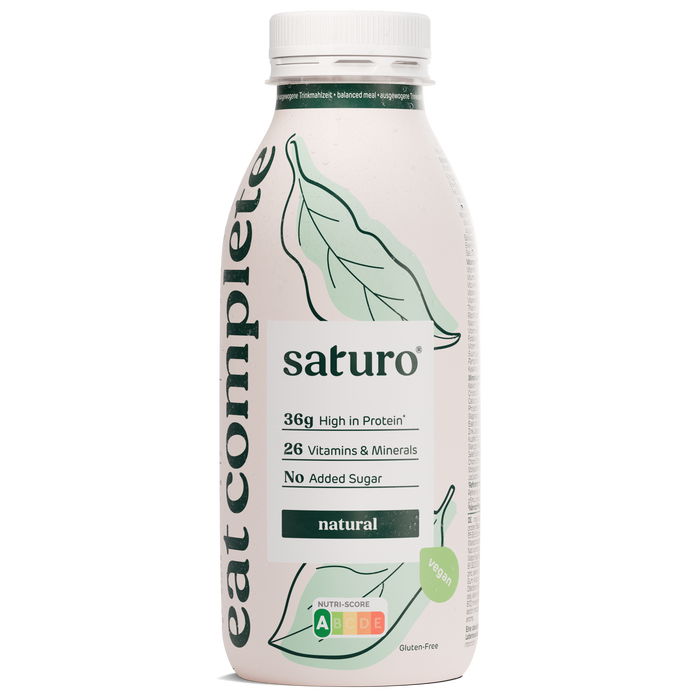
Trinkmahlzeit: eine vollwertige Mahlzeit aus der Flasche
400 kcal, 36 g Protein und 26 Vitamine und Mineralstoffe, darunter Kalium, Magnesium und Calcium. Salz pro Flasche je nach Sorte 0,89 bis 1,3 g (15 bis 22 % der Referenzmenge von 6 g). Für Tage, an denen Kochen nicht auf dem Plan steht.
Im Alter, beim Sport, bei Herz und Leber: Wer besonders aufpassen muss
Natriummangel im Alter: Was tun?
Im Alter treffen alle Ursachen aufeinander: Die Niere scheidet Wasser schlechter aus, ADH steigt, dazu kommen Thiazid gegen den Blutdruck, das Antidepressivum, wenig Appetit und der Rat, viel zu trinken. Mehr als jede:r Fünfte über 65 hat einen Wert unter 135, im Pflegeheim erlebt jede:r Zweite pro Jahr mindestens eine Episode. Was tun: bei neuer Verwirrtheit, einem Sturz oder Müdigkeit den Natriumwert erfragen und die Trinkmenge klären. Die Fachgesellschaft ESPEN empfiehlt älteren Frauen 1,6 und Männern 2 Liter am Tag, unter Thiaziden, SSRI oder SIADH entscheidet die Ärztin.
Sport und Schwitzen: Trinken nach Durst
Der Natriummangel beim Marathon entsteht nicht durch Schwitzen, sondern durch Trinken über den Durst hinaus, meist bei Läufer:innen, die länger als vier Stunden unterwegs sind und an jeder Station trinken. Bei Ultramarathons liegt der Anteil höher, Todesfälle sind dokumentiert. Sportgetränke ändern daran wenig: Natrium im Getränk verhindert die Belastungs-Hyponatriämie bei Überdrinken nicht. Der internationale Konsensus lautet trinken nach Durst, nicht nach Plan. Wer nach einem langen Lauf Kopfschmerzen, Übelkeit und Verwirrtheit hat und schwerer geworden ist, gehört in die Sanitätsstation, nicht ans Wasser.

Natriummangel Langzeitfolgen: Was passiert, wenn er bleibt
Auch ein leichter Mangel ohne Beschwerden ist nicht harmlos, die Leitlinie hat die Kategorie „asymptomatisch“ gestrichen. Stürze und Brüche: In der Rotterdam-Studie mit über 5.000 Menschen ab 55 stürzten die 7,7 % mit leichtem Mangel häufiger und hatten ein um 39 % höheres Bruchrisiko. Osteoporose: Der Körper mobilisiert Natrium aus dem Knochen, in einer US-Erhebung war das Risiko für Hüft-Osteoporose fast dreifach erhöht. Dazu eine erhöhte Sterblichkeit schon bei 130 bis 134. Bleibende Hirnschäden entstehen nur durch schnellen Abfall oder zu schnelle Korrektur.
Ist Natriummangel tödlich?
Ein akuter, schwerer Mangel kann es sein. Stürzt der Wert innerhalb von Stunden ab, schwillt das Gehirn im festen Schädel an; unbehandelt stirbt laut österreichischer Konsensusempfehlung bis zur Hälfte der Betroffenen. Von 15 zuvor gesunden Frauen, die nach Routineeingriffen mit hypotonen Infusionen einen Wert um 108 entwickelten, starben vier, neun blieben schwer geschädigt. Der chronische Mangel tötet nicht direkt, sondern über Stürze, Brüche und die Grunderkrankung. Die zweite Gefahr ist die zu schnelle Korrektur.
Wird ein älterer Mensch innerhalb von Tagen verwirrt, wackelig oder schläfrig, nach einem neuen Medikament, einem Infekt mit Erbrechen oder Durchfall oder dem Rat, mehr zu trinken: Natrium messen lassen, bevor jemand „Demenz“ sagt. Bei Krampfanfall oder Bewusstseinsstörung Notruf 112.
Häufige Fragen zu Natriummangel
Was raubt dem Körper Natrium?
Echte Verluste entstehen durch Erbrechen, Durchfall, stundenlanges starkes Schwitzen, Thiazid-Entwässerungstabletten und Nebennierenschwäche. Häufiger wird Natrium nicht geraubt, sondern verdünnt: durch Antidepressiva und Carbamazepin, Herz-, Leber- oder Nierenschwäche, das SIADH und Trinken über die Kapazität der Niere hinaus. Salzarme Kost ist bei Gesunden keine Ursache.
Welche Symptome treten bei Natriummangel bei Senioren auf?
Meist die, die für normales Altern gehalten werden: Müdigkeit, Antriebslosigkeit, Gangunsicherheit, Stürze, Konzentrationsprobleme und eine neue Verwirrtheit, die leicht mit Demenz verwechselt wird. Mehr als jede:r Fünfte über 65 hat einen Wert unter 135 mmol/l, meist durch Entwässerungstabletten, Antidepressiva oder zu viel Trinken.
Welcher Tumor verursacht Natriummangel?
Am bekanntesten ist das kleinzellige Lungenkarzinom, das das Wasserhormon ADH bildet und ein SIADH auslöst. Beschrieben sind auch Tumoren in Mund, Rachen, Magen, Bauchspeicheldrüse, Blase und Prostata, Lymphome sowie Chemotherapeutika wie Cyclophosphamid. Bei den allermeisten Betroffenen ist die Ursache ein Medikament, eine Infektion oder eine bekannte Organerkrankung.
Verursacht Natriummangel Wassereinlagerungen?
Nicht der Mangel selbst, sondern seine Ursache. Bei Herzschwäche, Leberzirrhose und Nierenschwäche lagert der Körper Wasser ein, und das Natrium wird verdünnt. Beim SIADH und bei Verdünnung durch Trinken gibt es keine Schwellungen. Bei Schwellungen plus niedrigem Wert ist mehr Salz der falsche Weg.
Kann Natriummangel zu Harndrang führen?
Nicht direkt: Der Mangel selbst macht müde, übel und wackelig. Harndrang kommt von den Ursachen: Entwässerungstabletten lassen mehr Urin ausscheiden und senken das Natrium, wer sehr viel trinkt, muss oft und verdünnt sein Blut, ein hoher Blutzucker macht Harndrang und drückt den Wert.
Ab welchem Wert wird Natrium gefährlich?
Die Leitlinie unterscheidet leicht (130 bis 135 mmol/l), moderat (125 bis 129) und schwer (unter 125), gefährlich wird es aber weniger durch die Zahl als durch Tempo und Symptome. Ein Abfall auf 130 innerhalb von Stunden kann das Gehirn anschwellen lassen, 125 nach Wochen macht oft nur müde.
Wie ist der Blutdruck bei Natriummangel?
Je nach Form. Bei echtem Salz- und Wasserverlust nach Erbrechen, Durchfall oder Nebennierenschwäche ist er niedrig. Beim SIADH ist er normal. Bei Herzschwäche und Leberzirrhose ist der Körper mit Wasser überladen, der Druck trotzdem oft niedrig. Viele Betroffene haben Bluthochdruck, weil das Thiazid dagegen den Mangel auslöst.
Sind 4 Liter Wasser am Tag zu viel?
Über den Tag verteilt sind sie für gesunde Nieren kein Problem, sie scheiden bis zu einen Liter pro Stunde aus. Vier Liter in ein bis zwei Stunden sind es, dann sammelt sich Wasser an. Zusätzlich gefährlich bei wenig Essen, wasserhaltenden Medikamenten, Herz-, Nierenschwäche und Säuglingen.
Quellen · 43 Quellen anzeigen
- Spasovski G., Vanholder R., Allolio B. et al. (Hyponatraemia Guideline Development Group): Clinical practice guideline on diagnosis and treatment of hyponatraemia. European Journal of Endocrinology 2014; 170(3): G1–G47.
- Schwarz C., Lindner G., Windpessl M., Knechtelsdorfer M., Saemann M. D.: Consensus recommendations on the diagnosis and treatment of hyponatraemia from the Austrian Society for Nephrology 2024. Wiener klinische Wochenschrift 2024; 136(Suppl 1): 1–33.
- Adrogué H. J., Tucker B. M., Madias N. E.: Diagnosis and Management of Hyponatremia: A Review. JAMA 2022; 328(3): 280–291.
- Hoorn E. J., Zietse R.: Diagnosis and Treatment of Hyponatremia: Compilation of the Guidelines. Journal of the American Society of Nephrology 2017; 28(5): 1340–1349.
- Bullmann C.: Hyponatriämie. Arzneiverordnung in der Praxis (Arzneimittelkommission der deutschen Ärzteschaft) 2016; 43(4): 188–194.
- Waikar S. S., Mount D. B., Curhan G. C.: Mortality after hospitalization with mild, moderate, and severe hyponatremia. American Journal of Medicine 2009; 122(9): 857–865.
- Mohan S., Gu S., Parikh A., Radhakrishnan J.: Prevalence of hyponatremia and association with mortality: results from NHANES. American Journal of Medicine 2013; 126(12): 1127–1137.
- Miller M., Morley J. E., Rubenstein L. Z.: Hyponatremia in a nursing home population. Journal of the American Geriatrics Society 1995; 43(12): 1410–1413.
- Bergh Fahlén C., Falhammar H., Skov J., Lindh J. D., Mannheimer B.: Thiazides and Risk of Hyponatremia by Age and Sex. JAMA Network Open 2026.
- Barber J., McKeever T. M., McDowell S. E. et al.: A systematic review and meta-analysis of thiazide-induced hyponatraemia: time to reconsider electrolyte monitoring regimens after thiazide initiation? British Journal of Clinical Pharmacology 2015; 79(4): 566–577.
- Zhang Y., Zhang J., Jing R.: Risk of antidepressant-induced hyponatremia in geriatric patients: a systematic review and meta-analysis. BMC Geriatrics 2026.
- Berghuis B., van der Palen J., de Haan G. J. et al.: Carbamazepine- and oxcarbazepine-induced hyponatremia in people with epilepsy. Epilepsia 2017; 58(7): 1227–1233.
- van Dijken G. D., Blom R. E., Hené R. J., Boer W. H.: High incidence of mild hyponatraemia in females using ecstasy at a rave party. Nephrology Dialysis Transplantation 2013; 28(9): 2277–2283.
- Almond C. S., Shin A. Y., Fortescue E. B. et al.: Hyponatremia among runners in the Boston Marathon. New England Journal of Medicine 2005; 352(15): 1550–1556.
- Hew-Butler T., Loi V., Pani A., Rosner M. H.: Exercise-Associated Hyponatremia: 2017 Update. Frontiers in Medicine 2017; 4: 21.
- Noakes T. D., Wilson G., Gray D. A., Lambert M. I., Dennis S. C.: Peak rates of diuresis in healthy humans during oral fluid overload. South African Medical Journal 2001; 91(10): 852–857.
- Thaler S. M., Teitelbaum I., Berl T.: „Beer potomania“ in non-beer drinkers: effect of low dietary solute intake. American Journal of Kidney Diseases 1998; 31(6): 1028–1031.
- Farrell D. J., Bower L.: Fatal water intoxication. Journal of Clinical Pathology 2003; 56(10): 803–804.
- Farrar H. C., Chande V. T., Fitzpatrick D. F., Shema S. J.: Hyponatremia as the cause of seizures in infants: a retrospective analysis of incidence, severity, and clinical predictors. Annals of Emergency Medicine 1995; 26(1): 42–48.
- Arieff A. I.: Hyponatremia, convulsions, respiratory arrest, and permanent brain damage after elective surgery in healthy women. New England Journal of Medicine 1986; 314(24): 1529–1535.
- Renneboog B., Musch W., Vandemergel X., Manto M. U., Decaux G.: Mild chronic hyponatremia is associated with falls, unsteadiness, and attention deficits. American Journal of Medicine 2006; 119(1): 71.e1–e8.
- Hoorn E. J., Rivadeneira F., van Meurs J. B. et al.: Mild hyponatremia as a risk factor for fractures: the Rotterdam Study. Journal of Bone and Mineral Research 2011; 26(8): 1822–1828.
- Verbalis J. G., Barsony J., Sugimura Y. et al.: Hyponatremia-induced osteoporosis. Journal of Bone and Mineral Research 2010; 25(3): 554–563.
- Gheorghiade M., Abraham W. T., Albert N. M. et al.: Relationship between admission serum sodium concentration and clinical outcomes in patients hospitalized for heart failure: an analysis from the OPTIMIZE-HF registry. European Heart Journal 2007; 28(8): 980–988.
- Angeli P., Wong F., Watson H., Ginès P. (CAPPS Investigators): Hyponatremia in cirrhosis: results of a patient population survey. Hepatology 2006; 44(6): 1535–1542.
- European Medicines Agency: Samsca (Tolvaptan), Zusammenfassung der Merkmale des Arzneimittels (Anhang I).
- Volkert D., Beck A. M., Cederholm T. et al.: ESPEN guideline on clinical nutrition and hydration in geriatrics. Clinical Nutrition 2019; 38(1): 10–47.
- Deutsche Gesellschaft für Ernährung (DGE): Referenzwerte für die Nährstoffzufuhr, Natrium. Schätzwerte für eine angemessene Zufuhr, Ableitung 2016.
- Deutsche Gesellschaft für Ernährung (DGE): Ausgewählte Fragen und Antworten zu Natrium.
- Deutsche Gesellschaft für Ernährung (DGE): Ausgewählte Fragen und Antworten zu Speisesalz. Stand März 2020.
- Strohm D., Boeing H., Leschik-Bonnet E. et al. für die DGE: Speisesalzzufuhr in Deutschland, gesundheitliche Folgen und resultierende Handlungsempfehlung. Ernährungs Umschau 2016; 63(3): M146–M154.
- Johner S. A., Thamm M., Schmitz R., Remer T.: Current daily salt intake in Germany: biomarker-based analysis of the representative DEGS study. European Journal of Nutrition 2015; 54(7): 1109–1115.
- Klenow S., Mensink G. B. M. (Robert Koch-Institut): Natriumzufuhr in Deutschland. Journal of Health Monitoring 2016; 1(2).
- EFSA Panel on Nutrition, Novel Foods and Food Allergens (NDA): Dietary reference values for sodium. EFSA Journal 2019; 17(9): 5778.
- World Health Organization (WHO): Guideline: Sodium intake for adults and children. Genf 2012.
- World Health Organization, UNICEF: Oral Rehydration Salts: Production of the new ORS. Genf 2006.
- Institut für Qualität und Wirtschaftlichkeit im Gesundheitswesen (IQWiG): Durchfall. gesundheitsinformation.de, Stand 8. Februar 2023.
- Verordnung über natürliches Mineralwasser, Quellwasser und Tafelwasser (Mineral- und Tafelwasserverordnung), Anlage 6: Angaben zum Natriumgehalt.
- Trinkwasserverordnung (TrinkwV 2023), Anlage 3 Teil I: Grenzwert Natrium 200 mg/l.
- Verordnung (EU) Nr. 1169/2011 (Lebensmittel-Informationsverordnung), Anhang I Nr. 11 und Anhang XIII: Salz = Natrium × 2,5, Referenzmenge Salz 6 g.
- Europäische Kommission: EU-Register der nährwert- und gesundheitsbezogenen Angaben (Kohlenhydrat-Elektrolyt-Lösungen, 20 bis 50 mmol/l Natrium; kein zugelassener Claim für Natrium).
- NDR Ratgeber Gesundheit: Natriummangel kann Ursache für Schwindel und Stürze sein. 9. Mai 2022.
- U.S. Department of Agriculture, Agricultural Research Service: FoodData Central, SR Legacy Release (2018). Natriumgehalte pro 100 g.
Schreibt seit 2019 für Saturo über Ernährung, Nährstoffe und die Frage, wie gute Versorgung im Alltag praktisch funktioniert.
Hat diesen Artikel am 23. September 2026 auf fachliche Richtigkeit geprüft. Die Inhalte ersetzen keine ärztliche Beratung.

Kaliummangel: Symptome, Ursachen und Behandlung
Der Gegenspieler des Natriums: Warum ein Kaliummangel selten am Teller entsteht, welcher Blutwert zählt und warum ohne Magnesium keine Kaliumtherapie funktioniert.
Weiterlesen · 16 Min

Neues aus dem Ratgeber
Neue Artikel, Updates und Tipps direkt ins Postfach. Verständlich, fachlich geprüft, ohne Spam.
Danke! Bitte bestätige die Anmeldung in deinem Postfach.