
Vitamin D deficiency: symptoms, causes and treatment
Tired, weak muscles, constantly catching colds in winter? More than one in two adults in Germany is below the recommended vitamin D level. Find out which symptoms are typical, which blood value matters, how much sun is enough and when a supplement makes sense.


Aktualisiert 24 September 2026 · 15 Min. Lesezeit · 18 Quellen

The essentials in 30 seconds
That's 800 IU, for everyone aged one and over (DGE). This value only applies if the skin produces no vitamin D at all, so mainly in winter.
During these months, UV-B radiation in Germany is too weak for skin production. The stores built up over summer have to last.
That's how much of your supply comes from the skin with enough sun. Food only provides 2 to 4 µg a day, even with fish.
Below 30 nmol/l (12 ng/ml) counts as a deficiency, from 50 nmol/l (20 ng/ml) as sufficient. Measure first, then dose, never the other way round.
Vitamin D deficiency symptoms: how to recognise it
Vitamin D deficiency rarely announces itself with a clear signal. Most signs are non-specific: tired, drained, aching muscles, more frequent infections. In Germany, more than one in two adults is below the level that the DGE and BfR consider sufficient, and even more in winter. No symptom can tell you whether you're one of them, only the 25(OH)D value can (chapter 4). This list helps you spot your own pattern.
Early signs: tiredness, muscle weakness, pain
The first signs are muscle weakness, tiredness and deep bone pain. Vitamin D controls how much calcium gets from the gut into the bones. If it's missing for months, new bone no longer gets mineralised: osteomalacia, or softening of the bones. It causes a dull, deep ache, often in the lower back, pelvis, hips and thighs. Add to that muscle weakness in the thighs: climbing stairs becomes hard, older people fall more often, and calf cramps are part of the picture. Tiredness is linked to low levels in observational studies, but there's no proof of cause and effect (BfR). In children, a severe deficiency leads to rickets with deformed legs, which is rare in Germany thanks to preventive supplementation.

Vitamin D deficiency: eye symptoms
Dry, burning eyes are measurably linked to low vitamin D levels: a meta-analysis of ten studies with almost 19,000 people found that people with dry eyes had levels that were 4 ng/ml lower on average, reported more discomfort and produced less tear fluid. That's an association, not a proven cause; whether both come down to the same lifestyle is an open question. Vision problems, blurred vision or flashes of light are not part of the picture. They have other causes and belong at the eye doctor's, not in a vitamin D test.
Vitamin D deficiency and mental health: depression and winter blues
Low vitamin D levels and low mood often occur together, especially in winter, when both depend on light. Research has only half-answered the question of whether vitamin D really lifts mood: a meta-analysis of 41 randomised trials with over 53,000 participants found a small positive effect on depressive symptoms, mainly from 2,000 IU a day, but rated the certainty of this finding as very low. What this means for you: vitamin D doesn't replace treatment for depression. If a deficiency is confirmed, replenishing it can be one building block, but no more than that.
If you have bone pain with muscle weakness, falls or cramps, or if your child has delayed growth or deformed legs, get your 25(OH)D level tested. Risk groups should also get tested even without symptoms: people who need care, people with dark skin, people who wear covering clothing, people with chronic gut, liver or kidney conditions, and people taking anti-epileptic drugs.
Hair loss, skin and weight
Hair loss, dry skin and weight gain are often reported alongside low vitamin D levels. The BfR sums up the situation soberly: the link has been observed, but a clear cause-and-effect relationship hasn't been proven for these non-specific symptoms. For hair loss, there are far more common reasons, above all iron deficiency, thyroid issues and hormonal changes. So if you're losing hair, don't just get your vitamin D checked, get your ferritin checked too. With weight, it tends to work the other way round, more on that in chapter 2.
Vitamin D deficiency causes: Where the deficiency comes from
Vitamin D is the only vitamin your body makes itself, using UV-B radiation in the skin. With enough sun, 80 to 90% of your supply comes from this self-production, while food contributes only 10 to 20% with 2 to 4 µg a day. That names the main cause of a deficiency: too little sun on too little skin. Age, skin type, clothing, excess weight and illnesses make this effect stronger. How much you need depends on your age and your situation in life.
Too little sun: October to March
Your skin needs UV-B, and that only gets through when the sun is high: in Germany, roughly from April to September around midday. From October to March, the radiation is too weak even under a clear blue sky, and almost everyone's level drops (BfS, BfR). In the DEGS1 health survey, one in four adults was below 30 nmol/l in winter, and in summer only half reached the sufficient level. Window glass barely lets UV-B through, so the office and the car don't count. If you spend the summer indoors, you go into winter with empty stores.
Age, skin type, clothing, medication
From around 65, the skin produces less than half of what it manages in younger years. Add in needing care or little exercise and a deficiency is almost the rule; for care homes, the BfR advises considering general supplementation. Dark skin contains more melanin and needs significantly more UV-B for the same amount of vitamin D. Covering clothing works like winter in summer, and sunscreen also reduces production. On the medical side, there are coeliac disease and Crohn's disease (the fat-soluble vitamin is poorly absorbed), liver and kidney conditions (activation stalls) and medicines such as anti-epileptics, which speed up breakdown.
Vitamin D deficiency and weight gain
Does vitamin D deficiency make you put on weight? The data say it's more the other way round. People with a high body fat percentage have lower levels because the fat-soluble vitamin is spread across more tissue. A study of 686 adults showed that this dilution fully explains the difference, rather than the vitamin being stored away in fat. In practical terms: if you weigh more, you need a higher dose to top up, and excess weight is a risk factor. There's no evidence that a deficiency itself leads to weight gain or a big belly (BfR). Fixing a deficiency is still worthwhile, because it holds back muscle strength and drive.
Your body stores vitamin D in fat and muscle tissue and releases it when you move. That's why the BfR recommends outdoor activity even in winter: it helps you use up your summer reserves when the sun isn't delivering anything new.
Risk groups at a glance
- People who rarely go outside: those needing care, the chronically ill, office and shift workers without an outdoor lunch break
- Older adults from 65, especially with limited mobility
- People with dark skin or covering clothing
- Infants, because they shouldn't be in the sun and breast milk contains hardly any vitamin D
- People with severe obesity
- Chronic bowel, liver and kidney disease, taking anti-epileptic medication
How vitamin D works in your body
Three stages from the skin to the bone. If you know them, you'll understand why sunshine matters more than your plate, why the blood value is called 25(OH)D, and why too much does just as much harm as too little.
Formation in the skin
UV-B radiation converts a cholesterol precursor in the skin into vitamin D3. In Germany, this only works from around April to September around midday. Window glass, clothing and strong sun protection let through hardly any UV-B, and in winter there's none at all. Vitamin D3 (fish, egg) and D2 (mushrooms) from food are absorbed via the small intestine.
Storage: 25(OH)D
The liver converts this into 25-hydroxyvitamin D, the storage and transport form with a long half-life. This is exactly the value the lab measures, because it reflects both sources: skin and food. The surplus from summer is stored in fat and muscle tissue and released again during exercise.
Effect: calcitriol
The kidney activates the storage form into calcitriol. This draws calcium from the gut into the blood, hardens the bones and acts on muscle and immune cells. If it's missing, the calcium in food stays unused, bones become soft and muscles weak. Too much, only possible through supplements, drives blood calcium up.
Vitamin D level: how a deficiency is diagnosed
What's measured isn't the active hormone but the storage form, 25-hydroxyvitamin D, or 25(OH)D for short. It has a long half-life and reflects the last few weeks. Labs report either nmol/l or ng/ml; ng/ml × 2.5 gives nmol/l. The thresholds differ too: some labs classify anything below 75 nmol/l (30 ng/ml) as undersupplied, others only below 50 nmol/l (20 ng/ml). The DGE, BfR, EFSA and the US National Academy of Medicine consider 50 nmol/l sufficient, and in 2024 the Endocrine Society withdrew its target value of 30 ng/ml. So a result above 50 nmol/l is usually no reason to take more.
The three levels of vitamin D status
-
1
Deficient25(OH)D < 30 nmol/l (< 12 ng/ml)
Risk of osteomalacia and rickets. Muscle weakness, bone pain, and in children growth disturbances. This needs topping up, at a doctor-prescribed dose.
-
2
Suboptimal30–50 nmol/l (12–20 ng/ml)
Not everyone in this range is undersupplied, needs vary individually. Typical in winter. Sun in summer, 20 µg a day for risk groups.
-
3
Sufficient≥ 50 nmol/l (≥ 20 ng/ml)
Covers the needs for bone health even with high individual requirements. Studies show no added benefit from topping up beyond this.
Thresholds according to BfR, DGE and EFSA (guidance from the former Institute of Medicine). Values above 100 nmol/l bring no proven benefit; overdose is only possible through supplements (chapter 5).
Who should get tested? Not everyone. In 2024 the Endocrine Society explicitly advised against routine testing for healthy adults under 75, because screening without symptoms doesn't measurably improve health. Testing makes sense if you have symptoms from chapter 1, belong to a risk group from chapter 2, or before taking any higher-dose supplement. If there's a valid clinical reason, health insurance covers it; as an optional service, testing usually costs 20 to 30 euros.

Vitamin D deficiency test: self-test from the pharmacy
Dried blood tests for home measure the same thing as the lab, using a drop of blood from your fingertip, and they work well if you keep two things in mind. First, the season: your level is lowest at the end of March and highest in September, so a test after a beach holiday tells you nothing about your winter. Second, the method: automated immunoassays pick up vitamin D2 less well than D3. If you mainly get D2 from mushrooms or fortified products, your result may read too low (BfR). A single value is a pointer, not a verdict; confirmation and dosage are a matter for your doctor's surgery.
Blood value: ng/ml × 2.5 = nmol/l (20 ng/ml = 50 nmol/l). Dose: 1 µg = 40 IU, 20 µg = 800 IU, 100 µg = 4,000 IU. The IU figure appears on supplements, the µg figure in DGE values.
Fixing a vitamin D deficiency: what really helps
Treatment follows the cause: too little sun. From April to September, midday sun is the best source. Expose your face, hands and arms two to three times a week for half the time it takes you to burn, without sun protection and never until your skin turns red. From October to March, a supplement covers you: according to the BfR, 20 µg (800 IU) a day gives you an adequate supply even without sun. If you have a confirmed deficiency below 30 nmol/l, that isn't enough. Your doctor will then set a higher dose for 8 to 12 weeks, based on your starting level and body weight. Take vitamin D with a meal that contains fat, as it's fat-soluble.
Vitamin D3 or D2, daily or weekly
D3 (cholecalciferol) is the form your skin produces itself, and it raises blood levels more reliably than D2 from mushrooms; vegan D3 is derived from lichen. The evidence on frequency is clear: daily, low-dose beats rare and high-dose. In 2024 the Endocrine Society favoured daily dosing. In the large meta-analysis on respiratory infections, vitamin D only protected when given daily or weekly without a bolus. Yearly or monthly high-dose bolus doses actually led to more falls and fractures in studies, which is why the BfR advises against them.
In summer, midday sun is the best source; in winter, 20 micrograms a day is enough. Anything beyond that without a measured value isn't prevention, it's a risk.
Joerg Hauke, Nutrition expert, technical review of this article
How long does it take to correct a deficiency?
Nothing works in days. With a dose set by your doctor, your 25(OH)D level rises into the target range over about 8 to 12 weeks, and a first check after 4 to 6 weeks makes sense. Muscle strength and cramps often improve within the first few weeks, but soft bone takes months to mineralise again. Without a supplement, your stores only start to refill with the spring sun from April.
-
Week 0
Test, don't guess
Get 25(OH)D tested if you have symptoms or risk factors. Don't take a high dose of any supplement on a hunch.
-
Weeks 1–8
Refill stores
Determine the dose with your doctor based on your level and body weight, daily with a fatty meal, no weekly or monthly bolus doses.
-
After 8–12 weeks
Check-up
Check your level, switch to a maintenance dose. Muscle strength is usually already better; bone pain takes longer.
-
After that
Maintain
April to September, midday sun on face, hands and arms. October to March, 20 µg a day if you belong to a risk group.
Vitamin D overdose: when it becomes too much
You can't overdose through the sun, as your skin regulates production itself. With supplements, you absolutely can. In 2023, the EFSA confirmed the tolerable upper limit for adults at 100 µg (4,000 IU) a day, and 50 µg for children aged 1 to 10.
According to the BfR, if you stay above that long term, you risk lower bone density, more falls and, if you have heart disease, poorer heart function. At even higher amounts, blood calcium rises: nausea, muscle weakness, heart rhythm disorders and, in the long run, kidney stones and kidney damage. Products with 10,000 or 20,000 IU per unit therefore belong in medical hands, with blood monitoring. For self-supply, the BfR recommends a maximum of 20 µg (800 IU) per day.
Large studies with over 2,000 participants show that if you're getting enough, extra vitamin D does nothing for you, whether for bones, heart, cancer or falls. A high dose without a blood test result brings no extra health benefit, only extra risk.
Vitamin D foods: what belongs on your plate
Vitamin D is found in only a few foods, almost all of them animal-based: oily sea fish, egg yolk, and traces in liver, butter and cheese. On the plant side, there are mushrooms, and only if they've been exposed to light. The typical diet in Germany therefore provides 2 to 4 µg a day, a tenth to a fifth of what you'd need without sun. The ranking shows where you'll still find the most.
Vitamin D per 100 g: top 10 plant-based and animal-based
Values per 100 g, USDA FoodData Central SR Legacy. Mushrooms provide vitamin D2, but only if they've been exposed to light: farmed button mushrooms 0.2 µg, UV-irradiated 26 µg. In portions: 100 g chanterelles 5.3 µg, 200 ml fortified soy drink 2.4 µg, 10 g fortified margarine 0.3 to 0.8 µg (DGE). Nuts, grains, vegetables and fruit contain practically no vitamin D.
Sun beats plate
Even if you eat oily fish twice a week, as the BfR recommends for vitamin D, omega-3 and iodine, you don't reach 20 µg a day on average.

That's not a reason to skip it, just some perspective: food is the add-on, your skin is the main source, and in winter a supplement steps in.
a day is what the typical diet provides, a tenth to a fifth of what you need without sun
of your supply is produced in your skin when you regularly go outside at midday
What boosts production and what slows it down
Because your skin is the main source, it's less about combinations on your plate and more about what happens between the sun and your skin. Glass, clothing and shade block UV-B. A high sun protection factor protects you from sunburn but also reduces production, which is why half the time it takes you to burn, without cream, is enough for short midday sun. Sunbeds mainly deliver UV-A and raise the risk of skin cancer; the BfS and BfR advise against them. On your plate, only one thing counts: vitamin D is fat-soluble, so eat supplements and mushrooms with a little fat.
Mushrooms produce vitamin D2 under UV light: irradiated button mushrooms contain 26 µg, normal ones 0.2 µg per 100 g. If you leave fresh mushrooms in the midday sun for an hour before cooking, you use the same effect; after storage, they usually still contain over 10 µg (review study).
Vitamin D in everyday life: fortified foods and drinks
Because hardly anyone eats fish every day, fortified foods are the norm in many countries. In Germany, fortification requires approval; mainly margarine and spreads (2.5 to 7.5 µg per 100 g), plant-based drinks and, for a few years now, UV-treated mushrooms, yeast and milk are permitted. The BfR considers targeted fortification sensible, but not across-the-board fortification. A second route is drinkable meals: one bottle of Saturo provides 1.5 µg of vitamin D, 30% of the reference intake, plus calcium. It's no replacement for sun or for a supplement if you have a deficiency, but it's a reliable contribution on days without fish.
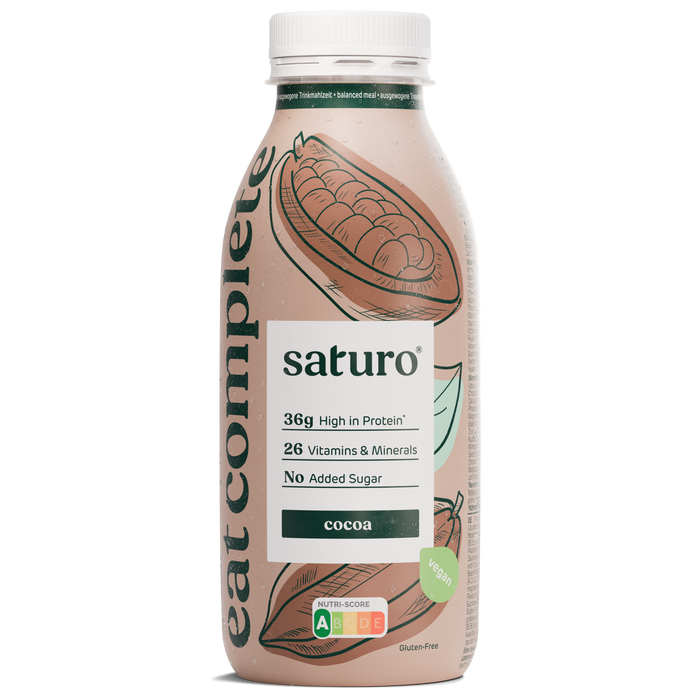
Drinkable meal: a complete meal in a bottle
26 vitamins and minerals, including vitamin D and calcium. Vitamin D contributes to the maintenance of normal bones and normal muscle function. Reference value for vitamin D: 5 µg per day (NRV). For days when fish isn't on the menu.
Winter, pregnancy, older age, vegan: who needs to pay extra attention
Vitamin D deficiency in winter
Winter is the normal case for deficiency, not the exception: in the health survey, one in four adults was below 30 nmol/l from October to March. What helps: really get outside from April to September and build up reserves, keep moving outdoors every day in winter because that releases stored vitamin D, and for risk groups, take 20 µg a day from October to March. If you're regularly ill, tired and tense in February, get tested once and you'll know.

Pregnancy and babies
In pregnancy, the same 20 µg apply, but since 2024 the Endocrine Society has advised pregnant women to take a supplement, because pre-eclampsia, premature births and low birth weight became less common in studies, though the certainty of the data is low. Routine testing isn't needed for this. After birth, prevention takes over: babies shouldn't be put in the sun, and breast milk contains hardly any vitamin D. That's why in Germany they get 10 to 12.5 µg (400 to 500 IU) daily until their second early summer, as a tablet or drops.
From 65: bones, falls, care
In older age, three things come together: the skin produces less than half as much, many people go outside less often, and bone density naturally declines anyway. Deficiency is therefore widespread among people needing care; the BfR recommends considering a general dose of 20 µg a day for residents of care facilities. The Endocrine Society recommends supplementation for everyone from age 75, since it may reduce mortality. What vitamin D doesn't do for healthy older adults was shown by the VITAL study.
Vegan and vegetarian
If you don't eat fish or eggs, you get almost nothing from food, which makes little difference anyway with an average of 2 to 4 µg. The sun is equally productive for everyone, and in winter it's missing for everyone. Plant-based sources are UV-treated mushrooms, fortified plant-based drinks and margarine, and supplements with D2 from mushrooms or vegan D3 from lichen. Two notes: D3 raises your blood level more reliably than D2, and common immunoassays measure D2 less well, so with D2 alone your lab result may come out too low (BfR).
Vitamin D deficiency: effects on bones, muscles and the immune system
Left untreated, a severe deficiency leads to osteomalacia in adults, rickets in children and osteoporosis in older age; muscle weakness raises the risk of falls. As for the immune system: 25 studies with over 11,000 people showed that taking vitamin D daily or weekly made respiratory infections about 12% less frequent, and 70% less frequent when starting levels were below 25 nmol/l. The 2021 analysis of 46 studies confirmed a small effect, clearest at 400 to 1,000 IU a day. For cancer, cardiovascular disease and diabetes, the large studies found no benefit in people who were already well supplied: fixing a deficiency is worth it, topping up beyond that is not.
Frequently asked questions about vitamin D deficiency
What are vitamin D robbers?
There's no such thing as foods that rob you of vitamin D. What lowers your level is a lack of UV-B radiation: October to March, glass, clothing, high-factor sun protection. Add to that age, dark skin, a high body fat percentage (the vitamin spreads across more tissue), chronic bowel, liver and kidney conditions, and medicines such as antiepileptics that speed up its breakdown.
How long does it take to replenish vitamin D?
With a dose set by your doctor, your 25(OH)D level reaches the target range in about 8 to 12 weeks; a first check after 4 to 6 weeks makes sense. Muscle weakness and cramps often improve in the first few weeks, while bones take months. Without a supplement, your stores only start to fill from April.
What does cholesterol have to do with vitamin D?
Vitamin D3 forms in the skin from a cholesterol precursor, 7-dehydrocholesterol, as soon as UV-B hits it. But a high cholesterol level in the blood doesn't mean more vitamin D, and vitamin D supplements don't demonstrably lower cholesterol. The two values are chemically linked, but not in everyday practice.
Is 10,000 IU of vitamin D a day too much?
Yes, if you take it long term. 10,000 IU is 250 µg, two and a half times the EFSA upper limit of 100 µg (4,000 IU); in the long run, raised calcium levels, kidney stones and loss of bone density are a risk. Doses like that belong in a doctor's hands. Even 3,000 IU (75 µg) is unnecessary without a measured deficiency; the BfR recommends no more than 20 µg (800 IU) for self-supplementing.
Should you take vitamin D daily or weekly?
Both raise your blood level, but the evidence favours a low daily dose. In 2024, the Endocrine Society preferred daily dosing, and in meta-analyses on respiratory infections, vitamin D only had a protective effect without bolus doses. Monthly or yearly high doses led to more falls and fractures in studies, so the BfR advises against them.
Does vitamin D3 always need vitamin K2 alongside it?
There's no official recommendation for it, and the BfR doesn't mention K2 in its vitamin D FAQ. The idea that K2 steers calcium into your bones rather than your blood vessels has no proven benefit at doses up to 20 µg, because calcium levels don't rise. If you take vitamin K antagonists, talk to your doctor before taking K2.
What hurts with a vitamin D deficiency? Can it cause leg pain?
Yes. Typical signs are dull, deep bone pain in the pelvis, hips, thighs, shins and lower back, because the bone isn't mineralising properly. Add to that muscle weakness in the thighs, calf cramps and tenderness over the shin or breastbone. Muscle tension and joint pain are reported, but they're non-specific.
Which blood values point to a vitamin D deficiency?
What matters is 25-hydroxyvitamin D: below 30 nmol/l (12 ng/ml) counts as deficient, 30 to 50 as suboptimal, and 50 nmol/l (20 ng/ml) and above as sufficient. In severe deficiency, calcium and phosphate in the blood can also be low, while alkaline phosphatase and parathyroid hormone are raised. Calcitriol is only measured for specific questions.
Sources · 18 sources anzeigen
- German Nutrition Society (DGE): Reference values for nutrient intake, vitamin D (calciferols). Estimated values in the absence of endogenous synthesis, derived 2012.
- German Nutrition Society (DGE): Selected questions and answers on vitamin D. As of 30.09.2025.
- German Federal Institute for Risk Assessment (BfR): Vitamin D – sun and exercise support good supply. FAQ dated 30 December 2025.
- Federal Office for Radiation Protection (BfS) and 19 professional societies: Consensus recommendation on UV radiation and vitamin D. 2012.
- Institute for Quality and Efficiency in Health Care (IQWiG): Vitamin D deficiency. gesundheitsinformation.de, as of 15.11.2023.
- Rabenberg M., Scheidt-Nave C., Busch M. A., Rieckmann N., Hintzpeter B., Mensink G. B. M.: Vitamin D status among adults in Germany – results from the German Health Interview and Examination Survey for Adults (DEGS1). BMC Public Health 2015; 15: 641.
- Rabenberg M. et al.: Implications of standardization of serum 25-hydroxyvitamin D data for the evaluation of vitamin D status in Germany, including a temporal analysis. BMC Public Health 2018; 18: 845.
- Demay M. B. et al.: Vitamin D for the Prevention of Disease: An Endocrine Society Clinical Practice Guideline. Journal of Clinical Endocrinology & Metabolism 2024; 109(8): 1907–1947.
- Holick M. F. et al.: Evaluation, Treatment, and Prevention of Vitamin D Deficiency: an Endocrine Society Clinical Practice Guideline. Journal of Clinical Endocrinology & Metabolism 2011; 96(7): 1911–1930.
- EFSA Panel on Nutrition, Novel Foods and Food Allergens (NDA): Scientific opinion on the tolerable upper intake level for vitamin D, including the derivation of a conversion factor for calcidiol monohydrate. EFSA Journal 2023; 21(8): e08145.
- LeBoff M. S. et al.: Supplemental Vitamin D and Incident Fractures in Midlife and Older Adults (VITAL). New England Journal of Medicine 2022; 387(4): 299–309.
- Martineau A. R. et al.: Vitamin D supplementation to prevent acute respiratory tract infections: systematic review and meta-analysis of individual participant data. BMJ 2017; 356: i6583.
- Jolliffe D. A. et al.: Vitamin D supplementation to prevent acute respiratory infections: a systematic review and meta-analysis of aggregate data from randomised controlled trials. Lancet Diabetes & Endocrinology 2021; 9(5): 276–292.
- Mikola T. et al.: The effect of vitamin D supplementation on depressive symptoms in adults: A systematic review and meta-analysis of randomized controlled trials. Critical Reviews in Food Science and Nutrition 2023; 63(33): 11784–11801.
- Liu J., Dong Y., Wang Y.: Vitamin D deficiency is associated with dry eye syndrome: a systematic review and meta-analysis. Acta Ophthalmologica 2020; 98(8): 749–754.
- Drincic A. T., Armas L. A. G., Van Diest E. E., Heaney R. P.: Volumetric dilution, rather than sequestration best explains the low vitamin D status of obesity. Obesity 2012; 20(7): 1444–1448.
- Cardwell G., Bornman J. F., James A. P., Black L. J.: A Review of Mushrooms as a Potential Source of Dietary Vitamin D. Nutrients 2018; 10(10): 1498.
- U.S. Department of Agriculture, Agricultural Research Service: FoodData Central, SR Legacy Release (2018). Vitamin D content (D2 + D3) per 100 g.
Writing for Saturo since 2019 about nutrition, nutrients and how good nutritional supply actually works in everyday life.
Hat diesen Artikel am 10. September 2026 auf fachliche Richtigkeit geprüft. This content doesn't replace medical advice.

Iron deficiency: symptoms, causes and treatment
Tired, pale, hair loss: why iron deficiency is the most common nutrient deficiency in the world, which blood value matters and what helps fast.
Weiterlesen · 13 Min

New from the guide
New articles, updates and tips straight to your inbox. Easy to understand, expert-checked, no spam.
Danke! Bitte bestätige die Anmeldung in deinem Postfach.