
Molybdenum deficiency: symptoms, effect and foods
Tired, headaches, thinning hair, and supposedly molybdenum is the problem? A genuine molybdenum deficiency has been described in humans exactly once, under intravenous feeding. Which symptoms are actually proven, what you can combine molybdenum with and where it's found.


Aktualisiert 2 October 2026 · 15 Min. Lesezeit · 55 Quellen

The key points in 30 seconds
That's how many people with an acquired molybdenum deficiency the scientific literature knows of: one patient with Crohn's disease, in 1981, after 18 months of intravenous feeding without molybdenum. In healthy people, none has ever been found.
This much molybdenum a day is considered adequate for teenagers and adults, derived in 2000 and unchanged since. According to a small study, adults in Germany eat 89 to 100 µg.
That's how much of the molybdenum in food the gut absorbs in healthy men, almost regardless of the amount. The kidney takes care of the rest: low intake is conserved, high intake is excreted straight away.
A plate of lentils or beans provides 40 to over 400 µg depending on soil and variety, around 180 on average. Next come peanuts, pumpkin seeds, porridge oats and wholemeal bread; meat, fish and milk contribute little.
Molybdenum deficiency symptoms: what's proven in humans
Molybdenum (Mo) is, like chromium and manganese, a trace element that the body only needs in micrograms and gets plenty of from legumes, grains and nuts. A molybdenum deficiency from diet has never been described in humans. The symptom lists online come from a single case report under intravenous feeding, from an inherited metabolic disease and from animal experiments. Here's what of that might apply to you.
Molybdenum deficiency symptoms in humans
The only documented case dates from 1981: a man with Crohn's disease was fed intravenously for 18 months with solutions that contained no molybdenum. In the last few months he developed a racing heart, rapid breathing, headaches, nausea and night blindness, became irritable, then lethargic and finally lost consciousness. In the lab, his uric acid was too low, while sulphite and methionine were raised. On 300 µg of ammonium molybdate a day, everything disappeared again. That's the entire evidence for acquired molybdenum deficiency: one patient, one clinic, one infusion.
Molybdenum and mental health: what's true
Not much. Irritability, lethargy and finally coma belong to that one case under artificial feeding, not to a normal diet. For depression, poor concentration or memory problems caused by molybdenum deficiency, there is not a single study in humans; a PubMed search only turns up work on metal exposure. If anything, the opposite is documented: a single case report describes an acute psychosis with hallucinations after 18 days on 300 to 800 µg from a supplement, and the cause remained unclear. If you're thinking about nutrients for low moods, you're better off looking at vitamin B12, vitamin D and iron.

Can molybdenum cause hair loss?
No, not according to what studies show. Hair loss only appears as a molybdenum symptom in animal observations: in mohair goats, an imbalance of copper and molybdenum changes the coat. In humans, there is no human study, either on deficiency or on supplementation. The advice sites that recommend molybdenum “for the hair root” don't cite any source. If you're losing hair, get the values checked that really explain something: ferritin (iron), zinc, thyroid, biotin only if deficiency is suspected, and vitamin D.
Two situations need a doctor straight away: a newborn with seizures, poor feeding and a shrill cry in the first days of life (suspected congenital molybdenum cofactor deficiency, chapter 2), and new symptoms such as a racing heart, headaches or vision problems during intravenous nutrition. If you have tiredness, hair loss or trouble concentrating on a normal diet, molybdenum isn't the suspect.
Tiredness, headaches, racing heart: what the lists online show
Google's answer to "molybdenum deficiency symptoms" lists headaches, nausea, tiredness, poor concentration, a racing heart, cramps and coma. Take away the 1981 case and nothing is left. No specialist source lists tiredness as a sign of deficiency, seizures and brain damage belong to the congenital form, and sulphite allergy, tooth decay, candida, histamine intolerance and impotence have no human data. The table sorts the twelve most common search terms so you can see where each claim comes from.
What actually fits molybdenum deficiency
The twelve complaints people search for most, and what the sources say: proven only in the case report on intravenous nutrition, only in congenital cofactor deficiency, or with no human data.
| What the studies say | Rating | |
|---|---|---|
| Racing heart, fast breathing | Described in the 1981 case, disappeared once molybdenum was added to the infusion | Only with artificial nutrition |
| Headaches, nausea | Same case; never described on a normal diet | Only with artificial nutrition |
| Night blindness, vision problems | Same case, mechanism unknown | Only with artificial nutrition |
| Irritability, lethargy, coma | Same case; brain damage otherwise only in the congenital form | Only with artificial nutrition |
| Seizures in newborns | Molybdenum cofactor deficiency, an inherited disease; eating more molybdenum doesn't help | Congenital only |
| Xanthine kidney stones | Only with a genetic xanthine oxidase defect | Congenital only |
| Tiredness, exhaustion | Not listed as a sign of deficiency in any specialist source | Unproven |
| Hair loss | Animal observation only (mohair goats), no human study | Unproven |
| Depression, concentration | No study on deficiency; PubMed only returns studies on high intake | Unproven |
| Sulphite intolerance, asthma | 3 to 10% of people with asthma react to sulphites, mechanism unclear, no link to molybdenum | Unproven |
| Candida, histamine intolerance | PubMed: no human study (search October 2026) | Unproven |
| Gout, high uric acid | With deficiency, uric acid is low; it only rises at 10 to 15 mg a day | Wrong |
Rating based on the sources in chapter 8 (NIH ODS 2021, IOM 2001, SCF 2000, ESPEN 2022, EMA 2022, Vally 2009, Ichida 2012, PubMed searches 2 October 2026). Correct as of 2 October 2026.
Molybdenum deficiency causes: who can actually be affected
The honest answer: almost nobody. The NIH knows of "no population group that is likely to take in too little molybdenum", and the ESPEN guideline has never seen a deficiency on a normal diet. There are exactly two routes: an infusion without molybdenum and a genetic defect. Plus the question of how much you actually need.
Artificial nutrition and bowel diseases
The only proven route to an acquired deficiency is parenteral nutrition over several months without added molybdenum, mostly in cases of intestinal failure, short bowel or severe Crohn's disease. For a long time this was hardly a problem, because the solutions contained molybdenum as a contaminant; modern solutions are cleaner, which is why ESPEN now recommends 19 to 25 µg a day in the infusion. Chronic inflammatory bowel diseases on their own, without intravenous nutrition, have not triggered a deficiency in any source: molybdenum is almost completely absorbed, even from an irritated gut.

Molybdenum cofactor deficiency: the congenital form
Behind this search term is not a nutrition issue but a rare inherited disease: the body can't build the cofactor that molybdenum is built into, and sulphite builds up in the brain. Affected newborns develop treatment-resistant seizures in the first days of life, feed poorly and suffer severe brain damage; untreated, most survive only a few years. Eating or injecting molybdenum doesn't help. For the most common type, type A, the drug fosdenopterin has been available since 2021 (USA) and 2022 (EU). It replaces the missing building block and, if given early, protects development.
Vegan, older, pregnant: who isn't at higher risk
Nobody on this list. Vegans eat the foods richest in molybdenum there are; German vegetarians measured at 170 to 179 µg a day, almost double the intake of people who eat a mixed diet. For older people there's no sign of a different requirement, and absorption stays high. Pregnant and breastfeeding women get the same value from EFSA as all adults (65 µg), while in the USA there's a calculated increase to 50 µg; a deficiency during pregnancy hasn't been described anywhere. Stress, smog, ready meals or amalgam as a cause: no evidence whatsoever.
Daily molybdenum requirement: how much you need
The DGE gives an estimated value of 50 to 100 µg a day for teenagers and adults, derived in 2000 and unchanged in 2025; children aged 1 to 4 years 25 to 50 µg, 4 to 7 years 30 to 75 µg, 7 to 10 years 40 to 80 µg. EFSA sets 65 µg for everyone aged 15 and over, the USA 45 µg, and on labels the reference value is 50 µg. All of these figures are estimates based on usual intake, not a measured requirement: according to balance studies, that is around 25 µg, the same for all adults.
Molybdenum effect: what molybdenum does in the body
Molybdenum (Mo) is the chemical element with atomic number 42, a hard metal found in steel and also a trace element your body needs only in micrograms. Three stops, from lentil to kidney, show why almost all of it gets absorbed, what it does there and why your body never lets it run short anyway.
Absorption: the gut lets almost everything through
Molybdenum is present in food as molybdate and is absorbed passively in the small intestine, without saturation: in healthy men, 88 to 93% reached the blood, whether their food contained 22 or 1,490 µg a day. From kale, 86% was absorbed, from soy only 57%, from a mixed diet about 76 to 83%. Black tea slows absorption at high single doses; phytate from wholegrains, unlike with iron and zinc, plays no proven role. In the blood, molybdenum is bound to proteins, and the highest levels are found in the liver and kidney.
Effect: one cofactor for four enzymes
Molybdenum only works once it's built into the molybdenum cofactor, which sits at the centre of four enzymes: sulphite oxidase turns sulphite, which is produced when the sulphur-containing amino acids methionine and cysteine are broken down, into harmless sulphate; xanthine oxidase breaks purines down into uric acid; aldehyde oxidase and mARC process medicines and foreign substances. Only sulphite oxidase is proven to be vital, and its failure causes the severe symptoms of the inherited form. This is also the basis of the only authorised EU claim: molybdenum contributes to the normal metabolism of sulphur-containing amino acids. It doesn't break down alcohol; a different enzyme takes care of that.
Excretion: the kidney manages your levels
What the body doesn't need leaves via the urine: with low intake, around 60% of the amount excreted, with plentiful intake over 90%. The kidney conserves when there's little and lets go when there's a lot; in the plasma, half is gone after 30 minutes and 6.6 hours. There's no store that a blood test could check; the serum level reflects your last meal. That's exactly why it's so hard to run short of molybdenum: four men kept their balance on 22 µg a day over three months, and an excess from food hasn't been described.
Diagnosing molybdenum deficiency: what the blood test can do
You can measure molybdenum in blood and urine, but no value answers the question of deficiency. EFSA puts it in one sentence: there is no biomarker for molybdenum status. Here's what labs offer, what it's good for and what "raised molybdenum" means.
Molybdenum in the blood: values and limits of the test
German labs measure molybdenum in serum (reference range 0.3 to 1.2 or 0.4 to 2.0 µg/l, depending on the lab), in red blood cells and in 24-hour urine, usually as a self-pay service. The problem: serum levels rise after every meal and drop back within an hour, while urine levels reflect your intake over the last few days. Neither tells you anything about your stores. Hair analyses have no validated basis. If there's a genuine suspicion during intravenous nutrition, ESPEN therefore recommends indirect signs: very low uric acid in the blood, raised sulphite, xanthine and hypoxanthine in the urine, plus molybdenum in the blood.

Raised molybdenum: causes and what it means
A raised molybdenum level usually means: you ate a lot or took a supplement. Because absorption isn't throttled, serum levels climb temporarily after a portion of pulses or a capsule. It stays high long-term with occupational dust exposure (the reference value for this is 150 µg/l in urine), with reduced kidney function because excretion stalls, and with liver disease. In the one region of Armenia with extremely molybdenum-rich soil, blood levels were 310 µg/l, a hundred times the normal level. Without circumstances like these, a slightly raised value isn't a finding, it's a snapshot of your breakfast.
Fix a molybdenum deficiency and avoid too much molybdenum
There's no molybdenum therapy for healthy people, because there's nothing to fix. The questions that remain are different ones: what do capsules from the chemist and online shops actually do, what can you take alongside molybdenum, and when does it become too much? The answers are here, with numbers.
Fixing a molybdenum deficiency: food instead of capsules
The one documented deficiency was treated in a clinic, with 300 µg ammonium molybdate a day in the infusion, and it was gone after a short time. Outside a clinic, this applies: a portion of pulses, a glass of soya drink, a handful of peanuts or 60 g of oats each cover the label value of 50 µg on their own, often several times over. Even a day of white bread, potatoes, schnitzel and sausage comes to 56 µg according to German database values. Nobody needs to do more. If you're fed intravenously, you get molybdenum in the trace element solution, and your treatment team sets the dose.
Molybdenum as a supplement: when it makes sense
Practically never. Neither EFSA, the NIH nor the Norwegian food safety authority found any evidence that healthy people benefit from extra molybdenum; the NIH writes that molybdenum is "not a standard treatment for any disease". Supplements on the market usually provide 100 to 200 µg, in the US up to 500 µg per daily dose. The BfR considers a maximum of 80 µg acceptable in a food supplement, as a suggestion, not as law. A multivitamin with 20 to 50 µg won't hurt, but it gives you nothing that isn't already in your muesli. The only reason for doctor-prescribed molybdenum: intravenous nutrition.
What shouldn't you take together with molybdenum?
As far as we know today: almost nothing. The most common Google question about molybdenum has a short answer, because the research found no proven interaction for magnesium, manganese, zinc, iron, vitamin C or medication. The only real opponent is copper: in ruminants, molybdenum binds copper together with sulphur and leaves the animals short of copper. In humans, up to 1.5 mg molybdenum a day changed nothing about copper status, and that's fifteen times the estimated value. So caution only applies if you already have a copper deficiency or take high-dose molybdenum supplements. The table shows what's proven.
What you can combine with molybdenum
Eight partners people search for, and what studies, the IOM and the NIH have to say about them. The basis is molybdenum from food or supplements in the microgram range.
| Compatible? | What the evidence shows | |
|---|---|---|
| Copper | Yes, up to 1.5 mg molybdenum | Antagonism only in ruminants; men up to 1.5 mg a day with no change in copper status (IOM, LPI) |
| Magnesium | Yes | No interaction described, fine to take together |
| Manganese | Yes | No interaction described; both are found in wholegrains and pulses anyway |
| Zinc and iron | Yes | No interaction described, unlike zinc with copper |
| Vitamin C | Yes, no added benefit | Given in combination over 5 years in Linxian: no effect on mortality |
| Black tea | Take apart | Clearly lowers absorption at high single doses (isotope studies); insignificant in everyday life |
| Medication | Yes | NIH ODS: no known interactions with medicines |
| Tetrathiomolybdate | Special case | A drug used for Wilson's disease at doses around 120 mg, binds copper; nothing to do with dietary molybdenum |
IOM 2001 (Turnlund and Keyes 2000), Linus Pauling Institute 2021, NIH ODS 2021, EFSA 2013 (Giussani 2006/2007), Wang 2018, ESPEN 2022, Brewer 2006. As of 2 October 2026.
That leaves the question of timing: when is the best time to take molybdenum? There's not a single study on it, because there's no reason to take it. If your doctor has prescribed a supplement, take it with a meal, not together with strong black tea, and add up the micrograms from all your packs: multivitamins, mineral complexes and single supplements often contain it all at once. You don't need any more rules than that.
With molybdenum, the capsule is a bigger risk than the plate. In practice I've never met anyone who was lacking molybdenum, but I have met some who took 200-microgram capsules against tiredness or hair loss that had completely different causes. My advice: put lentils, oats and nuts on the table, and if you're considering a supplement, check your iron, thyroid and vitamin D first.
Joerg Hauke, Nutrition expert, reviewed this article for accuracy
Molybdenum overdose and side effects
An overdose from food hasn't been described; ESPEN knows of “no reports of acute toxicity from dietary molybdenum”. The EU upper limit is 600 µg a day, while the US sets 2,000 µg; both come from the same rat study. Four men tolerated 1,490 µg over 24 days with no side effects. Problems have only been described in a region of Armenia, where people took in 10 to 15 mg a day from the soil: joint pain, gout-like symptoms and high uric acid, in a methodologically weak study. A single case of psychosis after 300 to 800 µg from a supplement remains unexplained. The scale shows where each figure sits.
Molybdenum in food: where you'll find the most
Molybdenum is found in pulses, peanuts, seeds, oats and wholegrains; liver is the only animal source of any weight, while meat, fish, eggs and milk provide little. The bars show both worlds according to the Bundeslebensmittelschlüssel 4.0 (the German food composition database). First, an honest word: the US database lists no molybdenum values at all, the German one has gaps for exactly lentils, beans and chickpeas, and the content depends heavily on the soil. Highlighted rows therefore come from specialist studies, and all figures are orders of magnitude.
Molybdenum per 100 g: top 10 plant-based and top 10 animal-based
Bundeslebensmittelschlüssel 4.0 (2025), rounded. * ANSES group average; the German database doesn't list lentils, beans and chickpeas; 20 to 200 µg depending on variety and soil. Per portion: 200 g lentils about 180 µg, 30 g peanuts 58, 60 g oats 42, one glass of soya drink 114.
Pulses, grains, nuts: the best sources
The biggest single portion comes from pulses: 200 g of cooked lentils, beans or chickpeas give around 180 µg on the French average, and 40 to over 400 µg in individual samples. Next come soya products (a glass of soya drink 114 µg), peanuts (a handful 58 µg), pumpkin seeds (two tablespoons 29 µg) and oats (60 g 42 µg). But it's bread that carries everyday intake: in European dietary surveys, 33 to 55% of molybdenum comes from cereal products, even though wholegrain bread has only 30 µg per 100 g. Pulses have the highest content, grains the volume.
Why the soil determines the molybdenum content
Plants take up molybdenum from the soil as molybdate, and how much is available depends on the pH: neutral and chalky soils release it easily, while acidic soils hold on to it. EFSA therefore writes that the molybdenum content of plant foods “varies widely”, and the countries show it: German adults measured 58 to 100 µg a day, Swedes 157 to 172, on a similar diet. According to the only series of measurements, cooking doesn't change the content measurably, and wholegrain gives about a quarter more than polished rice. For white flour versus wholemeal flour, Germany has no figures at all.

Animal foods: liver, eggs, milk
Only liver really counts: offal comes in at 101 µg per 100 g on the French group average, fried chicken liver at 68, and beef liver at around 100 µg per portion according to US data. Because of its vitamin A content, though, liver doesn't belong on your plate during pregnancy. Everything else is thin: meat and fish 1 to 10 µg, an egg about 4 to 9, a glass of milk 9 µg. Because milk and cheese are eaten in large amounts, they still provide 12% of intake in Sweden, and as much as bread in children. No gap for vegans: soya and pulses provide ten times as much.
Meeting your daily molybdenum requirement: what belongs on your plate
Nothing special. If you eat pulses two to three times a week, have oats or wholemeal bread in the morning and a handful of nuts in between, you land at double the estimated value, just like the vegetarians who were measured. Even a low-molybdenum day of white bread, potatoes and schnitzel reaches the label value. If a proper meal doesn't happen, a drinkable meal with defined nutrient amounts can step in: one bottle of Saturo (400 ml) provides 25 µg molybdenum, 50% of the reference value, plus 25 more vitamins and minerals, 36 g protein and 400 kcal. Molybdenum contributes to the normal metabolism of sulphur-containing amino acids. A nutritional fact, not a promise.
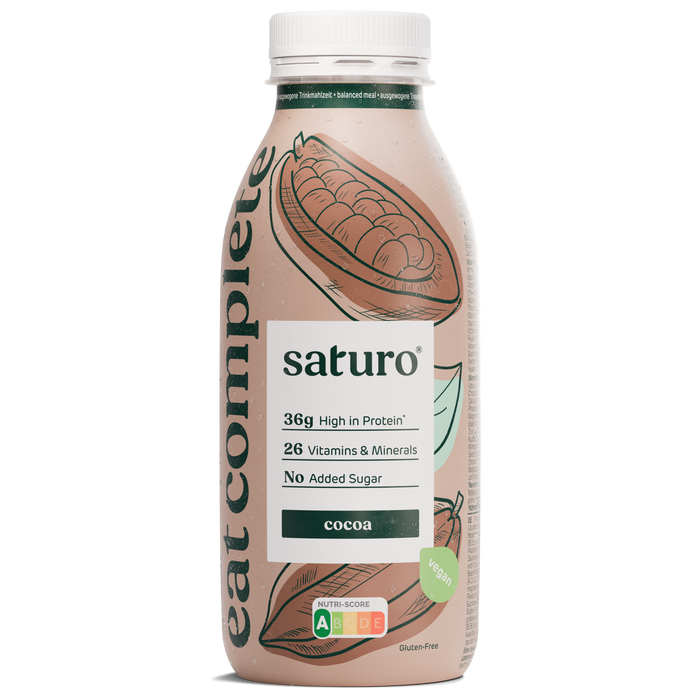
Drinkable meal: a complete meal in a bottle
26 vitamins and minerals, including molybdenum, copper, manganese and chromium, plus 36 g protein and 400 kcal per bottle. Molybdenum contributes to normal metabolism of sulphur-containing amino acids. Reference intake for molybdenum: 50 µg per day (NRV).
Detox, alcohol, gout: what molybdenum really does
Google “molybdenum effects” and you'll get liver, detox, alcohol, gut and hair. Some of it has a kernel of truth in the four enzymes from chapter 3; the rest is sales waffle. Here's the fact check, plus sulphite, gout, pregnancy and children.
Detox, liver, alcohol, gut: what molybdenum really does
The sulphite detox is real: sulphite oxidase turns sulphite, which comes from protein breakdown and from preservatives, into harmless sulphate. It's also true that aldehyde oxidase and mARC in the liver convert drugs and foreign substances. From that, the internet gets “molybdenum detoxes the liver” and “breaks down alcohol”. Neither is true: acetaldehyde from alcohol is broken down almost entirely by aldehyde dehydrogenase, and molybdenum enzymes are considered an “insignificant pathway” for it. For heavy metals, amalgam, gut flora, bloating and candida, there is no human study. The table sums up the claims.
Ten claims about molybdenum, checked
What shops, encyclopaedias and Google answers say about molybdenum, and what the sources actually support.
| What's true | Rating | |
|---|---|---|
| Molybdenum detoxifies sulphite | Yes, via sulphite oxidase; that's a basic function, not a therapy | True |
| Molybdenum breaks down alcohol | No, acetaldehyde is broken down by aldehyde dehydrogenase; molybdenum enzymes are an “insignificant pathway” | False |
| Molybdenum detoxes the liver | Two enzymes convert drugs; liver protection from taking molybdenum is not proven | Oversimplified |
| Helps gut flora and bloating | No human study; claim from a Google answer with no source | Unproven |
| Helps with candida and histamine intolerance | PubMed: no human study (October 2026) | Unproven |
| Detoxes heavy metals and amalgam | No human study | Unproven |
| Protects against oesophageal cancer | Linxian study, 29,584 people: vitamin C plus molybdenum had no effect, and was rather unfavourable in older people | Not proven, rather unfavourable |
| Helps with diabetes | 2023 review: “conflicting data” | Unproven |
| Treats Wilson's disease | Only the drug tetrathiomolybdate in milligram doses, not dietary molybdenum | Mix-up |
| Protects against tooth decay | SCF: evidence “contradictory and inconclusive”; lab effect only at unrealistic concentrations | Unproven |
Cederbaum 2012, Linus Pauling Institute 2021, NIH ODS 2021, Terao 2016, Wang 2018, Foteva 2023, ESPEN 2022, Brewer 2006, SCF 2000, Zohoori 2020, PubMed searches 2 October 2026.
Sulphite intolerance and histamine
The idea sounds logical: if you react to sulphites in wine or dried fruit, you have too little sulphite oxidase, so too little molybdenum. It isn't proven. 3 to 10% of people with asthma react to sulphite additives, the mechanism is unclear according to reviews, and no study has tested molybdenum as a cause or a treatment. A genuine sulphite oxidase deficiency is an inherited disease with seizures from birth, not an adult issue. The treatment for the intolerance is avoidance. The same goes for histamine intolerance: zero hits in the scientific literature, plenty in the shops.
Molybdenum, uric acid and gout
Molybdenum sits in xanthine oxidase, the enzyme that produces uric acid and that the gout drug allopurinol inhibits. That leads to the opposite of the claim online: with a molybdenum deficiency, uric acid is low, not high; very low levels are the lab sign of the inherited form. Uric acid was only raised at 10 to 15 mg a day from Armenian soil, a hundred times the estimated value, in a study with five control subjects. If you have gout, you need neither more nor less molybdenum. Look at purines, alcohol and soft drinks instead.
Pregnancy, breastfeeding and children
The DGE has no separate value for pregnant or breastfeeding women; the range of 50 to 100 µg still applies. EFSA stays at 65 µg, and the US sets 50 µg by calculation. A deficiency in pregnancy hasn't been described; molybdenum reaches the baby via the placenta and breast milk (about 2 µg per litre). For infants there is no upper limit; breast milk and infant formula should be the only sources. Toddlers have the lowest EU upper limit at 100 µg a day: a multivitamin “for the whole family” with 100 µg molybdenum is therefore already too much for a three-year-old.
Frequently asked questions about molybdenum deficiency
What happens if you have a molybdenum deficiency?
With a normal diet, nothing, because it doesn't occur. In the one hospital case on intravenous nutrition, there was a racing heart, rapid breathing, headaches, night blindness and finally coma; uric acid was low. Everything disappeared once molybdenum was added to the infusion.
What causes a molybdenum deficiency?
From exactly two sources: months of intravenous nutrition without added molybdenum, and an inherited defect of the molybdenum cofactor that affects newborns. Stress, ready meals, amalgam or a vegan diet have not been shown to be a cause anywhere.
How much molybdenum do you need per day?
The DGE (German Nutrition Society) considers 50 to 100 µg adequate for teenagers and adults, the EFSA gives 65 µg, and labels use 50 µg. Balance studies suggest the actual requirement is around 25 µg. One portion of lentils provides 40 to 400 µg.
Can you overdose on molybdenum?
Not from food. The EU upper limit is 600 µg a day and the US limit is 2,000 µg, both based on a rat study. Joint problems and high uric acid were only observed at 10 to 15 mg a day, from extremely molybdenum-rich soil.
What are the side effects of molybdenum?
None known from food. Four men tolerated 1,490 µg a day for 24 days without any problems. One case report describes hallucinations and seizures after 300 to 800 µg from a supplement, but the cause remained unclear. The BfR (German Federal Institute for Risk Assessment) advises a maximum of 80 µg per supplement.
Can I take molybdenum together with magnesium?
Yes. No interaction with molybdenum has been described for magnesium, manganese, zinc, iron or vitamin C, and according to the NIH, none with medications either. Only copper is an antagonist, and in humans only at doses well above 1.5 mg of molybdenum.
Do oats contain molybdenum?
Yes. According to the German Federal Food Code (Bundeslebensmittelschlüssel), they contain 70 µg per 100 g, so a 60 g portion provides 42 µg, which is 84% of the label value. That makes oats one of the best everyday sources after legumes, peanuts and pumpkin seeds, whether as porridge or in muesli.
Why does your body need molybdenum?
As a building block of the molybdenum cofactor in four enzymes: sulfite oxidase detoxifies sulfite from protein breakdown, xanthine oxidase forms uric acid from purines, and aldehyde oxidase and mARC process drug compounds. Only sulfite oxidase is proven to be vital.
Sources · 55 sources anzeigen
- German Nutrition Society (DGE): Reference values for nutrient intake, copper, manganese, chromium, molybdenum. Estimated value for molybdenum 50 to 100 µg/day for adolescents and adults (derived 2000, 3rd edition 2025 unchanged).
- EFSA NDA Panel: Scientific Opinion on Dietary Reference Values for molybdenum. EFSA Journal 2013; 11(8): 3333 (AI 65 µg, “deficiency in otherwise healthy humans has not been observed”, no biomarker).
- EFSA: Dietary Reference Values for nutrients, Summary report, tables January 2017 (AI for molybdenum by age).
- Scientific Committee on Food (SCF): Opinion on the Tolerable Upper Intake Level of Molybdenum, 19 October 2000, in: EFSA, Tolerable Upper Intake Levels for Vitamins and Minerals, 2006, pp. 77–86 (UL 0.6 mg, NOAEL 0.9 mg/kg from Fungwe 1990, UF 100, Armenia study).
- EFSA: Overview on Tolerable Upper Intake Levels as derived by the SCF and the EFSA NDA Panel, Version 11, August 2025 (molybdenum 0.1 to 0.6 mg by age).
- National Institutes of Health, Office of Dietary Supplements: Molybdenum, Fact Sheet for Health Professionals, as of 30 March 2021 (RDA 45 µg, UL 2,000 µg, case report 1981, food values, “not a standard treatment for any disease”).
- Institute of Medicine: Dietary Reference Intakes for Vitamin A, Vitamin K, Arsenic, Boron, Chromium, Copper, Iodine, Iron, Manganese, Molybdenum, Nickel, Silicon, Vanadium, and Zinc. National Academies Press 2001, Chapter 11 Molybdenum (copper antagonism “not considered to be of significance to humans”, plasma not a status marker).
- Regulation (EU) No 1169/2011 (Food Information to Consumers Regulation), Annex XIII: nutrient reference value for molybdenum 50 µg, significant amount 7.5% for drinks.
- German Federal Institute for Risk Assessment (BfR): Maximum level proposals for molybdenum in foods including food supplements, Opinion 009/2021 of 15 March 2021 (80 µg per daily dose, 5 µg/100 ml for drinks, intake in Germany 89 and 100 µg).
- BfR: Updated maximum level proposals for vitamins and minerals in food supplements and fortified foods. Opinion 009/2021 of 15 March 2021 (main document).
- Norwegian Scientific Committee for Food and Environment (VKM): Assessment of dietary intake of molybdenum in relation to tolerable upper intake level. Report 2018:05 (supplement scenarios, toddlers above the UL from 100 µg).
- Swiss Society for Nutrition (SSNS): Molybdenum information sheet, version 2.4, October 2025 (reference values compared across countries).
- Linus Pauling Institute, Oregon State University: Micronutrient Information Center, Molybdenum, updated May 2021 (four enzymes, “dietary molybdenum deficiency has never been observed in healthy people”, Linxian).
- Mendel R. R., Leimkühler S.: The biosynthesis of the molybdenum cofactors. Journal of Biological Inorganic Chemistry 2015; 20(2): 337–347.
- Terao M. et al.: Structure and function of mammalian aldehyde oxidases. Archives of Toxicology 2016; 90(4): 753–780 (xenobiotic metabolism, physiological role unclear).
- Cederbaum A. I.: Alcohol metabolism. Clinics in Liver Disease 2012; 16(4): 667–685 (aldehyde oxidase and xanthine oxidase “insignificant pathways” for acetaldehyde).
- Turnlund J. R., Keyes W. R., Peiffer G. L.: Molybdenum absorption, excretion, and retention studied with stable isotopes in young men at five intakes of dietary molybdenum. American Journal of Clinical Nutrition 1995; 62(4): 790–796 (absorption 88 to 93%, up to 1,490 µg without side effects).
- Turnlund J. R. et al.: Molybdenum absorption, excretion, and retention studied with stable isotopes in young men during depletion and repletion. American Journal of Clinical Nutrition 1995; 61(5): 1102–1109 (102 days on 22 µg without signs of deficiency).
- Turnlund J. R. et al.: Molybdenum absorption and utilization in humans from soy and kale intrinsically labeled with stable isotopes of molybdenum. American Journal of Clinical Nutrition 1999; 69(6): 1217–1223 (soy 57%, kale 86%).
- Novotny J. A., Turnlund J. R.: Molybdenum kinetics in men differ during molybdenum depletion and repletion. Journal of Nutrition 2006; 136(4): 953–957.
- Novotny J. A., Turnlund J. R.: Molybdenum intake influences molybdenum kinetics in men. Journal of Nutrition 2007; 137(1): 37–42 (mixed diet 76 to 83% available).
- Agency for Toxic Substances and Disease Registry (ATSDR): Toxicological Profile for Molybdenum, 2020 (urine main route of excretion, plasma half-lives 30 minutes and 6.6 hours, liver and kidney levels).
- Abumrad N. N., Schneider A. J., Steel D., Rogers L. S.: Amino acid intolerance during prolonged total parenteral nutrition reversed by molybdate therapy. American Journal of Clinical Nutrition 1981; 34(11): 2551–2559 (the only documented case of acquired deficiency).
- Fessler T. A.: Trace element monitoring and therapy for adult patients receiving long-term total parenteral nutrition. Practical Gastroenterology, March 2005, pp. 44–65.
- Berger M. M., Shenkin A. et al.: ESPEN micronutrient guideline. Clinical Nutrition 2022; 41(6): 1357–1424, chapter 10 Molybdenum (“clinically apparent nutritional deficiency … has not been reported in humans”, PN 19 to 25 µg/day, diagnostics, no acute toxicity from food).
- Berner Y. N. et al.: Selected ultratrace elements in total parenteral nutrition solutions. American Journal of Clinical Nutrition 1989; 50(5): 1079–1083 (molybdenum as a contaminant).
- Stahl-Pehe A., Heseker H.: Molybdän: Physiologie, Funktionen, Vorkommen, Referenzwerte und Versorgung in Deutschland. Ernährungs Umschau 2013; 60(11): M629–M633 (no valid biomarkers, deficiency only in isolated cases with parenteral nutrition).
- European Medicines Agency (EMA): Nulibry (Fosdenopterin), Medicine overview, EMA/669922/2022 (approval 15 September 2022, type A).
- EMA: Nulibry, EPAR Public Assessment Report, EMA/677145/2022 (incidence 1 in 341,690 to 411,187, over 100 cases, median survival 36 months, lab tests for MoCD).
- U.S. Food and Drug Administration: NULIBRY (fosdenopterin) Prescribing Information and Approval Letter, NDA 214018, 26 February 2021.
- Johannes L., Fu C. Y., Schwarz G.: Molybdenum Cofactor Deficiency in Humans. Molecules 2022; 27(20): 6896 (clinical picture in newborns, type A 50 to 60%).
- Schwahn B. C. et al.: Consensus guidelines for the diagnosis and management of isolated sulfite oxidase deficiency and molybdenum cofactor deficiencies. Journal of Inherited Metabolic Disease 2024; 47(4): 598–623.
- Ichida K. et al.: Mutations associated with functional disorder of xanthine oxidoreductase and hereditary xanthinuria in humans. International Journal of Molecular Sciences 2012; 13(11): 15475–15495 (xanthine stones only with a genetic defect).
- Vally H., Misso N. L., Madan V.: Clinical effects of sulphite additives. Clinical and Experimental Allergy 2009; 39(11): 1643–1651 (3 to 10% of people with asthma, mechanism unclear).
- Blot W. J. et al.: Nutrition intervention trials in Linxian, China: supplementation with specific vitamin/mineral combinations, cancer incidence, and disease-specific mortality in the general population. Journal of the National Cancer Institute 1993; 85(18): 1483–1492.
- Wang S. M. et al.: Effects of Nutrition Intervention on Total and Cancer Mortality: 25-Year Post-trial Follow-up of the 5.25-Year Linxian Nutrition Intervention Trial. Journal of the National Cancer Institute 2018; 110(11): 1229–1238 (vitamin C plus molybdenum: no effect on total mortality, HR 1.16 for oesophageal cancer death from age 55).
- Momčilović B.: A case report of acute human molybdenum toxicity from a dietary molybdenum supplement. Arhiv za Higijenu Rada i Toksikologiju 1999; 50(3): 289–297 (300 to 800 µg over 18 days, psychosis, seizures).
- Vyskocil A., Viau C.: Assessment of molybdenum toxicity in humans. Journal of Applied Toxicology 1999; 19(3): 185–192 (“a low order of toxicity”).
- Brewer G. J. et al.: Treatment of Wilson disease with ammonium tetrathiomolybdate. Archives of Neurology 2006; 63(4): 521–527 (drug, 48 patients).
- Foteva V. et al.: Does the Micronutrient Molybdenum Have a Role in Gestational Complications and Placental Health? Nutrients 2023; 15(15): 3348 (“conflicting data on the benefits of molybdenum for chronic diseases”).
- Zohoori F. V., Duckworth R. M.: Microelements: Part II: F, Al, Mo and Co. Monographs in Oral Science 2020; 28: 48–58 (molybdenum and dental caries).
- World Health Organization: Guidelines for drinking-water quality, 4th edition incorporating the first and second addenda, 2022, Chemical fact sheet Molybdenum (no formal guideline value, health-based reference value of 70 µg/l).
- Trinkwasserverordnung 2023 (TrinkwV, German Drinking Water Ordinance), Annex 2: molybdenum not regulated.
- MSD Manual Professional Edition: Molybdenum deficiency (L. E. Johnson, reviewed May 2025).
- LADR Laborverbund: Analysis directory, molybdenum (serum 0.3 to 1.2 µg/l, red blood cells, 24-hour urine), as of 12 February 2025.
- Labor Augsburg MVZ: Service directory, molybdenum (serum 0.4 to 2.0 µg/l, BAR value 150 µg/l urine, not covered by statutory health insurance).
- Commission Regulation (EU) No 432/2012: list of permitted health claims, entry for molybdenum (“contributes to normal metabolism of sulphur-containing amino acids”, ID 313).
- Regulation (EC) No 1924/2006 (Health Claims Regulation), annex: conditions for the claim “source of minerals”.
- Holzinger S., Anke M., Röhrig B., Gonzalez D.: Molybdenum intake of adults in Germany and Mexico. Analyst 1998; 123(3): 447–450 (mixed diet 89 and 100 µg respectively, vegetarians 170 to 179 µg, requirement approx. 25 µg).
- Sinkovič L. et al.: Phytic Acid and Bioactive Compounds in Marketable Pulses. Plants 2023; 12(1): 170 (molybdenum 0.54 to 8.46 mg/kg dry matter in 16 legume samples, commercial lentils a factor of 10).
- ANSES: Étude de l'alimentation totale française 2 (EAT 2), Tome 1, 2011, section on molybdenum (legumes 0.91 mg/kg, offal 1.01 mg/kg, adult intake 93.9 µg).
- Oskarsson A., Kippler M.: Molybdenum, a scoping review for the Nordic Nutrition Recommendations 2023. Food and Nutrition Research 2023; 67: 10326 (Swedish market basket 2015: cereals 55% of intake, eggs 6 µg/100 g, cooking without measurable loss).
- Smedley P. L., Cooper D. M., Lapworth D. J.: Molybdenum distributions and variability in drinking water from England and Wales. Environmental Monitoring and Assessment 2014; 186(10): 6403–6416 (all samples below 2 µg/l).
- Verbraucherzentrale NRW, Klartext Nahrungsergänzung: Maximum levels for food supplements in a European comparison, as of September 2025 (molybdenum Germany 80, Belgium 225, France 300 µg).
- Max Rubner-Institut: Bundeslebensmittelschlüssel (BLS), version 4.0, German nutrient database, Karlsruhe 2025, molybdenum (µg per 100 g), documentation January 2026.
Has been writing for Saturo since 2019 about nutrition, nutrients and how getting what your body needs works in practice in everyday life.
Hat diesen Artikel am 2. Oktober 2026 auf fachliche Richtigkeit geprüft. This content is no substitute for medical advice.

Copper deficiency: symptoms, causes and treatment
Molybdenum's counterpart: why healthy people rarely lack copper, when zinc and stomach surgery make it scarce, how to read the blood test and where copper is found.
Weiterlesen · 16 Min

News from the guide
New articles, updates and tips straight to your inbox. Easy to understand, expert-reviewed, no spam.
Danke! Bitte bestätige die Anmeldung in deinem Postfach.