Two bottles of Vanilla and one each of Cocoa, Natural, Strawberry and Cappuccino. One-off purchase, no subscription.
CHF 35.00CHF 5.83 per meal · CHF 1.46/100 mlFree delivery in DE and AT

Astronaut food is the everyday name for high-calorie nutrition from a bottle. Behind it are two worlds: medical nutrition drinks from the pharmacy and drinkable meals as regular food. What's in them, where you can get them and who they suit.


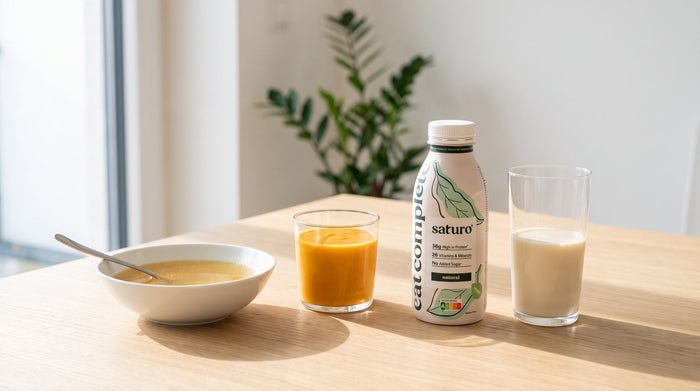
400 kcal, 36 g plant-based protein, 26 vitamins and minerals, no added sugar. 100% vegan, gluten-free, lactose-free. No powder to mix: chill, shake, drink. Five flavours, ready to drink straight away, no recipe needed.
Two bottles of Vanilla and one each of Cocoa, Natural, Strawberry and Cappuccino. One-off purchase, no subscription.
Or go straight for your flavour in a 6-pack:
Alle Preise inkl. MwSt., zzgl. Versand. Free delivery in Germany and Austria from 2 packs.
A drinkable meal like Saturo delivers 400 kcal in 400 ml, medical nutrition drinks 300 to 400 kcal in 200 ml. Both are called astronaut food in everyday speech, but they're made for different people.
That's what you pay per pack if your health insurer covers medical nutrition drinks: 10%, minimum 5, maximum 10 euros. Nobody pays for drinkable meals and protein shakes except you.
That's how many older people were malnourished in pooled data from twelve countries: 5.8% at home, 50.5% in rehab clinics. The most common reason to search for astronaut food.
The first liquid nutrition was developed for NASA but never flew. Today the ISS crew eats around 200 normal dishes, freeze-dried or heat-preserved. The name stuck to the bottle.
Astronaut food is the everyday name for high-calorie, ready-to-drink nutrition that packs lots of nutrients into a small volume: usually medical nutrition drinks from the pharmacy, and increasingly drinkable meals as regular food. It has little to do with what's eaten in space today. The name comes from space research in the 1960s and has stuck for anything that replaces a meal in a bottle.
In everyday use, yes: astronaut food and cosmonaut food mean the same thing, and care portals and trade journals use the words as synonyms for drink and tube nutrition. Behind them, though, are two legally different product worlds. Medical nutrition drinks are a food for special medical purposes, a nutritionally formulated diet: for patients, under medical supervision, available on prescription (Fresubin, Fortimel, Resource and others). A drinkable meal like the Saturo drinkable meal is a normal food: freely available, for healthy adults who want to replace a meal. Which world you need depends on the reason, not the word.
Not nutrition drinks. The first chemically defined liquid diet was developed for NASA in 1965 but, according to the manufacturer, never flew because the astronauts didn't want to drink it. Tubes only existed in the Mercury programme: in 1962, John Glenn ate applesauce from an aluminium tube. Today the ISS crew chooses from around 200 standard dishes, freeze-dried or heat-preserved, plus tortillas instead of bread because they don't crumble; there's no fridge for food on board. So space travel gave nutrition drinks their name, not their recipe.
For people who can't get enough energy and nutrients from normal food. Medical nutrition drinks are made for patients: with existing or looming malnutrition, after operations, with cancer, swallowing disorders or in old age, when appetite and portions shrink; they temporarily supplement or replace meals and belong under medical supervision. A drinkable meal is for healthy people who lack time, a kitchen or appetite: one complete meal a day from the bottle, with the plate remaining the rule. If you're searching for a relative over 65, read chapter 6.

Food law knows two worlds: foods for special medical purposes and normal foods. Under EU regulation, medical nutrition drinks must be used “under medical supervision”, may not carry advertising claims and are labelled as nutritionally complete or incomplete. Drinkable meals fall under general food law; only the nutrition table shows what's inside. The table sorts the common product lines.
Between 300 and 500 kcal per serving. Medical nutrition drinks are dense: the standard line delivers 1.5 kcal/ml, so 300 kcal in 200 ml, the 2 kcal line 400 kcal in 200 ml, and compact products 300 kcal in 125 ml. Technically, anything above 1.2 kcal/ml counts as high-calorie, and the market goes up to 3.2 kcal/ml. Drinkable meals sit at 1 kcal/ml, which means 400 to 500 kcal per bottle depending on the brand; the Saturo drinkable meal has 400 kcal in 400 ml. Density isn't a measure of quality: if you've barely any appetite, you need lots of energy in a few sips; if you're replacing a meal, you need volume and fullness.
Three lines from the pharmacy and the drinkable meal from the supermarket shelf, compared per serving.
| Standard line 1.5 kcal | 2 kcal line | Compact 2.4 kcal | Drinkable meal | |
|---|---|---|---|---|
| Serving | 200 ml | 200 ml | 125 ml | 330 to 500 ml, Saturo 400 ml |
| Energy per serving | 300 kcal | 400 kcal | 300 kcal | 400 to 500 kcal |
| Protein per serving | 11 to 20 g | 20 g | 12 g | 16 to 36 g, Saturo 36 g |
| Sugar per serving | 8 to 22 g | 6 to 13 g | around 19 g | 1 to 22 g, Saturo 1.0 to 1.4 g |
| Protein source | Milk protein | Milk protein, one plant-based line | Milk protein | Milk or plant-based, Saturo faba bean and soy |
| Fibre | Standard without, Fibre variants with | mostly without | without | depends on the product, Saturo 7 to 8 g |
| Legal status | complete diet, medical supervision | complete diet, medical supervision | complete diet, medical supervision | regular food |
| Prescription possible | yes | yes | yes | no |
| Where to buy | Pharmacy, medical supply shop, online pharmacy | Pharmacy, medical supply shop, online pharmacy | Pharmacy, medical supply shop, online pharmacy | Drugstore, supermarket, online shop, online pharmacy |
Manufacturer information, as of October 2026: standard line 1.5 kcal per 200 ml with 300 kcal, 11 to 12 g protein (protein variant 20 g) and 8 to 22 g sugar; 2 kcal line 400 kcal, 20 g protein, 6 to 13 g sugar; compact line 2.4 kcal per 125 ml with 300 kcal, 12 g protein, 19 g sugar. Drinkable meals according to manufacturer websites (500 ml: 500 kcal, 28 to 30 g protein, 1.6 to 22 g sugar) and Saturo (400 ml: 400 kcal, 36 g protein, 1.0 to 1.4 g sugar, 7.3 to 7.7 g fibre).
The bottle is the norm, but not the only form. Ready to drink means unscrew and drink, no preparation, even on the go. Powder (build-up powder, drinkable meal powder) is cheaper per serving and can be stirred into milk, plant-based drinks or food, but you need a shaker and scales. Creams and puddings are meant for people who find it hard to swallow liquids; the consistency is set by speech therapy, and you can read more in the article on swallowing difficulties. Savoury flavours such as tomato or asparagus only exist in medical nutrition drinks; most products taste sweet because the biggest demand comes from older people.
If the pack says “Food for special medical purposes (complete diet)” and “use under medical supervision”, it's a medical nutrition drink; disease-specific products can even harm healthy people. If that note is missing, it's a regular food.
Recipes and pack sizes change. All third-party figures come from manufacturer websites and product information, as of October 2026; please report outdated information to support@saturo.com.
Whether it's from the pharmacy or the supermarket: a bottle only replaces a meal if three things add up. This is how you tell whether a product deserves the name astronaut food.
A main meal delivers 400 to 700 kcal. Medical nutrition drinks pack 300 to 400 kcal into 200 ml because their target group only manages a few sips; a drinkable meal needs twice the volume for the same energy, and that volume is what fills you up. A protein shake with 110 kcal is not a meal, and neither is a diet shake with 200 kcal.
Protein keeps you full and preserves muscle. A food can be labelled “high protein” if at least 20% of its energy comes from protein; the guideline for older people calls for 30 g of protein per 400 kcal in nutrition drinks. Standard lines have 11 to 12 g per bottle, protein lines 20 g, the Saturo drinkable meal 36 g, which is 36% of the energy.
A nutritionally complete formula has to work as the sole source of food, so it contains all vitamins and minerals in set amounts, but usually no fibre. With drinkable meals, it's worth checking the table: 26 vitamins and minerals at roughly a quarter to a third of your daily needs each and 7 to 8 g of fibre per bottle, as in Saturo, are the benchmark for nutritionally complete.
There's no such thing as the best astronaut food, only the one that fits your reason. Three questions sort out whether you need a prescription, a chat at your GP surgery or a drinkable meal; after that, three lines of the nutrition table decide: sugar, protein source and protein per serving.
It exists, but rarely at the pharmacy. Medical nutrition drinks are usually clearly sweetened: standard lines contain 8 to 22 g sugar per 200 ml bottle, compact products around 19 g per 125 ml (manufacturer information, as of October 2026), because sweet things are accepted better when appetite is low. The WHO recommends that healthy people keep free sugars below 10% of energy, which is around 50 g a day. The Saturo drinkable meal has no added sugar and naturally contains 1.0 to 1.4 g sugar per bottle; the Natural flavour also does without sweeteners, while the other flavours are sweetened with sucralose.
Almost all medical nutrition drinks are based on milk protein; they're low in lactose, but not vegan. A plant-based 2 kcal line from a major manufacturer, made with pea and soy protein, is currently the exception and can be prescribed. With drinkable meals the choice is wider: the Saturo drinkable meal is vegan, lactose-free and gluten-free, its protein comes from faba bean and soy, and its fat from rapeseed oil. Soy isolate counts as a high-quality protein according to the FAO assessment; for seniors on a purely plant-based diet, the DGE advises getting guidance, because the data is thin. For drinkable meals from other brands, read the ingredients list: “lactose-free” doesn't mean vegan.
Protein per bottle, as sold. Medical nutrition drinks and drinkable meals from other brands according to manufacturer information, as of October 2026 (standard line 11.2 to 11.8 g, depending on the manufacturer); Saturo according to the nutrition table.
There is no test winner for astronaut food, because tests mix two product worlds. Medical nutrition drinks aren't chosen by taste, but prescribed based on diagnosis, energy density and tolerance; comparison sites mostly rate price and star ratings. For drinkable meals, four criteria count: protein per serving, sugar, fibre, and whether vitamins and minerals are fully listed, plus the price per meal, not per bottle. If you compare those lines, you don't need a test winner; if you're searching for someone who is ill, you need a doctor's appointment.
Where you buy astronaut food depends on the type. Medical nutrition drinks are available in pharmacies, medical supply shops and online pharmacies, without a prescription as a self-payer or on prescription at the health insurer's expense. Drinkable meals are sold in drugstores, supermarkets, online shops and now also in online pharmacies. You can get the Saturo drinkable meal at saturo.com and at Shop Apotheke.
Both. Legally, medical nutrition drinks count as food, aren't restricted to pharmacies, and anyone can buy them without a prescription, at a local pharmacy (usually ordered in within a few hours) or from online pharmacies. They stock the standard 1.5 kcal ranges, 2 kcal and compact ranges, build-up powders, puddings and thickeners. You only need a prescription if you want the health insurer to pay. Online pharmacies now also list drinkable meals as food; you'll find the Saturo drinkable meal at Shop Apotheke, sold and shipped by Saturo.
When a doctor contracted with the statutory health insurance prescribes it, and the Pharmaceuticals Directive (Arzneimittel-Richtlinie) only allows that “where the ability to eat a normal, adequate diet is absent or limited”, when changing and enriching meals with butter, cream, oil or snacks isn't enough. Standard products from 1.0 kcal/ml are prescribed; special products “for geriatrics” or for diabetes are excluded, and age alone is not a reason. A prescription can be valid for up to twelve months, and hospitals and rehab clinics may prescribe for seven days after discharge. The insurer never pays for drinkable meals and protein shakes.
dm stocks neither medical nutrition drinks nor Saturo: a search for “Astronautennahrung” gives no results there, while a search for “Trinkmahlzeit” shows drugstore own brands in 330 and 500 ml bottles as well as protein drinks (dm.de, as of 14 October 2026). According to its search results, Rossmann lists drinkable meals from other brands, and supermarkets like REWE have their own “Mahlzeitendrinks” (meal drinks) category. So the drugstore is the wrong place for a pharmacy product, but for a drinkable meal you'll find alternatives there; the Saturo drinkable meal isn't available at dm or Rossmann, only online.

For medical nutrition drinks on prescription, you only pay the co-payment of €5 to €10 per pack; without a prescription, you pay the pharmacy price, which varies a lot depending on range and pack. The Saturo drinkable meal costs €4.39 per bottle in the 6-pack (€26.34), €3.95 with the Spar-Abo (subscription), and €5.00 in the tasting pack with all five flavours; on top of that comes a €0.25 deposit per bottle, and shipping is free from €50 (as of October 2026). When comparing, the price per meal is always worth checking: 200 ml of medical nutrition drink is half a meal, 400 ml of drinkable meal is a whole one.
Compare 400 kcal against 400 kcal: a 200 ml bottle of the standard range delivers 300 kcal, a 2 kcal bottle 400, a drinkable meal 400 to 500. Only the price per 400 kcal shows what a meal really costs.
Online, you'll find both worlds: online pharmacies for medical nutrition drinks, where you can redeem a prescription, and manufacturer shops or marketplaces for drinkable meals. Check four things: nutritional values per serving rather than per 100 ml, best-before date, price per meal including shipping, and on marketplaces, who sells and ships. With Saturo, you order directly in the shop, as a 6-pack, tasting pack or Spar-Abo (subscription) with a delivery rhythm you choose freely. If you're ordering for someone who is ill or losing a lot of weight, check with a doctor first whether nutrition drinks on prescription are the better route.
As we get older, appetite drops, chewing and swallowing become a struggle, many people eat alone, and at the same time the body needs more protein. Malnutrition is therefore common and often overlooked: in a German hospital study, doctors identified only 6% of affected geriatric patients as malnourished. This chapter is written for relatives; the first step is never buying something, it's taking a close look.
By weight. Doctors use the GLIM criteria: unintentional weight loss of more than 5% in six months or more than 10% over a longer period, a BMI under 22 from age 70, muscle loss, plus reduced food intake or an illness. Pooled internationally, 22.8% of older people are malnourished: 5.8% at home, 13.8% in care homes, 50.5% in rehab clinics. The checklist collects the signs you see in everyday life; it doesn't replace screening, but prepares you for the conversation at the GP surgery.
For malnutrition or a risk of it, the European guideline for older people recommends oral nutritional supplements providing at least 400 kcal and 30 g of protein a day, for at least a month, with a monthly check of weight and appetite. That's one to two bottles of medical oral nutritional supplements. In studies, patients drink around 430 kcal a day on average. Fortifying your food comes first: cream, butter, oil, eggs, snacks between meals. The bottle goes between meals, not before them. According to the guideline, oral nutritional supplements hardly displace normal food. From the age of 65, protein needs are 1.0 g per kilogram of body weight, and higher when you're ill.
The first number I give relatives isn't the calorie count, it's last month's weight. If you weigh once a month and write it down, you'll spot a loss before the clothes start hanging loose. Only then does the surgery decide whether fortified food is enough or oral nutritional supplements should be added.
Joerg Hauke, Nutrition expert, specialist reviewer of this article
Oral nutritional supplements are accepted better when chilled, and that's the best-supported tip. Also: switch flavours instead of sticking with one, split large portions into two small ones, freeze the bottle as an ice lolly or pour it over berries in a glass. Once opened, it keeps in the fridge for about 24 hours, and should only be warmed to 60 °C at most. The guideline says to match flavour, texture and timing to the person's taste, and in studies smaller volumes improve adherence. For healthy older adults with no diagnosis who just can't be bothered to cook, a drinkable meal can be an everyday meal, agreed with the surgery.

As healthy as the reason you're drinking it. For people who can't eat enough, medical oral nutritional supplements are a therapy with proven benefit. For healthy people, a drinkable meal is a meal, no better and no worse than a cooked one with the same nutritional values. It only becomes unhealthy when the bottle replaces all your meals in the long term.
Yes, but less than advertising promises. In the Cochrane review of 62 studies, older people gained 2.2% of their body weight on average with oral nutritional supplements. More recent meta-analyses show about 1.3 kg for older people living at home and 0.9 kg after a hospital stay, with no confirmed effect for frail people. Gaining weight only works through an energy surplus: a drinkable meal that replaces a meal changes nothing, but as an extra meal it adds 400 kcal. You'll find how healthy people can gain weight in a planned way in the article Weight gain, and the bottle maths under high-calorie oral nutritional supplements.
The most common complaints are nausea, a feeling of fullness and diarrhoea. In the studies in the Cochrane review, anywhere from a few per cent to a good quarter of participants dropped out because of intolerance, depending on the study, so there's no single figure. The causes are the high energy density, lactose in milk-based products, portions that are too big at once and, with drinkable meals, fibres such as inulin from chicory, which can cause bloating in a sensitive gut. What helps: increase slowly, take small portions, drink it chilled, and if diarrhoea persists, switch flavour or range and talk to your doctor. If you have diarrhoea all the time, get the cause checked, not just the bottle.
With nutritionally complete oral nutritional supplements, theoretically indefinitely, but in practice only under medical supervision. People on tube feeding live like this for years, and the guideline on enteral nutrition at home sets out monitoring and criteria for stopping. For healthy people it's neither an option nor a goal. One complete drinkable meal a day is the sensible limit, as the article Liquid food shows. What's missing in the long run isn't the list of nutrients, but chewing, a variety of plant compounds and eating together.

Medical oral nutritional supplements when normal food is no longer enough: for unintended weight loss, after operations, with cancer, swallowing disorders or loss of appetite in old age, after a medical assessment and only when fortified food isn't enough. A drinkable meal when healthy people are short of time or a kitchen for a meal.
No. Medical nutrition drinks are a food and available over the counter, in pharmacies, medical supply shops and online. You only need a prescription if you want your statutory health insurance to cover the cost. In that case the conditions of the Pharmaceuticals Directive (Arzneimittel-Richtlinie) apply, plus a co-payment of €5 to €10 per pack.
With caution. Nutrition drinks can cause or worsen diarrhoea, especially with high energy density, large portions and a milk base. If you already have diarrhoea, get the cause checked. The guideline on enteral nutrition then recommends products containing fibre, small portions and building up slowly, agreed with your doctor's practice.
Slowly. In studies with older people, nutrition drinks added around 1 to 1.5 kg over weeks to months, on average 2.2% of body weight, with no proven effect in frail people. Healthy people only put on weight if the bottle comes on top of their food, not instead of a meal.
Fortified normal food first: cream, butter, oil, eggs, nut butter, high-protein snacks. If that isn't enough, your doctor's practice prescribes nutritionally complete drinks, preferably high-protein with 30 g protein per 400 kcal. Special products “for seniors” or “geriatric” can't be prescribed and aren't necessary.
A high-energy liquid meal, yes: skyr or silken tofu for protein, oats, banana or nut butter for energy, milk or soy drink as the liquid, linseed for fibre. A balanced diet with all micronutrients in set amounts can't be made at home. You'll find recipes in the article liquid nutrition.
Unopened, until the printed date, usually many months and without refrigeration. Once opened, the bottle belongs in the fridge and should be drunk within about 24 hours. Only heat it to 60 °C, otherwise vitamins and consistency suffer.
Sugar, and how it fits with your treatment. Standard nutrition drinks with 8 to 22 g sugar per bottle push up your blood sugar. Diabetes-specific formulas reduced the rise after a meal in a meta-analysis, but they can't be prescribed. If you take insulin or sulfonylureas, talk through amount and timing with your diabetes care team.
Has been writing for Saturo since 2019 about nutrition, nutrients and how to get good nutrition working in everyday life.
Hat diesen Artikel am 15. Oktober 2026 auf fachliche Richtigkeit geprüft. The content does not replace medical advice.

When high-calorie nutritional drinks make sense, how many bottles a day, what health insurance covers and how they differ from a drinkable meal.
Weiterlesen · 16 MinNew articles, updates and tips straight to your inbox. Easy to understand, expert-checked, no spam.
Danke! Bitte bestätige die Anmeldung in deinem Postfach.