
Fibre: requirements, effects & high-fibre foods
The DGE recommends 30 g of fibre a day, but most people only get to two-thirds of that. What fibre does in your gut, which foods really deliver a lot, and how to reach 30 g without bloating.


Aktualisiert 24 September 2026 · 15 Min. Lesezeit · 30 Quellen

The essentials in 30 seconds
This is the minimum the German Nutrition Society recommends for adults; the EFSA states 25 g. You get there with wholegrains, pulses, fruit, vegetables, nuts and seeds, not with powder.
This is the median intake for men in Germany, women manage 18 g (National Nutrition Survey II), roughly two-thirds of the reference value. About three-quarters stay below 30 g, and there's no more recent representative data.
This is how much lower mortality and the risk of heart attack, stroke, type 2 diabetes and bowel cancer are for those who eat the most fibre compared with those with the lowest intake (185 studies, Lancet 2019).
Meat, fish, eggs, milk, cheese and butter contain 0 g. Everything that counts comes from grains, pulses, vegetables, fruit, nuts and seeds, mainly from the skin, outer layer and core.
What Is Fibre? Soluble, Insoluble, and What Your Gut Does With It
Fibre is carbohydrates from plants that the small intestine can't digest: cellulose from cell walls, pectin from apples, beta-glucan from oats, inulin from chicory, resistant starch from cooled potatoes, plus lignin, which isn't actually a carbohydrate at all. The name dates back to the 19th century, when fibre was considered useless bulk. Today we know the opposite is true: whatever doesn't disappear in the small intestine reaches the large intestine, where trillions of bacteria are waiting for it.
Soluble and insoluble fibre: list
The classic classification asks whether a fibre dissolves in water. Soluble fibre swells into a gel, slows stomach emptying and the rise in blood sugar, binds bile acids, and is almost completely fermented by bacteria in the large intestine. Insoluble fibre binds water without dissolving, increases stool volume and speeds up transit. Almost every food contains both: oats, pulses, apples and flaxseed are rich in soluble fibre, wheat bran, wholegrain bread, nuts and vegetables in insoluble fibre. If you only eat bran, you get bulk but hardly any food for your gut bacteria; if you only eat porridge, you get the gel but little of a push. It's the mix that does it.
Soluble and insoluble fibre at a glance
- +Pectin: apples, pears, quinces, citrus fruits, berries, carrots; forms a gel, binds bile acids
- +Beta-glucan: oats and barley; proven to lower LDL cholesterol (from 3 g a day, an approved health claim)
- +Inulin and oligofructose: chicory, Jerusalem artichoke, onions, garlic, leek, asparagus, bananas; food for bifidobacteria
- +Psyllium husks: swell to many times their size, help with both constipation and diarrhoea
- +Resistant starch: cooled potatoes, rice, pasta, unripe bananas, pulses; converted into butyrate in the large intestine
- +Plant gums and mucilages: linseed, chia seeds, guar, acacia fibre
- −Cellulose: cell walls of vegetables, fruit peel, wholegrains, pulses; binds water, increases stool bulk
- −Hemicellulose: outer layers of grain, bran, wholegrain bread; speeds up gut transit
- −Lignin: linseed, bran, seeds, strawberry pips; not a carbohydrate, woody, almost non-fermentable
- −Wheat bran: the classic, 10 g a day speeds up gut transit (approved health claim)
- −Nuts and seeds: almonds, hazelnuts, sesame, pumpkin seeds; insoluble fibre plus fat and protein
- −Vegetables: cabbage, kale, fennel, parsnip, artichoke; lots of volume for few calories
Classification by solubility in water (Codex Alimentarius, EFSA 2010). What matters more today is whether a fibre is fermented in the large intestine: beta-glucan, inulin, pectin and resistant starch feed the microbiome, while cellulose and lignin mainly provide bulk.
What types of fibre are there? Fermentable or not
The modern classification asks about bacteria rather than water. Fermentable fibres like inulin, pectin, beta-glucan and resistant starch are broken down by gut bacteria into short-chain fatty acids: butyrate feeds the lining of the large intestine, while propionate and acetate affect satiety and sugar metabolism. Poorly fermentable fibres like cellulose, lignin and wheat bran work mechanically: they bind water, soften the stool and shorten transit time. Resistant starch forms when cooked potatoes, rice or pasta cool down: in white rice, its level rose from 0.64 to 1.65 g per 100 g after 24 hours in the fridge, and blood sugar rose more gently afterwards.

Fibre: Effects on the Gut, Blood Sugar, Cholesterol and Weight
Hardly any dietary component is as well studied as fibre. The largest analysis was published in the Lancet in 2019: 185 observational studies and 58 clinical trials covering around 135 million person-years. Those who eat the most fibre have a 15 to 30% lower risk of cardiovascular death, heart attack, stroke, type 2 diabetes and bowel cancer; for every extra 8 g a day, mortality and disease rates fell by 5 to 27%. Four mechanisms are behind this.
Fibre and gut: digestion, bowel movements, microbiome
The most direct effect is mechanical: insoluble fibre binds water and increases stool bulk, making transit faster and stools softer. This is why wheat bran carries the EU health claim 'contributes to an increase in faecal bulk', from 10 g a day. The second effect is biological: fermentable fibre is the main energy source for gut bacteria; their short-chain fatty acids lower the pH, inhibit unwanted microbes and feed the gut lining. In mice fed a low-fibre diet over four generations, bacterial diversity was partly lost for good. Building gut flora therefore means: feeding the bacteria.
Fibre, blood sugar and cholesterol
Soluble fibre forms a gel in the stomach and small intestine that slows down sugar absorption: blood sugar rises more gently, and over the years diabetes risk falls, by 15% for every extra 8 g a day in the Lancet analysis. Two health claims are approved for beta-glucan from oats and barley: normal cholesterol levels from 3 g a day, a lower blood sugar rise after meals from 4 g per 30 g of carbohydrate. The mechanism: the gel binds bile acids, which the body makes from cholesterol; the liver then draws more from the blood.
Fibre and weight loss: fullness without calories
Fibre provides hardly any energy and fills you up before the calories arrive: it needs to be chewed, swells in the stomach, delays emptying and triggers satiety hormones via short-chain fatty acids. In the Lancet analysis, people with high fibre intake had lower body weight; across 62 controlled studies with added viscous fibre, weight (around 0.3 kg) and waist circumference dropped even without any calorie targets. That might not sound like much, but it's habit rather than diet: swap white bread for wholegrain and rice for lentils, and you'll automatically eat less. For anyone wanting to lose weight, fibre isn't a trick — it's the foundation.
From plate to large intestine: what happens to fibre in your body
Three stops that explain why fibre fills you up, smooths blood sugar, and yet is still called 'indigestible'. Once you know the journey, you'll also understand why the first few weeks with more fibre can cause bloating, and why that stops.
Mouth and stomach: chewing, swelling, fullness
High-fibre foods need more chewing, and that alone slows down eating. In the stomach, soluble fibres absorb water and form a gel, making the stomach contents thicker and slowing how quickly they leave the stomach. Stretch receptors signal 'full' before many calories have arrived. That's why an apple fills you up longer than the same amount of apple juice.
Small intestine: nothing is absorbed, much is slowed down
Human digestive enzymes can't break the bonds between fibre building blocks. But the gel formed by soluble fibres slows down sugar absorption and binds bile acids that would otherwise return to the liver. The result: a flatter rise in blood sugar and lower cholesterol levels. The fibre itself moves on unchanged.
Large intestine: fermentation and volume
This is where the bacteria take over. Fermentable fibres are broken down into short-chain fatty acids; butyrate feeds the cells of the gut lining, lowers the pH value and keeps inflammation in check. This produces gas, which is why you get bloating during the adjustment phase, until the bacteria have adapted. Insoluble fibres bind water, making stools soft and bulky and shortening transit time to one or two days.
How Much Fibre Per Day? Reference Value, Reality and Your Breakfast
How much fibre per day?
The German Nutrition Society (DGE) states a reference value of at least 30 g of fibre a day for adults, including during pregnancy and breastfeeding. It's a reference value, not a requirement: fibre isn't an essential nutrient, but from this amount onwards, the risk of major lifestyle diseases falls measurably. EFSA sets the threshold at 25 g, and the Lancet analysis found the greatest benefit at 25 to 29 g, with risk continuing to fall beyond that. For children and teenagers, the DGE ties intake to energy: at least 14.6 g per 1,000 kcal, the same density as for adults.
Fibre deficiency: how little we really eat
There's no such thing as a 'fibre deficiency' in the medical sense, but there is a gap: the National Nutrition Survey II found a median of 18 g for women and 19 g for men, roughly two-thirds of the reference value. In the analysis based on food diaries, the medians were 23 and 25 g, but even there, 68% of men and 75% of women didn't reach 30 g. The survey dates from 2005 to 2007, and according to the Max Rubner Institute, there's no more recent representative data.
A high-fibre breakfast: where the day gets decided
A typical breakfast of toast, butter and jam provides around 2 g, a croissant with cappuccino even less. If you start like this, you need to make up 28 g by the evening, and that pretty much never happens. On the flip side, a good breakfast decides half the day: 50 g of oats as porridge with a banana comes to just under 8 g, and with 100 g of raspberries and a tablespoon of ground flaxseed instead of the banana, it's a good 14 g. Two slices of wholegrain bread with cheese and tomato provide 5 g.

The calculator shows where your breakfast stands; the values are calculated from the USDA nutrient database for the quantities stated.
Are you eating enough fibre? The habit check
Nobody adds up their fibre intake, and nobody needs to. Intake comes down to a few habits: is your bread white or wholegrain, do you eat pulses during the week, how often do you eat fruit and vegetables, do nuts and seeds feature, do you peel potatoes and apples. The more of the points below apply to you, the more likely you're under 20 g — and the easier it is to gain 10 g with just one or two changes.
High-fibre foods: list, table and values per serving
Lists of high-fibre foods usually put wheat bran and chia seeds at the top, because they provide the most per 100 g. The trouble is, nobody eats 100 g of bran. That's why the bars below show values per 100 g as the food is actually eaten — lentils and pasta cooked, nuts and seeds dry — and the notes convert this into portions. That's when pulses win, because you eat 150 to 200 g of them. Source: USDA FoodData Central.
Fibre Per 100 g: The Strongest Foods in Two Groups
Values per 100 g cooked or ready to eat, USDA FoodData Central SR Legacy. Per portion: 200 g lentils 15.8 g, 150 g kidney beans 13.9 g, 150 g chickpeas 11.4 g, 50 g oats 5.0 g, 2 slices wholegrain bread 4.8 g, 1 tbsp chia seeds 5.2 g.
Fibre table: 125 foods from high-fibre to low-fibre
This table lists 125 foods with their fibre content per 100 g, categorised by the thresholds used in EU nutrition labelling: from 6 g per 100 g, a food counts as 'high in fibre', from 3 g as a 'source of fibre', below that it's low in fibre. The notes state the portion size, because you'd eat 100 g of kale, but not 100 g of wheat bran.
A high-fibre diet: how to reach 30 g in everyday life
The difference between 11 and 40 g a day isn't different meals, it's different versions of the same meals. A white-flour day with toast and jam, orange juice, white pasta, a cheese roll and a banana comes to around 11.5 g. A wholegrain day with porridge, berries and flaxseed, wholegrain bread with hummus, lentil soup and an apple comes to around 41 g, with similar calories. Tip: build your own meals in the toolkit and see where you land.
The four levers, ranked by impact: pulses two to three times a week (10 to 16 g per serving), an oat breakfast instead of toast (plus 6 to 12 g), wholegrain bread and pasta (plus 3 to 4 g per meal), fruit with the skin on, berries, nuts and seeds as snacks (plus 3 to 8 g). The DGE rule of thumb: three portions of vegetables, two portions of fruit, wholegrain cereals — and the 30 g comes naturally.

Fibre in drinkable meals and shakes
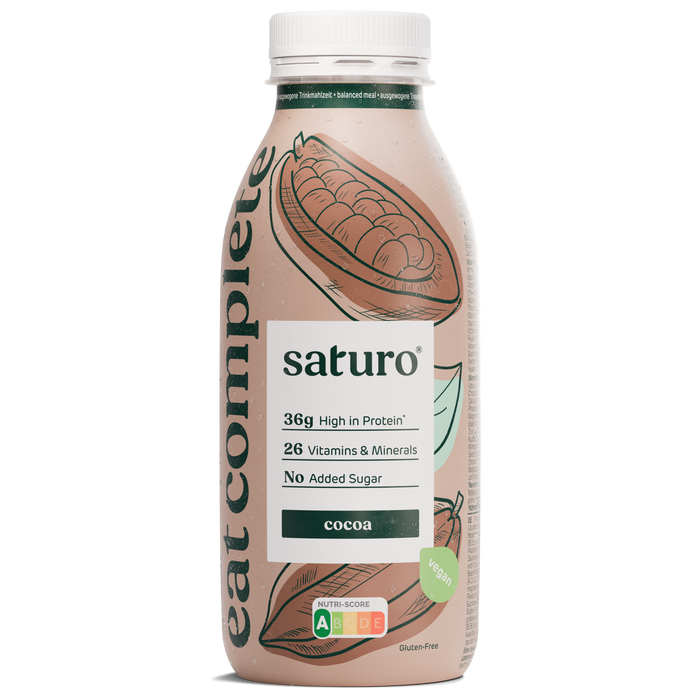
If you replace a meal with a shake, you usually also replace its fibre with nothing at all: a whey protein shake has 0 g. With a complete drinkable meal, it's worth checking the nutrition table. The EU rule offers guidance: from 1.5 g per 100 kcal, a food is called a 'source of fibre', from 3 g per 100 kcal 'high in fibre'; a 400 kcal bottle should therefore contain at least 6 g. Oat fibre, inulin, acacia fibre and resistant dextrin are common sources; they don't replace wholegrain and vegetables, but they do stop a liquid meal from leaving a gap.
Drinkable meal: a complete meal with fibre
Every bottle delivers 400 kcal, 36 g protein, 26 vitamins and minerals, and depending on the flavour, 7.3 to 7.7 g of fibre, making it a source of fibre under EU rules (1.8 to 1.9 g per 100 kcal). Vegan, straight from the fridge, no kitchen needed. Reference for the percentage figure: DGE guideline of 30 g a day.
Eating more fibre without bloating: pace, fluids, powder
The most common mistake when switching things up isn't what you choose, it's the pace. Jumping from 12 to 35 g overnight delivers triple the fermentable material to your large intestine before the right bacteria are even there. Gas, bloating and sometimes diarrhoea follow, and many people give up right at this point. The plan below spreads the change over four weeks, one lever per week: that's enough for your microbiome and for reaching 30 g.
To 30 g in four weeks: one lever per week
-
Week 1
Swap your breakfast
Replace toast or cornflakes with porridge, overnight oats or wholegrain bread. Plus 5 to 8 g a day, without changing anything else. Also, from now on, drink one large glass of water more a day.
-
Week 2
Switch bread and sides to wholegrain
Wholegrain bread instead of white (genuine wholegrain has at least 90% wholegrain content, grains sprinkled on top don't count), wholegrain pasta, potatoes with skin, brown rice or bulgur instead of white rice. Plus 3 to 5 g. Bloating during this phase is normal and usually settles after about three weeks.
-
Week 3
Pulses twice a week
Lentil soup, chilli, dal, chickpeas in salad, hummus on bread; tinned versions work just as well. Plus 10 to 16 g on these days. If you're sensitive: start small (100 g), rinse tinned beans, chew well.
-
Week 4
Berries, nuts, seeds, skins
A handful of nuts, a tablespoon of ground flaxseed in yoghurt, berries instead of juice, apples and pears with the skin on. Plus 4 to 8 g. You're now at 30 g, with a gut flora that can handle it.
Too much fibre? Fibremaxxing, bloating and what helps
There's no upper limit at which fibre from food becomes dangerous — only one at which it becomes uncomfortable. Typical signs of too much at once: bloating, feeling overly full, stomach cramps, soft stools or diarrhoea, and with too little fluid, hard stools too. Anyone following the 'fibremaxxing' trend and pushing to 60 g or more with powders also risks bran and psyllium binding iron, zinc and calcium. The cause is almost always fermentation: the more fermentable fibre arrives, the more gas is produced, until the bacteria have adjusted.
Almost everyone who has trouble with fibre has a pace problem, not a quantity problem. Your gut needs two, three weeks for the bacteria that can make use of lentils and wholegrain to catch up. If you shift one lever a week and drink half a litre more on top, you'll reach 30 g without a bloated stomach.
Joerg Hauke, Nutrition expert, technical review of this article
What helps: increase slowly (5 g per week), chew well, drink enough, soak pulses, rinse canned beans, and to start with, favour oats, berries and cooked vegetables over bran and raw onions. In one study, gas production rose by half at the start and was back to baseline after three weeks; the UK's NHS reckons on up to four weeks. If you have narrowed sections in the gut or swallowing difficulties, only do this after consulting a doctor (Chapter 7).
Psyllium husks, bran, inulin: fibre as powder
Psyllium husks are the best studied: 5 to 10 g a day with plenty of water softens stools, also helps with diarrhoea, and lowers LDL cholesterol by around 13 mg/dl; the IBS guideline explicitly recommends them. Wheat bran speeds up bowel transit (health claim from 10 g), but can worsen symptoms in IBS and binds iron and zinc. For flaxseed, the DGE states upper limits: 20 g a day (cadmium), 15 g per meal (cyanogenic compounds). Inulin feeds bifidobacteria but causes the most bloating; start with 2 to 3 g.
Without enough fluid, fibre makes stools harder rather than softer. In one study, 25 g of fibre a day worked better with 2 litres of water than with 1 litre. Rule of thumb: an extra half a litre, plus a large glass alongside psyllium and chia seeds.
Powders provide fibre, but not the vitamins, minerals, plant compounds and filling bulk of wholegrain, lentils and apples. If you can get to 30 g from food, you don't need any of them.

Low-fibre diet: when less fibre is the right choice
Sometimes the gut needs a temporary rest. A low-fibre diet, once called a 'low-residue' or 'light' diet, cuts intake to under 10 to 15 g a day and takes mechanical strain off the gut. It's a temporary measure for four typical situations: colonoscopy, acute inflammation such as a diverticulitis flare, the days after bowel surgery, and narrowed sections in the gut. Guidelines don't recommend it for IBS or inflammatory bowel disease during quiet phases.
Low-fibre foods: list
Low-fibre means: no wholegrain, no pulses, no nuts, seeds or kernels, no raw vegetables, no fruit with skin or pips, no cabbage, no onions. Grains: white bread, toast, rusks, white pasta, white rice, semolina, couscous, cornflakes, peeled potatoes, mash. Vegetables cooked, peeled, without seeds: carrots, courgette, pumpkin, fennel, parsnip, asparagus tips, tomatoes without skin and seeds, strained soups. Fruit: banana, apple sauce, peeled apple, peach without skin, melon, compote, clear juices. Protein: meat, fish, eggs, tofu, dairy products, all with 0 g. In the table in Chapter 5, anything showing a red light under 2 g is suitable.
A low-fibre day: in the morning, toast with cream cheese and a banana; at midday, steamed chicken with mashed potato and cooked carrots; in between, yoghurt or rusks; in the evening, clear soup with white bread and soft-cooked courgette. If you eat like this for several days, top up calories and protein specifically and then transition back gradually: start with cooked vegetables and smooth porridge, then wholegrain bread without whole grains, and lastly raw vegetables, nuts and seeds. Your treating practice sets the pace and duration.
Low-fibre diet before a colonoscopy
Before a colonoscopy, a low-fibre diet is standard: grains, seeds, skins and fibrous vegetables don't dissolve well with the bowel prep solution and can obscure the view of polyps. The European Society of Gastrointestinal Endoscopy (ESGE) recommends it for the day before the procedure (2019 guideline, strong recommendation). Many practices ask you to avoid grains, seeds, nuts, muesli, wholegrain, flaxseed, berries, grapes, tomatoes and kiwi for two to five days beforehand. The day before, you eat light, plain food, then only clear fluids from midday or afternoon onwards, followed by the bowel prep solution. Your practice's information sheet is what counts, because a poorly prepared bowel often means having to repeat the procedure.
A low-fibre diet over weeks lowers bacterial diversity in the gut and provides too little iron, folate and magnesium. If you're eating low-fibre long-term because of symptoms, get the cause checked out. Blood in your stool, weight loss, fever or persistent stomach pain need a doctor's attention.
IBS, diverticula, Crohn's disease: what the guidelines say
Irritable bowel syndrome: The S3 guideline recommends soluble fibre such as psyllium husks as a basic measure, but not insoluble fibre such as wheat bran, since it can worsen bloating and pain; a generally low-fibre diet doesn't help, and for persistent symptoms, a time-limited low-FODMAP diet under guidance may be considered. Crohn's disease and ulcerative colitis: The European nutrition guideline ESPEN advises against generally avoiding fibre; during quiet phases, a normal high-fibre diet applies. The exception is strictures: here, fibrous foods like nuts, seeds, raw vegetables and mushrooms can trigger a blockage, while soluble fibre from oats and peeled fruit remains fine.
Diverticular disease: Here the picture has flipped. The 2021 S3 guideline explicitly speaks against the old ban on nuts, grains, corn and popcorn and recommends, with the highest level of recommendation, at least 30 g of fibre a day for prevention. During an acute flare, diet depends on the course of the disease and medical instructions, often initially liquid or light; the guideline does not prescribe a low-fibre diet. For all three conditions: the decision is made by the treating practice, and 'low-fibre' is almost never the long-term solution.
Frequently asked questions about dietary fibre
Which foods have the most fibre?
Per 100 g, wheat bran (43 g), cocoa powder (37 g), chia seeds (34 g) and flaxseed (27 g) lead the way, but you only eat tablespoons of these. Per portion, legumes win out: 200 g of cooked lentils provide 16 g, 150 g of kidney beans 14 g. Behind them come oats, raspberries, avocado, artichoke, wholegrain bread and almonds.
How much fibre a day is healthy?
The DGE recommends at least 30 g a day for adults, the EFSA 25 g; the Lancet analysis saw the greatest benefit from 25 to 29 g. There's no harmful upper limit from food, though flatulence increases from 50 g upwards. In Germany, the median is 18 to 19 g.
Do eggs contain fibre?
No. Eggs contain 0 g of fibre, as do all animal products: meat, fish, milk, yoghurt, cheese and butter too. Fibre consists of components of plant cell walls and storage substances. Scrambled eggs with vegetables or an egg on wholegrain bread is still a great combination: the plant provides the fibre, the egg the protein.
Is fish high in fibre?
No, fish is fibre-free. Salmon, cod, tuna and trout contain 0 g, just like meat and eggs; with fish fingers, only the breading contributes 1 to 2 g per 100 g. Fish provides protein, iodine and omega-3 fatty acids; the fibre comes from the side dish: potatoes with skin, vegetables or lentils.
What is a low-fibre diet and when does it make sense?
A low-fibre diet reduces intake to 10 to 15 g a day: white bread, plain pasta, white rice, peeled vegetables, banana, apple sauce, anything animal-based; no wholegrain, no legumes, nuts, seeds, raw food. It makes sense before a colonoscopy, during acute intestinal inflammation, after bowel surgery and with intestinal narrowing, but not long-term.
Can you eat too much fibre?
From normal food, practically not. It gets uncomfortable when the amount increases faster than your gut flora can adapt: bloating, feeling of fullness, sometimes diarrhoea, usually for one to three weeks. Remedy: increase slowly, chew well, drink more. Caution is only needed with intestinal narrowing and with large amounts of powders that bind minerals.
What's the best fibre for your gut?
It's the mix. Fermentable fibres feed your gut bacteria: beta-glucan from oats, inulin from chicory, onions and leeks, pectin from apples and berries, resistant starch from cooled potatoes and legumes. Insoluble fibres from wholegrain, bran and vegetables provide bulk and fast transit. Psyllium husks are the best single measure for constipation.
Why is fibre so important for diabetes?
Because they slow down blood sugar after eating: soluble fibres make the food mass thicker, so glucose enters the blood more slowly. A 2020 meta-analysis shows: in diabetes, fibre lowers long-term blood sugar (HbA1c), fasting blood sugar, cholesterol and weight; the target is 35 g a day. In practice, this means: wholegrain, legumes, vegetables and whole fruit instead of juice.
Sources · 30 sources anzeigen
- German Nutrition Society (DGE): Reference values for nutrient intake, dietary fibre (guideline value, derived 2021).
- German Nutrition Society (DGE): Selected questions and answers on dietary fibre. As of 07.05.2026.
- Max Rubner-Institut: Scientific classification: dietary fibre. Karlsruhe, June 2026.
- EFSA Panel on Dietetic Products, Nutrition, and Allergies (NDA): Scientific Opinion on Dietary Reference Values for carbohydrates and dietary fibre. EFSA Journal 2010; 8(3): 1462.
- Max Rubner-Institut: National Nutrition Survey II. Results report, Part 2. Karlsruhe 2008.
- European Parliament and Council: Regulation (EU) No 1169/2011 on the provision of food information to consumers (FIC), Annex I No. 12 (definition of dietary fibre) and Annex XIV (energy value).
- European Parliament and Council: Regulation (EC) No 1924/2006 on nutrition and health claims made on foods, Annex (source of fibre, high fibre content).
- European Commission: Regulation (EU) No 432/2012 establishing a list of permitted health claims made on foods, Annex (beta-glucans, wheat bran, oat grain, barley grain and rye fibre).
- Reynolds A., Mann J., Cummings J. et al.: Carbohydrate quality and human health: a series of systematic reviews and meta-analyses. The Lancet 2019; 393(10170): 434–445.
- Aune D., Chan D. S. M., Lau R. et al.: Dietary fibre, whole grains, and risk of colorectal cancer: systematic review and dose-response meta-analysis of prospective studies. BMJ 2011; 343: d6617.
- Reynolds A. N., Akerman A. P., Mann J.: Dietary fibre and whole grains in diabetes management: Systematic review and meta-analyses. PLoS Medicine 2020; 17(3): e1003053.
- Gill S. K., Rossi M., Bajka B., Whelan K.: Dietary fibre in gastrointestinal health and disease. Nature Reviews Gastroenterology & Hepatology 2021; 18(2): 101–116.
- Makki K., Deehan E. C., Walter J., Bäckhed F.: The Impact of Dietary Fiber on Gut Microbiota in Host Health and Disease. Cell Host & Microbe 2018; 23(6): 705–715.
- Sonnenburg E. D., Smits S. A., Tikhonov M. et al.: Diet-induced extinctions in the gut microbiota compound over generations. Nature 2016; 529(7585): 212–215.
- Jovanovski E., Mazhar N., Komishon A. et al.: Can dietary viscous fiber affect body weight independently of an energy-restrictive diet? A systematic review and meta-analysis of randomized controlled trials. The American Journal of Clinical Nutrition 2020; 111(2): 471–485.
- Yang J., Wang H.-P., Zhou L., Xu C.-F.: Effect of dietary fiber on constipation: A meta analysis. World Journal of Gastroenterology 2012; 18(48): 7378–7383.
- Anti M., Pignataro G., Armuzzi A. et al.: Water supplementation enhances the effect of high-fiber diet on stool frequency and laxative consumption in adult patients with functional constipation. Hepato-Gastroenterology 1998; 45(21): 727–732.
- Mego M., Manichanh C., Accarino A. et al.: Metabolic adaptation of colonic microbiota to galactooligosaccharides: a proof-of-concept-study. Alimentary Pharmacology & Therapeutics 2017; 45(5): 670–680.
- Federal Centre for Nutrition (BZfE): Dietary fibre. As of 21.11.2025.
- NHS Fife: Increasing your fibre intake. Patient advice.
- Jovanovski E., Yashpal S., Komishon A. et al.: Effect of psyllium (Plantago ovata) fiber on LDL cholesterol and alternative lipid targets, non-HDL cholesterol and apolipoprotein B: a systematic review and meta-analysis of randomized controlled trials. The American Journal of Clinical Nutrition 2018; 108(5): 922–932.
- Sonia S., Witjaksono F., Ridwan R.: Effect of cooling of cooked white rice on resistant starch content and glycemic response. Asia Pacific Journal of Clinical Nutrition 2015; 24(4): 620–625.
- Hassan C., East J., Radaelli F. et al.: Bowel preparation for colonoscopy: European Society of Gastrointestinal Endoscopy (ESGE) Guideline, Update 2019. Endoscopy 2019; 51(8): 775–794.
- Haas P., Soutschek S.: Colonoscopy: Ten tips for preparation. Apotheken Umschau, updated 20.04.2022.
- Memorial Sloan Kettering Cancer Center: Low-Fiber Diet. Patient education, as of 04.09.2026.
- Leifeld L., Germer C.-T., Böhm S. et al.: S3 guideline on diverticular disease/diverticulitis. Joint guideline of the DGVS and the DGAV, November 2021, AWMF registration number 021-020. Zeitschrift für Gastroenterologie 2022; 60(4): 613–688.
- Bischoff S. C., Bager P., Escher J. et al.: ESPEN guideline on Clinical Nutrition in inflammatory bowel disease. Clinical Nutrition 2023; 42(3): 352–379.
- Layer P., Andresen V., Allescher H. et al.: Update S3 guideline on irritable bowel syndrome: Definition, pathophysiology, diagnostics and therapy. Joint guideline of the DGVS and the DGNM, June 2021, AWMF registration number 021/016 (under revision since 03/2026). Zeitschrift für Gastroenterologie 2021; 59(12): 1323–1415.
- U.S. Department of Agriculture, Agricultural Research Service: FoodData Central, SR Legacy Release (2018). Fibre content per 100 g (Nutrient 1079).
- Federal Food Safety and Veterinary Office (BLV), Swiss Society for Nutrition (SGE): Swiss Nutrient Table, 2021 edition.
Writing for Saturo since 2019 about nutrition, nutrients and how to actually get proper nourishment in everyday life.
Hat diesen Artikel am 15. September 2026 auf fachliche Richtigkeit geprüft. This content doesn't replace medical advice.
Rebuilding your gut flora: what actually helps
Fibre is the food, but not the whole plan: how to rebuild your microbiome after antibiotics or years of white flour.
Weiterlesen · 5 Min
New from the guide
New articles, updates and tips straight to your inbox. Easy to understand, expert-checked, no spam.
Danke! Bitte bestätige die Anmeldung in deinem Postfach.