
Calcium deficiency: symptoms, causes and treatment
Tingling around the mouth, cramps in your hands, brittle nails? Your body quietly compensates for calcium deficiency in food from your bones for years. Which symptoms belong to it, why there's no self-test, and how to reach 1,000 mg.


Aktualisiert 24 September 2026 · 16 Min. Lesezeit · 68 Quellen

The essentials in 30 seconds
DGE reference value for adults, also during pregnancy and breastfeeding. Teenagers aged 13 to 18 need 1,200 mg, because bone is being built up during that time.
Of roughly one kilogram of calcium in your body, almost all of it sits in the skeleton. If calcium is missing from your food, your body takes it from there without you noticing anything.
Below this, doctors speak of hypocalcaemia. The blood level is regulated so strictly that it stays normal even with a nutritional deficiency. If it drops, there's usually a hormone behind it.
Vitamin D controls how much calcium your gut absorbs. Without it, even the best food won't reach your bones. That's why vitamin D deficiency is the most common cause of a genuine calcium deficiency.
Calciummangel Symptome: Woran du ihn erkennst
Ein Calciummangel im medizinischen Sinn, die Hypokalzämie, liegt vor, wenn das Calcium im Blut unter 2,2 mmol/l sinkt: Nerven und Muskeln werden überreizbar, es kribbelt um den Mund, die Hände verkrampfen. Wer nur zu wenig Calcium isst, bekommt diese Symptome nicht, der Körper hält den Blutwert jahrelang aus den Knochen stabil. Sinkt er, ist fast immer die Regelung selbst gestört.
Erste Anzeichen: Kribbeln, Krämpfe, Müdigkeit
Am Anfang steht fast immer Kribbeln um die Lippen, an Fingerspitzen und Zehen, wo die Nerven am dichtesten liegen. Dann folgen Muskelkrämpfe in Händen und Füßen, länger anhaltend und schlecht wegzudehnen. Verlässlicher Test in der Praxis: Eine drei Minuten aufgepumpte Blutdruckmanschette bringt die Hand in die Pfötchenstellung. Das Zucken der Mundwinkel beim Klopfen auf den Gesichtsnerv haben dagegen bis zu 10 % der Gesunden auch. Müdigkeit gehört dazu, aber wer nur müde ist, hat selten einen Calciummangel.
Calciummangel Symptome Augen
Die Augen reagieren beim Calciummangel zuletzt, nicht zuerst. Belegt ist der Graue Star: Bei Menschen, deren Nebenschilddrüsen dauerhaft zu wenig Hormon bilden, war das Kataraktrisiko in einer dänischen Registerstudie vierfach erhöht, in einer türkischen Studie umso stärker, je länger die Erkrankung bestand. Calcium und Phosphat lagern sich in der Linse ab, wenn ihr Verhältnis über Jahre verschoben ist, nicht durch zu wenig Milch. Dazu kommt Lidzucken. Für trockene Augen oder verschwommenes Sehen als frühes Zeichen gibt es keine Belege.

Calciummangel neurologische Symptome
Weil Calcium die Nerven bremst, sind fast alle Symptome eines echten Mangels neurologisch, in dieser Reihenfolge: Parästhesien (Kribbeln, Taubheit) an Lippen, Zunge, Händen und Füßen, dann Tetanie bis zur Pfötchenstellung, Kehlkopfkrämpfe mit Atemnot, bei schwerem Mangel Krampfanfälle (in der dänischen Registerstudie zehnfach häufiger). Bleibt der Wert jahrelang niedrig, verkalken die Basalganglien im Gehirn. Sonderfall Panik: Schnelles Atmen macht das Blut basisch, das freie Calcium fällt, und es kribbelt um den Mund, obwohl der Gesamtwert normal ist.
Calciummangel Symptome Frau
Die Symptome sind bei Frauen und Männern dieselben, unterschiedlich sind die Wege in den Mangel. 55 % der Frauen erreichen laut Verzehrsstudie die Empfehlung nicht, bei Mädchen zwischen 14 und 18 sind es 74 %. In den Wechseljahren sinkt mit dem Östrogen die Aufnahme im Darm (Kapitel 7). Nach einer Schilddrüsen-OP, bei Frauen häufiger, fällt der Wert bei jeder vierten Person vorübergehend ab. Haarausfall, Gewichtszunahme oder Wassereinlagerungen sind keine Calciumsymptome; dann Schilddrüse und Eisen prüfen.
Calciummangel Symptome Psyche
Reizbarkeit, innere Unruhe, Angstzustände und depressive Verstimmung sind bei chronischer Hypokalzämie gut belegt: Nach einer Schilddrüsen-OP mit ausgefallenen Nebenschilddrüsen war das Depressionsrisiko in der dänischen Registerstudie verdoppelt. Aber: Psychische Beschwerden sind praktisch nie das einzige Zeichen, und der Zusammenhang läuft oft rückwärts: Angst macht Hyperventilation, Hyperventilation macht Kribbeln, Kribbeln macht mehr Angst. Ohne körperliche Zeichen ist ein Calciummangel unwahrscheinlich, und ein Präparat hebt die Stimmung nicht. Bei Verdacht trotzdem Calcium mitbestimmen lassen, dazu Schilddrüse, Vitamin D und B12.
Tingling around the mouth plus cramps in the hands, especially after thyroid surgery, with kidney disease or while taking osteoporosis medication: get to a doctor promptly, with calcium, albumin, magnesium, vitamin D and ECG checks. Call 112 in the event of a seizure, breathing difficulties or persistent heart rhythm disturbances.
Haut, Haare, Nägel und Zähne
Trockene, schuppige Haut, spröde Nägel und grobes Haar beschreibt die Fachliteratur nur bei chronischer Hypokalzämie, nicht als Frühwarnung; bei sonst Gesunden stecken fast immer Eisen, Schilddrüse oder Zink dahinter. Bei den Zähnen hält sich ein Mythos: Der Körper hole sich bei Mangel Calcium aus den Zähnen. Zahnschmelz wird nach dem Durchbruch aber nicht mehr umgebaut, der Körper bedient sich am Skelett. Nur Kinder, deren Zähne noch gebildet werden, bekommen bei Hypoparathyreoidismus Schmelzdefekte.
Calciummangel Selbsttest: Geht das zu Hause?
Nein. Kein Teststreifen, keine App und kein Drogerie-Kit misst den Calciumwert; die Selbsttests messen meist Vitamin D oder Magnesium. Calcium wird aus dem Blutserum bestimmt, in jeder Hausarztpraxis, zusammen mit Albumin (Kapitel 4). Was du zu Hause prüfen kannst: Kommst du mit deinem Essen auf 1.000 mg am Tag? Das zeigt der Tages-Baukasten in Kapitel 6. Wer dort regelmäßig unter 500 mg landet, hat einen Calciummangel im Ernährungssinn, ohne jedes Symptom, und der geht auf die Knochen.
Calciummangel Ursachen: Woher der Mangel kommt
Der Körper enthält rund ein Kilogramm Calcium, 99 % davon im Skelett. Deshalb gibt es zwei Arten von Mangel. Der Ernährungsmangel ist häufig, 46 % der Männer und 55 % der Frauen erreichen die Empfehlung nicht, und bleibt still: Der Körper bedient sich aus den Knochen. Die Hypokalzämie ist selten und entsteht, wenn die Regelung versagt. Erste Frage: Wie viel brauchst du?
Zu wenig Calcium im Essen
Hauptquellen sind Milch, Milchprodukte und Käse, an zweiter Stelle Mineralwasser. Wer beides streicht, verliert den Großteil seiner Zufuhr: bei Laktoseintoleranz, veganer Ernährung ohne angereicherte Produkte, Diäten oder wenig Appetit im Alter. Der Körper kompensiert lautlos aus dem Knochen, die Rechnung kommt Jahrzehnte später als Osteoporose. EPIC-Oxford, 17 Jahre, 55.000 Menschen: Veganer:innen hatten ein 2,3-fach höheres Risiko für einen Hüftbruch, und der Unterschied schrumpfte, sobald man die Calciumzufuhr herausrechnete. Vegan ist kein Problem, zu wenig Calcium schon.
Vitamin-D-Mangel: der häufigste Grund, warum Calcium nicht ankommt
Ohne Vitamin D nimmt der Darm nur einen Bruchteil des Calciums auf. Vitamin D bildet die Haut unter Sonne, und daran fehlt es in Deutschland den meisten. Ein tiefer Mangel senkt das Calcium zweifach: weniger Aufnahme im Darm und mehr Parathormon, das den Knochen abbaut; bei Kindern heißt das Rachitis, bei Erwachsenen Osteomalazie. Deshalb steht bei jedem niedrigen Calciumwert zuerst Vitamin D auf dem Laborzettel, und deshalb verordnet die Osteoporose-Leitlinie beides zusammen.
Nebenschilddrüse, Magnesium, Niere
Der niedrige Blutwert hat fast immer eine hormonelle Ursache. Die vier Nebenschilddrüsen hinter der Schilddrüse bilden das Parathormon, das den Calciumwert nach oben regelt; fallen sie aus, meist nach einer Schilddrüsen-Operation, heißt das Hypoparathyreoidismus. Magnesium ist der stille Partner: Ohne Magnesium wird kein Parathormon ausgeschüttet, deshalb drückt schwerer Magnesiummangel (Alkohol, Durchfall, Säureblocker) das Calcium. Die Niere aktiviert Vitamin D und hält Calcium zurück; bei Nierenschwäche fällt beides weg. Weitere Auslöser: Bauchspeicheldrüsenentzündung, Sepsis, große Bluttransfusionen, Zöliakie, Morbus Crohn.
Calciummangel durch Medikamente
- Säureblocker (Protonenpumpenhemmer): senken die Magensäure, die Calciumcarbonat zum Lösen braucht, und verursachen bei Dauereinnahme in 19 % der Fälle einen Magnesiummangel (ohne Säureblocker 13,5 %).
- Bisphosphonate und Denosumab gegen Osteoporose: stoppen den Knochenabbau und damit die Calciumquelle des Blutes; bei Dialysepatientinnen fiel der Wert unter Denosumab in 41 % gefährlich ab.
- Schleifendiuretika (Furosemid): schwemmen Calcium über die Niere aus.
- Antiepileptika, Rifampicin und langfristig Cortison: beschleunigen den Vitamin-D-Abbau oder bremsen die Aufnahme.
How your body keeps calcium in balance
Three stages from plate to bone. Once you know them, you'll understand why the blood level stays normal even with a nutritional deficiency, why vitamin D matters more than the amount of milk, and why a low level is almost always a hormone problem.
Absorption in the gut
Out of 1,000 mg of calcium from food, adults' small intestine absorbs about a quarter, and the gut excretes the rest again. How much gets absorbed is decided by vitamin D: it builds the transporters that shuttle calcium through the gut wall. With small portions, the uptake rate is best; from 500 mg at once, it flattens out. Oxalic acid and phytic acid from the same meal bind part of it.
Bone as a savings account
99% of your body's calcium sits in the skeleton – about one kilogram. Bone isn't a static rock but a construction site: every year, part of it is broken down and rebuilt, with net gains up to about age 30, then net losses. If calcium is missing from food, the body withdraws from the account to keep the blood level stable. Nobody notices until, decades later, the account is empty: osteoporosis.
Parathyroid glands and kidneys regulate the blood level
Only one gram of calcium floats in your blood, and this one gram is controlled to the minute. If it drops, the four parathyroid glands release parathyroid hormone: it releases calcium from bone, makes the kidneys excrete less and produce more active vitamin D, which in turn boosts absorption in the gut. Without magnesium, this chain doesn't work. That's why a low blood level almost never comes from your plate, but from the regulation system.
Calciumwert zu niedrig: So wird ein Calciummangel festgestellt
Der Calciumwert wird aus dem Blutserum bestimmt, in Millimol pro Liter (2,2 mmol/l entsprechen 8,8 mg/dl). Normal sind 2,2 bis 2,6 mmol/l.
Die drei Stufen des Calciummangels
-
1
Leicht1,9–2,2 mmol/l
Meist ohne Beschwerden, oft ein Zufallsbefund. Albumin korrigieren, Vitamin D, Magnesium und Parathormon bestimmen, Ursache klären. Behandlung mit Calcium und Vitamin D zum Einnehmen, Kontrolle nach ein bis zwei Wochen.
-
2
Mittel1,75–1,9 mmol/l
Kribbeln und Krämpfe werden wahrscheinlich, im EKG kann sich die QT-Zeit verlängern. Ärztlich behandeln, bei Symptomen auch in diesem Bereich mit Calcium über die Vene; Magnesium zuerst ausgleichen, wenn es fehlt.
-
3
Schwer< 1,75 mmol/l
Tetanie, Kehlkopfkrampf, Krampfanfälle und Herzrhythmusstörungen drohen. Notfall: Calciumgluconat über die Vene unter EKG-Kontrolle im Krankenhaus, danach Dauerinfusion, bis die Ursache behandelt ist.
Einteilung nach der Notfall-Leitlinie der britischen Society for Endocrinology (2016) und dem MSD Manual: Unter 1,9 mmol/l oder bei Beschwerden gilt jede Hypokalzämie als Notfall, Tetanie tritt typischerweise unter 1,75 mmol/l auf. Werte bei normalem Albumin; Labore setzen teils eigene Normgrenzen, dann gelten die des Labors.
Der Rohwert hat eine Falle: Fast die Hälfte des Calciums hängt am Eiweiß Albumin und ist unwirksam. Wer wenig Albumin hat, etwa bei Lebererkrankungen oder Mangelernährung, bekommt einen zu niedrigen Wert angezeigt, ohne dass Calcium fehlt. Ärzt:innen korrigieren das rechnerisch oder messen das ionisierte Calcium, den freien Anteil (normal 1,15 bis 1,3 mmol/l). Das Schaubild zeigt, was das Labor eigentlich prüft: keinen Organwert, sondern einen Regelkreis.
Was das Labor noch prüft: Albumin, Vitamin D, Parathormon, Magnesium
Stimmt der Wert? Dafür Albumin oder ionisiertes Calcium. Fehlt Vitamin D? Ein Wert unter 30 nmol/l erklärt die meisten leichten Fälle. Was macht das Parathormon? Niedrig heißt: Die Nebenschilddrüsen arbeiten nicht; hoch heißt: Sie arbeiten, das Problem liegt bei Vitamin D, Niere oder Darm. Dazu Magnesium, Phosphat, Kreatinin und ein EKG (QT-Zeit). Für den Knochenvorrat gibt es keinen Blutwert, nur die Knochendichtemessung und die Frage nach der Ernährung.

Calciummangel Test: Wer den Wert bestimmen lassen sollte
Nicht jede:r. Bei Gesunden ohne Anlass ist der Wert fast immer normal. Sinnvoll ist die Messung, wenn Kribbeln und Krämpfe auf eine Risikosituation treffen: Schilddrüsen-OP, Nierenerkrankung, Zöliakie oder Morbus Crohn, Osteoporose-Mittel, Antiepileptika, langjährige Säureblocker, schwerer Vitamin-D-Mangel, Alkoholabhängigkeit. Wer wissen will, ob die Knochen genug bekommen, braucht nicht das Blut, sondern den Vitamin-D-Wert und die Bilanz aus dem Tages-Baukasten in Kapitel 6.
Keine Calcium- oder Vitamin-D-Präparate auf Verdacht in den Tagen davor, sie verdecken die Ursache. Medikamentenliste mitbringen, auch Säureblocker und Nahrungsergänzung. Beim Blutabnehmen nicht lange stauen lassen, sonst erscheint der Wert falsch hoch.
Calciummangel beheben: Was wirklich hilft
Die Behandlung hat zwei Ebenen. Beim Ernährungsmangel ohne Symptome ist die Therapie das Essen: 1.000 mg am Tag plus genug Vitamin D, Präparate laut DGE und Osteoporose-Leitlinie nur, wenn die Zufuhr anders nicht erreichbar ist. Bei der Hypokalzämie zählt die Ursache: Vitamin D auffüllen, Magnesium ausgleichen, Medikamente prüfen, bei ausgefallenen Nebenschilddrüsen dauerhaft Calcium plus Calcitriol. Wer nur Calcium nachfüllt, während Vitamin D oder Magnesium fehlen, füllt ein Fass ohne Boden.
Was hilft schnell bei Calciummangel?
Je nach Mangel. Bei einem akuten niedrigen Blutwert mit Symptomen hilft nur eines schnell: Calciumgluconat über die Vene, im Krankenhaus, unter EKG-Kontrolle, dann eine Dauerinfusion, bis die Ursache behandelt ist. Bei einem leichten Mangel ohne Symptome wirken Calcium und Vitamin D zum Einnehmen in Tagen bis Wochen. Beim Ernährungsmangel gibt es kein „schnell“: Der Knochen füllt sich nur über Jahre, mit täglich 1.000 mg, Vitamin D und Bewegung. Was sofort geht: Milch oder Sojadrink zum Frühstück, Käse aufs Brot, calciumreiches Wasser.
Wer Kribbeln und Krämpfe hat, braucht keine Calciumtablette aus der Drogerie, sondern vier Blutwerte: Calcium, Albumin, Vitamin D und Magnesium. Und wer einfach zu wenig Calcium isst, spürt gar nichts. Das ist das Tückische: Der Mangel, den man merkt, kommt nicht vom Essen, und der, der vom Essen kommt, merkt man nicht.
Joerg Hauke, Ernährungsexperte, fachliche Prüfung dieses Artikels
Calciumtabletten: Wann sinnvoll, wann nicht
Präparate sind sinnvoll, wenn Lebensmittel nicht reichen: bei Laktoseintoleranz ohne Käse, veganer Ernährung ohne angereicherte Produkte, wenig Appetit im Alter, unter Osteoporose-Medikamenten und immer bei Hypoparathyreoidismus. Eine Meta-Analyse von 2010 fand unter Calcium ohne Vitamin D 31 % mehr Herzinfarkte, eine spätere mit 63.000 Frauen keinen Effekt. Nebenwirkungen: Nierensteine (plus 17 % in einer Studie mit 36.000 Frauen) und Verstopfung (13 statt 9 %). Für Lebensmittel gilt keine dieser Warnungen: erst der Teller, dann das Mineralwasser, dann das Präparat.
Calcium richtig einnehmen: Dosis, Zeitpunkt, Abstände
Vier Regeln holen aus einem Präparat das Meiste heraus. Erstens maximal 500 mg pro Portion: Zweimal 500 mg bringen mehr als einmal 1.000 mg.
Zweitens die Form: Calciumcarbonat ist billig, braucht aber Magensäure und gehört zum Essen; wer Säureblocker nimmt oder älter ist, fährt mit Calciumcitrat besser. Drittens Vitamin D dazu, die Leitlinie nennt 800 Einheiten am Tag. Viertens Abstände: Calcium bindet Schilddrüsenhormon, Eisen, Tetracycline, Chinolone und Bisphosphonate im Darm; in einer Studie stieg der TSH-Wert deutlich, wenn L-Thyroxin und Calcium gleichzeitig genommen wurden. Mehrere Stunden Abstand, Bisphosphonate immer nüchtern und allein.
Wer Nierensteine hatte, eine Überfunktion der Nebenschilddrüse, Sarkoidose oder chronische Nierenschwäche hat, nimmt Präparate nur nach Rücksprache; Calcium aus Lebensmitteln bleibt erlaubt. Dasselbe gilt für hoch dosiertes Vitamin D. Viel Calciumcarbonat gegen Sodbrennen kann zum Calcium-Alkali-Syndrom mit Nierenversagen führen.
Calcium Lebensmittel: Was viel Calcium enthält
Milchprodukte und Käse liefern in Deutschland rund 40 % der Calciumzufuhr, Mineralwasser und andere Getränke etwa ein Viertel, alles andere laut Verzehrsstudie kaum etwas. Das Ranking zeigt die dichtesten Quellen pro 100 g, so wie sie gegessen werden (USDA-Datenbank). Ausnahme Spinat: viel Calcium, aber nur etwa 5 % verwertbar, weil Oxalsäure es im Darm bindet.
Calcium pro 100 g: Top 10 pflanzlich und tierisch
Werte pro 100 g trocken bzw. gekocht, USDA FoodData Central SR Legacy. Samen führen, weil sie kaum Wasser enthalten; in Portionen: 10 g Mohn 144 mg, 1 EL Sesam 98 mg, 100 g fester Tofu 683 mg (nur mit Calciumsulfat, mit Nigari 282 mg), 150 g Grünkohl 225 mg, 3 getrocknete Feigen 65 mg. Spinat liefert 136 mg, davon sind wegen Oxalsäure nur etwa 5 % verwertbar.
Auf 1.000 mg kommt man leichter, als die Zahl klingt: Ein Viertelliter Milch und zwei Scheiben Emmentaler liefern laut DGE schon mehr.
Wer keine Milch trinkt, kombiniert Joghurt, Käse, Grünkohl, calciumreiches Mineralwasser und einen Löffel Sesam. Zwei Dinge erhöhen die Ausbeute: über den Tag verteilen, weil der Darm aus kleinen Portionen anteilig mehr aufnimmt, und Vitamin D, das die Aufnahme in einer Studie um 65 % steigerte. Tippe an, was du an einem normalen Tag isst.
Wie viel Calcium steckt in Haferflocken, Eiern, Obst?
Weniger als gedacht. Haferflocken liefern 52 mg pro 100 g, eine Portion also 26 mg; das Calcium im Müsli kommt aus der Milch. Ein Ei bringt 30 mg, das Calcium sitzt in der Schale. Tomaten (10 mg), Äpfel (6 mg) und Bananen (5 mg) sind praktisch calciumfrei. Beim Obst ragen nur getrocknete Feigen heraus (162 mg, drei Stück 65 mg).
Was die Aufnahme fördert und was sie bremst
Beim Calcium entscheidet weniger die Menge auf dem Teller als das, was daneben liegt. Isotopenstudien zeigen große Unterschiede.
- +Vitamin D: Bei einem Blutwert von 86 statt 50 nmol/l nahm der Darm aus derselben Portion 65 % mehr Calcium auf
- +Kleine Portionen über den Tag: Aus sehr kleinen Mengen werden bis zu 64 % aufgenommen, aus 500 mg auf einmal noch 29 %
- +Grünkohl, Brokkoli, Pak Choi: oxalsäurearm, 41 bis 53 % Aufnahme, besser als Milch (27 bis 32 %)
- +Calciumreiches Mineralwasser ab 150 mg pro Liter: Aufnahme gleich gut wie aus Milch oder besser, ohne Kalorien
- +Tofu mit Calciumsulfat und Sojadrinks mit Calciumcarbonat: Aufnahme wie aus Kuhmilch (21 %), Tricalciumphosphat schneidet schlechter ab (18 %)
- −Oxalsäure in Spinat, Mangold und Rhabarber: bindet Calcium im Darm, aus Spinat kommen nur 5 % an
- −Phytinsäure in Weizenkleie und rohem Vollkorn: senkt die Aufnahme, auch aus der Milch daneben; Sauerteig und Hefe bauen sie ab, Brot ist deshalb unproblematisch
- −Viel Salz: Je 2,3 g Natrium (etwa 6 g Kochsalz) scheidet die Niere rund 40 mg Calcium zusätzlich aus
- −Säureblocker über Jahre: Ohne Magensäure wird Calciumcarbonat kaum gelöst; nach einem Jahr Einnahme lag das Hüftbruchrisiko in einer britischen Studie um 44 % höher
- −Calcium selbst bremst Eisen: 300 bis 600 mg zur Mahlzeit halbieren die Eisenaufnahme. Wer beides braucht, trennt Eisenpräparat und Milchprodukte
Quellen: Heaney 1988 bis 2003, Weaver 1991, Zhao 2005, Böhmer 2000, Greupner 2017, Nordin 1993, Yang 2006, Hallberg 1991 (Quellenliste am Ende). Kaffee kostet pro Tasse so wenig Calcium, dass ein Schuss Milch es ausgleicht; Cola schadet dem Knochen vor allem, weil sie die Milch ersetzt.
Calciumreiche Lebensmittel vegan
Vegan zu essen ist für die Knochen kein Problem, zu wenig Calcium schon: In der EPIC-Oxford-Studie verschwand das erhöhte Frakturrisiko, sobald Veganer:innen mindestens 525 mg Calcium am Tag aufnahmen. Die DGE zählt Calcium deshalb zu den kritischen Nährstoffen und nennt vier Wege: angereicherte Pflanzendrinks (120 mg pro 100 ml wie Milch, mit Calciumcarbonat gleich gut aufgenommen), Tofu mit Calciumsulfat (Zutatenliste: E 516), grünes Gemüse mit wenig Oxalsäure (Grünkohl, Brokkoli, Pak Choi, Rucola) und calciumreiches Mineralwasser. Was nicht reicht: Haferdrink ohne Zusatz, Spinat, Nüsse allein.

Laktoseintoleranz: Gereifter Käse wie Emmentaler, Parmesan und Gouda enthält praktisch keine Laktose mehr und ist mit 700 bis 1.200 mg pro 100 g die dichteste Calciumquelle überhaupt; Joghurt wird laut DGE meist vertragen, laktosefreie Milch liefert dieselbe Menge Calcium. Bei komplettem Verzicht: calciumreiches Gemüse und Mineralwasser, nicht Nüsse.
Ab 150 mg pro Liter darf ein Wasser „calciumhaltig“ heißen, viele Sorten liegen bei 300 bis über 500 mg. Der Körper nimmt es genauso gut auf wie aus Milch; ein Liter am Tag deckt ein Drittel bis die Hälfte des Bedarfs.
Calcium im Alltag: Trinkmahlzeiten
An Tagen ohne Frühstück, Kochen und Käsebrot fehlt die Hauptquelle einfach. Eine Trinkmahlzeit füllt einen Teil planbar auf: Eine Flasche Saturo liefert je nach Sorte 200 bis 208 mg Calcium, 25 bis 26 % der Referenzmenge von 800 mg, dazu Vitamin D. So viel wie ein kleines Glas Milch, keine Behandlung bei nachgewiesenem Mangel, aber ein verlässlicher Beitrag an Kaffee-und-Brötchen-Tagen. Zugelassene Aussage laut EU: Calcium wird für die Erhaltung normaler Knochen benötigt und trägt zu einer normalen Muskelfunktion bei.
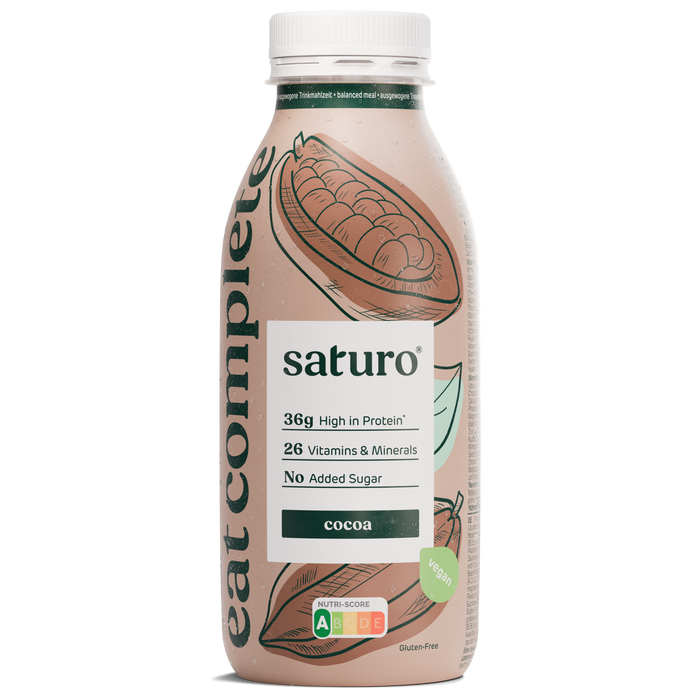
Trinkmahlzeit: eine vollwertige Mahlzeit aus der Flasche
26 Vitamine und Mineralstoffe, darunter Calcium, Vitamin D und Magnesium. Calcium wird für die Erhaltung normaler Knochen benötigt und trägt zu einer normalen Muskelfunktion bei. Referenzwert für Calcium: 800 mg pro Tag (NRV). Für Tage, an denen Kochen nicht auf dem Plan steht.
Wechseljahre, Schwangerschaft, Kinder, ab 65: Wer besonders aufpassen muss
Der Calciumbedarf ist über das Leben fast gleich, die Zufuhr nicht. Die Kurve zeigt, was Mädchen und Frauen in Deutschland tatsächlich aufnehmen (Robert Koch-Institut, Max Rubner-Institut). Die Lücken liegen dort, wo der Knochen es am wenigsten verträgt: in der Pubertät, wenn er aufgebaut wird, und im Alter, wenn er abbaut.
Calciummangel in den Wechseljahren
Östrogen hält den Knochen zusammen: Es bremst die abbauenden Zellen und hilft dem Darm bei der Calciumaufnahme. Laut SWAN-Studie an fast 2.000 Frauen beginnt der Abbau etwa ein Jahr vor der letzten Regelblutung, in den zehn Jahren darum verliert die Lendenwirbelsäule 10,6 % ihrer Dichte. Was hilft, ist unspektakulär und belegt: 1.000 mg Calcium am Tag, Vitamin D das ganze Jahr, Krafttraining, ab 50 bei Risikofaktoren eine Knochendichtemessung. Calcium plus Vitamin D senkte in acht Studien Hüftbrüche um 30 %, Calcium allein bremst kaum.

Calciummangel in Schwangerschaft und Stillzeit
Ein Kind kommt mit rund 30 g Calcium im Skelett zur Welt. Trotzdem gelten laut DGE und EFSA dieselben 1.000 mg wie sonst: In der Schwangerschaft verdoppelt der Darm seine Aufnahme, in der Stillzeit leiht sich der Körper vorübergehend aus dem Skelett der Mutter. Calciummangel-Symptome in der Stillzeit gibt es bei normaler Ernährung deshalb nicht; Müdigkeit, Haarausfall und Krämpfe haben andere Gründe. Nur bei sehr niedriger Zufuhr halbieren Calciumpräparate ab 1 g laut Cochrane das Präeklampsie-Risiko.
Kinder und Jugendliche: Die Knochenmasse, die ein Mensch mit 30 hat, wird in Kindheit und Pubertät aufgebaut. Deshalb liegt der höchste Bedarf zwischen 13 und 18 bei 1.200 mg, und genau dort ist die Lücke am größten: Laut EsKiMo II erreichen nur 12,7 % der 12- bis 17-jährigen Mädchen die Empfehlung. Bei Kleinkindern macht ein schwerer Mangel an Calcium oder Vitamin D Rachitis, was Vitamin-D-Tropfen im ersten Lebensjahr verhindern.
Ab 65 treffen drei Dinge zusammen: Der Darm nimmt Calcium schlechter auf, der Appetit sinkt, und die Medikamentenliste wächst: Säureblocker, Cortison, Entwässerungstabletten. Wer ein Präparat braucht, nimmt Citrat, wenn die Magensäure fehlt, sonst Carbonat zum Essen, immer mit Vitamin D. Ohne Tablette: Käse aufs Brot, calciumreiches Wasser statt der dritten Tasse Kaffee.
Ab 2,6 mmol/l spricht man von Hyperkalzämie. Sie kommt praktisch nie vom Essen, sondern von einer Überfunktion der Nebenschilddrüse, Krebserkrankungen oder zu viel Vitamin D; Zeichen: Durst, viel Urin, Verstopfung, Nierensteine. Die EU-Obergrenze von 2.500 mg gilt für Lebensmittel und Präparate zusammen.
Häufige Fragen zu Calciummangel
Wie macht sich Calciummangel bemerkbar?
Ein zu niedriger Blutwert (unter 2,2 mmol/l) macht die Nerven überreizbar: Kribbeln um den Mund, Muskelkrämpfe, bei starkem Mangel Pfötchenstellung, Herzstolpern und Krampfanfälle. Wer nur zu wenig Calcium isst, merkt nichts: Der Körper hält den Blutwert aus dem Knochen stabil, die Folge heißt Jahrzehnte später Osteoporose.
Was klaut dem Körper Calcium?
Belegt ist vor allem Salz: Je 2,3 g Natrium scheidet die Niere rund 40 mg Calcium zusätzlich aus. Oxalsäure und Phytinsäure binden Calcium im Darm, aber nur aus derselben Mahlzeit. Säureblocker, Cortison und Schleifendiuretika kosten Calcium. Kaffee kostet so wenig, dass ein Schuss Milch es ausgleicht.
Wie lange dauert es, bis Calciummangel behoben ist?
Der Blutwert normalisiert sich unter Behandlung in Tagen bis zwei Wochen, wenn die Ursache mitbehandelt wird; Vitamin-D-Speicher brauchen zwei bis drei Monate. Sind die Nebenschilddrüsen dauerhaft ausgefallen, wird der Mangel lebenslang gemanagt. Der Knochen braucht Jahre, und messbare Zuwächse bleiben klein.
Ist es gut, jeden Tag Calcium zu nehmen?
Aus Lebensmitteln ja. Als Präparat nur, wenn die Zufuhr anders nicht erreichbar ist: bei Laktoseintoleranz ohne Käse, veganer Ernährung ohne angereicherte Produkte, unter Osteoporose-Medikamenten oder bei ausgefallenen Nebenschilddrüsen. Das BfR empfiehlt für Nahrungsergänzungsmittel höchstens 500 mg am Tag.
Wann sollte man kein Calcium einnehmen?
Präparate nicht ohne Rücksprache bei Nierensteinen, chronischer Nierenschwäche, Überfunktion der Nebenschilddrüse, Sarkoidose oder erhöhtem Calciumwert. Nicht gleichzeitig mit Schilddrüsenhormon, Eisenpräparaten, Tetracyclin- oder Chinolon-Antibiotika und Bisphosphonaten, weil Calcium sie im Darm bindet: mehrere Stunden Abstand. Und nie mehr als 500 mg auf einmal.
Was hat Calcium mit Cholesterin zu tun?
Wenig. In einer Studie mit 223 Frauen nach den Wechseljahren stieg unter 1 g Calciumcitrat das HDL-Cholesterin um 7 %, das LDL sank nicht signifikant. Die Debatte, ob Calciumpräparate Gefäße verkalken, betrifft hochdosierte Tabletten ohne Vitamin D, nie Calcium aus Lebensmitteln.
Welche Rolle spielt Calcium bei Diabetes?
Calcium ist an der Insulinausschüttung beteiligt, und in Beobachtungsstudien hatten Menschen mit hoher Calcium- und Vitamin-D-Zufuhr ein um 18 % niedrigeres Risiko für Typ-2-Diabetes. Das ist eine Assoziation, kein Beweis. Für Diabetiker:innen gilt die normale Empfehlung von 1.000 mg.
In welchem Obst ist viel Calcium?
Obst ist keine Calciumquelle, mit einer Ausnahme: getrocknete Feigen mit 162 mg pro 100 g (drei Stück etwa 65 mg). Danach Datteln (64 mg), Rosinen (62 mg) und die Orange (40 mg). Banane, Apfel und Beeren tragen praktisch nichts bei.
Quellen · 68 Quellen anzeigen
- Deutsche Gesellschaft für Ernährung (DGE): Referenzwerte für die Nährstoffzufuhr, Calcium. D-A-CH-Referenzwerte, Ableitung 2013.
- Deutsche Gesellschaft für Ernährung (DGE): Ausgewählte Fragen und Antworten zu Calcium. Bonn, Juni 2013.
- German Nutrition Society: New Reference Values for Calcium. Annals of Nutrition and Metabolism 2013; 63(3): 186–192.
- Klug A. et al., Deutsche Gesellschaft für Ernährung: Neubewertung der DGE-Position zu veganer Ernährung. Positionspapier, Ernährungs Umschau 2024; 71(7): 60–84.
- EFSA NDA Panel: Scientific Opinion on Dietary Reference Values for calcium. EFSA Journal 2015; 13(5): 4101.
- EFSA NDA Panel: Scientific Opinion on the Tolerable Upper Intake Level of calcium. EFSA Journal 2012; 10(7): 2814.
- Bundesinstitut für Risikobewertung (BfR): Höchstmengenvorschläge für Calcium in Lebensmitteln inklusive Nahrungsergänzungsmitteln. Stellungnahme 2021, bestätigt 2024.
- Max Rubner-Institut: Nationale Verzehrsstudie II, Ergebnisbericht Teil 2. Karlsruhe 2008, Kapitel 5.7.3 Calcium und Tabelle A.48.
- Mensink G. B. M. et al.: EsKiMo II, die Ernährungsstudie als KiGGS-Modul. Projektbericht, Robert Koch-Institut, Berlin 2020.
- Rabenberg M. et al.: Vitamin D status among adults in Germany: results from DEGS1. BMC Public Health 2015; 15: 641.
- Mineral- und Tafelwasser-Verordnung (MTVO), Anlage 6: Angaben zu Mineralwässern („calciumhaltig“ ab mehr als 150 mg/l).
- Verordnung (EU) Nr. 432/2012 der Kommission: Liste zulässiger gesundheitsbezogener Angaben, Anhang (Calcium).
- Dachverband Osteologie (DVO): Leitlinie zur Diagnostik und Therapie der Osteoporose bei postmenopausalen Frauen und bei Männern ab dem 50. Lebensjahr, Version 2.2, 2023, Kurzfassung.
- Lewis J. L.: Hypokalzämie. MSD Manual, Ausgabe für medizinische Fachkreise.
- Lewis J. L.: Hyperkalzämie. MSD Manual, Ausgabe für medizinische Fachkreise.
- Turner J., Gittoes N., Selby P.; Society for Endocrinology: Emergency management of acute hypocalcaemia in adult patients. Endocrine Connections 2016; 5(5): G7–G8.
- Pepe J. et al.: Diagnosis and management of hypocalcemia. Endocrine 2020; 69(3): 485–495.
- Bollerslev J. et al.; European Society of Endocrinology: Clinical Guideline: Treatment of chronic hypoparathyroidism in adults. European Journal of Endocrinology 2015; 173(2): G1–G20.
- Khan A. A. et al.: Evaluation and Management of Hypoparathyroidism: Summary Statement and Guidelines from the Second International Workshop. Journal of Bone and Mineral Research 2022; 37(12): 2568–2585.
- Zivin J. R. et al.: Hypocalcemia: a pervasive metabolic abnormality in the critically ill. American Journal of Kidney Diseases 2001; 37(4): 689–698.
- Edafe O. et al.: Systematic review and meta-analysis of predictors of post-thyroidectomy hypocalcaemia. British Journal of Surgery 2014; 101(4): 307–320.
- Armstrong C. M., Cota G.: Calcium block of Na+ channels and its effect on closing rate. PNAS 1999; 96(7): 4154–4157.
- Macefield G., Burke D.: Paraesthesiae and tetany induced by voluntary hyperventilation. Brain 1991; 114(1B): 527–540.
- Hujoel I. A.: The association between serum calcium levels and Chvostek sign: a population-based study. Neurology: Clinical Practice 2016; 6(4): 321–328.
- Underbjerg L. et al.: The Epidemiology of Nonsurgical Hypoparathyroidism in Denmark: A Nationwide Case Finding Study. Journal of Bone and Mineral Research 2015; 30(9): 1738–1744.
- Underbjerg L. et al.: Postsurgical hypoparathyroidism: risk of fractures, psychiatric diseases, cancer, cataract, and infections. Journal of Bone and Mineral Research 2014; 29(11): 2504–2510.
- Koçer A. M. et al.: Quantitative investigation of the effect of surgically induced hypoparathyroidism on cataract development. Journal of Bone and Mineral Metabolism 2022; 40(1): 92–100.
- Goswami R. et al.: Prevalence and progression of basal ganglia calcification and its pathogenic mechanism in patients with idiopathic hypoparathyroidism. Clinical Endocrinology 2012; 77(2): 200–206.
- Cusano N. E. et al.: The effect of PTH(1-84) on quality of life in hypoparathyroidism. Journal of Clinical Endocrinology and Metabolism 2013; 98(6): 2356–2361.
- Gallacher A. A., Pemberton M. N., Waring D. T.: The dental manifestations and orthodontic implications of hypoparathyroidism in childhood. Journal of Orthodontics 2018; 45(1): 46–50.
- Srinutta T. et al.: Proton pump inhibitors and hypomagnesemia: a meta-analysis of observational studies. Medicine 2019; 98(44): e17788.
- Bird S. T. et al.: Severe Hypocalcemia With Denosumab Among Older Female Dialysis-Dependent Patients. JAMA 2024; 331(6): 491–499.
- Tong T. Y. N. et al.: Vegetarian and vegan diets and risks of total and site-specific fractures: results from the prospective EPIC-Oxford study. BMC Medicine 2020; 18: 353.
- Appleby P. et al.: Comparative fracture risk in vegetarians and nonvegetarians in EPIC-Oxford. European Journal of Clinical Nutrition 2007; 61(12): 1400–1406.
- Heaney R. P., Weaver C. M., Recker R. R.: Calcium absorbability from spinach. American Journal of Clinical Nutrition 1988; 47(4): 707–709.
- Heaney R. P., Weaver C. M.: Calcium absorption from kale. American Journal of Clinical Nutrition 1990; 51(4): 656–657.
- Heaney R. P. et al.: Absorbability of calcium from Brassica vegetables: broccoli, bok choy, and kale. Journal of Food Science 1993; 58(6): 1378–1380.
- Heaney R. P., Weaver C. M., Fitzsimmons M. L.: Influence of calcium load on absorption fraction. Journal of Bone and Mineral Research 1990; 5(11): 1135–1138.
- Heaney R. P., Dowell M. S., Hale C. A., Bendich A.: Calcium absorption varies within the reference range for serum 25-hydroxyvitamin D. Journal of the American College of Nutrition 2003; 22(2): 142–146.
- Heaney R. P., Recker R. R., Stegman M. R., Moy A. J.: Calcium absorption in women: relationships to calcium intake, estrogen status, and age. Journal of Bone and Mineral Research 1989; 4(4): 469–475.
- Weaver C. M., Heaney R. P., Martin B. R., Fitzsimmons M. L.: Human calcium absorption from whole-wheat products. Journal of Nutrition 1991; 121(11): 1769–1775.
- Weaver C. M. et al.: Bioavailability of calcium from tofu as compared with milk in premenopausal women. Journal of Food Science 2002; 67(8): 3144–3147.
- Zhao Y., Martin B. R., Weaver C. M.: Calcium bioavailability of calcium carbonate fortified soymilk is equivalent to cow's milk in young women. Journal of Nutrition 2005; 135(10): 2379–2382.
- Böhmer H., Müller H., Resch K. L.: Calcium supplementation with calcium-rich mineral waters: a systematic review and meta-analysis of its bioavailability. Osteoporosis International 2000; 11(11): 938–943.
- Greupner T., Schneider I., Hahn A.: Calcium bioavailability from mineral waters with different mineralization in comparison to milk and a supplement. Journal of the American College of Nutrition 2017; 36(5): 386–390.
- Heaney R. P.: Effects of caffeine on bone and the calcium economy. Food and Chemical Toxicology 2002; 40(9): 1263–1270.
- Heaney R. P., Rafferty K.: Carbonated beverages and urinary calcium excretion. American Journal of Clinical Nutrition 2001; 74(3): 343–347.
- Nordin B. E. et al.: The nature and significance of the relationship between urinary sodium and urinary calcium in women. Journal of Nutrition 1993; 123(9): 1615–1622.
- Yang Y. X., Lewis J. D., Epstein S., Metz D. C.: Long-term proton pump inhibitor therapy and risk of hip fracture. JAMA 2006; 296(24): 2947–2953.
- Hallberg L. et al.: Calcium: effect of different amounts on nonheme- and heme-iron absorption in humans. American Journal of Clinical Nutrition 1991; 53(1): 112–119.
- Recker R. R.: Calcium absorption and achlorhydria. New England Journal of Medicine 1985; 313(2): 70–73.
- Straub D. A.: Calcium supplementation in clinical practice: a review of forms, doses, and indications. Nutrition in Clinical Practice 2007; 22(3): 286–296.
- Singh N., Singh P. N., Hershman J. M.: Effect of calcium carbonate on the absorption of levothyroxine. JAMA 2000; 283(21): 2822–2825.
- Bolland M. J. et al.: Effect of calcium supplements on risk of myocardial infarction and cardiovascular events: meta-analysis. BMJ 2010; 341: c3691.
- Lewis J. R. et al.: The effects of calcium supplementation on verified coronary heart disease hospitalization and death in postmenopausal women: a collaborative meta-analysis of randomized controlled trials. Journal of Bone and Mineral Research 2015; 30(1): 165–175.
- Jackson R. D. et al.; Women's Health Initiative Investigators: Calcium plus vitamin D supplementation and the risk of fractures. New England Journal of Medicine 2006; 354(7): 669–683.
- Prince R. L., Devine A., Dhaliwal S. S., Dick I. M.: Effects of calcium supplementation on clinical fracture and bone structure: results of a 5-year, double-blind, placebo-controlled trial in elderly women. Archives of Internal Medicine 2006; 166(8): 869–875.
- Tai V., Leung W., Grey A., Reid I. R., Bolland M. J.: Calcium intake and bone mineral density: systematic review and meta-analysis. BMJ 2015; 351: h4183.
- Weaver C. M. et al.: Calcium plus vitamin D supplementation and risk of fractures: an updated meta-analysis from the National Osteoporosis Foundation. Osteoporosis International 2016; 27(1): 367–376.
- Greendale G. A. et al.: Bone mineral density loss in relation to the final menstrual period in a multiethnic cohort: results from SWAN. Journal of Bone and Mineral Research 2012; 27(1): 111–118.
- Hadji P., Esterberg E., Obermüller D., Bartsch R.: Bone evaluation study-2: update on the epidemiology of osteoporosis in Germany. Archives of Osteoporosis 2024; 19(1): 26.
- Kovacs C. S.: Maternal Mineral and Bone Metabolism During Pregnancy, Lactation, and Post-Weaning Recovery. Physiological Reviews 2016; 96(2): 449–547.
- Hofmeyr G. J., Lawrie T. A., Atallah Á. N., Torloni M. R.: Calcium supplementation during pregnancy for preventing hypertensive disorders and related problems. Cochrane Database of Systematic Reviews 2018; 10: CD001059.
- Munns C. F. et al.: Global Consensus Recommendations on Prevention and Management of Nutritional Rickets. Journal of Clinical Endocrinology and Metabolism 2016; 101(2): 394–415.
- Pittas A. G., Lau J., Hu F. B., Dawson-Hughes B.: The role of vitamin D and calcium in type 2 diabetes: a systematic review and meta-analysis. Journal of Clinical Endocrinology and Metabolism 2007; 92(6): 2017–2029.
- Reid I. R. et al.: Effects of calcium supplementation on serum lipid concentrations in normal older women: a randomized controlled trial. American Journal of Medicine 2002; 112(5): 343–347.
- Patel A. M., Goldfarb S.: Got calcium? Welcome to the calcium-alkali syndrome. Journal of the American Society of Nephrology 2010; 21(9): 1440–1443.
- U.S. Department of Agriculture, Agricultural Research Service: FoodData Central, SR Legacy Release (2018). Calciumgehalte pro 100 g.
Schreibt seit 2019 für Saturo über Ernährung, Nährstoffe und die Frage, wie gute Versorgung im Alltag praktisch funktioniert.
Hat diesen Artikel am 23. September 2026 auf fachliche Richtigkeit geprüft. Die Inhalte ersetzen keine ärztliche Beratung.

Vitamin-D-Mangel: Symptome, Ursachen und Behandlung
Der Türöffner fürs Calcium: Warum im Winter fast allen Vitamin D fehlt, welche Symptome dahinterstecken und wie viel du wirklich brauchst.
Weiterlesen · 15 Min

Neues aus dem Ratgeber
Neue Artikel, Updates und Tipps direkt ins Postfach. Verständlich, fachlich geprüft, ohne Spam.
Danke! Bitte bestätige die Anmeldung in deinem Postfach.