
Copper deficiency: symptoms, causes and treatment
Anaemic even though iron isn't working, tingling in your feet? Copper deficiency is rare in healthy people, but a real risk after stomach surgery or with a lot of zinc. Find out which symptoms go with it, how to read the blood test and where copper is found.


Aktualisiert 30 September 2026 · 16 Min. Lesezeit · 50 Quellen

The key points in 30 seconds
DGE estimated value for teenagers from 15 and adults, with no difference by sex. A handful of cashews provides 0.67 mg, a tablespoon of cocoa powder 0.38 mg.
That's how much copper an adult carries, mostly in the liver, brain and kidneys. The store buffers for months, which is why a deficiency often only shows up years after the cause.
That's the share of people who develop a copper deficiency after a Roux-en-Y gastric bypass, and up to 90% after a biliopancreatic diversion. With healthy digestion, it's rare.
Copper deficiency causes anaemia even when iron stores are full: without copper, iron can't get from the gut cell into the blood. If iron isn't working for you, get your copper measured.
Copper deficiency symptoms: how to recognise it
Copper deficiency shows up in two places that the specialist literature really supports: in the blood, as anaemia with few white cells that iron supplements do nothing about, and in the nerves, as tingling, numbness and an unsteady gait, like with vitamin B12 deficiency. Everything else, from grey hair to the thyroid, is observation or unproven; the table below sorts it out. And: with healthy digestion, a deficiency is rare. Almost always there's gastrointestinal surgery, too much zinc or a bowel condition behind it.
First signs: blood and immune system
The earliest sign is anaemia that doesn't respond to iron: too few, pale red blood cells with normal or high ferritin, because without copper the iron gets stuck in the gut and liver. Almost always there's also neutropenia, a shortage of white blood cells, with infections that keep piling up. In the largest case series, 78% had an abnormality like this and 68% had anaemia. The bone marrow picture is occasionally mistaken for a myelodysplastic syndrome; the difference is that the blood count recovers within weeks on copper. Tiredness and pallor are consequences of the anaemia, not symptoms in their own right.
Copper deficiency neurological symptoms: when your nerves are affected
The second proven sign is myelopathy, damage to the dorsal columns of the spinal cord: tingling and numbness in the feet, then an unsteady gait, especially in the dark, and later weakness in the legs. According to the case series by Jaiser and Winston, the picture is indistinguishable from B12 deficiency, both clinically and on MRI. So if you have typical B12 symptoms but a normal B12 level, you need to think of copper. After gastrointestinal surgery, symptoms began on average only eleven years later. The blood count returns to normal with treatment, the nerves only partly (chapter 5). More in our B12 article.

Copper deficiency symptoms on the skin: pallor, pigment and connective tissue
On the skin, copper deficiency shows up mainly as pallor, and that comes from the anaemia. The second sign is lost pigmentation: tyrosinase, the enzyme that makes melanin, needs copper; without it, skin and hair get lighter. The American obesity guideline lists this as an early sign after stomach surgery; with a mild deficiency you won't see it. That wounds heal more slowly because of the connective tissue isn't proven in adults, and copper peptides in cosmetics have nothing to do with the copper status in your body.
Copper deficiency symptoms in hair: grey hair and hair loss
Copper doesn't reverse grey hair, and there isn't a single study showing it does. All there is is one observation: in 66 young people with premature greying, serum copper was 90.7 instead of 105.3 µg/dl, and a 2020 meta-analysis confirms lower copper and calcium levels. For hair loss, even the observation is missing. If you're losing hair, get your iron, zinc and thyroid checked, see iron deficiency and zinc deficiency. If you combine zinc and copper on your own for your hair, you risk exactly the imbalance that causes copper deficiency (chapter 2).
Copper deficiency symptoms in women
The symptoms are the same as in men, but three things differ. The mix-up with iron deficiency: in women, tiredness and pallor get put down to menstruation; if an iron supplement does nothing after eight weeks and ferritin is normal, copper is the next value to check. The frequency: 3.6 women to one man in the case series, and 83% women in a bypass cohort. The measured value: on the pill and in pregnancy, serum copper rises by 40 to 70%. In men, the route in is the zinc supplement taken for strength training or during cold season; their lab range is lower (56 to 111 µg/dl).
What really fits copper deficiency
The twelve most-searched complaints and what the studies say: established (guideline, reference work, case collection), possible (observation or mechanism) or unproven (no primary source).
| What the studies say | Rating | |
|---|---|---|
| Anaemia despite iron | Core symptom: anaemia with normal ferritin, 68% of myelopathy cases, recovers fully with copper | Established |
| Frequent infections | Neutropenia is the most common blood count abnormality besides anaemia (Mayo Clinic 2008) | Established |
| Tingling, unsteady gait | Myelopathy in 55 pooled cases, picture like B12 deficiency, only partial improvement | Established |
| Worsening eyesight | Optic nerve damage only in isolated cases, 1.5 to 3 years after stomach surgery, outcome varies | Established, rare |
| Pale skin, light hair | Pigment loss via tyrosinase; visible in severe deficiency and Menkes disease, hardly in mild cases | Possible |
| Grey hair | Lower serum copper in early greying (meta-analysis 2020), no study on reversal with copper | Possible |
| Weak bones | Scoping review 2025 with 38,899 participants: association, no intervention study | Possible |
| Tiredness | Only as a result of anaemia, no separate mechanism found | Possible |
| Depression, mental health | Meta-analysis 2025 (24 studies): copper tends to be raised in depression, not lowered | Unproven |
| Thyroid | Mechanism conceivable, observational data contradictory, no intervention study | Unproven |
| Weight gain | No study, just a hypothetical chain via the thyroid | Unproven |
| Hair loss | No primary study found, websites mention it without a source | Unproven |
Rating based on the sources in chapter 8 (MSD Manual, ASMBS 2016, Jaiser/Winston 2010, Halfdanarson 2008, Chang/Sung 2020, Scoping Review 2025, Meta-analysis on depression 2025). As of 23 September 2026.
Eyes, mental health, thyroid, weight gain: what's true?
Eyes: In rare cases, a copper deficiency can damage the optic nerve, almost only after gastrointestinal surgery; the well-known copper ring in the eye, on the other hand, belongs to Wilson's disease, i.e. too much copper (chapter 5). Mental health: A 2025 meta-analysis with 8,617 participants found higher copper levels in depression, not lower. Thyroid: A conceivable mechanism, contradictory observations, no intervention study; TSH, iodine and selenium are what get checked. Weight gain: no study in humans, just a chain of guesses via the thyroid.
Tingling, numbness or an unsteady gait together with gastrointestinal surgery, zinc supplements or a bowel condition: see your doctor soon for a blood count, serum copper, caeruloplasmin, ferritin and B12. The same goes for anaemia that doesn't improve after eight weeks of iron. Go straight away if your eyesight gets worse quickly or you suddenly have weakness in your legs.
Copper deficiency causes: who's really at risk
Too little copper in your food is almost never the reason: the National Consumption Study shows 1.2 to 1.8 mg a day for Germany, and vegans are even ahead. Your body regulates absorption in the duodenum itself and keeps a reserve of around 100 mg. If you slip into deficiency anyway, it comes down to one of four reasons: an operation that bypasses the duodenum (47% of cases in the large case series), too much zinc (16%), a bowel condition (15%) or artificial nutrition without added copper.
After stomach surgery: bypass, sleeve gastrectomy, biliopancreatic diversion
Obesity surgery is the best-documented cause, and the risk depends on how much of the duodenum is bypassed. The professional society ASMBS reports copper deficiency in up to 90% of cases after biliopancreatic diversion and 10 to 20% after Roux-en-Y bypass, and only a single case after sleeve gastrectomy. A meta-analysis of 43 studies puts the figure across all procedures at 16% after one year and 28% after two. The tricky part is the timing: nerve symptoms began on average eleven years after the operation. If you've had surgery, you need a multivitamin with copper for life, plus regular check-ups (chapter 7).
Copper deficiency from zinc: the dose at which it gets critical
From around 50 mg of zinc a day over six weeks, copper status measurably drops, according to a controlled study. The NIH cites 60 mg over ten weeks. Zinc makes your gut cells produce a binding protein that holds on to copper, so you end up deficient despite a normal intake. Nerve damage has been described with permanently very high doses, and in denture wearers using a lot of zinc-containing denture adhesive cream. The EU's safe upper limit is 25 mg from all sources, and ASMBS recommends 8 to 15 mg of zinc per 1 mg of copper after surgery. More in the zinc deficiency article.
Bowel diseases, artificial nutrition, premature babies, Menkes
Anything that damages or shortens the upper small intestine can take copper with it: coeliac disease (4 of 55 cases in the case collection), Crohn's disease, ulcerative colitis, cystic fibrosis and short bowel syndrome. There are no percentages for these. If you have one of these diagnoses and are anaemic despite taking iron, have your copper measured too. There are three rarer routes: artificial nutrition without added copper, which according to the MSD Manual is the one true case of inadequate intake in adults; premature babies under 1,500 g, whose stores weren't filled in the last trimester of pregnancy; and Menkes disease, a genetic defect in around one in 100,000 to 250,000 newborns, which has nothing to do with acquired deficiency.
How copper works in the body
Three stops from your plate to the nerve sheath. Once you know them, you'll understand why zinc can become a trap, why iron can't get into your blood without copper, and why the liver decides everything.
Absorption in the duodenum
Copper from nuts, grains, cocoa or meat is absorbed just past the stomach: one transporter (CTR1) pulls it into the gut cell, a second (ATP7A) passes it on into the blood. When intake is low, the body absorbs more than half; when intake is high, only a fifth. Zinc competes at the same spot: in a high dose, it makes the gut cell produce a binding protein that holds on to copper until the cell is shed.
The liver stores and distributes
Almost all copper reaches the liver via the portal vein. The liver holds the store, around 100 mg in the whole body, builds copper into the transport protein caeruloplasmin, which carries about 90% of the copper in your blood, and removes any excess via the bile, not the kidneys. If the exit is blocked by a genetic fault (Wilson's disease), copper builds up; if the supply runs out, the body lives off its reserves for months before a deficiency becomes visible.
Effects: iron, energy, nerves, pigment
Copper sits at the core of a handful of enzymes. Caeruloplasmin and hephaestin make iron ready for transport; without them, iron gets stuck in the gut cell and your blood runs low. Cytochrome c oxidase produces energy, superoxide dismutase catches free radicals, lysyl oxidase cross-links collagen, tyrosinase colours skin and hair, and diamine oxidase breaks down histamine. In the spinal cord, copper keeps the insulating layer around the nerves intact.
Copper deficiency test: blood values and what they mean
Copper deficiency is diagnosed through your blood, using two values that belong together: serum copper and caeruloplasmin, plus a blood count. The test is worth doing if you have anaemia with neutropenia that doesn't respond to iron, after any stomach or bowel surgery, while taking high-dose zinc, and for any B12-like nerve symptoms with a normal B12 level.
Serum copper: the standard value
Serum copper is the standard test, measured in micrograms per decilitre (multiply by 0.157 to get µmol/l), and the ranges differ by sex and hormone status: a German lab gives 68 to 169 µg/dl for women, 100 to 200 on the pill or during pregnancy, and 56 to 111 for men. The obesity guideline sets the deficiency threshold after stomach surgery at below 75 µg/dl. The catch: the value rises with any inflammation, with oestrogen and in pregnancy, because 90% of your copper is bound to caeruloplasmin, an acute-phase protein. So a "normal" value during an infection or on the pill doesn't reliably rule out a deficiency.

Caeruloplasmin: what the value tells you
Caeruloplasmin is the protein that transports copper in your blood and makes iron usable. Your liver produces more of it when copper is available and when your body is inflamed. It is low in copper deficiency, Menkes disease, protein deficiency and Wilson's disease, where it's usually below 0.15 g/l because copper isn't built into the protein even though the body is overloaded with it. It is high with infections, rheumatism, bile congestion, in pregnancy and on the pill. A finding of "copper deficiency" only stands when serum copper and caeruloplasmin are both low and your blood count fits.
Which test tells you what
The tests used when copper deficiency is suspected, with German lab ranges. The range on your own results is what counts.
| What's measured | Normal range | What it tells you | |
|---|---|---|---|
| Serum copper | Total copper in the blood, 90% bound to ceruloplasmin | Women 68 to 169, on hormones 100 to 200, men 56 to 111 µg/dl | Standard test; falsely high with inflammation, the pill or pregnancy; after stomach surgery, deficiency is below 75 µg/dl |
| Ceruloplasmin | Transport protein from the liver, acute-phase protein | Varies by lab, Wilson's usually below 0.15 g/l | Always read together with serum copper; low in deficiency, Menkes and Wilson's; high with inflammation and oestrogen |
| Blood count | Haemoglobin, red cells, neutrophils | Hb women from 12, men from 13 g/dl | Shows the consequence: anaemia plus neutropenia; unspecific, but the first value to recover on copper |
| Ferritin and serum iron | Iron stores and iron in the blood | Ferritin roughly 15 to 300 ng/ml, varies by lab | The pattern is what counts: normal to high ferritin with low serum iron argues against iron deficiency and for copper |
| Vitamin B12 and holo-TC | B12 status, to rule it out | Varies by lab | Essential with nerve symptoms: if B12 and folate are normal, copper is the next question |
| MRI of the spinal cord | Signal in the dorsal columns of the cervical and thoracic spine | No abnormalities | Abnormal in 47% of myelopathy cases, can't be told apart from B12 deficiency; supports, doesn't prove |
| Copper in 24-hour urine | Copper excreted through the kidneys | Varies by lab | Standard when Wilson's disease is suspected (raised); hardly studied for deficiency itself, because copper leaves the body via the bile |
| Hair analysis, home test | Copper content in the hair | No recognised range | Not reliable: documented false-positive deficiency with a normal blood value; not a basis for supplements |
Serum copper according to bioscientia (ICP-MS, as of 23 September 2026), caeruloplasmin according to Labor Gärtner, deficiency threshold according to ASMBS 2016, MRI according to Jaiser/Winston 2010, hair analysis according to the lab comparison study in the sources. Haemoglobin and ferritin are reference values.
Hair analysis and how to tell copper deficiency apart from iron, B12 and bone marrow problems
We advise against hair analyses sent by post: in a Korean study, one of three labs diagnosed a copper deficiency from a healthy man's hair sample, despite normal blood values. Three conditions look similar to copper deficiency, and lab values tell them apart. Iron deficiency: ferritin is low, whereas in copper deficiency it's normal or high; in one case report it rose from 53 to 228 ng/ml four weeks after copper was given. B12 deficiency: the same nerve symptoms, but B12 and holotranscobalamin are normal, so measure copper instead of injecting B12 “just in case”. Myelodysplastic syndrome: similar-looking bone marrow, but on copper the blood count normalises within weeks.
Mention anything that shifts the result: the pill, pregnancy, a current infection, zinc supplements and any stomach or bowel surgery, even years ago. Ask for the full panel rather than a single value: serum copper, ceruloplasmin, full blood count, ferritin, vitamin B12.
Correcting copper deficiency: what really helps
Copper deficiency is treatable, and the rule is: remove the cause first, then give copper, and do it early. With zinc, that means stopping the supplement and switching your denture adhesive; after stomach surgery, restarting the multivitamin; with a bowel disease, treating the underlying condition. There's no German guideline; treatment relies on the American obesity guideline (ASMBS 2016), the MSD Manual and the large case collections.
Taking copper: when it makes sense and what dose
Without a diagnosis: don't. The BfR (German Federal Institute for Risk Assessment) considers the population sufficiently supplied, sees no point in supplements for healthy people and caps them at 1 mg per daily dose, and at zero for children. For a confirmed deficiency, the ASMBS recommends 3 to 8 mg a day orally as gluconate or sulphate, or with nerve symptoms 2 to 4 mg as an infusion over six days, followed by checks every three months, under medical supervision. There's no expert recommendation on time of day or magnesium; the only thing that's proven is not to take high-dose zinc at the same time.
If you don't respond to iron, you often just get more iron. The better next step is to measure copper and ceruloplasmin, especially after stomach surgery or while taking zinc supplements. A blood count that recovers within a few weeks on copper tells you more than any hair analysis.
Joerg Hauke, Nutrition expert, technical review of this article
How long does it take to correct a copper deficiency?
The blood count takes weeks, the nerves take months, and the nerves don't fully recover. In case reports, white blood cells normalised within 9 to 16 days, and the anaemia cleared up completely over one to three months, “quickly and completely”, as the case collection puts it. Of 47 people affected with myelopathy, 49% improved on copper and 51% stayed stable; a complete recovery was not reported in any case. Treatment reliably stops the progression, but rarely reverses what's already damaged. So don't wait if you get tingling after stomach surgery or while taking zinc.
Copper overdose and Wilson's disease: when is it too much?
The safe upper limit is 5 mg a day from all sources (EU committee, confirmed by EFSA in 2023); for supplements, the BfR recommends 1 mg. Acutely, around 10 mg in one go irritates the stomach, mostly from uncoated copper vessels. Liver provides around 15 mg per 100 g: once a week, not every day. The opposite of deficiency is Wilson's disease: a defect in the ATP7B transporter makes copper build up in the liver and brain, causing liver damage, tremors and a copper ring in the eye; it affects roughly 1 in 30,000 to 1 in 20,000 people and is treated for life with chelating agents or high-dose zinc, never on your own.
Copper-rich foods: where the most copper is
The highest levels per 100 g are in offal, nuts and seeds, cocoa and shellfish; but according to the BfR, the biggest contribution to supply comes from cereals, bread, potatoes and pulses, because we eat so much of them. The bars show the top 10 per 100 g, as served (USDA, cross-checked for 17 foods against the German Federal Food Code). One warning upfront: liver provides three times the upper limit in 100 g, so have it once a week, and not at all during pregnancy.
Copper per 100 g: top 10 plant-based and animal-based
USDA SR Legacy 2018, dry or roasted; flaxseed from the German Federal Food Code. In portions: 1 tbsp sesame 0.41 mg, 1 tbsp cocoa 0.38 mg, 30 g cashews 0.67 mg, 20 g dark chocolate 0.35 mg. Cooked pulses aren't in the ranking but contribute a lot in everyday eating: 150 g chickpeas 0.53 mg.
Which nuts are high in copper?
Cashews lead with 2.22 mg per 100 g, followed by Brazil nuts (1.74), hazelnuts (1.75), walnuts (1.59) and pistachios (1.30); almonds provide 1.10, peanuts 0.43 mg. In portions: 30 g of cashews give you 0.67 mg, two thirds of your daily requirement, 30 g of hazelnuts 0.53 mg, 10 g of sesame seeds 0.41 mg, 20 g of pumpkin seeds 0.27 mg. Roasting makes no difference. If you eat a handful of nuts or a spoonful of seeds every day, copper is sorted, no liver needed. Fruit hardly helps here: dates 0.36 mg, avocado 0.19, banana 0.08, apple 0.03 mg per 100 g.
Cocoa and chocolate: the darker, the more
The higher the cocoa content, the more copper: cocoa powder contains 3.79 mg per 100 g, so one tablespoon has 0.38 mg. Dark chocolate with 70 to 85% brings 1.77 mg, milk chocolate 0.49 mg; four squares of dark chocolate provide 0.35 mg, milk chocolate 0.10 mg, with twice as much sugar. That's why the Cocoa flavour of our drinkable meal contains more copper than the others. On absorption: the only things proven to slow it are zinc in high doses, molybdenum in very high doses and phytate from wholegrains, which still comes out ahead overall; there's no evidence for vitamin C, calcium and acid blockers, while protein-rich meals help.

Copper in everyday life: drinkable meals
On days without nuts, wholegrains and pulses, a drinkable meal with fixed nutrient amounts is an easy way to plan your intake: one bottle of Saturo provides, depending on the flavour, 0.50 to 0.89 mg copper, or 50 to 89% of the reference amount, with Cocoa giving the most. On top of that, 2.6 to 3.3 mg zinc, a ratio of around 4 to 5 to 1, which is kinder to your copper levels than the 8 to 15 to 1 in the obesity guideline. Approved EU claims: copper contributes to normal iron transport in the body, to the normal functioning of the nervous system and to normal hair pigmentation. If you have a confirmed deficiency, this doesn't replace treatment.
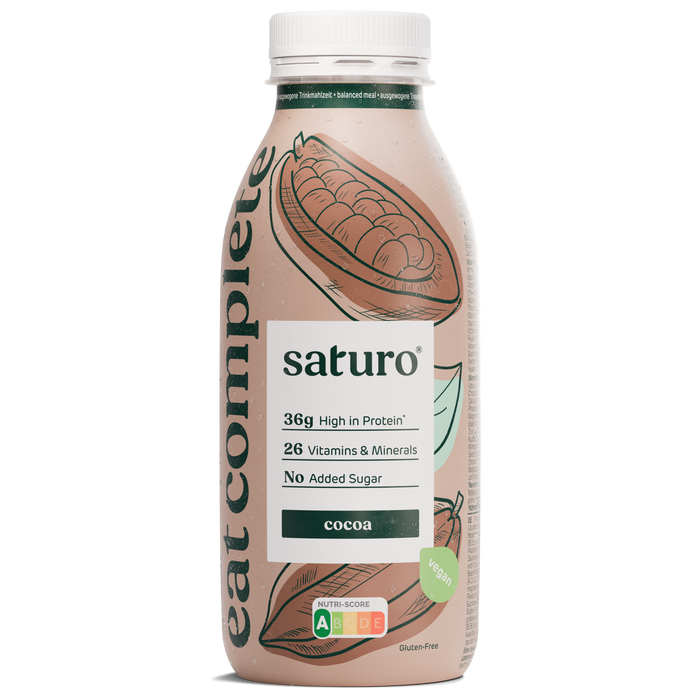
Drinkable meal: a complete meal in a bottle
26 vitamins and minerals, including copper, zinc and iron. Copper contributes to normal iron transport in the body and to the normal functioning of the nervous system. Reference amount for copper: 1 mg per day (NRV). Doesn't replace treatment for a confirmed deficiency.
Copper deficiency in special situations
After bariatric surgery: the supplement plan
After gastric bypass or biliopancreatic diversion, the ASMBS says a multivitamin should contain 2 mg copper a day; after a gastric sleeve or gastric band, 1 mg, with zinc and copper in a ratio of 8 to 15 to 1. Zinc-only supplements without copper are the classic mistake after surgery. Copper belongs in every follow-up blood test, because in the case series the average gap between surgery and nerve symptoms was eleven years. If you've let your follow-up slip, catch up with this list: blood count, copper, caeruloplasmin, zinc, iron status, B12, vitamin D.

Pregnancy, the pill and the copper coil
Under oestrogen, serum copper rises: by 40 to 70% in pregnancy, a bit less on the pill. German labs give a separate range for this (100 to 200 µg/dl). A high value in pregnancy is normal, while a “normal” one on the pill can be borderline. Needs rise slightly to 1.5 mg (EFSA); pregnant women should avoid liver because of the vitamin A. The copper coil is neither a copper source nor a poisoning risk: of twelve studies, eight found no rise in blood copper and four did. If you have one and are getting your copper measured, mention it anyway.
Infants, tap water and copper pipes
For infants, the issue isn't too little copper but too much: copper is the material of the drinking water pipes in 44% of German households, and the more acidic and soft the water is, and the longer it stands, the more dissolves out of the pipes. The German Drinking Water Ordinance limits copper to 2 mg per litre, designed for children up to two years old; for adults, 5 mg over the years is harmless. The rule: let water that has stood overnight run for a moment, and never use hot tap water for baby food. Premature babies under 1,500 g are the exception, at risk of too little, and their food is supplemented.
Vegan: not a nutrient of concern
Eating vegan doesn't raise your copper risk, quite the opposite. In the EPIC-Oxford cohort of 30,251 people, vegans had the highest copper intake of all groups, because grains, pulses, nuts and cocoa are the most copper-rich plant groups. The German NuEva study found no difference in either intake or serum copper; 7.5% of vegans were below the reference range compared with 5%, which isn't statistically significant. In children, the VeChi-Youth study showed less zinc but more copper. If you eat vegan and supplement zinc, keep an eye on the 25 mg limit; for copper, you don't need to do more than that.
Frequently asked questions about copper deficiency
How do you notice a copper deficiency?
Through anaemia that doesn't respond to iron (tiredness, paleness with normal ferritin), often with infections because of low white blood cell counts, and through nerve symptoms such as tingling in the feet and an unsteady gait. It's rare in healthy people, and a manganese deficiency is even rarer. Almost always, stomach surgery, too much zinc or a bowel condition is behind it.
Can copper deficiency lead to iron deficiency?
On impaired iron utilisation: caeruloplasmin and hephaestin need copper to get iron into the blood. Without copper, iron stays trapped in the gut cells and stores, ferritin is normal or high, and the anaemia stays despite iron supplements. In one case report, ferritin rose from 53 to 228 ng/ml in four weeks on copper.
How long does it take to correct a copper deficiency?
White blood cells recover in 9 to 16 days, and the anaemia clears fully within one to three months. Nerves take months and don't fully recover: around half improve, the other half stay stable. After that, get checked every three months. After a bypass or diversion, you take the copper supplement for life.
Can you take copper and zinc at the same time?
Yes, that's the whole point of combination supplements: the obesity guideline recommends 8 to 15 mg of zinc per 1 mg of copper. If you only take zinc, stay under 25 mg a day and you don't need extra copper. There's no expert recommendation for spacing them an hour apart; it only gets critical above 50 mg of zinc long term.
How much copper does a woman need per day?
1 to 1.5 mg, just like a man; the DGE doesn't differentiate by sex. The EFSA gives 1.3 mg for women and 1.5 mg for pregnant and breastfeeding women. A handful of cashews (0.67 mg) and a portion of lentils (0.38 mg) cover that. On the pill and during pregnancy, the blood level rises on its own.
What is copper called in a blood test?
Copper isn't part of a standard blood count, so you have to request it separately: "serum copper" (Cu, in µg/dl) and "caeruloplasmin", the transport protein. The two should be read together. Indirectly, a deficiency shows up in the blood count as low haemoglobin with few neutrophils and normal ferritin. Reference range: women 68 to 169, men 56 to 111 µg/dl.
Can copper reverse grey hair?
No, there's no study on that. The only thing proven is that people who go grey early have slightly lower copper levels on average (2020 meta-analysis). There's no study in which people took copper and their hair regained its colour. If you're not deficient and you take copper anyway, you risk hitting the upper limit of 5 mg and gain nothing.
Is copper helpful for histamine intolerance?
Copper is a building block of diamine oxidase (DAO), which breaks down histamine in the gut, alongside vitamin B6, vitamin C and zinc. There's no study showing that copper alone eases symptoms of histamine intolerance. Copper only makes sense if you have a proven deficiency; if you're well supplied, more copper won't improve your DAO.
Sources · 50 sources anzeigen
- German Nutrition Society (DGE): Reference values for nutrient intake, copper, manganese, chromium, molybdenum. D-A-CH reference values, 3rd edition 2025.
- German Federal Institute for Risk Assessment (BfR): Proposed maximum levels for copper in foods, including food supplements. Opinion 2021.
- German Federal Institute for Risk Assessment (BfR): Copper intake: essential in trace amounts, risky in larger amounts. Questions and answers.
- German Federal Institute for Risk Assessment (BfR): Nutrition during pregnancy, avoiding liver (vitamin A). Topic page.
- EFSA NDA Panel: Scientific Opinion on Dietary Reference Values for copper. EFSA Journal 2015; 13(10): 4253.
- EFSA Scientific Committee: Re-evaluation of the existing health-based guidance values for copper and exposure assessment from all sources. EFSA Journal 2023; 21(1): 7728.
- EFSA: Overview on Tolerable Upper Intake Levels as derived by the Scientific Committee on Food (SCF) and the EFSA NDA Panel. Version 11, August 2025.
- Regulation (EU) No 1169/2011 (Food Information Regulation), Annex XIII: Reference intakes for daily intake (copper 1 mg).
- Commission Regulation (EU) No 432/2012 establishing a list of permitted health claims, German version, Official Journal L 136 (copper: iron transport, nervous system, hair pigmentation).
- European Commission: EU Register on nutrition and health claims made on foods (copper: eight authorised claims, tiredness not authorised).
- Copper in Human Health and Disease: Insights from Inherited Disorders. Physiology 2026; 41: 253–271.
- MSD Manual, Professional Edition: Copper deficiency. As of May 2025.
- MSD Manual, Professional Edition: Copper toxicity.
- National Institutes of Health, Office of Dietary Supplements: Copper. Fact Sheet for Health Professionals.
- Halfdanarson T. R. et al.: Hematological manifestations of copper deficiency: a retrospective review. European Journal of Haematology 2008; 80(6): 523–531.
- Jaiser S. R., Winston G. P.: Copper deficiency myelopathy. Journal of Neurology 2010; 257(6): 869–881.
- Fong T. et al.: Copper deficiency: an important consideration in the differential diagnosis of myelodysplastic syndrome. Haematologica 2007; 92(10).
- Wazir S. M., Ghobrial I.: Copper deficiency, a new triad: anemia, leucopenia, and myeloneuropathy. Journal of Community Hospital Internal Medicine Perspectives 2017; 7(4): 265–268.
- Visual recovery in a patient with optic neuropathy secondary to copper deficiency. Case report, PMC 2024.
- Gray Hair: From Preventive to Treatment. Review, PMC 2025.
- Fatemi Naieni F. et al.: Serum Iron, Zinc, and Copper Concentration in Premature Graying of Hair. Biological Trace Element Research 2012; 146(1): 30–34.
- Chang H. C., Sung C. W.: Association between serum levels of minerals and premature hair graying: a systematic review and meta-analysis. International Journal of Dermatology 2020; 59: e378–e380.
- Mahendiratta S. et al.: Premature graying of hair: Risk factors, co-morbid conditions, pharmacotherapy and reversal. A systematic review and meta-analysis. Dermatologic Therapy 2020.
- The Association between Dietary and Circulating Copper Levels and Osteoporosis: A Scoping Review. Biological Trace Element Research 2025.
- Effects of essential metals (iron, zinc, and copper) on thyroid diseases: a narrative review. Frontiers in Medicine 2026.
- Copper Dysregulation in Major Depression: A Systematic Review and Meta-Analytic Evidence for a Putative Trait Marker. International Journal of Molecular Sciences 2025; 26(18): 9247.
- Copper Deficiency: A Frequently Overlooked Complication After MBS. A Systematic Review and Meta-analysis. Obesity Surgery 2025; 35(2): 602–613.
- Trends of copper deficiency following one anastomosis gastric bypass and Roux-en-Y gastric bypass. BMC Surgery 2025.
- Parrott J. et al.: American Society for Metabolic and Bariatric Surgery Integrated Health Nutritional Guidelines for the Surgical Weight Loss Patient 2016 Update: Micronutrients. Surgery for Obesity and Related Diseases 2017.
- Nations S. P. et al.: Denture cream: an unusual source of excess zinc, leading to hypocupremia and neurologic disease. Neurology 2008; 71(9): 639–643.
- Hedera P. et al.: Myelopolyneuropathy and pancytopenia due to copper deficiency and high zinc levels of unknown origin II. The denture cream is a primary source of excessive zinc. NeuroToxicology 2009; 30(6): 996–999.
- Fischer P. W. F., Giroux A., L'Abbé M. R.: Effect of zinc supplementation on copper status in adult man. American Journal of Clinical Nutrition 1984; 40(4): 743–746.
- Fosmire G. J.: Zinc toxicity. Summarised in: The Essential Toxin: Impact of Zinc on Human Health. PMC 2010.
- Copper Deficiency Presenting With Bicytopenia During Long-Term Parenteral Nutrition for Short Bowel Syndrome: A Case Report and Literature Review. PMC 2025.
- Ashkenazi S. et al.: Copper deficiency in the preterm infant of very low birthweight. Archives of Disease in Childhood 1985.
- bioscientia: Copper (S) (ICP-MS), test catalogue with reference ranges by age, sex and hormone use. As of 23.09.2026.
- Labor Dr. Gärtner: Coeruloplasmin, test catalogue (assessment, influencing factors, Wilson's disease).
- Perinatology.com: Reference Values for Ceruloplasmin in Pregnancy.
- Reliability on Intra-Laboratory and Inter-Laboratory Data of Hair Mineral Analysis Comparing with Blood Analysis. PMC 2013.
- LiverTox: Copper. NCBI Bookshelf, National Institute of Diabetes and Digestive and Kidney Diseases.
- State Office for Health and Social Affairs Mecklenburg-Vorpommern (LAGUS): Parameters of the German Drinking Water Ordinance (TrinkwV): Copper. Information sheet, as of 12.02.2024.
- Ernährungs Umschau: Copper in drinking water: no danger to infants. Report on a study in Berlin and Göttingen.
- Crandell L., Mohler N.: A Literature Review of the Effects of Copper Intrauterine Devices on Blood Copper Levels in Humans. Nursing for Women's Health 2021; 25(1): 71–80.
- Klein L. et al.: Selenium, Zinc, and Copper Status of Vegetarians and Vegans in Comparison to Omnivores in the Nutritional Evaluation (NuEva) Study. Nutrients 2023; 15(16): 3538.
- Bradbury K. E. et al.: High compliance with dietary recommendations in a cohort of meat eaters, fish eaters, vegetarians, and vegans: results from the EPIC-Oxford study. PMC 2016.
- Selenium, zinc, and copper intake and status of vegetarian, vegan, and omnivore children and adolescents: results of the VeChi Youth Study. European Journal of Nutrition 2025.
- Diamine Oxidase and Gastrointestinal Diseases. Biomolecules 2026; 16(8): 1136.
- Jacob R. A. et al.: Effect of Varying Ascorbic Acid Intakes on Copper Absorption and Ceruloplasmin Levels of Young Men. Journal of Nutrition.
- Max Rubner-Institut: Bundeslebensmittelschlüssel (BLS, German Nutrient Database) 4.0, version 2025 (copper in µg/100 g).
- U.S. Department of Agriculture, Agricultural Research Service: FoodData Central, SR Legacy Release (2018). Copper (Nutrient 1098) per 100 g.
Has been writing for Saturo since 2019 about nutrition, nutrients and how to get good nutrient supply to work in everyday life.
Hat diesen Artikel am 24. September 2026 auf fachliche Richtigkeit geprüft. This content is no substitute for medical advice.

Zinc deficiency: symptoms, causes and treatment
The counterpart: how much zinc you really need, why wholegrains change your requirement and when zinc tablets start to harm your copper levels.
Weiterlesen · 16 Min

Latest from the guide
New articles, updates and tips straight to your inbox. Easy to understand, expert-checked, no spam.
Danke! Bitte bestätige die Anmeldung in deinem Postfach.