
Vitamin B12 deficiency: symptoms, causes and treatment
Tingling in your hands, forgetfulness, constantly tired? A vitamin B12 deficiency develops over years and often hits the nerves before it shows up in the blood. Which symptoms are typical, why the total B12 level alone isn't enough, when tablets are sufficient, and who needs the injection.


Aktualisiert 11 September 2026 · 16 Min. Lesezeit · 17 Quellen

The essentials in 30 seconds
DGE's estimated value for everyone aged 13 and over, 4.5 µg for pregnant women, 5.5 µg for breastfeeding women. The typical mixed diet in Germany provides more, and the deficiency usually starts in the stomach, not on the plate.
This is how many of the 65- to 93-year-olds in the KORA-Age study were below 221 pmol/l. Stomach acid decreases with age, and without it B12 can't be released from food.
That's how long reserves last if supply suddenly stops. That's why the deficiency creeps up, and why it's noticed so late.
Active B12 drops first. Below 25 pmol/l counts as a deficiency, 25 to 70 is a grey zone, and then methylmalonic acid decides. The total B12 level alone misses many cases.
Vitamin B12 deficiency symptoms: how to recognise it
Your body needs vitamin B12 in two places that seem to have nothing to do with each other at first glance: in the bone marrow for new red blood cells, and in the nerves for the insulating layer around nerve fibres. That's why a deficiency has two faces. One is anaemia with tiredness and paleness, the other is tingling, unsteady gait and forgetfulness. It used to be thought that anaemia comes first and nerve symptoms follow. Today we know it's often the other way round. The 2024 British guideline puts it as a rule for doctors: a normal blood count doesn't rule out a B12 deficiency. This list will help you spot your own pattern.
Early signs: tiredness, tingling, forgetfulness
It usually starts with exhaustion that doesn't improve with sleep. This comes from anaemia: without B12, the precursor cells in the bone marrow don't divide properly, the red blood cells become too large and too few, and the blood carries less oxygen. Paleness, heart palpitations and breathlessness on exertion fit this picture too. Because this happens gradually over months, the body gets used to it, and many people only realise in hindsight how worn out they were.
The nerve symptoms almost always start in the feet and hands: tingling, pins and needles, numbness, a feeling like cotton wool under the soles of your feet. This is polyneuropathy. If it affects the dorsal columns of the spinal cord, walking becomes unsteady, especially in the dark, when the eyes can no longer compensate for the missing sense of depth. Doctors call this subacute combined degeneration of the spinal cord. In the head, the deficiency shows up as forgetfulness, trouble concentrating, irritability or low mood, and in older people, also as confusion that can look like early dementia. A review in Mayo Clinic Proceedings describes exactly this as the reason the deficiency is so often overlooked: the symptoms are neurological or psychiatric, the blood count looks normal, and nobody thinks of a vitamin.

Vitamin B12 deficiency symptoms: eyes
Blurred vision, a blind spot in the centre of your field of view, colours that look paler: these are the eye symptoms a B12 deficiency can trigger. It's not the eye itself that's affected, but the optic nerve, which, like all nerves, depends on B12. The British NICE guideline explicitly lists visual disturbances caused by optic nerve damage among the common signs, along with visual field loss and, in extreme cases, optic nerve atrophy. In practice, this is rare and usually only occurs after a long, severe deficiency. Dry or irritated eyes, which appear on many lists, have no proven link to B12. If your eyesight suddenly gets worse, see an ophthalmologist; it's worth asking about your B12 level there if you also have tingling or an unsteady gait.
Vitamin B12 deficiency symptoms: tongue, skin and hair
The tongue is the one symptom you can actually see. With B12 deficiency, it can burn, become sensitive to acidic and spicy foods, and lose its fine papillae until it looks smooth and beefy red. Experts call this Hunter's glossitis, and the NICE guideline lists tongue inflammation among the common signs. The skin turns pale from the anaemia, sometimes slightly yellowish, because the oversized red blood cells break down faster. Whether hair loss belongs on this list is less clear: it's been reported, but no guideline lists it as a typical sign. If you're losing hair, get your ferritin checked as well as your B12, since iron deficiency is by far the more common cause.
Vitamin B12 deficiency and weight gain
The question comes from two directions: does the deficiency cause weight gain, and does vitamin B12 cause weight gain? The answer to both is no. A B12 deficiency tends to take away your appetite – people affected lose weight, partly because the lining of the digestive tract suffers and diarrhoea can occur. If the scale goes up after starting treatment, that's usually recovery: appetite comes back, and so does energy. There's no evidence that B12 supplements or injections build up weight on their own; the vitamin provides no calories and doesn't drive fat storage. Fluid retention is possible with severe anaemia, because the heart has to pump harder against the lack of oxygen and fluid stays in the legs. In that case, the anaemia is the problem, not the vitamin. Sweating, especially at night, is also reported; studies don't identify it as a standalone B12 symptom, but it can accompany any pronounced anaemia.
If you have tingling or numbness that doesn't go away, an unsteady gait, memory problems or visual disturbances, see a doctor promptly, regardless of your blood count. Nerve damage from B12 deficiency can only reliably be reversed in the first few months. If you take metformin or acid blockers, eat a vegan diet, or have had gastrointestinal surgery, mention it at your appointment.
Vitamin B12 deficiency symptoms in women
The symptoms are the same in women and men; unlike with iron, there's no loss through menstruation. Still, there are two special cases. First, the pill: combined hormonal contraceptives lower the total B12 level in the blood without an actual deficiency being present; the NICE guideline therefore advises interpreting the value cautiously in pill users and, if in doubt, measuring the active form or methylmalonic acid instead. Second, pregnancy: the requirement rises, the total B12 level drops physiologically, and a real deficiency hits the child harder than the mother (chapter 7). Women who eat a vegetarian or vegan diet and want to become pregnant are best off having their level checked beforehand.
Vitamin B12 deficiency causes: where the deficiency comes from
Vitamin B12 is produced exclusively by microorganisms and ends up in meat, fish, eggs and milk via animals. People who eat these foods in Germany take in more, on average, than the DGE recommends: 5.5 to 6 µg a day for men, 3.7 to 4 µg for women. Even so, deficiency is common. The reason: the journey from plate to bloodstream is complicated – it needs stomach acid, a transport protein from the stomach, and a healthy final section of the small intestine. If any one of these fails, a full plate doesn't help. Too little intake is therefore the exception, too little absorption the rule. How much you actually need depends on your age and life situation.
Pernicious anaemia: when intrinsic factor is missing
The classic cause is autoimmune gastritis: the immune system destroys the parietal cells of the stomach lining, which produce stomach acid and intrinsic factor, the transport protein without which B12 can't be absorbed in the small intestine. The result used to be called pernicious anaemia, meaning malignant anaemia, because it was fatal before the vitamin was discovered. Today it's treatable but not curable: the parietal cells don't come back, so lifelong vitamin B12 is needed in a form that bypasses intrinsic factor, usually as an injection. Autoimmune gastritis tends to run in families and often occurs alongside other autoimmune conditions such as Hashimoto's or type 1 diabetes. It's diagnosed via antibodies against intrinsic factor, though a negative test doesn't rule it out.
Acid blockers and metformin
Two of the most commonly prescribed medications lower B12 levels. Proton pump inhibitors such as pantoprazole or omeprazole reduce stomach acid, and without acid, B12 can't be released from dietary protein. In an analysis of nearly 26,000 people with B12 deficiency and 184,000 controls, the risk was 65% higher after at least two years of use, and nearly doubled with more than one and a half tablets a day; weaker H2 blockers such as famotidine raised it by 25%. Metformin, the standard medication for type 2 diabetes, interferes with absorption in the small intestine. In the Diabetes Prevention Program Outcomes Study (DPPOS), risk rose by 13% for every year of use; after five years, 19% of the metformin group had low or borderline levels compared with 10% on placebo, and nerve damage was more common. The authors recommend routinely checking B12 levels in people on metformin.
Vegan, vegetarian, low intake of animal foods
Plants contain no vitamin B12 that the human body can use. Sauerkraut, nori seaweed and shiitake mushrooms do contain B12-like compounds that show up in lab tests but don't work in the body; the DGE considers it impossible to meet requirements on a purely plant-based diet. Anyone living vegan therefore needs a supplement or fortified foods, no exceptions. Those who do this are well supplied: in the Berlin RBVD study by the BfR, 36 vegans, almost all of whom supplemented, had the same B12 status as 36 people on a mixed diet. For vegetarians, it depends on how much milk, cheese and eggs are on the menu; if you eat little of these, you can quickly fall below 4 µg. Your stores can bridge this gap for years, which is deceptive: if you have no symptoms three years after switching, you might assume the supplement is unnecessary – and then in year four, your feet start to tingle.
A B12 supplement is only worth taking if it contains the right form: cyanocobalamin, methylcobalamin or adenosylcobalamin. The NICE guideline explicitly points out that some over-the-counter products contain too little, or the wrong form. Checking the label is enough.
Age, gastrointestinal surgery, laughing gas: further risk groups
- From age 65: The stomach lining produces less acid, often due to chronic gastritis. B12 from food is then poorly released, while B12 from supplements is still well absorbed.
- After surgery: gastric band or gastric bypass surgery, stomach removal, removal of the final section of the small intestine. According to NICE, deficiency here is so certain that testing isn't even needed before starting replacement therapy.
- Bowel conditions: Crohn's disease in the small intestine, coeliac disease, bacterial overgrowth, fish tapeworm.
- Medications: besides acid blockers and metformin, also colchicine, some anti-epileptics such as topiramate, phenobarbital and primidone, as well as pregabalin.
- Laughing gas: nitrous oxide, inhaled as a party drug, renders the B12 in your body unusable. It can cause severe spinal cord damage within weeks, even with a normal B12 level in the blood.
- Alcohol: regular heavy drinking damages the stomach lining and the liver, where the vitamin is stored.
How vitamin B12 gets from your plate to your nerves
Three stages from stomach acid to nerve cell. Once you know them, you'll understand why the deficiency starts in the stomach, why the blood value is called Holo-TC, and why 1,000 µg tablets work even without intrinsic factor.
Release in the stomach
In food, B12 is bound to protein. Stomach acid and pepsin release it, a salivary protein picks it up, and the parietal cells of the stomach supply intrinsic factor, the transport protein for the small intestine. Low acid, as in older age or with acid blockers, means the vitamin stays trapped in the food. From supplements, on the other hand, it's freely available.
Absorption and storage
Only in the last section of the small intestine, the terminal ileum, does the B12–intrinsic factor complex dock onto its receptor. This pathway manages 1.5 to 2 µg per meal, no more; about one percent of each dose also passes passively through the gut wall. In the blood, the vitamin travels bound to transcobalamin, this is the Holo-TC that labs measure. The liver stores 3 to 5 mg, enough for years.
Effect in the cell
Inside the cell, B12 works in two enzymes. One converts homocysteine into methionine, supplying the building blocks for DNA and the insulating layer around nerves. The other clears methylmalonic acid. Without B12, blood cells don't divide properly, the myelin around nerves suffers, and homocysteine and methylmalonic acid build up in the blood. These two substances are exactly what reveal a deficiency when the B12 level is in the grey zone.
Vitamin B12 level: how a deficiency is diagnosed
The standard test measures total vitamin B12 in blood serum, and that's exactly the problem: only a fifth of it is the active form, the rest is bound to a transport protein that doesn't supply any cells. The total value drops late and unreliably; people with clear nerve symptoms can still be within the normal range. That's why the 2024 NICE guideline defined three levels, applying to both total B12 and the active form, plus a grey zone where a second test decides. German labs sometimes report ng/l, sometimes pmol/l; ng/l is the same as pg/ml, and pmol/l × 1.36 gives you ng/l.
The three levels according to the 2024 NICE guideline
-
1
DeficiencyTotal B12 < 133 pmol/l (< 180 ng/l) or Holo-TC < 25 pmol/l
The deficiency is considered confirmed. Start treatment, investigate the cause, and don't wait for further results if there are nerve symptoms or anaemia.
-
2
Grey zone133–258 pmol/l (180–350 ng/l) or Holo-TC 25–70 pmol/l
Possible deficiency. If symptoms are present, follow up with a methylmalonic acid test; in cases of autoimmune gastritis, after gastrointestinal surgery, during pregnancy, or with nerve symptoms, start treatment already.
-
3
Unlikely> 258 pmol/l (> 350 ng/l) or Holo-TC > 70 pmol/l
A deficiency is unlikely. Look for other causes of the symptoms; if they persist, retest after three to six months.
Thresholds according to NICE NG239 (March 2024). Some labs set their own limits, in which case those apply. Don't take a B12 supplement before the test, as it raises the value without fixing the deficiency.
Holotranscobalamin: the active B12 value
Holotranscobalamin, or Holo-TC, also known as active B12, is the portion of the vitamin bound to transcobalamin that can actually get into your cells. It's the first to drop when intake or absorption declines, before the total value reacts and long before the blood count changes. That's why researchers in Saarbrücken described it back in 2008 in Deutsches Ärzteblatt as the earliest lab marker for B12 deficiency and recommended testing risk groups with it every two to three years. The NICE guideline puts Holo-TC on equal footing with total B12 as a first-line test and makes it the preferred choice during pregnancy, because the total value naturally drops then. Below 25 pmol/l counts as deficiency, 25 to 70 is the grey zone, and above 70, a deficiency is unlikely. The test costs more out of pocket than the total value, but often saves you a second appointment.

Methylmalonic acid and homocysteine: the cells respond
Neither value measures the vitamin itself, but rather its effect. Without B12, cells can't break down methylmalonic acid, and it builds up in the blood. This only happens once stores are truly empty; an elevated value therefore means the deficiency has already reached the cells. The NICE guideline recommends methylmalonic acid as a second test when the first result was in the grey zone and symptoms are present, and as a first-line test when laughing gas could be the cause, because the B12 value is misleading in that case. Homocysteine also rises, but is less specific: it also reacts to folate deficiency and kidney problems. With treatment, both values drop within a few weeks, which makes them useful for checking whether therapy is working.
Vitamin B12 deficiency test: who should get tested
Not everyone. In 2022, the IQWiG examined whether people over 50 without symptoms benefit from regular B12 testing, and found no evidence that they do. The NICE guideline recommends testing when at least one symptom from chapter 1 and at least one risk factor from chapter 2 are both present; with symptoms but no risk factor, it's up to the doctor's judgement. If you take metformin or acid blockers long-term, live vegan, or are over 65, you already have the risk factor. Self-tests from pharmacies or online usually measure Holo-TC from a finger-prick blood sample and are useful if three rules apply: no B12 supplement in the weeks beforehand, awareness that the pill can distort total values, and confirmation of a low result at the doctor's before starting treatment. With reasonable suspicion, health insurance covers the total B12 test; Holo-TC and methylmalonic acid are often out-of-pocket, depending on the practice.
Fixing a vitamin B12 deficiency: tablets, injections, duration
Treatment depends on the cause, not the number. If B12 is missing from the diet, a supplement at a normal dose plus a change in diet is enough. If absorption is the problem, because stomach acid, intrinsic factor or the small intestine aren't playing along, you need either a high oral dose, enough of which gets through the gut wall passively, or an injection, which bypasses the gut entirely. For autoimmune gastritis, after removal of the stomach or the last section of the small intestine, the NICE guideline recommends lifelong injections; for other absorption disorders, at least 1 mg daily orally or injections as well. With nerve symptoms or anaemia, treatment starts immediately, without waiting for further lab results. A deficiency caused by metformin or acid blockers is treated for as long as the medication continues, and your doctor checks whether it's still needed.
Vitamin B12 injection or tablets?
For a long time, the injection was seen as the only route for absorption disorders. The 2018 Cochrane review found across three studies with 153 participants that 1,000 µg daily as a tablet normalised blood levels just as well as injections, at lower cost; the evidence is thin but points clearly in one direction. The mechanism is simple: one percent of 1,000 µg is 10 µg, more than the daily requirement, with no intrinsic factor needed. The injection remains the first choice when things need to move fast (nerve symptoms, pronounced anaemia), when absorption has failed reliably and permanently (autoimmune gastritis, stomach removal), or when it's unclear whether someone will take a tablet daily. In Germany, hydroxocobalamin injections are typical: several in the first one to two weeks, then weekly, then every one to three months as maintenance. With tablets, the rule is: daily and high-dose, not the 3 µg capsule from the drugstore shelf.
With a confirmed deficiency, it's not the form that matters, but the cause. If you can't absorb vitamin B12, you need the high dose or the injection, and permanently, not just until the number looks good again.
Joerg Hauke, Nutrition expert, technical review of this article
How long does it take to fix the deficiency
Blood responds quickly, nerves slowly. Young red blood cells rise within a week, and the blood count is usually normal after about six to eight weeks. Tiredness improves correspondingly early. The NICE guideline tells patients: initial improvement is possible within two weeks, but can take up to three months, and symptoms may temporarily worsen at the start. Nerve symptoms take months; whatever's still there after six to twelve months often stays. That's why, with tingling and unsteady gait, every week counts. The first check-up makes sense after three months, or after one month during pregnancy. If you don't feel sufficiently better by then, you'll get a higher tablet dose or switch to injections.
-
Week 0
Measure, then start
Blood count, total B12 or holo-TC, methylmalonic acid if needed. With nerve symptoms or anaemia, treat immediately, clarify the cause in parallel.
-
Week 1–2
Blood responds
Young red blood cells rise, methylmalonic acid and homocysteine start to fall. For absorption disorders: injections at short intervals or 1,000 µg daily orally.
-
Week 6–12
Blood count normal, check-up
Anaemia usually resolved, tiredness improved. First check-up: better? Adjust dose, set maintenance plan.
-
Month 3–12
Nerves take time
Tingling and unsteady gait slowly recede. With autoimmune gastritis or after stomach surgery: lifelong maintenance, don't stop.
Vitamin B12 overdose: can you take too much?
There's no tolerable upper limit for vitamin B12, neither from EFSA nor from the EU's former Scientific Committee on Food. The reason: even with intakes above 100 µg a day over years, no harmful effects have been observed, and 1,000 µg or more is given therapeutically. Whatever the body doesn't need gets excreted via the kidneys. Still, the BfR proposes a maximum of 25 µg per daily dose for supplements, out of caution and because many people combine several products. Healthy people without a deficiency get no benefit from high-dose products with 500 or 1,000 µg, the vitamin doesn't build up reserves beyond what's needed. A high B12 level in the blood without taking a supplement isn't an overdose, but a finding worth discussing with a doctor, since it can come from the liver or blood formation. And anyone taking a lot of B12 skews their test result (Chapter 4).
High-dose folic acid improves the anaemia from B12 deficiency without protecting the nerves. The blood count then looks fine while nerve damage progresses. If you take folic acid and have tingling or an unsteady gait, get your B12 measured before continuing.
Hochdosierte Folsäure bessert die Blutarmut bei B12-Mangel, ohne die Nerven zu schützen: Das Blutbild sieht gut aus, während die Nervenschäden fortschreiten. Wer Folsäure nimmt und Kribbeln oder Gangunsicherheit hat, lässt B12 messen, bevor er weitermacht.
Vitamin B12 foods: what belongs on your plate
Vitamin B12 is in everything that comes from animals: most in organ meat and shellfish, plenty in oily seafood, a solid amount in beef, eggs, cheese and milk. On the plant side, there's only what's been fortified. The ranking shows both sides, per 100 g and as it lands on the plate: meat, fish and shellfish cooked, eggs boiled. The figures come from the US nutrient database USDA, because it lists them separately by preparation method.
Vitamin B12 per 100 g: top 10 animal and fortified sources
Figures per 100 g cooked, USDA FoodData Central SR Legacy. Per portion: 150 g mackerel 28.5 µg, 100 g herring 13 µg, 150 g beef steak 5.7 µg, 100 g minced beef 2.6 µg. Everyday sources are lower but add up: Emmental 3.1, mozzarella 2.3, Gouda 1.5, boiled egg 1.1 (one egg 0.55), natural yoghurt 0.4 to 0.6, milk 0.45 per 100 ml, pork fillet 1.0, chicken breast 0.3. Liver sausage comes to 13.5.
How many eggs cover the daily requirement?
One boiled egg provides around 0.55 µg of vitamin B12, so mathematically you'd need seven eggs for 4 µg. That maths is misleading, in both directions. First, the active absorption route only takes up 1.5 to 2 µg per meal; seven eggs at once won't get you more than three. Second, you don't need the 4 µg from one food: a glass of milk, a yoghurt, two slices of cheese and an egg spread across the day add up to 3 to 4 µg together, with no meat or fish involved. That's why vegetarians eating dairy are usually covered, and vegans without a supplement never are. And that's why spreading it out beats any single portion.

Vitamin B12 im Alltag: angereicherte Lebensmittel und Trinkmahlzeiten
Wer wenig oder keine tierischen Lebensmittel isst, holt sich das Vitamin dort, wo es zugesetzt wurde: Pflanzendrinks, Frühstückscerealien, Hefeflocken, Fleischalternativen, nicht Sauerkraut, Algen oder Shiitake. Ein zweiter Weg sind Trinkmahlzeiten mit definierten Nährstoffmengen: Eine Flasche Saturo liefert je nach Sorte 0,9 bis 1,0 µg Vitamin B12, also 36 bis 40 % der Referenzmenge, dazu Folsäure und Eisen für die Blutbildung. Kein Ersatz für ein Präparat bei veganer Ernährung und erst recht nicht bei einer Aufnahmestörung, aber ein planbarer Beitrag an Tagen ohne Fisch oder Milchprodukte.
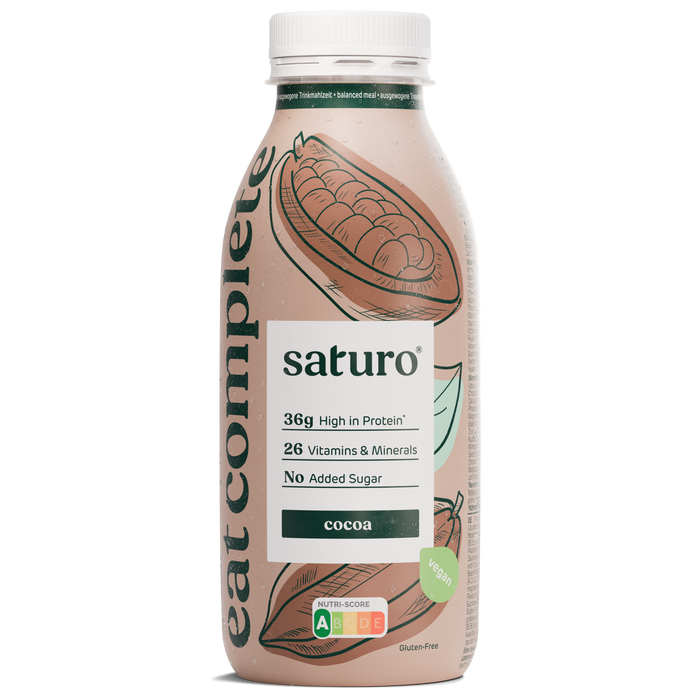
Trinkmahlzeit: eine vollwertige Mahlzeit aus der Flasche
What helps absorption and what slows it down
With vitamin B12, it's less about combinations on the plate and more about what happens between the stomach and the small intestine. The list below shows what matters.
Vegan, pregnant, over 65, diabetes: who needs to pay extra attention
Vitamin B12 deficiency on a vegan diet
Vegan without a B12 supplement doesn't work, and expert bodies agree on that; the DGE calls supplementation necessary. The good news comes from the BfR's RBVD study: vegans who take a supplement are just as well supplied as omnivores, even though they absorb almost nothing from food. What matters: the form (cyanocobalamin, methylcobalamin or adenosylcobalamin), consistency, and keeping an eye on levels, ideally holo-TC every two to three years, sooner if you're planning a pregnancy. Parents: children in vegan families need the supplement from the start, via the mother while breastfeeding. And if you eat only a little animal food without calling yourself vegan, it's worth doing an honest count: do you actually reach 4 µg on a normal day?

Pregnancy, breastfeeding and infants
During pregnancy, the estimated requirement rises to 4.5 µg, and to 5.5 µg while breastfeeding, because the baby builds its own stores and is later supplied through milk. Total B12 levels drop naturally during pregnancy, which is why the NICE guideline recommends holo-TC as the first test here, and injections without waiting for antibody results in cases of autoimmune gastritis. The most at-risk isn't the mother but the baby: infants have no reserves, and a deficiency in the first months of life can permanently damage brain development. That's why the IQWiG recommended in 2024 that acquired B12 deficiency be included in newborn screening. So breastfeeding mothers on a vegan or very low-meat diet aren't supplementing for themselves, but for the child.
From 65: stomach, medication, forgetfulness
In older age, three things come together: the stomach lining produces less acid, an acid blocker or metformin is often added, and the symptoms get put down to normal ageing. One in four people over 65 falls below the threshold. The tricky part is how similar it looks to other diagnoses: unsteady gait is taken as frailty, forgetfulness as early dementia, low mood as loneliness. The IQWiG doesn't recommend routine screening without symptoms, because the benefit isn't proven. But with exactly these symptoms, the B12 level belongs in the work-up before a dementia diagnosis is made. The upside in older age: vitamin from supplements is well absorbed even with low stomach acid, because it doesn't need to be released from dietary protein first.
Diabetes and metformin
Metformin is the most commonly prescribed diabetes medication and a quiet B12 thief: it disrupts absorption in the small intestine, and the risk grows with dose and duration. The mix-up is especially tricky: tingling and numbness in the feet are attributed to diabetic nerve damage, but the same finding can come from B12 deficiency, which is treatable. In the DPPOS study, nerve damage was more common in the metformin group. The UK's medicines regulator issued a safety warning on this in 2022, and the NICE guideline lists metformin among the risk factors. In practice: if you take metformin, have B12 checked at your annual review, and immediately if you get foot symptoms. The medication isn't stopped because of this, the deficiency is treated alongside it.
Consequences of vitamin B12 deficiency: nerves, blood, mind
Left untreated, the deficiency leads to megaloblastic anaemia, which strains the heart, and to progressive nerve damage: polyneuropathy in hands and feet, damage to the spinal cord pathways causing gait disturbance and bladder problems, optic nerve damage, and in severe cases paralysis. On the mental side, effects range from irritability and depression to confusion and psychosis; the NICE guideline names all three explicitly. The key difference between the two: blood always recovers, nerves only if treated early. That's why, with a B12 deficiency and nerve symptoms, what counts isn't the number but the time until the first dose.
Common questions about vitamin B12 deficiency
What are B12 thieves?
Not foods, but medications and circumstances that disrupt absorption: proton pump inhibitors and H2 blockers (low stomach acid), metformin (small intestine), nitrous oxide (renders existing B12 unusable), large amounts of alcohol, plus autoimmune gastritis, stomach and intestinal surgery, and chronic bowel conditions. Coffee, tea or vitamin C don't rob you of B12.
How long does it take to replenish B12?
Blood responds within a week, and the blood count is usually normal after six to eight weeks. The NICE guideline states a first noticeable improvement within two weeks to three months. Nerve symptoms take months, and with autoimmune gastritis or after stomach surgery, treatment continues for life because the cause remains.
What helps quickly with a B12 deficiency?
Injections work fastest, because they bypass the gut and are given at close intervals in the first weeks. If absorption is intact, high-dose tablets of 1,000 µg daily are enough, which according to the Cochrane review raise levels just as reliably. Food alone doesn't help fast enough with a confirmed deficiency, because only 1.5 to 2 µg can be absorbed per meal.
How many eggs cover your daily vitamin B12 requirement?
Mathematically seven, but that's not a sensible number in practice: one boiled egg provides around 0.55 µg, but the active absorption route only manages 1.5 to 2 µg per meal. Better to have several small sources across the day, such as milk at breakfast, cheese at lunch, egg or fish in the evening. Together that adds up to 3 to 4 µg, more than from any single portion.
What shouldn't you take together with B12?
There are no foods that interfere with absorption. Timing with medication matters: acid blockers reduce absorption from food, not from supplements. Be careful with high-dose folic acid: it can improve anaemia and mask a B12 deficiency while nerve damage continues. And don't take B12 before a planned blood test, otherwise the result won't be meaningful.
Do nuts or yoghurt contain vitamin B12?
Nuts don't, like all plant foods without fortification. Yoghurt does: natural yoghurt provides 0.4 to 0.6 µg per 100 g, so around 0.6 to 0.9 µg per 150 g pot, milk about 0.45 µg per 100 ml, Emmental sits around 3 µg per 100 g. Dairy is the most important B12 source for vegetarians.
What nerve damage can a vitamin B12 deficiency cause?
First a polyneuropathy with tingling, numbness and burning in the feet and hands. Then funicular myelosis, damage to the spinal cord pathways causing unsteady gait, balance problems and falls, later paralysis and bladder problems. Damage to the optic nerve is also possible, along with memory problems, depression and confusion. Treated early, the damage usually reverses; after many months, often not completely.
How long can you take high-dose vitamin B12?
For as long as the cause persists, so with autoimmune gastritis or after stomach surgery that means for life; this is considered safe because no upper limit with harmful effects is known for B12. Without a proven deficiency, high doses don't help: the body only uses what it needs and excretes the rest. The BfR recommends a maximum of 25 µg per day for self-supplementation; anything above that is treatment under medical supervision.
Sources · 17 sources anzeigen
- German Nutrition Society (DGE): Reference values for nutrient intake, vitamin B12 (cobalamins). Estimated values for adequate intake, derivation 2018.
- German Nutrition Society (DGE): Selected questions and answers on vitamin B12. As of 10 September 2025.
- German Federal Institute for Risk Assessment (BfR): Maximum levels for vitamin B12 in food including food supplements. Opinion 2021.
- EFSA Panel on Dietetic Products, Nutrition and Allergies (NDA): Scientific Opinion on Dietary Reference Values for cobalamin (vitamin B12). EFSA Journal 2015; 13(7): 4150.
- National Institute for Health and Care Excellence (NICE): Vitamin B12 deficiency in over 16s: diagnosis and management. NICE guideline NG239, 6 March 2024.
- Institute for Quality and Efficiency in Health Care (IQWiG): Benefit of regular vitamin screening in symptomless older adults not proven. Press release on HTA report HT20-04, 16 March 2022.
- Conzade R., Koenig W., Heier M., Schneider A., Grill E., Peters A., Thorand B.: Prevalence and Predictors of Subclinical Micronutrient Deficiency in German Older Adults: Results from the Population-Based KORA-Age Study. Nutrients 2017; 9(12): 1276.
- Green R., Allen L. H., Bjørke-Monsen A.-L. et al.: Vitamin B12 deficiency. Nature Reviews Disease Primers 2017; 3: 17040.
- Stabler S. P.: Vitamin B12 Deficiency. New England Journal of Medicine 2013; 368(2): 149–160.
- Herrmann W., Obeid R.: Causes and early diagnosis of vitamin B12 deficiency. Deutsches Ärzteblatt International 2008; 105(40): 680–685.
- Wolffenbuttel B. H. R., Wouters H. J. C. M., Heiner-Fokkema M. R., van der Klauw M. M.: The Many Faces of Cobalamin (Vitamin B12) Deficiency. Mayo Clinic Proceedings: Innovations, Quality & Outcomes 2019; 3(2): 200–214.
- Lam J. R., Schneider J. L., Zhao W., Corley D. A.: Proton Pump Inhibitor and Histamine 2 Receptor Antagonist Use and Vitamin B12 Deficiency. JAMA 2013; 310(22): 2435–2442.
- Aroda V. R., Edelstein S. L., Goldberg R. B. et al.: Long-term Metformin Use and Vitamin B12 Deficiency in the Diabetes Prevention Program Outcomes Study. Journal of Clinical Endocrinology & Metabolism 2016; 101(4): 1754–1761.
- Wang H., Li L., Qin L. L., Song Y., Vidal-Alaball J., Liu T. H.: Oral vitamin B12 versus intramuscular vitamin B12 for vitamin B12 deficiency. Cochrane Database of Systematic Reviews 2018; 3: CD004655.
- Weikert C., Trefflich I., Menzel J. et al.: Vitamin and Mineral Status in a Vegan Diet (RBVD study). Deutsches Ärzteblatt International 2020; 117(35–36): 575–582.
- MSD Manual, Professional Edition: Vitamin B12 deficiency. Reviewed August 2024.
- U.S. Department of Agriculture, Agricultural Research Service: FoodData Central, SR Legacy Release (2018). Vitamin B12 content per 100 g.
Writing for Saturo since 2019 about nutrition, nutrients and how good nutrition works in everyday life.
Hat diesen Artikel am 11. September 2026 auf fachliche Richtigkeit geprüft. This content doesn't replace medical advice.

Iron deficiency: symptoms, causes and treatment
Tired, pale, hair loss: why iron deficiency is the most common nutrient deficiency in the world, which blood value matters and what helps quickly.
Weiterlesen · 13 Min

New from the guide
New articles, updates and tips straight to your inbox. Clear, fact-checked, no spam.
Danke! Bitte bestätige die Anmeldung in deinem Postfach.