
Folsäuremangel: Symptome, Ursachen und Behandlung
Ständig müde, blass, die Zunge brennt? Folat ist das Vitamin der Zellteilung und fehlt in Deutschland öfter, als viele denken. Welche Symptome typisch sind, warum Gewichtszunahme keins davon ist, welcher Blutwert zählt und was hilft.


Aktualisiert 24. September 2026 · 16 Min. Lesezeit · 25 Quellen

Das Wichtigste in 30 Sekunden
Folat-Äquivalente pro Tag empfiehlt die DGE ab 13 Jahren, Schwangere 550 µg, Stillende 450 µg. Die Verzehrsstudie fand im Median 283 µg bei Männern und 252 µg bei Frauen.
Der Körper hat nur 12 bis 28 mg Folat auf Vorrat, die Hälfte in der Leber. Wer über Wochen zu wenig aufnimmt, rutscht in den Mangel; beim Vitamin B12 dauert das Jahre.
Darunter liegt ein Folatmangel im Serum vor, zwischen 3 und 4,4 ng/ml ist der Wert grenzwertig. Immer zusammen mit Blutbild und Vitamin B12 messen.
Folsäure in hoher Dosis repariert das Blutbild auch, wenn eigentlich B12 fehlt; die Nervenschäden laufen dann unbemerkt weiter. Deshalb: erst B12 prüfen, dann Folsäure nehmen.
Folsäuremangel Symptome: Woran du ihn erkennst
Folat, auch Vitamin B9, liefert die Bausteine für neue DNA. Fehlt es, kommen die Zellen nicht mehr hinterher, die sich am schnellsten erneuern: zuerst die roten Blutkörperchen, dann die Schleimhäute in Mund und Darm, mit Verzögerung das Nervensystem. In dieser Reihenfolge zeigen sich die Beschwerden: Müdigkeit und Blässe, eine brennende Zunge, Durchfall, später Konzentrationsprobleme und gedrückte Stimmung. Die Liste hilft dir, dein Muster zu erkennen.
Erste Anzeichen: Müdigkeit, Blässe, brennende Zunge
Am Anfang steht fast immer das Blut. Ohne DNA-Bausteine wachsen die Vorläufer der roten Blutkörperchen weiter, teilen sich aber nicht mehr richtig: zu wenige, zu große Zellen, die megaloblastäre Anämie. Weniger Sauerstofftransport fühlt sich an wie bleierne Müdigkeit, dazu Blässe, Herzklopfen und Kurzatmigkeit bei Belastung. Als Zweites melden sich die Schleimhäute: Die Zunge brennt, wird glatt und rot, der Geschmack verändert sich, die Mundwinkel reißen ein, im Darm heißt derselbe Mechanismus Durchfall und Appetitlosigkeit. Wer jetzt Gewicht verliert, verliert es wegen des Appetits. Der Blutwert klärt es in einem Tag.

Folsäuremangel neurologische Symptome
Ein Folsäuremangel trifft die Nerven selten und spät. Der Neurologe Edward Reynolds zählt auf: Konzentrations- und Gedächtnisstörungen, bei Älteren Verwirrtheit bis zur Demenz, Depression, Reizbarkeit, Schlafstörungen, deutlich seltener eine Polyneuropathie. Nervensymptome und Blutarmut treten oft nicht zusammen auf: Das Blutbild kann normal sein, während die Psyche schon reagiert. Eine japanische Studie mit 18 Patient:innen beschreibt die Neuropathie: Sie beginnt in den Beinen, betrifft vor allem Lage- und Vibrationsempfinden, nur sieben hatten vergrößerte Blutkörperchen. Kribbeln in Händen und Füßen ist also möglich, aber zuerst ein Verdacht auf Vitamin-B12-Mangel, und beides wird gemessen, bevor jemand Folsäure schluckt.
Folatmangel oder Vitamin-B12-Mangel?
- +Blutbild zuerst: Müdigkeit, Blässe, Kurzatmigkeit, vergrößerte rote Blutkörperchen
- +Zunge brennt, Mundwinkel reißen ein, Durchfall, Appetit weg
- +Stimmung und Konzentration leiden, Kribbeln fehlt meist
- +Entwickelt sich in Wochen bis Monaten: wenig Gemüse, Alkohol, Methotrexat, Pille, Zöliakie
- +Wer sonst gesund isst und nicht vegan lebt, hat eher hier das Problem
- −Nerven zuerst: Kribbeln und Taubheit in Füßen und Händen, unsicherer Gang, Gedächtnislücken
- −Blutbild kann dabei noch normal sein
- −Entwickelt sich über Jahre: Speicher reichen lange
- −Vegan, Magensäureblocker, Metformin, über 60, Magen-Darm-Operationen
- −Folsäure allein würde hier das Blutbild schönen und die Nerven weiter schädigen
Beide Werte werden immer zusammen bestimmt, weil sich die Blutbilder gleichen und die Behandlung sich unterscheidet (Devalia 2014, Reynolds 2014, Koike 2015). Bei Kribbeln zuerst an B12 denken.
Folsäuremangel Symptome Frau
Die Symptome sind bei Frauen und Männern dieselben, unterschiedlich sind die Risiken. Frauen im gebärfähigen Alter haben in Deutschland sogar etwas höhere Folatwerte als Männer, brauchen für eine mögliche Schwangerschaft aber ein Niveau, das kaum jemand erreicht (Kapitel 7).
Die Pille senkt den Folatspiegel messbar, das zeigt eine Meta-Analyse mit 2.831 Frauen; wer sie wegen Kinderwunsch absetzt, beginnt sofort mit Folsäure. In der Schwangerschaft verdoppelt sich der Bedarf fast. Haarausfall ist bei ausgeprägtem Mangel möglich, die Evidenz ist dünn; diffuser Haarausfall hat bei Frauen viel häufiger mit Eisen, Schilddrüse oder dem Ende einer Schwangerschaft zu tun.
Bei anhaltender Müdigkeit mit Blässe, brennender Zunge, Kurzatmigkeit oder Haarausfall zeitnah in die Praxis, mit Blutbild, Folat, Vitamin B12, Ferritin und Schilddrüse. Notruf 112 bei Atemnot in Ruhe, Brustschmerz, Verwirrtheit oder plötzlichen Lähmungen. Methotrexat, Antiepileptika oder Sulfasalazin beim Termin nennen.
Folsäuremangel und Gewichtszunahme
Gewichtszunahme ist kein Symptom eines Folsäuremangels, in keiner Leitlinie. Wenn der Mangel etwas mit dem Gewicht macht, dann über Appetitlosigkeit und Durchfall nach unten. Wer wochenlang erschöpft ist, bewegt sich weniger und isst anders, das Gewicht steigt ohne Zutun des Vitamins. Und viele suchen Nebenwirkungen der Folsäure-Tabletten: In der Gebrauchsinformation eines 5-mg-Präparats stehen Magen-Darm-Beschwerden bei sehr hohen Dosen, allergische Reaktionen und Schlafstörungen, keine Gewichtszunahme. Wer zunimmt und müde ist, lässt Schilddrüse, Vitamin B12 und Ferritin mit dem Folat in einer Blutabnahme prüfen; die drei erklären die Kombination viel häufiger.
Folsäuremangel bei Männern
Dieselben Symptome, andere Risiken. Männer essen laut Verzehrsstudie etwas mehr Folat als Frauen, trinken aber häufiger regelmäßig Alkohol, bei ihnen die Ursache Nummer eins. Die zweite Männerfrage ist die Fruchtbarkeit: Folsäure steckt in fast jedem Präparat „für den Mann“. Die größte Studie dazu testete bei 2.370 Paaren in Kinderwunschbehandlung 5 mg Folsäure plus 30 mg Zink über sechs Monate gegen Placebo: keine bessere Spermienqualität, keine höhere Geburtenrate. Ein echter Mangel gehört behoben, Folsäure als Fruchtbarkeitsbooster ohne Mangel hat keine Grundlage.
Folsäuremangel Ursachen: Woher der Mangel kommt
Vier Wege führen in den Folsäuremangel: zu wenig rein, zu wenig aufgenommen, zu viel verbraucht oder ein Medikament, das den Folatstoffwechsel blockiert. Der erste ist hier der häufigste. Die Nationale Verzehrsstudie fand einen Median von 283 µg am Tag bei Männern und 252 µg bei Frauen, unter der heutigen Empfehlung von 300 µg. Zur Begriffsklärung: Folat ist das natürliche Vitamin im Essen, Folsäure die synthetische Form in Tabletten; der Folsäuremangel im Alltag meint den Folatmangel.
Zu wenig Gemüse, zu lange gekocht: Die häufigste Ursache
Folat ist empfindlich: wasserlöslich, hitze- und lichtempfindlich. Eine Messung der Universität Ulster zeigt, was der Kochtopf kostet: Nach dem Kochen in Wasser waren im Spinat noch 49 % des Folats übrig, im Brokkoli 44 %, beim Dämpfen ging nichts verloren. Wer Gemüse weich kocht, das Wasser wegschüttet und die Reste aufwärmt, nimmt am Ende die Hälfte dessen auf, was in der Tabelle steht. Dazu kommt die Menge: Die wichtigsten Folatquellen der Verzehrsstudie waren nicht Spinat und Linsen, sondern angereicherte Getränke, dann Brot, Gemüse, Milchprodukte und Obst.
kommen aus Spinat, Linsen oder Salat im Körper an: Der Darm muss die lange Folatkette erst zerlegen, ein Teil geht beim Kochen und Lagern verloren
werden aus Tabletten und angereicherten Produkten aufgenommen, deshalb zählt 1 µg Folsäure wie 2 µg Nahrungsfolat (Folat-Äquivalente der DGE)
Folsäuremangel durch Medikamente
Einige Medikamente greifen direkt in den Folatstoffwechsel ein. Methotrexat bei Rheuma, Schuppenflechte und in der Krebstherapie blockiert das Enzym, das Folsäure aktiviert; deshalb bekommen Rheumapatient:innen routinemäßig Folsäure dazu, an einem anderen Wochentag. Sulfasalazin und das Antibiotikum Trimethoprim wirken ähnlich. Antiepileptika senken den Spiegel über Jahre; hier legt die Neurologin die Dosis fest, weil Folsäure manche Wirkstoffe abschwächt. Dazu die Pille, Triamteren und Metformin, das zusätzlich die B12-Aufnahme stört. Und Alkohol stört Aufnahme, Speicherung und Verwertung zugleich: Von 211 Menschen zu Beginn einer Entzugsbehandlung hatten 23 % einen Folatmangel im Serum.
Zöliakie, Darmerkrankungen, erhöhter Bedarf
Folat wird im oberen Dünndarm aufgenommen; alles, was diesen Abschnitt schädigt, senkt den Wert. Bei Zöliakie ist der Folatmangel der klassische Laborbefund, selbst unter glutenfreier Ernährung hatten in einer Studie mit 825 Patient:innen noch 7 % einen Mangel. Morbus Crohn, Dünndarm-Operationen und Magenverkleinerungen wirken ähnlich. Auf der anderen Seite steht der Verbrauch: Schwangerschaft, Wachstum, chronische Hämolyse, Schuppenflechte, Dialyse; dort wird routinemäßig Folsäure gegeben. Die MTHFR-Genvariante verlangsamt die Aktivierung nur wenig; die amerikanische Fachgesellschaft für Humangenetik rät vom Test ab, weil er nichts an der Behandlung ändert.
So arbeitet Folat im Körper
Drei Stationen vom Teller bis zur Zelle. Wer sie kennt, versteht, warum der Mangel so schnell entsteht, warum das Blutbild zuerst reagiert und warum Folsäure ohne Vitamin B12 gefährlich werden kann.
Aufnahme
Nahrungsfolat liegt als lange Kette vor, die der Dünndarm erst zerlegen muss; etwa die Hälfte kommt an. Synthetische Folsäure aus Tabletten wird fast komplett aufgenommen und in der Leber aktiviert. Die aktive Form heißt 5-Methyl-Tetrahydrofolat, und sie ist es, die im Blut kreist. Ein Vorrat von 12 bis 28 mg, zur Hälfte in der Leber, reicht für zwei bis vier Monate.
Zellteilung
Folat überträgt Kohlenstoff-Bausteine dorthin, wo neue DNA gebaut wird. Jede Zelle, die sich teilt, braucht es. Am meisten teilen sich die Vorläufer der roten Blutkörperchen im Knochenmark, die Schleimhautzellen in Mund und Darm und in der Frühschwangerschaft die Zellen des Embryos. Fehlt Folat, wachsen die Zellen, können sich aber nicht teilen: groß, unreif, zu wenige.
Der B12-Kreislauf
Folat gibt seine Methylgruppe nur ab, wenn Vitamin B12 als Partner bereitsteht. So wird Homocystein zu Methionin abgebaut und Folat für die DNA-Synthese wieder frei. Fehlt B12, bleibt Folat in der Methylform gefangen: Der Folatwert kann normal sein, und trotzdem fehlt es dort, wo die DNA gebaut wird. Hochdosierte Folsäure überspringt diese Falle für das Blut, aber nicht für die Nerven.
Folatwert: So wird ein Folsäuremangel festgestellt
Gemessen wird das Folat im Blutserum, in Nanogramm pro Milliliter oder Nanomol pro Liter (1 ng/ml = 2,27 nmol/l). Die britische Leitlinie für Blutkrankheiten empfiehlt den Serumwert als Test der ersten Wahl. Er reagiert schnell: Er sinkt schon ein bis drei Wochen nach Beginn einer folatarmen Ernährung und steigt nach einer folatreichen Mahlzeit kurz an, deshalb morgens nüchtern abnehmen.
Die drei Stufen des Folatmangels
-
1
Grenzwertig3–4,4 ng/ml
Der Vorrat schrumpft, das Blutbild ist meist noch normal. Ursache klären, Ernährung umstellen, bei Risikofaktoren ein niedrig dosiertes Präparat. Kontrolle nach zwei bis drei Monaten.
-
2
Mangel< 3 ng/ml
Der Körper ist in negativer Folatbilanz. Blutbild und Vitamin B12 prüfen, Homocystein ist meist erhöht. Behandlung mit Folsäure in Milligramm-Dosis, sobald ein B12-Mangel ausgeschlossen ist.
-
3
Mangel mit Anämie< 3 ng/ml + MCV > 100 fl
Die roten Blutkörperchen sind vergrößert, der Hämoglobinwert ist gesunken, oft sind auch weiße Blutkörperchen und Blutplättchen vermindert. Ärztlich behandeln, Ursache suchen, nach vier bis acht Wochen Blutbild kontrollieren.
Grenzen nach dem US-Institute of Medicine (Serumfolat unter 3 ng/ml = negative Bilanz, Erythrozytenfolat unter 140 ng/ml = leere Speicher) und der WHO-Schwelle von 10 nmol/l, also 4,4 ng/ml, für eine ausreichende Versorgung. Labore setzen teils eigene Normgrenzen, dann gelten die des Labors. Bei Beschwerden zählt das Symptom, nicht die Stufe.
Was das Labor noch prüft: Blutbild, Vitamin B12, Homocystein
Ein niedriger Folatwert ist ein Befund, keine Diagnose. Im Blutbild steigt das mittlere Zellvolumen (MCV) über 100 Femtoliter, das Hämoglobin sinkt. Dasselbe Bild macht der B12-Mangel, deshalb gehört Vitamin B12 immer dazu, am besten als Holotranscobalamin. Homocystein ist bei beiden Mängeln erhöht, die Methylmalonsäure nur beim B12-Mangel; sie trennt die beiden. Das Erythrozytenfolat zeigt die Versorgung der letzten drei bis vier Monate und ist der Wert, an dem die WHO den Schutz vor Neuralrohrdefekten festmacht. Bleibt die Ursache unklar, folgen Ferritin, Zöliakie-Antikörper und die Medikamentenliste.

Folsäuremangel Test: Wer den Wert bestimmen lassen sollte
Ein Screening ohne Anlass bringt wenig, die meisten in Deutschland sind ausreichend versorgt. Sinnvoll ist die Messung, wenn Beschwerden auf eine Risikosituation treffen; dann zahlt die Kasse. Einen Schnelltest für zu Hause gibt es nicht, Selbsttests schicken die Probe ins Labor.
Wer den Wert kennen sollte:
- Kinderwunsch und Schwangerschaft, besonders nach der Pille
- Wenig Gemüse, Salat und Hülsenfrüchte, etwa bei Diäten oder wenig Appetit im Alter
- Regelmäßig viel Alkohol
- Zöliakie, Morbus Crohn, Colitis ulcerosa, Magen- oder Darmoperationen
- Methotrexat, Sulfasalazin, Trimethoprim, Antiepileptika, Triamteren, Metformin
- Dialyse, chronische Hämolyse, Schuppenflechte
- Ältere mit Vergesslichkeit oder gedrückter Stimmung, zusammen mit B12
Morgens nüchtern, weil eine folatreiche Mahlzeit den Serumwert kurz anhebt. Folsäure-Präparate und Multivitamine erst nach der Abnahme nehmen, sie machen den Wert falsch hoch. Medikamentenliste mitbringen, auch Pille und Nahrungsergänzung. Vitamin B12 gleich mitbestimmen lassen.
Folsäuremangel beheben: Was wirklich hilft
Die Behandlung hat zwei Teile: die Ursache abstellen und die Speicher füllen. Bei einem grenzwertigen Befund ohne Blutarmut reicht oft die Ernährung: täglich Salat oder gedämpftes grünes Gemüse, zwei- bis dreimal die Woche Hülsenfrüchte, weniger Alkohol. Bei einem gemessenen Mangel verordnen Ärzt:innen Folsäure in Milligramm-Dosis, meist 5-mg-Tabletten, apothekenpflichtig, aber rezeptfrei. Darin liegt das Risiko: Bei Blutarmut mit großen Zellen ist Folsäure ohne B12-Ausschluss laut Gebrauchsinformation kontraindiziert.
Folsäure-Tabletten: Dosis, Dauer, Kombination mit B12
Die Dosis richtet sich nach dem Grund. Zum Auffüllen sind 5 mg am Tag üblich, das Zwölffache der Kinderwunsch-Dosis. Die Einnahme läuft einige Monate, bis eine komplette Generation roter Blutkörperchen unter guter Versorgung entstanden ist. Unter Methotrexat wird Folsäure dauerhaft gegeben, meist 5 mg einmal pro Woche am Tag danach; sie senkt die Nebenwirkungen, ohne die Wirkung zu stören. Bei Antiepileptika legt die Neurologin die Dosis fest. Wer beides hat, bekommt zuerst B12, dann Folsäure. 400 µg aus der Drogerie sind für einen Mangel zu schwach, für die Vorbeugung bei Kinderwunsch genau richtig.
Bevor jemand Folsäure in Milligramm-Dosen nimmt, will ich den Vitamin-B12-Wert sehen. Folsäure repariert das Blutbild auch bei einem B12-Mangel, und die Nervenschäden laufen dann unbemerkt weiter. Das ist der eine Fehler, den man bei diesem Vitamin nicht machen darf.
Joerg Hauke, Ernährungsexperte, fachliche Prüfung dieses Artikels
Wie lange dauert es, bis ein Folsäuremangel behoben ist?
Das Blut ist schnell, der Kopf ist langsam. Der Serumwert steigt unter Folsäure innerhalb von Tagen, nach etwa einer Woche erscheinen die ersten neuen Blutkörperchen. Müdigkeit und Blässe bessern sich über vier bis acht Wochen, so lange braucht das Hämoglobin; die Zunge erholt sich früher. Die Speicher sind nach einigen Monaten voll. Am längsten braucht das Nervensystem: Stimmung und Konzentration erholen sich über Wochen bis Monate. Ein reiner Folatmangel ist vollständig heilbar. Läuft die Ursache weiter, etwa ein Medikament oder eine Darmerkrankung, bleibt die Folsäure Dauerbegleiter.
Folsäure Nebenwirkungen: Zu viel Folsäure und was dabei passiert
Natürliches Folat aus Lebensmitteln kann man nicht überdosieren, der Körper scheidet den Überschuss aus. Für synthetische Folsäure gilt eine Obergrenze von 1.000 µg am Tag, das Bundesinstitut für Risikobewertung sichert sie mit 200 µg als Höchstmenge für Nahrungsergänzungsmittel ab.
Das Problem oberhalb der Grenze ist nicht Vergiftung, sondern Verschleierung: Folsäure korrigiert die Blutarmut eines B12-Mangels, und der bleibt dann Jahre unentdeckt, bis Kribbeln, Gangstörungen und Gedächtnisprobleme da sind. Dazu kreist bei hohen Dosen unverstoffwechselte Folsäure im Blut, deren Bedeutung noch erforscht wird. Gewichtszunahme steht in keiner Gebrauchsinformation und in keiner Studie.
Wer eine Blutarmut mit großen Zellen hat, Kribbeln spürt, vegan lebt oder Magensäureblocker nimmt, klärt zuerst Vitamin B12. Unter Antiepileptika, Methotrexat oder in der Krebstherapie gehört jede Folsäure-Dosis in ärztliche Hand. Über 1.000 µg ist Therapie, kein Nahrungsergänzungsmittel.
Folsäure Lebensmittel: Was viel Folat enthält
Folat kommt vom lateinischen folium, das Blatt: Blattgemüse, Salat, Kohl, Spargel, Hülsenfrüchte, Kerne und Weizenkeime sind die dichtesten Quellen, dazu Leber. Das Ranking zeigt Werte pro 100 g so, wie gegessen wird: Hülsenfrüchte, Spargel und Spinat gekocht, Leber gegart, Salat und Kerne roh (USDA). Kommen dir die Zahlen niedriger vor als anderswo: Viele Tabellen rechnen mit Rohware, etwa 340 µg für trockene Kichererbsen; gekocht sind es 172 µg.
Folat pro 100 g: Top 10 pflanzlich und tierisch
Pro 100 g gekocht bzw. roh, USDA FoodData Central SR Legacy, Folat-Äquivalente. In Portionen: 200 g gekochte Linsen 362 µg, 150 g gekochter Spinat 219 µg, eine Schüssel Romanasalat (80 g) 109 µg, 30 g Sonnenblumenkerne 68 µg, eine halbe Avocado 81 µg, eine Orange 45 µg. Zum Vergleich: 200 g Nudeln 14 µg, eine Scheibe Vollkornbrot 17 µg.
Folsäure Tagesbedarf: So kommst du auf 300 µg
Ein Tag ohne Tablette: Morgens Vollkornbrot mit Ei, 40 µg. Mittags eine Linsensuppe mit 200 g gekochten Linsen, 362 µg, damit ist der Tag voll. Wer stattdessen Nudeln isst (14 µg), braucht den Rest vom Tag: Salat aus Romana, Rucola und Tomaten (etwa 130 µg), 150 g gedämpfter Brokkoli (160 µg), eine Orange (45 µg), Sonnenblumenkerne aufs Müsli (68 µg).

Zwei Muster: Hülsenfrüchte sind der Hebel, eine Portion deckt den Tag. Ohne sie braucht es täglich Salat oder grünes Gemüse, gedämpft oder roh, nicht verkocht.
Wer Spinat in Wasser kocht statt dämpft, verliert die Hälfte (192 auf 94 µg pro 100 g). Auch Warmhalten und Aufwärmen kosten jedes Mal Folat, ebenso lange Lagerung: frisch kaufen, kühl und dunkel lagern, zügig verbrauchen. In der Schwangerschaft mit 550 µg ist selbst das knapp, deshalb gehört dort das Präparat dazu. Wer Leber mag, hat es leicht: 100 g Hühnerleber decken den Bedarf fast zweimal, außer in der Schwangerschaft.
Folsäure im Alltag: Angereicherte Lebensmittel und Trinkmahlzeiten
In Deutschland wird Mehl nicht mit Folsäure angereichert, anders als in den USA, wo seit 1998 jedes angereicherte Getreideprodukt 140 µg pro 100 g enthält und die Neuralrohrdefekte seither um rund 1.300 Fälle pro Jahr gesunken sind. Das Bundesinstitut für Risikobewertung hat 2017 dagegen entschieden, weil es die Obergrenze bei Menschen fürchtet, die ohnehin Präparate nehmen. Hier gibt es einzelne angereicherte Produkte: Folsäuresalz mit 100 µg pro Gramm, Säfte, Frühstückszerealien und Milchprodukte.
Folsäuresalz ist der günstigste Weg, die Grundversorgung zu heben: Ein Gramm Jodsalz mit Folsäure enthält 100 µg, ein Drittel des Tagesbedarfs in einer Prise. Bei Kinderwunsch ersetzt es das Präparat mit 400 µg nicht.
Auch Trinkmahlzeiten mit definierten Nährstoffmengen gehören dazu: Eine Flasche Saturo liefert je nach Sorte 60 bis 61 µg Folsäure, rund 30 % der Referenzmenge von 200 µg, dazu Vitamin B12. Kein Ersatz für eine Behandlung bei nachgewiesenem Mangel, aber ein planbarer Beitrag an Tagen ohne Linsen und Salat.
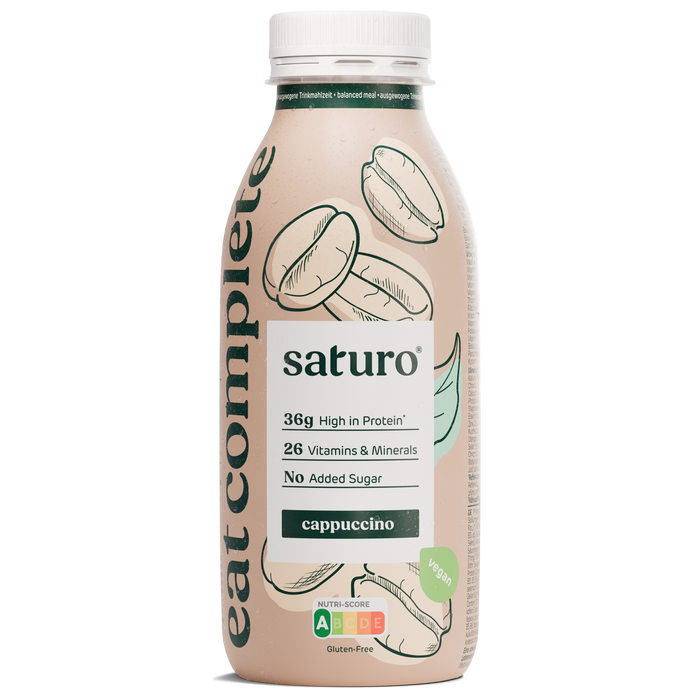
Trinkmahlzeit: eine vollwertige Mahlzeit aus der Flasche
26 Vitamine und Mineralstoffe, darunter Folsäure und Vitamin B12. Folat trägt zur normalen Blutbildung und zur Verringerung von Müdigkeit und Ermüdung bei. Referenzwert für Folsäure: 200 µg pro Tag (NRV). Für Tage, an denen Kochen nicht auf dem Plan steht.
Schwangerschaft, Alter, Psyche: Wer besonders aufpassen muss
Folsäuremangel Schwangerschaft: Warum die ersten vier Wochen zählen
Das Neuralrohr, aus dem Gehirn und Rückenmark entstehen, schließt sich zwischen dem 22. und 28. Tag nach der Befruchtung, wenn viele Frauen noch nicht wissen, dass sie schwanger sind. Fehlt dann Folat, bleibt das Rohr offen: Spina bifida, im schlimmsten Fall Anenzephalie. In Sachsen-Anhalt, wo das systematisch erfasst wird, betrifft es 9,3 von 10.000 Geburten. Dass Folsäure das verhindert, ist seit 1991 bewiesen: In der britischen MRC-Studie senkte sie das Wiederholungsrisiko um 72 %.
Die Empfehlung in Deutschland: 400 µg Folsäure täglich ab Kinderwunsch, nicht erst ab dem positiven Test, bis zum Ende der 12. Woche. Wer weniger als vier Wochen vor der Empfängnis beginnt, nimmt 800 µg.
Folsäure bei Kinderwunsch: Der Zeitplan
-
Kinderwunsch
Sofort 400 µg täglich
Am Tag, an dem die Verhütung endet, beginnt die Folsäure: 400 µg als Präparat, dazu folatreich essen. Die Speicher brauchen etwa vier Wochen, um das Schutzniveau zu erreichen. Wer erst später anfängt, nimmt 800 µg.
-
Woche 3–4
Das Neuralrohr schließt sich
Tag 22 bis 28 nach der Befruchtung, oft vor dem positiven Test. Jetzt entscheidet sich, ob Gehirn und Rückenmark sauber angelegt werden. Nachholen geht nicht, deshalb der frühe Start.
-
Bis Woche 12
Präparat weiter nehmen
Die Empfehlung gilt bis zum Ende des ersten Drittels. Danach reicht bei normalem Blutwert die Ernährung mit 550 µg, viele Ärzt:innen lassen das Präparat trotzdem weiterlaufen; Leber bleibt wegen Vitamin A vom Speiseplan.
-
Stillzeit
450 µg aus dem Essen
Folat geht in die Muttermilch über. Salat, gedämpftes Gemüse und Hülsenfrüchte decken den Bedarf; ein Präparat nur, wenn der Wert nach der Geburt niedrig ist oder die nächste Schwangerschaft geplant wird.
Nur etwa 40 % der Schwangeren in Deutschland machen es zum richtigen Zeitpunkt in der richtigen Dosis. Wer die Pille absetzt, beginnt am selben Tag.

Folsäuremangel im Alter
Ältere Menschen haben in Deutschland im Schnitt höhere Folatwerte als jüngere. Gefährdet sind zwei Gruppen: wer wenig isst, weil Appetit, Zähne oder Einsamkeit das Kochen erschweren, und wer Medikamente nimmt, die Folat kosten, oder regelmäßig Alkohol trinkt. Bei ihnen zeigt sich der Mangel zuerst als Vergesslichkeit, Antriebslosigkeit und gedrückte Stimmung, leicht für normales Altern gehalten; Reynolds nennt niedriges Folat und hohes Homocystein Risikofaktoren für Demenz. Im Alter ist der Vitamin-B12-Mangel häufiger, weil der Magen weniger Säure bildet, und beides sieht im Blutbild gleich aus. Deshalb Folat, B12 und Blutbild zusammen bestimmen, bevor jemand von Demenz spricht.
Folsäuremangel Psyche: Depression, Konzentration, Schlaf
Der Zusammenhang läuft in beide Richtungen. Menschen mit Depression haben im Schnitt niedrigere Folatwerte, das zeigt eine Meta-Analyse von 2017, und niedriges Folat kann die Depression vertiefen: Wer antriebslos ist, kocht nicht und isst kein Gemüse. Folsäure heilt keine Depression, aber bei einer Depression, die schlecht auf die Behandlung anspricht, gehört der Folatwert zur Diagnostik, und ein Mangel wird behoben. Konzentrationsprobleme, Reizbarkeit und Schlafstörungen sind bei einem Folatmangel möglich, aber fast nie das einzige Zeichen. Wer nur schlecht schläft und sonst nichts hat, hat keinen Folatmangel.
Folsäuremangel Wechseljahre
Die Wechseljahre verursachen keinen Folatmangel, und der Bedarf steigt nicht: Die DGE empfiehlt ab 51 dieselben 300 µg. Was sich überschneidet, sind die Symptome: Müdigkeit, Reizbarkeit, gedrückte Stimmung und Schlafstörungen stehen auf beiden Listen, deshalb wird ein Folatmangel in dieser Phase leicht auf die Hormone geschoben. Manche Anbieter empfehlen 400 bis 800 µg Folsäure am Tag; dafür gibt es keine Empfehlung einer Fachgesellschaft und keine Studie zu Hitzewallungen. Sinnvoll ist, bei anhaltender Erschöpfung Folat, B12, Ferritin und Schilddrüse messen zu lassen.
Folsäuremangel Folgen: Was passiert, wenn er bleibt
Ein grenzwertiger Wert über Wochen bleibt ohne Folgen, sobald er ausgeglichen ist. Bleibt der Mangel Monate, drohen vier Dinge: die Blutarmut mit Erschöpfung, Belastung fürs Herz und bei Älteren Stürzen; steigendes Homocystein, ein Marker für Gefäßrisiko, kein bewiesener Auslöser; das Nervensystem mit Stimmung und Gedächtnis, je länger, desto langsamer die Erholung; und das ungeborene Kind, weil ein Mangel in den ersten vier Wochen das Neuralrohr trifft. Alle vier lassen sich mit einer Blutabnahme, einem Dampfeinsatz und dem Präparat ab Kinderwunsch vermeiden.
Häufige Fragen zu Folsäuremangel
Wie macht sich ein Folsäuremangel bemerkbar?
Zuerst über das Blut: Müdigkeit, Blässe und Kurzatmigkeit durch eine Blutarmut mit vergrößerten roten Blutkörperchen. Dann über die Schleimhäute: brennende, glatte Zunge, eingerissene Mundwinkel, Appetitlosigkeit, Durchfall. Bei längerem Mangel Konzentrationsstörungen, Reizbarkeit und gedrückte Stimmung. Kribbeln ist selten und zuerst ein Verdacht auf Vitamin-B12-Mangel.
Wie viel Folsäure braucht man pro Tag?
Die DGE empfiehlt ab 13 Jahren 300 µg Folat-Äquivalente, in der Schwangerschaft 550 µg, in der Stillzeit 450 µg, Kinder 120 bis 240 µg. Bei Kinderwunsch zusätzlich 400 µg Folsäure als Präparat bis zum Ende der 12. Woche. Obergrenze für synthetische Folsäure: 1.000 µg am Tag.
Kann ein Folsäuremangel zu Gewichtszunahme führen?
Nein. Gewichtszunahme ist kein Symptom eines Folsäuremangels, in keiner Leitlinie. Wenn der Mangel etwas mit dem Gewicht macht, dann Gewichtsverlust über Appetitlosigkeit und Durchfall. Wer müde ist und zunimmt, lässt eher Schilddrüse, Vitamin B12 und Eisen prüfen. Auch Folsäure-Tabletten führen laut Gebrauchsinformation nicht zu Gewichtszunahme.
Hilft Folsäure beim Abnehmen?
Nein. Keine Studie zeigt, dass Folsäure das Abnehmen unterstützt, und kein Mechanismus spricht dafür: Folat ist ein Vitamin der Zellteilung, kein Stoffwechselbeschleuniger. Wer einen echten Mangel behebt, ist weniger müde, und Bewegung fällt leichter. Beim Abnehmen helfen Gemüse, Salat und Hülsenfrüchte, die nebenbei Folat liefern.
Verursacht ein Folsäuremangel Haarausfall?
Möglich, aber selten der Grund. Haarfollikel teilen sich schnell, ein ausgeprägter Mangel kann das Wachstum bremsen, die Studienlage ist dünn. Diffuser Haarausfall hat viel häufiger mit Eisenmangel, Schilddrüse, dem Ende einer Schwangerschaft oder Stress zu tun. Ferritin, Schilddrüse, B12 und Folat in einem Termin messen lassen.
Wie gefährlich ist ein Folsäuremangel für das ungeborene Kind?
In den ersten vier Wochen nach der Befruchtung schließt sich das Neuralrohr. Fehlt dann Folat, steigt das Risiko für Spina bifida oder Anenzephalie, etwa 9 von 10.000 Geburten. Folsäure senkt das Risiko, in der MRC-Studie um 72 %. Deshalb 400 µg ab Kinderwunsch bis zum Ende der 12. Woche.
Sind Vitamin B12 und Folsäure das Gleiche?
Nein, aber sie arbeiten im selben Stoffwechselweg, deshalb sehen sich die Mangelbilder ähnlich: zu große, zu wenige rote Blutkörperchen. Folat steckt in Gemüse und Hülsenfrüchten und ist nach Monaten aufgebraucht, Vitamin B12 kommt aus tierischen Lebensmitteln und reicht Jahre. Ein B12-Mangel schädigt zusätzlich die Nerven. Mehr im Artikel Vitamin-B12-Mangel.
Kann man Folsäure und Vitamin B12 gleichzeitig nehmen, und was verträgt sich nicht mit Folsäure?
Ja, bei einem Mangel an beiden ist das üblich. Wichtig ist die Reihenfolge: Erst B12-Mangel ausschließen oder mitbehandeln, sonst bringt Folsäure das Blutbild in Ordnung, während die Nervenschäden weiterlaufen. Vorsicht bei Antiepileptika, Methotrexat und Trimethoprim: Sie und Folsäure schwächen sich gegenseitig; die Dosis mit der Praxis absprechen.
Quellen · 25 Quellen anzeigen
- Deutsche Gesellschaft für Ernährung (DGE): Referenzwerte für die Nährstoffzufuhr, Folat. Empfohlene Zufuhr in Folat-Äquivalenten, Ableitung 2015; Supplementempfehlung bei Kinderwunsch.
- Deutsche Gesellschaft für Ernährung (DGE): Ausgewählte Fragen und Antworten zu Folat (Folat versus Folsäure, Folat-Äquivalente, Zufuhr in Deutschland, Zubereitung, Obergrenze).
- Bundesinstitut für Risikobewertung (BfR): Aktualisierung (2024): Höchstmengenvorschläge für Folsäure in Lebensmitteln inklusive Nahrungsergänzungsmitteln. Stellungnahme 009/2024 vom 22. Februar 2024.
- Netzwerk Gesund ins Leben (BLE): Handlungsempfehlungen Supplement Folsäure vor und in der Schwangerschaft (400 bzw. 800 µg, Neuralrohrdefekte 9,3/10.000 in Sachsen-Anhalt, Anteil korrekt supplementierender Frauen). Stand 06.07.2026.
- Max Rubner-Institut: Nationale Verzehrsstudie II, Ergebnisbericht Teil 2. Karlsruhe 2008, Kapitel 5.6.5 Folsäure und Tabelle A.43.
- Mensink G. B. M., Weißenborn A., Richter A.: Folate status in Germany (DEGS1). Journal of Health Monitoring 2016; 1(2): 24–28.
- Institute of Medicine (US): Dietary Reference Intakes for Thiamin, Riboflavin, Niacin, Vitamin B6, Folate, Vitamin B12, Pantothenic Acid, Biotin, and Choline. Kapitel 8 Folate. Washington 1998.
- Devalia V., Hamilton M. S., Molloy A. M., British Committee for Standards in Haematology: Guidelines for the diagnosis and treatment of cobalamin and folate disorders. British Journal of Haematology 2014; 166(4): 496–513.
- Baddam S., Khan K. M., Jialal I.: Folic Acid Deficiency. StatPearls, Treasure Island (FL), Stand 25. Juni 2025.
- Reynolds E. H.: The neurology of folic acid deficiency. Handbook of Clinical Neurology 2014; 120: 927–943.
- Koike H., Takahashi M., Ohyama K. et al.: Clinicopathologic features of folate-deficiency neuropathy. Neurology 2015; 84(10): 1026–1033.
- Bender A., Hagan K. E., Kingston N.: The association of folate and depression: A meta-analysis. Journal of Psychiatric Research 2017; 95: 9–18.
- Petridou E. T., Kousoulis A. A., Michelakos T. et al.: Folate and B12 serum levels in association with depression in the aged: a systematic review and meta-analysis. Aging & Mental Health 2016; 20(9): 965–973.
- McKillop D. J., Pentieva K., Daly D. et al.: The effect of different cooking methods on folate retention in various foods that are amongst the major contributors to folate intake in the UK diet. British Journal of Nutrition 2002; 88(6): 681–688.
- MRC Vitamin Study Research Group: Prevention of neural tube defects: results of the Medical Research Council Vitamin Study. Lancet 1991; 338(8760): 131–137.
- Williams J., Mai C. T., Mulinare J. et al.: Updated estimates of neural tube defects prevented by mandatory folic acid fortification, United States, 1995–2011. MMWR 2015; 64(1): 1–5.
- Chen M.-Y., Rose C. E., Qi Y. P. et al.: Defining the plasma folate concentration associated with the red blood cell folate concentration threshold for optimal neural tube defects prevention. American Journal of Clinical Nutrition 2019; 109(5): 1452–1461.
- Sanvisens A., Zuluaga P., Pineda M. et al.: Folate deficiency in patients seeking treatment of alcohol use disorder. Drug and Alcohol Dependence 2017; 180: 417–422.
- Shere M., Bapat P., Nickel C., Kapur B., Koren G.: Association Between Use of Oral Contraceptives and Folate Status: A Systematic Review and Meta-Analysis. Journal of Obstetrics and Gynaecology Canada 2015; 37(5): 430–438.
- Ezenekwe L., Camacho G. A., Green P. H. R., Lebwohl B.: Prevalence and Predictors of Folate Deficiency in Patients with Celiac Disease. Digestive Diseases and Sciences 2026.
- Hickey S. E., Curry C. J., Toriello H. V.: ACMG Practice Guideline: lack of evidence for MTHFR polymorphism testing. Genetics in Medicine 2013; 15(2): 153–156 (Addendum 2020).
- Almohanna H. M., Ahmed A. A., Tsatalis J. P., Tosti A.: The Role of Vitamins and Minerals in Hair Loss: A Review. Dermatology and Therapy 2019; 9(1): 51–70.
- Schisterman E. F., Sjaarda L. A., Clemons T. et al.: Effect of Folic Acid and Zinc Supplementation in Men on Semen Quality and Live Birth Among Couples Undergoing Infertility Treatment: A Randomized Clinical Trial. JAMA 2020; 323(1): 35–48.
- Gebrauchsinformation Folsan 5 mg Tabletten (Folsäure): Anwendungsgebiete, Dosierung, Gegenanzeigen, Nebenwirkungen, Wechselwirkungen.
- U.S. Department of Agriculture, Agricultural Research Service: FoodData Central, SR Legacy Release (2018). Folatgehalte (Folat-Äquivalente) pro 100 g.
Schreibt seit 2019 für Saturo über Ernährung, Nährstoffe und die Frage, wie gute Versorgung im Alltag praktisch funktioniert.
Hat diesen Artikel am 16. September 2026 auf fachliche Richtigkeit geprüft. Die Inhalte ersetzen keine ärztliche Beratung.

Vitamin-B12-Mangel: Symptome, Ursachen und Behandlung
Der Partner des Folats: Warum ein B12-Mangel die Nerven vor dem Blut trifft, welcher Wert zählt und wann Tabletten reichen.
Weiterlesen · 16 Min

Neues aus dem Ratgeber
Neue Artikel, Updates und Tipps direkt ins Postfach. Verständlich, fachlich geprüft, ohne Spam.
Danke! Bitte bestätige die Anmeldung in deinem Postfach.