
Biotin Deficiency: Symptoms, Causes and Treatment
Thinning hair, brittle nails, flaky skin around the nose and mouth? A real biotin deficiency is rare, and there's almost always a trigger behind it. Which symptoms really fit, when biotin tablets do more harm than good, and where biotin is found.


Aktualisiert 1 October 2026 · 15 Min. Lesezeit · 61 Quellen

The essentials in 30 seconds
The DGE's estimated value for everyone aged 15 and up, including during pregnancy; breastfeeding women need 45 µg. One boiled egg plus 50 g of oats together provide about half of that.
From this daily dose in supplements, the EMA and BfR warn: biotin interferes with blood tests for the thyroid, heart and hormones. So always mention that you're taking biotin before any blood draw.
is what many hair-skin-nail supplements contain, 125 times the daily requirement. It's not toxic, but at 10 mg a day, one study found 39% of the blood tests checked came back skewed.
that biotin makes you gain weight: it has no calories, and no study shows weight gain from supplements. If you're putting on weight, get your thyroid and medications checked instead.
Biotin deficiency symptoms: how to spot it
Biotin, also known as vitamin B7 or vitamin H, helps power five enzymes that keep the metabolism of fat, sugar and protein running. If it's lacking, it shows up in skin, hair and nerves, gradually. A vitamin B7 deficiency is very rare with a normal diet; there's almost always a trigger from chapter 2 behind it. Here are the signs, honestly weighed up.
Biotin deficiency, hair and hair loss
Thinning hair, right through to hair loss over the whole body, is the first sign named by sources such as the NIH, often together with loss of eyebrows and eyelashes. But: hair loss much more often comes from iron deficiency, thyroid issues, hormones, stress or genetics. In one hair clinic, 38% of women with hair loss did have a low biotin level in the blood, but only one in ten of them had a genuine risk, and the author himself warns that the blood value says little. Without a trigger from chapter 2, biotin is almost never the reason for hair loss, zinc or iron are more likely culprits.

Biotin deficiency, skin and face
A typical sign is a scaly, reddened rash around body openings: eyes, nostrils, corners of the mouth, also in the genital area. It looks similar to the rash seen with zinc deficiency, and the yeast Candida often settles on it. In severe deficiency, the NIH also describes an unusual fat distribution in the face, known as "biotin deficiency facies". Dry skin, spots or rosacea aren't part of this. Cracked corners of the mouth alone point more towards vitamin B2 or iron deficiency, and flaky skin on the face more often towards seborrhoeic dermatitis. A biotin cream is cosmetic, not a treatment.
Brittle nails
Soft, splitting nails appear on every list of deficiency signs, and as an accompanying sign of a genuine deficiency they're well documented. The claim that biotin tablets strengthen brittle nails in otherwise healthy people rests on three small studies without a placebo group from the 1990s using 2.5 mg; this is why EFSA hasn't approved a nail-related claim. Brittle nails more often come from water, washing-up liquid, nail polish remover, iron deficiency or thyroid issues.
Nerves and mood: what biotin actually does there
"Biotin effect on mood" is one of the most common searches related to this article, and the answer has two sides. In a genuine, severe deficiency, depression, lack of drive, hallucinations and tingling in the arms and legs are well documented, along with muscle weakness and seizures in infants. In people who are otherwise well supplied, extra biotin does nothing for mood: the only approved claim is that biotin contributes to normal psychological function, meaning maintenance, not improvement. If you feel inwardly restless or low, get vitamin B12, vitamin D, thyroid function and iron checked instead.
What really fits with biotin deficiency
Twelve complaints from searches and forums, and what the studies actually say about them.
| What the studies say | Rating | |
|---|---|---|
| Hair loss, thinning hair | NIH, DGE, case reports; in genuine deficiency, can extend to loss of body hair | Proven |
| Scaly rash around the eyes, nose, mouth | Classic sign, similar to zinc deficiency, often with Candida | Proven |
| Conjunctivitis | Sign of severe deficiency, also seen in biotinidase deficiency | Proven |
| Tingling, depression, lack of drive | Described in severe deficiency (NIH) | Proven |
| Seizures, muscle weakness in babies | Biotinidase deficiency, part of newborn screening | Proven |
| Brittle nails | Accompanying sign; benefit of tablets only shown in small studies without a placebo | Possible |
| Tiredness with no other signs | Only described as lethargy in severe deficiency; EFSA did not approve a tiredness claim | Unproven |
| Being overweight, weight gain | No human study; in animals, deficiency tends to cause weight loss instead | Unproven |
| Menopause symptoms | No source found | Unproven |
| High blood pressure | No study; biotinidase deficiency tends to cause low blood pressure instead | Unproven |
| Acne, blemished skin | No study, only theories from forums | Unproven |
| Sleep problems | No source found | Unproven |
Based on NIH ODS 2022, DGE FAQ 2020, Mock 1991, Patel 2017, Lipner 2018, Belda 2022, Watanabe-Kamiyama 2008, Regulation (EU) 432/2012, and a keyword search in Europe PMC. As of 1 October 2026.
Biotin deficiency symptoms in women
There are no signs that only show up in women. Two things are specific to women, though. First, the risk: during pregnancy and breastfeeding the body breaks down biotin faster, more on that in chapter 7. Second, the mix-up: hair loss, brittle nails and dry skin during menopause are usually linked to hormonal changes; no study backs a connection between biotin deficiency and menopause. The same signs can also be caused by iron deficiency, which is common in women before menopause and should be checked first.
Biotin deficiency and being overweight: what's true?
Biotin deficiency doesn't make you gain weight, there's no evidence for that. What's actually backed up is the reverse link: in people with severe obesity, biotin levels tended to be lower in one large European study, likely because an unbalanced diet and altered gut flora reduce the supply; cause and effect remain unclear. If you're gaining weight and feeling tired, get your thyroid, blood sugar and medications checked. And if you're taking biotin tablets and gaining weight: you'll find the answer in chapter 5.
Hair loss together with a rash around the eyes, nose or mouth, plus tingling or conjunctivitis, especially if you eat raw eggs, take anti-epileptic drugs or drink a lot of alcohol: get it checked out medically. In infants with muscle weakness, seizures or a skin rash, go to the paediatrician straight away.
Biotin deficiency causes: who's really at risk
Not eating enough is almost never the reason: in Germany, women take in a median of 36 to 42 µg of biotin a day, men 43 to 48 µg, so the estimated requirement of 40 µg is already met. A deficiency develops when something binds biotin, breaks it down faster, or disrupts absorption: raw egg white, medications, alcohol, bowel issues, dialysis, or an inherited enzyme defect.
Raw egg white: how avidin binds biotin
Raw egg white contains avidin, a protein that binds biotin so tightly the gut can no longer absorb it. Four weeks of egg-white drinks high in avidin produced a measurable but symptom-free deficiency in healthy people. Heat destroys avidin: thoroughly cooked eggs aren't a problem; with soft-boiled, poached or fried eggs, one measurement found some binding capacity remained. Documented deficiency cases only occurred with several raw egg whites a day over months, for instance in one case report involving five to eight raw egg whites a day over 16 months. No source gives a threshold of "from X eggs onwards".
of biotin actually reaches you: the avidin binds more biotin than the whole egg provides, and also takes other biotin from the meal with it
of biotin, a quarter of the daily requirement, over 80% of it in the yolk; the heat has neutralised the avidin
Medications: anti-epileptics, isotretinoin, antibiotics
The best-documented case is anti-epileptic drugs: among 264 people with epilepsy, those on carbamazepine, phenytoin, phenobarbital and primidone for at least a year had significantly lower biotin levels than a comparison group, as these drugs speed up its breakdown. For the acne medication isotretinoin, disrupted biotin metabolism is only a suspicion from one small study; dermatology reviews name long-term broad-spectrum antibiotics and sulfonamides as a possible cause. Under valproate, biotin levels stay normal, yet in individual cases hair loss improved with 10 mg of biotin. If you take any of these medications, never stop them on your own, instead bring up biotin with your doctor.
Alcohol, smoking, bowel issues and dialysis
Years of heavy alcohol use inhibits absorption in the gut; 15% of people with alcohol dependence have a low biotin level, usually alongside vitamin B1 deficiency. Smoking speeds up breakdown: in one small study, female smokers excreted 30% less biotin, a sign of tight reserves. In Crohn's disease and ulcerative colitis, biotin deficiency based on metabolic markers was more common than in healthy people. Two rare but classic triggers: dialysis and intravenous feeding without added biotin. Being vegan or vegetarian, on the other hand, isn't a risk, soybeans, nuts, oats and mushrooms are among the best sources.
Inherited: biotinidase deficiency
About one in 60,000 to 80,000 newborns can't recycle biotin because the enzyme biotinidase is missing. Left untreated, this risks seizures, muscle weakness, rash, hair loss, hearing loss and developmental delay. In Germany, the test is part of newborn screening from the heel-prick blood sample; if caught early and biotin is taken for life, development is normal. Rarely, the condition only comes to light in teenagers or adults, with optic nerve and spinal cord damage that can initially look like multiple sclerosis. More on this in chapter 7.
How biotin works in the body
Three stops from your plate to your cells. Know them and you'll understand why biotin almost never runs short, why a tablet can't do more than food already does, and why it still messes with your blood test.
One vitamin, three names
Biotin is also called vitamin B7 or vitamin H; "vitamin B8" is an outdated French numbering. It has nothing to do with vitamin B12 apart from both belonging to the family of water-soluble B vitamins. The gut absorbs about half of it from food, and nearly all of it from tablets; protein-bound biotin from meat and grains has to be released first.
Key to five enzymes
Biotin's effect comes down to five carboxylases: enzymes that build fatty acids, make new sugar from protein, and break down amino acids. Without biotin, these steps stall, and tissue with high turnover suffers first: skin, hair roots, nerves, gut. The seven approved health claims describe exactly that: normal energy metabolism, normal skin, normal hair.
Small store, own cycle
The body's store sits mainly in the liver and doesn't last long. To compensate, the body recycles: the enzyme biotinidase releases used biotin from its enzymes again, and gut bacteria produce some, though how much actually reaches the body is unclear. Excess goes into the urine, which is why there's no poisoning risk, but high doses still leave enough biotin in the blood to throw off lab tests.
Biotin deficiency test: how it's diagnosed
Whether biotin is lacking is harder to measure than with most vitamins: there's no routine value that reliably shows a mild deficiency. Here are the two questions readers ask most, the blood test and the at-home self-test.
Can you detect biotin deficiency in the blood?
Only to a limited extent. Labs offer serum biotin, as a self-pay test for around €50, but the value barely drops in mild deficiency, and normal ranges vary tenfold between labs because the tests also pick up breakdown products. More reliable markers are in the urine, such as 3-hydroxyisovaleric acid, or enzyme activity in white blood cells, research methods that hardly any lab offers. In practice, what counts is your history: raw eggs, medications, alcohol, bowel issues, plus the typical skin signs; iron, zinc and thyroid are checked alongside. If an inherited biotinidase deficiency is suspected, enzyme activity is measured in the serum.

Biotin deficiency test at home: what self-tests are worth
The "self-tests" on manufacturer websites are questionnaires: they tally up hair loss, brittle nails and tiredness, and then recommend a product. This says nothing about your actual biotin status, the symptoms are unspecific. At-home dried-blood tests measure serum biotin with the same weaknesses as the lab version; consumer protection groups advise caution with online providers, since selling products is their main focus. If there's good reason for suspicion, your GP will arrange testing, and your health insurer covers it; without suspicion, an all-round vitamin test rarely makes sense in Germany.
If you're taking a biotin supplement, including a hair-skin-nail product, a B-complex or a multivitamin, mention it at the lab. It can skew the biotin value and many other tests; the lab will tell you how long to pause beforehand.
Correcting biotin deficiency: treatment, dose and side effects
A genuine deficiency is easy to treat: remove the cause, supplement biotin, with the dose set by the doctor. The trickier part of this chapter is the other side, since most readers are already taking biotin: does it cause weight gain, does it have side effects, and what does it do to a blood test?
Treatment: how long it takes for biotin to work
First the cause: cut out raw egg white, discuss medications with your doctor, reduce alcohol. Then free biotin as a medicine; typical doses are 2.5 to 5 mg a day for acquired deficiency, 5 to 20 mg for life for biotinidase deficiency, though there's no guideline with fixed doses for adults. How long: metabolism and skin improve within days to weeks, hair needs months due to the hair cycle, around three in case reports. Nerve damage doesn't always fully reverse if treatment starts late. Without a deficiency, biotin speeds up nothing, not even hair growth.
Most people who come to me with hair loss are already taking biotin, often 5 or 10 milligrams, 125 to 250 times what's needed. It hasn't harmed their hair, but it's rarely helped either, because a genuine biotin deficiency is extremely rare with a normal diet. My advice: look for the cause first, iron, thyroid, hormones, and tell the lab about any biotin supplement, otherwise those very values won't be accurate.
Joerg Hauke, Nutrition expert, technical review of this article
Biotin and weight gain: what's true?
No, there's no evidence that biotin causes weight gain: biotin has no calories, and no study shows weight gain from biotin supplements. Neither the NIH, DGE nor BfR mention it; the only side effect listed in the leaflet for a 5 mg product is very rare hives. What's really behind it when your weight goes up while you're taking biotin: concurrent causes like menopause, an underactive thyroid, medications or less exercise. And there's a catch: biotin can distort thyroid lab values, so a genuine underactive thyroid may be missed or an overactive one falsely suggested, more on that below. The reverse is also true: biotin doesn't help with weight loss.
Biotin side effects and overdose
Biotin is considered practically non-toxic: excess is excreted in urine, neither the EFSA nor the BfR has set an upper limit, and according to the DGE no adverse effects are known at up to 20 mg a day. Side effects are rare: hives in fewer than one in 10,000 people treated, allergies very rare. Acne, skin rash, high blood pressure or heart racing are not documented anywhere; in biotinidase deficiency, blood pressure tends to be low. The only real risk of overdose is the blood test: from 150 µg a day, thyroid, heart and hormone values can come back wrong. The scale shows where your dose sits.
Biotin before a blood draw: which lab values it distorts
Many blood tests use the binding of biotin to streptavidin as their underlying technology. If you take a lot of biotin, it circulates in your blood and interferes with exactly this mechanism: sandwich tests like TSH or troponin come back falsely low, competitive tests like fT4, fT3 or oestradiol come back falsely high. The result: a falsely suggested overactive thyroid with unnecessary treatment, or a missed heart attack. How long to pause beforehand: around 8 hours after 5 mg, one to two days after 10 mg, longer with kidney impairment, and the FDA doesn't give a definite safe period. So: tell the lab, and pause as agreed.
Which blood values biotin distorts
Documented interference from supplemental biotin, depending on the lab's test method.
| Direction | Possible misinterpretation | |
|---|---|---|
| TSH (thyroid) | Falsely low | Apparent overactive thyroid, unnecessary treatment |
| fT4, fT3 (thyroid hormones) | Falsely high | Falsely suggested Graves' disease |
| Troponin (heart attack marker) | Falsely low | Heart attack missed; one death reported to the FDA |
| BNP, NT-proBNP (heart failure) | Falsely low | Heart failure underestimated |
| Parathyroid hormone (PTH) | Falsely low | Below detection limit even at 1.5 mg |
| 25-OH vitamin D | Falsely high | Apparently oversupplied; case report in dialysis |
| Oestradiol, cortisol, other hormones | Falsely high | Incorrect hormone diagnoses |
| HIV test, hepatitis B (HBs antigen) | Falsely negative | Infection missed |
Based on BfArM Bulletin 4/2018, EMA/PRAC 2019, Li 2017 (JAMA), Zhang 2020, Plasse 2020 and MVZ Labor Ludwigsburg 2019. Which tests are affected depends on the equipment; ask the lab. As of 1 October 2026.
Only procedures using streptavidin technology are affected; some manufacturers have switched their tests since 2019, others haven't, and you can't tell from the result which test was used. The problem is widespread: in a US emergency department, 7.4% of blood samples had biotin levels above the interference threshold. So the rule applies without exception: always tell them you're taking biotin before any blood draw, even if it's a hair-skin-nails combo or a B-complex, and tell the paramedics in an emergency too. The same goes for high-dose biotin medicines; the warning has been on the package leaflet since 2019.
Biotin foods: where you'll find the most
Biotin is found in many foods, but the table values are less reliable than for almost any other vitamin: depending on the database and measuring method, they vary by a factor of two to forty. The bars therefore show rough orders of magnitude based on the German Food Code, as eaten; liver blows every scale and is covered in the note.
Biotin per 100g: top 10 plant-based and animal-based
German Food Code 4.0 (2025), nuts and seeds dried, soya beans cooked, mushrooms steamed. In portions: 30g almonds around 21 µg, 30g hazelnuts 18, 30g sunflower seeds 17, 150g mushrooms 30, 150g soya beans 32, 50g porridge oats 10 µg (the most robust figure, confirmed by both the USDA and DGE). A caution with nuts: other measurements find 4 to 57 µg in almonds, 3 to 17 in walnuts; the ranking holds, the number is just an order of magnitude. Fruit provides 1 to 5 µg per portion.
How much biotin is in an egg?
Around 9 to 12 µg, a quarter to just under a third of the daily requirement, with over 80% of it sitting in the yolk. This applies to fully cooked eggs; in raw egg white, avidin binds the biotin (chapter 2). Two eggs as scrambled eggs come to around 21 µg, more than any fruit and most types of meat. This makes eggs, alongside nuts, porridge oats, mushrooms and soya beans, one of the more reliable sources where the databases roughly agree.

Nuts, porridge oats and fruit: plant-based sources
Which fruit is high in biotin? None really: fresh fruit provides just 1 to 5 µg per portion, with honeydew melon, avocado and banana at the top, dried fruit a little higher. The real plant-based sources are elsewhere: a handful of nuts or seeds (5 to 20 µg depending on the measurement), 50g porridge oats (around 10 µg), 150g mushrooms or cooked soya beans (around 30 µg), plus wholegrain bread, pulses and dairy products in small but regular amounts. This makes it easy to get enough on a vegan diet. Cooking losses are minimal, as biotin is more heat-stable than vitamin C; it does leach into cooking water, so steaming helps.
Biotin deficiency: what should you eat?
Variety instead of supplements: a breakfast with oats and nuts, an egg, mushrooms or legumes at lunch, plus dairy products, and your day works out to over 40 µg, vegan included. Eggs should only be eaten fully cooked; raw egg white isn't something to have daily. If you have an actual deficiency, you'll need biotin as a medicine on top, no food can replace that. On days with canteen food, sandwiches and sweets, it's often exactly this group that's missing; a drinkable meal is then a manageable contribution without going overboard on doses: one bottle of Saturo contains 15 µg biotin, 30% of the reference intake, plus 25 other vitamins and minerals, 36 g protein and 400 kcal, well below any lab threshold.
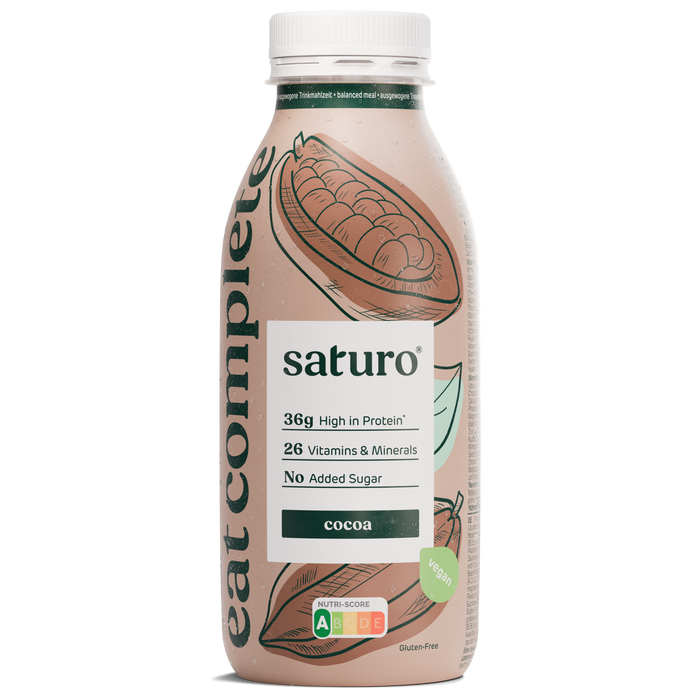
Drinkable meal: a complete meal in a bottle
26 vitamins and minerals, including biotin, vitamin B6, B12 and folic acid. One bottle provides 15 µg biotin, that's 30% of the reference intake of 50 µg per day (NRV).
Biotin for hair loss, during pregnancy and in babies
Three situations where the answer isn't "more biotin" or isn't yours to decide: hair loss without a deficiency, pregnancy and breastfeeding, and the rare genetic condition every newborn is screened for.
Does biotin help with hair loss if you're not deficient?
No, there's no solid study to support that. Reviews up to 2017 found not a single controlled study on biotin for hair loss or hair quality in healthy people; in the 18 published cases showing improvement, everyone affected had either a deficiency or a rare hair shaft defect. The same applies to vitamin B5, where hair loss was only shown in animal studies. The German S3 guideline on alopecia areata advises against supplementation. More common causes are iron deficiency, thyroid issues, hormonal changes, stress, medication, and genetics. If you take biotin anyway, it won't harm your hair, but it will mess with your next blood test.
Biotin during pregnancy and breastfeeding
The estimated requirement stays at 40 µg, rising to 45 µg while breastfeeding, because biotin passes into breast milk. Even so, urine markers show a mild, symptomless deficiency in about one in three pregnant women, as the body breaks down biotin faster; in mice this led to malformations, but no effect has been shown in humans, and the significance remains unclear according to the NIH. Standard pregnancy supplements contain biotin in the microgram range, which is enough. Don't take high-dose hair supplements without checking with your doctor first: they can distort thyroid and hormone lab results, and the BfArM specifically lists pregnant women as a risk group for this.

Babies and children: biotinidase deficiency and newborn screening
About one in 60,000 to 80,000 children is born with biotinidase deficiency, with roughly one in 120 people carrying the gene. In Germany, every newborn is tested for it in the first days of life using a heel-prick blood sample. When the condition is detected this way, children take 5 to 20 mg of biotin daily for life and develop normally; in a 30-year study, all children diagnosed early remained symptom-free. Left untreated, it can cause seizures, muscle weakness, skin rash, hearing loss and developmental delay, not all of which is reversible. For healthy children, the estimated requirement is 20 to 35 µg, and they don't need a supplement.
Frequently asked questions about biotin deficiency
Is vitamin B12 the same as biotin?
No. Biotin is vitamin B7 (also known as vitamin H), vitamin B12 is cobalamin; they only belong to the same family of water-soluble B vitamins. B12 is found almost exclusively in animal foods and is often lacking in a vegan diet, while biotin is found in both plants and animals and is almost never lacking. Tingling is more likely to point to a B12 issue.
What happens if you take biotin every day?
Nothing useful, if your diet is already normal: the excess is flushed out in your urine, and biotin isn't toxic. Two things do happen though: from 150 µg a day, blood tests for your thyroid, heart, and hormones can come back wrong, and the biotin blood level itself then reflects the tablet, not your actual status.
When shouldn't you take biotin?
Before a blood test, unless you've discussed it with your doctor or the lab, and if you have a known allergy, which is very rare. Be careful with kidney problems, during pregnancy, and in children: the lab interference lasts longer there. If you take anti-epileptic medication, talk to your doctor about biotin instead of dosing it yourself.
What doesn't mix well with biotin?
Raw egg white: its avidin binds biotin in your gut. Alcohol and smoking speed up its breakdown, and anti-epileptic drugs like carbamazepine, phenytoin, and phenobarbital lower your levels. There are no known interactions with other vitamins or minerals; taking biotin together with vitamin D, zinc, or magnesium is fine.
How long can you take biotin for?
If you have a confirmed deficiency, until the cause is resolved and your symptoms are gone; for congenital biotinidase deficiency, for life — your doctor decides both. Without a deficiency, there's no reason to take it long-term: the German Nutrition Society (DGE) sees no benefit beyond the recommended intake, not even for hair and nails.
Should I take biotin in the morning or evening?
There's no study on this, and the timing doesn't matter: biotin is absorbed at nearly 100%, with or without food. What matters more is the timing before a blood test: with high-dose supplements, the interference peaks two hours after taking it and can last up to two days.
Can you take L-thyroxine and biotin together?
The two substances don't interfere with each other, but biotin skews exactly the thyroid values used to adjust your L-thyroxine dose: TSH comes back falsely low, fT4 falsely high, which looks like an overdose. If you take both, mention it before every lab check, or pause biotin after talking to your doctor.
Does biotin make your hair thicker?
Not in healthy people: there's no controlled study showing thicker or fuller hair from biotin, and the DGE states that hair and nails don't improve beyond the recommended intake. Hair only got thicker in children with a rare hair shaft defect and in cases of a genuine deficiency.
Sources · 61 sources anzeigen
- German Nutrition Society (DGE): Reference values for nutrient intake, Biotin (estimated value 40 µg, as of 2020).
- German Nutrition Society (DGE): Selected questions and answers on biotin, as of November 2020.
- Jungert A., Ellinger S., Watzl B., Richter M.: Revised D-A-CH reference values for the intake of biotin. European Journal of Nutrition 2022; 61(4): 1779–1787.
- EFSA NDA Panel: Scientific Opinion on Dietary Reference Values for biotin. EFSA Journal 2014; 12(2): 3580.
- EFSA: Overview on Tolerable Upper Intake Levels as derived by the SCF and the EFSA NDA Panel, Version 11 (August 2025).
- Federal Institute for Risk Assessment (BfR): Proposed maximum levels for biotin in foods including food supplements (as of 15 March 2021).
- Federal Institute for Risk Assessment (BfR): FAQ “Biotin supplements can distort laboratory tests” of 21 May 2026.
- National Institutes of Health, Office of Dietary Supplements: Biotin, Fact Sheet for Health Professionals (as of January 2022).
- Mock D. M.: Biotin: From Nutrition to Therapeutics. Journal of Nutrition 2017; 147(8): 1487–1492.
- Mock D. M.: Skin manifestations of biotin deficiency. Seminars in Dermatology 1991; 10(4): 296–302.
- Patel D. P., Swink S. M., Castelo-Soccio L.: A Review of the Use of Biotin for Hair Loss. Skin Appendage Disorders 2017; 3(3): 166–169.
- Soleymani T., Lo Sicco K., Shapiro J.: The Infatuation With Biotin Supplementation: Is There Truth Behind Its Rising Popularity? Journal of Drugs in Dermatology 2017; 16(5): 496–500.
- Trüeb R. M.: Serum Biotin Levels in Women Complaining of Hair Loss. International Journal of Trichology 2016; 8(2): 73–77.
- Colombo V. E., Gerber F., Bronhofer M., Floersheim G. L.: Treatment of brittle fingernails and onychoschizia with biotin: scanning electron microscopy. Journal of the American Academy of Dermatology 1990; 23(6): 1127–1132.
- Lipner S. R., Scher R. K.: Biotin for the treatment of nail disease: what is the evidence? Journal of Dermatological Treatment 2018; 29(4): 411–414.
- Belda E. et al. (MetaCardis Consortium): Impairment of gut microbial biotin metabolism and host biotin status in severe obesity. Gut 2022; 71(12): 2463–2480.
- Orphanet: Biotinidase deficiency (ORPHA:79241), prevalence, course, treatment.
- German Society for Newborn Screening (DGNS): Target diseases of newborn screening, biotinidase deficiency.
- Wolf B.: Biotinidase Deficiency. GeneReviews, University of Washington, Seattle (PMID 20301497).
- Porta F. et al.: Neonatal screening for biotinidase deficiency: A 30-year single center experience. Molecular Genetics and Metabolism Reports 2017; 13: 80–82.
- Mock D. M., Quirk J. G., Mock N. I.: Marginal biotin deficiency during normal pregnancy. American Journal of Clinical Nutrition 2002; 75(2): 295–299.
- Mock D. M. et al.: Marginal biotin deficiency is teratogenic in ICR mice. Journal of Nutrition 2003; 133(8): 2519–2525.
- Perry C. A. et al.: Pregnancy and lactation alter biomarkers of biotin metabolism in women consuming a controlled diet. Journal of Nutrition 2014; 144(12): 1977–1984.
- Mock D. M., Dyken M. E.: Biotin catabolism is accelerated in adults receiving long-term therapy with anticonvulsants. Neurology 1997; 49(5): 1444–1447.
- Castro-Gago M. et al.: The influence of valproic acid and carbamazepine treatment on serum biotin and zinc levels and on biotinidase activity. Journal of Child Neurology 2011; 26(12): 1522–1524.
- Aksac S. E. et al.: Evaluation of biophysical skin parameters and hair changes in patients with acne vulgaris treated with isotretinoin, and the effect of biotin use on these parameters. International Journal of Dermatology 2021; 60(8): 980–985.
- Piraccini B. M. et al.: Biotin: overview of the treatment of diseases of cutaneous appendages and of hyperseborrhea. Giornale Italiano di Dermatologia e Venereologia 2019; 154(5): 557–566.
- Sealey W. M., Teague A. M., Stratton S. L., Mock D. M.: Smoking accelerates biotin catabolism in women. American Journal of Clinical Nutrition 2004; 80(4): 932–935.
- Subramanya S. B. et al.: Inhibition of intestinal biotin absorption by chronic alcohol feeding: cellular and molecular mechanisms. American Journal of Physiology, Gastrointestinal and Liver Physiology 2011; 300(3): G494–G501.
- Erbach J. et al.: Relevance of Biotin Deficiency in Patients with Inflammatory Bowel Disease and Utility of Serum 3-Hydroxyisovaleryl Carnitine as a Practical Everyday Marker. Journal of Clinical Medicine 2022; 11(4): 1118.
- Stratton S. L. et al.: Urinary excretion of 3-hydroxyisovaleryl carnitine is an early and sensitive indicator of marginal biotin deficiency in humans. Journal of Nutrition 2011; 141(3): 353–358.
- Mock N. I. et al.: Increased urinary excretion of 3-hydroxyisovaleric acid and decreased urinary excretion of biotin are sensitive early indicators of decreased biotin status in experimental biotin deficiency. American Journal of Clinical Nutrition 1997; 65(4): 951–958.
- Eng W. K. et al.: Identification and assessment of markers of biotin status in healthy adults. British Journal of Nutrition 2013; 110(2): 321–329.
- Durance T. D.: Residual avidin activity in cooked egg white assayed with improved sensitivity. Journal of Food Science 1991; 56(3): 707–709.
- Krabbe B.: Biotin Deficiency Caused By Long-Term Raw Egg Consumption: A Case Report. Nutritional Perspectives 2023; 46(3).
- Bioscientia Institute for Medical Diagnostics: Laboratory test biotin (vitamin H) in serum, method, reference range, GOÄ (as of 1 October 2026).
- Verbraucherzentrale: Which vitamin deficiency tests make sense? (as of 6 January 2026).
- Verbraucherzentrale: Does biotin provide healthy skin, shiny hair and strong nails? (as of 10 March 2026).
- Patient information leaflet Biotin 5 mg tablets (ratiopharm), as of September 2014: usage, dosage, side effects.
- AWMF/DDG: S3 guideline on diagnosis and treatment of alopecia areata, part 2: treatment. Journal der Deutschen Dermatologischen Gesellschaft 2026; 24(8): 1155–1179.
- U.S. Food and Drug Administration: UPDATE: The FDA Warns that Biotin May Interfere with Lab Tests, Safety Communication of 5 November 2019 (archived version).
- U.S. Food and Drug Administration: Biotin Interference with Troponin Lab Tests, Assays Subject to Biotin Interference (as of 21 June 2022).
- European Medicines Agency, PRAC: Recommendations on signals adopted at the 14–17 January 2019 PRAC meeting, Biotin: Interference with clinical laboratory tests.
- Federal Institute for Drugs and Medical Devices (BfArM): Rote-Hand-Brief (Dear Healthcare Professional letter) on biotin-containing medicines of 15 May 2019.
- Katić J., Bick N. (BfArM): Biotin interference in laboratory tests. Bulletin zur Arzneimittelsicherheit 4/2018, pages 12–19.
- Li D. et al.: Association of Biotin Ingestion With Performance of Hormone and Nonhormone Assays in Healthy Adults. JAMA 2017; 318(12): 1150–1160.
- Zhang Y. et al.: Biotin interference in thyroid function tests and its duration after 5 and 10 mg per day. Medicine 2020; 99(9): e19232.
- Ylli D., Soldin S. J., Stolze B. et al.: Biotin Interference in Assays for Thyroid Hormones, Thyrotropin and Thyroglobulin. Thyroid 2021; 31(8): 1160–1170.
- Katzman B. M. et al.: Prevalence of biotin supplement usage in outpatients and plasma biotin concentrations in patients presenting to the emergency department. Clinical Biochemistry 2018; 60: 11–16.
- Plasse R. A., Olson S. W., Yuan C. M., Nee R.: Biotin interference in parathyroid hormone and 25-hydroxyvitamin D assays in a hemodialysis patient. Clinical Kidney Journal 2020; 13(4): 710–712.
- MVZ Labor Ludwigsburg: Influence of high doses of biotin on test results, Laboratory information July 2019.
- Cree B. A. C. et al. (SPI2): Safety and efficacy of MD1003 (high-dose biotin) in patients with progressive multiple sclerosis (SPI2): a randomised, double-blind, placebo-controlled, phase 3 trial. Lancet Neurology 2020; 19(12): 988–997.
- Watanabe-Kamiyama M. et al.: Antihypertensive effect of biotin in stroke-prone spontaneously hypertensive rats. British Journal of Nutrition 2008; 99(4): 756–763.
- Lis K.: Biotin Supplementation, Hypersensitivity and Allergy Diagnostics. Nutrients 2025; 17(15): 2423.
- Commission Regulation (EU) No 432/2012: List of permitted health claims, entries for biotin.
- Regulation (EU) No 1169/2011 (Food Information Regulation), Annex XIII: Reference intakes and significant amount (biotin 50 µg).
- Max Rubner Institute: German Nutrient Database (BLS) 4.0, Version 2025, biotin per 100 g.
- Staggs C. G., Sealey W. M., McCabe B. J., Teague A. M., Mock D. M.: Determination of the biotin content of select foods using accurate and sensitive HPLC/avidin binding. Journal of Food Composition and Analysis 2004; 17(6): 767–776.
- Kim N. et al.: Effect of Takadiastase on the Extraction of Biotin from Plant-Based Foods. Preventive Nutrition and Food Science 2025; 30(4): 399–408.
- U.S. Department of Agriculture, Agricultural Research Service: FoodData Central, Foundation Foods (biotin, cross-check).
- Institute of Medicine, Food and Nutrition Board: Dietary Reference Intakes for Thiamin, Riboflavin, Niacin, Vitamin B6, Folate, Vitamin B12, Pantothenic Acid, Biotin, and Choline. Chapter 10 Pantothenic Acid. National Academies Press 1998.
Writing for Saturo since 2019 about nutrition, nutrients and how good nutritional intake actually works in everyday life.
Hat diesen Artikel am 1. Oktober 2026 auf fachliche Richtigkeit geprüft. This content doesn't replace medical advice.

Zinc deficiency: symptoms, causes and treatment
The deficiency with the same rash: why zinc is more often behind hair loss and brittle nails than biotin, why the blood test reveals little, and what belongs on your plate.
Weiterlesen · 16 Min
New from the guide
New articles, updates and tips straight to your inbox. Easy to understand, fact-checked, no spam.
Danke! Bitte bestätige die Anmeldung in deinem Postfach.