
Hochkalorische Trinknahrung: Vergleich, Nährwerte und Tipps
Medizinische Trinknahrung aus der Apotheke oder frei verkäufliche Trinkmahlzeit? Hochkalorische Trinknahrung packt viel Energie in wenig Flüssigkeit, aber nicht jedes Produkt passt zu jeder Situation. Welches Produkt was liefert, wie viele Flaschen sinnvoll sind und wann die Kasse zahlt.


Aktualisiert 24. September 2026 · 16 Min. Lesezeit · 33 Quellen

Das Wichtigste in 30 Sekunden
So dicht ist medizinische Trinknahrung, normales Essen hat rund 1 kcal pro Gramm. In 125 ml steckt so die Energie einer kleinen Mahlzeit.
27 % der Patient:innen in deutschen Kliniken sind mangelernährt, bei den über 70-Jährigen sind es 43 %. Das wichtigste Warnzeichen: ungewollt abnehmen.
plus 30 g Protein pro Tag zusätzlich zum Essen, mindestens einen Monat lang: So setzt die europäische Fachgesellschaft ESPEN Trinknahrung bei Mangelernährung ein.
Trinknahrung wirkt nur zusätzlich zu den Mahlzeiten. Wer die Flasche statt dem Mittagessen trinkt, hat am Abend dieselbe Bilanz wie vorher und nimmt nicht zu. Also dazwischen, nicht daneben.
Was hochkalorische Trinknahrung ist und für wen sie gedacht ist
Hochkalorische Trinknahrung packt Energie in wenig Volumen, für Menschen, die nicht mehr genug essen: nach einer Operation, in der Chemotherapie, im Alter ohne Appetit, bei Kau- und Schluckproblemen. Gemessen wird sie in Kalorien pro Milliliter: Normale Kost liefert etwa 1 kcal pro Gramm, als normokalorisch gilt Trinknahrung nach der Fachgesellschaft DGEM mit 1,0 bis 1,2 kcal/ml, als hochkalorisch alles darüber; die Produkte liegen bei 1,5 bis 3,2 kcal/ml.
Medizinische Trinknahrung, Trinkmahlzeit, Proteinshake: drei Kategorien
Drei Produkte heißen Trinknahrung. Medizinische Trinknahrung (Fresubin, Fortimel, Resource und andere) ist ein Lebensmittel für besondere medizinische Zwecke: für Menschen, die sich mit normaler Kost nicht ausreichend ernähren, meist vollbilanziert und nur dann verordnungsfähig. Die Trinkmahlzeit ist ein normales Lebensmittel: eine komplette Mahlzeit mit 400 bis 500 kcal, allen Vitaminen und Mineralstoffen, mit rund 1 kcal/ml normokalorisch; die Saturo Trinkmahlzeit liefert 400 kcal und 36 g Protein pro 400-ml-Flasche. Der Proteinshake (20 bis 25 g Eiweiß, kaum Energie, keine Vitamine) ergänzt eine Mahlzeit und ersetzt keine. Aufbaupulver sind hochkalorisch, aber weder bilanziert noch verordnungsfähig.

Für wen sie sinnvoll ist, sagen die Leitlinien klar: Trinknahrung ist Stufe drei nach Anreichern und Zwischenmahlzeiten. Sie hilft bei krankheitsbedingter Mangelernährung (Krebs, chronische Darm-, Lungen- und Nierenerkrankungen, Demenz, nach großen Operationen), bei Kau- und Schluckproblemen, bei Appetitlosigkeit im Alter und bei Menschen, die gesund sind, aber zunehmen wollen; für die letzte Gruppe ist ein medizinisches Produkt meist die falsche Wahl (Kapitel 5). Drei Fragen zeigen, welches Kapitel für dich zählt.
Ist hochkalorische Trinknahrung gesund?
Für die Menschen, für die sie gemacht ist, ja, und messbar: Eine Cochrane-Analyse mit älteren, mangelernährten oder gefährdeten Menschen zeigt mit Energie- und Proteinsupplementen rund 2 % Gewichtszunahme und weniger Komplikationen, bei Unterernährten sank die Sterblichkeit. Für Gesunde mit normalem Gewicht ist sie nicht ungesund, sondern überflüssig: Energie, die der Körper nicht braucht, je nach Sorte mit 6 bis 15 g Zucker pro Flasche, weil Süße bei Appetitlosigkeit hilft. Wer ohne medizinischen Grund zunehmen will, fährt mit einer vollwertigen Mahlzeit besser, die satt macht und weniger Zucker enthält.
Mehr als 5 % Gewicht in drei bis sechs Monaten ungewollt verloren, BMI unter 20 (ab 70 unter 22), seit fünf Tagen kaum gegessen? Dann erst in die Praxis, dann zur Trinknahrung; nach langer Hungerphase droht ein Refeeding-Syndrom (Kapitel 7).
Welche Trinknahrung ist die beste? Medizinische Trinknahrung und Trinkmahlzeit im Vergleich
Die beste Trinknahrung ist eine Situationsfrage, keine Markenfrage. Die medizinischen Produkte unterscheiden sich in Energiedichte, Protein, Volumen und Geschmack, nicht im Prinzip: alle vollbilanziert, alle nach derselben Verordnung, alle in der Apotheke. Die frei verkäufliche Trinkmahlzeit ist ebenfalls eine Trinknahrung, nur ohne Rezept und medizinische Zweckbestimmung: weniger dicht, dafür eine komplette Mahlzeit mit mehr Protein und Ballaststoffen.
Welche Trinknahrung hat die meisten Kalorien?
Pro Milliliter die Kompaktprodukte: 2,4 bis 3,2 kcal, also 300 bis 400 kcal in 125 ml. Die 2-kcal-Linien liegen bei 200 kcal pro 100 ml, die Standardlinien bei 150, eine Trinkmahlzeit bei rund 100. Was zählt, ist aber, was pro Flasche ankommt, und da liegen die Produkte näher beieinander, als die Dichte vermuten lässt. Die Balken zeigen Energie und Protein pro Flasche nach Herstellerangaben, Stand September 2026.
Pro Flasche: Energie und Protein im Vergleich
Je ein typisches Produkt der beiden Marktführer je Linie, Herstellerangaben pro Portion, September 2026. Pro 100 ml: Kompakt 3,2 kcal 320, Kompakt Protein 245, Kompakt 2,4 kcal 240, 2-kcal-Linie 200, Standardlinien 150, Trinkmahlzeit 100, Aufbaupulver in Wasser 78, Vollmilch 61.
Fresubin oder Fortimel: Worin sie sich unterscheiden
Im Prinzip kaum: Fresubin (Fresenius Kabi) und Fortimel (Nutricia) bieten dieselben Bausteine, eine Standardlinie mit 1,5 kcal/ml und rund 300 kcal pro 200 ml, eine 2-kcal-Linie, eine Kompaktlinie in 125 ml, proteinreiche Varianten mit 18 bis 20 g Eiweiß, Ballaststoff- und Diabetes-Sorten und klare Saft-Varianten. Beide sind vollbilanziert und verordnungsfähig. Der Unterschied, der zählt, ist der persönliche Geschmack: Die Studien zeigen, dass nicht die Marke über den Erfolg entscheidet, sondern ob das Produkt getrunken wird. Deshalb zwei bis drei Sorten aus dem Probierpaket testen, dann nach Geschmack, Proteingehalt und Apothekenpreis wählen.
Ist 125 ml oder 200 ml Trinknahrung besser?
Bei wenig Appetit die 125-ml-Flasche, bei Durst die 200-ml-Flasche; beide liefern 300 kcal. Die Frage ist, welche leichter ausgetrunken wird, und dazu gibt es Daten: In einer Übersicht über 46 Studien mit über 4.300 Patient:innen lag der Anteil der tatsächlich getrunkenen Trinknahrung im Schnitt bei 78 %, und er war umso höher, je energiedichter das Produkt war. Für Menschen mit schnellem Sättigungsgefühl ist die kompakte Flasche deshalb die bessere Wahl.
Standardflasche: mehr Flüssigkeit, mehr Schlucke, löscht auch Durst
gleiche Energie in einem Drittel weniger Volumen; dichtere Produkte werden laut Studien eher ausgetrunken
Hochkalorische Trinknahrung ohne Zucker, vegan, herzhaft
Ganz ohne Zucker gibt es medizinische Trinknahrung nicht: Ein Teil der Energie kommt aus Kohlenhydraten, die Standardprodukte enthalten je nach Sorte 6 bis 15 g Zucker pro Flasche (Herstellerangaben 2026). Diabetes-Varianten setzen auf langsam verfügbare Kohlenhydrate, sind aber nicht verordnungsfähig. Wer gesund zunimmt und Zucker meiden will, ist bei einer zuckerarmen Trinkmahlzeit wie der Saturo Trinkmahlzeit mit 1 bis 1,5 g Zucker pro Flasche richtig. Vegan sind fast alle medizinischen Produkte nicht (Milcheiweiß, meist laktosearm); auch viele Trinkmahlzeiten basieren auf Milch, die Saturo Trinkmahlzeit ist vegan. Herzhaft gibt es als Suppen und Cremes.
Hochkalorische Trinknahrung bei Rossmann, dm und in der Apotheke: Wo kaufen?
In der Apotheke, vor Ort oder online; mit Rezept zahlst du dort nur die Zuzahlung. Rossmann führt keine medizinische Trinknahrung, weder im Regal noch online. dm hat sie nicht in den Filialen, verkauft aber online über die Partner-Apotheke dm-med Mischkartons (Stand September 2026). Vor dem Kauf pro 100 kcal und pro Gramm Protein rechnen, dann werden 125-, 200- und 400-ml-Flaschen vergleichbar.
Hersteller ändern Rezepturen, Packungsgrößen und Preise. Alle Fremdwerte stammen von den Herstellerseiten mit Stand September 2026; Hinweise auf veraltete Angaben nehmen wir unter support@saturo.com entgegen.
Warum Kalorien allein nicht reichen: Energie, Protein, Bilanz
Drei Stellschrauben entscheiden, ob Trinknahrung bei dir ankommt: wie dicht die Energie ist, ob genug Protein dabei ist, und ob die Flasche das Essen ergänzt oder verdrängt.
Energiedichte: Volumen macht satt
Der Magen meldet Sättigung nach Volumen, nicht nach Kalorien. Ein Liter Suppe füllt, ein Esslöffel Öl nicht, obwohl er 90 kcal hat. Fett liefert 9 kcal pro Gramm, Kohlenhydrate und Eiweiß 4. Hochkalorische Trinknahrung nutzt genau das: viel Fett und Kohlenhydrate auf wenig Flüssigkeit, damit die Energie ankommt, bevor die Sättigung einsetzt.
Protein: sonst wird nur Fett aufgebaut
Wer zunimmt, will Kraft, nicht nur Gewicht. Ohne Protein wandert der Überschuss ins Fettgewebe, die Muskeln bleiben, wie sie sind. Die Fachgesellschaft ESPEN empfiehlt Älteren mindestens 1,0 g Protein pro Kilogramm Körpergewicht am Tag und bei Trinknahrung mindestens 30 g zusätzlich; beim Krafttraining steigt der Bedarf auf rund 1,6 g pro Kilogramm.
Bilanz: ergänzen, nicht ersetzen
Vollbilanziert heißt: Alle Vitamine und Mineralstoffe sind anteilig drin, die Flasche könnte theoretisch allein ernähren. Praktisch entscheidet der Zeitpunkt: Zwischen den Mahlzeiten getrunken, kommen 300 bis 400 kcal obendrauf. Zur Mahlzeit oder statt ihr getrunken, verdrängt sie das Essen, und die Tagesbilanz bleibt, wo sie war.
Wie viel Trinknahrung am Tag? Richtig anwenden
Die meisten Fehler mit Trinknahrung sind Anwendungsfehler: zu viel auf einmal, zur falschen Zeit, als Ersatz statt als Ergänzung, oder nach einer Woche abgesetzt, weil die Waage nichts zeigt. Das Ziel ist ein Energieüberschuss, den der Körper über Wochen halten kann.
Wie viele Flaschen Trinknahrung am Tag zum Zunehmen?
Ein bis zwei Flaschen zusätzlich zum Essen. Die europäische Leitlinie nennt bei Mangelernährung als Ziel mindestens 400 kcal und 30 g Protein pro Tag zusätzlich, die deutsche Leitlinie mindestens 300 kcal und proteinreich: ein bis zwei Flaschen medizinische Trinknahrung oder eine Saturo Trinkmahlzeit mit 400 kcal und 36 g Protein. Mehr als zwei bis drei Flaschen ergänzend verdrängen das Essen; als alleinige Ernährung mit fünf bis sieben Flaschen kommt Trinknahrung nur ärztlich begleitet infrage. Eine Trinkmahlzeit ist ein Lebensmittel ohne Obergrenze; trotzdem: eine Flasche dazu, nicht drei statt dem Essen.
Trinknahrung oder normales Essen: Was ist besser?
Normales Essen, solange es funktioniert: Es liefert Kauen, Geschmack, Gesellschaft und eine Sättigung, die keine Flasche ersetzt. Trinknahrung ist das Werkzeug für die Energie, die über das Essen nicht mehr reinkommt. Die Frage, wie viel normales Essen eine Flasche ersetzt, ist deshalb falsch gestellt: 300 kcal entsprechen rechnerisch einem Käsebrot oder einer kleinen Portion Nudeln, und wenn die Flasche das Brot ersetzt, ist nichts gewonnen. Sie wirkt nur zusätzlich, das zeigt die Rechnung:
Die Tagesbilanz bleibt gleich, das Gewicht auch
der Überschuss, der über Wochen Gewicht aufbaut
Der beste Zeitpunkt liegt zwischen den Mahlzeiten, mindestens eine Stunde vor der nächsten: Vormittag, Nachmittag, Betthupferl. Kühl schmeckt Trinknahrung den meisten besser, in kleinen Schlucken über eine halbe Stunde (Sipping) belastet sie den Magen weniger. Wer eine Flasche nicht schafft, teilt sie und lagert den Rest verschlossen im Kühlschrank bis zum Abend. Medikamente, die nüchtern genommen werden, nicht mit der Flasche kombinieren.
Kann ich Trinknahrung dauerhaft nehmen oder nur kurzfristig?
So lange, wie der Grund besteht. Die Leitlinien empfehlen Trinknahrung bei Mangelernährung für mindestens einen Monat und danach eine Kontrolle von Gewicht, Appetit und Kraft. Bessern sich die Werte, wird schrittweise reduziert; bleibt die Ursache, etwa eine chronische Krankheit, kann vollbilanzierte Trinknahrung über Monate und Jahre Teil der Ernährung sein. Für eine Trinkmahlzeit gilt dasselbe wie für jedes Lebensmittel: dauerhaft möglich, aber nicht als einzige Mahlzeit, weil Abwechslung und Kauen zur Ernährung gehören. Der typische Verlauf:
Die ersten vier Wochen mit Trinknahrung
-
Tag 1 bis 3
Verträglichkeit testen
Eine halbe Flasche zwischen zwei Mahlzeiten, kühl, in kleinen Schlucken. Zwei bis drei Sorten probieren, auch eine herzhafte oder klare. Wer Blähungen oder Durchfall bekommt, wechselt auf eine ballaststofffreie oder laktosefreie Variante.
-
Woche 1
Eine Flasche pro Tag, feste Zeit
Immer zur selben Uhrzeit, zum Beispiel 16 Uhr, damit sie nicht vergessen wird und das Abendessen nicht verdrängt. Einmal wiegen, morgens nüchtern, als Startwert. Zusätzlich die Mahlzeiten anreichern (Kapitel 6).
-
Woche 2 bis 4
Dosis anpassen, Kraft trainieren
Zeigt die Waage nach zwei Wochen nichts, kommt eine zweite Portion dazu. Wöchentlich wiegen, mehr nicht. Wer kann, macht zwei- bis dreimal pro Woche Kraftübungen, damit aus dem Überschuss Muskeln werden.
-
Nach 4 Wochen
Bilanz ziehen
Ziel sind 0,25 bis 0,5 % des Körpergewichts pro Woche, bei 60 kg 0,5 bis 1 kg im ersten Monat. Bei medizinischem Grund die Kontrolle in der Praxis; bei Erfolg langsam reduzieren, bei Stillstand Ursache klären, nicht die Dosis verdoppeln.
Trinknahrung schmeckt nicht: Was tun?
Kälter servieren, Sorten wechseln, mischen. Kälte (Eiswürfel, Gefrierfach) dämpft Süße und Milchgeschmack. Kaffee-, Kakao- und Nusssorten sind weniger süß und ermüden den Gaumen langsamer als Vanille. Mischen geht mit Espresso, Kakaopulver, Zimt, pürierter Banane oder Beeren, oder eingerührt in Haferbrei, Grießbrei und Pudding. Herzhafte Suppen-Varianten lauwarm, nie kochen, sonst flockt das Eiweiß. Wer die milchige Konsistenz nicht mag, greift zu den klaren, saftartigen Varianten: Sie schmecken wie Fruchtsaft, die Energie steckt in den Kohlenhydraten. Und wer Trinknahrung als Strafe erlebt, sagt das: Angereichertes Essen, das schmeckt, ist besser als eine halb volle Flasche.

Gesund zunehmen mit Trinknahrung: So klappt es
Die meisten, die das lesen, sind nicht krank. Sie sind schlank, essen nach eigenem Empfinden viel und nehmen trotzdem nicht zu, oder sie haben nach einer Krankheit oder einer stressigen Phase Gewicht verloren und wollen es zurück. Dafür braucht es keine Apotheke, sondern einen Plan mit drei Teilen: Überschuss, Protein, Krafttraining.
Wie schnell kann man mit Trinknahrung zunehmen?
Realistisch sind 0,25 bis 0,5 % des Körpergewichts pro Woche, bei 60 kg 150 bis 300 g; fünf Kilo in zwei Wochen sind Wasser und Wunschdenken. Dafür reicht ein Überschuss von 10 bis 20 % des Bedarfs, meist 300 bis 400 kcal am Tag, über Wochen; wer mehr zuführt, nimmt schneller zu, aber vor allem Fett. Eine Flasche Trinkmahlzeit oder ein bis zwei Flaschen medizinische Trinknahrung zusätzlich zum Essen liefern diesen Überschuss, zuverlässiger als der Vorsatz, mehr zu essen. Was ihn bremst: Wasser, Suppe oder Salat vor dem Essen und lange Läufe.
Protein und Krafttraining: damit Muskeln zunehmen, nicht nur Fett
Ein Kalorienüberschuss allein baut Fett auf. Damit das Gewicht als Muskel ankommt, braucht der Körper Widerstand und Baumaterial: Krafttraining zwei- bis dreimal pro Woche, auch mit 75 Jahren, und Protein. Laut einer Meta-Analyse von 49 Studien verbessert Protein den Muskelaufbau beim Training bis 1,6 g pro Kilogramm Körpergewicht, mehr bringt nichts; für 60 kg rund 100 g auf vier bis fünf Portionen. Hier trennt sich die Saturo Trinkmahlzeit von medizinischer Trinknahrung: 36 g Protein pro Flasche gegen 11 bis 20 g, ein Drittel des Tagesbedarfs gegen ein Zehntel.
Trinknahrung ist ein Werkzeug, kein Ersatz fürs Essen. Wer die Flasche zwischen die Mahlzeiten legt und dazu Kraft trainiert, nimmt Muskeln zu, nicht nur Gewicht.
Joerg Hauke, Ernährungsexperte, fachliche Prüfung dieses Artikels
Untergewicht ohne Krankheit (BMI unter 18,5, aber fit, normaler Appetit, keine Beschwerden) braucht keine Abklärung auf Mangelernährung, aber einmal Blutbild, Schilddrüse und Eisenwerte, weil eine unbemerkte Ursache das Zunehmen sonst blockiert. Danach gilt der Plan: Überschuss, Protein, Kraft, Geduld über drei Monate. Wer ungewollt abgenommen hat, unter Appetitlosigkeit oder Erschöpfung leidet oder unter einen BMI von 17 rutscht, gehört in die Praxis, nicht in den Onlineshop.
Trinkmahlzeit zum Zunehmen: wann sie die bessere Wahl ist
Für gesunde Menschen, die zunehmen wollen, hat die Saturo Trinkmahlzeit drei Vorteile gegenüber medizinischer Trinknahrung: Sie ist eine komplette Mahlzeit mit Ballaststoffen, sie liefert mit 36 g bis zu dreimal so viel Protein pro Flasche, und sie enthält kaum Zucker (1 bis 1,5 g). Der Nachteil: 400 ml Volumen bei 1 kcal pro Milliliter. Wer Appetit hat, schafft das; wer krankheitsbedingt nach drei Schlucken satt ist, fährt mit der kompakten medizinischen Variante besser. Faustregel: gesund und schlank, Trinkmahlzeit zusätzlich zum Essen; krank, appetitlos, ungewollt abgenommen, medizinische Trinknahrung auf Rezept.
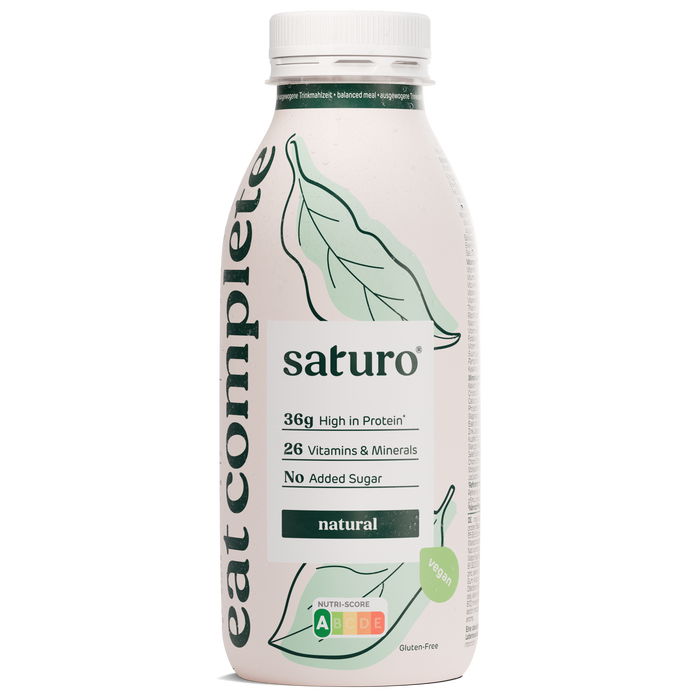
Trinkmahlzeit: 400 kcal und 36 g Protein aus der Flasche
Eine komplette Mahlzeit mit 400 kcal, 36 g pflanzlichem Protein, 26 Vitaminen und Mineralstoffen und Ballaststoffen, vegan und zuckerarm. Protein trägt zu einer Zunahme an Muskelmasse bei. Als vierte Mahlzeit zwischen den anderen, kalt aus dem Kühlschrank, ohne Rezept.
Hochkalorische Trinknahrung selber machen und Essen anreichern
Bevor die Flasche kommt, kommt die Küche. Die Leitlinien setzen zwei Schritte davor: das Essen anreichern und zwei bis drei kleine Zwischenmahlzeiten einbauen, etwa Joghurt mit Nussmus, ein Käsebrot oder einen Bananenshake. Das funktioniert, wenn der Appetit klein, aber vorhanden ist. Reicht es nicht, kommt Trinknahrung dazu, laut deutscher Leitlinie ergänzend und nicht erst, wenn alles andere versagt hat.
Essen anreichern: 300 Kalorien mehr, ohne mehr auf dem Teller
Anreichern erhöht die Energiedichte des Essens: Studien mit älteren Menschen zeigen so einige hundert Kalorien mehr pro Tag. In jeder Küche: ein Esslöffel Olivenöl (88 kcal) in Suppe, Püree oder Salat; Butter oder Sahne in Gemüse und Sauce (2 EL Sahne 100 kcal); Nussmus in Joghurt und Haferbrei (1 EL 90 kcal); Käse über alles Warme (20 g Parmesan 84 kcal); Vollmilch statt Wasser für Haferbrei und Kakao. Faustregel: drei Anreicherungen pro Mahlzeit, drei Mahlzeiten, ergibt 300 bis 400 kcal am Tag, so viel wie eine Flasche Trinknahrung.

Rezept: Hochkalorischer Shake mit 600 kcal
Ohne Apotheke: 250 ml Vollmilch (150 kcal, 8 g Protein), eine reife Banane (100 kcal), 2 EL Erdnussmus (180 kcal, 7 g Protein), 40 g zarte Haferflocken (150 kcal, 5 g Protein) und zwei entkernte Datteln (60 kcal), 30 Sekunden im Mixer. Ergibt rund 640 kcal und 22 g Protein in 400 ml, so viel wie zwei Flaschen Standard-Trinknahrung. Mit einem Löffel Proteinpulver oder 100 g Skyr steigt das Eiweiß auf über 30 g; bei Milchunverträglichkeit Hafer- oder Sojadrink und 3 EL Nussmus. Kühl trinken, in zwei Portionen am Vormittag und Nachmittag.
Hochkalorischer Joghurt: 150 g griechischer Joghurt (Vollmilch, 145 kcal) mit 1 EL Nussmus, 1 TL Honig und 20 g gehackten Nüssen ergibt rund 400 kcal und 15 g Protein. Herzhaft: Eine Tasse Cremesuppe mit 2 EL Sahne, 1 EL Öl und 20 g Parmesan liefert 350 kcal statt 120, Rührei mit Sahne und Käse 350 kcal auf zwei Eier. Wer wochenlang anreichert, denkt an die Vitamine: Selbst gemacht ist nicht bilanziert, eine vollbilanzierte Trinkmahlzeit oder medizinische Trinknahrung am Tag sichert die Mikronährstoffe.
Selbst gemachte Shakes halten im Kühlschrank einen Tag, angebrochene Trinknahrung ebenfalls 24 Stunden, gekühlt und verschlossen. Nussmus, Öl und Sahne haben das beste Verhältnis von Kalorien zu Volumen; wer wenig schafft, fängt damit an.
Krankenkasse, Senioren, Krebs, Diabetes: Wer was braucht
Wann zahlt die Krankenkasse hochkalorische Trinknahrung?
Wenn sie ärztlich verordnet wird, und das geht nur unter den Bedingungen der Arzneimittel-Richtlinie des Gemeinsamen Bundesausschusses (Abschnitt I, §§ 18 bis 26): bei fehlender oder eingeschränkter Fähigkeit zur ausreichenden normalen Ernährung, wenn Umstellung und Anreicherung mit Butter, Sahne, Vollmilch oder Öl nicht ausreichen. Verordnet werden vollbilanzierte Standardprodukte; Spezialprodukte für Diabetes, Geriatrie oder Tumorpatient:innen und Produkte unter 1,0 kcal/ml sind ausgeschlossen. Typische Fälle: Mangelernährung bei Krebs, nach großen Operationen, bei Demenz, Schluckstörungen nach Schlaganfall, chronischen Darmerkrankungen. Trinkmahlzeiten, Proteinshakes und alle normalen Lebensmittel sind nicht verordnungsfähig; wer gesund zunehmen will, zahlt selbst.
Trinknahrung für Senioren
Im Alter sinkt der Appetit, der Geschmackssinn lässt nach, Zähne und Schlucken machen Probleme, viele essen allein; gleichzeitig steigt der Proteinbedarf, weil Muskeln schneller abgebaut als aufgebaut werden. Die europäische Leitlinie empfiehlt deshalb mindestens 1,0 g Protein pro Kilogramm Körpergewicht und rund 30 kcal pro Kilogramm am Tag, bei Mangelernährung oder Risiko Trinknahrung mit mindestens 400 kcal und 30 g Protein zusätzlich, mindestens einen Monat lang. Für Angehörige: Gewicht monatlich notieren, bei ungewolltem Verlust die Hausarztpraxis einschalten, das Essen anreichern, die Flasche zwischen die Mahlzeiten stellen. Im Pflegeheim ist das Screening Pflicht; fragt nach dem Ergebnis.
Hochkalorische Trinknahrung bei Krebs
Bei Krebs geht es darum, den Gewichtsverlust zu stoppen, weil Mangelernährung die Verträglichkeit der Therapie senkt und die Prognose verschlechtert. Die deutsche Onkologie-Leitlinie rechnet mit 25 bis 30 kcal und 1,2 bis 1,5 g Protein pro Kilogramm Körpergewicht am Tag; reicht das Essen nicht, folgen Ernährungsberatung, Anreicherung und Trinknahrung. Bei Übelkeit, Geschmacksveränderungen und Mundschleimhautentzündung helfen kühle, milde, nicht säurehaltige Sorten, kleine Mengen über den Tag und der Wechsel zwischen süß und herzhaft; Metallgeschmack wird mit Plastiklöffel und kalten Produkten erträglicher. Standard-Trinknahrung ist verordnungsfähig, spezielle Tumorprodukte nicht; die Adresse ist das Ernährungsteam der Onkologie.

Bei Diabetes, Schluckbeschwerden und für Kinder
Bei Diabetes treibt Standard-Trinknahrung (6 bis 15 g Zucker pro Flasche) den Blutzucker; Diabetes-Varianten sind nicht verordnungsfähig, und wer Insulin spritzt, fragt die Diabetesberatung. Gesunde mit Diabetes, die zunehmen wollen, nehmen einfacher eine zuckerarme Trinkmahlzeit wie die Saturo Trinkmahlzeit (unter 2 g Zucker). Bei Schluckstörungen (Schlaganfall, Parkinson, Hals-Operationen) wird dünnflüssige Trinknahrung angedickt oder als Pudding gegeben, die Stufe legt die Logopädie fest (IDDSI 0 bis 4); mehr im Artikel über Schluckbeschwerden. Für Kinder gibt es eigene Produkte (Frebini, Fortini); Erwachsenenprodukte und Trinkmahlzeiten sind nichts für sie; die Kinderarztpraxis verordnet, die Zuzahlung entfällt.
Zehn Tage kaum gegessen, BMI unter 16 oder über 15 % in drei bis sechs Monaten verloren? Dann nicht mit vollen Portionen starten: Kohlenhydrate lassen Phosphat, Kalium und Magnesium absacken, gefährlich für Herz und Atmung. Aufbau nur ärztlich, mit Blutkontrolle.
Häufige Fragen zu hochkalorischer Trinknahrung
Wie oft darf man medizinische Trinknahrung wie Fresubin am Tag trinken?
Als Ergänzung ein bis drei Flaschen am Tag zwischen den Mahlzeiten; die Leitlinie nennt mindestens 400 kcal und 30 g Protein zusätzlich als Ziel. Als alleinige Ernährung sind fünf bis sieben Flaschen nötig, das gehört unter ärztliche Kontrolle. Die Menge steht auf der Verordnung, nach Gewicht und Erkrankung.
Ersetzt medizinische Trinknahrung wie Fresubin eine Mahlzeit?
Rechnerisch ja: Eine Flasche mit 300 bis 400 kcal enthält die Energie einer kleinen Mahlzeit und, weil sie vollbilanziert ist, anteilig alle Vitamine und Mineralstoffe. Zum Zunehmen soll sie das aber nicht tun: Wer die Flasche statt dem Mittagessen trinkt, hat am Abend dieselbe Bilanz. Sie wirkt zwischen den Mahlzeiten.
Kann man mit Trinknahrung zunehmen, auch ohne Krankheit?
Ja, wenn sie zusätzlich zum Essen getrunken wird und der Überschuss bei 10 bis 20 % des Bedarfs liegt; dann sind 0,25 bis 0,5 % des Körpergewichts pro Woche realistisch. Für Gesunde ist eine Trinkmahlzeit wie die Saturo Trinkmahlzeit (400 kcal, 36 g Protein) meist die bessere Wahl, dazu Krafttraining.
Ist hochkalorische Nahrung bei Untergewicht geeignet?
Bei gesundem Untergewicht (BMI unter 18,5 ohne Beschwerden) ja, als Teil eines Plans aus Überschuss, Protein und Krafttraining; vorher einmal Blutbild, Schilddrüse und Eisen prüfen lassen. Bei ungewolltem Gewichtsverlust, Appetitlosigkeit oder einem BMI unter 17 gehört die Ernährung in ärztliche Hände, auch wegen des Refeeding-Risikos.
Wann ist Trinknahrung sinnvoll?
Wenn das Essen den Bedarf nicht mehr deckt und Anreichern plus Zwischenmahlzeiten nicht reichen: bei krankheitsbedingter Mangelernährung, Kau- und Schluckproblemen oder Appetitlosigkeit im Alter, dann medizinische Trinknahrung auf Rezept. Wer gesund ist und zunehmen will, nutzt eine Trinkmahlzeit zusätzlich zum Essen; wer normal isst und sein Gewicht hält, braucht keine.
Worauf muss man bei den Inhaltsstoffen achten?
Auf vier Zahlen pro Flasche: Kalorien (300 bis 400), Protein (Standardlinien 11 bis 12 g, Protein-Varianten 18 bis 20 g, Saturo Trinkmahlzeit 36 g), Zucker (Standardprodukte 6 bis 15 g, Saturo Trinkmahlzeit 1 bis 1,5 g; Herstellerangaben 2026) und ob das Produkt vollbilanziert ist, also alle Vitamine und Mineralstoffe enthält.
Was ist eine Kalorienbombe und welches Essen hat extrem viele Kalorien?
Lebensmittel mit hoher Energiedichte auf wenig Volumen: Olivenöl (884 kcal pro 100 g, USDA), Butter (717), Walnüsse (654), Erdnussmus und Zartbitterschokolade (je 598), Mandeln (579), Parmesan (420), Sahne (340), Honig (304), Datteln (277). Sie sind die Zutaten, die das Essen dichter machen, ohne dass die Portion wächst (Kapitel 6).
Wie schafft man 3.000 kcal am Tag?
Nicht mit größeren Portionen, sondern mit dichterem Essen: drei Anreicherungen pro Mahlzeit (Öl, Sahne, Nussmus, Käse) bringen 300 bis 400 kcal, dazu zwei Zwischenmahlzeiten wie hochkalorischer Joghurt (400 kcal) und ein Shake (640 kcal, Kapitel 6). Zusammen über 1.000 kcal mehr als normale Kost, ohne mehr zu kauen.
Quellen · 33 Quellen anzeigen
- Europäische Kommission: Delegierte Verordnung (EU) 2016/128 zur Ergänzung der Verordnung (EU) Nr. 609/2013 im Hinblick auf die besonderen Zusammensetzungs- und Informationsanforderungen für Lebensmittel für besondere medizinische Zwecke. ABl. L 25 vom 2.2.2016, S. 30.
- Europäisches Parlament und Rat: Verordnung (EU) Nr. 609/2013 über Lebensmittel für Säuglinge und Kleinkinder, Lebensmittel für besondere medizinische Zwecke und Tagesrationen für gewichtskontrollierende Ernährung. ABl. L 181 vom 29.6.2013, S. 35.
- Gemeinsamer Bundesausschuss (G-BA): Arzneimittel-Richtlinie (AM-RL), Abschnitt I: Enterale Ernährung, §§ 18–26. Fassung vom 18. Juni 2026, in Kraft seit 5. September 2026.
- § 31 Abs. 5 und § 61 SGB V: Anspruch auf bilanzierte Diäten zur enteralen Ernährung und Zuzahlung (10 %, mindestens 5, höchstens 10 Euro).
- Valentini L., Volkert D., Schütz T. et al.: Leitlinie der Deutschen Gesellschaft für Ernährungsmedizin (DGEM): DGEM-Terminologie in der Klinischen Ernährung. Aktuelle Ernährungsmedizin 2013; 38(2): 97–111.
- Volkert D., Beck A. M., Cederholm T. et al.: ESPEN guideline on clinical nutrition and hydration in geriatrics. Clinical Nutrition 2019; 38(1): 10–47.
- Volkert D., Bauer J., Benzinger P. et al.: S3-Leitlinie Klinische Ernährung und Hydrierung im Alter (DGEM, DGG). AWMF-Registernummer 073-019, Stand September 2025. Aktuelle Ernährungsmedizin 2025; 50: 220–283.
- Cederholm T., Jensen G. L., Correia M. I. T. D. et al.: GLIM criteria for the diagnosis of malnutrition: A consensus report from the global clinical nutrition community. Clinical Nutrition 2019; 38(1): 1–9.
- Pirlich M., Schütz T., Norman K. et al.: The German hospital malnutrition study. Clinical Nutrition 2006; 25(4): 563–572.
- Milne A. C., Potter J., Vivanti A., Avenell A.: Protein and energy supplementation in elderly people at risk from malnutrition. Cochrane Database of Systematic Reviews 2009; (2): CD003288.
- Hubbard G. P., Elia M., Holdoway A., Stratton R. J.: A systematic review of compliance to oral nutritional supplements. Clinical Nutrition 2012; 31(3): 293–312.
- Trabal J., Farran-Codina A.: Effects of dietary enrichment with conventional foods on energy and protein intake in older adults: a systematic review. Nutrition Reviews 2015; 73(9): 624–633.
- Morilla-Herrera J. C., Martín-Santos F. J., Caro-Bautista J. et al.: Effectiveness of Food-Based Fortification in Older People. A Systematic Review and Meta-Analysis. Journal of Nutrition, Health & Aging 2016; 20(2): 178–184.
- National Institute for Health and Care Excellence (NICE): Nutrition support for adults: oral nutrition support, enteral tube feeding and parenteral nutrition. Clinical guideline CG32, 2006, aktualisiert 2017 (Refeeding-Risiko, Empfehlungen 1.4.6 bis 1.4.8).
- Arends J., Bertz H., Bischoff S. C. et al.: S3-Leitlinie der Deutschen Gesellschaft für Ernährungsmedizin (DGEM): Klinische Ernährung in der Onkologie. Aktuelle Ernährungsmedizin 2015; 40: e1–e74.
- Morton R. W., Murphy K. T., McKellar S. R. et al.: A systematic review, meta-analysis and meta-regression of the effect of protein supplementation on resistance training-induced gains in muscle mass and strength in healthy adults. British Journal of Sports Medicine 2018; 52(6): 376–384.
- Iraki J., Fitschen P., Espinar S., Helms E.: Nutrition Recommendations for Bodybuilders in the Off-Season: A Narrative Review. Sports 2019; 7(7): 154.
- Deutsche Gesellschaft für Ernährung (DGE): Referenzwerte für die Nährstoffzufuhr, Energie. Richtwerte nach Alter, Geschlecht und körperlicher Aktivität (Ableitung 2015).
- Deutsche Gesellschaft für Ernährung (DGE): Referenzwerte für die Nährstoffzufuhr, Protein (Ableitung 2017).
- Verordnung (EG) Nr. 1924/2006 über nährwert- und gesundheitsbezogene Angaben über Lebensmittel, Anhang (Nährwertbezogene Angaben: zuckerarm, Proteinquelle, hoher Proteingehalt), konsolidierte Fassung.
- Verordnung (EU) Nr. 432/2012 der Kommission zur Festlegung einer Liste zulässiger gesundheitsbezogener Angaben über Lebensmittel, Anhang (Proteine tragen zu einer Zunahme an Muskelmasse bei).
- Cichero J. A. Y., Lam P., Steele C. M. et al.: Development of International Terminology and Definitions for Texture-Modified Foods and Thickened Fluids Used in Dysphagia Management: The IDDSI Framework. Dysphagia 2017; 32(2): 293–314.
- U.S. Department of Agriculture, Agricultural Research Service: FoodData Central, SR Legacy Release (2018). Energie- und Proteingehalte pro 100 g.
- Fresenius Kabi: Fresubin Energy DRINK, Produktseite und Nährwertangaben (200 ml, 300 kcal, 11,2 g Protein). Abgerufen 14.09.2026.
- Fresenius Kabi: Fresubin 2 kcal DRINK, Produktseite und Nährwertangaben (200 ml, 400 kcal, 20 g Protein). Abgerufen 14.09.2026.
- Fresenius Kabi: Fresubin 3.2 kcal DRINK, Produktseite und Nährwertangaben (125 ml, 400 kcal, 20 g Protein). Abgerufen 14.09.2026.
- Fresenius Kabi: Fresubin PROTEIN ENERGY DRINK, Produktseite und Nährwertangaben (200 ml, 300 kcal, 20 g Protein). Abgerufen 14.09.2026.
- Nutricia: Fortimel 1.5 kcal, Produktseite (200 ml, 300 kcal, 12 g Protein). Abgerufen 14.09.2026.
- Nutricia: Fortimel Compact 2.4, Produktseite (125 ml, 300 kcal, 12 g Protein). Abgerufen 14.09.2026.
- Nutricia: Fortimel Compact Protein 2.4, Produktseite (125 ml, 306 kcal, 18 g Protein). Abgerufen 14.09.2026.
- Calo-Shop: CaloVital Trinknahrung hochkalorisch, Produktseite mit Nährwertangaben (50 g Pulver in 250 ml Wasser 194 kcal; Lebensmittel, keine bilanzierte Diät). Abgerufen 14.09.2026.
- dm-drogerie markt: Fresubin Energy Trinknahrung Mischkarton 6 x 4 x 200 ml, Verkauf durch dm-med, nicht in dm-Märkten verfügbar. Abgerufen 14.09.2026.
- Saturo: Nährwertangaben Trinkmahlzeit 400 ml (Cocoa, Natural, Cappuccino, Vanilla, Strawberry, Banana), Stand September 2026.
Schreibt seit 2019 für Saturo über Ernährung, Nährstoffe und die Frage, wie gute Versorgung im Alltag praktisch funktioniert.
Hat diesen Artikel am 16. September 2026 auf fachliche Richtigkeit geprüft. Die Inhalte ersetzen keine ärztliche Beratung.
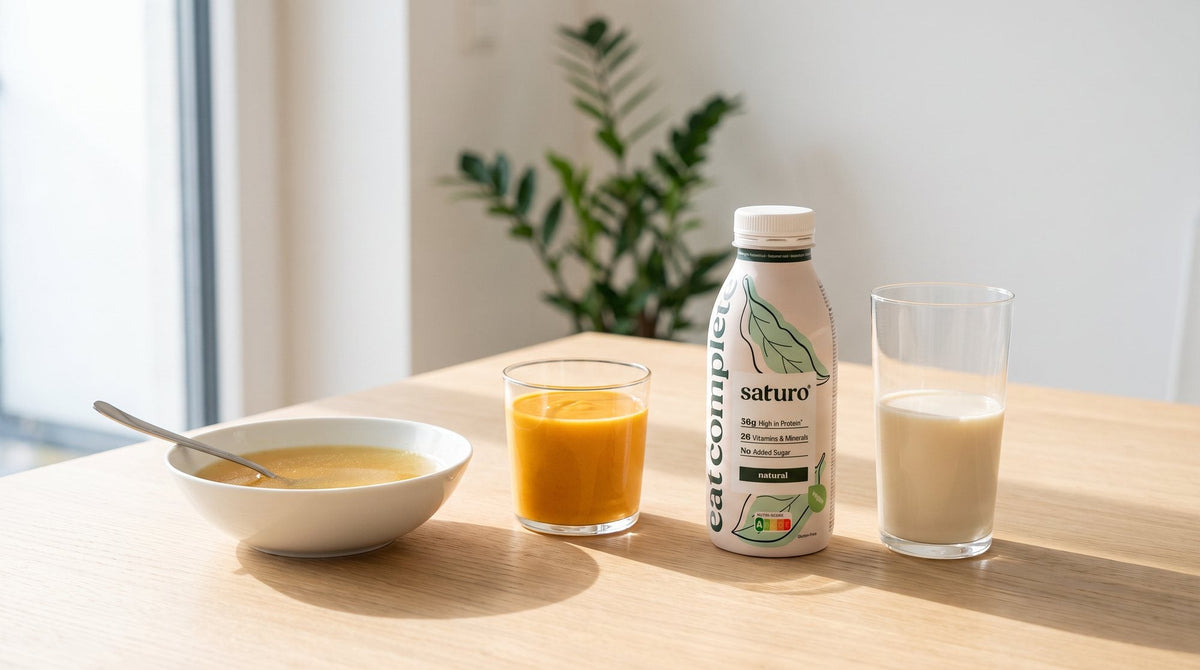
Flüssignahrung: Arten, Anwendung und Vergleich
Medizinische Trinknahrung, Astronautenkost oder Trinkmahlzeit? Die Unterschiede in Zusammensetzung, Nährstoffprofil und Preis.
Weiterlesen · 15 Min
Neues aus dem Ratgeber
Neue Artikel, Updates und Tipps direkt ins Postfach. Verständlich, fachlich geprüft, ohne Spam.
Danke! Bitte bestätige die Anmeldung in deinem Postfach.