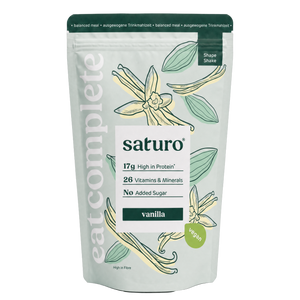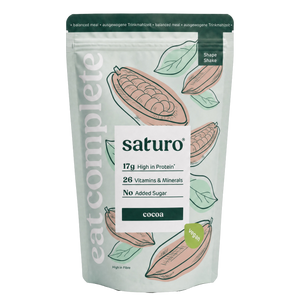
Cocoa – Shape Shake
127,99 zł
9,14 zł per serving · 30,47 zł/100 g

Meal replacement is clearly defined in the EU: 200 to 250 kcal, plenty of protein, a third of your vitamins and minerals. What that means for shakes and drinkable meals, how much weight you can realistically lose and where the limits are.


That's how much a portion may provide under EU regulation to count as a meal replacement for weight control. Less is a snack, more is a meal, but not a diet product.
A quarter to half of the calories must come from protein, with no more than 30% from fat and at least 30% of the daily reference intake of 23 vitamins and minerals. A protein shake made with water doesn't manage that.
That's how much more people lost with meal replacement after twelve months than with other diets, across 23 studies with 7,884 participants. With intensive support it was up to 6 kg.
According to the EU claim, replacing two main meals is the way to lose weight, and replacing one meal is the way to keep it off afterwards. Replacing all three is a formula diet and belongs under medical supervision.
Meal replacement for a weight-control diet: 203 kcal and 17 g protein per serving with 300 ml unsweetened soya drink, vegan and low in sugar. 420 g makes 14 servings.
Alle Preise inkl. MwSt., zzgl. Versand. Free shipping in Germany and Austria from 2 packs. All weight-loss shakes →
A meal replacement is a food that replaces a complete main meal: fewer calories, but all the nutrients of a meal. In the EU, this protected category has been called “meal replacement for weight control” since Regulation (EU) 2016/1413, and only products with 200 to 250 kcal per meal, 25 to 50% of energy from protein, no more than 30% from fat and at least 30% of the daily reference intake of 23 vitamins and minerals may be advertised as replacing meals and helping you lose weight.
Yes, if it's put together like a meal: energy, protein, fat, carbohydrates, fibre, vitamins and minerals. A meal replacement under EU rules delivers these in measured amounts. A protein shake made from 30 g of powder and water provides around 110 kcal and 23 g of protein, almost no fat, hardly any carbohydrates and usually no vitamins; it complements a meal rather than replacing it, and mustn't be advertised as a replacement. The drinkable meal replaces a meal with usually 400 to 500 kcal, without a deficit and without a diet claim. The daily ration (formula diet) replaces all meals with 600 to 1,200 kcal under its own regulation.
Four products that sit side by side on the shelf and are legally four different things.
| Meal replacement | Daily ration (formula diet) | Drinkable meal | Protein shake | |
|---|---|---|---|---|
| Replaces | one or two main meals | all meals of the day | one meal, without a deficit | nothing, a supplement |
| Energy | 200 to 250 kcal per meal | 600 to 1,200 kcal per day | usually 400 to 500 kcal per portion | around 110 kcal per 30 g in water |
| Protein | 25 to 50% of energy | 75 to 105 g per day | depends on the product, Saturo 36 g | 20 to 24 g, around 85% of energy |
| Vitamins and minerals | at least 30% of the daily reference intake per meal | full daily requirement, minimum amounts per nutrient | depends on the product, Saturo 26 nutrients | usually none declared |
| Legal basis | Regulation (EU) 2016/1413, health claims | Delegated Regulation (EU) 2017/1798 | general food law | general food law |
| May advertise | weight loss (2 a day), weight maintenance (1 a day) | nothing: claims and speed promises are prohibited | nutritional values, no diet claims | protein content |
| Duration | one meal a day possible long term | no longer than 8 weeks without professional advice | one meal a day possible long term | long term as a supplement |
| Who it's for | adults who want to lose weight or maintain it | healthy adults with overweight or obesity | healthy people without time for a meal | athletes, high protein needs |
Meal replacement and daily ration as worded in Regulations (EU) 2016/1413 and 2017/1798; drinkable meal based on manufacturer information and the Saturo nutrition table; protein shake based on the USDA generic whey protein powder (30 g: 106 kcal, 23.4 g protein) and manufacturer information per 30 g, as of September 2026.
Because the category is protected, it's worth checking the pack: products called “meal for weight control”, recommending three shakes a day or promising kilos per week don't follow the rules. Whether a product comes from the pharmacy, the drugstore or an online shop, and whether it's a powder or ready to drink, says nothing about quality, because the requirements are the same everywhere (chapter 7).

“Can you lose weight with meal replacement?” is one of the best-researched diet questions there is. The answer is yes, and it's also: not much more than with other diets, unless someone supports you along the way. The German Obesity Society lists the meal replacement strategy in its 2024 S3 guideline as one of seven equally valid dietary strategies for losing weight, alongside reducing fat or carbohydrates, the Mediterranean diet and intermittent fasting.
Yes: in the largest analysis (23 studies, 7,884 adults, 2019), people using meal replacement had lost 1.44 kg more after one year than with another diet; with support it was 2.2 kg, with intensive support 6.1 kg. In 2003, Heymsfield found a 2.5 kg advantage with one to two replaced meals on the same calorie target, and in type 2 diabetes, liquid products brought 2.4 kg more in nine studies. The advantage comes from behaviour, not from the powder: if you replace a meal with 220 kcal, you can't misjudge the portion, you don't go back for seconds and you don't have to cook in the evening.
Yes, two replaced main meals is the proven dose under the law: “Replacing two of the daily main meals within a low-calorie diet with a meal replacement of this kind contributes to weight loss.” The qualifier matters: two shakes achieve nothing if the third meal and the snacks fill the deficit back up. A typical lunch delivers 600 to 800 kcal, a meal replacement 200 to 250. If you replace lunch and dinner, you save around 800 to 1,000 kcal and land at the guideline's 1,200 to 1,600 kcal; if you only replace a small breakfast, there's little deficit left.
One to two kilos, and part of that in the first week is water. A deficit of 500 to 600 kcal a day gives roughly 0.5 kg a week according to the guideline. Higher figures from adverts and forums come from formula diets of around 800 kcal; for those, the guideline cites 1 to 2.5 kg a week, but only with medical supervision. The DROPLET study shows the price: after eight weeks on an 810 kcal formula diet, 10.7 kg were gone after one year, and 6.2 kg after three years. Fast rarely means lasting.
The formula diet replaces all meals, usually with 800 to 1,200 kcal a day. Legally it's a “total diet replacement for weight control”: 600 to 1,200 kcal, all essential nutrients, mandatory notices “only for healthy adults with overweight” and “for a maximum of eight weeks without professional advice”; advertising speed or kilos lost is prohibited. The obesity guideline allows it for a limited time, up to twelve weeks, with medical supervision. In the DiRECT study, a formula phase with 825 to 853 kcal put type 2 diabetes into remission after one year in 46% of people with recently diagnosed diabetes, and in 13% after five years.
A meal replacement doesn't work through an active ingredient but through four mechanisms: the deficit, satiety, protein, and the nutrients that go missing first on any diet.
Losing weight takes less energy in than your body burns, and the guideline gives 500 to 600 kcal a day as a sensible amount. A meal replacement delivers 200 to 250 kcal instead of the 600 to 800 of a main meal, with no scales, no app, no guesswork. That's why, according to the guideline, weight loss is easier to predict with energy-defined products than with any other diet. The catch: once the product is gone, the structure is gone too.
In one study, an apple as a starter cut the energy intake of the following meal by 15%, apple sauce by less, apple juice barely at all. People who were given the same starter as a drink ate around 400 kcal more over the day than with the solid version. Meal replacement shakes make up for this with protein and fibre, especially viscous ones like beta-glucan from oats, which reduced appetite in 59% of studies. Drinking slowly helps, and for many people bars or spoonable soups fill them up better than a shake.
On any diet, the body also loses muscle mass. According to meta-analyses, a higher protein intake during energy restriction preserves more muscle and gives more satiety than a low-protein diet; the recommendation is 1.2 to 1.6 g per kilogram of body weight a day and 25 to 30 g per meal. The 25 to 50% protein share in a meal replacement is therefore not a marketing number but the reason the scales show fat loss rather than muscle loss. Exercise on top strengthens the effect.
If you eat less, you automatically take in fewer vitamins and minerals, and the guideline explicitly warns about nutrient gaps with crash diets. A meal replacement has to provide at least 30% of the daily reference intake of 23 nutrients per meal, including vitamin D, B12, iodine, iron and calcium. Two shakes therefore cover 60%, and the third meal covers the rest. These are exactly the nutrients that are almost always missing from home-mixed shakes (chapter 6).
Meal replacement is neither a miracle cure nor poison. It's a tool with a clear purpose. It's healthy when the product meets the requirements, replaces one or two meals, and the rest of your day is made up of balanced food. It becomes unhealthy as your only food, with a product that doesn't follow the rules, or for people it isn't meant for. The obesity guideline presents it in exactly this way: as one building block, not the solution.
It makes sense if you need a routine that works without cooking, if portion size has tripped you up so far, or if you want to keep a calorie deficit with little time. Then you replace one or two main meals, eat the third with vegetables, wholegrains and a protein source, and drink plenty. It doesn't make sense as a permanent solution for all three meals, as a way to make up for eating habits you don't want to change, or as a replacement for food you enjoy. The guideline advises against extremely one-sided diets: no long-term weight loss and unnecessary risks.

With one to two shakes a day, studies report no side effects from the meal replacement. It's different with the formula diet of around 800 kcal: in the DROPLET study, one in two people had a complaint, one in seven had constipation, one in twelve had tiredness and one in seventeen had headaches. The guideline adds hunger, weakness, trouble concentrating, feeling cold, dizziness and electrolyte imbalances if you drink too little, and rarely gallstones, kidney stones and hair loss. Gallstones are three times as common on very low calories. Once the energy restriction ends, the complaints disappear quickly, and almost all of them can be avoided: don't go below 1,200 kcal, drink at least two litres and keep an eye on fibre.
A meal replacement solves the portion problem, not the habit problem. If you use it to calmly learn what a good third meal looks like, you'll have something to build on after the diet. If you just swap, all you'll have after the diet is an empty tin.
Joerg Hauke, Nutrition expert, expert review of this article
Two shakes for weeks, one shake for months, three shakes only with a doctor's supervision. There's no legal time limit for an individual meal replacement. According to the EU claim, one replaced meal a day is meant for the period after weight loss, so for the long term, and the Ulm study ran like this for four years. Two replaced meals make up the weight-loss phase, which according to the guideline lasts about three months, until the body goes into energy-saving mode. Replacing all three meals counts as a total daily ration, with a legal limit of eight weeks without professional advice and the guideline's limit of twelve weeks with medical supervision.
Under the regulation, pregnant and breastfeeding women, teenagers and people with health conditions shouldn't use total daily rations without professional advice, and the same caution applies to any diet with meal replacement. For very low-calorie diets, the guideline lists contraindications including type 1 diabetes, advanced kidney or liver disease, heart failure, heart rhythm disorders, eating disorders, alcohol or drug dependency and frailty in old age. If you take medication for diabetes or high blood pressure, you'll need an adjustment for any larger deficit, because blood sugar and blood pressure can drop quickly. If you're underweight or losing weight unintentionally, you're not looking for meal replacement but for high-calorie liquid nutrition.
The studies set the framework, but everyday life decides whether you succeed. Three questions always come up: which meal do I replace, how do I plan the phases, and what do I do if I don't want to lose weight at all?
The one that gives you the most calories and the least enjoyment. For many people that's lunch: the canteen or a delivery service easily serves up 700 to 900 kcal. Replacing dinner gives a similarly big deficit, but it often fails because of shared meals and evening hunger. Replacing breakfast is the easiest, but it saves the least, as it's usually the smallest meal. What doesn't work is making up for the replaced meal in the evening. The deficit applies to the whole day, not just the hour when you drink the shake.
Hunger between meals, and sometimes headaches and tiredness because carbohydrates and salt drop. Drink plenty, sip your shake slowly and plan snacks of vegetables and fruit.
The scales often show 1 to 2 kg less, and part of that is water from your carbohydrate stores. Don't count it as fat loss, and don't be disappointed if week 2 is slower.
Around 0.5 kg per week with a 500 to 600 kcal deficit, up to 1 kg with a bigger deficit. Now is the time to build your third meal with intention: half a plate of vegetables, a quarter protein, a quarter wholegrain.
Your body saves energy and weight loss slows down. That's normal, and it's the moment to swap the second replaced meal for real food with 300 to 400 kcal and start the transition.
Two groups look for meal replacement without wanting to lose weight. The first has lost weight and wants to keep it off: for them, one shake a day is exactly what the EU claim describes and what the Ulm study showed over four years. The second wants a meal without the kitchen and is hungry again after two hours on 200 kcal. For them, a meal replacement is the wrong product, because it's built around a deficit; the right one is a drinkable meal with 400 to 500 kcal, which replaces a meal without saving calories; read more in the article liquid nutrition.

The same rules apply to bars as to shakes. A 60 g meal replacement bar delivers 200 kcal, 18 to 19 g protein, 8 g fibre and 30% of the daily reference intake for each nutrient. A 45 g protein bar has similar calories, but doesn't declare any vitamins and has only a sixth of the fibre. The bar's advantage is chewing: solid food fills you up better than liquid, and it fits in your pocket. The downside: 60 g is not much volume in your stomach. As a lunch on the go it's a good choice, but as a permanent solution for two meals a day it gets monotonous fast.
Of course you can build a meal in the blender yourself, and for one meal a day it's often the better choice: fresher, cheaper, and you get to chew. What you can't build is a meal replacement within the meaning of the regulation, because the guaranteed vitamins and minerals don't occur in kitchen ingredients in those amounts. Three recipes show what's possible, and the bars after them show what's missing; all values are calculated with the USDA database, not estimated.
Let the oats and flaxseed soak in the soy drink for ten minutes, add the banana and peanut butter, and blend until creamy. It keeps you full for a long time, but delivers twice the energy of a meal replacement and only 16% of that from protein: a good meal, not a diet product.
Blend everything cold, and thin with a little water if needed. The highest in protein of the three shakes, with 42% of its energy from protein, plus 77% of the daily reference intake for calcium and, thanks to the milk and quark, around 50 µg iodine. Weak on iron at 12% of the reference and, because German milk isn't fortified, practically no vitamin D.
Blend the spinach with the oat drink until smooth, then add the protein, avocado and pineapple. Plenty of iron from the pea protein and spinach and 87% of the vitamin C reference, but only 10% calcium with an unfortified oat drink, and vitamin D, B12 and iodine are at zero. Vegan means you need to plan for nutrients from other sources.
Nutritional values calculated with USDA FoodData Central SR Legacy (soy drink fortified FDC 175215, rolled oats 173904, banana 173944, peanut butter 172470, flaxseed 169414, skimmed milk 171269, blueberries 171711, chia 170554, spinach 168462, avocado 171705, pineapple 169124) as well as manufacturer data for low-fat quark (BLS), oat drink (Oatly Bio) and pea protein (Raab), as of September 2026. Vitamin D in milk based on German BLS values (not fortified).
A shake as a meal needs five building blocks: a liquid (200 to 300 ml of milk, soy drink or fortified oat drink), a protein source with 20 to 30 g protein (150 g low-fat quark or skyr, 30 g protein powder), a fibre source (30 to 40 g rolled oats, 10 g flaxseed or chia), a portion of fruit or vegetables and a small source of fat such as 15 g nut butter or 50 g avocado. That adds up to 300 to 500 kcal, so a proper meal, not a diet product. If you want to lose weight with it, you'd have to cut the amount to 250 kcal and end up with a glass that barely fills you up.
Recipe 1 with an unfortified soy drink (USDA 172446), as most organic drinks are; percentage of the daily reference intake per serving. Only a fortified drink adds calcium, vitamin D and B12; iodine stays at zero even then (plant-based drinks in Germany mostly contain no iodine).
The three nutrients that every homemade shake lacks are in short supply in Germany anyway. Hardly any food provides vitamin D apart from oily fish; the DGE (German Nutrition Society) assumes 20 µg a day when there's no sun, and the milk shake gives you zero. Vitamin B12 only comes from animal foods or fortification; a vegan shake without a fortified drink has none. Iodine comes from milk, fish and iodised salt; since 2025 the DGE recommendation has been 150 µg, and the milk shake delivers a third of that, the plant-based one nothing. A meal replacement has to provide 30% of all three per meal, plus 20 other nutrients.

“Which meal replacement is the best?” can't be answered with a name, but it can be answered with six lines of the nutrition table. The regulation sets the criteria, and the table shows you in a minute whether a product meets them.
The regulation doesn't set a sugar value, which is why powders range from under 1 g to over 15 g per serving (recommendation: see tile). Fibre is the regulation's second blind spot: it keeps you full, helps prevent constipation on a low-calorie diet, and the DGE recommends 30 g a day. A meal replacement with 8 to 11 g per serving covers a third of that for you, one with 2 g covers nothing. Sweeteners are a matter of taste: harmless in the approved amounts, and without them it's hard to make a low-sugar shake taste sweet.
Vegan products use pea, soy or rice protein instead of milk protein and have to add vitamin B12, vitamin D and iodine, otherwise they don't reach the 30%. Protein quality holds up as long as the manufacturer combines sources; the regulation requires an amino acid index at WHO level. “Without sugar” usually means “without added sugar”, because lactose from milk powder or fructose from fruit powder remains; the “of which sugars” line is the honest one. The Saturo Shape Shake is vegan, made with soy protein, and sits at the low end with 0.5 to 0.8 g sugar per serving; you'll find all vegan weight-loss shakes in the overview here.
Powder is the most common form: cheapest per serving and the lightest. Ready-to-drink options save you the mixing and cost more; make sure the bottle has 200 to 250 kcal and isn't a 400 kcal drinkable meal. Bars are the solution for when you're on the go (chapter 5). Where you buy is secondary, as the regulation applies the same everywhere: the pharmacy offers advice, the drugstore the price, the manufacturer's shop a choice of flavours and subscriptions. Work it out per prepared serving including milk or drink, not per pack, and plan your third meal right away, because it decides your success, not the brand.
Yes. In 23 studies with 7,884 participants, people using meal replacements lost 1.4 kg more after a year than on other diets, and up to 6 kg more with support. At 1,200 to 1,600 kcal, the guideline expects around 6.5 kg after three months. The requirement: a deficit across the whole day.
Yes, two replaced main meals is the dose from the EU claim. That's enough as long as the third meal and snacks don't fill the deficit back up: the guideline's target is 1,200 to 1,600 kcal and at least two litres of fluid. A third shake turns it into a formula diet, which needs medical supervision.
Realistically one to two kilos, with some of it in the first week being water. A deficit of 500 to 600 kcal gives about 0.5 kg a week. Higher figures come from formula diets of around 800 kcal: 1 to 2.5 kg a week, only with medical supervision, and a lot comes back afterwards.
Only if it's put together like a meal: protein, fat, carbohydrates, fibre, vitamins and minerals. A meal replacement delivers that with 200 to 250 kcal, a drinkable meal with 400 to 500 kcal. A protein shake made with water delivers 110 kcal and almost only protein; it supplements a meal, it doesn't replace it.
The one that meets the regulation: 200 to 250 kcal, 25 to 50% of energy from protein, no more than 30% from fat, at least 30% of the daily reference value of 23 vitamins and minerals, plus under 5 g sugar and over 5 g fibre. The label check in chapter 7 covers this.
With five building blocks: 200 to 300 ml milk or fortified plant drink, 20 to 30 g protein from low-fat quark or powder, 30 to 40 g rolled oats, fruit or veg, and 15 g nut butter. That gives 300 to 500 kcal, but not a meal replacement under the regulation: vitamin D, B12 and iodine are missing.
Occasionally yes, long term no. A protein shake made with 30 g powder in water delivers around 110 kcal and 23 g protein, but hardly any fat, carbohydrates or fibre, and usually no vitamins. It can't be advertised as a meal replacement. If you want to replace a meal, go for a meal replacement that meets the EU rules or a drinkable meal.
A diet where all meals are replaced by powder products, usually providing 800 to 1,200 kcal. Legally, the product is called a total diet replacement for weight control, with the advice: no longer than eight weeks without professional guidance. The obesity guideline allows it for up to twelve weeks with medical supervision, especially for a BMI of 30 or above with accompanying conditions.
Has written for Saturo since 2019 about nutrition, nutrients and how to get properly nourished in everyday life.
Hat diesen Artikel am 22. September 2026 auf fachliche Richtigkeit geprüft. This content is no substitute for medical advice.
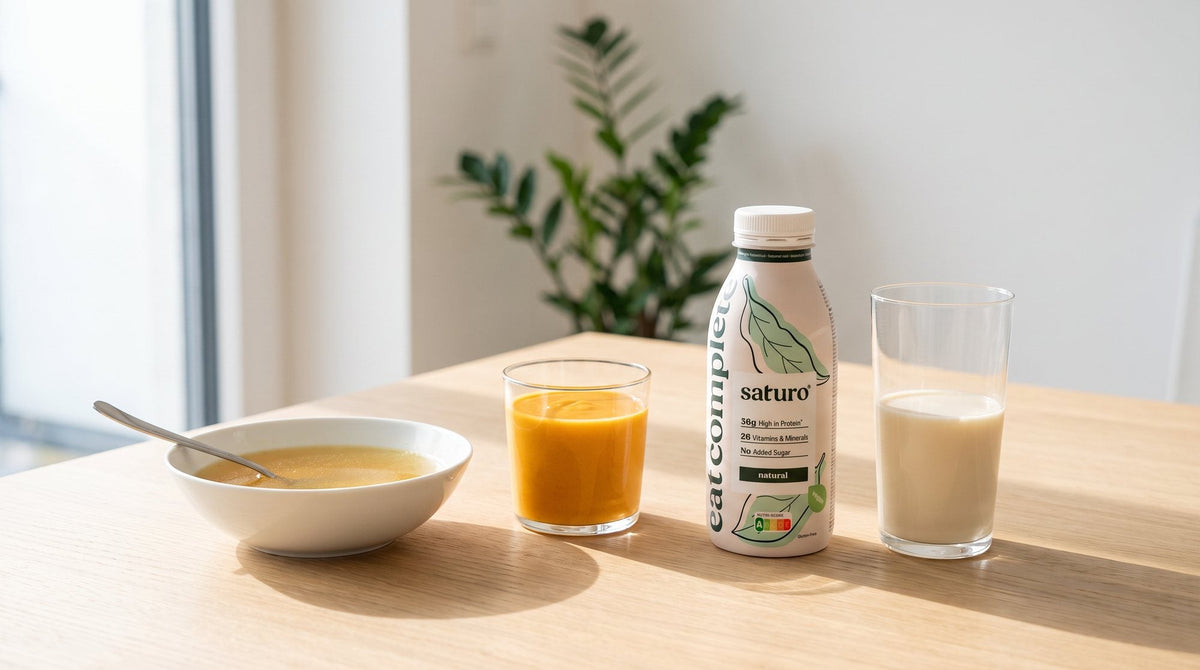
What sets liquid food, medical drinkable nutrition and a drinkable meal apart, whether liquid food fills you up, and how long you can live on liquids alone.
Weiterlesen · 15 Min

New articles, updates and tips straight to your inbox. Easy to follow, fact-checked, no spam.
Danke! Bitte bestätige die Anmeldung in deinem Postfach.