You eat plenty and still don't gain weight? Putting on weight only works with a surplus that fits your needs, not with randomly eating more. How much more you need, which foods get you there and how fast it realistically goes.
Gregor Aßlaber, Editor, Saturo
· ✓Fachlich geprüft von Joerg Hauke, Nutrition expert
Aktualisiert 14 October 2026 · 14 Min. Lesezeit · 40 Quellen
Gaining weight starts at the breakfast table: porridge with banana, nuts and peanut butter, avocado on toast with egg and a glass of whole milk together give you the energy of a main meal.
The key points in 30 seconds
The surplus
10–20%
above your maintenance needs, according to sports nutrition recommendations. At 2,000 kcal that's 200 to 400 kcal more: one shake or two handfuls of nuts.
Realistic pace
0.25–0.5%
of your body weight per week, so 150 to 300 g at 60 kg. Anything the scales show faster is usually water and glycogen.
Underweight according to the WHO
18.5BMI
Below this you count as underweight; below 17 the risk of health problems rises markedly. Whether that's an issue for you is something for your doctor to decide, not a calculator.
The signal
Strength training
steers the surplus into muscle instead of fat. Two sessions a week are enough to start, plus 1.6 g of protein per kilo of body weight, spread over four meals.
01 Basics
Gaining weight: how it works and when it makes sense
Gaining weight is energy balance, just the other way round: your body only lays down tissue when, over several weeks, more energy arrives than it uses. That sounds simple, but it fails every day at the same points: underestimated portions, feeling full early and a daily routine that burns more than you think. This article works out what you need and shows you how to get there.
How do you gain weight?
By taking in roughly 10 to 20 per cent more energy than your body uses over several weeks, eating protein at every meal and doing strength training twice a week. The surplus provides the building material; the training decides whether it becomes muscle or fat. In practice that means energy-dense foods instead of bigger portions, five to six meals instead of three, and drinking your calories too. What most people lack isn't knowledge but the number that fits them. The calculator in chapter 4 gives you yours.
When are you underweight?
According to the World Health Organization, from a BMI below 18.5, regardless of age and sex. Below 17 the risk of health problems rises measurably, and below 16 markedly. BMI is your body weight in kilograms divided by your height in metres squared; 55 kg at 1.70 m gives 19.0. It says nothing about muscle, body fat or causes, and for children and teenagers, growth charts apply instead of fixed limits. For older people, clinics use higher thresholds (BMI below 20 or 22), but as a sign of malnutrition, not as a definition of being underweight.
Gaining weight doesn't mean bigger plates, but denser ones: avocado, egg and nuts bring energy without doubling the volume.
Gaining weight healthily makes sense for four groups: people who are underweight and feel drained or are often ill; people after an illness or operation who have lost weight; athletes who want to build muscle mass; and older people whose appetite and muscle are fading. If you're slim, performing well and well nourished, you don't need to gain weight, even if your BMI is just under 18.5. Eating disorders are a special case: here, weight gain belongs in medical and therapeutic hands (chapter 7). And if you're losing weight without meaning to, find out the cause first.
02 Causes
Why am I not gaining weight? The most common reasons
Most people who don't gain weight eat less than they think, or burn more than they realise. Illness is a less common reason, but it's the one you must not overlook. The order of checks: everyday reasons first, then metabolism, then the doctor's surgery.
Why am I not gaining weight even though I eat a lot?
Because “a lot” is measured in volume, not energy. A big salad, two apples and two slices of wholemeal bread fill your stomach but add up to barely 400 kcal. On top of that come three silent brakes: meals that get skipped when you're stressed; an early feeling of fullness that stops you finishing big portions; and movement that doesn't count as exercise, from fidgeting to climbing stairs. In an overfeeding study, exactly this everyday movement explained why some people barely put on any fat on 1,000 extra kcal while others put on a lot. Tick what applies to you:
Interactive
What's holding back your weight gain?
Tick what applies to you. You'll then see how many everyday brakes add up, and which chapters solve them.
Not a diagnosis, just an overview of typical everyday reasons. Unintended weight loss should always be checked by a doctor.
Gaining weight with a fast metabolism
A “fast metabolism” in the sense of an engine that burns through calories hardly exists; what does exist are differences in basal metabolic rate and everyday movement. In a study of 150 adults, fat-free body mass explained 63 per cent of the differences in basal metabolic rate, while 26 per cent remained unexplained. Then there's genetic predisposition: when twelve pairs of twins ate 1,000 kcal more every day for 84 days, they gained between 4.3 and 13.3 kg. People with constitutional thinness (“hardgainers” in strength training) have normal hormone levels, eat as much as others and still stay lean. The route is the same for them, only the number is bigger: more energy, not less movement.
When should you see a doctor?
Whenever you're losing weight without having changed anything. As a rule of thumb in medicine, an unintended loss of more than 5 per cent in six months counts, and in older people over six to twelve months; the threshold varies slightly depending on the guideline. Behind it can be an overactive thyroid, coeliac disease, chronic inflammatory bowel diseases, diabetes, depression, medication and, in rare cases, tumours. If you have no appetite and feel tired, it's also worth checking iron and vitamin B12.
When to see a doctor
Lost weight without meaning to, plus fever, night sweats, ongoing diarrhoea, trouble swallowing or pain? Don't try to counter it by eating more, see a doctor first. The same goes if food and weight dominate your thoughts (chapter 7).
03 Understand
Surplus, protein, training: what new weight is made of
Three things decide whether you gain weight and what the new weight is made of. If one is missing, little happens, or the wrong thing does.
1
Energy: the surplus
Your body only builds with what's left over. It only lays down tissue when, over several weeks, more energy arrives than your basal metabolism, digestion and movement use up. Without a surplus, even the best training builds no mass; with too big a surplus, most of it becomes fat.
2
Building block: protein
In a study with a surplus of 954 kcal a day, everyone gained weight, but only the groups on 15 or 25 per cent protein built around 3 kg of fat-free mass; at 5 per cent protein, almost all of it became fat. Without enough protein, the surplus lacks the material.
3
Signal: strength training
The stimulus decides which tissue grows. A surplus alone has only a weak building effect; surplus plus strength training steers it into muscle. Two sessions a week with several sets per muscle group are enough to set the signal.
04 Needs
How many calories to gain weight? Your surplus
The question isn't whether you need to eat more, but how much more. Too little, and the scales don't budge; too much, and the surplus ends up as body fat. The specialist literature gives a range, and the calculator turns it into your number.
How many calories do I need to gain weight?
Around 10 to 20 per cent more than you need to maintain your weight. That's the sports nutrition recommendation for people who want to build mass; advanced athletes stick to 5 to 10 per cent. With a requirement of 2,000 kcal, that's 200 to 400 kcal more, and with 2,500 kcal it's 250 to 500. The NHS gives 300 to 500 kcal a day as a guide; the percentage rule adapts to your body, a fixed number doesn't. The calculator estimates your maintenance requirement from your weight, age and activity:
Interactive
How much more do you need to gain weight?
Maintenance requirement using the DGE formula, your surplus at two paces, and the weight gain that's realistic with it.
Sex
Body
Daily activity
Mostly sitting, with walking and standing in between (DGE example: students, lab work)
Pace
2.050Maintenance requirement
2.255To gain weight
+205Your surplus per day
Realistic weight gain per week
140 bis 280 g
Your BMI
19,5 (within the WHO normal range of 18.5 to 24.9)
Calculated with PAL
1,6
Your maintenance requirement is an estimated 2.050 kcal. With 10% more, you land at 2.255 kcal, so 205 kcal extra per day: ein Porridge mit Milch und Nussmus mehr am Tag. On paper, 140 to 280 g per week is realistic. Weigh yourself in the morning, work with the weekly average and adjust after three weeks.
Estimate: resting energy expenditure using the DGE formula from weight, age and sex, multiplied by the PAL value (DGE), plus 10 or 20% (Iraki et al. 2019), weight gain of 0.25 to 0.5% of body weight per week. The formula was developed on people of normal weight; what counts is your weight on the scales. Not a diagnosis. If you have an illness or an eating disorder, your doctor will set the amount.
How much weight can you gain per week?
A realistic target is 0.25 to 0.5 per cent of your body weight per week: 150 to 300 g at 60 kg, or 200 to 400 g at 80 kg. Anything faster mostly means more fat. When elite athletes ate around 600 kcal more per day, they gained 3.9 per cent in body weight, a disproportionate share of it fat, and no more muscle mass than the comparison group with a smaller surplus. Weigh yourself two to three times a week in the morning and work with the weekly average; single days can swing by one to two kilos.
Gaining weight fast in 2 weeks: what's realistic
Around half a kilo of real tissue, a bit more if you're heavier; the rest on the scales is water. If you suddenly eat a lot more overnight, especially carbs, your body first tops up the glycogen stores in your liver and muscles, and every gram of glycogen binds three to four grams of water. Add more food in your gut, and the scales jump by one to two kilos in the first week without any muscle or fat having grown. The same pace applies to women and men; only the needs differ. Here's what happens in the first twelve weeks:
The first twelve weeks
Week 1The scales jump
One to two kilos more is normal: glycogen, water, gut contents, no tissue yet. Note your starting weight as the average of three mornings, not a single reading.
Weeks 2 to 4First real gain
Now the trend counts: 150 to 400 g per week depending on body weight. If the scales don't budge for two weeks, add 100 to 150 kcal, not 500.
Weeks 4 to 8Strength goes up
With strength training, you'll notice it first in the weights you lift, then in the mirror. Have protein with every meal and keep the surplus moderate.
Week 12Review
Three months make one cycle. Compare weight, strength and waist measurement: if mainly your belly is growing, cut the surplus to 10 per cent. Then carry on or maintain.
05 Nutrition
Foods for gaining weight: high-calorie and healthy
More calories doesn't mean bigger plates. Your stomach signals fullness by volume, so the winner is whoever raises the energy density: foods with lots of energy per gram, fat as a carrier, and liquids that don't keep you full for long. Here are the numbers per portion, the way you actually eat them.
High-calorie foods: what gives you the most per portion
Per 100 grams, nuts, nut butters and oils lead with 550 to 900 kcal; per portion the list looks different, because nobody eats 100 g of walnuts, but everybody eats a plate of pasta. That's why the portion counts: a handful of nuts gives you around 200 kcal, a big plate of wholegrain pasta 300, and a ball of mozzarella almost 400. The bars show the ten strongest plant-based and animal-based portions, cooked or prepared, so exactly as they are on your plate.
Calories per portion: top 10 plant-based and animal-based
Wholegrain pasta, 200 g cooked: 298 kcal
Avocado, 1 whole (150 g): 240 kcal
Potatoes, 250 g cooked: 215 kcal
Granola, 50 g: 210 kcal
Chickpeas, 125 g cooked: 205 kcal
Dates, 3 pieces (72 g): 199 kcal
Walnuts, 1 handful (30 g): 196 kcal
Rice, 150 g cooked: 195 kcal
Peanut butter, 2 tbsp (32 g): 191 kcal
Oats, 50 g dry: 190 kcal
Mozzarella, 1 ball (125 g): 374 kcal
Beef mince 20% fat, 120 g fried: 326 kcal
Chicken thigh with skin, 1 piece (137 g): 318 kcal
Salmon, 120 g cooked: 247 kcal
Herring, 120 g cooked: 244 kcal
Quark 40%, 150 g: 238 kcal
Whole milk 3.5%, 1 glass (250 ml): 157 kcal
Eggs, 2: 155 kcal
Cottage cheese, 150 g: 147 kcal
Greek yoghurt, 150 g: 146 kcal
Portions based on the DGE (German Nutrition Society) food circle or typical household amounts; pasta, rice, potatoes and pulses cooked, nuts and oats dry; USDA FoodData Central SR Legacy. Per 100 g, macadamia (718 kcal), pecans (691), walnuts (654), peanut butter (598) and dark chocolate (598) lead; a handful of macadamia gives you 215 kcal, a handful of almonds 174.
Foods for gaining weight: your shopping list
Nuts and nut butter, avocado, dried fruit, full-fat dairy, oil and oily fish are the basis, plus oats, wholegrain pasta, rice, potatoes and pulses as sides you can serve generously. Eggs, chicken with skin, mince, salmon and herring give you energy and protein in one. Diet and "light" products, raw veg as a main course and large amounts of water before eating belong on the other list. Plant-based works just as well, just with more nut butter, pulses and soy products as your protein sources.
Your snack drawer for gaining weight: nuts, dried fruit and nut butter give you 200 kcal per handful without filling you up like a meal.
Breakfast and snacks for gaining weight
Porridge made with 50 g oats and 200 ml whole milk instead of water, a banana and two tablespoons of peanut butter gives you around 610 kcal and 21 g protein, more than three times what a bowl made with water gives you. For snacks, anything goes that fits in your bag and doesn't fill you up like a meal: trail mix, dates, a glass of whole milk, cubes of cheese, hummus with bread. If you have no appetite in the morning, drink your breakfast: you'll find the shake recipes in Chapter 6.
Fortifying your food: 300 kcal more without a bigger portion
Fortifying means making the meals you already eat denser: it's how the guidelines approach people with a small appetite, and it works for you too. The most effective tricks:
Whole milk instead of water in your porridge: +126 kcal and 6.5 g protein per 200 ml
2 tbsp peanut butter in your muesli or on your bread: +191 kcal
30 g grated Parmesan over pasta or soup: +126 kcal and 8.5 g protein
2 tbsp cream in soup or sauce: +102 kcal
1 tbsp olive oil over your veg: +88 kcal
One extra egg in your scrambled eggs: +78 kcal and 6 g protein
Three of these per day add up to 300 kcal more, without making a single portion bigger. To see how this works as a completely liquid meal, read the article on liquid nutrition.
06 Plan
Weight gain shakes and nutrition plan
Drinking is the easiest way to get more energy: drinks fill you up less than solid food, and a shake fits in between two meals where no more food would fit on your plate. Here are three shakes with the numbers worked out, the builder for your 500 extra calories and an honest look at weight gainers.
Make your own weight-gain shake
The base is always the same: a liquid with energy (full-fat milk or soya drink), a carbohydrate source (oats, banana), a fat source (nut butter) and, if you need it, protein (quark, skyr). Together they come to 600 to 700 kcal, as much as a main meal, in five minutes. More peanut butter and oats turn it into a 1,000-calorie shake, more quark makes it higher in protein. All values per shake, rounded:
Blend everything for 30 seconds and drink straight away; oats soaked overnight make it creamier. For the 1,000-calorie shake, add another 50 g of oats and 2 tbsp of peanut butter: around 1,050 kcal and 38 g protein.
2
Vegan shakecold · 5 minutes · vegan
590 kcal
24 g protein
11 g fibre
Zutaten
50 g oats
1 banana (120 g)
2 tbsp peanut butter (32 g)
300 ml soya drink, unsweetened
Zubereitung
Like the classic. With around 7 g of protein per glass, soya drink has the most of any plant-based drink; oat and almond drinks have less than half that. With three dates instead of the banana it gets sweeter and adds around 90 kcal.
3
Protein shake with quarkcold · 5 minutes · vegetarian
620 kcal
48 g protein
8 g fibre
Zutaten
250 g low-fat quark or skyr
200 ml full-fat milk 3.5%
40 g oats
1 banana (120 g)
1 tbsp peanut butter (16 g)
Zubereitung
Stir the quark with the milk until smooth first, then blend in the rest. 48 g of protein is almost half the daily requirement of a 70 kg person building muscle; if you avoid dairy, use silken tofu and soya drink.
Nutritional values calculated with USDA FoodData Central SR Legacy (shakes 1 and 2, unsweetened soya drink) and the German Federal Food Code (Bundeslebensmittelschlüssel) 4.0 (shake 3), rounded to 10 kcal. Daily protein requirement for building muscle: 1.6 g per kg of body weight (chapter 7).
Weight gainer: worth it or not?
Worth it as a tool, not as a miracle cure. A weight gainer is a powder made from maltodextrin, sugar and a little protein that delivers 500 to over 1,000 kcal when mixed with milk. It works because energy is what counts, not the product: in studies, men who had around 2,000 extra kcal from a shake plus strength training gained about 3 kg in eight weeks, most of it lean mass. A shake you mix yourself has the same effect, with more fibre and vitamins and usually less sugar. Don't mix them up: a meal replacement is made for losing weight and delivers only 200 to 250 kcal.
Interactive
Build your 500 extra calories
Tick what you can manage today on top of your normal food. The bar shows when the 500 kcal are full. Two example days are preset.
500 kcal
0 kcal von 500 kcal
Nothing chosen yet. Three small tweaks a day are usually enough for 300 to 500 kcal, without any portion getting bigger.
Values per portion according to USDA FoodData Central SR Legacy (olive oil with a DGE spoon measure of 10 g), Saturo drinkable meal according to the nutritional table. For guidance only, not individual nutrition advice.
Meal plan for gaining weight: what a day looks like
Five to six meals instead of three: breakfast, mid-morning snack, lunch, afternoon shake, dinner, bedtime snack. According to the literature, smaller, more frequent meals are the best-tolerated way to get more energy, because your stomach is never overfull. An example day: porridge with milk and peanut butter (610 kcal), trail mix (200), wholegrain pasta with oil, vegetables and Parmesan (600), a shake (650), salmon with potatoes and oil (600), quark with nuts in the evening (430): around 3,100 kcal. The two example days in the builder show how you add 500 kcal on top; the rest is your normal food, just regularly.
Drinkable meal for gaining weight
A drinkable meal is the ready-made weight-gain shake: a complete meal in a bottle, with protein, fat, carbohydrates and all the vitamins and minerals, no blender needed. It works best between meals, because you barely make up for drunk calories by eating less: in one study, daily energy intake rose by the full amount with liquid extra calories, while with solid ones participants fully compensated. How many bottles a day make sense and how they differ from medical nutritional drinks is covered in the article on high-calorie nutritional drinks.
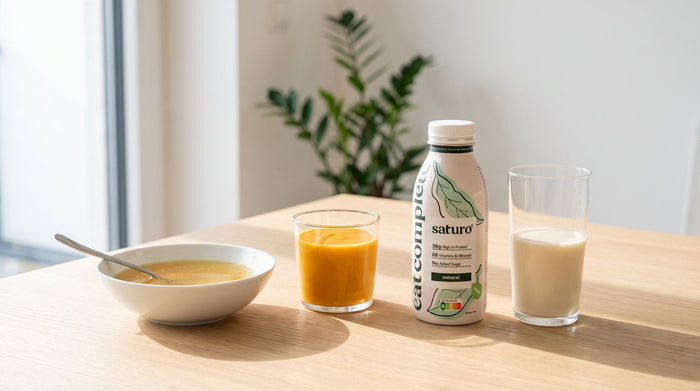
The fourth meal that always fits: an afternoon drinkable meal adds 400 kcal without pushing out your dinner.
The Saturo drinkable meal delivers 400 kcal and 36 g protein per bottle, with 1 to 1.5 g sugar. Protein contributes to a gain in muscle mass. As a fourth or fifth meal in the afternoon, it's the easiest part of your plan. If you want to stick with it for longer, the Weight Gain Starterbox has six bottles plus powder for 32 more meals, and you'll find all our weight-gain products in the overview.
From the Saturo range
Drinkable meal: 400 kcal and 36 g protein between meals
A complete meal with 400 kcal, 36 g plant-based protein, 26 vitamins and minerals, vegan and with 1 to 1.5 g sugar. Protein contributes to a gain in muscle mass. As an afternoon meal, cold from the fridge, no cooking.
36 gProtein
400kcal
26Vitamins & minerals
+400 kcalYour extra per bottle36 g protein, 1.3 g sugar
Healthy weight gain without belly fat: training, protein, mistakes
Gaining weight and staying healthy is a question of direction: the surplus should go into muscle, not into your belly and not into your liver. There are three levers for that, and a few shortcuts that aren't really shortcuts.
Gaining weight without belly fat
Nobody gains weight without any fat at all, but you can steer where it goes: a small surplus of 10 to 20 per cent, 1.6 g protein per kilo of body weight, strength training and the right fats. In one study, 39 normal-weight adults ate muffins every day for seven weeks, made with either saturated palm oil or polyunsaturated sunflower oil. Both groups gained the same amount, but the palm oil group stored significantly more fat in the liver and abdomen, while the sunflower oil group built almost three times as much lean tissue. So nuts, oils, avocado and oily fish are more than just calorie sources when you want to gain weight.
Clean bulk: nutrient-rich, moderate+10–20%
above your needs, from nuts, oil, dairy, fish and wholegrains; gain of 0.25 to 0.5% of body weight per week, mostly muscle
Dirty bulk: fast food, big surplus×2
calories in a study of 18 healthy people: +6.4 kg in four weeks, liver enzyme ALT permanently above the normal range in 11 of 18, liver fat more than doubled
Building muscle mass: strength training and protein
Two to three strength sessions per week with several sets per muscle group and 1.6 g of protein per kilo of body weight per day: according to a meta-analysis of 49 studies, more protein doesn't bring any extra gain in fat-free mass. Spread your protein over four meals with 0.4 g per kilo each, so at 70 kg that's 28 g per meal. The WHO recommends muscle-strengthening activity on at least two days a week; for muscle growth, the sports medicine society ACSM says what matters most is enough sets (ten or more per muscle group per week) and progressively heavier weights. Beginners build muscle fastest; there's no reliable figure for "kilos of muscle per month".
If you want to gain weight, you first need to eat regularly, not eat a lot. Hardly anyone who fills up quickly manages three big meals. Five small ones, plus a shake in the afternoon and two strength sessions: that's the plan that works in practice.
Joerg Hauke, Nutrition expert, expert review of this article
Gaining weight with tablets?
There are no over-the-counter tablets that help you gain weight; what's sold as weight gain tablets is vitamins, yeast or compressed protein with hardly any energy. Prescription appetite stimulants such as megestrol or cyproheptadine are used by doctors for serious illnesses; even there, guidelines advise against routine use, because side effects like thrombosis and sedation outweigh the small effect on weight. The US medicines agency FDA warns against products like Apetamin, which contain cyproheptadine and are sold via social media: not approved, with reports of liver and nerve damage.
Strength training is the signal that steers the surplus into muscle: two sessions per week, increasing the weights slowly.
Gaining weight in older age
From 65, the problem often turns around: appetite drops, muscle fades, and every lost kilo is harder to win back. That's why different numbers apply: at least 1 g of protein per kilo of body weight per day, 1.2 to 1.5 g when you're ill, strength training on three days a week, and if food alone isn't enough, fortified meals and oral nutritional supplements. For this, the European society ESPEN recommends at least 400 kcal and 30 g of protein extra per day, and the German guideline at least 300 kcal with a high protein content, both under medical supervision. Strength training works beyond 50 too: in a meta-analysis with over 1,300 participants, it brought an average of 1.1 kg of lean mass.
When eating becomes a struggle
If you control food to cope with feelings, skip meals out of fear of gaining weight or make yourself sick after eating, you don't need a weight gain plan, you need help: your GP practice, a counselling centre or the anonymous info line of the Federal Institute for Public Health on 0221 892031 (Mon to Thu 10am to 10pm, Fri to Sun 10am to 6pm), essstoerungen.bioeg.de.
08 Look up
Frequently asked questions about gaining weight
Can you gain two kilos in two weeks?
On the scales, yes; as tissue, no. If you suddenly eat more, you store glycogen and water and can quickly show one to two kilos more. Real tissue grows at 0.25 to 0.5 per cent of body weight per week, so in two weeks that's around half a kilo.
How do you gain 5 kg quickly?
With a surplus of 10 to 20 per cent, five to six meals, one shake a day and two strength sessions per week. At 60 kg body weight, realistically that takes four to eight months. Going faster only works with a much higher share of fat.
How long does it take to gain 10 kg?
At 150 to 400 g per week, six to fifteen months, depending on your body weight and surplus. Your needs rise with every kilo, so recalculate every three months. If you gain 10 kg in three months, you've mostly built fat.
What are calorie bombs for gaining weight?
Foods with lots of energy in a small volume: nut butter (190 kcal in 2 tbsp), nuts (200 kcal per handful), dried fruit, avocado, cheese, whole milk, oil. Healthy calorie bombs also deliver protein or unsaturated fats; crisps and sweets deliver only energy.
Which fruit is good for gaining weight?
Bananas (around 105 kcal each), avocado (240 kcal), dates (200 kcal for three), raisins, dried apricots and figs. Fresh fruit like apples or berries has lots of water and little energy; better in a shake or porridge than on its own.
What should I have for breakfast to gain weight?
Porridge made with 50 g of oats, whole milk, a banana and two tablespoons of peanut butter: around 610 kcal and 21 g of protein. Other options are wholegrain bread with avocado and egg, scrambled eggs with cheese, or a shake if you have no appetite in the morning.
How much more do you weigh in the evening than in the morning?
Usually one to two kilos, and more if you eat and drink a lot. That's food, fluid and glycogen with bound water, not tissue. So weigh yourself in the morning after going to the toilet, and compare weekly averages, not single days.
How do I know if I've gained muscle or fat?
By the relationship between strength, waist measurement and weight: if your training weights go up and your waist stays the same, it's mostly muscle growing. If your belly grows faster than your weight, the surplus was too big. Body fat scales fluctuate with your hydration and are only good for spotting trends.