
Jodmangel: Symptome, Ursachen und Behandlung
Müde, frierst schnell, der Hals fühlt sich eng an? Jodmangel bleibt lange still, bis die Schilddrüse wächst. Welche Symptome wirklich dazugehören, welcher Test etwas aussagt und wo Jod drinsteckt.


Aktualisiert 30. September 2026 · 16 Min. Lesezeit · 55 Quellen

Das Wichtigste in 30 Sekunden
Seit 2025 empfiehlt die DGE 150 Mikrogramm am Tag für alle ab 13 Jahren, vorher waren es 200. Schwangere brauchen 220, Stillende 230. Ein Ei liefert 29, ein Kabeljaufilet über 300.
So viele Erwachsene lagen im letzten Jodmonitoring des Robert Koch-Instituts (2008 bis 2011) unter dem geschätzten Bedarf, bei Kindern und Jugendlichen 44 %. Deutschland gilt wieder als mildes Jodmangelgebiet.
Nur so viele Brote und Brötchen im Handel enthalten laut Produktmonitoring 2025 Jodsalz, fünf Jahre vorher waren es 12,7 %, bei Bio-Brot sind es 0,5 %. Dein Salzstreuer zu Hause ist der Hebel.
Leichter Jodmangel macht meist keine Beschwerden. Die Schilddrüse wächst still, bis sie tastbar wird. Müdigkeit, Frieren und Gewichtszunahme kommen erst, wenn daraus eine Unterfunktion wird.
Jodmangel Symptome: Woran du ihn erkennst
Jodmangel ist leise. Die Schilddrüse braucht Jod für ihre Hormone, und wenn es fehlt, gleicht sie das zuerst durch Wachstum aus: Das sichtbare Zeichen ist der Kropf, oft mit Knoten. Müdigkeit, Frieren, trockene Haut oder Gewichtszunahme kommen erst, wenn die Drüse nicht mehr genug Hormon schafft, meist bei stärkerem Mangel. Deshalb fragt die Checkliste nicht nur nach Beschwerden, sondern auch danach, ob du überhaupt Jod bekommst.
Kropf und Knoten: das sichtbare Zeichen
Ein Kropf (Struma) ist die vergrößerte Schilddrüse, die klassische Folge auch eines leichten Jodmangels: Die Hirnanhangdrüse schickt mehr TSH, die Drüse wächst und bildet Knoten. Kleine Kröpfe machen keine Beschwerden, größere drücken auf Luft- und Speiseröhre: Engegefühl, Kloß, Heiserkeit, enger Kragen. In der Papillon-Studie mit 96.000 Berufstätigen hatte jede:r Dritte einen Kropf oder Knoten. Knoten sind meist harmlos; die hausärztliche Leitlinie von 2025 betont, dass Jodmangel sie nicht allein erklärt, Veranlagung spielt mit. Der Ultraschall sieht die Drüse, lange bevor sie tastbar wird (Kapitel 4).
Jodmangel Symptome bei Frauen
Frauen sind häufiger betroffen: In der Papillon-Studie hatten 17 % der Frauen Knoten gegenüber 11,5 % der Männer, und eine Unterfunktion kommt bei Frauen rund fünfmal so oft vor. Dazu kommen zwei Zeichen, die nur Frauen kennen: Zyklusstörungen, wenn die Schilddrüse zu wenig Hormon bildet, und der Mehrbedarf in Schwangerschaft und Stillzeit (220 bzw. 230 µg), der ohne Jodsalz und Milchprodukte kaum zu decken ist (Kapitel 7). In den Wechseljahren überlappen die Beschwerden mit einer Unterfunktion, TSH gehört dann ins Blutbild. Bei Männern zeigt sich Jodmangel öfter als Kropf ohne Knoten, sonst gleich.

Jodmangel Muskelschmerzen: was dran ist
Leichter Jodmangel verursacht keine Muskelschmerzen. Erst eine Schilddrüsenunterfunktion kann Muskeln schwach, steif und krampfanfällig machen: In einer Untersuchung neu diagnostizierter Unterfunktionen klagten 79 % über Muskelbeschwerden, 38 % hatten messbar weniger Kraft, 29 % ein Karpaltunnelsyndrom. Typisch sind schwere Beine beim Treppensteigen, Nackenverspannungen und Krämpfe. Ob deine Schilddrüse dahintersteckt, klärt ein einziger Wert: TSH. Ist er normal, liegt es nicht am Jod. Nächtliche Wadenkrämpfe ohne weitere Zeichen passen eher zu Magnesiummangel.
Jodmangel Symptome Darm: Verstopfung
Der Darm spürt Jodmangel nur über die Schilddrüse: Fehlt Hormon, wird die Darmbewegung träge, und Verstopfung gehört zu den häufigsten Zeichen einer Unterfunktion. Durchfall, Blähungen oder Bauchschmerzen sind dagegen nicht belegt, und die Umkehrung, Jod gegen trägen Darm, funktioniert ohne Unterfunktion nicht. Wer seit Wochen seltener als dreimal pro Woche auf die Toilette geht, prüft zuerst Trinkmenge und Ballaststoffe, dann TSH. Ein neuer Kloß im Hals mit Verstopfung ist ein Grund für den Arzttermin.
Jodmangel Symptome an Haut und Haaren
Trockene, kühle Haut und Haarausfall sind Zeichen der Unterfunktion, nicht des leichten Jodmangels: In einer dänischen Studie hatten 63 % der Betroffenen trockene Haut, und Haarausfall machte eine Unterfunktion viereinhalbmal wahrscheinlicher. Die Haare werden dünn und stumpf und fallen diffus aus, nicht in Kreisen. Für brüchige Fingernägel gibt es keine Studie, für Pickel oder Ausschlag auch nicht. Haarausfall hat häufigere Ursachen, vor allem Eisenmangel und Zinkmangel; Ferritin, Zink und TSH gehören deshalb zusammen aufs Laborblatt.
Was wirklich zu Jodmangel passt
Die meistgesuchten Beschwerden und was die Studien sagen: belegt (Leitlinie, Fachgesellschaft, Metaanalyse), möglich (nur über eine Unterfunktion oder Beobachtung) oder unbelegt (keine Primärquelle).
| Was die Studien sagen | Einstufung | |
|---|---|---|
| Kropf, Knoten | Klassische Folge auch leichten Mangels: Dauer-TSH lässt die Drüse wachsen (DGE, MSD Manual) | Belegt |
| Müdigkeit, Frieren | Zeichen der Unterfunktion (81 % der Betroffenen müde), nicht des leichten Mangels | Belegt bei Unterfunktion |
| Verstopfung | Häufiges Zeichen der Unterfunktion (Lancet 2017); Durchfall unbelegt | Belegt bei Unterfunktion |
| Trockene Haut, Haarausfall | 63 % trockene Haut; Haarausfall macht eine Unterfunktion viereinhalbmal wahrscheinlicher | Belegt bei Unterfunktion |
| Zyklusstörungen, Kinderwunsch | Bei Unterfunktion belegt; verringerte Fruchtbarkeit nur bei schwerem Mangel | Belegt bei Unterfunktion |
| Gewichtszunahme | Klein und meist Wasser: Hormontherapie senkt das Gewicht im Mittel um 1,4 kg (Metaanalyse 2026) | Möglich, klein |
| Muskelschmerzen, Schwäche | 79 % Muskelbeschwerden bei manifester Unterfunktion; für Jodmangel allein keine Studie | Möglich |
| Gelenkschmerzen, Kribbeln | Karpaltunnel bei 29 % der Unterfunktionen; für Jodmangel keine Daten | Möglich |
| Depression, Konzentration | Von der DGE als Unterfunktionszeichen genannt, für leichten Jodmangel nicht belegt | Möglich |
| Kinder: Entwicklung | Schwerer Mangel in der Schwangerschaft schadet belegt; bei mildem Mangel nur Hinweise | Belegt bei schwerem Mangel |
| Augen | Hervortretende Augen gehören zu Morbus Basedow (Überfunktion), nicht zu Jodmangel | Unbelegt |
| Wechseljahresbeschwerden | Überlappen mit einer Unterfunktion, aber keine Studie zu Jodmangel | Unbelegt |
| Brüchige Fingernägel | In keiner Leitlinie oder Übersicht als Jodmangel-Zeichen genannt | Unbelegt |
Einstufung nach den Quellen in Kapitel 8: DGE-FAQ Jod 2025, MSD Manual 2025, Zimmermann/Boelaert 2015, Carlé 2014, Chaker 2017, Duyff 2000, Levothyroxin-Metaanalyse 2026. Stand 30. September 2026.
Die Faustregel aus der Tabelle: Was „bei Unterfunktion“ steht, entscheidet ein TSH-Wert. Was „unbelegt“ ist, kann viele Gründe haben, Jod ist dann selten der erste. Und wer keinen Kropf und normale Schilddrüsenwerte hat, sucht die Ursache seiner Müdigkeit woanders, egal, was ein Jod-Heimtest sagt (Kapitel 4).
Eine Schwellung vorn am Hals, Engegefühl, Schluckbeschwerden oder neue Heiserkeit: zeitnah in die Praxis, mit TSH und Ultraschall. Sofort bei Atemnot. Und bei Herzrasen, Zittern und Gewichtsverlust kein Jod nehmen, das sind Zeichen einer Überfunktion (Kapitel 5).
Jodmangel Ursachen: Warum Deutschland wieder Mangelgebiet ist
Jodmangel hat in Deutschland einen einfachen Grund: Die Böden sind jodarm, Gemüse, Obst und Getreide liefern fast nichts, und natürlich jodreich sind nur Seefisch, Meeresfrüchte und Algen. Alles andere hängt an zwei Umwegen: an Jodsalz und am Futter von Kühen und Hühnern. Beide bröckeln seit den 2000er-Jahren, deshalb ist das Land, das den Kropf einmal losgeworden war, wieder Mangelgebiet.
Jodmangel in Deutschland: die Zahlen
Nach den Kriterien der WHO herrscht in Deutschland wieder ein milder Jodmangel. Das Robert Koch-Institut maß 2008 bis 2011 im Urin von Erwachsenen einen Median von 69 µg/l (Männer) und 54 µg/l (Frauen); ausreichend wären 100 bis 199. Daraus errechnet: 32 % der Erwachsenen liegen unter dem geschätzten Bedarf. Bei Kindern und Jugendlichen fiel der Wert von 118 µg/l (2003 bis 2006) auf 89 (2014 bis 2017), 44 % sind unterversorgt. Neuere repräsentative Messungen gibt es nicht.
Weniger Jodsalz in Brot und Fertigprodukten
Der größte Hebel der letzten 40 Jahre war Jodsalz in Bäckerei, Metzgerei und Industrie, und genau der geht verloren. Das Produktmonitoring 2025 des Max Rubner-Instituts fand Jodsalz nur noch in 9,3 % der Brote und Brötchen (2020: 12,7 %) und in 33,9 % der Wurstwaren (2020: 48,1 %); bei Bio-Brot waren es 0,5 %. Das BfR rechnet vor: Ohne Jodsalz nimmt ein Erwachsener im Median nur rund 75 µg am Tag auf, und ausreichend versorgt wäre das Land erst, wenn 40 % aller Lebensmittel mit Jodsalz hergestellt würden. Heute sind es knapp 30 %.
Vegan, ohne Milch, Bio-Milch: wer wenig Jod bekommt
Milch ist nur deshalb eine Jodquelle, weil Kühe jodhaltiges Mineralfutter bekommen. Bio-Milch enthält laut BfR nur 60 bis 85 % des Jods konventioneller Milch, die DGE rechnet mit 15 statt 30 µg je Glas; Bio-Eier sind dagegen nicht ärmer. Wer vegan isst oder Milch und Fisch wegen Allergie oder Laktoseintoleranz meidet, hat die größte Lücke: In der BfR-Studie erreichten nur 8 % der Veganer:innen den WHO-Wert im Urin, ein Drittel lag im Bereich schweren Mangels. Pflanzendrinks sind selten mit Jod angereichert. Rauchen, Kohl oder Soja bremsen die Jodaufnahme nur, wenn ohnehin wenig Jod da ist (FAQ).
So arbeitet Jod im Körper
Drei Stationen vom Teller bis in jede Zelle. Wer sie kennt, versteht, warum die Schilddrüse bei Jodmangel wächst, warum ein Urintest wenig über dich sagt und warum ältere Menschen mit Knoten vorsichtig sein müssen.
Aufnahme im Dünndarm
Jod aus Fisch, Milch, Ei oder Jodsalz wird als Jodid fast vollständig im Dünndarm aufgenommen. Der Körper hält davon kaum einen Vorrat außerhalb der Schilddrüse: Was sie nicht sofort einfängt, geht binnen eines Tages zu rund 90 % über die Nieren in den Urin. Deshalb muss Jod täglich kommen, und deshalb misst man die Versorgung ganzer Bevölkerungen am Urin.
Die Schilddrüse fängt und baut
Ein Transporter zieht Jodid aus dem Blut in die Drüse, dort wird es in die Hormone T4 und T3 eingebaut; der Vorrat reicht für einige Wochen. Gesteuert wird alles von der Hirnanhangdrüse über TSH: Sinkt der Hormonspiegel, steigt TSH, die Drüse arbeitet mehr und wächst. Das ist die ganze Mechanik des Kropfs.
Wirkung: Stoffwechsel, Wärme, Gehirn
T4 und T3 stellen in jeder Zelle den Grundumsatz ein: Wärme, Herzschlag, Darmbewegung, Aufmerksamkeit. Beim Ungeborenen und Säugling steuern sie die Reifung des Gehirns, deshalb ist der Bedarf in Schwangerschaft und Stillzeit höher. Fehlt Hormon, läuft alles auf Sparflamme: müde, kalt, träge.
Jodmangel Test: Urin, Schilddrüsenwerte und Ultraschall
Einen Jodmangel bei dir persönlich kann kein Test sicher beweisen. Was sich messen lässt, ist die Folge: ob deine Schilddrüse vergrößert ist, Knoten hat oder zu wenig Hormon bildet. Deshalb läuft die Abklärung über TSH, Ultraschall und eine Frage nach deinem Essen, nicht über den Jodwert im Urin.
Jod im Urin: was der Wert aussagt
Rund 90 % des Jods verlassen den Körper über den Urin, deshalb ist die Jodausscheidung das Maß der Wissenschaft. Aber nur für Gruppen: Die WHO-Stufen (unter 20 schwer, 20 bis 49 moderat, 50 bis 99 mild, 100 bis 199 ausreichend, ab 300 zu viel, alles µg/l) gelten für den Median einer Bevölkerung. Beim einzelnen Menschen schwankt ein Spontanurin je nach Vortag und Trinkmenge von 10 bis 260 µg/l; in einer dänischen Studie brauchte es zwölf Proben, um eine Person auf 20 % genau einzuordnen. Ein einzelner Wert ist also weder Diagnose noch Entwarnung, die DGE hält ihn für Einzelpersonen für ungeeignet.

TSH und fT4: die Schilddrüsenwerte
TSH ist der erste Wert: Er steigt, sobald die Schilddrüse zu wenig Hormon liefert, lange bevor du etwas merkst. Die hausärztliche Leitlinie nennt als Obergrenze 4,0 mU/l (18 bis 70 Jahre), 5,0 bis 80 und 6,0 darüber. Ist er erhöht, folgt fT4: normal heißt latente, erniedrigt manifeste Unterfunktion; fT3 braucht es selten. Die Leitlinie warnt zugleich vor Überdiagnostik: TSH schwankt von Tag zu Tag, ein einzelner leicht erhöhter Wert wird nach Wochen kontrolliert, nicht behandelt. Kein TSH-Screening ohne Anlass, kein Ultraschall „zur Sicherheit“.
Welcher Test was sagt
Die Untersuchungen rund um Jod und Schilddrüse, sortiert nach dem, was sie über dich persönlich aussagen.
| Was er zeigt | Aussagekraft für dich | |
|---|---|---|
| TSH | Signal der Hirnanhangdrüse; über 4,0 mU/l (bis 70 Jahre) erhöht | Hoch: erster und wichtigster Wert, erkennt die Unterfunktion früh; leicht erhöht nach Wochen kontrollieren |
| fT4, fT3 | Freie Schilddrüsenhormone im Blut | Hoch bei erhöhtem TSH: trennt latente von manifester Unterfunktion |
| Ultraschall | Volumen (Kropf ab 18 ml Frauen, 25 ml Männer), Knoten, Gewebe | Hoch bei tastbarer Schwellung oder Knoten; nicht als Vorsorge ohne Anlass |
| Schilddrüsen-Antikörper (TPO) | Zeichen einer Hashimoto-Entzündung | Hoch, wenn TSH erhöht ist: entscheidet, ob Jod überhaupt das Thema ist |
| Jod im Spontanurin | Jodausscheidung, WHO-Stufen ab 100 µg/l ausreichend | Gering: gilt für Bevölkerungsmediane, beim Einzelnen 10 bis 260 µg/l Schwankung |
| Jod im 24-Stunden-Urin | Tagesausscheidung, Näherung an die Zufuhr | Mittel: genauer als Spontanurin, für Studien; im Alltag selten sinnvoll |
| Heimtest (Urin per Post) | Jod-Kreatinin-Quotient aus einem Morgenurin | Gering: ein einzelner Wert, siehe oben; ersetzt kein TSH |
| Jodsättigungstest (Lugol) | Hohe Joddosis schlucken, dann Urin messen | Keine: laut Arbeitskreis Jodmangel nie validiert, die Dosis selbst ist riskant |
Grenzen nach DEGAM S2k „Erhöhter TSH-Wert“ 2023, DEGAM S3 Schilddrüsenknoten 2025, WHO 2007, Andersen 2008, DGE-FAQ Jod 2025. Maßgeblich ist der Referenzbereich auf deinem Befund.
Jodmangel-Tests für zu Hause
Heimtests schicken dir ein Röhrchen für den Morgenurin und melden den Jod-Kreatinin-Wert zurück, für 25 bis 50 Euro. Das Ergebnis ist ehrlich gemessen und trotzdem wenig wert: Es ist genau der Einzelwert, der beim Einzelnen um das Zwanzigfache schwankt. Ein niedriger Wert beweist keinen Mangel, ein hoher schließt einen Kropf nicht aus. Wer wissen will, ob die Schilddrüse leidet, lässt TSH messen, das zahlt die Kasse bei Beschwerden. Vom Jodsättigungstest mit Lugolscher Lösung raten Fachgesellschaften ab: nie validiert, und ein Tropfen enthält das Zehnfache der Tagesobergrenze.
Bring drei Dinge mit: ob du Jodsalz nutzt, wie oft Seefisch und Milchprodukte auf dem Teller sind, und ob in deiner Familie Kropf oder Schilddrüsenerkrankungen vorkommen. Nenn Präparate mit Jod, Algen oder Kelp. Das entscheidet, ob Jod überhaupt das Thema ist.
Jodmangel beheben: Was wirklich hilft
Die gute Nachricht: Die Versorgung ist in Tagen gedeckt, mit Jodsalz im Streuer, Milchprodukten, Eiern und einmal pro Woche Seefisch. Die weniger gute: Ein Kropf, der über Jahre gewachsen ist, schrumpft nur langsam und selten ganz. Tabletten sind für klar umrissene Fälle da, und in zwei Situationen sind sie sogar riskant. Der Entscheider unten sortiert das für dich.
Jodtabletten: Wann sind sie sinnvoll?
Jodid-Tabletten mit 100 oder 200 µg sind Arzneimittel aus der Apotheke, ohne Rezept. Sinnvoll sind sie laut DGE und Fachgesellschaften in drei Fällen: in Schwangerschaft und Stillzeit (100 bis 150 µg zusätzlich, Kapitel 7), bei einer diffusen Vergrößerung ohne Knoten bei Jüngeren als Therapie in ärztlicher Hand, und wenn die Ernährung dauerhaft keine Jodquelle hergibt, etwa vegan ohne Jodsalz. Für alle anderen gilt: erst Jodsalz und Essen, dann messen. Für Nahrungsergänzungsmittel empfiehlt das BfR höchstens 100 µg je Tagesdosis. Nebenwirkungen sind bei 100 bis 200 µg nicht zu erwarten, mit einer Ausnahme (nächster Abschnitt).
Warum ab 45 keine Jodtabletten?
Diese Regel gibt es, aber sie meint andere Tabletten: die hochdosierten Kaliumiodid-Tabletten für den Nuklearnotfall. Zwei davon enthalten 100 mg Jod, das Tausendfache einer Jodid-Tablette, und blockieren die Schilddrüse gegen radioaktives Jod. Das Bundesamt für Strahlenschutz rät Menschen über 45 davon ab, weil viele in dieser Generation unerkannte heiße Knoten aus der Jodmangelzeit tragen: Eine solche Dosis kann eine Überfunktion bis zum Herz-Kreislauf-Versagen auslösen. Eingenommen werden sie nur auf behördliche Aufforderung. Für 100 µg Jodid gibt es keine Altersgrenze, aber dieselbe Vorsicht: Ab 45 vorher die Schilddrüse ansehen lassen.
Die meisten, die mich nach Jodtabletten fragen, brauchen einen Salzstreuer mit Jodsalz und einmal die Woche Fisch, keine Tablette. Und die wenigen, die wirklich Jodid brauchen, Schwangere zum Beispiel, sollen es nach Rücksprache nehmen und nicht auf Verdacht. Was ich nie sehen will: Lugolsche Lösung im Wasserglas.
Joerg Hauke, Ernährungsexperte, fachliche Prüfung dieses Artikels
Jod bei Hashimoto: erlaubt oder nicht?
Erlaubt in normaler Menge. Die Deutsche Gesellschaft für Endokrinologie schreibt Betroffenen: Jodsalz, Seefisch einmal pro Woche und Urlaub am Meer sind unbedenklich, auch zu Beginn der Erkrankung. Zu meiden sind hohe Dosen: tägliche Algen, viel Sushi, hochdosierte Präparate, weil sie den Verlauf beschleunigen könnten. Hashimoto ist die häufigste Ursache einer Unterfunktion in Deutschland, und sie ist kein Jodmangel: Mehr Jod bessert sie nicht, die hausärztliche Leitlinie sieht für Jod- oder Selenpräparate keinen Nutzen. Eine Ausnahme nennt die Fachgesellschaft ausdrücklich: In Schwangerschaft und Stillzeit sollen auch Frauen mit Hashimoto Jodid nehmen, ärztlich abgestimmt.
Wie lange dauert es, bis ein Jodmangel behoben ist?
Zwei Uhren laufen. Die Versorgung ist schnell aufgeholt: Der Vorrat der Schilddrüse füllt sich in Wochen, wer heute auf Jodsalz umstellt, ist im nächsten Monat versorgt. Der Kropf braucht Monate und schrumpft selten ganz: Die Gebrauchsinformation von Jodid rechnet mit 6 bis 12 Monaten oder länger; in der deutschen LISA-Studie mit 1.024 Erwachsenen sank das Schilddrüsenvolumen in einem Jahr unter Jod allein um 2,5 %, mit Levothyroxin um 5,2 %, mit beidem um 7,9 %, Knoten um 17 %. Was über Jahrzehnte wuchs, hört auf zu wachsen, verschwindet aber nicht. Eine Unterfunktion wird mit Hormon behandelt, nicht mit Jod.
Von Bedarf bis zu viel: Jod in Zahlen
-
1
Tagesbedarf150 µg
Empfehlung der DGE seit 2025 für alle ab 13 Jahren, Schwangere 220, Stillende 230. Ein Kabeljaufilet liefert das Doppelte, ein Ei ein Fünftel, eine Flasche Trinkmahlzeit ein Viertel.
-
2
Höchstmenge im Präparat100 µg
Empfehlung des BfR für die Tagesdosis eines Nahrungsergänzungsmittels, 150 µg für Schwangere und Stillende. Jodid 200 aus der Apotheke ist ein Arzneimittel.
-
3
Obergrenze600 µg
Tolerable Upper Intake Level der EFSA für Erwachsene, 500 für 15- bis 17-Jährige; der alte deutsche Wert 500 ist damit abgelöst. Mit Jodsalz und Fisch kaum zu erreichen, mit Braunalgen sofort.
-
4
Ein Tropfen Lugol6.000 µg
So viel Jod steckt laut BfR in einem Tropfen 5 %iger Lugolscher Lösung, das Zehnfache der Obergrenze. Kein Lebensmittel, nicht verkehrsfähig. Die Strahlenschutz-Tablette liegt nochmals beim Fünfzehnfachen.
DGE/ÖGE 2025; BfR-Höchstmengenvorschläge 065/2025; EFSA/SCF (Übersicht 2025); BfR-Mitteilung 027/2026 zu Lugolscher Lösung; SSK-Merkblatt 2024 (130 mg Kaliumiodid = 100 mg Jod).
Zu viel Jod: ab wann es schadet
Über Jodsalz und Fisch ist ein Zuviel praktisch unmöglich, selbst wenn alles Salz jodiert wäre, so die DGE. Gefährlich sind getrocknete Braunalgen (Kombu, Wakame, Hijiki, Arame mit bis zu 5.500 µg je Gramm), hochdosierte Präparate, Lugolsche Lösung und jodhaltige Kontrastmittel. Eine gesunde Schilddrüse blockiert bei Überflutung kurz die Hormonbildung und fängt sich in Tagen. Wer aber alte heiße Knoten trägt, kann eine Überfunktion entwickeln: Herzrasen, Schwitzen, Zittern, Gewichtsverlust, Herzrhythmusstörungen, bei Älteren lebensbedrohlich. Eine „Jodallergie“ gibt es übrigens nicht: Reaktionen auf Kontrastmittel oder Meeresfrüchte haben andere Auslöser.
Nori-Blätter für Sushi sind mit rund 70 µg je Blatt in Ordnung. Braunalgen wie Kombu, Wakame, Arame und Hijiki nicht: Schon 1 bis 10 g können die Obergrenze um ein Vielfaches überschreiten, das BfR hält Produkte über 20 mg Jod je kg für nicht verkehrsfähig. Nur mit deklariertem Jodgehalt, nie täglich.
Jodhaltige Lebensmittel: Wo am meisten Jod drinsteckt
Natürlich jodreich sind fast nur Seefisch und Meeresfrüchte. Alles andere kommt über Umwege: Milch, Joghurt, Käse und Eier über das Futter der Tiere, Brot, Wurst und dein Essen zu Hause über Jodsalz. Pflanzen aus deutschen Böden liefern fast nichts, deshalb heißt der zweite Balken „pflanzlich und angereichert“. Werte je 100 g so, wie es auf den Teller kommt, aus dem Bundeslebensmittelschlüssel 4.0.
Jod pro 100 g: Top 10 tierisch und pflanzlich
150 g Kabeljau liefern 336 µg, mehr als das Doppelte des Tagesbedarfs, deshalb reicht Seefisch einmal pro Woche. Ein Ei bringt 29 µg, ein Glas Milch 28 µg. Lachs nur 6 µg je 100 g.
Seefisch und Meeresfrüchte: Kabeljau statt Lachs
Die mageren Meeresfische liegen vorn: Schellfisch 328, Kabeljau 224, Seelachs 77 µg je 100 g, dazu Miesmuscheln, Garnelen, Sardinen und Hering. Der verbreitete Irrtum heißt Lachs: Zuchtlachs bringt 6 µg, Forelle 8, Pangasius 4, Süßwasserfisch ist keine Jodquelle. Fischstäbchen aus Seelachs liefern immerhin 47. Beim Kochen und Auftauen gehen 10 bis 20 % ins Wasser, Braten und Backen kosten nichts. Die Faustregel der Behörden: ein- bis zweimal pro Woche Seefisch, dann ist der Wochenbedarf schon zur Hälfte gedeckt.

Jodgehalt in Joghurt, Käse und Milch
Milch liefert rund 14 µg je 100 ml, ein Glas also 28 µg; Marktproben schwanken je nach Futter, Jahreszeit und Betrieb zwischen 9 und 18. Joghurt liegt mit etwa 8 bis 14 µg leicht darunter, Skyr mit 20 und Magerquark mit 17 darüber, weil sie konzentrierter sind. Bei Käse entscheidet die Sorte: Parmesan 81 und Feta 78 sind echte Quellen, Gouda (12), Emmentaler (10) und Mozzarella (15) nur ein Beitrag. Bio-Milch bringt etwa 60 bis 88 % des konventionellen Werts. Für alle Milchprodukte gilt: Sie decken den Bedarf nur zusammen mit Jodsalz, nicht allein.
Jodsalz: gesund oder überflüssig?
Jodsalz enthält gesetzlich 15 bis 25 µg Jod je Gramm, im Handel gemessen rund 20. Die von der DGE empfohlenen höchstens 6 g Salz am Tag liefern damit 120 µg, vier Fünftel des Bedarfs, und das ohne mehr Salz: Die Regel heißt „wenn Salz, dann Jodsalz“, nicht „mehr Salz“. Meersalz bringt 0,4 µg je Gramm, Steinsalz und Himalayasalz 0,05, Fleur de Sel hat keinen Messwert; das BZfE nennt sie keine Alternative. Auch das Kochwasser zählt: Nudeln und Kartoffeln nehmen Jod aus Jodsalzwasser auf, beim Backen und Braten bleibt es erhalten. Dass Jodsalz der Schilddrüse schadet, ist ein Mythos, so die Modellrechnung des BfR.
Jod vegan: So klappt es ohne Fisch und Milch
Ohne Fisch, Milch und Ei bleibt Jodsalz die einzige große Quelle, und sie muss an drei Stellen sitzen: im Streuer, im Brot (auf „Jodsalz“ in der Zutatenliste achten, Bio-Brot hat es fast nie) und im Kochwasser. Dazu ein Pflanzendrink mit Jodzusatz: 200 ml bringen 45 µg, ohne Zusatz 4. Zusammen ergibt ein veganer Tag rechnerisch rund 190 µg; fällt eine der drei Quellen weg, sinkt er auf 120 bis 160, fallen alle weg, auf etwa 50. Wer das nicht hinbekommt, spricht über 100 µg Jodid; B12 ist dann meist schon geregelt, siehe Vitamin-B12-Mangel.
Jod im Alltag: Trinkmahlzeiten
An Tagen ohne Fisch, Milchprodukte oder Jodsalz-Brot ist eine Trinkmahlzeit mit festgelegten Nährstoffmengen ein planbarer Beitrag: Eine Flasche Saturo liefert 37 µg Jod, ein Viertel der Referenzmenge von 150 µg, bei allen Sorten gleich, dazu 26 weitere Vitamine und Mineralstoffe, darunter Selen und Zink. Das Jod stammt aus den Zutaten, nicht aus einem Zusatz. Eine Mahlzeit ersetzt weder Jodsalz im Haushalt noch eine ärztliche Behandlung.
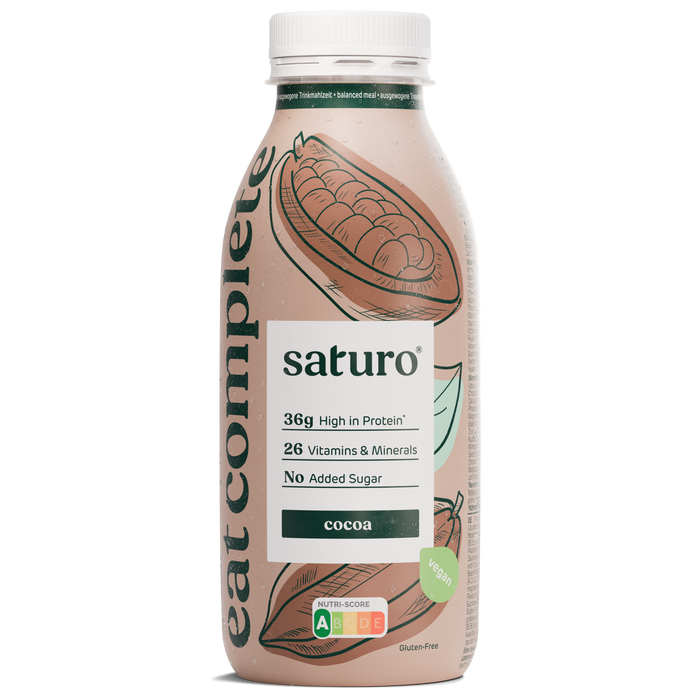
Trinkmahlzeit: eine vollwertige Mahlzeit aus der Flasche
26 Vitamine und Mineralstoffe, darunter 37 µg Jod pro Flasche, ein Viertel der Referenzmenge von 150 µg. 400 kcal und 36 g Protein je Flasche. Ersetzt keine ärztliche Behandlung.
Jod in Schwangerschaft, Stillzeit und Kindheit
Jod in der Schwangerschaft und Stillzeit
Der Bedarf steigt auf 220 µg (schwanger) und 230 µg (stillend), weil die Schilddrüse des Kindes von der Mutter versorgt wird und Jod in die Muttermilch übergeht. DGE, BfR und das Netzwerk Gesund ins Leben empfehlen deshalb ab Kinderwunsch zusätzlich zu Jodsalz und Milchprodukten ein Präparat mit 100 (bis 150) µg, bei Schilddrüsenerkrankung nach Rücksprache; Folsäure kommt in dasselbe Präparat (siehe Folsäuremangel). Ehrlich dazu: Schwerer Mangel schadet der Entwicklung belegt, bei mildem Mangel sind die Studien uneins, ein großer Versuch fand keinen IQ-Effekt der Tabletten, die hausärztliche Leitlinie hält die Evidenz für dünn. Die Empfehlung gilt trotzdem, weil Deutschland Mangelgebiet ist.

Kinder und Jugendliche sind die Gruppe mit dem größten Rückgang: Der Jodwert im Urin fiel zwischen den beiden KiGGS-Erhebungen von 118 auf 89 µg/l, fast jedes zweite Kind bleibt unter dem Bedarf, bei Ein- bis Zweijährigen 45 % der Mädchen. Der Bedarf liegt bei 90 µg (1 bis 6 Jahre), 120 µg (7 bis 12) und 150 µg ab 13; Säuglingsnahrung ist gesetzlich mit Jod versorgt, Stillkinder hängen an der Mutter. Im Alltag heißt das: Jodsalz in der Familienküche, täglich Milch oder Joghurt, Fischstäbchen zählen mit; Präparate nur nach Rücksprache.
Häufige Fragen zu Jodmangel
Ist Deutschland ein Jodmangelgebiet?
Ja, nach den Kriterien der WHO ein mildes: Der Median der Jodausscheidung lag bei Erwachsenen bei 54 bis 69 µg/l, bei Kindern bei 89, ausreichend wären 100. 32 % der Erwachsenen und 44 % der Kinder liegen unter dem Bedarf. Kein Notstand, aber ein Trend nach unten seit den 2000ern.
Kann Jodmangel zu Gewichtszunahme führen?
Nur über eine Unterfunktion, und dann wenig: meist 1 bis 4 kg, überwiegend eingelagertes Wasser. Eine Metaanalyse von 2026 fand unter Hormontherapie im Mittel 1,4 kg weniger. „Jodmangel macht dick“ ist nicht belegt; wer zunimmt und normale Schilddrüsenwerte hat, sucht die Ursache woanders.
Ist in Bananen Jod?
Kaum: 3 µg je 100 g, eine Banane liefert rund 4 µg, das sind 2 bis 3 % des Tagesbedarfs. Obst kommt insgesamt auf etwa 1 µg je 100 g, weil die Böden jodarm sind. Bananen bringen Kalium, für Jod braucht es Seefisch, Milchprodukte, Ei oder Jodsalz.
Ist in Skyr Jod enthalten?
Ja, rund 20 µg je 100 g, ein 150-g-Becher liefert etwa 30 µg, ein Fünftel des Tagesbedarfs. Skyr ist konzentrierter als Joghurt (8 bis 14 µg) und liegt damit mit Magerquark (17) vorn. Der Wert schwankt mit der Fütterung der Kühe, Bio meist niedriger.
Was hemmt die Aufnahme von Jod?
Rauchen (Thiocyanat), sehr viel Kohl, Kresse, Rettich, Hirse oder Leinsamen sowie Perchlorat konkurrieren mit Jod um die Schilddrüse. Laut BfR wirkt das erst, wenn ohnehin zu wenig Jod da ist. Soja hat laut Metaanalyse keinen relevanten Effekt. Selen-, Eisen- oder Vitamin-A-Mangel verschärfen einen Jodmangel.
Kann man Jod und Folsäure zusammen nehmen?
Ja, in der Schwangerschaft ist das sogar üblich: Kombipräparate enthalten 400 µg Folsäure und 100 bis 150 µg Jod, das BfR beschreibt beide zusammen. Sie beeinflussen sich nicht. Nur bei bekannter Schilddrüsenerkrankung wird der Jodanteil vorher ärztlich abgestimmt, die Folsäure bleibt in jedem Fall.
Wie viele Algen darf man pro Tag essen?
Nori-Blätter für Sushi (rund 70 µg je Blatt) sind unkritisch. Braunalgen wie Kombu, Wakame, Hijiki und Arame nicht: 1 bis 10 g getrocknet können die Obergrenze von 600 µg um ein Vielfaches übersteigen. Nur Produkte mit deklariertem Jodgehalt, nie täglich, bei Schilddrüsenerkrankung gar nicht.
Kann ein Kropf auch wieder verschwinden?
Teilweise. Bei jüngeren Menschen mit diffuser Vergrößerung schrumpft die Drüse unter Jodid oder Hormon über 6 bis 12 Monate, in der LISA-Studie um 2,5 bis 8 % je Jahr. Ein alter Kropf mit Knoten geht nicht zurück, er hört auf zu wachsen. Bei Beschwerden bleiben Radiojod oder Operation.
Quellen · 55 Quellen anzeigen
- Deutsche Gesellschaft für Ernährung (DGE) / Österreichische Gesellschaft für Ernährung (ÖGE): Referenzwerte für die Nährstoffzufuhr, Jod. Stand der Ableitung 2025.
- DGE: Neue Referenzwerte für Jod und Vitamin E erschienen. Pressemeldung 2025.
- DGE: Fragen und Antworten zu Jod. Letzte Änderung 15.09.2025.
- Bundesinstitut für Risikobewertung (BfR): Aktualisierung (2025): Höchstmengenvorschläge für Jod in Lebensmitteln inklusive Nahrungsergänzungsmitteln. Stellungnahme Nr. 065/2025 vom 19.12.2025.
- EFSA: Overview on Tolerable Upper Intake Levels as derived by the SCF and the EFSA NDA Panel. Version 11, August 2025 (Jod: 600 µg/Tag Erwachsene).
- Verordnung (EU) Nr. 1169/2011 (Lebensmittelinformationsverordnung), Anhang XIII: Referenzmengen für die tägliche Zufuhr (Jod 150 µg).
- Bundesministerium für Landwirtschaft, Ernährung und Heimat (BMLEH): Jodversorgung in Deutschland, Ergebnisse des Jodmonitorings bei Kindern, Jugendlichen und Erwachsenen (DEGS1, KiGGS).
- Thamm M. et al.: Jodversorgung in Deutschland, Ergebnisse des Jodmonitorings im Kinder- und Jugendgesundheitssurvey (KiGGS). Bundesgesundheitsblatt 2007; 50: 744–749.
- Johner S. A. et al.: Examination of iodine status in the German population: an example for methodological pitfalls of the current approach of iodine status assessment. European Journal of Nutrition 2016; 55(3): 1275–1282.
- Iodine Global Network: Global scorecard of iodine nutrition in 2025 (Deutschland: Median 89 µg/l, insufficient).
- BfR: Jodversorgung in Deutschland wieder rückläufig, Tipps für eine gute Jodversorgung. FAQ vom 20.02.2020, aktualisiert 09.02.2021.
- BfR: Rückläufige Jodzufuhr in der Bevölkerung, Modellszenarien zur Verbesserung der Jodaufnahme (BfR-MEAL-Studie). Stellungnahme Nr. 005/2021.
- Max Rubner-Institut (MRI): Ergänzende Auswertungen zum Produktmonitoring 2025: Verwendung von Jodsalz in Brot und Kleingebäck, Wurstwaren, Fleischerzeugnissen, Suppen und Instantgerichten. April 2026.
- MRI: Studie zum Einfluss von Herstellungs- und Verarbeitungsprozessen auf den Jodgehalt bei Verwendung von jodiertem Speisesalz. Abschlussbericht, März 2018.
- Bundeszentrum für Ernährung (BZfE): Salz, Wenn Salz, dann Jodsalz. Stand 04.09.2026.
- BZfE: Gute Jodversorgung bei veganer und vegetarischer Ernährung.
- BMLEH: Fragen und Antworten zu Jodsalz.
- Verbraucherzentrale: Welches Salz kann ich im Haushalt verwenden? Stand 31.07.2026.
- Reiners C. et al.: Prevalence of thyroid disorders in the working population of Germany: ultrasonography screening in 96,278 unselected employees (Papillon). Thyroid 2004; 14(11): 926–932.
- DEGAM: S3-Leitlinie Schilddrüsenknoten bei Erwachsenen in der hausärztlichen Versorgung. AWMF-Register-Nr. 053-058, Stand 30.11.2025.
- DEGAM: S2k-Leitlinie Erhöhter TSH-Wert in der Hausarztpraxis. AWMF-Register-Nr. 053-046, Stand April 2023.
- Zimmermann M. B., Boelaert K.: Iodine deficiency and thyroid disorders. The Lancet Diabetes & Endocrinology 2015; 3(4): 286–295.
- MSD Manual, Ausgabe für medizinische Fachkreise: Jodmangel. Vollständige Überprüfung Mai 2025.
- Carlé A. et al.: Hypothyroid symptoms and the likelihood of overt thyroid failure: a population-based case-control study. European Journal of Endocrinology 2014; 171(5): 593–602.
- Chaker L. et al.: Hypothyroidism. The Lancet 2017; 390(10101): 1550–1562.
- Duyff R. F. et al.: Neuromuscular findings in thyroid dysfunction: a prospective clinical and electrodiagnostic study. Journal of Neurology, Neurosurgery & Psychiatry 2000; 68(6): 750–755.
- Karmisholt J., Andersen S., Laurberg P.: Weight loss after therapy of hypothyroidism is mainly caused by excretion of excess body water associated with myxoedema. Journal of Clinical Endocrinology & Metabolism 2011; 96(1): E99–E103.
- Wolde Sellasie S. et al.: Levothyroxine therapy for euthyroidism restoration results in clinically insignificant weight and anthropometric changes: a systematic review and meta-analysis. International Journal of Obesity 2026.
- WHO/UNICEF/ICCIDD: Assessment of iodine deficiency disorders and monitoring their elimination. 3. Auflage 2007 (Bewertungsstufen der Jodausscheidung).
- Andersen S. et al.: Reliability of studies of iodine intake and recommendations for number of samples in groups and in individuals. British Journal of Nutrition 2008; 99(4): 813–818.
- Arbeitskreis Jodmangel e. V.: Gefährlicher Trend: Lugolsche Lösung für Jodsupplementation und Jodsättigungstest. Pressemitteilung 10.06.2021.
- Hexal AG: Jodid 100 µg / 200 µg HEXAL Tabletten, Gebrauchsinformation. Stand Mai 2025.
- Grussendorf M. et al.: Reduction of thyroid nodule volume by levothyroxine and iodine alone and in combination: a randomized, placebo-controlled trial (LISA). Journal of Clinical Endocrinology & Metabolism 2011; 96(9): 2786–2795.
- Bundesamt für Strahlenschutz (BfS): Einnahme und Wirkung von Jodtabletten. Stand 11.02.2026.
- Strahlenschutzkommission (SSK): Verwendung von Jodtabletten zur Jodblockade der Schilddrüse bei einem Notfall mit Freisetzung von radioaktivem Jod. Merkblatt, Fassung 30.01.2024.
- BfR: Lugolsche Lösung ist keine Lösung zur Verbesserung der Jodversorgung. Mitteilung Nr. 027/2026 vom 21.05.2026.
- Bundesamt für Verbraucherschutz und Lebensmittelsicherheit (BVL): Lugolsche Lösung ist kein Lebensmittel. Pressemitteilung vom 21.05.2026.
- Deutsche Gesellschaft für Endokrinologie: Hashimoto-Thyreoiditis, Autoimmunthyreoiditis. Ratgeber für Patienten und Angehörige.
- Pharmazeutische Zeitung: Iodallergie ist ein Mythos. Ausgabe 41/2015.
- BfR: Gesundheitliche Risiken durch zu hohen Jodgehalt in getrockneten Algen. Aktualisierte Stellungnahme Nr. 026/2007.
- BgVV: Getrockneter Seetang und getrocknete Algenblätter mit überhöhten Jodgehalten (Tabelle der Algenarten). 2001.
- CVUA Stuttgart: Algen, eine gute Jodquelle? 06.02.2024, aktualisiert 25.03.2025.
- Netzwerk Gesund ins Leben: Warum brauchen Schwangere zusätzlich Jod?
- BfR: Jod, Folat/Folsäure und Schwangerschaft: Ratschläge für die ärztliche Praxis.
- Harding K. B. et al.: Iodine supplementation for women during the preconception, pregnancy and postpartum period. Cochrane Database of Systematic Reviews 2017; 3: CD011761.
- Gowachirapant S. et al.: Effect of iodine supplementation in pregnant women on child neurodevelopment: a randomised, double-blind, placebo-controlled trial. The Lancet Diabetes & Endocrinology 2017; 5(11): 853–863.
- Bath S. C. et al.: Effect of inadequate iodine status in UK pregnant women on cognitive outcomes in their children: results from ALSPAC. The Lancet 2013; 382(9889): 331–337.
- Delegierte Verordnung (EU) 2016/127 (Säuglingsanfangsnahrung und Folgenahrung), Anhang I und II: Jod 15 bis 29 µg je 100 kcal. Amtsblatt L 25 vom 02.02.2016.
- Weikert C. et al. (BfR): Vitamin and Mineral Status in a Vegan Diet (RBVD-Studie). Deutsches Ärzteblatt International 2020; 117: 575–582.
- Otun J. et al.: Systematic Review and Meta-analysis on the Effect of Soy on Thyroid Function. Scientific Reports 2019; 9: 3964.
- Knudsen N. et al.: Risk factors for goiter and thyroid nodules (Rauchen, Thiocyanat). Thyroid 2002; 12(10): 879–888.
- Dahl L. et al.: Iodine and Mercury Content in Raw, Boiled, Pan-Fried, and Oven-Baked Atlantic Cod. Foods 2020; 9: 1652.
- Arbeitskreis Jodmangel e. V.: Jodgehalt in Biomilch und -milchprodukten. 2016.
- Landesamt für Verbraucherschutz und Lebensmittelsicherheit Niedersachsen (LAVES): Jodquelle Konsummilch.
- Max Rubner-Institut: Bundeslebensmittelschlüssel (BLS) 4.0, Version 2025 (Iodid in µg/100 g).
Schreibt seit 2019 für Saturo über Ernährung, Nährstoffe und die Frage, wie gute Versorgung im Alltag praktisch funktioniert.
Hat diesen Artikel am 30. September 2026 auf fachliche Richtigkeit geprüft. Die Inhalte ersetzen keine ärztliche Beratung.
Eisenmangel: Symptome, Ursachen und Behandlung
Der häufigste Mangel überhaupt, und er verschärft einen Jodmangel: Welche Symptome dazugehören, welcher Blutwert zählt und wo Eisen drinsteckt.
Weiterlesen · 13 Min

Neues aus dem Ratgeber
Neue Artikel, Updates und Tipps direkt ins Postfach. Verständlich, fachlich geprüft, ohne Spam.
Danke! Bitte bestätige die Anmeldung in deinem Postfach.