
Malnutrition: symptoms, causes and what helps
Trousers hanging loose, plate left half full, no strength? Malnutrition mostly affects older and ill people and is often noticed late. How to spot it, when it gets serious and what really helps.


Aktualisiert 20 October 2026 · 14 Min. Lesezeit · 43 Quellen

The key points in 30 seconds
patients in German hospitals were malnourished on nutritionDay 2018 according to the GLIM criteria: around 20% severely, 15% moderately. Most arrived already in that state.
That few were classed as malnourished by hospital staff on the same day. The rest slipped through, even though weight and food intake were right there on the table.
Unintended weight loss over three months is a warning sign, and more than 10% over six months even more so. At 70 kg, that's three and a half kilos.
First clarify the causes and enrich your food, then add snacks between meals, and only after that oral nutritional supplements on prescription. No step is skipped, and none replaces the one before.
What is malnutrition?
Malnutrition sounds like something from famine regions, but it happens right in the middle of Germany: in hospitals, in care homes and in kitchens where someone has only been eating half portions for months. Because doctors, nurses and the WHO all use the word differently, this chapter clears up the terms first. After that, you'll know what's being talked about when you speak to your GP surgery.
What is malnutrition? The definition
Malnutrition is a lasting deficit of energy and nutrients that measurably changes the body: less muscle and fat mass, less strength, worse outcomes when you're ill. That's how the European society ESPEN and the German expert standard for nursing define it. Since 2019, professionals need two things to make a diagnosis (GLIM criteria): a visible sign on the body, meaning unintended weight loss, low BMI or lost muscle mass, and a cause, meaning too little food or an illness with inflammation. Low weight alone isn't malnutrition, and a normal weight doesn't rule it out.
Undernutrition and malnutrition: the difference
In technical language, the two words usually mean the same thing: ESPEN lists “undernutrition” as a synonym for malnutrition. The German society DGEM uses “undernutrition” more narrowly for the form where people simply eat too little, without inflammation in the body, for example with swallowing disorders, dementia or depression. The WHO, on the other hand, defines “malnutrition” much more broadly and even includes overweight. In everyday speech, undernutrition often just means “too thin”. As soon as it comes to treatment and prescriptions, the clinical definition counts: too little energy and protein, with consequences for the body.
What forms of malnutrition are there?
Professional societies classify it by cause: illness-related with or without inflammation, or without illness due to hunger, poverty and emotional distress. In everyday life you often hear “quantitative malnutrition” (too little energy, weight drops) and “qualitative malnutrition” (energy is enough, but vitamins and minerals are missing, weight is often normal). The DGE uses this distinction in communal catering; it doesn't appear in guidelines or in the ICD-10 diagnostic code system. There, malnutrition means only energy and protein deficiency, while a vitamin deficiency or mineral deficiency is a diagnosis of its own. The table sorts the forms you'll come across in medical letters.
Forms of malnutrition
Classification by cause, as used by ESPEN, DGEM and ICD-10.
| What's missing | Typical in | How to spot it | |
|---|---|---|---|
| Illness-related with chronic inflammation (cachexia) | Energy and muscle protein, despite eating | Cancer, COPD, heart failure, bowel and kidney diseases | Weight and strength drop, no appetite, raised CRP |
| Illness-related, acute | Energy and protein in a short time | Major surgery, severe infection, burns, intensive care | Breakdown within days to weeks |
| Illness-related without inflammation | Energy and nutrients, because too little gets in | Swallowing disorder, dementia, depression, gastrointestinal disease, anorexia | Food intake drops over weeks, weight follows |
| Undernutrition without illness | Mainly energy | Poverty, loneliness, grief, hunger | Too little on the plate, often unnoticed for a long time |
| Sarcopenia | Muscle mass and strength | Older age, lack of exercise, often together with malnutrition | Getting up is hard, weight can be normal |
| Micronutrient deficiency | Individual vitamins or minerals | One-sided diet, absorption disorder, medication | Usually no weight loss, symptoms depend on the nutrient |
| Marasmus and kwashiorkor | Energy (marasmus) or protein with oedema (kwashiorkor) | Children in famine regions, ICD-10 E40 to E42 | Severe wasting or fluid retention |
Based on ESPEN terminology 2017, DGEM terminology 2013 and ICD-10-GM 2026. Sarcopenia and micronutrient deficiency are separate conditions that often occur together with malnutrition. Worldwide in 2024, around 150 million children under five suffered from stunting and 43 million from wasting (UNICEF/WHO).
Cachexia and sarcopenia: related, but not the same
Cachexia is illness-related malnutrition with chronic inflammation. It is not the “end stage” of malnutrition, as it's often described. With cancer, COPD, heart failure or chronic kidney disease, the body breaks down muscle and fat even when the person eats normally, because inflammation changes the metabolism. Sarcopenia, on the other hand, is a muscle disease: strength and muscle mass decline, typically in older age, even at a normal weight. Both often occur alongside malnutrition and need the same foundation, enough protein and exercise, as the article on protein needs in older age shows.

Recognising malnutrition: symptoms and signs
Most cases start quietly. Losing one kilo a month goes unnoticed, but after half a year it's six, and your body has got used to the new weight. That's why feelings don't count here, but three measurable things do: your weight over time, your BMI and how much you eat.
First signs: how to spot malnutrition
The most important sign is unintended weight loss, visible as loose-fitting clothes, belt, ring or watch. The UK's NICE guideline also lists thin, fragile skin, wounds that heal badly, lack of energy, wasting muscles, poor appetite, altered taste, swallowing problems, changes in digestion and infections that don't clear up. In older people, sunken cheeks, protruding shoulder bones and loose folds of skin on the arms and belly can be added to the list. No single sign proves anything. Two or three of them together with falling weight are reason enough to check properly: first with the Weight Check, then at your GP surgery.
At what BMI do we talk about malnutrition?
Under 18.5 counts as underweight in adults and as a criterion for malnutrition; from age 65, the DGEM sets the limit as high as 20, and the GLIM criteria from age 70 at 22. But BMI alone isn't enough: someone with a BMI of 27 who has lost six kilos in three months can be malnourished, and the German nursing expert standard explicitly warns that this is often overlooked in people who are overweight. That's why the Weight Check asks about the trend, not just the number. By the way, there is no fixed BMI limit for oral nutritional supplements on prescription.
Screening: MNA, NRS 2002 and MUST
Screening questionnaires sort out in a few minutes who is at risk. The MNA (Mini Nutritional Assessment) is designed for older people: six questions on how much they eat, weight loss, mobility, acute illness, memory and BMI, 14 points, under 12 means risk. A self-test version for relatives is available free of charge at mna-elderly.com. NRS 2002 is used in hospitals and factors in how severe the illness is; from 3 points there is a risk. MUST combines BMI, weight loss and acute illness; the British BAPEN offers an online self-screening tool. According to ESPEN, all older people should be screened at least once a year, including those who are overweight.
If weakness, circulation problems or confusion appear within hours or days, especially in older people who drink little. Also with more than 10% weight loss, coughing while eating or pain when swallowing: the appointment belongs in this week, not next month.
Malnutrition blood tests: what albumin shows and what it doesn't
There is no blood test that proves malnutrition. Albumin and prealbumin are often mentioned, but they drop mainly with inflammation and serious illness; the American society ASPEN explicitly advises against reading them as nutrition markers, and the GLIM criteria only list them as a sign of inflammation alongside CRP. What blood tests can do: find causes and accompanying deficiencies. These include CRP, blood count, iron, vitamin B12, folate and vitamin D, plus thyroid and kidney values if there's a suspicion. The doctor makes the diagnosis itself based on weight, trend, how much you eat and muscle strength.
Consequences: what malnutrition does to the body
Three stages where too little energy and protein get through. They explain why losing a few kilos means more in later life than at thirty, and why strength suffers before weight does.
Reserves run down
If the body gets less energy than it uses over several weeks, it empties the glycogen stores first, then the fat tissue. Weight drops, clothes get looser. With pure starvation it's mostly fat that is lost; with illness and inflammation, muscle goes too, right from the start.
Muscles break down
Without enough protein, the body breaks down muscle protein to get energy and building blocks. Strength and balance decline: malnourished older people fall around 45% more often. In acutely ill people, fat-free mass is lost within just a few days.
Defences and healing suffer
Immune cells, skin and wound healing need protein and micronutrients. Infections become more frequent, wounds and pressure sores heal more slowly, and hospital stays last one to three days longer on average. In care homes, six-month mortality among the malnourished was 27% instead of 14%.
Causes: why too little gets through
Malnutrition happens when less gets through than your body needs. The GLIM criteria describe two routes: intake drops because someone can't eat, doesn't want to eat or can't absorb food properly, or needs go up because of illness and inflammation. Usually several causes overlap, and very few have anything to do with "not enough money for food".
Illness, cancer and operations
Disease-related malnutrition is the most common form in wealthy countries. Cancer, COPD, heart failure, chronic inflammatory bowel disease and kidney disease keep inflammation going, which breaks down muscle and dampens appetite. With cancer, treatment adds nausea, changes in taste and inflamed mucous membranes. ESPEN estimates that 10 to 20% of cancer patients die from the effects of malnutrition rather than from the tumour. That's why checking nutritional status before and after major operations is routine. More on this in the chapter Oral nutritional supplements for cancer.
Mental health, medication and living situation
In older age, depression is one of the most common causes of loss of appetite, dementia makes people forget meals, and grief and loneliness take the point out of eating. People who eat alone eat less, and that's well documented. Medication plays a part too, often several drugs at once: loss of appetite, dry mouth, taste disturbance, nausea and tiredness are listed on the leaflet of many active ingredients. Add aching teeth, badly fitting dentures, swallowing difficulties and self-imposed diets. Anyone over 75 who still sticks to a strict low-salt or low-cholesterol diet is at higher risk. Eating disorders and alcohol dependence are further causes where rebuilding should be supervised by a doctor.

Malnutrition in older age: why it's so often overlooked
As you get older, your energy needs go down, but your need for protein and nutrients stays the same. At the same time, appetite, sense of smell, taste and thirst fade. Experts call this the "anorexia of ageing". A few kilos less can seem normal, but often it isn't, and that's exactly why malnutrition in older age is so often overlooked.
Weight loss in older age: when it gets serious
Unintentional weight loss counts as a warning sign from 5% in three months or 10% in six months. At 65 kg, that's a good three kilos in a quarter. For people aged 65 and over, the DGEM also names a BMI below 20 as a criterion. The key word is "unintentional": if you're losing weight on purpose, this isn't about you. The problem in older age is getting used to it. The new weight quickly becomes the normal state, the scales are down in the cellar, and the doctor only sees the person every few months. Work it out with the weight check and note down your weight once a month.
Loss of appetite in older age: what helps
Around 29% of older people have hardly any appetite: one in four at home, almost one in two in care homes. Loss of appetite is closely linked to malnutrition. What helps is expert consensus with thin study evidence, but tried and tested in everyday life: five to six small meals instead of three big ones, finger food for eating on the side, seasoning generously with herbs instead of salt, and colourful plates that contrast with the table. Company is the strongest lever: people who eat with others eat more, whether at the family table, at a community lunch club or with a neighbour.
In older people, weight is the most honest lab value there is. If you weigh yourself once a month and write it down, you'll spot a deficiency half a year earlier than any blood test.
Joerg Hauke, Nutrition expert, professional review of this article
Part of this is clearing away causes: have the dentures checked, go through medication at the surgery for side effects like dry mouth and nausea, and treat depression if someone is feeling low. Exercise before a meal stimulates appetite, but there are only individual studies for that, nothing more. Bitter drops are approved as a traditional remedy, but there are no studies in older people. Prescription appetite stimulants such as megestrol have serious side effects and remain individual decisions for doctors.
Chewing, swallowing, dementia: when eating gets hard
When chewing hurts or swallowing feels unsafe, people eat less long before they say so. Signs include coughing when drinking, long chewing times, food staying in the mouth, and a new preference for purées. In that case, texture-modified, fortified food helps, not simply more of the same. After a stroke, speech and language therapy assesses the swallowing disorder. With dementia, people forget meals or no longer recognise food: fixed mealtimes, finger food, help with eating and patience achieve more here than any oral nutritional supplement. How to eat and drink with swallowing difficulties is explained in its own article.

What to do about malnutrition: treatment step by step
Treatment follows a step-by-step plan set by ESPEN and DGEM, and written into the Arzneimittel-Richtlinie (the German pharmaceuticals directive) too: no step gets skipped, and prescription oral nutritional supplements only come in when food alone is no longer enough. At home, it's more about the kitchen than medicine.
How can you treat malnutrition?
Cause first: treat teeth, medication, depression, swallowing problems and underlying illness, and drop unnecessary diets, such as strict rules for diabetes or cholesterol in old age. Then see a dietitian, which ESPEN calls the “first line” of therapy; many health insurers contribute if you apply before you start, but there is no entitlement. After that, the food itself: fortify it, add snacks, and use protein or carbohydrate powder if needed. Only when that isn't enough come oral nutritional supplements, then tube feeding, and lastly infusion. Exercise belongs in every step, because even older muscles respond to training. The next chapter turns these steps into a plan for everyday life.
The step-by-step plan for malnutrition
-
1
Find the causes, adjust your eatingGP surgery
Check teeth, medication, mood and swallowing; drop diet rules that hold back eating; see a dietitian.
-
2
Fortify food and add snacksAt home
Oil, butter, cream, nut butter, cheese and egg in familiar dishes, plus two snacks. Proven to raise energy intake.
-
3
Oral nutritional supplementsDoctor's prescription
A nutritionally complete diet with at least 400 kcal and 30 g protein a day, for at least a month, only if steps 1 and 2 aren't enough.
-
4
Tube feeding or infusionHospital, nutrition team
When swallowing isn't possible for days, or less than half of your needs get through over a week; watch out for refeeding syndrome.
Order based on the ESPEN geriatrics guideline 2022 and § 21 of the Arzneimittel-Richtlinie. Each step builds on the last; it doesn't replace it.
Fortifying food: more energy and protein without a bigger portion
Fortifying means making familiar dishes denser in energy and protein without piling more on the plate: a tablespoon of rapeseed oil over the veg, cream and butter in the mash, grated cheese on the soup, nut butter in the porridge, whole milk instead of water, a finely chopped egg in the soup. The DGE (German Nutrition Society) recommends exactly this but gives no amounts; the values below are our own calculations from the German nutrient database (Bundeslebensmittelschlüssel) per household measure. One example: butter, cream, cheese and an egg in mashed potato add 322 kcal and 14 g protein. So “high-calorie eating” starts at your own hob. What's proven is that energy intake goes up this way; whether weight and strength follow is less well studied.
What each addition gives you
Kilocalories per addition according to the Bundeslebensmittelschlüssel BLS 4.0 (Max Rubner-Institut), household measures as approximations: 1 tbsp butter 10 g, nut butter 15 g, oil 10 ml. Oil, butter and cream give energy without protein; cream (2 tbsp) 62 kcal, whole milk instead of water (100 ml) 64 kcal.
Oral nutritional supplements for malnutrition
Medical oral nutritional supplements are a nutritionally complete diet from the pharmacy that doctors can prescribe when the ability to eat normally is limited and fortifying, snacks and other measures demonstrably aren't enough (Arzneimittel-Richtlinie § 21 para. 1). There is no fixed BMI cut-off; adults pay a 10% co-payment, a minimum of €5 and a maximum of €10 per pack. ESPEN then recommends at least 400 kcal and 30 g protein a day for at least a month, between meals, not instead of them. The effect is moderate: in studies, around one to two kilos more weight and slightly fewer complications, with little solid evidence for frail older people. Which products exist and when your health insurer pays is covered in the article on high-calorie oral nutritional supplements.
How long does it take to treat malnutrition?
Weeks to months, rarely faster. Older people gain weight more slowly than younger ones; in hospital studies, oral nutritional supplements brought roughly a kilo after about 30 days, which is why ESPEN advises at least a month with monthly check-ups. Strength often returns before weight when exercise is added. For individual nutrients it's measurable: iron-deficiency anaemia improves in blood tests after four weeks, while iron stores take months; how long a vitamin deficiency takes depends on the vitamin. After a long period of hunger, the rule is: build up slowly, not quickly.
If you've barely eaten for weeks, you shouldn't suddenly eat a lot or get high-dose oral nutritional supplements. During refeeding, phosphate, potassium and magnesium drop in the blood, which can affect the heart and breathing. For high-risk patients, guidelines start with no more than 10 kcal per kilo and build up over four to seven days, with vitamin B1 and blood checks. More on this under phosphate deficiency.
Preventing malnutrition: what a good day looks like
Prevention is easier than catching up. For older people, the ESPEN guideline gives a benchmark of 30 kcal and at least 1 g protein per kilo of body weight a day. Here you can see what a thin day looks like and how the same day reaches these values without bigger portions.
What to eat with malnutrition?
What you like, just denser: protein in every main meal (egg, quark, cheese, fish, meat, pulses, tofu), full-fat dairy instead of low-fat, oil and nuts as extras, plus two snacks and a late-evening bite, such as warm milk with honey or a yoghurt. Per 120 g portion, chicken breast gives 37 g, minced beef 32 g and salmon 28 g of protein; on the plant side, fried tofu with 27 g and soybeans with 19 g per 125 g lead the way. What doesn't help: diet products, light versions and rules like “nothing after dinner”. The timeline shows one day for a 75-year-old woman weighing 58 kg, calculated with the Bundeslebensmittelschlüssel.
A fortified day: from 889 to 1,758 kcal
-
7:30 am
Breakfast: 249 kcal, 6 g protein
One slice of toast with butter and jam stays. New: a little more butter and a milky coffee with 100 ml whole milk instead of a splash. Before: 169 kcal.
-
10 am
Snack: 203 kcal, 17 g protein
New: 100 g quark (20% fat) with a tablespoon of peanut butter. The highest-protein meal of the day, stirred together in five minutes.
-
12:30 pm
Lunch: 518 kcal, 27 g protein
A small portion of mash, 70 g chicken breast and carrots stay. New: butter and cream in the mash, a tablespoon of rapeseed oil over the carrots. Before: 268 kcal.
-
3 to 9 pm
Afternoon, evening, late: 788 kcal, 30 g protein
Yoghurt with ground almonds, bread in the evening with more cheese and crème fraîche as a dip, warm whole milk with honey at 9 pm. Daily total 1,758 kcal and 80 g protein.
How much energy and protein do you need per day?
As a guide, ESPEN gives 30 kcal per kilo of body weight and at least 1.0 g of protein per kilo for older people, and 1.2 to 1.5 g if you're ill; from 65, the DGE also uses 1.0 g as its estimated value. For 58 kg, that's around 1,740 kcal and 58 to 87 g of protein, spread across several meals with 20 to 30 g each. The example day is a constructed calculation using BLS values, not a prescription; it ends up at 80 g of protein, and with kidney disease the amount needs to be agreed with your doctor. You can work out your own needs with the calorie calculator and the protein calculator. If you want to put weight back on in later life, you'll find a plan in our article Gaining weight in later life.

If you don't feel like preparing a fourth meal in the afternoon, you can simply drink it. A drinkable meal like the one from Saturo is an ordinary food, not a medicine and not a prescribed sip feed: if malnutrition has been diagnosed, your doctor decides whether you need a food for special medical purposes on prescription. As a building block of a well-filled day, what counts is the nutritional values, and you'll find those on the label.
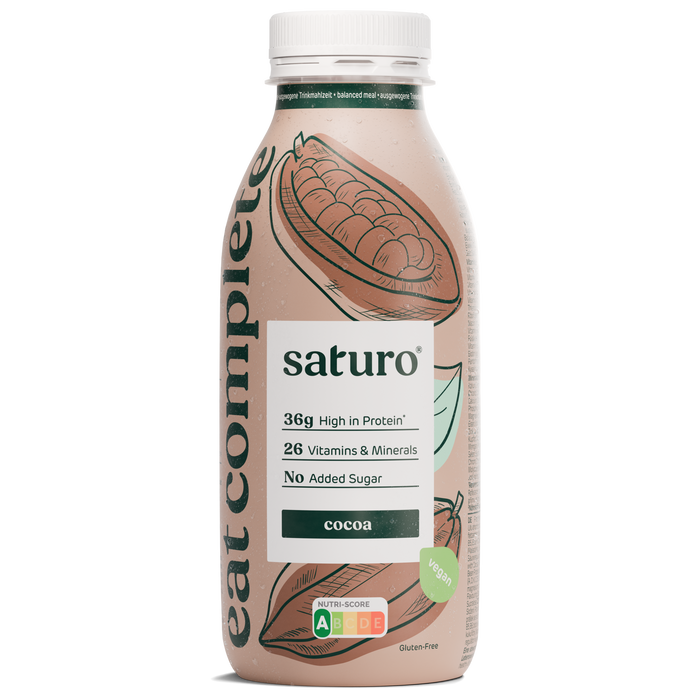
Drinkable meal: 400 kcal and 36 g protein from a bottle
According to the nutrition table, one bottle (400 ml) contains 400 kcal, 36 g plant protein from faba bean and soy, 26 vitamins and minerals and 7 to 8 g fibre, and is vegan and lactose-free. Protein contributes to the maintenance of muscle mass. A food for everyday life, not medical nutrition; a varied, balanced diet and a healthy lifestyle remain important.
Frequently asked questions about malnutrition
Which vitamins are missing in malnutrition?
There's no fixed pattern. Micronutrient deficiency is a diagnosis in its own right and often goes hand in hand with malnutrition: in older people, it's most commonly vitamin B12 (10 to 26% in Western countries), plus folate, vitamin B1 and vitamin D. In severe malnutrition, several are usually missing at once. Which sign points to which vitamin is shown in the overview of vitamin deficiency.
What happens to your body if you eat too little in the long term?
It lives off its reserves: first glycogen and fat, then muscle protein. Strength, concentration and immune defences decline, the skin becomes thin and wounds heal more slowly. In severe undernutrition, pulse, blood pressure and body temperature drop and water builds up in the tissues. Once you start building up again, the effects usually reverse, though more slowly in older people.
Can malnutrition cause dizziness?
Only indirectly. Dizziness isn't a criterion in any guideline. It's more likely to come from drinking too little, low blood pressure in severe undernutrition, or iron deficiency anaemia, which often comes with it. Dizziness in older people should always be checked by a doctor, especially together with weakness or confusion.
What is malnutrition prevention?
Prevention in care: regular screening with a recognised questionnaire, recording weight, tackling causes such as teeth, medication or depression, help with eating, snacks between meals and fortified food. In Germany, this is governed by the DNQP expert standard on nutrition management, which applies in care homes and hospitals.
What is the MNA test?
The Mini Nutritional Assessment, a screening for people aged 65 and over: the short form has six questions on food intake, weight loss, mobility, acute illness, memory and BMI, with a maximum of 14 points; 12 to 14 is normal, 8 to 11 is at risk, and under 8 means malnutrition. A self-test version is available free of charge from the provider.
What symptoms do women show with malnutrition?
The same as in men: weight loss, weakness, tiredness, infections, loose clothing. Women are affected more often, though, because they live longer, more often live alone and lose their appetite more frequently. On top of that, there's often an iron deficiency and smaller muscle reserves, so loss of strength shows up sooner.
Can you be malnourished despite being overweight?
Yes. If you lose six kilos in three months at a BMI of 28, you meet the weight-loss criterion, even if the number looks “normal”. The nursing expert standard warns that malnutrition is often overlooked in people who are overweight, and ESPEN explicitly calls for screening in obesity too. What matters is the trend, how much you eat and your muscle strength.
Does health insurance pay for sip feeds in malnutrition?
Only as a food for special medical purposes on prescription, if the ability to eat normally is limited and fortifying meals and other measures aren't enough. There's no fixed BMI limit or list of diagnoses. Adults pay a 10% co-payment, at least €5 and at most €10 per pack. More in the article on high-calorie sip feeds.
Sources · 43 sources anzeigen
- Cederholm T. et al.: ESPEN guidelines on definitions and terminology of clinical nutrition. Clinical Nutrition 2017; 36(1): 49–64.
- Valentini L. et al.: Guideline of the German Society for Nutritional Medicine (DGEM): DGEM-Terminologie in der Klinischen Ernährung. Aktuelle Ernährungsmedizin 2013; 38: 97–111.
- German Society for Nutritional Medicine (DGEM): Mangelernährung. Topic page, retrieved 19 October 2026.
- Cederholm T., Jensen G. L., Correia M. I. T. D. et al.: GLIM criteria for the diagnosis of malnutrition. A consensus report from the global clinical nutrition community. Clinical Nutrition 2019; 38(1): 1–9.
- Cederholm T. et al.: The GLIM consensus approach to diagnosis of malnutrition: A 5-year update. Clinical Nutrition 2025; 49: 11–20.
- Cruz-Jentoft A. J. et al.: Sarcopenia: revised European consensus on definition and diagnosis. Age and Ageing 2019; 48(1): 16–31.
- Federal Institute for Drugs and Medical Devices (BfArM): ICD-10-GM Version 2026, Chapter IV, E40–E46 Malnutrition.
- World Health Organization (WHO): Malnutrition. Fact sheet, 1 March 2024.
- UNICEF, WHO, World Bank: Levels and trends in child malnutrition. Joint Child Malnutrition Estimates, 2025 edition (2024 data).
- Volkert D., Weber J., Kiesswetter E., Sulz I., Hiesmayr M.: Ernährungssituation in Krankenhäusern und Pflegeheimen – Auswertung der nutritionDay-Daten für Deutschland. 14. DGE-Ernährungsbericht, advance publication of chapter 2. Bonn 2019.
- Galicia Ernst I. et al.: Malnutrition in nursing home residents: A nutritionDay analysis of staff judgment and a validated tool. Clinical Nutrition ESPEN 2025; 68: 326–334.
- Cereda E. et al.: Nutritional status in older persons according to healthcare setting: A systematic review and meta-analysis of prevalence data using MNA. Clinical Nutrition 2016; 35(6): 1282–1290.
- Kaiser M. J. et al.: Frequency of malnutrition in older adults: a multinational perspective using the Mini Nutritional Assessment. Journal of the American Geriatrics Society 2010; 58(9): 1734–1738.
- Volkert D. et al.: ESPEN practical guideline: Clinical nutrition and hydration in geriatrics. Clinical Nutrition 2022; 41(4): 958–989.
- National Institute for Health and Care Excellence (NICE): Nutrition support for adults: oral nutrition support, enteral tube feeding and parenteral nutrition. Clinical guideline CG32, 2006, last updated 2017.
- German Network for Quality Development in Nursing (DNQP): Expertenstandard Ernährungsmanagement zur Sicherung und Förderung der oralen Ernährung in der Pflege, 1st update 2017.
- Evans D. C. et al.: The Use of Visceral Proteins as Nutrition Markers: An ASPEN Position Paper. Nutrition in Clinical Practice 2021; 36(1): 22–28.
- Weimann A. et al.: ESPEN practical guideline: Clinical nutrition in surgery. Clinical Nutrition 2021; 40(7): 4745–4761.
- Nestlé Nutrition Institute: MNA – Mini Nutritional Assessment, forms and Self-MNA (German version).
- Kondrup J., Allison S. P., Elia M., Vellas B., Plauth M.: ESPEN Guidelines for Nutrition Screening 2002. Clinical Nutrition 2003; 22(4): 415–421.
- BAPEN (British Association for Parenteral and Enteral Nutrition): Introducing ‘MUST’ – Malnutrition Universal Screening Tool and Self-Screening.
- Landi F. et al.: Anorexia of Aging: Risk Factors, Consequences, and Potential Treatments. Nutrients 2016; 8(2): 69.
- Li W. et al.: Global prevalence of anorexia and appetite loss among older adults: a systematic review and meta-analysis. Age and Ageing 2025; 54(9).
- Cox N. J., Ibrahim K., Sayer A. A., Robinson S. M., Roberts H. C.: Assessment and Treatment of the Anorexia of Aging: A Systematic Review. Nutrients 2019; 11(1): 144.
- Muscaritoli M. et al.: ESPEN practical guideline: Clinical Nutrition in cancer. Clinical Nutrition 2021; 40(5): 2898–2913.
- Trevisan C. et al.: Nutritional Status, Body Mass Index, and the Risk of Falls in Community-Dwelling Older Adults: A Systematic Review and Meta-Analysis. Journal of the American Medical Directors Association 2019; 20(5): 569–582.
- Milne A. C., Potter J., Vivanti A., Avenell A.: Protein and energy supplementation in elderly people at risk from malnutrition. Cochrane Database of Systematic Reviews 2009; (2): CD003288.
- Kiesswetter E. et al.: Oral nutritional interventions in hospitalised older people at nutritional risk: a network meta-analysis of individual participant data. Cochrane Database of Systematic Reviews 2026; 3: CD015468.
- Thomson K. et al.: Oral nutritional interventions in frail older people who are malnourished or at risk of malnutrition: a systematic review. Health Technology Assessment 2022; 26(51): 1–112.
- Schuetz P. et al.: Individualised nutritional support in medical inpatients at nutritional risk: a randomised clinical trial (EFFORT). The Lancet 2019; 393(10188): 2312–2321.
- da Silva J. S. V. et al.: ASPEN Consensus Recommendations for Refeeding Syndrome. Nutrition in Clinical Practice 2020; 35(2): 178–195.
- Federal Joint Committee (Gemeinsamer Bundesausschuss, G-BA): Pharmaceuticals Directive, Section I Enteral Nutrition (§§ 18–26), version in force since 3 October 2026.
- Social Code Book V (Sozialgesetzbuch V), § 61 Co-payments.
- Association of Statutory Health Insurance Physicians Westfalen-Lippe (KVWL): InVo – Prescribing enteral nutrition. September 2024.
- Coordination Group for Quality Assurance in Nutrition Counselling and Nutrition Education: Framework agreement, version of 1 February 2024.
- German Nutrition Society (DGE): Reference values for nutrient intake, protein (derivation 2017).
- DGE Fit im Alter: Malnutrition – how the kitchen can help with prevention or treatment. Retrieved 19 October 2026.
- DGE Fit im Alter: Nutritional status – signs of impending malnutrition. Retrieved 19 October 2026.
- German Geriatrics Society (DGG), Working Group Nutrition and Metabolism: Malnutrition in older age: recognise it and act. Leaflet, December 2025.
- Verbraucherzentrale NRW (Consumer Advice Centre North Rhine-Westphalia): Malnutrition – recognise it early and act. As of 30 July 2026.
- Centre for Quality in Care (ZQP): Eating and drinking – practical tips for everyday care. 12th edition 2024.
- Berger M. M., Shenkin A., Schweinlin A. et al.: ESPEN micronutrient guideline. Clinical Nutrition 2022; 41(6): 1357–1424.
- Max Rubner-Institut: German Nutrient Database (Bundeslebensmittelschlüssel) BLS 4.0. Nutritional values per 100 g edible portion, queried 19 October 2026.
Has written for Saturo since 2019 about nutrition, nutrients and how to get good nutrition into everyday life in practice.
Hat diesen Artikel am 20. Oktober 2026 auf fachliche Richtigkeit geprüft. The content is not a substitute for medical advice.

High-calorie nutrition drinks: comparison, nutritional values and tips
Medical nutrition drinks from the pharmacy or an over-the-counter drinkable meal? What each product provides, how many bottles make sense and when health insurance pays.
Weiterlesen · 16 Min
Latest from the guide
New articles, updates and tips straight to your inbox. Easy to understand, expert-checked, no spam.
Danke! Bitte bestätige die Anmeldung in deinem Postfach.