
Eating after wisdom tooth surgery: when, what and for how long
Numbness, blood clot, swelling: in the first days after wisdom tooth surgery, what you eat helps decide how well the wound heals. What you can eat and when, how to get enough protein without chewing, and which warning signs mean it's time to call the dental practice.


Aktualisiert 24 September 2026 · 15 Min. Lesezeit · 29 Quellen

The essentials in 30 seconds
That's roughly how long your lip, cheek and tongue stay numb after an anaesthetic in the lower jaw. If you eat before then, you can bite your lip or burn yourself without noticing.
That's how many German dentists advise avoiding dairy products after dental surgery, compared with 4.6% internationally. Two randomised studies from Germany (2025, 2026) found no downside for wound healing.
From day six, quality of life after removal of lower wisdom teeth is back to baseline; on average, people take 1.4 days off. The first three days are the hardest.
13.2% of smokers develop dry socket after wisdom tooth removal, compared with 3.8% of non-smokers. Smoking on the day of surgery is the most dangerous.
The first hours: when and how to eat again after surgery
Wisdom tooth surgery takes half an hour, but for many people the question of what to eat afterwards takes up more time than the procedure itself. The principle is simple, though: a blood clot sits in the gap where the tooth was, the dressing your body applies itself. Everything you eat and drink in the first few days should leave it in peace: nothing hot, nothing hard, nothing crumbly. And right at the start, one thing matters most: wait for the anaesthetic to wear off.
The first 24 hours after wisdom tooth surgery
-
Hour 0 to 3
Don't eat, nothing hot
Bite down on the gauze until the bleeding stops (20 to 30 minutes), keep your head raised, and cool your cheek from outside with damp, cold compresses. As long as your lip and tongue are numb: no eating, no hot drinks, no chewing gum. Small sips of water are fine.
-
From hour 3 to 5
Lukewarm and liquid
Once feeling returns: lukewarm broth, diluted smoothie without seeds, chilled yoghurt, a drinkable meal from the glass. Small sips, nothing hot, nothing fizzy, and better without a straw in the first 24 hours.
-
Evening of surgery day
Soft, cool, on the other side
Mashed potato, scrambled egg, apple sauce, mashed banana. Chew on the side that wasn't operated on, don't rinse your mouth afterwards, just let water run through gently. Prop your head up a bit higher when sleeping.
-
Day 1
No coffee, no alcohol, no cigarettes
No filter coffee, black tea, cola or alcohol for 24 hours, according to the DGZMK's guidance; avoid smoking for the next few days. From the second day, you can rinse gently after eating, for example with the solution from your dentist.
When can you eat after wisdom tooth surgery?
As soon as the anaesthetic has worn off. After a nerve-block anaesthetic in the lower jaw, feeling returns to the lower lip after 155 minutes on average (study with 484 patients); lip and tongue stay numb for three to five hours. The DGZMK recommends not eating or drinking anything hot until then: you can bite your numb lip or burn yourself without feeling it. But waiting doesn't mean fasting. The ESPEN guideline recommends carrying on eating normally after operations and only adjusting the texture. Your first meal should be lukewarm, liquid or mushy, and it should happen the same day.

Drinking after wisdom tooth surgery: water, tea, straw?
Drinking plenty helps more than any list of bans: it keeps your circulation stable and rinses away food residue. Best choices are still water and lukewarm herbal tea; according to the DGZMK, black and green tea belong to the 24-hour break. And the straw? There's no evidence that the suction loosens the clot: in the only study on it (60 patients, 220 wisdom teeth), 15% of people developed dry socket (alveolitis sicca), both with and without a straw. Even so, drinking from a glass works just as well, and your dental practice's instructions come first.
Don't rinse your mouth on the day of surgery, as it can dislodge the clot (Hessian State Dental Chamber). From day 2, after every meal, let lukewarm water or the rinse solution from your practice run through your mouth rather than swishing it around; chlorhexidine clearly lowers the risk of dry socket (chapter 7). Leave the water flosser alone for two weeks.
What not to eat after wisdom tooth surgery
The lists of forbidden foods online are long and contradict each other. Sort them out and three reasons remain why a food stays off the menu in the first few days: it disturbs the blood clot mechanically (hard, crumbly, sticky), it irritates the wound or encourages bleeding (hot, spicy, acidic, fizzy), or it slows healing throughout the body (nicotine, alcohol). Everything else, from milk to garlic, is habit or myth.
Hot, hard, crumbly, spicy: what really bothers the wound
The DGZMK and the Hessian State Dental Chamber put it briefly: no hot, crumbly or hard food, and chew on the side that wasn't operated on. Hard foods (bread crust, crisps, rusks, nuts) press on the wound and can shift the clot. Crumbly and grainy foods (seeded bread, muesli, berries with seeds, sesame) lodge in the socket. Sticky foods (gummy sweets, caramel) pull at the tissue. Spicy and acidic foods (chilli, mustard, vinegar, citrus, tomato sauce) sting in the open wound. Hot food widens the blood vessels and encourages secondary bleeding; that isn't proven, though.
Coffee after wisdom tooth surgery, alcohol, fizzy drinks, nicotine
For coffee, the DGZMK's 24-hour rule applies: no coffee, black tea or cola on the day of surgery. There's no study on caffeine and secondary bleeding; from day 2, lukewarm coffee is fine. Alcohol disrupts the formation of new blood vessels (by up to 61% in experiments) and doesn't mix well with painkillers and antibiotics: avoid it for at least 24 hours, or better still for as long as you're taking painkillers. Fizzy drinks are a rule of thumb without a study behind it, but the bubbles sting in the wound. Nicotine matters most: it narrows the blood vessels and slows down the defence cells, and the result is dry socket (alveolitis sicca) (chapter 7).
Dairy after wisdom tooth surgery: how long, really?
From a scientific point of view, no need to avoid it at all. A Marburg research group checked in 2022: 56.1% of German dentists advised avoiding milk, versus 4.6% internationally, with no evidence behind it. Since then the rule has been tested twice in randomised trials: among 257 patients (2025), 19.1% with dairy and 20.3% without had wound healing problems; among 157 patients (2026), there were three complications with milk against eight without. Antibiotics: milk only slows down tetracyclines and quinolones; amoxicillin, penicillin V and clindamycin don't react to it. Yoghurt, quark and milk are fine from the day of surgery. If your practice says otherwise, follow their advice.

Garlic and ginger after dental surgery: blood-thinning?
Not measurably, in kitchen amounts. The warning about garlic, ginger, cinnamon and turmeric comes from the literature on herbal supplements before operations: two reviews describe platelet inhibition from garlic, ginkgo, ginger and turmeric, especially together with ibuprofen. Both refer to high-dose extracts and capsules. The better reason to skip both at first: raw garlic and fresh ginger are sharp and irritate the wound. Cooked in a soup or as a mild ginger tea, they're fine from day 2. Talk to your practice about supplements (garlic, ginkgo, omega-3, turmeric) and pause them until the stitches are out.
If you take aspirin (ASS), Marcumar, Eliquis or Xarelto, don't stop it yourself before the operation; your practice will plan the procedure around it. After the operation, bite on the gauze pad for longer and call if bleeding hasn't stopped after 30 minutes.
How the tooth socket heals: from blood clot to bone
Three stages from the operation to new bone. Once you know them, you'll understand why the first 24 hours are the most delicate, days 2 and 3 the most uncomfortable, and why the stitches can come out after a week even though healing takes months.
Hour 0 to 24: the blood clot
As soon as the tooth is out, the socket fills with blood. Within minutes, a clot forms from fibrin strands, red blood cells and platelets. This plug seals the bone, keeps bacteria out and forms the scaffold for everything that follows. If it's lost, the bone is exposed: dry socket. That's why you shouldn't rinse, suck or have anything hot in the first 24 hours.
Day 2 to 7: granulation tissue
From 48 to 72 hours, inflammatory cells move in, swelling peaks on the second and third day, and the jaw feels stiff. At the same time, granulation tissue, a cell-rich, well-supplied tissue, grows in from the edges and replaces the clot by the end of the first week. The body needs protein, vitamin C and zinc for this. From day 6, most people feel normal again.
Week 2 to month 3: bone
The mucous membrane closes after one to two weeks, and the stitches usually come out after 7 to 10 days. Underneath, woven bone starts forming from the second week and largely replaces the granulation tissue within six to eight weeks. Remodelling into solid bone takes months. For you, this means: after the stitches come out, you can eat normally again – just seeds and crumbs are still off-limits for a few more days.
What you can eat after wisdom tooth surgery: day by day
The list of what you can eat is longer than the list of bans, and it grows every day because it follows the healing process from chapter 3. On the day of surgery everything is liquid and lukewarm, from day 1 mushy and happily cold, from day 4 soft enough to eat with a spoon, and after the stitches come out you eat whatever you like again.
Four stages back to normal eating
-
1
Stage 1Day of surgery
After the anaesthetic: lukewarm broth, yoghurt, apple sauce, diluted smoothie without seeds, drinkable meal from a glass. Nothing hot, nothing carbonated, no rinsing.
-
2
Stage 2Day 1 to 3
Mushy and cool: mashed potato, cream soups, scrambled eggs, fine porridge, mashed banana, hummus, silken tofu, quark, ice cream without pieces. Chew on the other side, from day 2 rinse gently after eating.
-
3
Stage 3Day 4 to 7
Soft and warm: pasta cooked soft, fish mashed with a fork, rice, omelette, softly steamed vegetables, pancakes, soft bread without crust. Anything that pulls while chewing still waits.
-
4
Stage 4From stitch removal
After 7 to 10 days, gradually everything again, though until the mucous membrane closes in week 2, still no grains, nuts, crisps or crusts. If you still can't open your mouth well on day 7, stick with stage 3.
Timings based on the behavioural guidelines from the DGZMK and the Hesse Chamber of Dentists, and the healing process of the tooth socket (Udeabor et al. 2023). After a difficult extraction involving bone removal, your practice may deviate from this; in that case, follow their instructions.
Ice cream after wisdom tooth surgery: what's fine, what's not
Yes, you can eat ice cream from the day of your surgery. What the cold actually does is unclear: in a 2019 meta-analysis, cooling from the outside only slightly reduced pain on the second day, and there's no study on cooling from the inside. The upside: ice cream is soft, doesn't hurt and gives you calories. The rules: only flavours without chunks (no nuts, brittle or wafer), eaten from a spoon rather than sucked off a stick. Dairy ice cream and vanilla ice cream are allowed, the ban on dairy is a thing of the past (chapter 2). Water ice and sorbet work too, but very sour flavours sting at first, and anything with seeds is still off the menu.
Smoothies, porridge, mashed potato: the classics done right
Smoothie: banana, mango or avocado with milk or oat milk, plus yoghurt or peanut butter; no berries with seeds, no kiwi. Porridge: soft oats, cooked for a long time, served lukewarm, with milk, apple purée and cinnamon; no nuts or raisins. Mashed potato: it fills you up, but only has 1.9 g of protein per 100 g; boost it with egg, quark or cottage cheese. Cream soups made from pumpkin, carrot or red lentils, blended smooth, no croutons. Fish steamed and mashed from day 3 or 4; breaded food only after the stitches are out. Spinach works as creamed spinach, but tomato sauce is acidic and can wait until day 4.

3, 5 or 7 days after wisdom tooth surgery: when can you eat normally again?
Usually after the stitches come out, and the time before that is short: in a diary study, quality of life was reduced from day 1 to 5 and was back to baseline from day 6. As a rule of thumb: day 3 is often the worst day (swelling peaks), so stick to soft, mushy and cold food. Day 5: soft and warm is usually fine, and you chew on the other side. Day 7 to 10: stitches out, then gradually back to normal, avoiding seeds and crusts until the gum has closed. If it pulls or throbs when you chew, it's too early.
Nutrients for wound healing: protein, vitamin C, zinc, calories
A gap where a tooth was heals with the same tools as any wound: your body builds collagen, forms blood vessels and lets cells move in. For that it needs protein as building material, vitamin C to cross-link the collagen, and zinc for cell division and immune defence. After wisdom tooth surgery the problem isn't higher needs, it's the choice of food: broth, purée and apple purée fill your stomach and provide almost no protein.
Protein after wisdom tooth surgery: why soft food often doesn't provide enough
Because the classics are almost protein-free. A purée day of mashed potato, apple purée, broth, banana and vanilla ice cream gives you around 12 g of protein, a quarter of what a 60 kg person needs. Your body takes the difference from your muscles. The spoon-food day with the same rules: scrambled eggs made with two eggs (12 g), 200 g of blended lentil soup (18 g), 150 g of Greek yoghurt (15 g), a smoothie with peanut butter (7.5 g), 100 g of hummus (7.8 g), adding up to around 60 g. The rule: every soft meal needs protein, so think egg, quark, lentils, yoghurt or nut butter.
After dental surgery, getting enough nutrition rarely fails because of appetite, but because of choice. Purée, broth and apple sauce fill your stomach but provide almost no protein. Anyone who adds a portion of egg, quark, pulses or fish to every soft meal gives their body the material it needs to heal.
Joerg Hauke, Nutrition expert, technical review of this article
Vitamin C, zinc and calories: the rest of the building site
Vitamin C cross-links collagen, and the DGE recommends 95 to 110 mg a day; without chewing, fruit purée, smoothies and blended peppers in soup give you enough, while orange juice stings at first. Zinc is found in eggs, dairy, oats and lentils; the DGE reference value is 7 to 16 mg. Supplements don't speed up healing and only help if you have a proven deficiency. And then there are calories: your needs don't drop after surgery, but soft food is often low in energy, and a bowl of broth has 18 kcal. Energy without chewing: avocado, nut butter, full-fat dairy, oil in soup, ice cream.
Protein shake after wisdom tooth surgery
A shake is the fastest source of protein without chewing: 30 g of whey protein in water gives around 24 g of protein and 113 kcal according to the manufacturer, and a pea-and-rice protein about 22 g; with milk instead of water you get another 6 g per 200 ml. Drink it cold from a glass, and without a straw for the first 24 hours. One shake a day tops up the spoon-food day but doesn't replace it: it has hardly any calories, no fibre and few vitamins. If you want to replace whole meals, a drinkable meal is a better fit (chapter 6). Whey protein is a dairy product, so it's no problem according to chapter 2.
Meal plan for 7 days after wisdom tooth surgery
So you don't have to rethink it every day: a plan that grows with your healing. The mainstays are egg, quark, yoghurt, pulses and later fish, because they're soft and still provide protein; purée, fruit and broth are the sides.
Days 1 to 3: liquid, mushy, cool
Breakfast: fine porridge with milk, apple purée and cinnamon, plus 150 g of yoghurt. Lunch: blended lentil or pumpkin soup with a spoonful of oil, lukewarm, plus softly scrambled eggs. In between: a smoothie made with banana, mango, yoghurt and peanut butter, or a chilled drinkable meal from a glass. Evening: mashed potato with egg or cottage cheese, mashed banana or vanilla ice cream without chunks. Eat on the side that wasn't operated on, nothing hot, and from day 2 rinse after every meal. If you can barely open your mouth on day 3, stick to soup, shake and yoghurt; that's the swelling peak, not a setback.

Days 4 to 7: soft and warm
Breakfast: scrambled eggs or an omelette with soft bread without the crust, rice pudding or semolina porridge. Lunch: soft-cooked pasta with a mild cream sauce, steamed and mashed fish, soft steamed vegetables, potato gratin without the crust. In between: quark with mashed banana, pudding, pancakes without crispy edges. Evening: risotto, polenta with ricotta, mince in sauce. Chew on both sides once it no longer pulls; hot spices, crusts and seeds wait until after the stitches are out. From day 7 to 10 you gradually return to your normal plate.
Drinkable meal after wisdom tooth surgery
A drinkable meal solves the problem of the first few days: it's liquid, cold from the fridge, needs no kitchen, and it delivers what purée and broth can't, namely a complete meal with protein, fat, carbohydrates, fibre and micronutrients. Unlike a protein shake, it replaces a whole meal, and unlike medical drink nutrition, it's an ordinary food from the supermarket. What to look for: protein content per bottle, no carbonation, never heat it up, and pour it into a glass for the first 24 hours. One or two bottles a day cover the meals where spooning is too much effort.
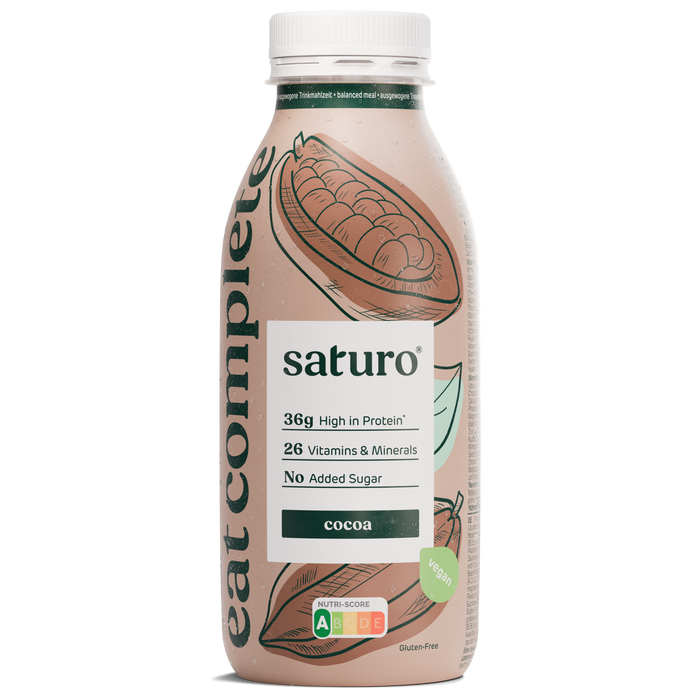
Drinkable meal: a complete meal in a bottle
36 g protein and 400 kcal per bottle, plus 26 vitamins and minerals, vegan. Protein contributes to the maintenance of muscle mass, vitamin C to normal collagen formation for the normal function of the gums, zinc to the normal function of the immune system. Reference intake for protein: 50 g per day (NRV). Drink it cold or eat it with a spoon, no chewing, no kitchen.
Secondary bleeding, dry socket, infection: when you need to see your dentist
Pain, swelling and a stiff jaw are all part of the first few days and improve from day 3 onwards. What doesn't belong is discomfort that returns after improving or increases after day 3. This list helps you tell the two apart.
Dry socket: the empty tooth socket
The most common complication is losing the blood clot. From day 2 or 3, a throbbing pain sets in that radiates to the ear, often with a foul taste. After simple extractions it affects 1 to 5%, after surgical removal of lower wisdom teeth up to 30% (Cochrane 2022). Risk factors: smoking, the contraceptive pill (21 versus 7%) and a difficult extraction. Chlorhexidine is proven to protect: according to Cochrane, rinses lower the risk by around 60%. Your dental practice will flush out the socket and place a pain-relieving dressing in it, and you'll feel better within hours.
Go to your dental practice today if you have pain that's getting worse again, a foul taste, an empty tooth socket, a fever above 38.5 °C or bleeding that hasn't stopped after 30 minutes. Go to A&E or call 112 if you have trouble swallowing with a fever, difficulty breathing or swelling towards your throat.
Bleeding after the procedure: what you can do yourself
It's normal for the wound to ooze in the first few hours and for your saliva to be pink. You can tell it's real bleeding when your mouth keeps filling with blood. In that case, place a clean, folded cloth handkerchief or a gauze pad on the wound and bite down firmly for 30 minutes without checking. Keep your head up, cool your cheek, don't rinse and don't lie down. The usual triggers are heat, exertion, alcohol or rinsing too early. If the bleeding hasn't stopped after two attempts, contact your dental practice or the emergency service. If you take blood thinners, call sooner.
Antibiotics after wisdom tooth surgery
Whether you get an antibiotic is up to your dental practice, based on how involved the procedure was and on your risk. It isn't compulsory. The German guideline says that prophylaxis may be given and names both sides: fewer infections and dry sockets, but also resistance and side effects. If you do get one, take it as prescribed until it's finished, with food and without alcohol. Milk only matters with tetracyclines and quinolones (chapter 2). With amoxicillin, penicillin V and clindamycin, you can eat yoghurt and drink milk as normal. Diarrhoea on antibiotics is common and usually harmless. If it's bloody or comes with a fever, see your dental practice.
Trismus and difficulty swallowing
Your mouth only opening two fingers wide in the first few days is down to swelling in the chewing muscles. It's at its worst on day 2, and by day 7, 80% have their normal mouth opening back. Gentle stretching exercises from day 3, warmth from day 4 and soft food all help. If your mouth still doesn't open fully after a week, get it checked. How to still get enough to eat with a locked jaw is covered in its own article. Difficulty swallowing with a fever and swelling that's spreading towards your throat is an emergency. For difficulty swallowing without these warning signs, the same rules apply as here: liquid, cold, high in protein.
Frequently asked questions about eating after wisdom tooth surgery
How long should you avoid eating after wisdom tooth surgery?
Until the anaesthetic has worn off, usually three to five hours. As long as your lip, cheek or tongue are numb, there's a risk of biting or burning yourself. After that, eat lukewarm and liquid food on the same day: broth, yoghurt, apple sauce, a smoothie without seeds, or a drinkable meal. Fasting doesn't help the wound heal.
Can you eat ice cream after wisdom tooth surgery?
Yes. Ice cream is soft, cold and gives you calories when you can't manage much else. There's no proof that cooling from the inside speeds up healing. The type matters, though: no nuts, biscuits, brittle or wafer, and don't suck on a stick. Vanilla and dairy ice cream are fine, as the ban on milk isn't evidence-based.
How long should you avoid dairy products after wisdom tooth surgery?
From a scientific point of view, not at all. A 2022 review found no evidence for the milk ban, and two randomised studies (2025, 2026) showed no difference in wound healing. Only tetracyclines and quinolones need to be kept apart from milk, amoxicillin and clindamycin don't. If your dental practice tells you something different, follow their advice.
Can I drink coffee after wisdom tooth surgery?
Not on the day of surgery. The DGZMK professional society advises against coffee, black tea, cola or alcohol for 24 hours. From day 2, lukewarm coffee is fine, but it shouldn't be hot in the first week. There's no study linking caffeine to post-extraction bleeding.
Do garlic and ginger really thin the blood after tooth surgery?
Not measurable in kitchen quantities. The warning comes from studies on high-dose garlic, ginkgo and ginger supplements, which can inhibit platelets. There's no evidence for garlic in a soup or ginger in a tea. Raw, both are sharp and irritate the wound. Pause capsules and extracts until the stitches are out.
Can you eat chocolate after wisdom tooth surgery?
Yes, if it melts softly: milk or dark chocolate without nuts, biscuits, praline pieces or caramel, let small pieces dissolve on your tongue, don't chew. Nut chocolate, bars with biscuit content and anything sticky should wait until after the stitches are removed. Cocoa as a drink is fine lukewarm from day 2.
What should you do if there's food debris in the wound?
From day 2, after every meal, let lukewarm water or rinsing solution run through, don't swish it around. Don't help it along with a toothpick or your fingernail, as that dislodges the clot. After the stitches are out, your dental practice often gives you a blunt irrigation syringe. A foul taste with increasing pain isn't leftover food, it's a dry socket (chapter 7).
Are scrambled eggs good after wisdom tooth surgery, and can I eat mashed potato?
Yes to both. Scrambled eggs from day 1, softly set and lukewarm, without a crust or bacon pieces. Two eggs give you around 12 g of protein. Mashed potato is fine from the day of surgery, lukewarm and creamy. On its own it has only 1.9 g of protein per 100 g, but stirred with egg, quark or cottage cheese it becomes a proper meal.
Sources · 29 sources anzeigen
- Deutsche Gesellschaft für Zahn-, Mund- und Kieferheilkunde (DGZMK), Arbeitsgemeinschaft für Kieferchirurgie: Verhaltensregeln nach operativen Eingriffen im Mund- und Kieferbereich. Patient information, as of 07/2016.
- Landeszahnärztekammer Hessen, Kassenzahnärztliche Vereinigung Hessen: Nach einer Zahnentfernung. Verhaltensregeln nach einem zahnärztlich-chirurgischen Eingriff. As of March 2022.
- Bayerische Landeszahnärztekammer (BLZK): Nach der Weisheitszahn-OP. Patient information on zahn.de.
- Kunkel M. et al., DGMKG/DGZMK: S2k-Leitlinie Operative Entfernung von Weisheitszähnen. AWMF registration number 007-003, long version, as of 08/2019 (expired, under revision).
- Seyedi Moghaddam S., Neff A.: Avoidance of milk and dairy products after oral surgery: is such a recommendation still valid? A cross-sectional study among German and international oral and maxillofacial surgeons and dental practitioners with review of the literature. Oral and Maxillofacial Surgery 2022; 26(4): 563–573.
- Otto T., Dittmann J. A., Stake J. et al.: Impact of postoperative dairy consumption on oral wound healing: critical analysis from a prospective, randomized and controlled trial. Head & Face Medicine 2025; 21: 40.
- Aliu A., Kübler N. R., Depprich R. et al.: Influence of milk and dairy products on wound healing after wisdom teeth removal: a prospective clinical study. BMJ Nutrition, Prevention & Health 2026; 9(1): e001432.
- Wiesner A., Zagrodzki P., Gawalska A., Paśko P.: Clinically important interactions of macrolides and tetracyclines with dietary interventions: a systematic review with meta-analyses. Journal of Antimicrobial Chemotherapy 2024; 79(11): 2762–2791.
- Daly B. J. M., Sharif M. O., Jones K., Worthington H. V., Beattie A.: Local interventions for the management of alveolar osteitis (dry socket). Cochrane Database of Systematic Reviews 2022; 9: CD006968.
- Kuśnierek W., Brzezińska K., Nijakowski K., Surdacka A.: Smoking as a Risk Factor for Dry Socket: A Systematic Review. Dentistry Journal 2022; 10(7): 121.
- Tang M., Gurpegui Abud D., Shariff J. A.: Oral Contraceptive Use and Alveolar Osteitis Following Third Molar Extraction: A Systematic Review and Meta-Analysis. International Journal of Dentistry 2022; 2022: 7357845.
- Kolokythas A., Olech E., Miloro M.: Alveolar Osteitis: A Comprehensive Review of Concepts and Controversies. International Journal of Dentistry 2010; 2010: 249073.
- Bloomer C. R.: Straws do not cause dry sockets when third molars are extracted. Texas Dental Journal 2012; 129(1): 25–32.
- do Nascimento-Júnior E. M., dos Santos G. M. S., Tavares Mendes M. L. et al.: Cryotherapy in reducing pain, trismus, and facial swelling after third-molar surgery: A systematic review and meta-analysis of randomized clinical trials. Journal of the American Dental Association 2019; 150(4): 269–277.
- McGrath C., Comfort M. B., Lo E. C. M., Luo Y.: Changes in life quality following third molar surgery: the immediate postoperative period. British Dental Journal 2003; 194(5): 265–268.
- Bienstock D. A., Dodson T. B., Perrott D. H., Chuang S. K.: Prognostic factors affecting the duration of disability after third molar removal. Journal of Oral and Maxillofacial Surgery 2011; 69(5): 1272–1277.
- Balakrishnan G. et al.: Incidence of Trismus in Transalveolar Extraction of Lower Third Molar. Journal of Pharmacy and Bioallied Sciences 2017; 9(Suppl 1): S222–S227.
- Udeabor S. E., Heselich A., Al-Maawi S. et al.: Current Knowledge on the Healing of the Extraction Socket: A Narrative Review. Bioengineering 2023; 10(10): 1145.
- Ang-Lee M. K., Moss J., Yuan C.-S.: Herbal Medicines and Perioperative Care. JAMA 2001; 286(2): 208–216.
- Abebe W.: Herbal medication: potential for adverse interactions with analgesic drugs. Journal of Clinical Pharmacy and Therapeutics 2002; 27(6): 391–401.
- Guo S., DiPietro L. A.: Factors Affecting Wound Healing. Journal of Dental Research 2010; 89(3): 219–229.
- Lodi G., Azzi L., Varoni E. M. et al.: Antibiotics to prevent complications following tooth extractions. Cochrane Database of Systematic Reviews 2021; 2: CD003811.
- Weimann A., Braga M., Carli F. et al.: ESPEN practical guideline: Clinical nutrition in surgery. Clinical Nutrition 2021; 40(7): 4745–4761.
- Hersh E. V., Moore P. A., Papas A. S. et al.: Reversal of soft-tissue local anesthesia with phentolamine mesylate in adolescents and adults. Journal of the American Dental Association 2008; 139(8): 1080–1093.
- Deutsche Gesellschaft für Ernährung (DGE): Reference values for nutrient intake, protein (2017 derivation).
- Deutsche Gesellschaft für Ernährung (DGE): Reference values for nutrient intake, vitamin C.
- Deutsche Gesellschaft für Ernährung (DGE): Reference values for nutrient intake, zinc.
- Deutsche Gesellschaft für Ernährung (DGE): Reference values for nutrient intake, energy (guideline values by age, sex and physical activity).
- U.S. Department of Agriculture, Agricultural Research Service: FoodData Central, SR Legacy Release (2018). Protein and energy content per 100g.
Writing for Saturo since 2019 about nutrition, nutrients and how good nutrition actually works in everyday life.
Hat diesen Artikel am 14. September 2026 auf fachliche Richtigkeit geprüft. This content doesn't replace medical advice.

Jaw lock: causes, treatment and what you can eat
When your mouth won't open properly: what causes it, what your dentist does, and how to still stay full and well-nourished.
Weiterlesen · 15 Min
New from the guide
New articles, updates and tips straight to your inbox. Easy to understand, expert-checked, no spam.
Danke! Bitte bestätige die Anmeldung in deinem Postfach.