
Lactose intolerance: symptoms, tests and what you can eat
Bloated after a latte, diarrhoea after ice cream? Around 15% of people in Germany don't tolerate milk sugar well, and very few have to give it up entirely. Which symptoms go with it, which test tells you something, and how much lactose is in cheese, bread and yoghurt.


Aktualisiert 20 October 2026 · 12 Min. Lesezeit · 33 Quellen

The key points in 30 seconds
According to EFSA, most people can handle this much lactose at once, about a glass of milk, with no or only mild symptoms. Spread across the day, it's up to 24 g.
Roughly one in seven people doesn't tolerate milk sugar well, according to estimates. It's less common in northern Europe, and the majority in East Asia and Africa.
Symptoms start half an hour after eating at the earliest, and are strongest after 1.5 to 2 hours. They can last several hours.
Since June 2026, dairy products may only be labelled this way if they contain less than 0.1 g of lactose per 100 g. Aged hard cheese is naturally below that.
What is lactose intolerance?
Lactose intolerance means your small intestine makes too little lactase, the enzyme that splits milk sugar. The milk sugar travels undigested into the large intestine, bacteria ferment it, and you get gas and diarrhoea. It's not an allergy and not a disease in the strict sense, but a normal variation in metabolism that affects the majority of adults worldwide. Symptoms depend on the amount, not on whether you have it or not.
What is lactose?
Lactose is milk sugar, a double sugar made of glucose and galactose, found in the milk of all mammals. Cow's milk contains around 4 to 5 g per 100 ml, and goat's and sheep's milk contain just as much. For your body to absorb it, lactase has to split it into the two single sugars in the small intestine. When cheese ripens, bacteria break down almost all of the lactose, and in yoghurt only part of it.
Primary, secondary, congenital
The primary form is genetic: after weaning, the body turns lactase down, in people with two C variants at the LCT-13910 gene locus to about a tenth. The secondary form develops when the lining of the small intestine is damaged, for example by coeliac disease, Crohn's disease or a stomach bug; it usually goes away again once the cause is treated. The congenital form (alactasia) is very rare, affects babies from birth and is the only one that requires a strictly lactose-free diet.
Lactose intolerance in older age and suddenly
There's no separate age-related form; in the primary form, lactase drops as early as childhood. If you suddenly can't tolerate milk at 40 or 60, there are usually one of three causes: your symptoms were mild before and became noticeable with more milky coffee, a secondary form after an infection or gut condition, or irritable bowel, which can look similar to lactose intolerance. In a Finnish study, only one in 42 people with symptoms from age 38 onwards actually had the genetic predisposition. New symptoms in adulthood should therefore be checked out before you take milk off the menu.

Lactose intolerance or milk protein allergy?
Milk intolerance isn't a medical term; behind it there is almost always one of the two: with lactose intolerance an enzyme is missing, while with a milk protein allergy the immune system attacks casein or whey protein. The allergy reacts to even traces, can affect the skin and airways and, in extreme cases, become life-threatening; it's mainly an issue in babies and young children and is often outgrown. Lactose-free milk only helps with the intolerance, because the milk protein is still in it.
Lactose intolerance or milk protein allergy: the difference
Both cause symptoms after milk, but for different reasons and with different consequences.
| Lactose intolerance | Milk protein allergy | |
|---|---|---|
| What reacts | Lactase enzyme missing in the small intestine | Immune system against casein or whey protein |
| Trigger | Milk sugar, the amount matters | Milk protein, even traces are enough |
| Symptoms | Bloating, cramps, diarrhoea 30 minutes to 2 hours later | Skin, airways, gut, up to anaphylactic shock |
| Who | Mostly from adolescence onwards | Mostly babies and toddlers, often temporary |
| Test | H2 breath test at the doctor's | IgE blood test, skin test, supervised challenge |
| Hard cheese | Almost lactose-free, usually fine | Contains milk protein, not suitable |
| Lactose-free milk | Helps | Doesn't help, the protein is still in there |
| Dangerous | No, just unpleasant | Can be life-threatening |
Classification based on IQWiG (2024), NIDDK (2018) and DAAB. If your baby has symptoms after milk, always have them checked by a paediatrician.
Lactose intolerance symptoms
The symptoms happen in your belly and arrive with a delay. The more lactose you have at once, the stronger they get; a glass of milk on an empty stomach hits harder than the same milk in your muesli. If you get the symptoms after food without milk too, think about other causes.
Typical symptoms and when they appear
Typical signs are a bloated belly, feeling overly full, loud gut noises, cramps in the lower abdomen, heavy wind and diarrhoea, and less often nausea or vomiting. They start half an hour after eating at the earliest, are strongest after 1.5 to 2 hours and can last several hours. After that it's all over, and your gut isn't damaged.
Stools with lactose intolerance
Your stool becomes soft to watery, often frothy and urgent, because undigested milk sugar draws water into the gut and the bacteria produce gases and acids. A sour smell and wind come with it. Blood in the stool, mucus lasting weeks or diarrhoea at night don't belong here and need to be checked out.
Constipation, skin, tiredness: what belongs and what doesn't
Constipation only happens sometimes, probably when the gut bacteria mainly produce methane; nobody knows exactly how common this is. Tiredness and headaches after milk are reported, but the link isn't proven and is mostly described in people with irritable bowel. Skin rash, itching or shortness of breath after milk don't point to lactose intolerance but to a milk protein allergy. Wind without milk involved often has other causes, such as a quick switch to more fibre.
Lactose intolerance in babies and children
Under the age of five, lactose intolerance is very rare; babies rely on milk sugar, and breast milk contains around 7% of it. Diarrhoea after milk in a baby is usually a temporary secondary form after a stomach bug or a cow's milk protein allergy, and a paediatrician can sort out either. Lactose-free infant formula is only for clear medical need. In school-age children and teenagers the primary form shows up, and the breath test works just as it does for adults.
What happens in your gut
Three stops from a glass of milk to a bloated belly. Once you know them, you'll see why the amount and what you have it with decide how you feel.
Small intestine: lactase splits
Normally, lactase splits milk sugar into glucose and galactose, and both pass into the blood. With lactose intolerance, only a remnant of the enzyme is working, about a tenth of the level in newborns.
Without lactase: lactose moves on
Whatever isn't split pulls water along with it and moves on into the large intestine. With a meal this happens more slowly, which is why many people tolerate milk in food better than on its own.
Large intestine: bacteria ferment
Gut bacteria feed on the sugar and produce hydrogen, methane, CO2 and acids. Gases cause bloating, while acids and water make stools loose. The breath test measures the hydrogen.
Lactose intolerance test
Test first, then change your diet: if you cut out milk on a hunch, you lose calcium and iodine without knowing whether lactose is even the problem. In Germany the H2 breath test is the standard method, and it's covered by statutory health insurance.
H2 breath test: how it works and how to prepare
You arrive at the surgery on an empty stomach, drink a solution with 25 g of lactose and blow into a measuring device every 15 to 30 minutes for at least three hours. If your small intestine can't break down the sugar, the bacteria in your large intestine ferment it into hydrogen, which passes through the blood into your lungs. What counts is the combination: if the hydrogen rises and you get your typical symptoms at the same time, that's the diagnosis.
Fast for 8 to 12 hours, no pulses or heaps of wholegrain the day before, no antibiotics for four weeks beforehand, and no smoking or chewing gum on the day of the test. Otherwise your gut flora skews the result.
Testing at home: what home tests can do
Drugstores, pharmacies and online shops sell cheek-swab gene tests, breath test kits and IgG blood tests. The consumer advice centre (Verbraucherzentrale) considers rapid tests for home use not reliable, and any result has to be confirmed by a doctor. A gene test only shows the predisposition, not whether you have symptoms, and misses every secondary form. According to Stiftung Warentest, IgG tests for foods are pointless and lead to needless avoidance. The honest home test is the elimination trial with a diary (chapter 5), and even that doesn't replace the breath test.
Which doctor tests for lactose intolerance?
Your first port of call is the GP surgery, which often does the breath test itself or refers you to a gastroenterology practice; for children, the paediatrician. The H2 breath test is part of the health insurers' benefits catalogue (EBM 02401). An alternative is the blood sugar test, which measures whether your blood sugar rises after the lactose solution. If the test comes back negative but your symptoms continue, it's worth looking at fructose, histamine or irritable bowel.
Tests compared: what each test tells you
From the standard at the surgery to the kit from the internet, sorted by what the result tells you about yourself.
| What is measured | What it tells you | |
|---|---|---|
| H2 breath test | Hydrogen in your breath after 25 g of lactose, at least 3 hours | High: the standard in Germany, covered by statutory health insurance; symptoms during the test count |
| Blood sugar test (lactose tolerance test) | Blood sugar after the lactose solution; if it barely rises, you're missing lactase | Medium: an alternative if the breath test isn't possible |
| Genetic test (blood, cheek swab) | LCT-13910 C/C gene variant | Medium: shows your predisposition, not your symptoms; misses secondary forms |
| Elimination trial with a diary | 2 to 4 weeks without lactose, then reintroduce it | Medium: a good first indicator, but without blinding it's prone to expectation bias |
| Self-test from the chemist or online | Depending on the kit: genes, breath or stool pH | Low: not reliable according to the Verbraucherzentrale (consumer advice centre); get it confirmed by a doctor |
| IgG blood test for foods | Antibodies against milk and other foods | None: pointless according to Stiftung Warentest, leads to unnecessary avoidance |
Classification based on the North American breath test consensus 2017, Misselwitz 2019, IQWiG 2024, Verbraucherzentrale 2026 and Stiftung Warentest. Not a rating of brands or retailers.
What can you eat with lactose intolerance?
Almost everything. Fruit, vegetables, potatoes, grains, pulses, nuts, eggs, meat and fish are naturally lactose-free, and so are plant-based drinks and aged cheese. The question isn't what you cut out, but how much milk sugar you can handle at once.
What shouldn't you eat with lactose intolerance?
Anything made from fresh milk contains a lot of lactose: milk, buttermilk, kefir, condensed milk, cream, sour cream, crème fraîche, cream cheese, quark, skyr, cottage cheese, pudding, milk ice cream and milk chocolate. A glass of milk has 8 to 10 g, a pot of yoghurt about 5 g, 125 g of quark 4 g. You don't have to avoid these across the board, just dose them: what stays under your limit and comes with a meal usually goes down fine. You only need to drop the big portions on their own, like a glass of milk at breakfast or a milkshake.
Instead of … have …
- +Lactose-free milk or plant-based drink: under 0.1 g per glass; soy drink gives you almost as much protein as milk
- +Oat or soy cream, coconut milk: 0 g; many people can still handle two tablespoons of cream
- +Aged cheese or fresh goat's cheese: hard cheese under 0.1 g, fresh goat's cheese 1.7 g per 100 g
- +Dark chocolate with 70% or more cocoa: 0.1 g per 100 g, check the ingredients list for milk powder
- +Sorbet or dairy-free fruit ice cream: 0 g; check creamy varieties for cream
- −Whole milk, 1 glass: around 8 to 10 g lactose
- −Cream, sour cream, crème fraîche: 2 tablespoons about 1 g, quickly more in a sauce
- −Cream cheese, quark, skyr: 125 g of quark about 4 g
- −Milk chocolate: 3 squares about 2.4 g, white chocolate 3.4 g
- −Milk ice cream: 1 scoop 2 to 3 g
Values per portion from the Bundeslebensmittelschlüssel 4.0 (German nutrient database, 2025) and USDA; portions are guide values.
Hidden lactose in sausage, bread and ready meals
Allergen labelling only says "contains milk", not how much lactose is in it. The ingredients list tells you more: whey, whey powder, skimmed milk powder, milk sugar, lactose, cream, condensed milk all point to lactose, while lactic acid, lactate and milk protein don't. Bread and rolls from the baker are usually lactose-free, milk rolls and quark bread aren't. In 135 sausage samples tested by the Bavarian state office, all were under 0.1 g per 100 g, but ready meals, packet soups, seasoning mixes and instant cappuccino can contain whey powder. The nearer the front of the list an ingredient is, the more of it there is.

How much lactose can you handle?
According to EFSA, most people with lactose intolerance can handle up to 12 g of lactose at once, about 250 ml of milk, with no or only mild symptoms. Spread over the day, up to 24 g is possible, so around 500 ml of milk in portions. Some people react to less than 6 g, others can handle much more; the only way to find your limit is to try it out. Lactose goes down better with a meal, because fat and protein slow down stomach emptying, so less milk sugar reaches your gut at once.
Going lactose-free is rarely necessary. If you know your limit and have dairy with a meal, you usually need neither special products nor tablets.
Joerg Hauke, Nutrition expert, expert reviewer of this article
Lactose-free milk: healthy or any side effects?
Lactose-free milk is normal milk with the enzyme lactase added: it splits the milk sugar into glucose and galactose, which is why it tastes a little sweeter, while calories, protein, fat and calcium stay the same. Side effects haven't been proven, and it doesn't contain more sugar either, as the total amount doesn't change. If you don't have lactose intolerance, it gives you no advantage. Since June 2026, "lactose-free" may only appear on dairy products if they contain less than 0.1 g per 100 g. Whether lactose-free milk really prevents symptoms better than small amounts of normal milk is something research hasn't been able to show so far.
From suspicion to everyday diet: the three-phase plan
-
Weeks 1 to 4
Elimination
Cut out milk, yoghurt, cream, cream cheese, quark and milk ice cream; hard cheese and butter can stay. Keep a diary: what you ate, when symptoms appeared. If they get much better, lactose is a prime suspect, which the breath test can confirm.
-
Then 2 to 3 weeks
Test phase
Reintroduce it step by step: first yoghurt or cheese, then half a glass of milk with a meal, then a whole one. Stick with each step for two or three days. That's how you find your personal limit in grams.
-
Long term
Lactose-reduced instead of lactose-free
Up to 12 g at once, up to 24 g a day, ideally with meals and spread out. Keep an eye on your calcium (chapter 7). Lactase tablets for exceptions like the hotel breakfast.
-
Any time
See a doctor instead of testing further
Blood in your stool, weight loss, fever, diarrhoea at night, or no improvement after four weeks without lactose: your doctor's surgery can sort that out, not another experiment.
Lactose table: how much lactose is in …?
The values below come from the Bundeslebensmittelschlüssel 4.0, the German nutrient database, supplemented by USDA and Australian analyses. They're given per 100 g and per typical portion, so you can work with the 12 g rule.
Which cheese is lactose-free?
Aged hard and semi-hard cheese: Parmesan, Emmental, mountain cheese, Appenzeller, Gouda, Edam and mature Cheddar contain under 0.1 g per 100 g, mostly below the detection limit, because bacteria break down the lactose as the cheese ripens. Camembert, Brie, Gorgonzola and feta also contain only a little. Anything fresh has more: cream cheese, quark, skyr, cottage cheese, ricotta, mascarpone, burrata and processed cheese. Mozzarella is a special case: fresh, it's usually barely detectable, as pizza cheese up to about 1 g. Cheese may only be called "lactose-free" if it stays under 0.1 g; with hard cheese that's the case anyway.

Butter, yoghurt and quark with lactose intolerance
Butter contains about 0.6 g per 100 g, so 0.06 g on a slice of bread, which makes it fine for almost everyone. Ghee is even completely lactose-free. Yoghurt comes in at 3 to 5 g per 100 g. The cultures only break down part of it, and creamy varieties with skimmed milk powder have more, without it having to appear in the ingredients list. Quark, skyr and cottage cheese have 3 to 4 g per 100 g, so a 125 g portion is around 4 g. Kefir and buttermilk are at the same level as milk.
Bread, chocolate, beer and eggs
Bread, bread rolls and toast are lactose-free according to the BLS analysis. Only milk rolls, croissants and bread made with quark contain some. Eggs have nothing to do with milk and contain no lactose. The same goes for meat, fish, fruit and vegetables. Beer brewed according to the Reinheitsgebot (German purity law) is lactose-free. Only milk stout has milk sugar added. With chocolate, the type makes the difference: milk chocolate 9.6 g, white 13.6 g, dark 0.1 g per 100 g.
Calcium, lactase tablets and everyday life
If you eat fewer dairy products, keep an eye on three nutrients: calcium, iodine and vitamin B2. In Germany, milk is a main source of all three. That's no reason to avoid milk just in case, but it is a reason to choose your replacement carefully.
Calcium without milk
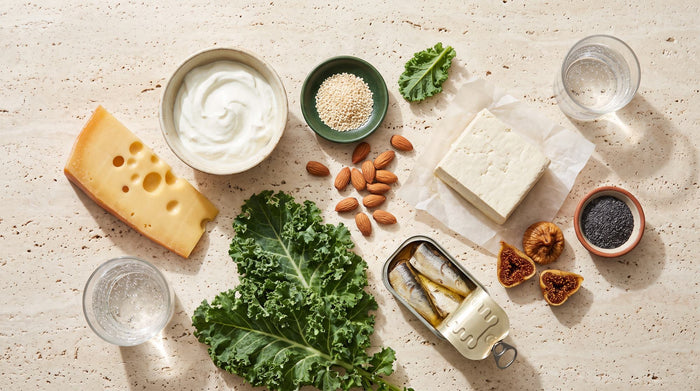
According to the German Nutrition Society (DGE), adults need 1,000 mg of calcium a day, teenagers 1,200 mg. If you drop milk and yoghurt and don't replace them, you can easily end up at half that, and over the years this probably raises the risk of bone fractures. The simplest lactose-free sources: mature cheese (30 g of Emmental gives you more than a glass of milk), lactose-free milk, fortified plant drinks, tofu made with calcium sulphate, kale, sesame, poppy seeds and calcium-rich mineral water with 150 mg or more per litre. Read more in the article Calcium deficiency.
Milk also provides iodine and vitamin B2; you can cover both with iodised salt, sea fish, eggs, cheese and wholegrain foods.
Calcium per portion: dairy-free and low-lactose
Values per portion as served, German Federal Food Code 4.0 and USDA. Tofu made with nigari gives only 282 mg; the coagulant is listed in the ingredients. Shake fortified drinks before drinking; organic drinks are usually not fortified.
Lactase tablets: when they help
Lactase products supply the enzyme from outside, available over the counter as food supplements. The studies are small and show a modest effect: with 20 to 25 g of lactose, hydrogen levels and symptoms drop a little; with 50 g, the tablet does nothing more. They're fine for exceptions like a hotel breakfast, not as a long-term solution, and should be taken right with the meal. Children, pregnant and breastfeeding women should check with their doctor first. Probiotics for lactose intolerance are not proven.
Medicines often contain lactose as a filler, but only in milligram amounts: up to 400 mg per dose is considered safe. Never stop taking a medicine because of this; ask your pharmacy about an alternative instead. In restaurants, allergen labelling rules also apply to unpackaged food, so you're welcome to ask about “milk”.

For days when cooking isn't happening, a plant-based drinkable meal is a simple solution: it contains no milk ingredients, so it's naturally lactose-free, and still gives you a complete meal with protein, fibre and 26 vitamins and minerals. If you swap your morning milky coffee for something else, you also get back the protein that disappears with the milk.
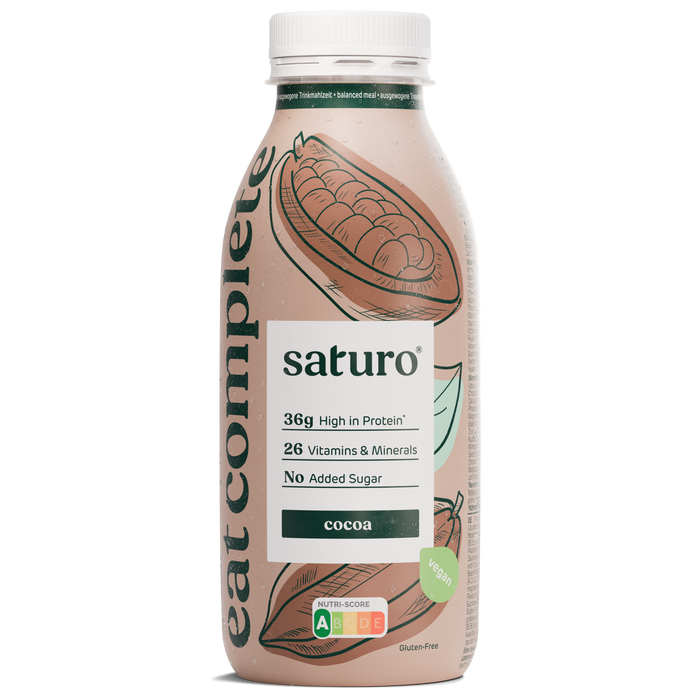
Drinkable meal: a complete meal without milk
Plant-based recipe made with faba bean and soy protein, with no milk ingredients and therefore naturally lactose-free. 400 kcal, 36 g protein and 26 vitamins and minerals per bottle. Contains soy.
Common questions about lactose intolerance
Can lactose intolerance go away?
The genetic form doesn't, but it can be managed so well that most people live without symptoms. The secondary form often disappears once the cause is treated: within weeks after a gut infection, or after 6 to 12 months of gluten-free eating in the case of coeliac disease.
Why do people suddenly become lactose intolerant?
Usually the predisposition was already there and only became noticeable once you ate more milk, or an infection, coeliac disease or Crohn's disease has damaged the gut lining. After the age of 20, the genetic form rarely develops from scratch. So new symptoms should always be checked out.
What happens if you eat dairy despite being lactose intolerant?
Bloating, cramps and diarrhoea for a few hours, then it's over. Your gut isn't damaged, and most people tolerate small amounts of up to 12 g with a meal anyway. Only with the very rare congenital form is lactose truly off the menu.
Can lactose intolerance lead to weight gain?
There's no evidence for that. A bloated belly looks like extra weight, but it's gas and water. If you replace milk with sweets or ready meals, you'll put on weight because of that, not because of the intolerance. Weight loss is more likely if diarrhoea lasts for weeks.
Can I eat bananas if I'm lactose intolerant?
Yes. Like all fruit, vegetables, grains, meat, fish and eggs, bananas contain no lactose. Milk sugar only comes from milk and products made from it. If fruit gives you bloating, think fructose instead.
Can you drink beer with lactose intolerance?
Yes. Beer brewed under the German Purity Law consists of water, malt, hops and yeast and contains no lactose. The exceptions are milk stouts and some craft beers with added milk sugar; you'll find that in the ingredients list.
Does breast milk contain lactose?
Yes, around 7 g per 100 ml, more than cow's milk. Babies produce plenty of lactase and rely on milk sugar. A breastfeeding mother with lactose intolerance doesn't need to change her diet: the lactose is made in the mammary gland, not taken from her food.
How long does the gut take to recover from lactose?
Symptoms last a few hours, and by the next day at the latest your gut is back to normal; it hasn't been damaged. Only with the secondary form does the lining need time, for coeliac disease, for example, 6 to 12 months gluten-free.
Sources · 33 sources anzeigen
- Institute for Quality and Efficiency in Health Care (IQWiG): Lactose intolerance (milk sugar intolerance). gesundheitsinformation.de, updated 6 November 2024.
- IQWiG: Causes and diagnosis of lactose intolerance. gesundheitsinformation.de, 6 November 2024.
- IQWiG: Diet and lactose intolerance. gesundheitsinformation.de, 6 November 2024.
- Federal Ministry of Health, gesund.bund.de: Lactose intolerance: symptoms and treatment. As of 23 February 2026.
- Misselwitz B., Butter M., Verbeke K., Fox M. R.: Update on lactose malabsorption and intolerance: pathogenesis, diagnosis and clinical management. Gut 2019; 68(11): 2080–2091.
- Szilagyi A., Ishayek N.: Lactose Intolerance, Dairy Avoidance, and Treatment Options. Nutrients 2018; 10(12): 1994.
- Rezaie A. et al.: Hydrogen and Methane-Based Breath Testing in Gastrointestinal Disorders: The North American Consensus. American Journal of Gastroenterology 2017; 112(5): 775–784.
- EFSA Panel on Dietetic Products, Nutrition and Allergies (NDA): Scientific Opinion on lactose thresholds in lactose intolerance and galactosaemia. EFSA Journal 2010; 8(9): 1777.
- Wilt T. J. et al.: Lactose Intolerance and Health. AHRQ Evidence Report/Technology Assessment No. 192, 2010.
- Shaukat A. et al.: Systematic review: effective management strategies for lactose intolerance. Annals of Internal Medicine 2010; 152(12): 797–803.
- Seppo L. et al.: Can primary hypolactasia manifest itself after the age of 20 years? A two-decade follow-up study. Scandinavian Journal of Gastroenterology 2008; 43(9): 1082–1087.
- Berni Canani R. et al.: Diagnosing and Treating Intolerance to Carbohydrates in Children. Nutrients 2016; 8(3): 157.
- Hodges J. K. et al.: Lactose Intolerance and Bone Health: The Challenge of Ensuring Adequate Calcium Intake. Nutrients 2019; 11(4): 718.
- Montalto M. et al.: Low-dose lactose in drugs neither increases breath hydrogen excretion nor causes gastrointestinal symptoms. Alimentary Pharmacology & Therapeutics 2008; 28(8): 1003–1012.
- European Medicines Agency (EMA): Information for the package leaflet regarding lactose used as an excipient in medicinal products for human use. Draft EMA/CHMP/186428/2016, 2018.
- Commission Regulation (EU) No 432/2012 establishing a list of permitted health claims, annex: lactase enzyme.
- National Institute of Diabetes and Digestive and Kidney Diseases (NIDDK): Lactose Intolerance, Symptoms & Causes. Last reviewed February 2018.
- German Nutrition Society (DGE): Reference values for nutrient intake, calcium. Derived 2013.
- DGE: Reference values for nutrient intake, iodine. Derived 2025.
- DGE: Reference values for nutrient intake, riboflavin. Derived 2015.
- DGE: Eating and drinking with lactose intolerance: cutting out milk and dairy products altogether is usually not necessary. Press release 05/2011, 20 December 2011.
- Dairy Product Quality Ordinance (MilchPQV) of 24 November 2025, Section 58 Labelling with the statement “lactose-free”. In force since 14 June 2026.
- Society of German Chemists (GDCh), Food Chemistry Division: Position paper “lactose-free” and “galactose-free”. August 2018.
- Verbraucherzentrale: Lactose-free foods: not sensible for everyone. As of 11 June 2026.
- Verbraucherzentrale NRW: Oat, coconut, almond, rice, soy: milk alternatives under the microscope. Market check 2024, as of 24 February 2026.
- Stiftung Warentest: Food intolerance: alarm from the gut. test.de.
- Bavarian State Office for Health and Food Safety (LGL): “Lactose-free” products: how reliable are the claims? Test results 2012 to 2015.
- National Association of Statutory Health Insurance Physicians (KBV): Uniform Assessment Standard (EBM), GOP 02401 H2 breath test. As of Q1 2025.
- Nutrition commissions of the ÖGKJ, DGKJ and SGP: Alternatives to cow's milk protein-based infant formulas. Monatsschrift Kinderheilkunde 2023; 171: 822–828.
- Max Rubner-Institut: Bundeslebensmittelschlüssel (BLS) version 4.0, 2025. Components: lactose (LACS) and calcium per 100 g.
- U.S. Department of Agriculture, Agricultural Research Service: FoodData Central, SR Legacy Release (2018). Lactose (Nutrient 1013) and calcium per 100 g.
- Food Standards Australia New Zealand (FSANZ): Australian Food Composition Database (AFCD) Release 3, December 2025. Feta, halloumi, camembert.
- Natrella G. et al.: Effect of Protective Culture and Modified Atmosphere Packaging on the Shelf Life of Burrata Cheese. Foods 2023; 12(9): 1867.
Has been writing for Saturo since 2019 about nutrition, nutrients and how good nourishment works in everyday life.
Hat diesen Artikel am 20. Oktober 2026 auf fachliche Richtigkeit geprüft. This content does not replace medical advice.

Gut health: 10 foods for a healthy gut
Yoghurt and kefir are just two of them: which ten foods feed your gut flora and what you can do after a course of antibiotics.
Weiterlesen · 15 Min
Latest from the advice hub
New articles, updates and tips straight to your inbox. Easy to understand, expert-checked, no spam.
Danke! Bitte bestätige die Anmeldung in deinem Postfach.