
Prepper list: food, quantities and shelf life
Power cut, flooding, empty shelves: what do you really need at home? The federal government recommends a ten-day supply and gives exact quantities. Here you'll find the list, a calculator for your household, shelf life and costs.


Aktualisiert 30 September 2026 · 14 Min. Lesezeit · 54 Quellen

The key points in 30 seconds
Households should ideally be able to look after themselves for ten days, though even three days helps. The EU names 72 hours as a minimum target, Austria 10 to 14 days, Switzerland about a week.
Ideally two litres, half a litre of which is for cooking. For ten days that's 20 litres per person, so just over two six-packs of 1.5-litre bottles, not counting water for hygiene and the toilet.
That's what the BLE's basic supply weighs for ten days and around 2,200 kcal a day: grains, vegetables, fruit, dairy, meat or fish, fat. Add 20 litres of drinks on top.
The best supply doesn't gather dust: you eat what you store and restock what you eat. That way nothing expires, and when an emergency hits, you have food you know and like.
Prepper list: what belongs in an emergency supply
An emergency supply isn't bunker romanticism, it's a recommendation from the Federal Office of Civil Protection and Disaster Assistance (BBK): every household should ideally be able to look after itself for ten days, with two litres of drinks per person per day and food that works without a fridge and, ideally, without a hob. The quantities come from the Federal Office for Agriculture and Food (BLE), which calculates with around 2,200 kcal per person per day. That's exactly the list you'll find here.
What is a prepper?
A prepper (from the English "to prepare") builds up supplies to get through crises such as power cuts, flooding or empty shelves for a few days without outside help. The German federal government defines it the same way in a 2019 reply to the Bundestag, and adds: preparing for crises is not extremist. The spectrum runs from a household with ten days of supplies as recommended by the BBK to people who go far beyond that. This article sticks to the first part: food and drink for a household, bought in a normal supermarket.
Prepping: sensible or overkill?
What the BBK recommends is sensible, and overkill is whatever you never eat. The most common mistakes aren't extremes but gaps: forgetting water, even though it matters more than food; buying only tins nobody likes and throwing them away years later; having no way to cook without electricity, which according to the survey applies to two thirds of those who prepare; setting up a supply once and never rotating it. If you solve these four points, you're better prepared than most households, with no bunker and no camouflage paint.
Federal government emergency supplies list: how much per person?
“What does the federal government recommend as an emergency supply?” is the most common question on the topic, and the answer comes from two sources. The BBK sets the duration and water, while the BLE provides the food quantities. The old table with 3.5 kg of grains that circulates on many blogs comes from an earlier brochure; the current figures are in the BLE's supply calculator and in the calculator below.
The federal government's prepper list: quantities for 10 days
For one person and ten days, the BLE supply table lists: 3.3 kg of grain products, bread and potatoes, 4.0 kg of vegetables and pulses (tinned, drained weight), 2.5 kg of fruit and nuts, 2.5 kg of milk and dairy products, 1.2 kg of eggs, meat, sausage and fish, 330 g of fats and oils, plus 20 litres of drinks. That comes to around 2,200 kcal a day, calculated with the nutrition societies' reference values. The BBK guide “Preparing for Crises and Disasters” (as of November 2025) no longer has a kilogram table and instead points to exactly this calculation.
Water: 2 litres per person per day
According to the BBK, drinking water matters more than food: ideally two litres per person per day, half a litre of which is for cooking. For ten days that's 20 litres per person, and 60 litres for three people. Water for washing and the toilet is not included. Buy bottled water with a best-before date: in a sealed glass bottle it keeps almost indefinitely, while PET bottles usually say one year. The BLE doesn't recommend bottling your own tap water as a supply, because nobody can guarantee how long it keeps.

What do you need for a 14-day blackout?
The same as for ten days, times 1.4, plus everything that gives you light, warmth and information without power. For two adults, the calculator comes to around 39 kg of food and 56 litres of drinks. On top of that, the BBK checklist lists a wind-up or battery radio, torch, candles, power bank, gas stove with cartridges for outdoor use, cash and a list of important phone numbers on paper. For a longer winter outage, the BBK also names sleeping bags and a heat source that doesn't depend on the grid, and indoors only one approved for indoor use.
Food supply for 6 months or 1 year
On paper, that's around 250 or 500 kg of food and 360 or 730 litres of water for one person; the calculator shows the breakdown. In practice, a one-year supply is a very different job from ten days: it needs a cool, dry room, tightly sealed containers against moths and a plan for how you'll eat 500 kg in everyday life before it expires. The authorities don't recommend it, and the BLE calculator stops at 28 days. If you plan this far anyway, stick to two rules from chapters 5 and 7: only food with a shelf life of over a year, and a living stockpile.
What runs short first in an emergency
Three things fail at the same time in almost every crisis: tap water, refrigeration and the cooker. Your supply is built exactly for that.
Drink before you eat
According to the BBK, a person can sometimes go three weeks without food, but only four days without fluids. Waterworks need electricity; if it fails across a wide area, eventually nothing comes out of the tap. That's why water comes first on every list: 1.5 litres for drinking and 0.5 litres for cooking, per person per day. Juices and UHT milk count, but coffee and tea need water.
Refrigeration lasts hours, not days
According to the US food authority, a closed fridge keeps food cold for about four hours; the Lower Saxony consumer advice centre says four to six. A full freezer manages around 48 hours, a half-full one 24. After that, the rule is: eat chilled food first, and cook thawed raw meat all the way through. So the emergency supply itself consists of food that needs no refrigeration; the BLE deliberately doesn't count frozen food.
Cooking without electricity
According to a 2024 survey, only a third of people who prepare can cook food without electricity. A gas hob often keeps working, an electric one doesn't. For everything else, the BBK rule applies: camping stove with gas cartridge and barbecue only outdoors, indoors only appliances approved for it, plus a carbon monoxide detector. That's why every supply needs a share of food you can eat cold: tinned food, crispbread, nuts, dried fruit.
Prepper shopping list: the food that belongs on it
The prepper shopping list is shorter than many people think, and it contains nothing you don't already know. The BBK names three criteria: keeps without refrigeration, ready without cooking or with a short cooking time, and suits the people in your household. You can tick off the list below; the calculator in chapter 2 gives you the quantities.
Prepper food: what belongs on the list
The core is six groups. Grains for energy: pasta, rice, oats, crispbread, rusks. Pulses and vegetables for protein and fibre: lentils, beans and chickpeas in tins or jars, plus sweetcorn, peas, sauerkraut, tomatoes. Fruit and nuts: tinned fruit, dried fruit, trail mix. Dairy: UHT milk, hard cheese, milk powder. Fish and meat: tuna, sardines, corned beef, liver sausage. Fats: oil and ghee. Add honey, jam, salt, sugar, instant stock, coffee, tea, chocolate as you like, and for each person whatever they really enjoy.
The best tinned food for emergencies
The best tins are the ones that make a meal without cooking and that you'd eat anyway: stews, chilli, ravioli, fish in oil or water, pulses, sweetcorn, fruit in juice. According to the US food authority, tinned meat, fish and most vegetables keep for two to five years, acidic ones like tomatoes and fruit for twelve to 18 months; the best-before date in the supermarket is usually 18 months, and undamaged tins often stay edible for years longer. Don't eat: bulging, leaking or badly dented tins. Watch the salt content and choose vegetables without added salt where you can.
How much energy is in 100 g of supplies?
USDA FoodData Central SR Legacy per 100 g as purchased. Oils and fats are higher at 884 to 900 kcal, but they're not a meal.
Prepper list from the discounter: Aldi, Lidl and co.
Everything on this list is available in a normal supermarket or discounter, and own-brand products are fine: for shelf life, the type of food matters, not the brand. In August 2024, the Saxony consumer advice centre put together a complete 10-day supply for one person, including water, using own-brand products, and came to €64.55 excluding deposit. If you pick up two or three more things from the list on every shop, you'll have your supply together in four weeks without a single big shop. You don't need special packages from the internet.
Long-life foods: what keeps for months and years
“How long does it keep?” decides how often you need to rotate your stock. Four rules apply to everything: cool (the BLE gives 15 to 20 °C for the pantry), dry, dark and tightly sealed, because pantry moths eat their way through paper and plastic. Put new purchases at the back and older ones at the front. Below you'll find the shelf life of 130 foods to look up.
Which foods keep forever?
Legally, only table salt, sugar and vinegar don't need a best-before date; they don't spoil when stored dry. Honey keeps practically indefinitely in microbial terms, but according to LAVES Lower Saxony it loses quality after one and a half to three years at room temperature. Mineral water stays good almost indefinitely in a sealed glass bottle. According to the consumer advice centre, white rice and durum wheat pasta keep for a few years beyond the best-before date. Everything else ages: oil and nuts go rancid, wholegrain products and oats are high in fat, and tins eventually rust. “No food keeps forever,” writes the BLE.
The stock with the best shelf life is the one you eat regularly. If you only buy by the years printed on the label, you end up storing things nobody wants to eat and eventually throwing them away. If you buy what's already on your menu, you always have fresh food, and in an emergency you have food you know.
Joerg Hauke, Nutrition expert, expert review of this article
Which foods keep for 10 or 30 years?
The 30 years come from Brigham Young University studies: white rice, wheat and split peas were still acceptable after 30 to 34 years in large oxygen-sealed emergency tins, though with vitamin losses. That applies to those tins, not to the bag from the supermarket. Manufacturers promise ten years or more for emergency ration bars and specialist tins; those are the manufacturers' own claims. The Saxony consumer advice centre sees no added value in extra-long-life tins: they're pricier, saltier, and a normal tin lasts years anyway if stored well.

Past the best-before date: what you can still eat
The best-before date isn't a throw-away date: until then the manufacturer guarantees taste, smell and nutritional value, and after that, according to the Federal Office of Consumer Protection, the traffic light turns amber, so check first. Undamaged tins, pasta, rice, pulses and UHT milk are often fine for months or even years past the date, as long as the packaging, smell and taste are normal. The use-by date (“use by”) on highly perishable foods such as minced meat is different: don't eat it after that. Bin straight away: bloated tins, clumped dry goods with webbing, rancid smell.
Eating without power: what works in a blackout
A blackout is exactly what a stockpile is built for: no hob, no fridge, and after a while no tap water. What works then comes down to three questions: what do you cook with, what do you eat cold, and which emergency food is actually worth it?
Cooking without power: gas stoves, but safely
A gas hob usually keeps working in a power cut, an electric hob doesn't. For indoors, the BBK mentions a tea-light warmer for heating things up, a fondue set with gel fuel, and a gas stove if it's approved for indoor use. Camping stoves with gas cartridges and barbecues are for outdoors only. Plan fuel for several days and cook economically: lid on, little water, pasta and rice that cook in a few minutes. The Verbraucherzentrale Sachsen considers classic gas stoves the best choice for emergencies.
Never use barbecues, camping stoves or outdoor heaters inside your home: with too little oxygen they produce carbon monoxide, which is odourless and life-threatening. The BBK recommends a tested carbon monoxide detector. In a power cut, switch off the hob and oven, otherwise they start up as soon as the power comes back.
Eat it cold: the blackout list
Without a stove, you're left with what comes ready to eat from the packet: tinned fish, meat, pulses, vegetables and fruit, crispbread, rusks, canned bread, nuts, dried fruit, muesli bars, dry sausage, hard cheese, honey, chocolate, UHT milk and ready-to-drink meals. Oats also soften in cold milk. Dried pulses, pasta and rice, on the other hand, need heat and water, so in a blackout they're only useful with a stove. A good stockpile mixes both: cold food for the first few days, then the stove.
Emergency food: bars, ready meals or a drinkable meal?
Emergency food is a product category, not a must: the Verbraucherzentrale Sachsen considers specialist products unnecessary for a private stockpile. Pressed emergency ration bars (such as NRG-5 or BP-5) keep for a very long time and are high in calories, but according to the market check they're too sweet and too fatty for more than a last-resort reserve. Freeze-dried meals need 400 to 570 ml of hot water per portion, so a stove and a bigger water supply. A ready-to-drink meal fills the gap in between: eat it straight away, no water needed, but with a shorter shelf life, which makes it a building block to rotate.
Emergency food compared
Five types that can sit side by side in your stockpile, and what they need in a real emergency.
| Cooking needed | Water needed | Typical shelf life | Energy | |
|---|---|---|---|---|
| Tinned food (stew, fish, vegetables) | no, can be eaten cold | no | best-before date usually 18 months, often years longer | 100 to 250 kcal per 100 g |
| Dry goods (pasta, rice, lentils) | yes | 0.25 to 1 litre per 100 g | 1 to 2 years, white rice longer | 350 to 380 kcal per 100 g dry |
| Emergency ration bars and biscuits | no | no, drink plenty alongside | 15 to 20 years (manufacturer information) | 445 to 460 kcal per 100 g |
| Freeze-dried meal | yes, hot water | 400 to 570 ml per portion | 3 to 5 years (manufacturer information) | 470 to 1,000 kcal per pouch |
| Drinkable meal, ready to drink | no | no | up to 12 months unrefrigerated | 400 kcal per 400 ml bottle |
| Powder meal | no, shaker | 400 to 500 ml per portion | 12 months in the pouch | 400 kcal per portion |
Manufacturer information and market check by the Verbraucherzentrale Sachsen (2024 survey), Saturo per Shopify data, as of September 2026. Bar brands are mentioned in the text for explanation only, not as a rating of individual products.
For the first days of an outage, when cooking is awkward and water is scarce, a ready-to-drink meal is the simplest solution in your stockpile: unscrew, drink, done. Because it keeps for up to twelve months, it belongs in the living part of your stockpile, the part you drink day to day and restock.
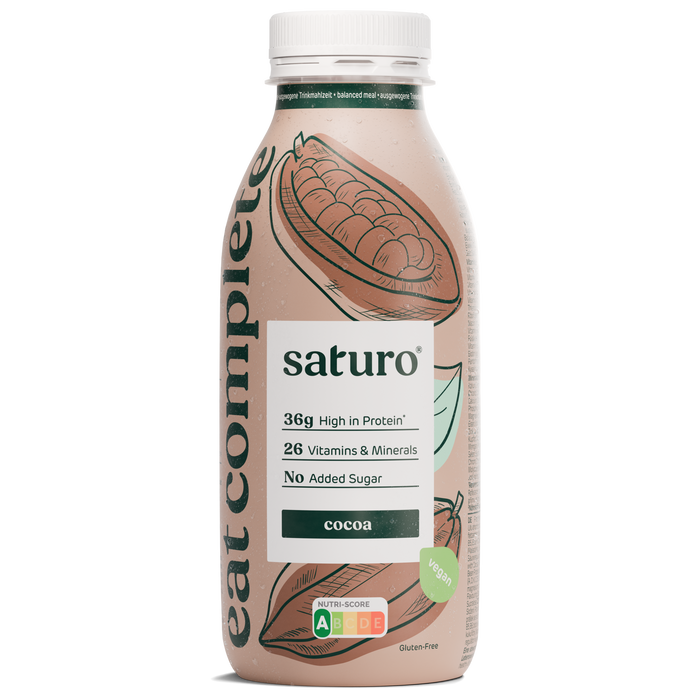
Drinkable meal: a complete meal, no cooking and no water
400 kcal, 36 g plant-based protein and 26 vitamins and minerals in a 400 ml bottle, vegan. Unopened, it keeps for up to twelve months unrefrigerated; the best-before date is on the bottle. Unscrew and drink: no hob, no water, no fridge. A building block for an emergency stockpile that rotates: drink it day to day, restock, and in an emergency it's your first meal of the day.
At 400 kcal, one bottle delivers just under a fifth of the 2,200 kcal the BLE calculates with, so six bottles cover roughly one day. For the rest, a basic supermarket stockpile remains the foundation; the drinkable meal is the reserve for days without a kitchen.

Building an emergency stockpile: step by step, no panic buying
An emergency stockpile isn't built in one big shop, and it shouldn't be: the federal government expressly recommends building it up step by step, and the BLE says the extra cost only applies the first time. Four weeks is enough if you pick up a few extra things on every shop.
Living stockpile: store what you eat
The BBK distinguishes two approaches. The one-off stockpile is bought, checked once a year and replaced. The living stockpile is the better option: on every shop you pick up one or two more packs than you need right now, use the oldest first in everyday life, and restock. That way nothing expires, you always have food you like, and the stockpile costs nothing extra in the long run. Note the purchase date on packs without a best-before date and put new items at the back.
To a 10-day stockpile in four weeks
-
Week 1
Water and the basic stock for three days
Water first: two six-packs per person. Add pasta or rice, a few tins of fish, pulses and fruit, crispbread and nuts. That gets you to the BBK's entry level.
-
Week 2
Grains, pulses, oil
Top up the big categories: oats, flour, rusks, lentils and beans in tins or jars, oil and ghee. Use the quantities from the calculator, and buy airtight containers for dry goods while you're at it.
-
Week 3
Tins, fruit, milk, treats
Tinned vegetables and fruit, dried fruit, UHT milk, hard cheese, milk powder, plus honey, jam, coffee, tea, chocolate and the kids' favourites. Now ten days are fully covered.
-
Week 4
Stove, light, radio, first-aid kit
Gas stove with cartridges, tin opener, torch, wind-up radio, power bank, candles, first-aid kit following the BBK list, cash. From now on, rotate: check the dates every three to six months.
What does an emergency stockpile cost?
Less than a ready-made emergency pack, and with more energy. In 2024, the Verbraucherzentrale Sachsen (Saxony consumer advice centre) tested eight pre-packed packs from the internet: not a single one reached 2,200 kcal per day, on average they cost around twice as much per day as a supermarket stockpile, and the only vegan pack delivered just 962 kcal. Stiftung Warentest puts a 15-day pack from one provider at around €300. According to both, buying items individually saves money, and you eat what suits your own table. The figures come from 2022 to 2025 and different shopping baskets, but the direction is clear.
What's it all for? The BBK justifies preparedness with everyday life: power cuts, extreme weather, an illness that keeps you at home, empty shelves after supply chain disruptions. It also writes that “even a war no longer seems as unlikely as it did a few years ago”. The stockpile is the same for every scenario; once you have it, you don't need to think about each one separately.
Supplies for family, medication and pets
The BLE calculates 2,200 kcal for every person, and the BBK asks in return: who is the stockpile for? Are there allergies, children, pets, people on medication? Three groups need their own lines on the list.
Prepper list for the family: children and babies
In the calculator, children count like adults but need less: according to the BLE, a child up to twelve needs one litre of drinks a day, and according to the DGE, a toddler needs around 1,100 to 1,300 kcal. The reserve is intentional. More important than calories is what children actually eat: pasta, tinned fruit, muesli, a few sweets. For babies, the stockpile should include infant formula, jars of baby food, nappies and boiled water. The BfR advises mixing powdered formula only shortly before feeding and throwing away leftovers after two hours. According to the Verbraucherzentrale, emergency ration bars are unsuitable for babies and toddlers because of the sugar, and honey is never suitable under one year.

Medication and first-aid kit
According to the BBK guide, anyone who regularly needs medication should have a supply for at least ten days. Talk to your doctor's surgery or pharmacy about how much and how to store it, as shelf life and cooling differ from one medicine to another. The BBK first-aid kit also includes painkillers, anti-diarrhoea remedies, electrolytes to replace lost fluids, a fever thermometer, bandaging material and personal medication such as an asthma inhaler. Where to keep it: cool, dry, lockable, not in the bathroom. Restock before anything runs out, and include expiry dates in your rotation.
Don't forget your pets
According to the BBK and BLE, food and water for your animals belong in the stockpile too, as tins or dry food for the same ten days, plus medication, litter and a carrier with their papers. There's no official quantity per animal. Work out what your pet eats in ten days, and check the shelf life of the food as you would for your own supplies. According to the Umweltbundesamt (Federal Environment Agency), freezing dry food for 24 hours after buying it protects against pantry moths.
The BBK adds things you can't eat to the stockpile: a wind-up or battery radio for warning alerts, a torch and candles, a power bank, cash (with no amount given), hygiene items including bin bags for the toilet, and a folder of important documents, packed waterproof and also kept as a digital copy.
Common questions about prepper food
What should a prepper have at home?
According to the BBK checklist: water for ten days, long-life food, a way to cook with fuel, first-aid kit, wind-up radio, torch, candles, power bank, hygiene items, cash and important documents. Families also need baby food, nappies and pet food. Any equipment beyond that is a matter of taste, not official advice.
Which 6 foods never expire?
Counted honestly, there are three: table salt, sugar and vinegar don't need a best-before date under the Food Information Regulation. Then there's honey (practically unlimited microbially, though quality drops after one to three years), mineral water in a sealed glass bottle, and white rice, which lasts a few years beyond its best-before date.
Which foods should you always have at home?
Water, pasta or rice, oats, crispbread, tinned pulses and vegetables, tinned fruit, nuts, UHT milk, tinned fish or meat, oil, salt, sugar, honey and instant stock. That's the basis of the BLE stockpile table. The calculator in chapter 2 shows the quantities for your household.
How can I make emergency food myself?
Drying is the safest way: dried fruit, dried meat or toasted oat bars keep for weeks to months. Even home preserving is risky, because at home you reach 100 °C at most and spores survive. According to the BfR, most botulism cases are traced back to home-preserved jars and tins. For a stockpile, commercially produced tins are the safe choice.
Should you keep cash at home?
Yes, the BBK recommends cash, because cash machines and card payments stop working in a power cut, but it doesn't name an amount. Switzerland advises keeping enough small change to pay for a week's shopping and a tank of fuel in cash, and the Austrian National Bank advises €100 per family member in small notes.
How many preppers are there in Germany?
Nobody knows: in 2019, the federal government replied to an enquiry that it had no information on this. All we have is how many households prepare: in 2024, 61% had long-life food at home beyond a week's needs, 57% had a water supply, and around 45% considered their stockpile sufficient for ten days.
Is the prepper list available as a PDF?
Yes, the BBK provides its checklists as PDFs you can tick off (link in the sources). You can tick off the shopping list in chapter 4 right here and print the page. The stockpile calculator in chapter 2 works out the quantities for your household, and you won't find that in any PDF.
What do I need if war breaks out?
The same as for any other crisis, says the BBK: a ten-day stockpile, water, radio and the NINA warning app, documents, cash, first-aid kit. On top of that, there's the “Seeking shelter” chapter of the BBK guide, with the rule to put two walls between you and the outside in case of explosions.
Sources · 54 sources anzeigen
- Federal Office of Civil Protection and Disaster Assistance (BBK): Preparing for crises and disasters (Vorsorgen für Krisen und Katastrophen). Guide, as of 11/2025, 2nd edition: 10 days of supplies, 2 litres of water, cooking without electricity, first aid kit, cash, documents, finding shelter.
- BBK: Checklists for preparing for crises and disasters (Checklisten zur Vorsorge Krisen und Katastrophen), PDF, December 2025 (drinking water for 3/5/7/10 days, long-life food, cooking options, food supplies for pets).
- BBK: Stocking up on food and drink: ideally ten days' worth, three weeks without food, four days without fluids, one-off and rotating supplies.
- BBK: Home first aid kit: top up your supplies, keep it cool, dry and lockable, and not in the bathroom.
- Federal Office for Agriculture and Food (BLE), Ernährungsvorsorge (food preparedness): Supplies calculator, 1 to 10 people, 1 to 28 days, 2,200 kcal per person per day, 1 litre of drinks for children up to 12 years.
- BLE, Ernährungsvorsorge: Supplies table, basic food supplies for one person for 10 days (3.3 kg cereals, 4.0 kg vegetables, 2.5 kg fruit, 2.5 kg dairy products, 1.2 kg meat/fish/eggs, 330 g fat, 20 l drinks).
- BLE, Ernährungsvorsorge: Emergency supplies, your personal emergency supplies: 10 days, around 2,200 kcal, without frozen food.
- BLE, Ernährungsvorsorge: Recommendations and tips: no food keeps forever; extra costs only arise when you first build up your supplies.
- BLE, Ernährungsvorsorge: How to store food (storage table: tinned goods, dry products, oils, sugar, salt, tea).
- BLE, Ernährungsvorsorge: How to look after your food supplies (new items to the back, don't eat from bulging tins, note the purchase date).
- BLE, Ernährungsvorsorge: How to store mineral water (keeps almost indefinitely, best-before date: glass 2 years, PET 1 year).
- BLE, Ernährungsvorsorge: Frequently asked questions about state food emergency reserves (no filling your own bottles with tap water, no legal obligation).
- BLE, Ernährungsvorsorge: Pests, 10 tips for prevention (tightly sealed containers, cool, dry, check for infestation).
- German Bundestag: Federal Government response, printed paper 20/3009 of August 2022 (cost of 10 days' supplies up to 130 euros, building up gradually, private stockpiling at your own discretion).
- German Bundestag: Federal Government response, printed paper 19/6941 of 10 January 2019 (definition of preppers, no data on numbers, crisis preparedness is not extremist).
- BBK, Civil Protection Magazine (Bevölkerungsschutz-Magazin) 1/2025: Knowledge, supplies, skills. PREP project, 1,084 interviews, June 2024 (45% have supplies for ten days, one in three can prepare food without electricity, 42% are engaged with preparedness).
- Rohs M., Lacher L., Großmann C.: Emergency and disaster preparedness in Germany. Results of a representative population survey. RPTU Kaiserslautern-Landau (61% keep long-life food, 57% keep more than a week's worth of water).
- European Commission and High Representative: Preparedness Union Strategy, JOIN(2025) 130 final, 26 March 2025, Action 14: self-sufficiency of the population for at least 72 hours.
- Federal Office for National Economic Supply (BWL, Switzerland): Kluger Rat, Notvorrat. Brochure, 17 February 2025 (supplies for around one week, cash for a weekly shop and a tank of fuel).
- Austrian Civil Protection Association with AGES: Provisions, recommended supplies for 10 to 14 days.
- Oesterreichische Nationalbank: Bargeld für alle Fälle, press release, 27 February 2023 (100 euros per family member in small denominations).
- Bundesnetzagentur (Federal Network Agency): press release, 9 October 2025, electricity supply interruptions in 2024 (SAIDI 11.7 minutes per end consumer).
- Stromnetz Berlin: power cut in Steglitz-Zehlendorf, January 2026 (around 45,400 households, power restored within 100 hours).
- U.S. Department of Agriculture, Food Safety and Inspection Service: Keep Your Food Safe During Emergencies (fridge up to 4 hours, full freezer about 48 hours, half-full freezer 24 hours).
- Federal Institute for Risk Assessment (BfR): Correct cooling of food in the home, FAQ, 13 February 2023 (frozen food during a power cut, refreezing, heating raw animal-based foods).
- Consumer Advice Centre of Lower Saxony: Food during a power cut, as of 4 August 2026 (fridge four to six hours, freezer up to 48 hours, cook outdoors, switch off the cooker).
- Consumer Advice Centre of Saxony: Market check on emergency equipment: food supplies, good and practical? 6 February 2025, survey from 2024 (emergency packs, bars, tinned food, cooking stoves, sample stockpile 64.55 euros).
- Stiftung Warentest: Supplies for disasters and pandemics, which ones and how much? test.de, 20 January 2025 (15-day pack around 300 euros, buying items separately saves money).
- Consumer Advice Centre: Best-before date (MHD) is not the same as use-by date (no best-before date on sugar, table salt, vinegar).
- Consumer Advice Centre: Tinned food, everything on shelf life and storage (often many years past the best-before date, throw away bulging tins, store below 19 °C).
- Consumer Advice Centre: Pasta, rice, flour: shelf life and storage of dry foods (white rice and pasta a few years past the best-before date, wholemeal flour 4 to 6 months, pulses 1 to 2 years).
- Consumer Advice Centre: Milk, everything you need to know about shelf life and storage (UHT milk, unopened and unrefrigerated, keeps for several months).
- Consumer Advice Centre: Nuts, keeping them longer through correct storage (whole and unshelled, several months).
- Consumer Advice Centre: Pantry pests, how can I prevent moths and beetles in food?
- Federal Office of Consumer Protection and Food Safety (BVL): FAQ on best-before date and use-by date (traffic light turns amber after the best-before date, red after the use-by date).
- Regulation (EU) No 1169/2011 (Food Information Regulation), Article 24 and Annex X: best-before date, use-by date, exemptions for vinegar, table salt and sugar.
- Lower Saxony State Office for Consumer Protection and Food Safety (LAVES): Honey, a valuable natural product: how to store it properly (keeps for years, HMF limit reached after 1.5 to 3 years at 18 to 25 °C).
- BfR: Rare but preventable: questions and answers on botulism (no honey for babies under one year, throw away bulging cans, home-preserved foods as a common source).
- USDA FSIS: FoodKeeper data (pantry, unopened: low-acid cans 2 to 5 years, high-acid 12 to 18 months, rice, pasta, milk powder, oils, spices), archived copy from 2 July 2025.
- USDA FSIS: Shelf-Stable Food Safety (cans are safe long after the date as long as they aren't dented, rusty or bulging; storage temperature).
- Brigham Young University, Dept. of Nutrition, Dietetics and Food Science: An Approach to Longer-Term Food Storage, September 2019 (rice, wheat and pulses in low-oxygen cans for at least 30 years, skimmed milk powder 15 years).
- Lloyd M. A. et al.: Sensory and nutritional quality of white rice after residential storage for up to 30 years. International Journal of Food Sciences and Nutrition 2014; 65(3): 320–326.
- Rose D. J. et al.: Quality and sensory characteristics of hard red wheat after residential storage for up to 32 y. Journal of Food Science 2011; 76(1): S8–S13.
- Chapman J. S., Jefferies L. K., Pike O. A.: Sensory and nutritional quality of split peas stored up to 34 y in residential storage. Journal of Food Science 2010; 75(3): S162–S166.
- U.S. Department of Agriculture, Agricultural Research Service: FoodData Central, SR Legacy Release (April 2018), energy per 100 g for the bar chart and table.
- German Nutrition Society (DGE): Reference values for nutrient intake, energy (guideline values by age, sex and activity; children aged 1 to under 4 years: 1,100 to 1,300 kcal).
- BfR: Recommendations for the hygienic preparation of powdered infant formula, Opinion No. 009/2022 of 29 March 2022.
- BfR: Hygienic handling of mineral, spring, table and tap water in the home, FAQ of 11 September 2024 (boil water for babies, store opened bottles in a cool place).
- German Environment Agency: Pantry moths (larvae chew holes in packaging, use airtight containers, freeze dry pet food for 24 hours at -18 °C).
- Vier Pfoten: How to protect your pet in disasters and emergencies, 6 May 2026 (check food and medication for shelf life, emergency box).
- rbb SUPER.MARKT / ARD consumer editorial team: Survival bars, emergency food tested, August 2026 (manufacturers claim 20 to 30 years, BBK recommends a rotating stock instead of special bars).
- notvorsorge.com: NRG-5 emergency food 500 g, manufacturer's details on nutritional values and shelf life, accessed 30 September 2026 (for explanation only).
- Trek'n Eat (Katadyn) via ausdauerleistung.de: Hearty travel stew with beef, 240 g, 570 ml boiling water, manufacturer's details, accessed 30 September 2026.
- Saturo: Drinkable meal 400 ml, nutritional values and shelf life (unopened, keeps for twelve months without refrigeration), as of September 2026.
Has been writing for Saturo since 2019 about nutrition, nutrients and how good nourishment works in practice in everyday life.
Hat diesen Artikel am 30. September 2026 auf fachliche Richtigkeit geprüft. This content is not a substitute for medical advice.

Getting up early made easy: the best morning rituals
How you spend your morning shapes your day: rituals that build stress resilience, focus and contentment.
Weiterlesen · 10 Min

New from the guide
New articles, updates and tips straight to your inbox. Easy to understand, expert-checked, no spam.
Danke! Bitte bestätige die Anmeldung in deinem Postfach.