
Caffeine: effects, duration and how much a day is okay
Awake after the first sip, wide awake at midnight? Caffeine blocks adenosine, the messenger that makes you tired, and stays in your blood for hours. How it works, how long it lasts, how much a day is okay and what's in coffee, tea and energy drinks.


Aktualisiert 29 October 2026 · 16 Min. Lesezeit · 58 Quellen

The essentials in 30 seconds
According to EFSA, this much caffeine spread across the day is considered safe, which is a good four cups of filter coffee. For pregnant and breastfeeding women, the limit is 200 mg.
After around four hours, half of it is broken down; depending on the person, that takes two to eight hours. Of a coffee at 4 pm, a quarter is still there at midnight.
That's how quickly you feel caffeine; blood levels peak after 30 to 60 minutes. If you wait for the kick and pour another cup, you end up with two doses in your blood.
Adenosine builds up in the brain over the day and makes you tired. Caffeine occupies the same docking sites, so the tiredness signal doesn't get through. It doesn't create new energy.
What is caffeine?
Caffeine is a natural plant compound from the group of purine alkaloids, produced by the coffee plant, tea plant, cacao tree, mate and guarana. For the plant, it's protection against being eaten; for us, it's a pick-me-up. Chemically, it's called 1,3,7-trimethylxanthine. Whether it comes from a cup of tea, an espresso or a tablet makes no difference to your body: it's always the same molecule, only the amount per serving differs.
Where caffeine is found: in coffee, espresso and everything made from them, in black, green and white tea, in matcha and mate, in cocoa and chocolate, in cola and energy drinks, in caffeine tablets, headache remedies and pre-workout powders. Herbal and fruit teas, rooibos and decaffeinated coffee contain little or none. You'll find exactly how much in Chapter 5, where you can look up every drink.
Caffeine is regulated as an ingredient: drinks with more than 150 mg per litre must carry the label “High caffeine content”, except coffee and tea; energy drinks may contain no more than 320 mg per litre.

Caffeine effects: what happens in your body
Caffeine doesn't wake you up, it stops you from getting tired. That difference explains almost everything: the quick effect, the slump afterwards and the coffee that "does nothing any more" for heavy drinkers. Then there are effects you can't feel but can measure: on your blood vessels, your blood pressure and your heart.
What does caffeine do to your body?
Caffeine resembles the messenger substance adenosine and occupies its docking sites in the brain, mainly the A1 and A2A receptors. Adenosine builds up over the course of the day and slows your nerve cells down; once the receptor is blocked, the brake stays off. The result: you feel more awake, more focused and quicker to react, and at higher doses your pulse speeds up too. Via the A2A receptor, caffeine also boosts the dopamine signal, but only indirectly: a PET study found no dopamine release after 300 mg like you see with amphetamine. The “kick” is a blockade, not a high.
From 100 mg of caffeine, painkillers work measurably better: according to a Cochrane analysis, 5 to 10 percent more people get good pain relief, and one in 14 people benefits additionally. For migraine, the combination of aspirin, paracetamol and caffeine is the only caffeine combination backed by studies: 19.6 instead of 9.0 percent were pain-free after two hours. The guideline limits acute medication to a maximum of 10 days a month.
Does caffeine constrict blood vessels?
In the brain, yes, clearly. Adenosine widens the blood vessels in the brain; when caffeine blocks the receptors, they contract. In perfusion MRI studies, blood flow to the grey matter fell by 20 to 27 percent after 184 to 250 mg of caffeine. That's one of the reasons caffeine is in headache remedies. The often-quoted line “caffeine boosts blood flow to the brain” is wrong. In the rest of the body the picture is mixed: caffeine constricts vessels by blocking adenosine, but also widens them via the vessel lining; overall, not much happens in your arms and legs.
Caffeine and blood pressure
In the short term it goes up: in people with high blood pressure, 200 to 300 mg of caffeine raised blood pressure by an average of 8 over 6 mmHg, for at least three hours. In the long term the effect is small: in studies lasting at least a week, coffee raised blood pressure by just over 1 mmHg, and regular coffee drinkers had a 7 percent lower risk of high blood pressure in cohort studies. That's an observation, not proof. Getting used to it isn't guaranteed: after five days on 300 to 600 mg a day, half of the participants still had the full rise in blood pressure.
Caffeine not working: tolerance and genes
If coffee “does nothing any more”, it's usually tolerance. If you drink caffeine every day, you need your dose just to get back to your normal level: in a study with 379 people, caffeine raised alertness in regular consumers only to the level that non-drinkers had anyway. Genes play a part too: around half of the population breaks caffeine down via a slow variant of the liver enzyme CYP1A2, and variants of the A2A receptor decide who gets jittery or sleeps badly. If you “feel nothing”, you still shouldn't increase the amount: the blood pressure effect stays.
The path of caffeine through the body
Three stages decide how quickly caffeine kicks in, how strongly and for how long: the gut, the docking sites in the brain and the liver. Once you know them, the times in chapter 4 make sense.
Absorption: stomach and small intestine
Caffeine enters the blood almost completely; bioavailability is around 100 percent. You feel the first effects after 15 to 30 minutes, and blood levels peak after 30 to 60 minutes; a full meal can delay that by up to two hours. Whether it's a cup, a tablet or a can makes no difference to absorption.
Effect: adenosine receptors
Caffeine blocks the adenosine receptors A1 and A2A in the brain, heart and kidneys. The tiredness signal doesn't come through, pulse and blood pressure rise slightly, and the kidneys briefly excrete a little more water. Dopamine isn't released; its signal is simply amplified.
Breakdown: the liver
The enzyme CYP1A2 breaks down about 95 percent of caffeine, with a half-life of around four hours. Smoking speeds up breakdown to almost double; the contraceptive pill, pregnancy, some antibiotics and antidepressants slow it down, in extreme cases to days.
How long does caffeine last?
The effect kicks in after 15 to 30 minutes and lasts several hours, but the caffeine is only “gone” much later: what you drink at 4 pm is still a quarter in your blood at midnight. The evening clock below works out when your last cup should be, depending on your bedtime and dose.
Onset, duration, after-effects
You feel caffeine after 15 to 30 minutes, and your blood level peaks after 30 to 60 minutes, or only after two hours following a big meal. According to EFSA, the alert phase lasts “several hours”; exactly how long depends on dose, tolerance and genes. Caffeine has a measurable effect for much longer than you feel it: 400 mg six hours before bed shortened sleep in the sleep lab by a good hour, without the participants noticing.
Caffeine half-life: what the number means
The half-life is the time it takes for half of the caffeine to be broken down: in healthy adults about four hours on average, two to eight individually, and up to twelve in some studies. So 90 mg at 4 pm becomes 45 mg at 8 pm and a good 20 mg at midnight. According to EFSA, even 100 mg close to bedtime can disturb some adults' sleep.
You can't break caffeine down faster. There's no proven remedy that speeds up your liver. The only thing that helps against too much caffeine is time; all you can influence is your next dose.
What changes how fast you break it down. Smoking speeds it up: at more than 20 cigarettes a day, the breakdown rate rises by around 70 per cent, which is why smokers suddenly feel every cup when they quit. The pill slows breakdown by about a third, and in pregnancy the half-life extends to 8 hours on average. In a small study, the antidepressant fluvoxamine extended it from 5 to 56 hours and the antibiotic ciprofloxacin from 5 to 8, while a severely damaged liver works at a third of the speed. If you're in one of these groups, it's better to use the next level up on the evening clock.
Caffeine content: coffee, espresso, tea and energy drinks compared
The numbers on packs and websites contradict each other because cup size, bean and preparation can shift the content threefold. We use the reference values from EFSA and BfR and add official measurements from Germany. All values are per typical serving, rounded; if something isn't listed here, you'll find it in the reference block.
How much caffeine is in a cup of coffee?
A cup of filter coffee (200 ml) contains about 90 mg of caffeine, a 250 ml mug around 115 mg, and a 400 ml takeaway cup up to 180 mg. The range per cup runs from 80 to 120 mg: Robusta beans have 2 to 4.5 per cent caffeine, about twice as much as Arabica (1 to 1.7 per cent), and more grounds per cup means more caffeine. Decaffeinated coffee isn't caffeine-free: 2 to 5 mg per cup remain. With the same amount of grounds, cold brew has the same amount of caffeine as hot brew, or up to 9 per cent more, not less.
Espresso: less caffeine than you'd think
A single espresso from a café (about 30 ml) has around 60 mg of caffeine, a double has 120 mg. That's less than a cup of filter coffee, even though it tastes stronger: it's concentrated, at about 200 mg per 100 ml, but the portion is small. The official reference cup from EFSA and BfR holds 60 ml and comes to 80 mg. Capsule coffee is higher, at an average of 110 mg per capsule, and in Scottish cafés researchers measured espressos with up to 320 mg. Cappuccino and latte macchiato have as much caffeine as the shots in them; the milk doesn't count.
Green tea and black tea
Black tea provides around 45 mg per cup (200 ml), green tea around 30 mg, and matcha with 2 g of powder about 50 mg, because you drink the whole leaf. Brewing time and amount of leaf change the figure a lot, and official measurements found up to 75 mg in black tea. Mate has 80 mg per 150 ml, which is almost coffee level. Herbal tea, fruit tea and rooibos contain no caffeine. If you have iron deficiency, there's something else to know: the tannins in tea and coffee slow down iron absorption, so drink both well away from meals.
Theine and caffeine: what's the difference?
There isn't one. Theine is caffeine, the very same molecule. It was just first isolated from tea and so got a different name, as the BfR also points out. The difference lies in the amount per cup (45 mg instead of 90 mg) and in what comes with it: tea contains tannins and the amino acid L-theanine. It's a widespread belief that tea therefore works “more gently” or “for longer”, but that's not proven. Studies on theanine plus caffeine show small effects, mostly using capsule doses rather than cups of tea. If coffee makes you jittery, tea helps mostly because it's half the dose.
caffeine per cup, reference value from EFSA and BfR
half as much, same molecule; green tea 30 mg
Mate, cola and energy drinks
A can of energy drink (250 ml) contains 80 mg of caffeine, and a 500 ml can 160 mg. That's no coincidence: in Germany, soft drinks may contain at most 320 mg per litre, and most manufacturers use the full limit. Three small cans in a row go over the 200 mg single dose. Cola has around 35 mg per 330 ml, less than half a cup of coffee, and cola zero is on a par with it. Iced tea has 20 mg, and mate lemonades are subject to the same limit. Energy shots count as food supplements with no maximum value, so there only the label matters.

How much caffeine a day is okay?
The answer has been settled since 2015: 400 mg a day and 200 mg at once are safe for healthy adults, says the European Food Safety Authority EFSA, and the BfR confirmed this in January 2026. Here's what that means in cups, who has different limits, and how to put your day together without doing the maths.
The 400 mg rule and the 200 mg single dose
400 mg equals a good four cups of filter coffee, five small cans of energy drink or six single espressos, spread over the day. The second figure is often forgotten: more than 200 mg at once, roughly 3 mg per kilogram of body weight, is no longer considered safe by EFSA, not even right before sport. Two large takeaway cups in your lunch break are over that. Both values apply to healthy people not taking medication: for people with cardiovascular disease or medicines that interact, EFSA hasn't derived a safe amount.
Who can tolerate how much caffeine
Limits from EFSA (2015) and the BfR (2026) for people without a medical condition. The daily amount applies across the whole day, the single dose to one serving or a short period.
| Per day | At once | In cups | |
|---|---|---|---|
| Healthy adults | 400 mg | 200 mg | 4 cups of filter coffee, no more than 2 of them at once |
| Pregnant women | 200 mg | 200 mg | 2 cups of filter coffee or 2 espressos a day |
| Breastfeeding women | 200 mg | 200 mg | same as in pregnancy (BfR) |
| Children and teenagers | 3 mg per kg | 3 mg per kg | at 40 kg: 120 mg, and one can of energy drink has 80 mg |
| Before bed | – | under 100 mg | even 100 mg can disturb sleep for some people |
| With a medical condition or medication | no limit derived | no limit derived | check with your doctor |
EFSA 2015, confirmed by the BfR in January 2026. The values are safety limits, not a recommendation to drink that much.
Are 3 coffees a day too many?
No. Three cups of filter coffee are around 270 mg, three cappuccinos 300 mg, three double espressos 360 mg: all under 400 mg, as long as the cups aren't oversized and nothing else gets added. In observational studies, three to four cups is even the range with the lowest risk of death, although that may also be down to the kind of people who drink that much. It gets too much through the total: coffee plus energy drink plus a painkiller with caffeine plus dark chocolate. That's exactly what the builder is for.
Children and teenagers: For them, 3 mg per kilogram applies, both as a single dose and per day. At 40 kg that's 120 mg, and two cans of energy drink (80 mg each) go over the limit. The BfR found no measurable changes to the heart in teenage heavy drinkers, but almost half reported a racing heart, sleep problems or headaches.
Before sport: Sports science names 3 to 6 mg per kilogram an hour before exercise as performance-boosting; the EFSA single dose without concerns ends at 3 mg per kilogram. What else belongs on your plate beforehand is covered in the article Eating before sport.
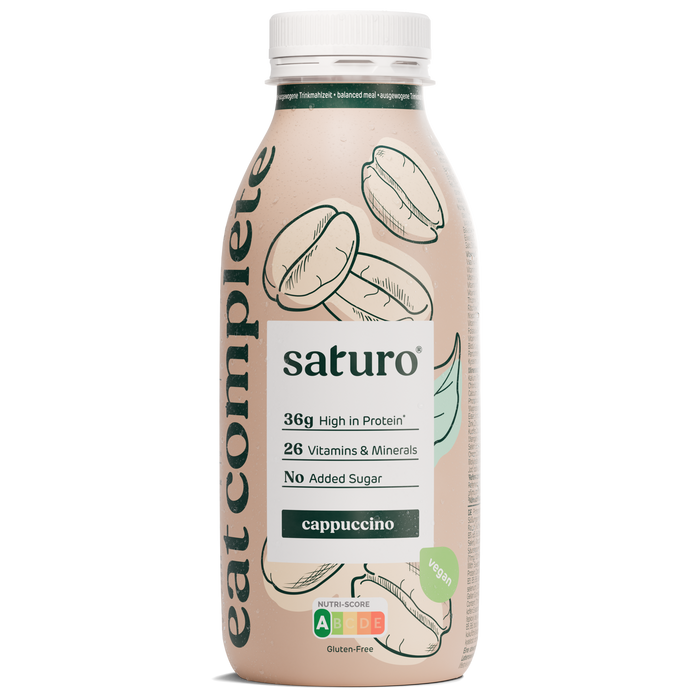
Drinkable meal Cappuccino: breakfast and coffee in one bottle
The Cappuccino flavour contains coffee extract and 44 mg caffeine per 400 ml bottle, about half as much as a cup of filter coffee. Plus 400 kcal, 36 g protein and 26 vitamins and minerals, ready to drink for mornings without a kitchen. All other flavours are caffeine-free.
Spread your caffeine across the day: two cups in the morning, one after lunch, nothing after that. That way most people stay under 300 mg and are caffeine-free nine hours before bed. If you do intermittent fasting, you can drink black coffee during the fasting phase; milk and sugar count. The 44 mg in the Cappuccino bottle counts too, about half a cup.

Caffeine in pregnancy and while breastfeeding
In pregnancy the limit is halved, and the reason isn't just the baby: your body now breaks down caffeine much more slowly, so every cup lasts longer. Here's what 200 mg means in everyday life and what applies while breastfeeding.
How much caffeine in pregnancy?
At most 200 mg a day, spread across the day: two cups of filter coffee at 200 ml each or two espressos at 60 ml each, according to the recommendation from the Netzwerk Gesund ins Leben (2026), which EFSA and the BfR share. High intake was linked in studies to low birth weight (31 per cent higher likelihood), miscarriage and premature birth; caffeine and lifestyle can't be reliably separated there, hence the caution. The half-life rises from 3.4 to an average of 8.3 hours, and in the final weeks the enzyme that breaks caffeine down works at a third of its capacity. Your unborn baby doesn't have it yet.
Coffee while breastfeeding
Here too, 200 mg a day, says the BfR: caffeine passes into breast milk, and babies break it down extremely slowly in the first months, with a half-life of several days instead of four hours. Only at around six months do they reach the speed of adults. Because blood levels peak 30 to 60 minutes after the cup, it's better to have your coffee straight after feeding than shortly before. Decaffeinated coffee is an option in both phases; at 2 to 5 mg per cup it doesn't really matter.
Two cups of filter coffee (90 mg each) make 180 mg, and then your day is full. With a cappuccino (100 mg) in the morning, you have 100 mg left: one large cup of black tea and a piece of chocolate. Four cups of green tea (30 mg each) come to 120 mg. The toolkit in chapter 6 has the “200 mg day” for this.
Is caffeine healthy? Benefits and side effects
Coffee drinkers live slightly longer in studies, and yet caffeine isn't a health remedy; both are true. Here's the honest summary: what observational data shows, what caffeine does to your heart and stomach, how you can tell you've had too much and when it becomes dangerous.
Is caffeine healthy?
Healthy is the wrong word, harmless is the right one. An overview of 201 meta-analyses in the BMJ found the lowest risk of all-cause mortality (17 per cent lower), cardiovascular disease and type 2 diabetes at three to four cups of coffee a day. But that's observational data, mostly of “very low” quality, and decaffeinated coffee shows similar associations, so it's hardly down to the caffeine. The same goes for the heart: in the UK Biobank with 386,000 people, the risk of arrhythmia fell by 3 per cent per cup; in a two-week trial, though, coffee increased extra beats from the ventricle. If your heart races, you're not imagining it.
Caffeine isn't a nutrient but a stimulant you enjoy, and it has real effects. The good news: the safe amount is generous. The bad news: it applies per day, not per cup, and your sleep notices before you do.
Joerg Hauke, Nutrition expert, expert review of this article
The most common side effects
The BfR lists nervousness, excitability, sleeplessness, sweating and a racing heart; on top of that come trembling, needing the loo more often and stomach trouble. From around 500 mg, participants in studies reported tension, anxiety, nausea and tingling. Coffee can trigger heartburn, but caffeine isn't the driver there; other compounds in coffee are. Coffee doesn't dehydrate you at your usual intake: in 50 men, body water and urine volume after three days of coffee didn't differ from water. And iron absorption drops if coffee or tea comes right with a meal.
Caffeine overdose: when it becomes dangerous
With coffee, practically never: 5 to 10 g of caffeine is considered potentially lethal, which would be around ten litres of filter coffee. Concentrated forms are what's dangerous. One to two teaspoons of pure caffeine powder contain exactly that amount, and a knife tip (0.2 g) is already the full single dose; the BfR reports a young woman who died after two teaspoons. According to the specialist literature, symptoms of poisoning begin at around 1 g: racing heart, trembling, vomiting, confusion, seizures. Energy drinks combined with lots of alcohol or intense exercise are a risk of their own for the heart, according to the BfR.
Pure caffeine powder doesn't belong in the kitchen: household spoons measure grams, but your body tolerates tenths of a gram. Pre-workout powders contain between 60 and 600 mg per serving. In official samples, caffeine shots and capsules reached up to 600 mg per single serving and were classed as harmful to health. With energy drinks, the rule is: not with lots of alcohol, and not as a thirst quencher during exercise.
Caffeine withdrawal: symptoms, duration and the way back
If you drink caffeine regularly and suddenly stop, you'll get a headache in most cases; as little as 100 mg a day is enough to count as a habitual dose. Withdrawal is unpleasant but harmless and short-lived. Here's how it unfolds, hour by hour, and what helps.
Caffeine withdrawal: symptoms
Ten symptoms are well documented in studies: headaches, tiredness, less energy, less alertness, drowsiness, low mood, dissatisfaction, trouble concentrating, irritability and a “foggy” head. In experiments, headaches hit one in two people, and 13 per cent were so affected that it disrupted their daily life. Both are officially recognised: the DSM-5 counts caffeine withdrawal as a diagnosis if at least three of five core symptoms appear within 24 hours of stopping. “Caffeine dependence”, however, no longer exists in the current ICD-11.
How caffeine withdrawal unfolds
-
12 to 24 hours
First signs
About half a day to a full day after your last cup, headaches, tiredness and irritability kick in, often in the morning when your usual coffee doesn't show up. If you only pause overnight, you won't feel anything yet; withdrawal typically starts the next morning.
-
20 to 51 hours
Peak
Days one and two are the worst: a headache in about every second person, plus a tired, foggy head. A cup of coffee would end it all within an hour, and that's exactly what keeps many habits alive.
-
Day 3 to 9
Fading
The symptoms get weaker every day. After two to nine days they're gone, and the higher your previous dose, the longer it takes. Because caffeine shortens deep sleep, many people sleep more deeply in this phase; daytime tiredness lasts the longest.
-
Afterwards
Back to zero
Without tolerance, the next cup works again: in non-drinkers, caffeine doesn't raise alertness above normal, while in habitual drinkers it only restores it. If you start again, one cup in the morning gives you the full effect.
How long does caffeine withdrawal last?
Two to nine days, with the low point on days one and two. After that your body is back to zero, and that's the whole point of a break: your tolerance disappears and a cup feels like a cup again. Withdrawal headaches go away with caffeine within an hour, but that only postpones the withdrawal. Gradually or all at once? There's no study comparing the two. Because symptoms rise with the dose, cutting down gradually is plausible: drop the afternoon cup first, then replace your second morning cup with decaf coffee.
Common questions about caffeine
How can you tell you've had too much caffeine?
By a racing heart, shaky hands, inner restlessness, sweating, stomach complaints and poor sleep. Symptoms start within an hour and fade as the caffeine is broken down, usually over the course of the day. If they happen regularly, your total amount or single serving is too high; there's a checklist in chapter 8.
How many hours before bed should you avoid caffeine?
At least six hours, ideally nine: a meta-analysis gives 8.8 hours for a cup of coffee and 13 hours for doses of 200 mg or more. 400 mg taken six hours beforehand still cost an hour of sleep in the sleep lab. The evening clock in chapter 4 works it out for you.
Which has more caffeine, coffee or cola?
Coffee, by a clear margin: a cup of filter coffee (200 ml) has about 90 mg, a can of cola (330 ml) about 35 mg, and cola zero the same. An energy drink, at 80 mg per 250 ml, is almost on a par with coffee, because manufacturers push the maximum of 320 mg per litre.
Does coffee count towards your daily fluid intake?
Yes. If you're used to it, coffee doesn't dehydrate you: in a study with 50 men, body water and urine volume after three days of four cups of coffee were the same as with water. The diuretic effect is weak; coffee counts towards your fluid balance.
How much caffeine is in chocolate?
Dark chocolate with 70 percent cocoa contains about 40 mg per 50 g, a whole bar 80 mg, so almost as much as a cup of coffee. Milk chocolate has 10 mg per 50 g, and a cup of hot chocolate around 10 mg.
How long does a caffeine overdose last?
A racing heart, shaking and restlessness after too much caffeine pass within a few hours: blood levels peak after 30 to 60 minutes and then roughly halve every four hours. If you have chest pain, shortness of breath or feel faint, get medical help immediately.
Which is better: coffee or caffeine tablets?
The active ingredient is the same, the dose isn't: a tablet usually contains 200 mg, the whole dose at once, while a cup of coffee has 90 mg, sipped over several minutes. For everyday life, coffee is enough; tablets are pharmacy-only medicines and not for children or pregnant women.
Is caffeine good for migraines?
As an addition to painkillers, yes: according to the guideline, the fixed combination of aspirin, paracetamol and caffeine is effective for migraine attacks, with 19.6 instead of 9.0 percent pain-free after two hours. Caffeine on its own isn't a migraine remedy, and acute medication should be taken on no more than ten days a month.
Sources · 58 sources anzeigen
- EFSA NDA Panel (2015). Scientific Opinion on the safety of caffeine. EFSA Journal 2015;13(5):4102
- EFSA: Caffeine. Topic page with the key findings of the 2015 opinion (single dose 200 mg, daily amount 400 mg, pregnancy 200 mg, 3 mg/kg for children, content per serving)
- EFSA (2015). EFSA explains risk assessment: Caffeine. Plain-language version (onset of effect 15 to 30 minutes, half-life about 4 hours, range 2 to 8)
- EFSA NDA Panel (2015). Draft Scientific Opinion on the safety of caffeine, consultation draft of 15 January 2015 (pharmacokinetics only: CYP1A2, smoking, oral contraceptives, genetics, newborns)
- Federal Institute for Risk Assessment (BfR) (2026). Coffee, energy drinks or caffeine powder: pick-me-ups with health risks? FAQ of 5 January 2026
- Federal Institute for Risk Assessment (BfR) (2024). Highly concentrated caffeine powder can cause serious poisoning even in small amounts. Press release 46/2024 of 15 October 2024
- Federal Institute for Risk Assessment (BfR) (2026). Energy drinks: BfR updates its assessment of the health risks for children and adolescents from acute and chronic consumption. Opinion 037/2026 of 7 July 2026
- Netzwerk Gesund ins Leben (2026). Caffeine in pregnancy. Recommendations for action, updated July 2026
- Federal Institute for Risk Assessment (BfR). Risiko – the BfR podcast, episode 007: Caffeine kick with risk (theine and caffeine are the same molecule)
- Blanchard J, Sawers SJ (1983). The absolute bioavailability of caffeine in man. European Journal of Clinical Pharmacology 24(1):93–98
- Cappelletti S, Piacentino D, Sani G, Aromatario M (2015). Caffeine: cognitive and physical performance enhancer or psychoactive drug? Current Neuropharmacology 13(1):71–88
- Volkow ND, Wang GJ, Logan J et al. (2015). Caffeine increases striatal dopamine D2/D3 receptor availability in the human brain. Translational Psychiatry 5:e549
- Temple JL, Bernard C, Lipshultz SE et al. (2017). The Safety of Ingested Caffeine: A Comprehensive Review. Frontiers in Psychiatry 8:80
- Knutti R, Rothweiler H, Schlatter C (1981). Effect of pregnancy on the pharmacokinetics of caffeine. European Journal of Clinical Pharmacology 21(2):121–126
- Tracy TS, Venkataramanan R, Glover DD, Caritis SN (2005). Temporal changes in drug metabolism (CYP1A2, CYP2D6 and CYP3A activity) during pregnancy. American Journal of Obstetrics and Gynecology 192(2):633–639
- Culm-Merdek KE, von Moltke LL, Harmatz JS, Greenblatt DJ (2005). Fluvoxamine impairs single-dose caffeine clearance without altering caffeine pharmacodynamics. British Journal of Clinical Pharmacology 60(5):486–493
- Healy DP, Polk RE, Kanawati L, Rock DT, Mooney ML (1989). Interaction between oral ciprofloxacin and caffeine in normal volunteers. Antimicrobial Agents and Chemotherapy 33(4):474–478
- Scott NR, Stambuk D, Chakraborty J, Marks V, Morgan MY (1988). Caffeine clearance and biotransformation in patients with chronic liver disease. Clinical Science 74(4):377–384
- Drake C, Roehrs T, Shambroom J, Roth T (2013). Caffeine effects on sleep taken 0, 3, or 6 hours before going to bed. Journal of Clinical Sleep Medicine 9(11):1195–1200
- Gardiner C, Weakley J, Burke LM et al. (2023). The effect of caffeine on subsequent sleep: A systematic review and meta-analysis. Sleep Medicine Reviews 69:101764
- Addicott MA, Yang LL, Peiffer AM et al. (2009). The effect of daily caffeine use on cerebral blood flow: How much caffeine can we tolerate? Human Brain Mapping 30(10):3102–3114
Has been writing for Saturo since 2019 about nutrition, nutrients and how to get what your body needs in everyday life.
Hat diesen Artikel am 29. Oktober 2026 auf fachliche Richtigkeit geprüft. The content does not replace medical advice.

What to eat before training? Snacks, timing and amounts
Banana or porridge, one hour before or three? Before training, timing and amount matter more than the perfect food.
Weiterlesen · 15 Min

Latest from the guide
New articles, updates and tips straight to your inbox. Easy to understand, expert-checked, no spam.
Danke! Bitte bestätige die Anmeldung in deinem Postfach.