Ways of eatingOne of 10 articles on the topic

Meal prep: guide, weekly plan and recipes

Cook every evening or order in again? Meal prep means cooking on one day for several days, and it's easier than it sounds. How to get started, how long the boxes keep and which dishes are worth it.

Fünf gefüllte Glasboxen mit Reis, Hähnchen, Ofengemüse, Chili und Eiermuffins auf einer Küchenarbeitsplatte, von oben
One prep day, five lunches: rice, roasted veg, chicken and chilli, portioned into glass boxes.

The key points in 30 seconds

days is how long pre-cooked food keeps in the fridge
2–3

Eat reheated dishes within two to three days or freeze them; meals with raw ingredients by the next day at the latest. That's the recommendation of the German Federal Institute for Risk Assessment.

Minutes a day on cooking and kitchen work
41

That's how much time people in Germany spend on average on meals and kitchen work: women 53 minutes, men 29. A prep day bundles part of that.

Kilograms of food per person in the bin
76

Per person per year in German households, including peel and bones. Planning and the right portion sizes are seen as the most important levers against it, and that's exactly what meal prep is.

instead of a recipe collection
Building blocks

For each meal, a base such as rice or pasta, a protein source, plenty of veg and a sauce. Three pre-cooked components make a week without repeats.

01 Basics

What is meal prep?

Meal prep isn't a fitness ritual, it's a way of working: on one day you cook for several days and pack the meals into boxes, portion by portion. The fridge takes care of the rest of the week. What's behind it, what it brings and, honestly, what it doesn't.

What meal prep means

Meal prep is short for meal preparation: cooking or preparing dishes several days in advance, as defined by the German Federal Institute for Risk Assessment (BfR). “Meal prepping” means the same thing. Batch cooking is the variant where you cook large quantities of individual components, such as a pot of rice and a tray of roasted veg, and only combine them when you eat. “Vorkochen” is simply the German word for it. There is no scientific definition; studies mostly use “meal planning”, which means the planning, not the cooking.

Benefits of meal prep

The benefits are practical, not medical: you know what's in your food, you cook once instead of five times and you order in on a whim less often. Research only shows associations here. In a French observational study of around 40,000 adults, people who plan their meals ate a more varied diet that was closer to the recommendations; in a British cohort, people who ate home-cooked food more than five times a week got around 100 g more veg a day. Studies like these don't prove that prepping ahead is the cause. What you do gain for sure is control over portions and ingredients.

Downsides of meal prep

The biggest downside is shelf life: reheated dishes keep for two to three days in the fridge, not five. Then there's fridge space, two to three hours on the prep day, less spontaneity and texture: pasta goes soft, salad wilts, roasted veg loses its bite. According to the BfR, meal prep is less suitable for pregnant women, very elderly people, children under five and people with a weakened immune system, because the risk of germs rises with every day of storage. If you know that, you can plan around it: store for less time, freeze, add raw veg fresh.

Person putting filled glass boxes of pre-cooked food on the bottom shelf of a fridge
It's coldest at the bottom back: that's where the boxes belong, at 7 °C at most, ideally 5 °C.
02 Guide

Meal prep for beginners: how to get started

The most common mistake at the start is doing too much at once: seven days, three meals, five recipes. Better to start with three lunches from one building-block system, in four steps: plan, shop, cook, store. All you need is a plan, two hours and a few boxes.

The building-block principle

Every box has four parts: a base (rice, pasta, potatoes, quinoa; wholegrain for at least every third portion), a protein source (chicken, fish, eggs, tofu, pulses), plenty of veg (one portion is a handful, around 110 g) and a sauce or dressing, which stays separate. Two bases, two protein sources and three kinds of veg give you six different meals without six recipes. The guideline values come from the German Nutrition Society (DGE) recommendations from 2024: five portions of fruit and veg a day, pulses at least once a week, no more than 300 g of meat a week.

What do I need for meal prep?

Less than the box vendors tell you: four to six airtight containers in meal size with the glass-and-fork symbol, a baking tray, a large pot, a frying pan, a fridge thermometer (only half of households have one, according to a BfR survey) and a pen for the date. A Thermomix doesn't speed up anything crucial. More important than gadgets is space: a free shelf at the bottom of the fridge, where it's coldest. And a fixed slot, usually Sunday, because without one the prep day is the first thing to get dropped.

Your prep day in two hours

  1. 0:00 Oven on, rice on

    Oven to 200 °C. Chop the veg and put it on a tray, put the rice for the bowls and the quinoa on. Soak soya granules for the chilli.

  2. 0:20 Hob

    Start the chilli; it simmers on its own for 30 minutes. Fry the chicken through in a pan, sweat veg for the egg muffins.

  3. 0:50 Oven, round two

    Roasted veg out, egg muffins in (20 to 25 minutes). Spread the rice and chicken out flat on trays so they cool quickly.

  4. 1:30 Cool and pack

    Everything into boxes, portion by portion, date on, bottom fridge shelf. One portion of chilli and any leftover bowls go straight into the freezer.

The order matters: the BfR recommends preparing everything that won't be heated later (raw veg, salad, dressing) first, and then the dishes that get cooked. That way no germs travel from the raw chicken to the salad. Don't wash raw meat; pat it dry with kitchen paper.

Start small

Three lunches for Monday to Wednesday from one recipe, dressing separate, boxes labelled. If that works for two weeks, add a second prep session.

03 Understand

What really matters when you batch cook

Three things decide whether meal prep works: the plan, the kitchen and the fridge. Everything else is a matter of taste.

1

Plan

Two or three basic recipes are enough for a week, as long as they can be combined. Write your shopping list from the recipes, not from memory, and check what you already have first. According to the Federal Ministry of Food and Agriculture, shopping planning and sensible portion sizes are the biggest levers against the 76 kg of food each person throws away every year.

2

Cook

According to the BfR, dishes that reach 70 to 100 °C during cooking are better suited to meal prep than raw foods, because the heat kills most germs. Work in parallel: oven, hob and rice cooker at the same time, prepare raw items first, then heated ones. Cook until just firm, because everything gets a bit softer again when reheated.

3

Store

The window between hob and fridge is what counts: get cooked food below 7 °C within a few hours in shallow containers, then store it at 7 °C at most, ideally 5 °C, and eat heated dishes within two to three days or freeze them. When reheating, reach at least 70 °C for two minutes throughout.

04 Week

Meal prep for a week: weekly plan and shopping list

A whole week from one cooking day doesn't work, at least not safely: heated dishes keep in the fridge for two to three days. The plan below solves this with two prep sessions and the freezer. Two or three basic recipes are enough.

Meal prep weekly plan

The plan is built on the three recipes from chapter 6: egg muffins for breakfast, chicken and rice bowl and chilli sin carne, plus a lentil curry and a quinoa salad in a jar from Wednesday. Sunday is the big prep session (around two hours), Wednesday evening the small one (45 minutes). You eat the rice bowl on Monday straight from the fridge and on Tuesday defrosted, and the chilli up to day 3; the remaining bowls (rice in its own box) and one portion of chilli go straight into the freezer on Sunday. Each recipe makes four portions, so if you're cooking for one, freeze the rest.

Weekly plan

Five days from two prep sessions

Monday to Friday with breakfast, lunch and dinner. Heated dishes keep for two to three days in the fridge at most, which is why the second session is on Wednesday.

BreakfastLunchDinner
Sunday, prep 1 (2 hrs)––Make egg muffins, bowl components and chilli; freeze remaining bowls (rice separate) and 1 portion of chilli
MondayEgg muffinsChicken and rice bowlChilli sin carne
TuesdayEgg muffinsChicken and rice bowl from the freezerChilli sin carne
Wednesday, prep 2 (45 min)Egg muffinsChilli sin carne, last fridge portionCook fresh lentil curry, cook quinoa
ThursdayOvernight oats, made the evening beforeQuinoa and chickpea salad in a jarLentil curry
FridayOvernight oatsLentil curryChilli from the freezer

Time limits according to the BfR (heated dishes 2 to 3 days, raw ingredients 1 day); the rice bowl comes from the fridge on Monday only and is defrosted on Tuesday, because the North Rhine-Westphalia consumer advice centre gives 24 hours for cooked rice. Cut the raw veg for the salad on Thursday morning.

How much do I need to buy?

For each meal, plan on a base, a protein source, vegetables and a tablespoon of oil. The DGE gives 60 g of dry rice or pasta as one portion and 120 g as the usual larger one, 120 g of meat or fish, and 110 g of vegetables per portion. Raw and cooked aren't the same: rice becomes around 2.7 times as heavy when cooked, pasta 2.3 times, and chicken loses a quarter; for pulses the DGE uses a factor of 1.8. The calculator takes care of that and tells you how many boxes you need.

Interactive

How much do you need to buy?

Set the number of people, meals per person and portion size. Normal is the DGE portion (60 g of dry rice), Large is the usual double amount. Meat and pulses are alternatives, not both.

People
1
Meals per person
Portion
5Boxes
Calculated for
Portion
  • Rice or pasta, dryRice becomes 2.7 times as heavy, pasta 2.3 times
  • Chicken, fish or meat, rawLoses around a quarter when cooked
  • Instead of meat: lentils, beans, chickpeas, driedMakes one DGE portion ready to eat (DGE factor 1.8)
  • Vegetables, trimmedOne to two handfuls, including around 15% trimming loss
  • OilOne tablespoon per meal

Buy extra vegetables to allow for trimming: with broccoli, carrots and courgettes, 10 to 20 per cent is lost to stalks and peel, with peppers, cabbage and pumpkin 20 to 35 per cent. Tinned pulses are the shortcut: 125 g drained equals one portion, with no soaking or cooking.

When your week is longer than your prep

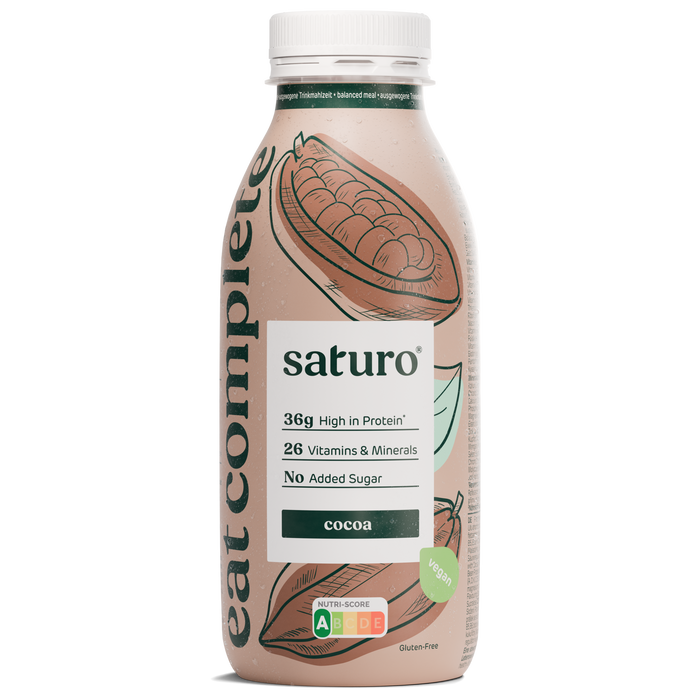
Thursday is the day meal prep usually fails: the boxes from Sunday are empty or too old, and the second prep session didn't happen. Have a plan B that needs no cooking: a portion from the freezer, a salad in a jar from the evening before, or a drinkable meal with 400 kcal and 36 g of protein sitting in your desk drawer. The only thing that matters is that plan B is settled before you're hungry, not after.

Ready-to-Drink 6 x 400 ml
From the Saturo range

Drinkable meal: plan B without cooking

400 kcal, 36 g of protein and 26 vitamins and minerals per bottle, ready to drink. For the day when the boxes are empty or the prep session didn't happen.

26Vitamins & minerals
36 gProtein
400kcal
0 minPreparationready to drink, no cooking
Choose a flavour
CHF 5.15per meal
Drinkable meal · CocoaCHF 5.15 per meal ·
05 Shelf life

How long does meal prep keep?

Online, you'll see five to seven days, and in US sources three to four. For Germany, the BfR figure applies, and it's shorter. Here you'll find the rules, a reference guide for 60 dishes and ingredients, and the answers on rice, freezing and boxes. For unopened supplies, a different reference applies: the prepper list.

How long does meal prep keep in the fridge?

Heated dishes two to three days, meals with raw ingredients one day at most: that's the recommendation of the German Federal Institute for Risk Assessment (BfR), and it applies at 7 °C at most, ideally 5 °C. According to the BfR, there's no blanket shelf life; it depends on how hot the food was cooked, how quickly it was cooled and how cold it was stored. US authorities say three to four days, and the shorter figure is the safer yardstick. Sniffing only helps to a limited extent: salmonella and campylobacter change neither smell nor taste.

Interactive

How long does batch-cooked … keep?

Type in a dish or ingredient, or pick a group. The traffic light shows how long it keeps in the fridge at 7 °C or below; the note tells you whether you can freeze it.

  • Rice, cooked boiled rice, basmati, brown rice, leftover rice 1 day, 2 to 3 at mostSpread out flat, get below 7 °C within a few hours; frozen 6 months
  • Pasta, cooked noodles, spaghetti, penne, wholewheat pasta 2 to 3 daysCook until al dente, cool quickly; frozen 6 months
  • Potatoes, boiled jacket potatoes, boiled potatoes 2 to 3 daysFreezing only works to a limited extent; never freeze them in soup
  • Quinoa, cooked 2 to 3 daysFor salads, let it cool completely first; freezable
  • Couscous, bulgur, millet, cooked 2 to 3 daysGeneral BfR leftovers rule, no specific guidance; freezable
  • Lentils, beans, chickpeas, home-cooked pulses 2 to 3 daysCool before mixing with raw ingredients; freezable
  • Tinned pulses, opened kidney beans, chickpeas, sweetcorn 2 to 3 daysTransfer from the tin to a clean container
  • Roasted veg, steamed veg carrots, broccoli, courgette, pepper 2 to 3 daysCook until al dente; cooked and frozen up to 12 months
  • Raw veg, chopped cucumber, carrot, pepper, veg sticks 1 dayEat raw ingredients by the next day at the latest; don't freeze
  • Leafy salad, washed or dressed salad bowl, bagged salad 1 dayKeep the dressing separate; don't freeze
  • Mushrooms, cooked mushroom stir-fry, mushroom ragout 1 dayCool quickly, reheat only once, 70 °C for 2 minutes
  • Spinach, cooked leaf spinach, creamed spinach 2 days at mostDon't leave it standing warm; reheated spinach is not for infants
  • Soup, stew lentil soup, veg stew, goulash soup 2 to 3 daysFrozen 3 to 6 months; don't freeze potatoes and pasta in it
  • Curry lentil curry, veg curry, chicken curry 2 to 3 daysStore rice separately; frozen 3 to 6 months
  • Chilli con carne, chilli sin carne 2 to 3 daysIdeal for freezing in portions, 3 to 6 months
  • Bolognese, mince sauce, ragù 2 to 3 daysKeep pasta separate; frozen 3 to 6 months
  • Lasagne, pasta bake, veg bake 2 to 3 daysPre-freeze in the dish, then wrap; 2 to 3 months
  • Veg stir-fry with mince or meat mince skillet 2 to 3 daysFrozen 3 to 6 months
  • Rice bowl, rice skillet rice mixed with veg and meat 1 dayThe rice sets the limit: store the components separately
  • Bowl with cooked and raw ingredients quinoa salad, Buddha bowl 1 dayCooked base 2 to 3 days, add raw ingredients on the day you eat it
  • Dishes with cream sauce sliced meat in cream sauce, creamed veg 2 to 3 daysFreezing only works to a limited extent: cream turns watery
  • Jar salad with dressing mason jar salad 1 dayDressing at the bottom, raw veg on top; don't freeze
  • Jar salad without dressing dressing separate 1 dayStays crunchier, but doesn't keep longer: raw ingredients
  • Pasta salad also with mayonnaise 2 to 3 daysCool the cooked ingredients, then add the sauce; don't freeze
  • Potato salad 2 to 3 daysDon't freeze
  • Egg salad 2 to 3 daysWith egg and mayonnaise; don't freeze
  • Chicken salad, poultry salad 2 to 3 daysDon't freeze
  • Tuna salad, fish salad 1 to 2 daysEat fish dishes early in the week; don't freeze
  • Wraps, sandwiches, burritos, filled 1 dayRaw ingredients; fill them in the morning
  • Pizza, leftovers 2 to 3 daysFreezable
  • Chicken, turkey, cooked breast, sliced strips, chicken strips 2 to 3 daysCool flat; frozen 3 months
  • Chicken in sauce curry base, fricassee 2 to 3 daysFrozen 3 months
  • Breaded chicken, nuggets, schnitzel 2 to 3 daysThe coating goes soft; frozen 3 months
  • Mince, cooked meatballs, rissoles, mince skillet 2 to 3 daysCook through; frozen 3 to 6 months
  • Beef, pork, cooked roast, goulash, pulled pork 2 to 3 daysFreeze sliced, with sauce, 3 to 6 months
  • Fish, cooked salmon, pollock, cod, trout 1 to 2 daysGerman sources say 1 to 2 days; best cooked on the day you eat it
  • Prawns, seafood, cooked 1 to 2 daysLike fish dishes: plan them early in the week
  • Eggs, hard-boiled in the shell 1 weekDon't freeze, the egg white turns rubbery
  • Scrambled eggs, omelette 2 to 3 daysChill egg dishes straight away, at 7 °C or below
  • Egg muffins, frittata, quiche baked 2 to 3 daysFreeze individually wrapped, 2 to 3 months
  • Pancakes, crêpes 2 to 3 daysFreeze separated with baking paper, 2 to 3 months
  • Tofu, cooked or fried 2 to 3 daysGeneral leftovers rule; freezing changes the texture
  • Tempeh, cooked 2 to 3 daysGeneral leftovers rule
  • Soya mince, prepared vegan mince alternative 2 to 3 daysFor chilli and bolognese
  • Porridge, cooked 2 to 3 daysWith milk or fresh fruit, the shorter rule applies; freezable
  • Overnight oats, chia pudding Eat the next dayNo official guidance; BfR rule for raw ingredients applied
  • Sweet muffins, cake Not in the fridgeStore at room temperature or freeze
  • Fruit, cut apple, pear, pineapple, fruit salad 1 dayRaw ingredients; whole fruit keeps longer
  • Melon, cut open 1 dayAccording to the BfR a high-risk fruit: chill immediately
  • Frozen berries, raw in overnight oats, smoothie Heat before eatingBfR: heat to about 90 °C; otherwise use fresh berries
  • Apple purée, home-made Up to 3 weeksUS guidance; freezable
  • Vinaigrette, oil and vinegar dressing, home-made 2 to 3 weeksUS guidance; keep separate from the box
  • Yoghurt or quark dressing, home-made Same dayNo reliable guidance; add dips just before eating
  • Mayonnaise, aioli, home-made 3 to 4 daysUS guidance; keep cool
  • Pesto, opened jar 3 daysFreezable
  • Hummus Up to 7 daysUS guidance; airtight
  • Salsa, fresh 4 daysUS guidance; freezable
  • Tomato sauce, home-made 2 to 3 daysFreezable
  • Guacamole 2 to 3 daysFreezable, but the texture suffers
  • Stock, home-made 2 to 3 daysFrozen 4 to 6 months
  • Gravy 1 to 2 daysBring to the boil when reheating

Can you batch-cook for 5 days?

Yes, but not all of it in the fridge. Five working days from one Sunday only works if you freeze the Thursday and Friday portions straight away on Sunday, or add a second prep session on Wednesday. The Verbraucherzentrale NRW recommends batch-cooking for three days at most; the Verbraucherzentrale Niedersachsen advises putting salads and fish dishes on Monday and Tuesday and fully cooked dishes on Wednesday and Thursday, with the rest coming from the freezer.

Freezing meal prep

Freezing extends shelf life, not quality: at minus 18 °C food stays safe, but it loses moisture and flavour over time. The BfR's method: cool it down, portion it, get as little air as possible into the container, and write the date on it. As a guide by food type, the BfR gives poultry 3 months, beef and pork 3 to 6, fish 6, and cooked vegetables up to 12 months; the BZfE gives 3 to 6 months for leftover rice and stews. Defrost in the fridge overnight, never on the worktop. Don't freeze: salad, hard-boiled eggs and cream sauces, as they turn watery.

Shelf life isn't decided on day three, but in the first hour after cooking. If you leave a hot pot of rice on the hob in the evening, the problem is already there before the box ever reaches the fridge. Spread it out flat and cool it quickly, and your pre-cooked food will keep for the two to three days the BfR mentions.

Joerg Hauke, Nutrition expert, expert review of this article

Reheating properly

The same number applies to reheating as to cooking: at least 70 °C for two minutes throughout. Stir halfway through in the microwave, and bring sauces and soups to the boil. What reheating can't do: destroy toxins that bacteria have produced when food has been left standing too long, such as the heat-stable toxin of Bacillus cereus in rice and pasta. That's why cooling matters more than heating. Despite the old myth, mushroom dishes can be reheated, but only after cooling quickly and at most one day later; the same goes for spinach, as long as it wasn't left warm for long.

Rice and pasta: cooling is the key

Bacillus cereus spores survive cooking. If rice sits warm for hours, they germinate and produce a toxin that no amount of reheating will destroy. So spread rice out flat, get it below 7 °C within a few hours and eat it within two to three days; the NRW consumer advice centre even says 24 hours.

Meal prep boxes: glass or plastic?

Either, says the BfR, which names no material as a criterion: airtight, glass-and-fork symbol, thoroughly cleaned, and no bigger than one meal, so leftovers aren't chilled and reheated twice. Only glass, porcelain or plastic labelled for the purpose, such as polypropylene, belongs in the microwave. Melamine resin tableware, often sold as bamboo ware, isn't for hot food or the microwave. Bisphenol A has been banned EU-wide in most food contact materials since January 2025; the transition period for finished products ended in July 2026, and some uses have until 2028. Glass is heavier, plastic scratches, and both work.

06 Recipes

Meal prep recipes and ideas

You don't need 250 recipes, just three that fit your week: one for breakfast, a hot main meal and one for the freezer. The three below have been calculated with the Bundeslebensmittelschlüssel, shelf life included. After that, ideas for different occasions.

Three recipes for your weekly plan

1
Veggie egg muffinsBreakfast · 35 minutes · 4 servings of 3 muffins
  • 357 kcal
  • 27 g protein
  • 2 to 3 days
  • Freezable
Zutaten
  • 10 eggs (size M, approx. 600 g beaten egg)
  • 100 ml milk 3.5%
  • 120 g feta
  • 150 g peppers
  • 150 g courgette
  • 100 g leaf spinach
  • 60 g onion
  • 10 g rapeseed oil, salt, pepper
Zubereitung

Preheat the oven to 180 °C and oil a 12-hole muffin tin. Dice the peppers, courgette and onion, chop the spinach, and fry everything for 4 to 5 minutes until the water has evaporated, then let it cool briefly. Whisk the eggs with the milk, salt and pepper, divide the vegetables and feta between the holes, and pour the egg mixture over the top. Bake for 20 to 25 minutes until set. Cool quickly on a rack and pack in threes.

2
Chicken and rice bowl with roasted vegetablesMain meal · 40 minutes · 4 servings
  • 548 kcal
  • 42 g protein
  • Rice: 1 day
  • Freezable
Zutaten
  • 600 g chicken breast fillet
  • 280 g rice
  • 300 g broccoli
  • 250 g peppers
  • 200 g carrots
  • 30 g rapeseed oil
  • 30 ml lemon juice
  • Salt, paprika, pepper
Zubereitung

Preheat the oven to 200 °C. Cut the broccoli into florets and the peppers and carrots into chunks, mix with half the oil and the spices, and roast for 25 minutes. Cut the chicken into strips and cook through in the remaining oil over a medium heat. Cook the rice according to the packet instructions. Spread the rice, vegetables and chicken out flat to cool, then fill four boxes, with the rice in its own box each time. Add the lemon juice only when you eat. Freeze portions straight away from day 2.

3
Chilli sin carne with soya granulesMain meal, vegan · 45 minutes · 4 servings
  • 585 kcal
  • 29 g protein
  • 2 to 3 days
  • Freezable
Zutaten
  • 480 g kidney beans (tinned, drained)
  • 200 g sweetcorn (tinned, drained)
  • 80 g soya granules
  • 500 g passata
  • 40 g tomato purée
  • 300 g peppers
  • 150 g onion
  • 150 g carrots
  • 10 g garlic
  • 200 g rice on the side
  • 20 g rapeseed oil, paprika, cumin, chilli
Zubereitung

Soak the soya granules in 200 ml hot stock. Sweat the onion and garlic in the oil, then briefly fry the tomato purée with them. Dice the peppers and carrots and simmer with the beans, sweetcorn, granules, passata and spices for 25 to 30 minutes, adding water if needed, then season with salt. Cook the rice separately. Cool the chilli and rice in shallow dishes and portion them separately; freeze one portion of chilli straight away.

Nutritional values per serving from the Bundeslebensmittelschlüssel 4.0 (Max Rubner-Institut 2025), calculated using raw weights; salt and spices not included. Shelf life according to the BfR and consumer advice centres, see chapter 5.

Meal prep breakfast

Breakfast is the easiest way in, because you can prepare it in five minutes the evening before: egg muffins (baked, three days, freezable), overnight oats made with rolled oats, milk or yoghurt and chia seeds that swell overnight, with berries added only in the morning, or quark with nuts. No authority gives a shelf life for overnight oats; make them the evening before and eat them the next day, as the BfR advises for meals with raw ingredients. Heat frozen berries first; according to the BfR, they don't belong in the bowl raw.

Vegetarian and vegan meal prep

Pulses are the foundation: chilli sin carne, lentil curry, chickpea salad and bean stew keep for two to three days and freeze well. The protein gap is real: without additions, lentil curry comes to 24 g and chilli to 19 g of protein per serving, while with 80 g of soya granules it's 29 g. Tofu, tempeh and soya granules lift any vegan box above 25 g; the protein article works out how much protein you need per day.

Three glass boxes from above with egg muffins, a chicken and rice bowl and chilli sin carne
Three recipes, three boxes: egg muffins, chicken and rice bowl and chilli sin carne cover breakfast, lunch and the freezer.

Meal prep without reheating

For the office without a microwave, good options are jar salads (dressing at the bottom, raw veg on top, cooked base in between), wraps, cold pasta or potato salads, hummus with veg sticks, and hard-boiled eggs. The rule: as soon as raw ingredients are in, you have one day. So put the raw veg and dressing in the box in the morning; the cooked base can be made two to three days ahead. Let cooked ingredients cool first, then mix them with the raw ones. A cool bag for the journey is a must, not a nice-to-have.

Dishes to cook ahead and freeze

The best dishes for freezing are the ones that don't suffer when reheated and often get better: chilli, goulash, bolognese, curries, stews, soups, bakes and mince pan dishes. Freeze rice and pasta separately, and don't freeze potatoes and pasta as part of a soup. Keep out of the freezer: salad, raw veg, hard-boiled eggs, cream sauces and ready-mixed bowls with rice.

Good to cook ahead, better fresh

Good to cook ahead
  • Chilli, curry, stew, bolognese: get better as the flavours develop, 2 to 3 days, freezable
  • Oven-roasted veg, still with a bite: 2 to 3 days, up to 12 months if frozen cooked
  • Cooked pulses and quinoa: 2 to 3 days, a base for cold boxes
  • Chicken, mince, roasts in sauce: 2 to 3 days, 3 to 6 months in the freezer
  • Egg muffins, frittata, bakes: 2 to 3 days, freezable individually
Better fresh
  • Dressed salad and chopped raw veg: 1 day, don't freeze
  • Cooked fish and seafood: 1 to 2 days, cook on the day you eat it
  • Mushroom dishes: 1 day, reheat only once
  • Rice in an assembled bowl: 1 day, store the rice separately and cool it quickly
  • Cream sauces and avocado: they go watery or brown, add them fresh

Time limits according to the BfR and consumer advice centres for the fridge at 7 °C or below. Better fresh means: make it on the day you eat it, or in Prep 2 rather than Prep 1.

07 Goals

Meal prep for weight loss and more protein

Meal prep won't make you slim or build muscle. It just takes away the decision about what's on your plate at 1 pm, and that's exactly where most slip-ups happen. Here's what the research says about pre-portioned meals, and how to set up your boxes for a goal.

Meal prep for weight loss

When you're losing weight, the calorie deficit counts, not the box; the calorie calculator shows how big yours should be, and the weight loss article explains the rest. Meal prep helps you stick to it: in a study with 183 participants, people given pre-portioned main meals lost 8.6% in twelve weeks instead of 6.0%. A one-year study found the lead only at the start; after six and twelve months it was gone. Honestly, that means pre-portioning makes the start easier, but the overall balance decides. Bigger containers measurably lead to bigger portions, so use meal-sized boxes.

High-protein meal prep

For more protein you don't need special recipes, just one protein source per box: the bowl with 150 g chicken breast comes to 42 g, three egg muffins with feta to 27 g, and the chilli only reaches 29 g with soya mince. The DGE (German Nutrition Society) gives 0.8 g per kilogram of body weight a day, 1.0 g from age 65; higher values apply if you do strength training, and the protein calculator works them out. Spread your protein across all meals rather than one, which is easier with boxes than with spontaneous eating. What belongs in the box after training is covered in the article Eating after exercise.

Meal prep for work

Three things count for work: the cold chain, a way to reheat, and variety. Take the box from the fridge into a cool bag in the morning and put it straight in the office fridge; if there's no microwave, pick cold options. Against boredom, use the building-block approach: same base, different sauce. If you eat on the go, choose dishes that taste good lukewarm, such as quinoa salad, chilli or egg muffins. For the day without a box: Plan B from chapter 4.

Person eating quinoa salad from a glass box in the office
Lunch at the office without a microwave: quinoa salad from the jar, raw veg added only in the morning.
08 Look it up

Frequently asked questions about meal prep

Is meal prep really healthy?

As healthy as what you cook ahead. Studies link planning and home cooking with more vegetables and a more varied diet, but they don't prove cause and effect. What matters most is food safety: cool quickly, at 7 °C at most, two to three days, heat thoroughly.

What are the downsides of meal prep?

Short shelf life (two to three days in the fridge), fridge space, a fixed cooking slot, less spontaneity and loss of texture with pasta, salad and roasted vegetables. According to the BfR (German Federal Institute for Risk Assessment), it's less suitable for pregnant women, older people, small children and people with weakened immune systems.

What isn't suitable for meal prep?

Anything with raw ingredients for longer than a day: dressed salads, chopped raw veg, sushi. Also cooked fish after one to two days, mushroom dishes after one day, and ready-mixed rice bowls. Don't freeze: salad, hard-boiled eggs, cream sauces.

How far ahead can you meal prep?

For the fridge, two to three days for heated dishes, one day for raw ingredients. For anything beyond that, freeze: in portions, with little air, labelled with the date, and defrost overnight in the fridge.

Which dishes taste better reheated?

Dishes that benefit from time to infuse: chilli, goulash, bolognese, curries, stews, lentil soup, roasted vegetables with spices. What suffers when reheated: pasta, fried fish, salad, chips.

Can you reheat rice?

Yes, if it was cooled quickly after cooking and has been in the fridge for two to three days at most; the Verbraucherzentrale NRW (North Rhine-Westphalia consumer advice centre) says 24 hours. When reheating, heat to at least 70 °C for two minutes. Throw away rice that has stood warm for hours: the toxin from Bacillus cereus survives heat.

Should you reuse meal prep containers?

Yes. The BfR explicitly recommends reusable containers made of glass, stainless steel, porcelain or suitable plastic, airtight and thoroughly cleaned. Only heat plastic if it's labelled for that; melamine resin and bamboo ware are for cold food only.

Meal prep after giving birth: what works?

Dishes that work lukewarm, can be eaten one-handed and can be frozen: stews, curries, bakes, egg muffins, soups. Best to cook before the birth and freeze in portions, then heat thoroughly after defrosting.

Sources · 36 sources anzeigen
  1. German Federal Institute for Risk Assessment (BfR): Cooking in advance for several days: what to bear in mind. FAQ, as of 08.07.2025
  2. BfR: Chilling food correctly at home. FAQ, as of 13.02.2023
  3. BfR: Consumer tips: protection against foodborne illness caused by bacterial toxins. Updated version 2020
  4. BfR: Bacillus cereus bacteria in food can cause gastrointestinal illness. Opinion No. 048/2020 of 30.10.2020
  5. BfR: Foodborne infections at home: spotting sources, avoiding risks. FAQ, as of 22.08.2024
  6. BfR: Nitrate and nitrite in vegetables: a varied diet and good kitchen hygiene. FAQ, as of 12.10.2026
  7. BfR: Colourful, light, sturdy: health risks of tableware and kitchen utensils made of melamine-formaldehyde resin. FAQ, as of 17.07.2026
  8. BfR: Enjoying food sustainably and safely: here's how. Leaflet, 2020
  9. BfR: Bisphenol A (BPA) in everyday products. FAQ, as of 07.09.2026
  10. Regulation (EU) 2024/3190 on the use of bisphenol A in food contact materials, Official Journal L of 31.12.2024
  11. Federal Centre for Nutrition (BZfE): Meal prep for your lunch break: save time and eat well. As of 23.04.2025
  12. BZfE: Popular with white or brown caps (reheating mushroom dishes). Press release of 04.09.2024
  13. BLE/BZfE: Freezing food: recommended storage times. Order no. 0126, 2019
  14. Verbraucherzentrale: Kitchen hygiene: preparing food safely. As of 15.09.2025
  15. Verbraucherzentrale Niedersachsen: Meal prep: cooking in advance and avoiding waste. As of 29.09.2025
  16. Verbraucherzentrale NRW: Family cooking with a plan: shopping planning and meal prep. As of 10.06.2026
  17. Verbraucherzentrale NRW: Using your microwave properly: these are the foods you can reheat. As of 22.12.2025
  18. Verbraucherzentrale NRW: Chilled out: how to freeze food properly. As of 22.12.2025
  19. Verbraucherzentrale/Umweltberatung NRW: Enjoying food with no leftovers: portion planner and preparation losses. School year 2013/14
  20. USDA Food Safety and Inspection Service: Leftovers and Food Safety. As of 31.07.2020
  21. U.S. Food and Drug Administration: Refrigerator & Freezer Storage Chart
  22. German Nutrition Society (DGE): Eating and drinking well: the DGE nutrition circle with reference values, 2024
  23. DGE: Eating and drinking well: the DGE recommendations, March 2024
  24. DGE: Selected questions and answers on the food-based dietary recommendations
  25. DGE: Reference values for nutrient intake: protein. Derivation as of 2017
  26. Max Rubner-Institut: German Nutrient Database (Bundeslebensmittelschlüssel, BLS) 4.0, 2025, CC BY 4.0
  27. Federal Statistical Office: Time spent on meal preparation has barely changed in ten years (Time Use Survey 2022). Press release N 002 of 14/01/2026
  28. Federal Ministry of Agriculture, Food and Regional Identity: Germany, how it eats: the BMLEH Nutrition Report 2025
  29. BMLEH: A closer look at food waste in private households (GfK studies). As of 13/08/2024
  30. Eurostat: Food waste and food waste prevention by NACE Rev. 2 activity (env_wasfw), households in Germany 2023: 76 kg per capita. Data as of 28/09/2026
  31. Ducrot P et al.: Meal planning is associated with food variety, diet quality and body weight status in a large sample of French adults. Int J Behav Nutr Phys Act 2017;14:12
  32. Mills S et al.: Frequency of eating home cooked meals and potential benefits for diet and health: cross-sectional analysis of a population-based cohort study. Int J Behav Nutr Phys Act 2017;14:109
  33. Hasan B et al.: The effect of culinary interventions (cooking classes) on dietary intake and behavioral change: a systematic review and evidence map. BMC Nutrition 2019;5:29
  34. Rock CL et al.: Randomized clinical trial of portion-controlled prepackaged foods to promote weight loss. Obesity 2016;24(6):1230-1237
  35. Rolls BJ et al.: Does the incorporation of portion-control strategies in a behavioral program improve weight loss in a 1-year randomized controlled trial? Int J Obes 2017;41(3):434-442
  36. Hollands GJ et al.: Portion, package or tableware size for changing selection and consumption of food, alcohol and tobacco. Cochrane Database Syst Rev 2015;(9):CD011045
Gregor Aßlaber
Gregor AßlaberAuthor · Editor at Saturo

Has been writing for Saturo since 2019 about nutrition, nutrients and how to get good nutrition in practice in everyday life.

Joerg Hauke
Joerg HaukeFachliche Prüfung · Nutrition expert

Checks claims about food safety, nutritional values and reference values against BfR, DGE and primary studies. This content is not a substitute for medical or dietetic advice. Shelf-life information is a guideline assuming correct refrigeration, not a guarantee in individual cases.