
Potassium deficiency: symptoms, causes and treatment
Muscle weakness, calf cramps, heart flutters? A potassium deficiency rarely comes from your plate. Usually potassium is lost through vomiting, diarrhoea or water tablets. Which symptoms are typical, which blood value counts and what really helps.


Aktualisiert 24 September 2026 · 16 Min. Lesezeit · 19 Quellen

The essentials in 30 seconds
DGE estimated value for everyone aged 15 and over and for pregnant women; 4,400 mg for breastfeeding women. Most people in Germany reach it with a normal mixed diet, and a deficiency almost never comes from what's on your plate.
That's the share of hospital patients with a potassium level that is too low, according to a 2018 review. It's usually caused by vomiting, diarrhoea or medication, and is especially common with water tablets.
Below that, doctors speak of hypokalaemia, and below 2.5 mmol/l it becomes dangerous for the heart. It's measured in the blood. There is no self-test for home.
In more than half of potassium deficiencies that need treatment, magnesium is also low. As long as that's not corrected, the potassium level stays low, no matter how much potassium you add.
Potassium deficiency symptoms: how to spot it
Potassium is the body's electricity. 98% of it sits inside your cells, mainly in the muscles, and only a tiny remainder floats in the blood. This gradient makes nerves fire and muscles contract, including the heart muscle. That's why a potassium deficiency shows up first where the current has to flow: in the legs, the gut and the heart. How severe the symptoms are depends on how far the level drops and how quickly.
First signs: muscle weakness, cramps, tiredness
It almost always starts with the muscles: heavy legs, a calf that cramps at night. Without enough potassium, muscle cells don't pass on the electrical signal cleanly, so they tire faster and cramp more easily. On top of that comes an exhaustion that sleep doesn't fix. The gut is a muscle too and reacts with constipation, which in severe deficiency can go as far as a complete standstill. If the level drops further, weakness turns into paralysis that creeps up from the legs and, in extreme cases, reaches the breathing muscles. That's why a pronounced potassium deficiency is an emergency, not a job for a banana.

Potassium deficiency symptoms in the heart: flutters and rhythm disorders
The heart reacts most sensitively to potassium, because its beat is controlled entirely by electrical signals. A low level makes heart cells more irritable: extra beats that feel like stumbling or skipped beats, palpitations, and a U wave and flattened T wave on the ECG. In severe deficiency, serious rhythm disorders up to ventricular fibrillation are a risk. People with heart failure, people after a heart attack and people taking digitalis are particularly at risk, because a low potassium level strengthens its effect. For them, expert bodies recommend at least 4.0 mmol/l. If you have heart flutters and take water tablets or have just had a stomach bug, get your level measured soon.
Potassium deficiency symptoms in women
The symptoms are the same in women and men. What differs are the causes, and they shift with age. In younger women, laxatives, water tablets taken for weight loss and eating disorders involving vomiting are the main factors. In pregnancy, heavy vomiting in the first months can push the level down. In women over 60, the most common cause is a thiazide for blood pressure, which flushes potassium out through the kidneys. And then there's water retention: a potassium deficiency doesn't cause oedema by itself. But if you take water tablets for swollen legs, you lose potassium, and in Conn's syndrome high blood pressure, potassium deficiency and oedema occur together (chapter 2).
Muscle weakness or heart flutters after vomiting, diarrhoea or while taking water tablets: go to the surgery soon and ask for potassium, magnesium and an ECG. Call 112 if you have signs of paralysis, shortness of breath, a racing heart that won't stop or impaired consciousness. Tell the doctor straight away if you take digitalis, insulin or cortisone, or if you have an eating disorder.
Potassium deficiency symptoms: the mind
Your head runs on the same current as your muscles. A mild deficiency shows up as lack of drive, irritability and poor concentration. If the level drops significantly, apathy and low mood follow, and in older people confusion; the review by Kardalas also lists delirium and psychosis in severe deficiency. Mental symptoms are almost never the only sign, though. They appear alongside muscle weakness, cramps or heart flutters. If you've felt drained for weeks and belong to a risk group, have your potassium and magnesium checked too. A potassium deficiency does not explain depression without these other signs.
Potassium deficiency self-test: can you do it at home?
No. There's no urine strip, no saliva test and no home device that measures your potassium level. The value is determined in the blood serum, at any GP surgery, within a day, and it's covered by statutory health insurance if there's a justified suspicion. You can still assess the situation yourself: the checklist above shows whether several typical signs add up, and the question of losses decides how urgent the test is. Don't take potassium tablets just in case beforehand: they raise the level without clarifying the cause, and with weak kidneys or certain blood pressure medication, a deficiency can quickly turn into a dangerous excess (chapter 5).
Causes of potassium deficiency: where the deficiency comes from
There are three routes into potassium deficiency: too little in, too much out, or a shift from the blood into the cells. In Germany the first is the exception. According to the DEGS1 study, men take in an average of 4,300 mg a day and women 3,900 mg, and the DGE says a deficiency from low intake is rare. Almost always it's losses through the gut or kidneys. How much you need depends on your age.
Vomiting, diarrhoea, laxatives: losses through the gut
Normally the gut excretes only about 5% of your potassium. With diarrhoea that flips: every litre of stool water takes potassium with it, and after days of a stomach bug this becomes a measurable deficiency. Laxatives work the same way, only on a long-term basis. Regularly reaching for bisacodyl or senna is one of the most common hidden causes. With vomiting, there's little potassium in the vomit itself. But stomach acid takes chloride with it, the blood turns alkaline, and the kidneys respond by releasing potassium into the urine. That's why your level can keep dropping after days of vomiting.
Potassium deficiency caused by medication: diuretics, cortisone, insulin
The most common cause in GP surgeries is water tablets: thiazides such as hydrochlorothiazide and loop diuretics such as furosemide flush out potassium along with sodium and water. According to Kardalas, up to 80% of patients on diuretics have a low level. That's why it's checked routinely during this kind of therapy. Cortisone works through the same kidney mechanism as aldosterone and drives potassium out. Insulin and asthma sprays containing beta-2 agonists shift potassium into the cells. And then there's liquorice: glycyrrhizin blocks the enzyme in the kidney that breaks down cortisol. Cortisol then acts like aldosterone, potassium is lost and blood pressure rises.
Alcohol, eating disorders, magnesium deficiency
With alcohol, several factors come together: vomiting, diarrhoea, damaged kidneys and almost always a magnesium deficiency. With eating disorders, it's vomiting, laxatives and water tablets, often combined and kept secret. Rebuilding after a long period of fasting is also risky: in refeeding syndrome, the insulin surge pulls potassium, phosphate and magnesium into the cells, and the blood level crashes. And then there's magnesium: more than half of all potassium deficiencies that need treatment come with a magnesium deficiency. If it's missing in the kidney cells, the potassium channels stay open and potassium runs into the urine, no matter how much you top up. If you can't get your level up, check magnesium first.
Kidneys, hormones, rare causes
- Conn's syndrome: the adrenal gland produces too much aldosterone. Typical signs: high blood pressure that responds poorly to medication, plus low potassium. Often overlooked for years.
- Cushing's syndrome and high-dose cortisone: the same mechanism via cortisol.
- Overactive thyroid: drives potassium into the cells, rarely as far as sudden paralysis.
- Kidney diseases: tubular acidosis, recovery after acute kidney failure, hereditary syndromes such as Bartter and Gitelman.
- Hypokalaemic periodic paralysis: hereditary, with attacks after carb-rich meals or exertion.
- Medicinal earth and clay: bentonite binds potassium in the gut.
How your body keeps potassium in balance
Three stops from your plate to your kidney. Understand them, and you'll see why the blood value says so little about your reserves, why insulin and adrenaline shift it, and why no potassium therapy works without magnesium.
Intake and reserves
Potassium from food is almost completely absorbed in the small intestine, around 100 mmol a day, that's about 4 g. The body holds around 3,500 mmol, 98% of it inside cells, 80% in the muscles alone. Only a tiny fraction floats in the blood, and that's exactly what the lab measures. So the blood value is a window, not a bank balance: it can look normal while your cells are already running low.
Inside and outside
The gap between lots of potassium inside the cell and little outside creates the electrical charge that lets nerves fire and muscles work. A pump in every cell wall keeps it up, driven by insulin and adrenaline. Both push potassium into cells: after a carb-heavy meal, under stress, with asthma inhalers. Because shifting just one percent halves the blood value, the reading can swing without your reserves actually changing.
The kidney decides
95% of potassium leaves the body via the kidneys, 5% via the gut. The hormone aldosterone sets the pace: it makes the kidneys hold onto sodium and excrete potassium. Water tablets, cortisone, liquorice and Conn's syndrome turn this tap up. And magnesium is the bolt on the kidney's potassium channels: without it, they stay open and potassium flows straight into the urine, no matter how much you take in.
Potassium level: how a potassium deficiency is diagnosed
Your potassium level is measured from blood serum and given in millimoles per litre; mEq/l is the same number. The normal range is 3.5 to 5.0 mmol/l, and below that you have hypokalaemia. How urgent it is depends less on the number than on two questions: are there any heart or muscle symptoms? And how quickly did the level fall? A 3.2 after three days of diarrhoea is not the same as a 3.2 that has lasted for years on a water tablet.
The three stages of potassium deficiency
-
1
Mild3.0–3.5 mmol/l
Usually without symptoms, the most common finding. Clarify the cause, measure magnesium alongside, and correct with a potassium-rich diet and tablets if needed. Recheck after one to two weeks.
-
2
Moderate2.5–3.0 mmol/l
Muscle weakness, cramps and constipation are likely, and early changes may show up on an ECG. Treat medically, usually with oral potassium chloride, with close monitoring for those with heart conditions.
-
3
Severe< 2.5 mmol/l
Emergency. Paralysis, breathing difficulties and life-threatening rhythm disturbances are possible. Treatment in hospital with an infusion under ECG monitoring, magnesium first if it's lacking.
Classification based on Kardalas et al. (2018) and the American Academy of Family Physicians (2015). If you have heart symptoms or signs of paralysis, the symptom counts, not the grade. Some labs set their own reference ranges. If so, go by your lab's ranges.
What else the lab checks: magnesium, urine, ECG
A low potassium level is a finding, not a diagnosis. The second thing to look at is magnesium, because without correcting it, no potassium stays in the body. The potassium content in urine shows whether the kidneys are excreting too much or whether the losses are happening through the gut. A blood gas analysis reveals whether the blood is alkaline (vomiting) or acidic (diarrhoea). With high blood pressure plus low potassium, renin and aldosterone are part of the workup, to rule out Conn's syndrome. The ECG shows whether the heart is already feeling the deficiency, and decides whether tablets are enough or you need a drip.

Potassium deficiency test: who should get their level checked
Screening without a reason is pointless, because in healthy people the kidneys keep the level stable. Testing makes sense when a loss situation meets symptoms: muscle weakness or heart palpitations after days of vomiting or diarrhoea, while taking laxatives, or after heavy drinking. It's measured regularly with water tablets, cortisone, digitalis and in heart failure, usually during a blood check that's due anyway. High blood pressure that won't come down despite several medications is a reason in its own right. If you know the result of your last blood test, you're already ahead of most people: around 4.0 is good, and anything below 3.5 should be discussed with your doctor.
Don't take potassium tablets or electrolyte supplements in the days beforehand: they raise the level and mask the cause. Bring a list of your medication, including laxatives and supplements. When your blood is being taken, don't pump your fist. It pushes potassium out of the muscle cells and makes the result falsely high.
Fixing potassium deficiency: what actually helps
Treatment has two parts: stop the cause, refill the stores. If you only refill while the water tablet keeps running or magnesium is missing, you're filling a bottomless barrel. With a mild deficiency, a few days of potassium-rich food is often enough. From a moderate deficiency upwards, there's oral potassium chloride, usually 40 to 100 mmol a day. A severe deficiency with heart symptoms or paralysis is treated in hospital with a drip, slowly and under ECG monitoring. If magnesium is low, it comes first.
What helps quickly with a potassium deficiency?
If a deficiency has been measured, food alone isn't fast enough. A banana provides around 430 mg of potassium, which is 11 mmol; a moderate deficiency means a shortfall of several hundred millimoles. Potassium chloride works quickly because it's high-dose, and your blood level rises within days. A drip works fastest, and that belongs in hospital. What you can do yourself right away: stop the loss. No laxatives, no liquorice, no water tablets without checking with your doctor first, and if you have diarrhoea or vomiting, don't just drink water. Have an electrolyte solution or a broth with potatoes and vegetables.
A low potassium level first needs two things: the cause and the magnesium level. Not a banana, and definitely not potassium tablets on your own initiative. That's the surest way to turn a deficiency into a dangerous excess.
Joerg Hauke, Nutrition expert, medical review of this article
Potassium tablets: when they make sense, when they're dangerous
According to the BfR's proposal, over-the-counter food supplements may contain no more than 500 mg of potassium per daily dose: too little for a genuine deficiency, and of no benefit for healthy people according to the DGE. Prescription potassium products usually provide 40 mmol per effervescent tablet, three times the BfR limit, so they're a matter for your doctor. With reduced kidney function, or while taking ACE inhibitors, sartans, spironolactone or potassium-sparing diuretics, your level can tip over, and a potassium level that's too high is just as dangerous for the heart as one that's too low. If you get cramps but have no measured deficiency, you're better off with magnesium and stretching than with potassium off the shelf.
How long does it take to fix a potassium deficiency?
Your blood levels bounce back quickly, but your body takes longer. After an infection with a mild deficiency, the level is often back above 3.5 within a week. On potassium chloride, the blood level rises within days, while the stores in your cells fill up over weeks. That's why you usually keep taking it even once the lab gives the all-clear. If you're on long-term water tablets (diuretics), the deficiency isn't fixed but managed, and the replacement runs alongside. If you're low on magnesium, magnesium comes first, otherwise your potassium stays low despite the tablets. Muscle weakness, cramps and heart palpitations usually improve in step with your blood level.
Potassium foods: what's high in potassium
Potassium is in almost everything that grows, and in everything that has muscles. The richest sources: dried fruit, nuts, pulses, potatoes, leafy greens and fish. In everyday life, what counts is how much ends up on your plate: according to the German National Consumption Survey, most of our potassium comes from coffee, bread, fruit and dairy, simply because we consume so much of them. The ranking shows values per 100 g, the way food is actually eaten: boiled, cooked or dry.
Potassium per 100 g: top 10 plant-based and animal-based
Values per 100 g boiled or dry, USDA FoodData Central SR Legacy. Dried fruit and nuts come out on top because the water is missing; per portion, the filling staples catch up: 200 g baked potato 1,070 mg, 200 g white beans 1,122 mg, one banana 430 mg, 200 g pasta just 88 mg.
Which drinks are high in potassium?
Mostly the ones pressed from vegetables and fruit: carrot juice has 292 mg per 100 ml, tomato juice 217 mg, orange juice 200 mg, coconut water 165 to 250 mg. A glass of carrot juice (200 ml) gives you almost 600 mg. Milk, kefir and buttermilk provide around 140 mg per 100 ml. Coffee isn't a concentrate at 49 mg, but the quantity adds up to around 200 mg over three cups. If you have diarrhoea, neat juices aren't ideal because of the sugar. A diluted spritzer with a pinch of salt or an electrolyte solution is better.
is what a medium-sized banana provides, around 11% of the daily requirement. A solid potassium source, but a drop in the ocean as treatment for a measured deficiency
comes together from 200 g baked potato, 150 g natural yoghurt, a banana and 30 g almonds: half the daily requirement from four everyday ingredients
Potassium gets in through potatoes, pulses, vegetables and fruit; 200 g of baked potato gives you twelve times as much as 200 g of pasta. Because it's water-soluble: steam, bake, or use the cooking water for soup. It goes out through water tablets, laxatives, liquorice and diarrhoea, and without magnesium your body can't hold on to potassium, no matter how much is on your plate.

Highly processed foods have a potassium problem in both directions: potassium is lost during processing, and salt is added. If you eat a lot of them, you end up low on potassium and high on sodium, and it's exactly this ratio that drives blood pressure.
In a study in China with almost 21,000 participants, potassium salt, where part of the sodium is replaced with potassium, cut the stroke rate by 14%. For healthy people with high blood pressure, it's a simple lever to pull. For people with weak kidneys or on ACE inhibitors, sartans and spironolactone, it's off-limits.
With drinkable meals it's different, because the minerals are part of the recipe: depending on the flavour, one bottle of Saturo gives you 457 to 883 mg of potassium, 23 to 44% of the reference intake of 2,000 mg. Cocoa is in front because cocoa is rich in potassium. It's no substitute for treatment if you have a confirmed deficiency, but it's a plannable contribution on days without potatoes, beans and fruit. If your kidney function is reduced, first clarify how much potassium you're allowed.
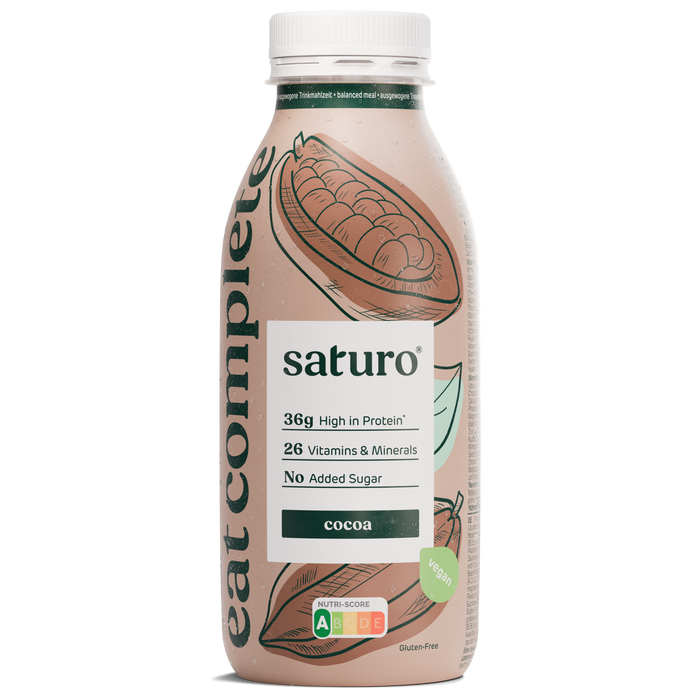
Drinkable meal: a complete meal in a bottle
26 vitamins and minerals, including potassium, magnesium and calcium. Potassium contributes to normal muscle function and normal functioning of the nervous system. Reference value for potassium: 2,000 mg per day (NRV). For days when cooking isn't on the plan.
High blood pressure, sport, over 60, kidneys: who needs to be especially careful
Potassium deficiency and blood pressure
Potassium and sodium are opposites: the more potassium you eat, the more sodium you excrete, and your blood vessels relax. In Aburto's meta-analysis (BMJ), a higher potassium intake lowered the systolic (upper) value by 3.5 mmHg, much more with high blood pressure, and was associated with a 24% lower stroke risk. The WHO recommendation of 3,510 mg and the DGE estimated value of 4,000 mg are based on this. More isn't better: from about 30 mmol extra per day, the effect levels off (dose-response analysis 2020). High blood pressure that won't come down despite three medications, plus low potassium: the classic sign of Conn's syndrome.

Sport and sweating
A calf cramp after a run is almost never a potassium deficiency. Sweat contains a lot of sodium and little potassium, and during exercise potassium even briefly moves out of the muscle cells into the blood. Only days of heavy sweating in the heat or ultra-endurance events add up, and then almost always together with eating too little or stomach and gut problems. If you often get cramps after exercise, check fluids, salt and magnesium first; what belongs on your plate afterwards is covered in the article Eating after exercise. The exception is athletes who dehydrate or use laxatives to make weight: one of the few situations where a young, fit person ends up in A&E with dangerously low potassium.
From 60: medication, gut and heart
With age, the causes pile up: a thiazide for blood pressure, a laxative for constipation, less appetite, plus cortisone or digitalis. Each of them lowers potassium, and together they do it reliably. At the same time, an older heart is more sensitive to rhythm disturbances, and muscle weakness gets put down to normal ageing. The woman around 60 with heart palpitations, heavy legs and constipation who takes a blood pressure medication is the classic case; the solution is a blood test. From 60, the rule is: have your potassium checked with every blood test. Between 4.0 and 4.5 mmol/l is the best range for a heart with existing disease.
Kidneys, diabetes, heart failure: when more potassium becomes dangerous
If your kidneys can no longer excrete too much potassium, the mineral becomes a risk: a level above 5.0 mmol/l, hyperkalaemia, causes the same symptoms as the deficiency. With chronic kidney weakness, your doctor will often set an upper limit for daily intake, and the foods from chapter 6 are rationed instead of recommended. With diabetes, insulin pushes potassium into your cells, and long-term diabetes damages the kidneys. With heart failure, doctors aim for 4.0 to 5.0 mmol/l. For all three groups: no potassium supplement, no salt substitute, no switch to a potassium-rich diet without talking to your doctor first.
Potassium deficiency: the consequences if it persists
A mild deficiency lasting a few weeks usually has no consequences. If it goes on longer or gets severe, four things can happen: heart rhythm disorders, which in a damaged heart can lead to sudden cardiac death. Muscle breakdown: in severe deficiency, muscle cells can break down (rhabdomyolysis), which damages the kidneys. The kidneys themselves: chronic deficiency impairs their ability to concentrate urine, hence thirst and large volumes of urine. And your metabolism: potassium is involved in insulin release, so a deficiency worsens blood sugar control. A blood test in good time can prevent all four.
Common questions about potassium deficiency
What robs the body of potassium?
Mostly losses through the kidneys and gut: water tablets (diuretics), cortisone, laxatives, persistent vomiting and diarrhoea, heavy drinking and larger amounts of liquorice. Add to that a magnesium deficiency, which makes the kidneys excrete potassium, and hormonal disorders such as Conn's syndrome. Coffee, stress and normal sweating are not significant potassium thieves.
What helps quickly with potassium deficiency?
If a deficiency has been measured: potassium chloride taken by mouth, which works within days, or in severe cases an infusion in hospital, both dosed by a doctor. Food alone is too slow: a banana provides 430 mg, while a moderate deficiency means a shortfall of several grams. What helps right away is stopping the loss.
Is tingling a symptom of potassium deficiency?
Yes. Tingling or numbness in your hands and feet is one of the nerve symptoms, usually together with muscle weakness, cramps or heart palpitations. On its own it's non-specific: too high a potassium level, a vitamin B12 deficiency or trapped nerves can also cause tingling. If you're also in a situation where you're losing potassium, get your level checked.
Which drink raises potassium levels?
Carrot juice (292 mg per 100 ml), tomato juice (217 mg), orange juice (200 mg) and coconut water (165 to 250 mg) provide the most, milk 140 mg. A glass of carrot juice delivers almost 600 mg. With a real deficiency, no drink replaces treatment; with diarrhoea, an electrolyte solution is better than pure juice.
What shouldn't you eat with potassium deficiency?
There are no forbidden foods, but three things make it worse: liquorice, because glycyrrhizin makes the kidneys excrete potassium; alcohol in larger amounts; and a diet of ready meals, pasta, rice and white bread, high in sodium and low in potassium. Good choices are potatoes, pulses, vegetables, fruit, nuts, dairy products and fish.
Is sweating a symptom of potassium deficiency, and can stress trigger it?
Sweating isn't a typical symptom and only matters as a cause after days of heavy exertion, because sweat contains little potassium. Stress briefly shifts potassium into your cells via adrenaline, and your blood level recovers by itself. It's different if stress leads to eating disorders, alcohol or laxatives.
Can you take potassium without worry?
No. With healthy kidneys, intake through food is safe according to the DGE, but supplements are not: the BfR suggests a maximum of 500 mg per day for food supplements. Supplements are dangerous with weak kidneys and when taking ACE inhibitors, sartans or spironolactone. Without a measured deficiency, potassium tablets have no benefit.
Can potassium deficiency lead to weight gain or fluid retention?
Not directly. A potassium deficiency neither makes you gain weight nor causes oedema. The link runs through the causes: in Conn's syndrome, aldosterone causes potassium loss, water retention and high blood pressure all at once, and liquorice works in a similar way. If you take water tablets for swollen legs, you lose potassium as a result. If both occur together, get it checked by a doctor.
Sources · 19 sources anzeigen
- German Nutrition Society (DGE): Reference values for nutrient intake, potassium. Estimated values for adequate intake, derived 2016.
- German Nutrition Society (DGE): Selected questions and answers on potassium (intake in Germany according to DEGS1, causes and consequences, sample calculations).
- Strohm D., Ellinger S., Leschik-Bonnet E., Maretzke F., Heseker H., German Nutrition Society (DGE): Revised Reference Values for Potassium Intake. Annals of Nutrition and Metabolism 2017; 71(1–2): 118–124.
- EFSA Panel on Dietetic Products, Nutrition and Allergies (NDA): Dietary reference values for potassium. EFSA Journal 2016; 14(10): 4592.
- World Health Organization (WHO): Guideline: Potassium intake for adults and children. Geneva 2012.
- Federal Institute for Risk Assessment (BfR): Proposed maximum levels for potassium in food including food supplements. Opinion 2021.
- Max Rubner Institute: National Nutrition Survey II, Results Report Part 2. Karlsruhe 2008, chapter 5.7.2 Potassium and table A.47.
- Kardalas E., Paschou S. A., Anagnostis P., Muscogiuri G., Siasos G., Vryonidou A.: Hypokalemia: a clinical update. Endocrine Connections 2018; 7(4): R135–R146.
- Gennari F. J.: Hypokalemia. New England Journal of Medicine 1998; 339(7): 451–458.
- Unwin R. J., Luft F. C., Shirley D. G.: Pathophysiology and management of hypokalemia: a clinical perspective. Nature Reviews Nephrology 2011; 7(2): 75–84.
- Viera A. J., Wouk N.: Potassium Disorders: Hypokalemia and Hyperkalemia. American Family Physician 2015; 92(6): 487–495.
- Cohn J. N., Kowey P. R., Whelton P. K., Prisant L. M.: New Guidelines for Potassium Replacement in Clinical Practice. Archives of Internal Medicine 2000; 160(16): 2429–2436.
- Huang C.-L., Kuo E.: Mechanism of Hypokalemia in Magnesium Deficiency. Journal of the American Society of Nephrology 2007; 18(10): 2649–2652.
- Aburto N. J., Hanson S., Gutierrez H., Hooper L., Elliott P., Cappuccio F. P.: Effect of increased potassium intake on cardiovascular risk factors and disease: systematic review and meta-analyses. BMJ 2013; 346: f1378.
- Filippini T., Naska A., Kasdagli M.-I. et al.: Potassium Intake and Blood Pressure: A Dose-Response Meta-Analysis of Randomized Controlled Trials. Journal of the American Heart Association 2020; 9(12): e015719.
- Neal B., Wu Y., Feng X. et al.: Effect of Salt Substitution on Cardiovascular Events and Death (SSaSS). New England Journal of Medicine 2021; 385(12): 1067–1077.
- Scientific Committee on Food (SCF) of the European Commission: Opinion on glycyrrhizinic acid and its ammonium salt. 10 April 2003.
- National Institute for Health and Care Excellence (NICE): Nutrition support for adults. Clinical guideline CG32 (refeeding syndrome), last updated 2017.
- U.S. Department of Agriculture, Agricultural Research Service: FoodData Central, SR Legacy Release (2018). Potassium content per 100 g.
Writing for Saturo since 2019 about nutrition, nutrients and how good nourishment actually works in everyday life.
Hat diesen Artikel am 11. September 2026 auf fachliche Richtigkeit geprüft. This content doesn't replace medical advice.

Vitamin B12 deficiency: symptoms, causes and treatment
Tingling, forgetfulness, constantly tired: why a B12 deficiency hits the nerves before the blood, which level matters and when tablets are enough.
Weiterlesen · 16 Min

New from the guide
New articles, updates and tips straight to your inbox. Clear, expert-checked, no spam.
Danke! Bitte bestätige die Anmeldung in deinem Postfach.