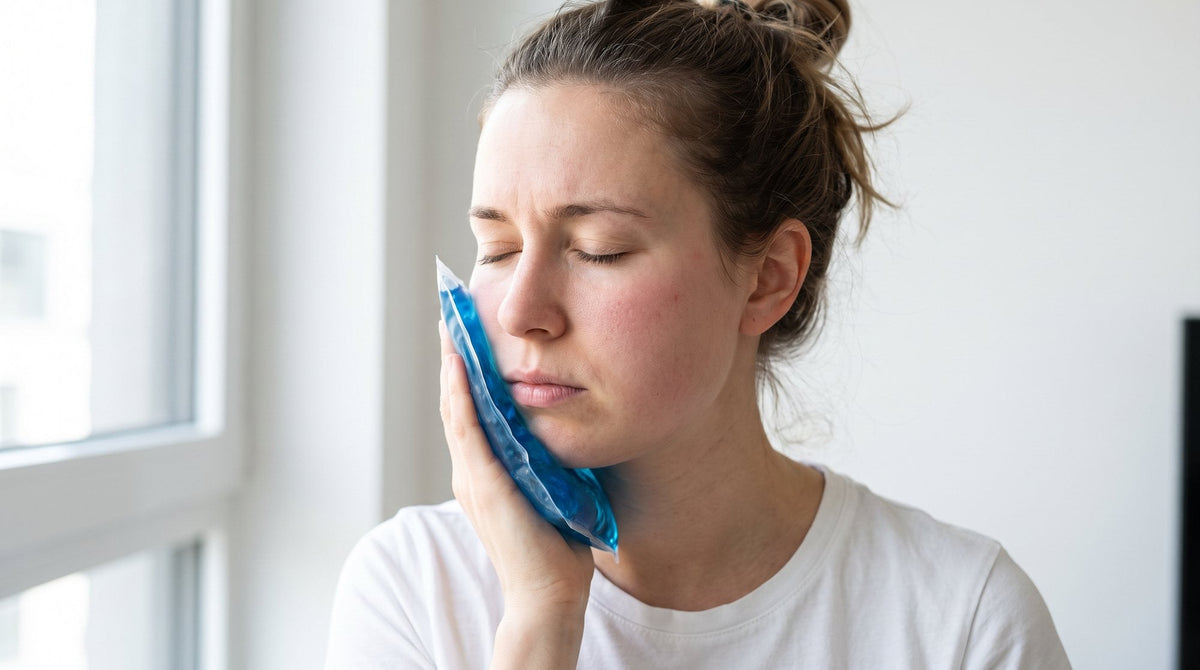
Your mouth won't open, or won't close after a yawn? Jaw clamp and jaw lock are two different things with different first aid. Here's how to tell them apart, what you can do right away and how to eat.
Gregor Aßlaber, Editor, Saturo
· ✓Fachlich geprüft von Joerg Hauke, Nutrition expert
Aktualisiert 30 September 2026 · 15 Min. Lesezeit · 62 Quellen
Jaw clamp: when your mouth only opens a crack, what you eat over the next few days helps decide how quickly you're back on your feet.
The key points in 30 seconds
Normal mouth opening
47mm
This is how wide the mouth opens on average in healthy adults, measured between the cutting edges of the teeth; 98% fall between 34 and 60 millimetres. At 35 millimetres or less, doctors speak of a jaw clamp.
Does the jaw lock happen again?
20%
In about one in five people whose jaw joint has been dislocated once, it happens again, according to the oral surgeons' guideline. So after it's been put back: don't open wide for several weeks, and put your fist under your chin when you yawn.
After wisdom tooth surgery
12mm
That's how much less your mouth opens on the first day after the operation compared with before, according to a Graz study of 100 procedures; by day 7, about half of that is back.
What counts when you eat
Soft & small
Anything that stays on the spoon and slides down without biting: cream soup, skyr, mash with scrambled egg, a drinkable meal. Every portion should contain protein. What fits through the gap is shown in the eating traffic light in chapter 5.
01 Recognise
Lockjaw or locked-open jaw: what's the difference?
In everyday speech both are called “jaw lock”, but medically they are two different things with different first aid. With a jaw clamp (trismus), your mouth won't open, or barely opens, because chewing muscles are cramped, tissue is swollen or the cartilage disc is blocking. With a jaw lock (dislocation), the joint head has jumped in front of the joint bump while yawning or biting, and your mouth won't close. The clamp usually goes away by itself; the lock belongs in a doctor's hands.
At a glance
Jaw clamp or jaw lock?
Two conditions, one jaw joint: how to tell them apart and what to do first.
Yawning, laughing, biting into food, vomiting, long dental treatment
How it feels
Stiff, tight, often with swelling; opening pulls or hurts
Lower jaw sticks out or sits crooked, talking and swallowing are hard, dent in front of the ear
How long
Days to about two weeks, depending on the cause
Until someone puts it back in place; after three to four weeks usually only surgery helps
First aid
Rest, no force, cool after surgery, otherwise warmth, gentle stretching
Don't put it back yourself, keep your mouth still, go to a dental practice or A&E straight away
Where to go
Dentist or oral surgeon; today if you have a fever and swelling
Dentist, oral surgeon, ENT or A&E, the same day
Eating
Spoonable food, small portions, lukewarm, nothing you have to bite into
Soft and small for weeks after it's put back, don't open your mouth wide
Based on the S3 guideline on jaw joint dislocation (AWMF 007/063), the overview by Prechel and colleagues in Deutsches Ärzteblatt 2018 and the MSD Manual. Jaw clamp means “mouth won't open”, jaw lock means “mouth won't close”.
What is lockjaw: trismus and the 35-millimetre limit
Doctors speak of lockjaw or trismus when the mouth opens 35 millimetres or less; the limit comes from a Dutch study of head and neck patients. On average, a normal opening is 47 millimetres, and 98% of 700 healthy adults measured between 34 and 60. In the Pomerania study, 9% of adults stayed under 40 millimetres, mostly without noticing. For a self-check, the rough test used by British clinics is enough: put three fingers stacked on their edge between your front teeth. If they fit, your opening is normal; if only two or one fit, it's restricted.
Interactive
How wide does your mouth open?
Tap how many fingers fit on their edge between your front teeth, or enter the value you measured.
Severely restrictedLockjawBorderlineNormal
03060 mm
Tap what fits. The value is the opening between the cutting edges of your upper and lower teeth; finger widths are approximations (one finger is roughly 18, two roughly 30, three roughly 45 millimetres).
Severely restricted. About one finger fits. After dental surgery or an injection, this is common in the first few days: rest, cool it, then use warmth and gentle stretching (chapter 4). If you have a fever, growing swelling, trouble swallowing, or no obvious trigger, see a dentist or doctor today. Eating: everything off a spoon, the green items on the food traffic light.
Lockjaw. Two fingers fit, not three: the 35-millimetre limit at which doctors speak of trismus. With warmth and the exercises from chapter 4, this usually improves within a week after surgery or tension. Eating: small, soft or pureed, the yellow and green items.
Borderline. Just under 40 millimetres, like 9% of adults in the Pomerania study. If it's new, clicking or stiff in the morning: tension, teeth grinding or a displaced cartilage disc are the usual reasons (chapter 7). Eating is almost normal; only biting into things and tough food are a strain.
Normal. Three fingers fit, and your opening is within the 34 to 60 millimetres measured in 98% of healthy people. If your jaw still sticks, clicks or drifts, head to chapter 7.
Not a diagnostic tool. Normal values after Cox and Walker (1997), trismus limit of 35 mm after Dijkstra et al. (2006), population values from the Study of Health in Pomerania (Gesch 2004). The finger test is a rough self-check without scientific validation; your dentist or doctor will clarify the cause and treatment.
Lockjaw symptoms: how to tell
Your mouth doesn't open as far as usual, opening pulls or hurts, and your cheek feels tight or swollen. The accompanying signs give away the cause: after wisdom tooth surgery, lockjaw is part of the normal swelling, a “normal condition that can last a few days”. After an injection in the lower jaw, it starts the next day, without fever, with sore-muscle pain behind the molars. With an infection, fever and growing swelling come on top. With tension or teeth grinding, it's worst in the morning, and your jaw clicks. Lockjaw with no trigger needs to be checked out.
The finger test: if three fingers fit on their edge between your front teeth, your opening is normal. If only two or one fit, your jaw is stuck.
Dislocated jaw: how to tell
A locked-open jaw happens mid-yawn, mid-laugh, biting into a burger or at the end of a long dental treatment: a jolt, and your mouth stays open. The guideline names a lower jaw that is “fixed in an open position” as the key finding. Your teeth don't meet, your chin sticks out or sits crooked, talking and swallowing are hard, you drool, and you can feel a dent in front of your ear because the joint socket is empty. Waiting doesn't help: the muscles tighten more and more over time. What to do is in chapter 4.
02 Causes
Causes of lockjaw and a stuck-open jaw: why your mouth won't open or close
Lockjaw has four groups of causes. Muscle: clenching and grinding (bruxism), stress, CMD. Treatment: swelling after wisdom tooth surgery or a bruise after the anaesthetic injection. Infection: wisdom tooth, abscess, tonsil abscess. Joint: a cartilage disc that stays stuck at the front. A locked-open jaw almost always has the same trigger: opening too wide when yawning, laughing, biting, vomiting or during a long dental treatment. People with hypermobile joints are more susceptible, and it mostly affects 20- to 40-year-olds.
Lockjaw after wisdom tooth surgery: how long does it last?
Lockjaw after surgery is normal, strongest on days 1 to 3 and mostly gone after about a week. In Graz, 50 patients lost an average of 12 millimetres of mouth opening on the first day; by day 7 they had got almost 6 of it back. In a Turkish study, the opening was 22 millimetres on day 3 and 29 on day 7. The cause is the swelling next to the chewing muscles. If your opening is still just as poor after a week, or gets worse again after day 3, get it checked.
Progress
Mouth opening after wisdom tooth surgery: the typical progress
Distance between the cutting edges in millimetres, combined from three studies with measurements up to day 7; around 40 millimetres counts as normal.
Surgery: 40 mm Before surgery: normal opening, on average between 34 and 47 millimetres; three fingers fit.
Day 1: 28 mm Low point of the first few days: 12 millimetres less than before in the Graz study. Cool it, eat soft food, don't stretch.
Day 3: 26 mm Swelling is at its worst and opening is often at its smallest (22 millimetres in the Turkish study). From now on, use warmth and gentle opening if the wound is calm.
Day 7: 34 mm About half of the loss is back (29 to 37 millimetres in the studies). Two fingers fit again and eating gets easier.
Day 14: 39 mm Expected value: close to your starting point. If your opening is still just as limited after a week, get it checked.
Typical progress, not a single study: days 1 and 7 after Kirnbauer et al. 2022 (Graz, 100 procedures, minus 12.2 millimetres, plus 5.5 by day 7), days 3 and 7 after Ulu 2025 (22.4 and 29.5 millimetres), days 2 and 7 after Jaiswal 2025 (26.1 and 36.6). Baseline assumed to be 40 millimetres; day 14 is an expected value based on the professional societies (“a few days”), not a measurement. Surgery on both sides, secondary bleeding or wound infection prolong the recovery.
Lockjaw after a numbing injection: the needle in the chewing muscle
The injection for the lower back teeth goes in right next to the medial pterygoid muscle, which closes your mouth. If the needle hits the muscle or a blood vessel, the muscle cramps or a bruise forms, and the next day your mouth won't open properly. There's no fever, just a sore, achy feeling behind your teeth. This is rare, but it's documented: in a case report in the Zahnärztliche Mitteilungen, a patient could only open 20 millimetres, then 40 the next day after warmth, stretching and painkillers; bruises go down within 10 to 15 days. If it hasn't improved after a week, go to the dental practice.
Lockjaw caused by inflammation: wisdom tooth, abscess, tonsils
Inflammation makes lockjaw hot: fever, throbbing pain, growing swelling. The most common trigger is a partially erupted wisdom tooth; the guideline puts pathological changes in wisdom teeth left in place at 20 to over 60%. An abscess at the tooth root can spread into the muscle compartments and needs to be opened the same day. With a peritonsillar abscess at the palatine tonsil, 41% of children in a US analysis had lockjaw, compared with 5% for other throat diagnoses. Lockjaw with fever or trouble swallowing means seeing a dentist or ENT doctor, or going to A&E; there's more in the article on tonsillitis.
Jaw tension from stress: bruxism, tight muscles, CMD
If you wake up with a stiff jaw and clench your teeth when you're stressed, you most likely have overworked chewing muscles, not a locked jaw or an inflammation. Bruxism is common: according to the guideline, around 13% of adults grind their teeth in their sleep and 22 to 31% clench during the day. Shortened, tender chewing muscles then hold your mouth narrower than it needs to be. Things that make it worse: smoking (1.6 to 2.9 times the risk), heavy drinking (1.9 times), more than eight cups of coffee (1.4 times), reflux, sleep apnoea, stress. CMD (craniomandibular dysfunction) is the umbrella term for pain and functional problems in the chewing muscles and jaw joint.
How long does lockjaw last, and does it go away on its own?
Muscular lockjaw almost always goes away by itself: within days to two weeks after an injection, mostly within about a week after wisdom tooth surgery, and with tension as soon as the cause is gone. Inflammatory lockjaw only goes once the inflammation is treated, joint-related lockjaw often won't go without physiotherapy or a splint, and lockjaw after radiotherapy may be permanent (chapter 7). A jaw stuck open never goes back by itself: the muscles hold the joint head in front of the bony ridge, and after four weeks it counts as chronic, when putting it back usually no longer works.
03 Understand
What happens in the jaw joint: joint, muscle, blockage
Three stops explain why the jaw joint slips so easily, why the muscles then hold it in place, and why the clamp usually goes away by itself but the lock never does.
1
The joint glides, it doesn't just rotate
The jaw joint is the most mobile joint in the body: when you open your mouth, the joint head first rotates in its socket and then glides forward with the cartilage disc onto the joint bump. In a wide yawn, it sits right at the front edge. Opening three fingers wide needs both movements; if one gets stuck, your mouth gets stuck.
2
The lock: the head jumps over the edge
If the joint head slips past the bump, the closing muscles don't pull it back but wedge it in place in front of it; the guideline calls this a fixed dislocation. The longer it stays there, the harder the muscles tense, and the harder it is to put back. So the rule is: have it put back in place straight away, and never push it yourself.
3
The clamp: protection that stays too long
Swelling, bruising or inflammation next to the chewing muscles triggers a protective reflex: the muscle shortens and keeps your mouth shut so nothing hurts. That makes sense for days, not for weeks. Warmth, gentle stretching and chewing soft food tell the muscle it can let go; force tells it the opposite.
04 What to do
Lockjaw: what to do. First aid when your mouth won't open or close
The first question isn't “which exercise”, but “open or closed”. If your mouth won't close any more, it's a stuck-open jaw: don't force anything, get it put back. If it won't open, the cause decides whether warmth and stretching are enough or whether you need to go to the practice today; the warning signs are listed below.
Releasing a stuck-open jaw: why you shouldn't put it back yourself
There are guides online for putting your jaw back yourself. The guideline describes the same manoeuvre, but with a bite block, double gloves and a helper holding the head, and it lists what can go wrong: bite injuries to the thumbs, a fractured joint head, or a fracture shifting after a fall or a blow. Every failed attempt makes the muscles tense up harder. A fresh lock can usually be put back in seconds at the practice, without anaesthetic.
Dislocated jaw: what to do straight away
Don't try to pop it back in yourself, don't bite down, don't push against it. Keep your mouth relaxed, dab away any saliva and don't eat anything. Get to a dental practice, oral surgeon, ENT or A&E today. After a fall or a blow, always go to hospital, because a fracture has to be ruled out.
Dislocated jaw: what to do and what the practice does
A short examination (with an X-ray after an injury), then the Hippocratic manoeuvre: the doctor places their thumbs next to the lower molars and their fingers under the lower jaw, then presses first down, then back, and the joint head slides back into place. According to a Chinese study, it's quicker and less painful when you're lying down. If that doesn't work, muscle relaxants are added, and rarely a short general anaesthetic. After three to four weeks, surgery is usually the only option left. Afterwards: a head-and-chin bandage for two to three days, soft food, and no opening wide for weeks (chapter 5).
Easing a locked jaw: rest, warmth, gentle stretching
For a locked jaw after surgery, an injection or muscle tension, follow a three-step plan. First, rest: no force, no prying it open; every jolt of pain makes the muscle tighten more. Then cold or warmth, depending on the phase: in the first two days after surgery, Universitätsmedizin Mainz and DGZMK recommend damp, cold compresses; heat and saunas stay off limits for seven days after surgery. For a muscular lockjaw without a wound, warmth is right from the start: 15 to 20 minutes, two to three times a day. Then gentle stretching: after surgery from day 3, and never beyond the pain threshold.
Warmth, then stretching: thumb on top, index finger below, gently apart, hold for five seconds. It can pull, but it shouldn't hurt.
Ibuprofen helps with pain and swelling. You can buy it over the counter up to 1,200 milligrams in 24 hours, and shouldn't take it for more than four days without medical advice. A Cochrane review found insufficient evidence for painkillers in jaw joint problems: they ease the pain, but they don't release anything. Muscle relaxants are prescription only.
Warning signs: get seen today
Fever; swelling on the cheek or neck that keeps growing hour by hour; difficulty swallowing; numbness that stays after the anaesthetic has worn off; bleeding again despite 30 minutes of pressure; no improvement after a week, or getting worse again from day 3; a locked jaw for over two weeks with no trigger. If any of these apply, go to a dental practice, oral surgeon or ENT today. If you're struggling to breathe, call 112.
Lockjaw exercises: four cards for at home
The exercises come from instructions that clinics give their patients: Klinik Birshof, Reha Bad Hamm, two British university hospitals and the patient guideline on oral cancer. They all follow the same rules: slowly, without pain, without clicking, and stop as soon as it's more than a gentle pull. A review of 48 studies found small to medium effects for exercises in jaw joint problems, best combined with manual therapy.
Exercises
Four exercises for lockjaw
Slowly, without pain, without clicking. After surgery, start with exercise 1 from day 3, and only use your fingers and warmth once the wound is calm.
1
Active mouth openingfrom day 3 · 1 minute
10 reps
hold for 5 seconds
up to 10 times a day
Sit upright with the tip of your tongue resting loosely behind your upper front teeth.
Open your mouth as far as it goes without pain, straight down, without your chin drifting to the side.
Hold for five seconds, close slowly, relax briefly.
Repeat ten times; then slowly slide your lower jaw to the left and right five times, five seconds each.
Practise in front of a mirror: if your chin drifts to the side, open less wide. It can pull, but it shouldn't hurt.
2
Finger stretchonce the wound is calm · 2 minutes
3 to 5 stretches
hold for 5 to 30 seconds
3 to 5 times a day
Wash your hands. If you don't have a surgical wound, put warmth on your cheek for 15 minutes first.
Place your thumb on the edge of your upper front teeth and your index finger on the lower ones, crossed like scissors.
Push gently apart until you clearly feel a pull, but no pain. Hold for five seconds, building up to 30 seconds over time.
Let go, relax your jaw, and repeat three to five times.
Stop rule: pain, clicking or trembling means too much. Never use spoons, bottles or pieces of wood as levers.
3
Chewing muscle massageany time · 3 minutes per side
circular motion, gentle pressure
30 seconds to 3 minutes
2 to 3 times a day
Clench your teeth briefly and touch your cheek: the muscle that tightens is the masseter. Then relax.
With your index and middle finger, stroke over the muscle in circles from the cheekbone downwards, with a light pull, without digging in.
Do the same movement at your temple, where you feel movement when you bite down (temporalis muscle).
Hold tender spots with steady pressure for two to three minutes, until they ease off.
Warmth beforehand or a warm shower makes the massage more effective. After surgery, don't massage over the wound.
4
Jaw relaxation in everyday lifeall day · 10 seconds
Lips together, teeth apart
Tongue on the roof of your mouth
at every reminder point
Close your lips and leave a small gap between your teeth: they only touch when you chew and swallow.
Rest the tip of your tongue on the roof of your mouth, behind your upper front teeth, without pressure.
Breathe out, let your lower jaw go heavy, and drop your shoulders.
Check in five times a day: on your phone, in the car, at your screen. A dot sticker on your monitor helps you remember.
The bruxism guideline recommends exactly this kind of self-observation to counter daytime clenching; stickers as reminders are explicitly mentioned there.
Based on the exercise sheet from Physiotherapie Klinik Birshof (Hirslanden), the CMD exercise sheet from Reha Bad Hamm, the stretching programmes from Cambridge University Hospitals and Worcestershire Acute Hospitals (NHS), the patient guideline on oral cancer and the S3 guideline on bruxism. If your jaw is stuck open, do none of these exercises; after it's been put back, only do what your practice clears.
05 Eating
Eating with a locked or tight jaw: what fits through the gap
Whether your mouth opens two fingers wide or just one, the question is the same: what fits through the gap without you having to open wide, bite off a piece or chew hard? Three rules from the professional societies: soft or liquid (the DGFDT advises steering clear of bread rolls and steaks when your chewing muscles hurt), lukewarm rather than hot (the oral surgeons: "soft, not-too-hot food") and small (the MSD Manual: after a dislocation, cut food into small pieces).
What to eat with a locked jaw: the spoon rule
Clinics sort food by the IDDSI texture levels. Levels 3 and 4 (drinkable to puréed) need no biting and no chewing: cream soup, skyr, porridge, mashed potato, scrambled eggs, a drinkable meal. Level 5 needs minimal chewing and no biting, with pieces of 4 millimetres at most: small pasta in sauce, mashed fish, soft mince. Level 6 you chew properly; according to IDDSI, dry bread only comes back once everything else works. The food traffic light sorts by this: you can spoon green straight away, even with a one-finger opening. Amber works small, soft or puréed from two fingers. Red waits for three fingers.
Look it up
Will it fit through a small gap? The food traffic light
Type in a food or filter by group. Green you can spoon or drink straight away, amber works small, soft or puréed from a two-finger mouth opening, and red waits for three fingers and the all-clear.
Porridge oatmeal, overnight oatsRight awayCook fine flakes until soft and eat lukewarm with a spoon; made with milk instead of water, it has about twice as much protein.
Semolina porridge rice pudding, puddingRight awayStir until smooth; more nourishing when cooked with milk; rice pudding only if the grains are completely soft.
Plain yoghurt drinking yoghurt, kefirRight awayWithout fruit pieces or seeds; 150 g gives you 5 g protein, Greek yoghurt twice that.
Skyr Greek yoghurt, quarkRight awaySmooth and cool, with around 10 g protein per 100 g, it's the easiest protein source for spoon-only days.
Scrambled eggs softly setRight awayCreamy and lukewarm, not fried dry; two eggs give you 12 g protein. After dental surgery, from day 3 to 4.
Toast white bread, milk rollsFrom 2 fingersCrusts off, soak in milk, cocoa or soup; according to IDDSI, dry bread and toast only count as normal food.
Pancakes crêpes, KaiserschmarrnFrom 2 fingersSoft, cut into small pieces, with apple sauce; no crispy edges.
Rusks crispbread, crackersFrom 3 fingersHard and crumbly; the crumbs end up in the wound area. Soaked in milk, they work earlier.
Muesli granola, grain breadFrom 3 fingersHard grains and nuts need chewing power; as finely blended porridge, right away.
Croissant puff pastry, pretzelFrom 3 fingersFlaky, crumbly and made for biting into, which is exactly the movement your jaw shouldn't make right now.
Cream soup potato, pumpkin, carrot, peaRight awayBlended smooth and lukewarm, with cream cheese or cream for energy; after dental surgery, pass it through a sieve.
Broth chicken broth, vegetable brothRight awaySlips down easily and gives you salt and fluid, but almost no energy: 240 ml has 14 kcal. Only as a supplement.
Mashed potato mashed sweet potato, polentaRight awaySmooth with no lumps, made with milk and butter; add egg, cheese or quark and it becomes a proper meal.
Lentil soup blended pulses, hummusRight awayBlended and lukewarm, it has 9 g protein per bowl; in the wound healing phase, strain it so no skins are left.
Noodles pasta, gnocchiFrom 2 fingersCook until very soft, cut small, use plenty of sauce; twirling spaghetti won't work, but small shapes do.
Rice risottoFrom 2 fingersOnly soft and in sauce, not grainy; as risotto or rice pudding, earlier.
Fish salmon, codFrom 2 fingersSteamed, it flakes apart under a fork, with 22 g protein per 100 g; no bones, no breadcrumbs; blended into a sauce, right away.
Mince bolognese, meatballFrom 2 fingersFine and braised soft in sauce, pieces 4 mm at most; the meatball can wait.
Tofu silken tofu, firm tofuSilken tofu right awaySilken tofu on its own or in a smoothie; firm tofu mashed or blended from two fingers.
Chicken breast schnitzel, whole cuts of meatFrom 3 fingersStringy, needs chewing and jaw strength; finely blended into a sauce or as poultry cream, earlier.
Steak tough meat, sausage with skinFrom 3 fingersLong, hard chewing; the professional society specifically names steak as something your jaw doesn't need right now.
Burger sandwich, filled rollFrom 3 fingersTo bite in, you have to open wide, and that's exactly what your jaw shouldn't do after a dislocation or with lockjaw.
Baguette bread crust, bread rollsFrom 3 fingersHard crust, biting, chewing: three strikes. The soft inside, soaked, from two fingers.
PizzaFrom 3 fingersCrust, biting, hot. As an exception, lukewarm with a soft edge in small pieces from two fingers.
Pudding vanilla pudding, jellyRight awayCool and smooth; pudding cooked with milk gives you a bit of protein, jelly almost none.
Ice cream vanilla ice cream, milk ice cream, ice lollyRight awayCools your cheek from the inside; choose flavours without nuts, brittle, wafer or biscuit pieces.
Apple sauce mashed banana, fruit puréeRight awaySmooth and mild, as a spoon snack or stirred into porridge and skyr.
ChocolateRight away, let it meltLet a piece melt on your tongue instead of biting it; no nuts or brittle. Cold cocoa always works.
Cake sponge cake, muffinFrom 2 fingersSoft baked goods dunked in milk, without nuts, crumble or crust.
Biscuits butter biscuits, wafflesFrom 3 fingersHard and crumbly; soaked in milk, from two fingers.
Jelly sweets chewy sweets, toffee, liquoriceFrom 3 fingersTough and a long time to chew; in clinic lists, chewy sweets are right at the top of what has to wait.
Chewing gumOnly once clearedNon-stop work for your chewing muscles. The professional society for functional diagnostics advises skipping chewing gum if you have pain in the jaw joint or chewing muscles.
Crisps popcorn, pretzel sticks, nutsFrom 3 fingersHard, sharp-edged, with husks: everything that needs chewing power and leaves crumbs behind.
Peanut butter almond butter, nut butterRight awaySmooth, stirred in thinly to porridge, shakes or skyr: 96 kcal and 3.6 g protein per tablespoon. Not in sticky amounts.
Banana mashedRight awaySoft and mild, mashed with a fork or in a shake.
Avocado mashedRight awayCreamy and rich in energy, 160 kcal per 100 g; on its own with a pinch of salt or in a smoothie.
Berries strawberries, blueberries, raspberriesRight away, strainedBlended and pushed through a sieve, right away; whole berries with seeds wait after dental surgery.
Melon mango, peach, ripe pearFrom 2 fingersVery soft small pieces, or blended, right away.
Apple raw, biting inFrom 3 fingersBiting and chewing; grated or as sauce, right away.
Raw carrot pepper, celery, raw vegFrom 3 fingersVery hard. Cooked soft and puréed, it's fine straight away, and carrot purée with butter is even nourishing.
Vegetable purée pumpkin, spinach, broccoliStraight awayCook until soft, purée, then add butter or cream cheese. Spinach provides calcium.
Tomato cucumber, lettuceFrom 2 fingersWithout skin and seeds, in small pieces. Lettuce leaves are tough and can wait.
Sweetcorn whole peas, whole pulsesFrom 3 fingersThe husks get stuck between your teeth and in the wound area. Puréed and sieved, they're fine straight away.
Water still water, lukewarm herbal teaStraight awayThe most important drink, in small sips. The DGE gives 1.4 litres from drinks per day as a guideline.
Milk cold cocoa, buttermilk, kefirStraight awayEnergy, protein and calcium in one glass: 250 ml of whole milk has 153 kcal and 8 g protein.
Soya drink oat drink, almond drinkStraight awaySoya drink with added calcium gives you about as much protein as milk. Oat and almond drinks give you much less.
Smoothie shake, protein shakeStraight awayBlended smooth, with no seeds or bits. Add yoghurt, nut butter or whey and it becomes a meal.
Drinkable meal nutritional drinkStraight awayReplaces a whole meal without any chewing: protein, fat, carbs, vitamins and minerals from the bottle, cold and mild.
Orange juice fruit juice, spritzerNot on the fresh woundThe acid stings in the wound area after dental surgery. Otherwise it's fine, and with 124 mg of vitamin C per glass it's even useful.
Coffee black tea24 hours after surgeryAfter procedures in the mouth, skip it for the first 24 hours, then have it lukewarm. According to the bruxism guideline, more than eight cups a day raises the risk of teeth grinding.
Cola lemonade, energy drink, sparkling waterAfter the wound phaseAvoid fizz and sugar on the fresh wound. Oral and maxillofacial surgeons explicitly name cola for the first 24 hours.
Alcohol beer, wineAfter the wound phaseOff-limits for at least 24 hours after procedures, and for a week after a broken jaw. Heavy drinking doubles the risk of teeth grinding.
Cottage cheese ricotta, cream cheeseStraight awaySoft, eaten plain or stirred into soup and purée. Cottage cheese gives you 12 g protein per portion. Purée it during the wound phase.
Whey protein powderStraight awayStirred into milk or a shake, it gives you 23 g protein per portion. The easiest way to boost spoonable food.
Hard-boiled egg egg saladFrom 2 fingersMashed fine with yoghurt or mayonnaise as an egg cream, it's fine straight away. In quarters from two fingers.
Soft cheese Camembert, BrieFrom 2 fingersWithout the rind, in small pieces. Melted into soup and purée, it's fine straight away.
Ham cold cuts, sausageFrom 2 fingersSliced very thin and in small pieces. Sausage with skin and salami are tough.
Tuna tinnedFrom 2 fingersPuréed with yoghurt or mayonnaise into a cream, it's fine straight away, with 16 g protein per tin.
Hard cheese Gouda, Parmesan in a blockFrom 3 fingersTough in a block. Grated and melted into soup or purée, it's fine straight away, with 700 mg calcium per 100 g.
MozzarellaFrom 3 fingersRubbery and tough. Melted in a sauce, it's fine from two fingers.
Chickpeas beans, whole lentilsFrom 3 fingersWhole, they need chewing. As hummus or puréed lentils they're fine straight away, with 18 g protein per bowl.
Not on the list? Rule of thumb: anything that stays on a spoon and slides down without chewing works straight away. Anything you can cut small, cook soft or purée works from two fingers. Anything you have to bite off or chew for a long time has to wait.
Classified by the IDDSI texture levels (levels 3 to 4 = green, 5 to 6 = yellow, 7 = red) and the patient information from DGZMK/DGMKG, DGFDT and the NHS; nutritional values per portion from USDA FoodData Central SR Legacy. Not a substitute for your practice's instructions, especially after dental surgery, having your jaw put back in place or a broken jaw.
Eating after jaw reduction: soft, small, don't open wide
After a locked jaw has been put back in place, the joint is irritated and the capsule is stretched. The S3 guideline recommends soft food and no wide opening "for a few days"; the MSD Manual says: don't open wide for six weeks, cut food small, and put a fist under your chin when you yawn. For your plate: no biting into an apple, no burger, no baguette; everything is made small or comes off a spoon. Cream soup with cream cheese, skyr with fruit purée, mash with scrambled egg cover your energy and protein without your jaw opening wider than two fingers.
With a tight jaw, many people live on broth, apple sauce and pudding for days because it fits through the gap. The consistency is right, but there's almost no protein. Skyr, scrambled egg, cream soup with cream cheese or a drinkable meal slide down just as easily and give your body what it needs for muscle and healing.
Joerg Hauke, Nutrition expert, specialist review of this article
Eating with a broken jaw: four to six weeks of liquids
With a wired lower jaw fracture, your mouth stays shut so it can heal: according to British hospital leaflets, about six weeks, four of them purely liquid, then a "liquid-pureed" diet. You eat with a syringe, teaspoon or straw placed behind the teeth, in six to eight small portions totalling 1,800 to 2,500 kilocalories a day. Why so much: in a British study, six weeks of wiring cost 4.5 kilograms on average, 3.3 kilograms of it lean mass. Drinkable meals and cream soups with cheese are the building material for healing here; the straw is allowed because there's no open wound in a tooth socket.
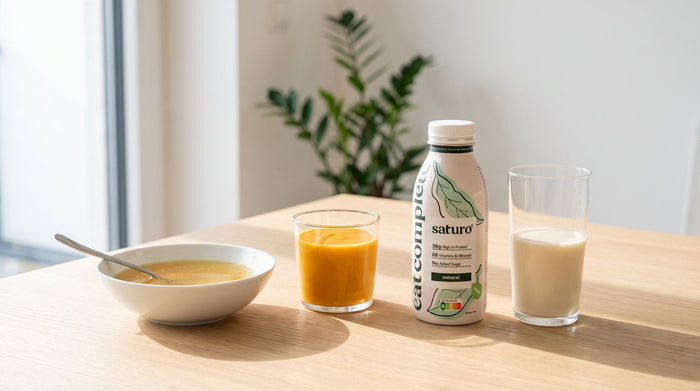
What fits through the gap: cream soup, skyr with fruit purée, mash with scrambled egg and a shake. All from a spoon or a glass, nothing to bite into.
After dental surgery, jaw rules and wound rules apply at the same time: soft food that isn't too hot, no coffee, no cola and no alcohol for 24 hours, no smoking for several days. Nothing that can get stuck in the wound: crumbs, grains, seeds. The straw stays in the cupboard for a week: the suction can pull the blood clot out of the socket, which according to the Cleveland Clinic happens in 2 to 5% of all tooth extractions. More in the article on wisdom tooth surgery.
06 Nourish
Stay nourished when your mouth only opens a crack
A tight jaw lasts days, a broken jaw six weeks. The problem is rarely the consistency but the amount: tea, broth, apple sauce and pudding fit through the gap, but they give you hardly any energy or protein. In a British study, wired jaws cost 3.3 kilograms of lean mass in six weeks. The ESPEN guideline: if you can't eat for more than five days, or stay below half your needs for more than seven days, you get nutrition therapy "without delay", starting with oral nutritional supplements.
Why tea and rusks aren't enough
The typical tight-jaw day, worked out: tea, six soaked rusks, apple sauce, broth, banana, pudding. That's around 590 kilocalories and 11 grams of protein: a third of what the DGE gives for a woman (1,800 kcal), a fifth of the protein for 70 kilograms (56 grams). ESPEN target for people who are healing: 1.0 to 1.5 grams per kilogram. The well-nourished day has the same consistency, just with more in it: the three recipes below plus porridge with milk and scrambled egg on mash, together around 2,200 kilocalories and over 100 grams of protein. Every soft portion needs protein and a bit of fat.
Three meals that fit through a finger-wide gap
1
Mid-morning: banana-oat shake with whey5 minutes · cool or lukewarm · from the glass
≈ 480 kcal
36 g protein
440 mg calcium
Zutaten
250 ml whole milk (or soya drink with calcium)
1 banana (100 g)
30 g fine rolled oats
30 g whey protein, neutral or vanilla
1 tsp honey
Zubereitung
Let the oats soak in the milk for five minutes, then blend everything finely for at least a minute until no bits of flake are left. Drink from the glass in small sips or eat with a spoon. Without whey: use 150 g Greek yoghurt instead of the powder, which gives you 28 g protein.
2
Lunch: potato and leek cream soup with cream cheese and Gouda30 minutes · lukewarm · 2 portions
≈ 540 kcal
17 g protein
330 mg calcium
Zutaten
400 g potatoes, peeled
150 g leek, white part only
500 ml chicken or vegetable stock
100 g cream cheese
100 ml whole milk
10 g butter
50 g Gouda, grated
Salt, nutmeg
Zubereitung
Sweat the leek in butter until soft, add the diced potatoes and stock, and simmer for 20 minutes. Stir in the cream cheese, milk and Gouda, blend until smooth, and after dental surgery press it through a sieve. Let it cool to drinking temperature; the second portion keeps for two days in the fridge.
3
Afternoon: skyr and berry cream with peanut butter5 minutes · cool · by the spoon
≈ 300 kcal
25 g protein
59 mg vitamin C
Zutaten
200 g skyr (or Greek yoghurt)
100 g strawberries, fresh or thawed
1 tbsp honey
1 tbsp smooth peanut butter (15 g)
Zubereitung
Purée the strawberries and press them through a sieve so no seeds are left. Stir smooth with the skyr, honey and peanut butter, then spoon it up cool. In the wound phase after dental surgery, use a mashed banana instead of the berries.
Nutritional values rounded per portion based on USDA FoodData Central SR Legacy (whole milk 171265, banana 173944, oats 173904, whey 173180, honey 169640, potatoes 170440, leek 168426, stock 174536, cream cheese 173418, Gouda 171241, strawberries 167762, peanut butter 172470; skyr based on Greek yoghurt 170894, manufacturer values are usually slightly higher). All three without biting, without chewing, without crumbs.
Drinkable meal: On days when even spooning is too much effort, it's the simplest solution: from the glass or with a straw behind the teeth (allowed after a broken jaw, after a tooth extraction only after a week), cold, mild, no chewing, and unlike tea or apple sauce, a complete meal with protein, fat, carbohydrates, fibre and micronutrients.
When your mouth only opens a crack: cold, mild, in small sips. A drinkable meal replaces the meal you'd otherwise miss.
British hospital leaflets recommend six to eight nutritious drinks a day and, after a week on liquids, a vitamin supplement, because a liquid diet can be "very filling and low in energy"; a drinkable meal solves both with one bottle. Unlike medical nutrition drinks, it's an ordinary food. Drink it cold, in small sips; vanilla and natural are the mildest flavours.
From the Saturo range
Drinkable meal: a complete meal in a bottle
36 g protein and 400 kcal per bottle, plus 26 vitamins and minerals, vegan. Protein contributes to the maintenance of muscle mass. Reference intake for protein: 50 g per day (NRV). Drink it cold, mild, no chewing. Vanilla and Natural are the mildest flavours.
36 gProtein
400kcal
26Vitamins & minerals
LiquidNo chewingA complete meal from the glass, fits through any gap
Choose a flavour
111,50 Kčper meal
Choose a flavour
Drinkable meal · Cocoa111,50 Kč per meal ·
07 If it doesn't go away
When it keeps locking: CMD, grinding, recurrent stuck-open jaw
Jaw clicks and locks: the displaced cartilage disc
Around a third of adults know the click when opening their mouth. Usually it's harmless: the cartilage disc sits slightly too far forward, and the joint head snaps back onto it with a click. Only what hurts gets treated. It's different when the click disappears and your mouth stops at two to three centimetres: then the disc is blocking the joint head (disc displacement without reduction), with pain in front of the ear and a chin that drifts towards the affected side. That one's for the dentist: splint, physiotherapy, sometimes joint lavage.
Jaw tension from stress and teeth grinding
The most common long-term lock is the muscular kind: clenching during the day, grinding at night, and a jaw in the morning that needs to warm up first. The drivers are listed in chapter 2 (smoking, alcohol, coffee, reflux, sleep apnoea, stress); tooth position is not a main factor. What helps is a package: awareness ("lips together, teeth apart", exercise 4), heat and massage before bed, relaxation techniques and the bite splint for the night. What doesn't help: chewing gum as "training" and stretching programmes for night-time grinding, where the guideline found more episodes.
CMD treatment and health insurance: If you've lived with a locked jaw, clicking and chewing-muscle pain for weeks, you'll end up with a CMD diagnosis. The initial examination and the classic bite splint are covered by statutory health insurance, the functional analysis usually isn't, physiotherapy is available on a dentist's insurance prescription, and you pay for Botox yourself. CMD treatment takes months and starts with the simple things.
At a glance
CMD and locked jaw: treatments compared
What guidelines and the specialist society for functional diagnostics think each measure can do, and what statutory health insurance covers.
When
What the guidelines say
Health insurance
Bite splint
Grinding, chewing-muscle pain, jaw-joint lock
Standard measure; protects the teeth, temporarily reduces grinding activity
Yes, the classic splint; special types privately
Self-exercises, heat
Muscular lock, tension
Awareness and relaxation recommended; exercises with a small to medium effect
Free
Physiotherapy, manual therapy
Persistent lock, muscle and joint pain
Recommended, usually with heat or cold; evidence low to moderate
Yes, on a dentist's prescription for jaw-joint damage
Relaxation training
Clenching during the day, stress as a trigger
Recommended for awake bruxism; mixed evidence
Partly via prevention courses
Painkillers
Acute pain
Ibuprofen short term; Cochrane found insufficient evidence for CMD pain
Over the counter, you pay
Botulinum toxin
Severe bruxism, recurring jaw dislocation
Can be considered; reduces pain and muscle strength, not the number of episodes; off-label
No, usually private
Joint lavage (arthrocentesis)
Joint lock from a blocked cartilage disc
According to Charité, often the first surgical step for joint causes
Yes, as a medical service with an indication
Functional analysis
Before splints and bigger procedures
Diagnostics of chewing function with measurements
No, private; the initial examination is covered
Based on the S3 guideline on bruxism (2019), the S3 guideline on jaw joint dislocation (2022), the Cochrane review on painkillers for CMD (2010), the overview by Armijo-Olivo and colleagues (2016), the DGFDT, Charité oral and maxillofacial surgery, the consumer advice centre (as of June 2024) and the G-BA's remedies guideline for dentists. Coverage can change; if in doubt, check with your insurer first.
When the stuck-open jaw comes back: habitual dislocation
In around 20% of cases the jaw gets stuck again, and this can turn into a habitual dislocation, where the jaw jumps out even during a normal yawn. Conservative treatment: painkillers, physiotherapy, splint, and limiting how wide you open for four weeks. Minimally invasive: autologous blood injection into the joint has the best evidence and leaves about 80% symptom-free for twelve months; botulinum toxin in the lateral pterygoid muscle stops the lock-ups for at least five months, off-label and private. Surgical: removal of the articular eminence (eminectomy) or the Dautrey procedure (locking plasty), with only 4% repeat lock-ups in a study of 75 patients.
Rare causes: After radiotherapy to the head and neck, the chewing muscles scar: 25% developed a locked jaw, 5% with modern technique; in the Swedish ARTSCAN study, one in four still had a clear restriction after five and a half years. Early training (jaw stretching devices gained 9.5 millimetres on average) and nutritional therapy help here. Tetanus often starts with a locked jaw and stiff neck, three days to three weeks after a contaminated wound. Medication for psychoses, depression and nausea rarely triggers an acute spasm, which an antidote ends within minutes. A locked jaw with no trigger that gets worse over two weeks should be checked out.
Relax at night, stay aware during the day
Heat and three minutes of massage in the evening, then exercise 4. Check your coffee after lunch and your alcohol in the evening, as both make grinding worse. Skip the chewing gum while your muscles hurt. If you're still waking up with a locked jaw after four weeks, talk to your dentist about a splint.
08 Look it up
Common questions about lockjaw and trismus
What's the difference between trismus and a jaw lock?
With a locked jaw (trismus), your mouth barely opens, or doesn't open at all, because the chewing muscles are cramped or the tissue is swollen. With a stuck-open jaw (dislocation), your mouth won't close because the joint head has jumped in front of the joint eminence. A locked jaw usually passes on its own, while a stuck-open jaw has to be put back in place.
How do you get rid of a jaw lock?
Only by having it put back in place at a dental practice or A&E, never by yourself. The doctor places their thumbs next to your lower molars and presses first down, then back (Hippocratic manoeuvre). With a fresh lock, this usually takes seconds and doesn't need an anaesthetic. After three to four weeks, surgery is usually the only option.
How long does trismus last after wisdom tooth surgery?
Trismus after surgery is normal. In a study from Graz, the mouth opened 12 millimetres less on the first day. By day 7, half of that had come back, and after ten to fourteen days three fingers usually fit in again. If it hasn't improved after a week, or if you have a fever, go to the practice.
Which doctor should I see for a jaw lock?
For a jaw lock, go to a dentist, oral and maxillofacial surgery, an ENT doctor or A&E on the same day. After a fall or a blow, always go to hospital. For trismus, see a dentist. If you have a fever or trouble swallowing, go today. The 116117 line doesn't refer you to dentists. At night, the emergency dental service can help. If you struggle to breathe, call 112.
Is trismus dangerous?
Usually not: after surgery, an injection or muscle tension, it goes away. It becomes dangerous when it's a sign of an infection that is spreading: fever, growing swelling on your cheek or neck, trouble swallowing, difficulty breathing. An abscess could be behind it, and that needs hospital straight away. Get it checked if trismus has no obvious cause and gets worse over more than two weeks.
Which medication helps with trismus, and is ibuprofen suitable for jaw joint pain?
Ibuprofen is the usual remedy for pain and swelling: available without a prescription up to 1,200 milligrams in 24 hours, for no longer than four days without medical advice, and according to Embryotox not from the 28th week of pregnancy. A Cochrane review found insufficient evidence for painkillers in jaw joint problems: they ease the pain, but they don't fix the cause.
Which sleeping position relaxes the jaw?
There's no study that recommends a particular position. What makes sense is anything that doesn't put strain on your lower jaw: don't sleep with your hand or fist under your jaw, and avoid a pillow that pushes it to one side. According to the bruxism guideline, an evening routine with warmth, massage and relaxation helps more, and a bite splint helps if you grind your teeth at night.
Which health insurer covers CMD treatment?
Every statutory health insurer covers the initial examination and the standard bite splint for jaw joint disorders, according to the consumer advice centre. Special types of splint are private. For jaw joint damage, your dentist can prescribe physiotherapy on an insurance prescription. You usually pay for the detailed functional analysis and botulinum toxin yourself.