
Nutrition for building muscle: calories, protein, foods
Do you train regularly and still see hardly any progress? Muscles only grow with a training stimulus, enough energy and enough protein. How much more you should eat, how much protein you need and which foods provide it.


Aktualisiert 20 October 2026 · 15 Min. Lesezeit · 62 Quellen

The essentials in 30 seconds
Beyond this amount, more protein brought no extra muscle gain in studies. At 70 kg that's 112 g a day, at 60 kg 96 g.
Enough for building muscle with strength training. A bigger surplus mostly ends up as fat; beginners can go a bit higher, advanced lifters stay below.
About 0.4 g of protein per kilo each, spread across the day. At 70 kg that's four portions of around 28 g, with the last one in the evening.
Food alone doesn't build muscle. Two strength sessions a week with increasing load are the minimum, and creatine is the only supplement with strong evidence.
Nutrition for building muscle: what really matters
Muscles grow when three things come together: a training stimulus, enough protein as building material and slightly more energy than you burn. If one of them is missing, little happens, no matter how good the other two are. The numbers behind it are smaller than fitness shops claim: around 1.6 g of protein per kilo of body weight and about 10% more calories, not 500. The calculator below works out what that means for you.
What promotes muscle growth best?
Training. Without a stimulus, your body doesn't build muscle, not even with 200 g of protein a day. Next comes your daily protein amount, then your energy balance, and only well behind those come timing, shakes and supplements. In the largest analysis on strength training, extra protein brought on average 0.3 kg more fat-free mass in three months, a small effect compared with the training itself. It's worth remembering this order, because most mistakes happen at the start: eating too little, training too rarely, but having a shelf full of powders.
How fast can you build muscle?
More slowly than before-and-after photos promise. For beginners, one review cites around 1.4 kg of lean mass in ten weeks; for people over 50, the average across 49 studies was 1.1 kg. The longer you train, the slower it gets, and there are no reliable figures for advanced lifters. On top of that, results vary enormously: in a study of 585 people, upper arm muscle growth over twelve weeks ranged from −2 to +59%. That's why comparing yourself with others isn't worth it. Only compare yourself with you, for example every four weeks, using weight, measurements and training weights.
How many calories do you need to build muscle?
Without an energy surplus, hardly any muscle grows, and with too much of one, mostly fat grows. How big the surplus needs to be is less well researched than online calculators suggest: a 2019 review literally states that the optimal surplus has never been validated. The table shows the range that studies and practice work with.
How big should your calorie surplus be?
Roughly 10 to 20% above your total energy expenditure: beginners at the upper end, advanced lifters below the lower end. If you need 2,500 kcal, that's 250 to 500 kcal more a day, so the often-quoted 300 to 500 kcal is within range, but at the top end. The scales are your check: 0.25 to 0.5% of your body weight per week, which is 175 to 350 g at 70 kg. A study with elite athletes shows why more doesn't help: with a large surplus, fat mass rose by 15% instead of 3%, while lean mass grew the same in both groups.
Surplus and gain by training level
Guideline values from the review on the building phase (Iraki et al. 2019), with examples for 70 kg and 2,500 kcal total energy expenditure; beginners and intermediates count as one group, recomp = losing fat and building muscle at the same time.
| Surplus | Gain per week | Example 70 kg | |
|---|---|---|---|
| Beginners | 10 to 20% above your needs | 0.25 to 0.5% of body weight | 250 to 500 kcal more, 175 to 350 g |
| Advanced | smaller, under 10% | under 0.25% | 100 to 250 kcal more, under 175 g |
| Recomp | small deficit, 200 to 300 kcal | stable or slightly falling | 2,200 to 2,300 kcal, 2 g protein per kg |
| Dirty bulk | 500 kcal and more | over 0.5% | more fat, not more muscle |
The percentages refer to the total energy expenditure from the calculator in chapter 1. The fat gain with a large surplus comes from Garthe et al. 2013 (elite athletes, 8 to 12 weeks).
Lean bulk: build slowly instead of just bulking up
A lean bulk means a small surplus, slow gain and little added fat. The opposite, the dirty bulk with 500 kcal and more, fills out your trousers faster than your sleeves. The rule of thumb from the table applies to both: gaining more than 0.5% per week is a sign your surplus is too big. Weigh yourself in the morning on an empty stomach, twice a week, and work with the weekly average; daily swings of a kilo are water and gut contents, not fat.
Your total energy expenditure rises with training and with every extra kilo on the scales. Recalculate every four to six weeks, otherwise your surplus quietly shrinks to zero.
Build muscle and lose weight at the same time?
Yes, but not for everyone, and not quickly. Body recomposition works mainly for beginners, people returning to training and people with a higher body fat percentage. The conditions: a small deficit of 200 to 300 kcal, lots of protein and consistent strength training. In a study of young men in a hard deficit, the group on 2.4 g protein per kilo gained 1.2 kg of lean mass, while the group on 1.2 g gained only 0.1 kg. In a meta-analysis, a deficit of 500 kcal prevented any gain at all. That's why the calculator above works out “Lose weight + build muscle” with a 300 kcal deficit and 2 g protein; the deficit itself is explained in the article on losing weight.
How muscles grow
Three stops between dumbbell and muscle. Once you know them, you'll understand why your total daily protein matters more than the shake straight after training.
Stimulus: training sets the signal
Strength training pushes your muscle fibres to their limit and causes tiny bits of damage. That's the signal: for at least 24 hours, the muscle cell switches to repair and build. Without this stimulus, extra protein is simply burned or stored. It doesn't turn into muscle.
Muscle protein synthesis: amino acids get built in
After every protein-rich meal, muscle protein synthesis rises for a few hours, and after training it rises more strongly and for longer. It needs all nine essential amino acids, with leucine firing the starting gun. About 0.4 g of protein per kilo per meal stimulates it fully, and for older people it's more rather than less.
Balance: building minus breakdown across the day
Muscle protein is constantly being built up and broken down. Overall, muscle only grows when building outweighs breakdown over days and weeks. Four protein meals, enough energy and enough sleep make that happen: a single night without sleep lowers synthesis by 18%.
How much protein do you need to build muscle?
Protein is the building block, but more of it doesn't automatically mean more muscle. The question is where the amount stops having an effect, and how you spread it across the day. You'll find the baseline requirement without training, different life situations and a calculator of their own in the article How much protein a day?; here we only cover building muscle.
How much protein per day?
Around 1.6 g per kilo of body weight, so 112 g at 70 kg. The figure comes from a meta-analysis of 49 studies: up to that point, extra protein helped with building muscle, beyond it no longer did; the range of uncertainty goes up to 2.2 g. Sports science bodies give 1.4 to 2.0 g, and according to EFSA, up to about 1.7 g is considered safe. The DGE sees it differently: if you train moderately for half an hour four to five times a week, you need no more than 0.8 g; the 1.2 to 2.0 g range only applies from five hours of training a week. Both are right, they just have different goals: health or targeted muscle building.
How much protein per meal?
Around 0.4 g per kilo, so 25 to 30 g at 70 kg, at least four times a day. That's how you reach your daily amount, and every meal fully stimulates muscle protein synthesis. The old rule that the body can't use more than 30 g has been disproved: in one study, 100 g of protein in one go worked longer and stronger than 25 g. Spreading it out still makes sense, because hardly anyone manages big portions in the evening. Quality counts too: animal protein and soy contain more leucine, the amino acid that kicks off muscle building; lentils or beans need bigger portions or a second source alongside.
Four protein meals at 70 kg
-
Morning
around 28 g
Skyr with oats and nuts, or three eggs with wholemeal bread. Muesli with milk and banana on its own gets you to 13 g, a bread roll with jam to under 5 g.
-
Midday
around 28 g
Chicken or tofu with rice and vegetables, lentil curry with a spoonful of quark, tuna salad with bread. The meal that reaches 30 g most easily anyway.
-
Afternoon or after training
around 28 g
Low-fat quark with berries, cottage cheese with bread or a drinkable meal. Within one to two hours after training is handy, but not a must: the daily total is what counts.
-
Evening
around 28 g
Fish, meat or pulses for dinner; if you train late, eat afterwards. 30 to 40 g of quark or skyr about half an hour before bed is digested overnight.
Do you need a protein shake?
No, but it can be handy. Studies show no advantage of shakes over protein from food as long as your daily amount is right; the DGE considers high-protein products unnecessary, even for athletes. The honest reason for a shake is logistics: 112 g of protein on a day with work, training and family is hard without planning, and the gap is almost always the afternoon or the day with no time to cook.
If you want to build muscle, you don't need a shake, you need four meals with protein. The shake is for the day the fourth one falls through.
Joerg Hauke, Nutrition expert, technical review of this article
If you're topping up, do it with a portion that counts as a meal: 25 to 40 g protein plus carbs and fat, not just powder with water. A vegan drinkable meal delivers 36 g protein from faba bean and soya at 400 kcal, which means 36 % of the energy comes from protein. Protein contributes to a growth in muscle mass. If you want to combine bottle and powder, you'll find both in the High Protein Starterbox.
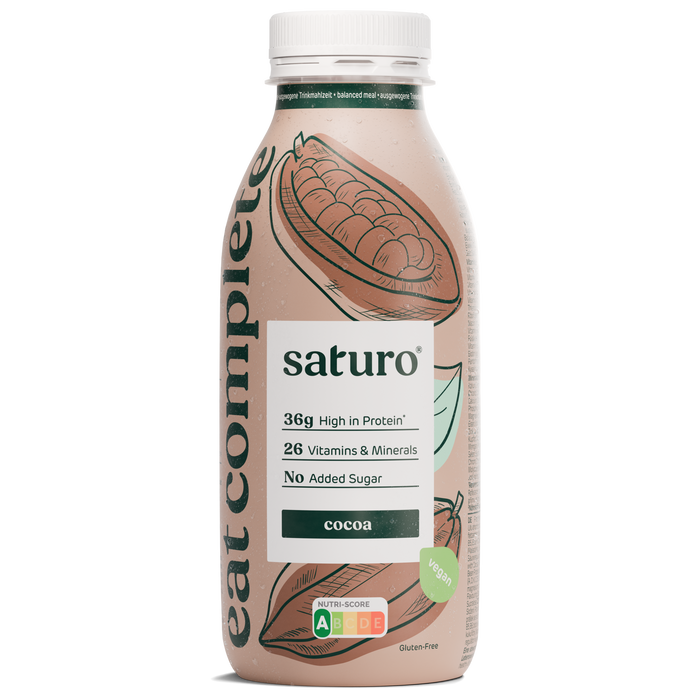
Drinkable meal: 36 g protein when the fourth meal falls through
400 kcal, 36 g plant-based protein from faba bean and soya, 26 vitamins and minerals, ready to drink. Protein contributes to a growth in muscle mass. For the afternoon after training, or the day when cooking just doesn't happen.
What to eat to build muscle? The best foods
The best diet for building muscle is unspectacular: a protein source at every meal, plus carbs for training and enough fat. The ranking shows which foods give you the most protein per portion, calculated with the German nutrient database (BLS), based on the portion as it sits on your plate.
Protein sources: animal and plant-based
Animal sources lead per portion: 150 g of turkey or chicken breast gives you almost 50 g, a full tub of low-fat quark 30 g, two eggs 16 g. Among plant-based foods, seitan, tofu, tempeh and soya chunks are out in front; pulses give you 10 to 14 g per portion, so they need a second source alongside. Dairy products are the lowest-calorie animal suppliers: low-fat quark and skyr deliver 16 to 18 g protein per 100 kcal, beef fillet 18, chicken breast 22.
Protein per portion: top 10 plant-based and animal
Protein per example portion, pulses cooked, tofu pan-fried; BLS 4.0, with tempeh, lupins, edamame and peas from the USDA. Leucine per portion: pan-fried tofu 2.2 g, seitan 1.9 g, lentils 1.2 g. All 96 foods to look up are in the Protein article.
Carbs and fat for building muscle
Once protein is sorted, how you split the rest hardly matters: from low-fat to low-carb, all approaches improve body composition to a similar degree, according to the sports nutrition society, as long as protein and calories are right. For hard strength training, reviews recommend 3 to 5 g carbs per kilo so your glycogen stores last through your sessions, and 0.5 to 1.5 g fat per kilo. Don't push fat below 0.5 g: a very low-fat diet measurably lowers testosterone levels in men, though it hasn't been shown whether that slows muscle gain. For 70 kg and 2,600 kcal, that roughly means: 110 g protein, 70 g fat, and the rest carbs, so around 380 g. That's a good 5 g per kilo, because the surplus ends up there.

Building muscle on a vegan diet: is plant-based protein enough?
Yes, as long as you get the amount right. In a study with vegans and omnivores, each eating 1.6 g protein per kilo, strength and muscle mass grew equally over twelve weeks; a second study with around 2 g per kilo came to the same result. Plant-based protein contains less leucine and is used by the body slightly less efficiently, so aim for the upper end of the range and go for soya, seitan, lupins and pulses combined with grains. All Saturo products are vegan; the drinkable meal delivers 36 g from faba bean and soya.
What shouldn't you eat if you want to build muscle?
There's no forbidden food. What really slows muscle gain comes down to three patterns: too little energy overall (the classic “but I eat loads” on 1,800 kcal), days without a protein source in the morning and the afternoon, and alcohol after training. Sweets or fast food aren't a problem for your muscles, only for your balance if they push out protein. A burger with 30 g protein is a muscle-building meal; a salad without a protein source isn't.
Nutrition plan for building muscle: what a day looks like
A nutrition plan for building muscle isn't a diet plan: four meals, each with 25 to 40 g protein, plus enough carbs and fat to build up the surplus. Three example days, calculated with the German nutrient database (BLS) at 1.6 g protein per kilo, show what that looks like for different weights and diets.
Three days at 1.6 g protein per kilo
Protein per meal in grams, amounts are examples; calories are calculated for a day with strength training.
| 70 kg, omnivore | 60 kg, vegetarian | 80 kg, vegan | |
|---|---|---|---|
| Breakfast | Porridge with milk, banana, almonds: 26 g | Two eggs, bread, tomato: 25 g | Rolled oats with soya yoghurt, pumpkin seeds: 31 g |
| Lunch | Chicken and rice bowl with broccoli: 33 g | Lentil curry with rice: 24 g | Tofu and rice bowl with broccoli: 30 g |
| Afternoon | Low-fat quark with berries, rolled oats: 27 g | Low-fat quark with berries, pumpkin seeds: 24 g | Drinkable meal, banana, dates: 40 g |
| Evening | Salmon with potatoes and salad: 28 g | Tofu and vegetable noodles: 25 g | Lentil bolognese with pasta: 29 g |
| Total protein | 113 g (1.6 g per kg) | 99 g (1.65 g per kg) | 129 g (1.6 g per kg) |
| Energy | 2,600 kcal | 2,100 kcal | 2,950 kcal |
Calculated with BLS 4.0 and USDA; the drinkable meal with the manufacturer's values (400 kcal, 36 g). Amounts per ingredient are in the research notes, and the calculator in chapter 1 gives you your own target values.
Breakfast for building muscle
Breakfast is the meal where most people lose protein: a bread roll with jam gives you under 5 g, muesli with milk around 13 g. Aim for 25 to 30 g. You can get there with porridge made from 80 g rolled oats with milk and nuts (26 g), skyr or low-fat quark with rolled oats and fruit (30 g), or two eggs with wholemeal bread and cottage cheese (28 g). Vegan: rolled oats with soya yoghurt, pumpkin seeds and almond butter (31 g). If you don't fancy eating in the morning, drink your breakfast; the morning's shortfall is hard to make up in the evening.

Dinner and before bed
In the evening, the same rules apply as at lunch: a protein source, vegetables, carbs as needed, for example salmon with potatoes or lentil bolognese. If you train late, simply have dinner afterwards; you don't need a separate snack. On top of that, 30 to 40 g of slow-digesting protein about half an hour before bed (quark, skyr or cottage cheese) boosts muscle protein synthesis overnight. In one study with young men, their thigh muscle grew more over twelve weeks this way. This hasn't been shown for older people, and it only counts if the portion is added to your daily total rather than replacing another meal.
Creatine, shakes, supplements: what really helps
The market for muscle-building products runs on hope. Only one supplement is backed by solid science: creatine. Everything else either doesn't work, works only weakly, or works only through your daily protein total. The table ranks the most common products by the evidence. Saturo doesn't sell creatine, so this assessment is independent of our range.
Creatine for building muscle
According to professional bodies, creatine is the most effective legal supplement for strength and lean mass, and the only one with approved EU health claims: it “increases physical performance in successive bursts of short-term, high-intensity exercise”, and in adults over 55 “daily intake can enhance the effect of resistance training on muscle strength”, in both cases from 3 g a day. In practice: 3 to 5 g of creatine monohydrate daily, whenever suits you; you don't need a loading phase. It's considered safe with healthy kidneys, and hair loss hasn't been proven. In older people, creatine plus strength training added 1.4 kg more lean mass across 22 studies.
What supplements actually do for muscle building
Seven product groups, checked against meta-analyses, professional bodies and authorities up to 2025.
| What studies show | What it means for you | |
|---|---|---|
| Creatine | Strongest evidence: more strength and lean mass, two EU claims | 3 to 5 g daily, no loading phase, safe with healthy kidneys |
| Protein powders | Work only through your daily total, no better than food | Handy if you can't otherwise reach your amount |
| BCAAs, EAAs | Small effect on their own, below that of whole protein | Unnecessary with enough protein; the BfR warns against high doses |
| HMB | Mixed data, unclear in trained people | No reason to spend money |
| Vitamin D | Small strength effect, no muscle mass effect, only if deficient | Only supplement based on blood levels |
| Magnesium | Claim only “normal muscle function”, not muscle building | Deficiency is rare in Germany |
| Testosterone boosters, tablets | No evidence; authorities found undeclared anabolic steroids | Steer clear |
Sources: ISSN 2017/2021, Chilibeck 2017, Wolfe 2017, Rathmacher 2025, Beaudart 2014, Regulation (EU) 432/2012, BfR 2019, BfArM/BfR 2006, Verbraucherzentrale 2025.
Muscle-building products and tablets
“Muscle-building tablets”, testosterone boosters or capsules with plant extracts have no proven effect. It gets dangerous with products bought online: German regulatory authorities have found undeclared anabolic steroids in products sold as food supplements, with consequences ranging from liver damage to infertility, and have been warning about this for years. Contamination with doping substances also occurs in protein powders and creatine; the DGE recommends tested products, for example from the Cologne List. For BCAAs and EAAs, there's no benefit when you get enough protein; as a guideline, the BfR gives a maximum of 8.2 g of isolated BCAAs a day on top of your food.
Promises like “10 kg of muscle in 8 weeks” or “natural testosterone booster” are warning signs, not selling points. If you have doubts about what's in a product, the BfR advises not taking it at all.
Alcohol and sleep when building muscle
A beer after training doesn't ruin anything: according to a review, around 0.5 g of alcohol per kilo (about two beers at 70 kg) barely affects recovery. A binge does: 1.5 g per kilo, roughly twelve standard drinks, lowered muscle protein synthesis after training by 24%, even with a protein shake on top. Sleep works in the same direction: a single night without sleep lowered synthesis by 18% and testosterone by 24%. The often-quoted line “70% of muscle growth happens during sleep”, on the other hand, has no source; all that's proven is that lack of sleep slows you down.
Building muscle as you age and as a woman
Two groups get the most myths thrown at them when it comes to building muscle: people over 60 (“too late”) and women (“will get too bulky”). Both are wrong, and the evidence is good for both. The minimum training advice at the end of this chapter applies to everyone.
Building muscle in later life: is it still possible at 60, 70, 80?
Yes, at any age. Without training, from middle age onwards you lose on average 0.4 to 0.5% of muscle mass per year, and strength disappears two to five times faster than mass. Strength training reverses that, even at 70 or 80. What changes is your diet: older muscles respond less to protein, which experts call anabolic resistance. That's why every meal needs about 0.4 g per kilo and the day at least 1.0 to 1.2 g per kilo, or more like 1.2 to 1.6 if you train. If you don't have the appetite for big portions, a drinkable meal can be one of your four meals. If you're losing weight without meaning to, have had falls or have a kidney condition, your plan belongs in a doctor's hands.
Building muscle as a woman: what's different
Less than most people think. Relative to their starting mass, women in studies build just as much muscle as men, and in upper-body strength they even gain relatively more; in absolute terms, the amount of mass stays smaller. Without doping, nobody gets visibly “bulky”. According to current research, the phase of your cycle has no relevant effect on strength or gains. For food, the same per-kilo numbers apply: 1.6 g protein, 10% surplus; at 60 kg, that's 96 g protein and often only 200 kcal more. After menopause, strength training is doubly worthwhile because muscle and bone decline at the same time; there's more on this in the article Losing weight during menopause.

Training: the minimum that works
This article isn't a training plan, but without training, none of it applies. The minimum dose from guidelines and meta-analyses: strength training on at least two days a week for all the major muscle groups, each muscle group twice a week, several sets per muscle per week, each set taken close to your limit, and the load increased over the weeks. Whether you do light weights with lots of reps or heavy weights with few makes little difference to your gains, as long as the set ends up hard. Strength rises in the first few weeks, and mass follows with a delay.
The minimum training plan in four steps
-
1
Two days a weekWHO minimum
Strength training for all major muscle groups on at least two days. Full-body workouts are enough to start with.
-
2
Every muscle twiceseveral sets per week
Training each muscle group twice a week does more than once. Every extra set per week adds a little more growth on average.
-
3
Close to your limit8 to 12 reps
The last two reps feel hard. Light and heavy weights work similarly if the set goes close to muscle failure.
-
4
A little more every weekprogressive overload
More weight, more reps or one more set. Without progression the stimulus stops, and growth stops with it.
WHO 2020, Schoenfeld et al. 2016/2017, ACSM 2009. Not a training plan, but the minimum that triggered muscle growth in studies; older adults should also do balance training on three days.
Common questions about nutrition for building muscle
How long does it take to build 1 kg of muscle?
For beginners, roughly two to three months: studies show about 1.4 kg of lean mass in ten weeks, and 1.1 kg in older people. The longer you train, the slower it gets, and the variation between people is huge. The scales also show water and glycogen, not just muscle.
What is the best way to build muscle quickly?
There isn't one. What works best is regular strength training with increasing load, 1.6 g of protein per kilo and a small calorie surplus. The only supplement with solid evidence behind it is creatine, 3 to 5 g a day. Anything that promises faster results is either useless or doping.
How many eggs are good for building muscle?
As many as fit into your protein target: one egg provides around 8 g of protein and 80 kcal, so three eggs at breakfast give you 24 g. There's no upper limit for healthy people. More important than the number: eggs alone rarely do the job, but three eggs plus wholegrain bread or quark get you to 25 to 30 g.
Is yoghurt good for building muscle?
Plain yoghurt provides only 7 to 8 g of protein per pot, which is too little for a muscle-building meal. Skyr or low-fat quark give you more than double that for the same amount, plus more leucine. So yoghurt is an ingredient, not a protein source; with oats, nuts and a spoonful of quark it becomes one.
Can I build muscle without a calorie surplus?
Yes, especially as a beginner or with a higher body fat percentage. With maintenance calories or a small deficit, plenty of protein (2 g per kilo) and strength training, building muscle is possible, just slower. In studies, a deficit of more than 500 kcal a day practically stops it altogether.
What happens if you do strength training but eat too little protein?
You'll get stronger, but hardly more muscular. Strength first comes from the nervous system, while muscle needs building material. Below about 1.3 g per kilo, every extra tenth of a gram of protein brings clearly more growth in studies than it does above that; in a calorie deficit, your body even loses muscle.
What should you drink when building muscle?
Mainly water, with a little salt when you train. Milk or soy drink provides 8 g of protein per glass and belongs at breakfast. Alcohol in moderation does no harm, but twelve drinks after training lower muscle protein synthesis by a quarter. Sugary drinks are only a problem for your calorie balance, not for your muscles.
Is it better to do more reps or lift more weight?
For muscle growth, both work about equally well as long as the set goes close to muscle failure. Heavy weights build more maximum strength, and 8 to 12 reps is the usual middle ground. What matters is progression over the weeks: more weight, more reps or one more set.
Sources · 62 sources anzeigen
- Morton R. W. et al.: A systematic review, meta-analysis and meta-regression of the effect of protein supplementation on resistance training-induced gains in muscle mass and strength in healthy adults. British Journal of Sports Medicine 2018; 52(6): 376–384.
- Jäger R. et al.: International Society of Sports Nutrition Position Stand: protein and exercise. Journal of the International Society of Sports Nutrition 2017; 14: 20.
- Thomas D. T., Erdman K. A., Burke L. M.: American College of Sports Medicine Joint Position Statement. Nutrition and Athletic Performance. Medicine & Science in Sports & Exercise 2016; 48(3): 543–568.
- Nunes E. A. et al.: Systematic review and meta-analysis of protein intake to support muscle mass and function in healthy adults. Journal of Cachexia, Sarcopenia and Muscle 2022; 13(2): 795–810.
- Tagawa R. et al.: Dose-response relationship between protein intake and muscle mass increase: a systematic review and meta-analysis of randomized controlled trials. Nutrition Reviews 2021; 79(1): 66–75.
- König D., Carlsohn A. et al.: Protein intake in sport. Position of the DGE Sports Nutrition working group. Ernährungs Umschau 2020; 67(7): M406–M413.
- Deutsche Gesellschaft für Ernährung (DGE): Reference value for protein (as derived in 2017). Retrieved 19 October 2026.
- EFSA NDA Panel: Scientific Opinion on Dietary Reference Values for protein. EFSA Journal 2012; 10(2): 2557.
- Iraki J., Fitschen P., Espinar S., Helms E.: Nutrition Recommendations for Bodybuilders in the Off-Season: A Narrative Review. Sports 2019; 7(7): 154.
- Slater G. J. et al.: Is an Energy Surplus Required to Maximize Skeletal Muscle Hypertrophy Associated With Resistance Training. Frontiers in Nutrition 2019; 6: 131.
- Aragon A. A. et al.: International society of sports nutrition position stand: diets and body composition. Journal of the International Society of Sports Nutrition 2017; 14: 16.
- Garthe I., Raastad T., Refsnes P. E., Sundgot-Borgen J.: Effect of nutritional intervention on body composition and performance in elite athletes. European Journal of Sport Science 2013; 13(3): 295–303.
- Westcott W. L.: Resistance training is medicine: effects of strength training on health. Current Sports Medicine Reports 2012; 11(4): 209–216.
- Hubal M. J. et al.: Variability in muscle size and strength gain after unilateral resistance training. Medicine & Science in Sports & Exercise 2005; 37(6): 964–972.
- Murphy C., Koehler K.: Energy deficiency impairs resistance training gains in lean mass but not strength: A meta-analysis and meta-regression. Scandinavian Journal of Medicine & Science in Sports 2022; 32(1): 125–137.
- Barakat C. et al.: Body Recomposition: Can Trained Individuals Build Muscle and Lose Fat at the Same Time? Strength and Conditioning Journal 2020; 42(5): 7–21.
- Longland T. M. et al.: Higher compared with lower dietary protein during an energy deficit combined with intense exercise promotes greater lean mass gain and fat mass loss: a randomized trial. American Journal of Clinical Nutrition 2016; 103(3): 738–746.
- Schoenfeld B. J., Aragon A. A., Krieger J. W.: The effect of protein timing on muscle strength and hypertrophy: a meta-analysis. Journal of the International Society of Sports Nutrition 2013; 10: 53.
- Moore D. R. et al.: Protein ingestion to stimulate myofibrillar protein synthesis requires greater relative protein intakes in healthy older versus younger men. Journals of Gerontology Series A 2015; 70(1): 57–62.
- Schoenfeld B. J., Aragon A. A.: How much protein can the body use in a single meal for muscle-building? Implications for daily protein distribution. Journal of the International Society of Sports Nutrition 2018; 15: 10.
- Trommelen J. et al.: The anabolic response to protein ingestion during recovery from exercise has no upper limit in magnitude and duration in vivo in humans. Cell Reports Medicine 2023; 4(12): 101324.
- Zaromskyte G. et al.: Evaluating the Leucine Trigger Hypothesis to Explain the Post-prandial Regulation of Muscle Protein Synthesis in Young and Older Adults: A Systematic Review. Frontiers in Nutrition 2021; 8: 685165.
- Snijders T. et al.: Protein Ingestion before Sleep Increases Muscle Mass and Strength Gains during Prolonged Resistance-Type Exercise Training in Healthy Young Men. Journal of Nutrition 2015; 145(6): 1178–1184.
- Reis C. E. G. et al.: Effects of pre-sleep protein consumption on muscle-related outcomes – A systematic review. Journal of Science and Medicine in Sport 2021; 24(2): 177–182.
- Escobar K. A., VanDusseldorp T. A., Kerksick C. M.: Carbohydrate intake and resistance-based exercise: are current recommendations reflective of actual need? British Journal of Nutrition 2016; 116(12): 2053–2065.
- Whittaker J., Wu K.: Low-fat diets and testosterone in men: Systematic review and meta-analysis of intervention studies. Journal of Steroid Biochemistry and Molecular Biology 2021; 210: 105878.
- Kreider R. B. et al.: International Society of Sports Nutrition position stand: safety and efficacy of creatine supplementation in exercise, sport, and medicine. Journal of the International Society of Sports Nutrition 2017; 14: 18.
- Antonio J. et al.: Common questions and misconceptions about creatine supplementation: what does the scientific evidence really show? Journal of the International Society of Sports Nutrition 2021; 18: 13.
- Chilibeck P. D., Kaviani M., Candow D. G., Zello G. A.: Effect of creatine supplementation during resistance training on lean tissue mass and muscular strength in older adults: a meta-analysis. Open Access Journal of Sports Medicine 2017; 8: 213–226.
- Commission Regulation (EU) No 432/2012 establishing a list of permitted health claims made on foods, Annex (entries on creatine, protein, magnesium, vitamin D). OJ L 136, 25.5.2012.
- Commission Implementing Regulation (EU) 2017/672 authorising a health claim (creatine, adults over 55). OJ L 97, 8.4.2017.
- Ziegenhagen R. et al.: Safety aspects of dietary supplements in sport. Position of the DGE Sports Nutrition working group. Ernährungs Umschau 2020; 67(2): M90–M98.
- Wolfe R. R.: Branched-chain amino acids and muscle protein synthesis in humans: myth or reality? Journal of the International Society of Sports Nutrition 2017; 14: 30.
- Federal Institute for Risk Assessment (BfR): Dietary supplements – isolated branched-chain amino acids can harm health when taken in high amounts. Opinion No. 052/2019 of 20 December 2019.
- Rathmacher J. A. et al.: International society of sports nutrition position stand: β-hydroxy-β-methylbutyrate (HMB). Journal of the International Society of Sports Nutrition 2025; 22(1): 2434734.
- Messina M., Lynch H., Dickinson J. M., Reed K. E.: No Difference Between the Effects of Supplementing With Soy Protein Versus Animal Protein on Gains in Muscle Mass and Strength in Response to Resistance Exercise. International Journal of Sport Nutrition and Exercise Metabolism 2018; 28(6): 674–685.
- Monteyne A. J. et al.: Vegan and Omnivorous High Protein Diets Support Comparable Daily Myofibrillar Protein Synthesis Rates and Skeletal Muscle Hypertrophy in Young Adults. Journal of Nutrition 2023; 153(6): 1680–1695.
- Hevia-Larraín V. et al.: High-Protein Plant-Based Diet Versus a Protein-Matched Omnivorous Diet to Support Resistance Training Adaptations: A Comparison Between Habitual Vegans and Omnivores. Sports Medicine 2021; 51(6): 1317–1330.
- Verbraucherzentrale: Substances for athletes: what you should know about them. As of 24.09.2025, accessed 19.10.2026.
- BfArM and BfR: Be careful when buying muscle-building products. Joint press release No. 24/2006 of 28 August 2006.
- German Nutrition Society (DGE): High-protein products are unnecessary – extra protein has no health benefit. Press release 20/2021.
- Beaudart C. et al.: The effects of vitamin D on skeletal muscle strength, muscle mass, and muscle power: a systematic review and meta-analysis of randomized controlled trials. Journal of Clinical Endocrinology & Metabolism 2014; 99(11): 4336–4345.
- Verbraucherzentrale: Magnesium and exercise – is it worth it? Retrieved 19.10.2026.
- Parr E. B. et al.: Alcohol ingestion impairs maximal post-exercise rates of myofibrillar protein synthesis following a single bout of concurrent training. PLoS One 2014; 9(2): e88384.
- Barnes M. J.: Alcohol: impact on sports performance and recovery in male athletes. Sports Medicine 2014; 44(7): 909–919.
- Lamon S. et al.: The effect of acute sleep deprivation on skeletal muscle protein synthesis and the hormonal environment. Physiological Reports 2021; 9(1): e14660.
- Roberts B. M., Nuckols G., Krieger J. W.: Sex Differences in Resistance Training: A Systematic Review and Meta-Analysis. Journal of Strength and Conditioning Research 2020; 34(5): 1448–1460.
- Colenso-Semple L. M., D'Souza A. C., Elliott-Sale K. J., Phillips S. M.: Current evidence shows no influence of women's menstrual cycle phase on acute strength performance or adaptations to resistance exercise training. Frontiers in Sports and Active Living 2023; 5: 1054542.
- Mitchell W. K. et al.: Sarcopenia, dynapenia, and the impact of advancing age on human skeletal muscle size and strength; a quantitative review. Frontiers in Physiology 2012; 3: 260.
- Bauer J. et al.: Evidence-based recommendations for optimal dietary protein intake in older people: a position paper from the PROT-AGE Study Group. Journal of the American Medical Directors Association 2013; 14(8): 542–559.
- Volkert D. et al.: ESPEN guideline on clinical nutrition and hydration in geriatrics. Clinical Nutrition 2019; 38(1): 10–47.
- Wall B. T. et al.: Aging Is Accompanied by a Blunted Muscle Protein Synthetic Response to Protein Ingestion. PLoS One 2015; 10(11): e0140903.
- Peterson M. D., Sen A., Gordon P. M.: Influence of resistance exercise on lean body mass in aging adults: a meta-analysis. Medicine & Science in Sports & Exercise 2011; 43(2): 249–258.
- Bull F. C. et al.: World Health Organization 2020 guidelines on physical activity and sedentary behaviour. British Journal of Sports Medicine 2020; 54(24): 1451–1462.
- Schoenfeld B. J., Ogborn D., Krieger J. W.: Dose-response relationship between weekly resistance training volume and increases in muscle mass: A systematic review and meta-analysis. Journal of Sports Sciences 2017; 35(11): 1073–1082.
- Schoenfeld B. J., Ogborn D., Krieger J. W.: Effects of Resistance Training Frequency on Measures of Muscle Hypertrophy: A Systematic Review and Meta-Analysis. Sports Medicine 2016; 46(11): 1689–1697.
- Schoenfeld B. J., Grgic J., Ogborn D., Krieger J. W.: Strength and Hypertrophy Adaptations Between Low- vs. High-Load Resistance Training: A Systematic Review and Meta-analysis. Journal of Strength and Conditioning Research 2017; 31(12): 3508–3523.
- American College of Sports Medicine: Position stand. Progression models in resistance training for healthy adults. Medicine & Science in Sports & Exercise 2009; 41(3): 687–708.
- Devries M. C. et al.: Changes in Kidney Function Do Not Differ between Healthy Adults Consuming Higher- Compared with Lower- or Normal-Protein Diets: A Systematic Review and Meta-Analysis. Journal of Nutrition 2018; 148(11): 1760–1775.
- KDIGO CKD Work Group: KDIGO 2024 Clinical Practice Guideline for the Evaluation and Management of Chronic Kidney Disease. Kidney International 2024; 105(4S): S117–S314.
- Max Rubner-Institut: Bundeslebensmittelschlüssel (BLS) version 4.0. Protein, energy and leucine content per 100 g; portions based on practical assumptions.
- U.S. Department of Agriculture, Agricultural Research Service: FoodData Central, SR Legacy Release (2018). Tempeh, lupins, edamame, split peas.
Has been writing for Saturo since 2019 about nutrition, nutrients and how to make good nutrient supply work in everyday life.
Hat diesen Artikel am 20. Oktober 2026 auf fachliche Richtigkeit geprüft. The content does not replace medical advice.

How much protein a day? Requirements, calculator and foods
The baseline requirement without training, life stages from pregnancy to 65 plus, and a reference section with 96 foods.
Weiterlesen · 13 Min

Latest from the guide
New articles, updates and tips straight to your inbox. Easy to understand, expert-checked, no spam.
Danke! Bitte bestätige die Anmeldung in deinem Postfach.