
So funktioniert die richtige Ernährung bei Gicht
Innereien, Bier und Softdrinks treiben die Harnsäure hoch, Milchprodukte und Gemüse nicht. Hier findest du die Verbotsliste, die Purinwerte von über 130 Lebensmitteln, den Getränke-Check und eine ehrliche Antwort, wie viel Ernährung bei Gicht bringt.


Aktualisiert 24. September 2026 · 16 Min. Lesezeit · 52 Quellen

Das Wichtigste in 30 Sekunden
Ab etwa diesem Wert (rund 400 µmol/l) kann Harnsäure im Blut zu Kristallen werden. Unter Therapie gilt ein Zielwert von unter 6 mg/dl, bei Gichtknoten oft unter 5.
Nur rund ein Drittel stammt laut Schätzung des IQWiG aus dem Essen. Selbst eine streng purinarme Kost senkt den Wert deshalb höchstens um etwa 30 Prozent.
So viel stieg das Risiko je 355 ml Bier täglich in einer Kohorte mit 47.150 Männern. Je Schnaps waren es 15 Prozent, Wein zeigte in dieser Studie keinen Effekt.
Die S3-Leitlinie Gicht rät zu weniger Fleisch, mehr pflanzlicher Kost, weniger Alkohol und weniger Fruktose. Eine spezielle Gicht-Diät mit strengen Verbotslisten empfiehlt sie ausdrücklich nicht.
Was Gicht ist und warum Ernährung nur die halbe Miete ist
Gicht ist eine Stoffwechselkrankheit: Im Blut ist zu viel Harnsäure, ab einer bestimmten Konzentration fällt sie in den Gelenken als Kristalle aus, und das Immunsystem antwortet mit einer heftigen Entzündung, dem Gichtanfall. Harnsäure ist das Endprodukt des Purinstoffwechsels; Purine stecken in jeder Zelle, in Fleisch, Fisch, Innereien und Hefe.
Der größere Teil der Harnsäure stammt aber nicht aus dem Essen, sondern aus dem Abbau eigener Zellen, das IQWiG schätzt rund 70 Prozent. Deshalb senkt selbst eine streng purinarme Kost den Wert nur um etwa 30 Prozent, und die S3-Leitlinie Gicht sagt ausdrücklich: Für eine spezielle Gicht-Diät gibt es keine gesicherte Evidenz.
Gicht Symptome: so fühlt sich ein Anfall an
Ein Gichtanfall beginnt typisch nachts oder frühmorgens, ohne Vorwarnung, mit Schmerzmaximum innerhalb von 24 Stunden: Das Gelenk schwillt an, wird rot bis bläulich und heiß, schon die Bettdecke tut weh. Beim ersten Anfall ist es meist das Großzehengrundgelenk, die Medizin nennt das Podagra. Unbehandelt dauert ein Anfall laut Leitlinie 3 bis 14 Tage. Fieber, Schüttelfrost oder mehrere gleichzeitig entzündete Gelenke gehören nicht zum Standardbild und müssen ärztlich abgeklärt werden, weil eine bakterielle Gelenkinfektion ähnlich aussieht.

Harnsäure zu hoch: ab welchem Wert wird es kritisch?
Kritisch wird es ab der Löslichkeitsgrenze von etwa 6,8 mg/dl (rund 400 µmol/l): Darüber kann Harnsäure auskristallisieren. Bei diagnostizierter Gicht gilt unter Therapie ein Zielwert unter 6, bei Gichtknoten unter 5 mg/dl; im Anfall ist der Wert oft falsch niedrig, gemessen wird etwa zwei Wochen danach. Das Risiko hängt stark vom Wert ab: In vier US-Kohorten mit fast 19.000 Personen bekamen innerhalb von 15 Jahren 1,1 Prozent derjenigen unter 6 mg/dl Gicht, aber 49 Prozent derjenigen ab 10 mg/dl.
Wer bekommt Gicht? Die Risikofaktoren jenseits des Tellers
Gicht galt lange als Krankheit der Völlerei, die Daten sagen etwas anderes: In einer Metaanalyse mit fast 17.000 Menschen erklärte die Ernährung insgesamt weniger als ein Prozent der Unterschiede im Harnsäurespiegel, die Gene rund 24 Prozent. Bei den meisten Betroffenen scheiden die Nieren erblich bedingt zu wenig Harnsäure aus. Das nimmt niemandem die Verantwortung fürs Essen, aber es nimmt die Schuld; die amerikanische Rheumatologie-Gesellschaft warnt ausdrücklich davor, Gicht als Ernährungsversagen zu behandeln.
Dazu kommen Faktoren, die du kennen solltest: Männer erkranken drei- bis zehnmal häufiger als Frauen und meist ab 40, Frauen fast nur nach den Wechseljahren, weil Östrogen die Harnsäureausscheidung fördert. Übergewicht verdoppelt das Risiko etwa, ab einem BMI von 35 verdreifacht es sich. Entwässerungsmittel erhöhen es um das Anderthalb- bis Dreifache, eine nachlassende Nierenfunktion lässt die Gichtrate von 16 auf über 35 Prozent steigen. Auch niedrig dosiertes ASS erhöht die Harnsäure, darf aber nie eigenmächtig abgesetzt werden.
Verbotsliste bei Gicht: was du wirklich meiden solltest
Eine strikte Verbotsliste gibt es bei Gicht streng genommen nicht. Es zählt die Purinmenge über den Tag und das, was die Harnsäure zusätzlich hochtreibt oder ihre Ausscheidung bremst: Alkohol, Fruktose, Übergewicht. Eine Handvoll Lebensmittel liefert aber schon in einer Portion so viel wie ein ganzer Tag; die stehen links.
Die Tabelle folgt der aktuellen Studienlage, nicht den alten Purintabellen: Gemüse, Hülsenfrüchte und Vollkorn stehen rechts, obwohl sie Purine enthalten, denn in der Kohorte hinter fast allen Leitlinien hatten Männer mit dem höchsten Verzehr an purinreichem Gemüse kein erhöhtes Gichtrisiko, während Fleisch das Risiko um 41 und Meeresfrüchte um 51 Prozent erhöhten.
Meiden, selten, frei: die Verbotsliste bei Gicht auf einen Blick
Sortiert nach Lebensmittelgruppen. Purinwerte je 100 g findest du in Kapitel 4 zum Nachschlagen.
| Meiden | Selten, kleine Portion | Frei | |
|---|---|---|---|
| Fleisch | Innereien, Fleischextrakt, Brühwürfel | Rind, Schwein, Lamm, Wild, Geflügel: 100 bis 150 g, nicht täglich | Eier und Milchprodukte als Ersatz |
| Wurst | Salami, Speck, Leberwurst, Bratwurst | Kochschinken, Wiener in kleinen Mengen | Käse, Frischkäse, Hummus als Belag |
| Fisch | Sardinen, Sardellen, Ölsardinen, Fischkonserven | Kabeljau, Seelachs, Lachs, Forelle, Hering: 100 bis 150 g, ein- bis zweimal die Woche | Nichts davon ist purinfrei, die Portion zählt |
| Meeresfrüchte | Muscheln, Garnelen, Krabben, Fischmilch | Jakobsmuscheln, Tintenfisch in kleinen Mengen | Lachskaviar (Ikura) mit 4 mg |
| Getränke | Bier, auch alkoholfrei; Spirituosen; Cola, Limonade, Energydrinks | Wein und Sekt: ein kleines Glas, nicht täglich; Fruchtsaft | Wasser, Kaffee, Tee, Milch, zuckerfreie Softdrinks |
| Süßes | Zuckergetränke, Fruktosesirup, große Mengen Trockenfrüchte | Schokolade, Kuchen, Kekse, Eis: Zucker ist das Thema, nicht Purin | Frisches Obst in normalen Portionen |
| Gemüse & Pilze | Nichts | Nichts; auch Spinat, Spargel, Pilze, Brokkoli erhöhen das Risiko nicht | Alles, in jeder Menge |
| Hülsenfrüchte & Nüsse | Nichts | Nichts; gekochte Linsen und Bohnen liegen bei 10 bis 60 mg | Linsen, Bohnen, Kichererbsen, Tofu, Nüsse, Samen |
| Milch & Eier | Nichts | Nichts | Milch, Joghurt, Quark, Käse, Eier: senken die Harnsäure eher |
| Brot & Beilagen | Nichts | Weizenkeime, Reiskleie als Zusatz | Kartoffeln, Reis, Nudeln, Brot, Haferflocken |
| Würze | Hefeextrakt, Brühwürfel, Umami-Pulver, Sardellenpaste | Sojasauce, Senf, Ketchup | Kräuter, Gewürze, Zitrone, Essig, Öl |
Einordnung nach der S3-Leitlinie Gicht (DGRh 2024), der DGE-Infothek „Essen und Trinken bei Gicht“ (2023) und den Kohorten von Choi 2004 (NEJM, Lancet), Choi 2008 (BMJ) und Teng 2015 (Arthritis Rheumatol). Purinwerte aus Kaneko 2014/2020 und der USDA-Purindatenbank 2025.
Die Spitzenreiter sind Innereien, kleine fette Fische, Muscheln, gebratene Wurst und alles aus Hefe: Hühnerleber (312 mg) oder frische Sardellen (304) liefern je 100 Gramm so viel, wie die japanische Gicht-Leitlinie für einen ganzen Tag als Obergrenze nennt, Hefeextrakt kommt auf 847. Eier (0 mg), Milch, Joghurt, Quark und Käse (1 bis 13 mg) tragen praktisch nichts bei.
Verbotene Gemüse bei Gicht: Spinat, Spargel, Pilze, Hülsenfrüchte
Diese Liste stammt aus alten Purintabellen und ist überholt. Ja, Spinat (51 mg), Spargelspitzen (55), Champignons (50) und Brokkoli (70) enthalten mehr Purine als Gurke oder Karotte; nein, sie lösen keine Gichtanfälle aus. In der Kohorte mit 47.150 Männern war purinreiches Gemüse nicht mit dem Gichtrisiko verbunden, tierische Purine der letzten zwei Tage erhöhten das Anfallsrisiko auf das 2,4-Fache, pflanzliche nur auf das 1,4-Fache, und in Singapur senkten Soja und Hülsenfrüchte es um 14 bis 17 Prozent. Beim Kochen wandert zudem ein Viertel bis ein Drittel der Purine ins Wasser.

Purinarme Ernährung: was das eigentlich heißt
Purinarm heißt in deutschen Ernährungsberatungen: höchstens 500 mg Harnsäure am Tag und 3.000 mg in der Woche (Rationalisierungsschema der Fachgesellschaften 2004); die Deutsche Gichtliga rechnet mit 400 mg Harnsäure, die japanische Leitlinie mit 400 mg Purinen. Die rheumatologischen Leitlinien aus Deutschland, Europa und den USA nennen keine Zahl mehr, sondern sagen: weniger Fleisch, mehr Pflanzen, weniger Alkohol, weniger Fruktose. Purinzählen ist also kein Muss, aber die Portion zählt: 5 g Petersilie bringen 14 mg, 200 g Steak 350. Das zeigt der Baukasten.
Vom Teller zum Kristall: der Weg der Purine
Drei Stationen entscheiden, ob aus einem Steak ein Gichtanfall wird. An zwei davon kannst du mit dem Essen drehen, an der dritten nur bedingt.
Purine werden zu Harnsäure
Purine sind Bausteine der Erbsubstanz und stecken in jeder Zelle, in deinen eigenen wie in denen von Fleisch, Fisch oder Hefe. Die Leber baut sie über das Enzym Xanthinoxidase zu Harnsäure ab. Rund 70 Prozent dieser Harnsäure stammt aus dem eigenen Zellumsatz, der Rest aus dem Essen. Fruktose und Alkohol kurbeln den Abbau zusätzlich an.
Niere und Darm scheiden aus
Etwa zwei Drittel der Harnsäure verlassen den Körper über die Nieren, ein Drittel über den Darm. Bei den meisten Menschen mit Gicht liegt das Problem hier: Die Nieren geben zu wenig ab, oft genetisch bedingt, verstärkt durch Alkohol, Entwässerungstabletten oder eine nachlassende Nierenfunktion.
Ab 6,8 mg/dl fällt sie aus
Übersteigt die Konzentration im Blut die Löslichkeitsgrenze, bilden sich nadelförmige Kristalle, zuerst dort, wo es kühl ist und das Gewebe vorgeschädigt: im Großzehengrundgelenk. Das Immunsystem erkennt die Kristalle als Fremdkörper und löst über den Botenstoff Interleukin-1 eine heftige Entzündung aus, den Gichtanfall.
Schokolade, Kaffee, Tomaten, Käse: Was darf ich bei Gicht essen?
Die häufigsten Google-Fragen zu Gicht drehen sich um ein einzelnes Lebensmittel. Deshalb steht hier ein Nachschlagewerk mit über 130 Lebensmitteln und ihrem Puringehalt und darunter die Antworten auf die häufigsten Fragen.
Schokolade bei Gicht
Schokolade darfst du essen. Sie liefert rund 8 mg Purine je 100 g, zwei Rippen Zartbitter also unter 2 mg, und das Theobromin aus dem Kakao wird nicht zu Harnsäure abgebaut. Das Thema ist der Zucker: Vollmilchschokolade, Nuss-Nougat-Creme, Kuchen und Gummibärchen liefern Fruktose, und die treibt die Harnsäure hoch. Zartbitter in kleinen Mengen ist unproblematisch, die Tafel Vollmilch täglich nicht, wegen der 25 Gramm Zucker.
Bananen, Kiwi, Ananas, Zitrone: Obst bei Gicht
Ganzes Obst ist bei Gicht erlaubt: Bananen liegen bei 3 mg Purinen je 100 g, Kiwi, Erdbeeren, Ananas und Zitrusfrüchte bei 2. Die Sorge gilt der Fruktose, und die ist berechtigt für Säfte, Softdrinks und Trockenfrüchte, nicht für den Apfel, dessen Fruktose mit den Ballaststoffen langsam ankommt. Zitrone ebenfalls.
Tomaten (7 mg) gelten in Foren als Auslöser: 20 Prozent der Betroffenen nannten sie in einer Befragung als Trigger, messbar stieg die Harnsäure je zusätzlicher Portion pro Woche aber nur um 0,66 µmol/l. Keine Leitlinie rät ab; wer reproduzierbar Beschwerden hat, darf sie weglassen.
Käse und Eier bei Gicht
Beides ist frei. Käse liegt je nach Sorte zwischen 1 und 13 mg Purinen je 100 g, Eier bei null; die Regel „höchstens drei Eier pro Woche“ stammt aus der Cholesterindebatte, und die DGE nennt Eier 2023 ausdrücklich als Basis der empfohlenen ovo-lacto-vegetarischen Kost. Milchprodukte fördern zudem die Harnsäureausscheidung, und Butter ist purinfrei.
Hülsenfrüchte bei Gicht
Linsen, Bohnen und Kichererbsen darfst du essen. Getrocknet enthalten sie 170 bis 220 mg Purine je 100 g, nur isst niemand trockene Linsen: Gekocht bleiben rund 60 mg, Kichererbsen liegen bei 11, Kidneybohnen aus der Dose bei 23. Vor allem zeigen die Studien keine Gefahr: In der Kohorte mit 47.150 Männern erhöhte purinreiche Pflanzenkost das Risiko nicht, in Singapur senkten Soja und Hülsenfrüchte es um 14 bis 17 Prozent. Der Grund: Pflanzliche Purine bestehen überwiegend aus Adenin und Guanin, tierische aus Hypoxanthin, das die Harnsäure am stärksten treibt.
Die wichtigste Frage ist nicht, ob Spinat 50 Milligramm Purine hat, sondern ob dein Bier, dein Softdrink und deine Wurstsemmel durch etwas ersetzt werden, das du gern isst. Wer bei Gicht nur Verbote zählt, hält es sechs Wochen durch. Wer Milchprodukte, Eier, Hülsenfrüchte und Gemüse als Gewinn sieht, hält es Jahre durch.
Joerg Hauke, Ernährungsexperte, fachliche Prüfung dieses Artikels
Welches Fleisch und welcher Fisch gehen?
Kein Fleisch und kein Fisch ist purinfrei, deshalb geht es um Portion und Häufigkeit: 100 bis 150 Gramm, zwei- bis dreimal die Woche, Fleischbrühe, Haut und Innereien streichen. Am wenigsten Purine liefern Schweinebauch (76 mg), Schnitzel (91), Lamm (94), Pute (96) und Rinderfilet (98); Hähnchenbrust (141), Hackfleisch (161, gebraten bis 250) und Steak (174) liegen höher. Beim Fisch ist Kabeljau mit 98 mg die erste Wahl, Lachs liegt bei 119 bis 250, Hering bei 140, Forelle bei 181; Sardinen, Sardellen und Muscheln ab 210 setzt die DGE zu Recht auf die Streichliste.

Getränke bei Gicht: Bier, Wein, Cola, Kaffee und Wasser
Bei Getränken zählen Purine, Alkohol und Fruktose zusammen: Bier bringt Purine und Alkohol mit, der die Harnsäureausscheidung bremst, Softdrinks Fruktose, die in der Leber Harnsäure freisetzt, Kaffee und Milch nichts davon.
Wie viel Bier bei Gicht erlaubt ist
So wenig wie möglich. In der Kohorte mit 47.150 Männern stieg das Gichtrisiko je Bier am Tag (355 ml) um 49 Prozent, je Schnaps um 15, Wein zeigte keinen messbaren Effekt. Bier liefert rund 8,5 mg Purine je 100 ml, dunkles 13,5; ein halber Liter Pils bringt gut 40 mg plus Alkohol, der die Purinlast von Wurst und Steak in der Niere zurückhält. Akut erhöhen mehr als ein bis zwei alkoholische Getränke in 24 Stunden das Anfallsrisiko um 36 bis 51 Prozent.
Welches Getränk was mit der Harnsäure macht
Purine je 100 ml aus der USDA-Purindatenbank 2025 und Kaneko 2024; Wirkung nach den Kohorten von Choi 2004 bis 2010 und Neogi 2014.
| Purine je 100 ml | Wirkung auf die Harnsäure | Urteil | |
|---|---|---|---|
| Bier (Pils, Lager) | 8,5 mg | Purine plus Alkohol: Risiko je Bier am Tag plus 49 Prozent | Meiden |
| Dunkles Bier, Export | 10,7 bis 13,5 mg | Mehr Stammwürze, mehr Purine, gleicher Alkohol | Meiden |
| Weizenbier | 8,1 mg | Wie Pils | Meiden |
| Alkoholfreies Bier | 2,9 mg | Ein Drittel der Purine, erhöht die Harnsäure akut um 4,4 Prozent (Bier: 6,5) | Selten, kleine Menge |
| Radler | 3,6 mg | Halber Alkohol, dazu Zucker aus der Limonade | Meiden |
| Wein, rot oder weiß | 1,6 mg | Kaum Purine; kein Effekt auf das Gichtrisiko, aber ab zwei Gläsern akutes Anfallsrisiko | Ein kleines Glas, nicht täglich |
| Spirituosen | 0,2 mg | Purinfrei, aber Alkohol bremst die Ausscheidung: Risiko je Drink plus 15 Prozent | Meiden |
| Cola, Limonade | 0 mg | Rund 10 g Zucker je 100 ml, davon die Hälfte Fruktose: zwei Gläser am Tag verdoppeln fast das Risiko | Meiden |
| Cola Zero, Light | 0 mg | Kein Zucker, keine Purine, kein Zusammenhang mit Gicht in zwei Kohorten | Geht |
| Fruchtsaft, Orangensaft | 1,1 mg | 6 g Fruktose je 100 ml: ein Glas am Tag plus 41 Prozent Risiko bei Frauen | Selten |
| Sauerkirschsaft | etwa 2 mg | Kirschen in zwei Tagen: 35 Prozent weniger Anfälle in einer Beobachtungsstudie, im Test mit Konzentrat kein Effekt | Kann, muss nicht |
| Kaffee, auch entkoffeiniert | unter 1 mg | 4 bis 5 Tassen am Tag: 40 Prozent weniger Gicht bei Männern, ähnlich bei Frauen | Geht |
| Schwarztee, Grüntee, Kräutertee | unter 2 mg | Kein Zusammenhang mit dem Gichtrisiko | Geht |
| Milch, Buttermilch | 0,2 mg | Fördert die Ausscheidung; höchster Milchkonsum: 44 Prozent weniger Gicht | Geht |
| Wasser | 0 mg | Verdünnt den Urin, unterstützt die Niere; 2 bis 3 Liter empfehlen DGE und Gichtliga | Basis |
Purinwerte: USDA-Purindatenbank 2025 (Bier, Mittel aus 38 Proben), Kaneko 2024 (Wein, Saft, Tee), Kaneko 2014 (Spirituosen). Wirkung: Choi 2004 (Lancet), Choi 2007, 2008, 2010, Neogi 2014, Yamamoto 2002, Zhang 2012, Stamp 2020.
Alkoholfreies Bier und Wein bei Gicht
Alkoholfreies Bier ist besser als Bier, aber nicht neutral: Es enthält laut USDA-Purindatenbank im Mittel 2,9 mg Purine je 100 ml, ein Drittel des normalen Biers, und die DGE zählt es zu den purinhaltigen Getränken. Ein Glas zum Essen ja, der Kasten im Keller nein. Wein liegt bei 1,6 mg, rot wie weiß, und schnitt in der Kohorte ohne erhöhtes Gichtrisiko ab, erhöhte in der 24-Stunden-Studie aber ab dem zweiten Glas das akute Risiko: ein kleines Glas zum purinarmen Essen ja, die Flasche zum Steak nicht.
Cola bei Gicht: auch Zero?
Zuckerhaltige Cola und Limonade enthalten keine Purine, aber rund 10 Gramm Zucker je 100 ml, die Hälfte davon Fruktose. In den Kohorten hatten Männer mit zwei Softdrinks am Tag ein um 85 Prozent höheres Gichtrisiko, Frauen ein 2,4-fach höheres. Cola Zero und andere Light-Getränke waren in beiden Studien nicht mit Gicht verbunden. Fruchtsaft ist flüssige Fruktose: Ein Glas am Tag erhöhte das Risiko bei Frauen um 41 Prozent, zwei Gläser verdoppelten es fast.
Kaffee bei Gicht
Kaffee darfst du trinken, die Daten sprechen sogar dafür: Männer mit vier bis fünf Tassen am Tag hatten ein 40 Prozent niedrigeres Gichtrisiko, ab sechs Tassen 59 Prozent, Frauen mit mehr als vier Tassen 57 Prozent. Entkoffeinierter Kaffee wirkte ähnlich, Tee und Koffein allein gar nicht, vermutet werden die Chlorogensäuren; Koffein wird nicht zu Harnsäure abgebaut. Das sind Beobachtungsdaten, keine Leitlinie empfiehlt Kaffee als Therapie.
Das IQWiG übersetzt die Studienlage so: Mehr als ein bis zwei alkoholische Getränke in 24 Stunden erhöhen das Risiko für einen Anfall. Ein Getränk heißt eine kleine Flasche Bier (0,33 l), ein kleines Glas Wein (0,1 l) oder ein doppelter Schnaps (4 cl).
Wie viel trinken? Zwei bis drei Liter am Tag, sofern medizinisch nichts dagegenspricht, so Gichtliga und DGE: Viel Flüssigkeit verdünnt den Urin und schützt vor Nierensteinen; fürs Anfallsrisiko ist der Nutzen kaum belegt. Wasser, ungesüßter Tee und Kaffee zählen, Softdrinks und Bier nicht; bei Herz- oder Nierenschwäche entscheidet die Praxis über die Menge.
Harnsäure senken: was wirklich wirkt und was nicht
„Harnsäure senken“ ist die zweithäufigste Suche rund um Gicht. Die ehrliche Reihenfolge nach Studienlage: Am meisten bringt es, Alkohol wegzulassen (bis 1,6 mg/dl) und bei Übergewicht langsam abzunehmen. Dann kommt das Ernährungsmuster, weniger Fleisch, mehr Pflanzen, Milchprodukte statt Wurst, kein Zucker im Glas: Die DASH-Kost senkte die Harnsäure im randomisierten Versuch um 0,35 bis 1,3 mg/dl und ging in einer Kohorte mit 44.444 Männern mit 32 Prozent weniger Gicht einher. Ganz am Ende stehen die Hausmittel. Über allem steht die S3-Leitlinie: Für viele reicht Ernährung nicht, dann sind Medikamente kein Versagen; Allopurinol senkt in Zieldosis um 2 bis 4 mg/dl.
Abnehmen senkt die Harnsäure, aber langsam
Übergewicht ist nach der Veranlagung der stärkste Treiber, und Abnehmen wirkt wie ein Medikament in kleiner Dosis: Im systematischen Review sank die Harnsäure mit dem Gewicht um bis zu 2,8 mg/dl und in sechs von acht Studien nahmen die Anfälle ab, 5 Kilo weniger brachten 1,1 mg/dl. Entscheidend ist das Tempo: Crash-Diäten, Fasten und die Wochen nach einer Magen-OP lösen Anfälle aus, weil Ketonkörper die Ausscheidung blockieren. Ein halbes Kilo pro Woche ist das Maß (mehr im Artikel Abnehmen, zu Shakes im Artikel Mahlzeitenersatz).
Harnsäure senken Hausmittel: Kirschen, Apfelessig, Natron, Zitrone im Check
Kirschen sind das einzige Hausmittel mit Daten: In einer Beobachtungsstudie mit 633 Gichtpatient:innen war das Anfallsrisiko in den zwei Tagen nach dem Kirschenessen um 35 Prozent niedriger, mit Allopurinol um 75; der randomisierte Test mit Sauerkirschkonzentrat zeigte keinen Effekt. Apfelessig: null Studien. Natron macht den Urin basischer, was bei Harnsäure-Nierensteinen ärztlich genutzt wird, senkt die Harnsäure im Blut aber nicht. Zitronenwasser: eine kleine, nicht randomisierte Beobachtung. Ingwer, Kurkuma: keine belastbaren Studien. Vitamin C senkt um 0,23 mg/dl, klinisch belanglos; die Leitlinie rät von Präparaten ab.
Harnsäure sofort senken geht nicht, und es wäre nicht klug: Schnelle Schwankungen des Wertes, nach oben wie nach unten, lösen Anfälle aus, weil sich Kristalle aus den Depots lösen. Deshalb beginnt Allopurinol niedrig dosiert, in den ersten drei bis sechs Monaten mit Anfallsprophylaxe.
Wann Ernährung nicht reicht: Allopurinol und Co.
Die S3-Leitlinie empfiehlt eine dauerhafte Harnsäuresenkung bei mehr als einem Anfall im Jahr oder bei Gichtknoten; die amerikanische Leitlinie schon nach dem ersten Anfall bei eingeschränkten Nieren, Werten über 9 mg/dl oder Nierensteinen. Mittel der Wahl ist Allopurinol, begonnen mit 100 mg und gesteigert, bis der Wert unter 6 mg/dl liegt; Febuxostat ist die Alternative, bei Herzerkrankungen mit Vorsicht. Ernährung und Medikamente sind keine Alternativen: Wer beides macht, braucht oft weniger Dosis und hat seltener Anfälle. Nur mit Ernährung schafft es laut IQWiG „manchmal“.
Wie ein purinarmer Tag aussieht, der satt macht, zeigt ein Beispiel mit drei Gerichten: unter 120 mg Purinen, rund 85 Gramm Eiweiß, kein Gramm Fleisch, wie die DGE es empfiehlt.
Frühstück: Haferbrei mit Milch, Joghurt, Beeren und Walnüssen (31 mg Purine, 24 g Eiweiß). Mittag: Ofenkartoffeln mit Kräuterquark und Ofengemüse (62 mg, 32 g). Abend: Shakshuka mit zwei Eiern, Feta und Vollkornbrot (23 mg, 29 g). Zusammen rund 116 mg Purine und 1.680 kcal.
Der schwierigste Moment einer Umstellung ist nicht das Abendessen zu Hause, sondern der Mittag im Büro oder an der Raststätte: Dann landet die Leberkässemmel auf dem Teller, weil nichts anderes greifbar ist.

Wer für solche Tage eine Mahlzeit im Kühlschrank hat, die ohne Fleisch, Fisch, Wurst und ohne Zucker im Getränk auskommt, hat die Lücke geschlossen, in der Verbotslisten sonst scheitern.
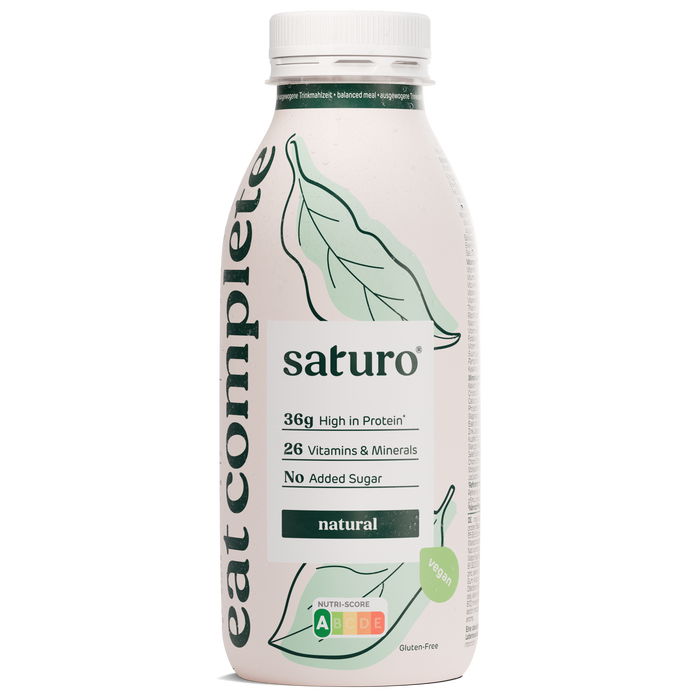
Trinkmahlzeit: eine vollwertige Mahlzeit ohne Fleisch und ohne Zucker
Jede Flasche liefert 400 kcal, 36 g Protein aus Ackerbohne und Soja, 26 Vitamine und Mineralstoffe und je nach Sorte nur 1,0 bis 1,4 g Zucker, ohne Fleisch, Fisch, Wurst, Innereien oder Hefeextrakt in der Zutatenliste. Kalt aus dem Kühlschrank, ohne Küche, unterwegs. Einen Purinwert für das Produkt gibt es nicht, deshalb versprechen wir dazu nichts.
Gichtanfall: was tun, was essen, was lassen
Wenn das Gelenk brennt, hilft keine Verbotsliste: Der akute Gichtanfall ist eine Entzündung, und die behandelt man entzündungshemmend. Die S3-Leitlinie nennt drei gleichrangige Mittel der ersten Wahl: Colchicin in niedriger Dosis, nichtsteroidale Antirheumatika wie Ibuprofen und Kortison, meist Prednisolon 30 mg für fünf Tage; welches, entscheidet die Praxis.
Gichtanfall was tun: die ersten Stunden
Gelenk ruhigstellen, hochlagern, kühlen: Eispackung im Handtuch, 20 bis 30 Minuten, mehrmals täglich, die einzige nicht-medikamentöse Maßnahme mit Studienbeleg (randomisierte Studie: weniger Schmerz mit Eis). Trinke reichlich Wasser oder ungesüßten Tee, lass Alkohol weg, und nimm ein verordnetes Anfallsmedikament sofort, sonst noch heute in die Praxis oder zum ärztlichen Bereitschaftsdienst (116 117). Bessert sich nichts in 24 bis 72 Stunden, laut Leitlinie zurück in die Praxis.
Kühlen oder wärmen, Bewegung oder Ruhe?
Kühlen, und im Anfall Ruhe. Die S3-Leitlinie empfiehlt Ruhigstellen, Hochlagern und Kühlen mit Empfehlungsgrad B, die amerikanische ebenfalls; Wärme gehört in die Zeit zwischen den Anfällen, wenn ein Gelenk steif ist. Das entzündete Gelenk will nicht belastet werden, Überlastung zählt zu den selbstberichteten Auslösern. Nach dem Anfall ist regelmäßige Bewegung wieder Teil des Lebensstils, den alle Leitlinien empfehlen; dass Sport Anfälle verhindert, hat allerdings keine Studie gezeigt.
Kein ASS als Schmerzmittel, es kann die Harnsäure erhöhen; niedrig dosiertes ASS fürs Herz aber nicht absetzen. Laufende Harnsäuresenker nicht stoppen, Schwankungen lösen selbst Anfälle aus. Colchicin nur nach Anweisung: höchstens 2 mg am Tag und 6 mg pro Anfall, Überdosierungen sind lebensgefährlich.
Gichtanfall Ernährung: was essen, während es wehtut
Während des Anfalls gilt die Verbotsliste in der strengen Fassung: kein Fleisch, kein Fisch, keine Wurst, keine Brühe, kein Alkohol, keine Zuckergetränke. Was bleibt, ist genug: Kartoffeln, Reis, Nudeln, Brot, Gemüse, Obst, Milchprodukte, Eier. Die Purinlast der letzten zwei Tage ist laut einer Studie mit 633 Betroffenen der stärkste kurzfristige Auslöser. Weil Appetit oft fehlt, darf es einfach sein: Haferbrei, Kartoffelpüree mit Quark, Omelett, Gemüsesuppe ohne Fleischbrühe.
Wie lange dauert ein Gichtanfall?
Unbehandelt 3 bis 14 Tage, so die S3-Leitlinie, meist ist er nach 7 bis 10 Tagen vorbei; mit Medikamenten, früh begonnen, oft nach wenigen Tagen. Das Problem ist der nächste Anfall: Ohne Harnsäuresenkung folgte in einer klassischen Verlaufsstudie bei 62 Prozent innerhalb eines Jahres und bei 84 Prozent innerhalb von drei Jahren ein weiterer.
Wann zum Arzt, und zu welchem?
Erste Anlaufstelle ist die Hausarztpraxis: Sie behandelt den Anfall, bestimmt den Harnsäurewert und beginnt die Dauertherapie. Zur Rheumatologie überweist sie laut Leitlinie, wenn andere Gelenke als Zehe und Fuß betroffen sind, die Therapie nicht anschlägt oder die Diagnose unsicher ist. Sicher wird die Diagnose durch Kristalle in der Gelenkflüssigkeit; Ultraschall und eine spezielle Computertomografie zeigen Ablagerungen ebenfalls, das Röntgenbild erst spät.
Häufige Fragen zur Ernährung bei Gicht
Was darf man bei Gicht auf gar keinen Fall essen?
Eine absolute Liste gibt es nicht, aber eine kurze: Innereien wie Leber, Niere und Bries, Sardellen, Sardinen, Muscheln, Hefeextrakt, Brühwürfel und Bierhefe liefern über 200 mg Purine je 100 g. Dazu Bier, auch alkoholfreies, Spirituosen und zuckergesüßte Getränke. Alles andere ist Portionssache.
Welches Getränk senkt die Harnsäure?
Kaffee und Milch. Männer mit vier bis fünf Tassen Kaffee am Tag hatten in einer Kohorte 40 Prozent weniger Gicht, auch entkoffeiniert; der höchste Milchkonsum ging mit 44 Prozent weniger Gicht einher. Ein Getränk, das die Harnsäure akut messbar senkt, gibt es nicht.
Sind Bananen bei Gicht erlaubt?
Ja. Bananen enthalten 3 mg Purine je 100 g und gehören wie fast alles frische Obst zu den freien Lebensmitteln. Die Fruktose im ganzen Obst kommt langsam an und war in Kohorten nicht mit Gicht verbunden, anders als Fruchtsaft und Softdrinks.
Darf ich Tomaten bei Gicht essen?
Ja. Tomaten haben 7 mg Purine je 100 g. In einer Befragung nannten 20 Prozent der Betroffenen sie als Auslöser, der messbare Effekt auf die Harnsäure lag aber bei einem Hundertstel Milligramm je Deziliter pro Portion. Keine Leitlinie rät ab.
Sind Eier gut für Harnsäure?
Ja. Eier sind praktisch purinfrei und waren in einer Metaanalyse mit 16.760 Personen mit niedrigerer Harnsäure verbunden. Eine Obergrenze wegen Gicht gibt es nicht; die alte Regel „drei Eier pro Woche“ stammt aus der Cholesterindebatte. Die DGE nennt Eier als Teil der empfohlenen ovo-lacto-vegetarischen Kost.
Welche Süßigkeiten sind bei Gicht erlaubt?
Purinarm sind fast alle, von Gummibärchen bis Kuchen. Entscheidend ist der Zucker, weil Fruktose in der Leber Harnsäure freisetzt. Eine kleine Portion am Tag ist vertretbar, Zuckergetränke und Fruktosesirup nicht. Am besten schneiden Zartbitterschokolade, ungezuckertes Popcorn und Salzstangen ab.
Kann Apfelessig den Harnsäurespiegel senken?
Dafür gibt es keine einzige Studie, ebenso wenig für Natron, Ingwer und Kurkuma; zu Zitronenwasser existiert nur eine kleine, nicht randomisierte Beobachtung. Belegt sind Alkoholverzicht, Gewichtsabnahme, ein pflanzenbetontes Ernährungsmuster und Medikamente wie Allopurinol. Apfelessig schadet in kleinen Mengen nicht, senkt aber nichts.
Ist bei Gicht Bewegung oder Ruhe besser?
Im Anfall Ruhe: Gelenk schonen, hochlagern, kühlen, so die deutsche und die amerikanische Leitlinie. Zwischen den Anfällen ist regelmäßige Bewegung Teil des gesunden Lebensstils, der bei Übergewicht auch die Harnsäure senkt. Studien, die zeigen, dass Sport Gichtanfälle verhindert, gibt es nicht.
Quellen · 52 Quellen anzeigen
- Deutsche Gesellschaft für Rheumatologie (DGRh): S3-Leitlinie Diagnostik und Therapie der Gicht, AWMF-Register 060-005, Version 2.1, 27.08.2024
- FitzGerald JD et al.: 2020 American College of Rheumatology Guideline for the Management of Gout. Arthritis Care Res 2020;72:744-760
- Richette P et al.: 2016 updated EULAR evidence-based recommendations for the management of gout. Ann Rheum Dis 2017;76:29-42
- IQWiG, gesundheitsinformation.de: Gicht, Stand 12.01.2022
- IQWiG, gesundheitsinformation.de: Was kann ich selbst tun, um Gichtanfällen vorzubeugen?, Stand 12.01.2022
- Deutsche Gesellschaft für Ernährung (DGE): Essen und Trinken bei Gicht, 3. Auflage 2023, Pressemeldung
- Deutsche Gichtliga e. V.: Ernährungstipps bei Gicht
- Kaneko K et al.: Total purine and purine base content of common foodstuffs for facilitating nutritional therapy for gout and hyperuricemia. Biol Pharm Bull 2014;37:709-721
- Kaneko K et al.: Determination of total purine and purine base content of 80 food products to aid nutritional therapy for gout and hyperuricemia. Nucleosides Nucleotides Nucleic Acids 2020;39:1449-1457
- Kaneko K et al.: Daily Amount of Purine in Commonly Recommended Well-Balanced Diets in Japan and Overseas. Nutrients 2024;16:4066
- Kaneko K et al.: Purine contents of soybean-derived foods and selected Japanese vegetables and mushrooms. Nucleosides Nucleotides Nucleic Acids 2008;27:628-630
- USDA Agricultural Research Service, NIH Office of Dietary Supplements: USDA and ODS-NIH Database for the Purine Content of Foods, Release 2, März 2025, Dokumentation
- Wu B et al.: Availability and quality of published data on the purine content of foods, alcoholic beverages, and dietary supplements. J Food Compos Anal 2019;84:103281
- Choi HK et al.: Purine-rich foods, dairy and protein intake, and the risk of gout in men. N Engl J Med 2004;350:1093-1103
- Choi HK et al.: Alcohol intake and risk of incident gout in men: a prospective study. Lancet 2004;363:1277-1281
- Choi HK et al.: Obesity, weight change, hypertension, diuretic use, and risk of gout in men. Arch Intern Med 2005;165:742-748
- Choi HK, Willett W, Curhan G: Coffee consumption and risk of incident gout in men. Arthritis Rheum 2007;56:2049-2055
- Choi HK, Curhan G: Coffee consumption and risk of incident gout in women. Am J Clin Nutr 2010;92:922-927
- Choi HK, Curhan G: Soft drinks, fructose consumption, and the risk of gout in men. BMJ 2008;336:309-312
- Choi HK, Willett W, Curhan G: Fructose-rich beverages and risk of gout in women. JAMA 2010;304:2270-2278
- Choi HK, Gao X, Curhan G: Vitamin C intake and the risk of gout in men. Arch Intern Med 2009;169:502-507
- Stamp LK et al.: Clinically insignificant effect of supplemental vitamin C on serum urate in patients with gout. Arthritis Rheum 2013;65:1636-1642
- Zhang Y et al.: Purine-rich foods intake and recurrent gout attacks. Ann Rheum Dis 2012;71:1448-1453
- Zhang Y et al.: Cherry consumption and decreased risk of recurrent gout attacks. Arthritis Rheum 2012;64:4004-4011
- Neogi T et al.: Alcohol quantity and type on risk of recurrent gout attacks. Am J Med 2014;127:311-318
- Yamamoto T et al.: Effect of beer on the plasma concentrations of uridine and purine bases. Metabolism 2002;51:1317-1323
- Gibson T et al.: Beer drinking and its effect on uric acid. Br J Rheumatol 1984;23:203-209
- Teng GG et al.: Food sources of protein and risk of incident gout in the Singapore Chinese Health Study. Arthritis Rheumatol 2015;67:1933-1942
- Messina M, Messina VL, Chan P: Soyfoods, hyperuricemia and gout: a review of the epidemiologic and clinical data. Asia Pac J Clin Nutr 2011;20:347-358
- Flynn TJ et al.: Positive association of tomato consumption with serum urate. BMC Musculoskelet Disord 2015;16:196
- Major TJ et al.: Evaluation of the diet wide contribution to serum urate levels: meta-analysis of population based cohorts. BMJ 2018;363:k3951
- Juraschek SP et al.: Effects of the Dietary Approaches to Stop Hypertension (DASH) diet and sodium intake on serum uric acid. Arthritis Rheumatol 2016;68:3002-3009
- Rai SK et al.: The Dietary Approaches to Stop Hypertension (DASH) diet, Western diet, and risk of gout in men. BMJ 2017;357:j1794
- Nielsen SM et al.: Weight loss for overweight and obese individuals with gout: a systematic review of longitudinal studies. Ann Rheum Dis 2017;76:1870-1882
- Dalbeth N et al.: Relationship between serum urate concentration and clinically evident incident gout: an individual participant data analysis. Ann Rheum Dis 2018;77:1048-1052
- Campion EW, Glynn RJ, DeLabry LO: Asymptomatic hyperuricemia. Risks and consequences in the Normative Aging Study. Am J Med 1987;82:421-426
- Stamp LK et al.: Serum urate as surrogate endpoint for flares in people with gout: a systematic review and meta-regression analysis. Lancet Rheumatol 2022
- Annemans L et al.: Gout in the UK and Germany: prevalence, comorbidities and management in general practice 2000-2005. Ann Rheum Dis 2008;67:960-966
- Engel B et al.: Treatment options for gout. Dtsch Arztebl Int 2017;114:215-222
- Underwood M: Diagnosis and management of gout. BMJ 2006;332:1315-1319
- Schlesinger N et al.: Local ice therapy during bouts of acute gouty arthritis. J Rheumatol 2002;29:331-334
- Terkeltaub RA et al.: High versus low dosing of oral colchicine for early acute gout flare (AGREE trial). Arthritis Rheum 2010;62:1060-1068
- Zhang Y et al.: Low-dose aspirin use and recurrent gout attacks. Ann Rheum Dis 2014;73:385-390
- Ohashi Y et al.: Urate transporter ABCG2 function and asymptomatic hyperuricemia: two-thirds of urate is excreted renally. Sci Rep 2023;13:93
- Kramer HJ et al.: The association between gout and nephrolithiasis in men. Kidney Int 2003;64:1022-1026
- Roddy E: Revisiting the pathogenesis of podagra: why does gout target the foot? J Foot Ankle Res 2011;4:13
- Hak AE et al.: Menopause, postmenopausal hormone use and risk of incident gout. Ann Rheum Dis 2010;69:1305-1309
- Abhishek A et al.: Triggers of acute attacks of gout, does age of gout onset matter? PLoS One 2017;12:e0186096
- Universitätsklinikum Freiburg, Klinik für Rheumatologie und Klinische Immunologie: Trotz Gicht Hülsenfrüchte essen: Empfehlungen und Tipps (Patienteninformation, PDF)
- Stiftung Ernährung und Gesundheit, ernaehrung.de: Gicht (Hyperurikämie), Purinobergrenzen nach dem Rationalisierungsschema 2004
- Kluthe R et al.: Das Rationalisierungsschema 2004. Aktuel Ernaehr Med 2004;29:245-253
- USDA FoodData Central, SR Legacy (April 2018): Energie und Protein des purinarmen Beispieltags
Gregor Aßlaber schreibt seit 2019 für Saturo über Ernährung. Für diesen Artikel hat er die S3-Leitlinie Gicht 2024, die Leitlinien aus Europa und den USA, die Purintabellen von Kaneko und der USDA sowie über 40 Studien ausgewertet und die Purinwerte für 130 Lebensmittel zusammengetragen.
Joerg Hauke, Ernährungsexperte, hat die Inhalte am 23. September 2026 auf fachliche Richtigkeit geprüft: Purinwerte, Studienzahlen, Leitlinienempfehlungen und die Einordnung der Hausmittel. Die Inhalte ersetzen keine ärztliche Beratung. Bei Verdacht auf einen Gichtanfall, bei Fieber oder mehreren entzündeten Gelenken bitte ärztlich abklären lassen; eine dauerhafte Harnsäuresenkung und ihre Dosis legt die Praxis fest.
Ballaststoffe: Wie viel du brauchst, wo sie stecken und was sie bewirken
Vollkorn, Hülsenfrüchte und Gemüse sind auch bei Gicht die Basis. Wie du auf 30 Gramm am Tag kommst, ohne dass der Bauch rebelliert.
Weiterlesen · 15 Min
Neues aus dem Ratgeber
Neue Artikel, Updates und Tipps direkt ins Postfach. Verständlich, fachlich geprüft, ohne Spam.
Danke! Bitte bestätige die Anmeldung in deinem Postfach.