Sore throat reaching into your ear, fever, white spots on your tonsils? Most cases of tonsillitis are viral and over within a week. Here's how to tell the difference, how long you're contagious and what helps against the pain.
Gregor Aßlaber, Editor, Saturo
· ✓Fachlich geprüft von Joerg Hauke, Nutrition expert
Aktualisiert 24 September 2026 · 16 Min. Lesezeit · 59 Quellen
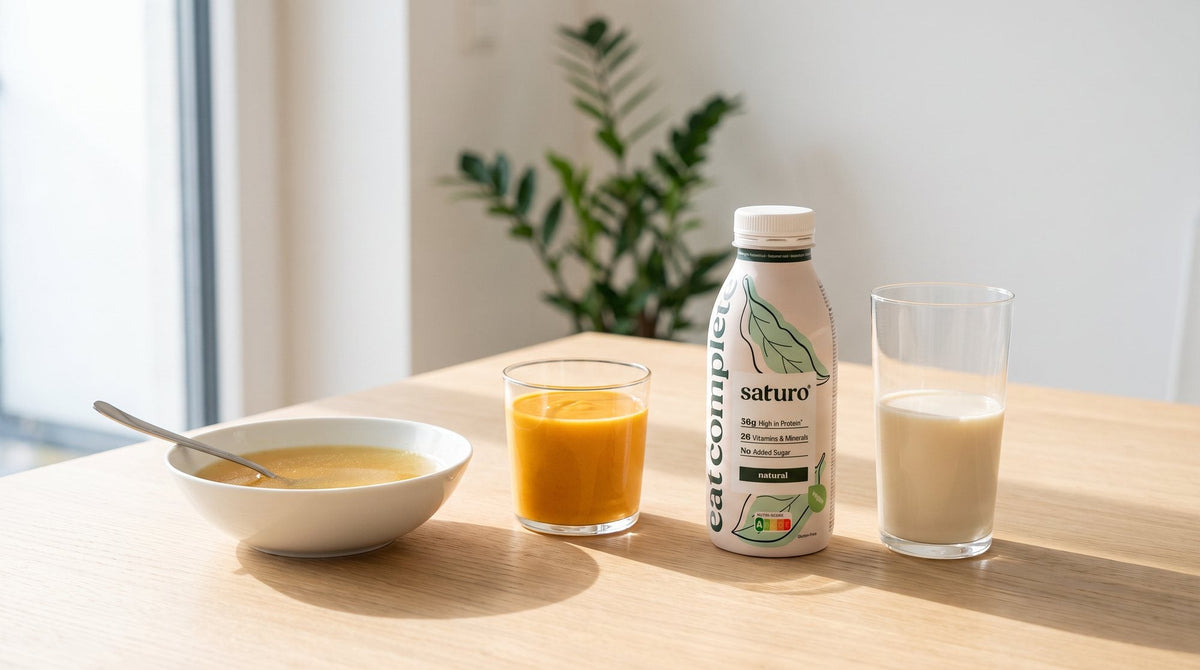
Tonsillitis: when swallowing hurts, what you eat over the next few days helps decide how well you get through it.
The most important points in 30 seconds
How often bacteria are behind it
5 to 15%
In adults with a sore throat, streptococci are the cause in 5 to 15% of cases, in children 20 to 30%. The rest is viral, and antibiotics don't help against that. The symptom check in chapter 1 shows where you stand.
What antibiotics do
16hours
That's how much antibiotics shorten a sore throat on average, according to the Cochrane review of 29 studies. They also lower the risk of a peritonsillar abscess. Without them, most people are well again after a week too.
No longer contagious after
24hours
That's how long it takes after the first dose of antibiotics for strep throat to stop being contagious, according to the Robert Koch Institute. Without antibiotics, you stay contagious with streptococci for up to three weeks.
What matters when eating
Cool & soft
Cold numbs the mucous membrane, soft and mild foods don't irritate it: yoghurt, smoothie, cream soup, ice cream, a drinkable meal. Crumbs, acidity and spice can wait until swallowing no longer hurts. Drinking comes before eating.
01 Recognise
Tonsillitis symptoms: how to recognise them
Tonsillitis (also called angina tonsillaris) is an inflammation of the palatine tonsils, the two pads of tissue at the back of the throat. Typical signs are a severe sore throat that gets worse when you swallow and radiates to the ear, red, swollen tonsils with white or yellow spots, tender lymph nodes at the angle of the jaw, fever and exhaustion; children sometimes complain of tummy ache instead of a sore throat. You can't reliably tell from looking at the tonsils whether viruses or bacteria are behind it.
At a glance
Viral or bacterial tonsillitis?
No single sign proves anything on its own, it's the combination that counts; only a rapid strep test or throat swab at your GP's gives certainty.
Viral (most cases)
Bacterial (streptococci)
Onset
Slow, often with a cold
Sudden, within hours
Cough, runny nose, hoarseness
Common
Usually not
Fever
Mild or none
Often above 38 °C
Coating on the tonsils
Possible, also with Pfeiffer's glandular fever
White-yellow spots typical
Lymph nodes at the angle of the jaw
Slightly swollen
Clearly swollen and tender
Age
All age groups
Mainly 5 to 15 years
Duration without treatment
About 1 week
About 1 week, complications less common with antibiotics
Antibiotics
Don't work
Shorten it by about 16 hours, lower the risk of complications
Compiled from the DEGAM guideline on sore throat, the IDSA recommendations on streptococcal pharyngitis and gesundheitsinformation.de (IQWiG). Pus on the tonsils is not proof of bacteria.
Bacterial tonsillitis: pus-covered tonsils, fever, no cough
The most important bacterial pathogen is group A streptococci: only 5 to 15% of cases in adults, 20 to 30% in children. Strep throat usually starts abruptly with fever, pain when swallowing, swollen lymph nodes at the angle of the jaw and whitish spots; cough, runny nose and hoarseness are absent. These signs are the Centor criteria: according to the DEGAM guideline, the probability of streptococci is around 13% at 0 to 2 points, 38% at 3 points and 57% at 4 points. Children and teenagers get the rapid test from 3 points; for adults, the GP decides.
Symptom check
How likely are streptococci? The Centor criteria
Tap what applies. The result shows the probability of a streptococcal infection according to the Centor-McIsaac criteria, as GPs use them.
Not a diagnostic tool. Centor criteria (Centor 1981) with the age point according to McIsaac (1998, 2004), probabilities from table 8.2 of the DEGAM guideline on sore throat; if you're 45 or older, subtract a point. The decision on testing and antibiotics is made by your GP.
Viral tonsillitis: the most common form
Most cases of tonsillitis come with a cold: adenoviruses, rhinoviruses or influenza viruses inflame your throat and tonsils at the same time. You also get a cough, a runny nose, hoarseness and usually only a mild fever. It starts more slowly and is over after five to seven days. One special case is glandular fever (Epstein-Barr virus) in teenagers and young adults: swollen tonsils with a thick grey coating, swollen lymph nodes all over your neck, days of fever and weeks of exhaustion. It looks bacterial but isn't, and amoxicillin often triggers a rash. Fever for more than a week: get it checked out (chapter 7).
Tonsillitis without a fever
A fever isn't a must: viral tonsillitis often runs its course without one, and strep throat in adults can also start with only a slightly raised temperature. No fever means one Centor point less, so bacteria become less likely, but you can't rule them out. Treatment depends on your symptoms, not on the thermometer. Only a throat that's inflamed on one side and getting worse over several days belongs at the doctor's even without a fever: it could be an abscess.
Diagram
A look inside your throat: healthy and inflamed
Mouth wide open, torch on, “Aaah”: a healthy throat on the left, tonsillitis on the right. The numbers explain what's where and which signs matter.
Gesunder RachenMandelentzündung
1
Palatine tonsil, inflamed
Red, swollen, with white or yellow spots. The spots are pus and dead cells in the crevices of the tonsil; they appear with both bacteria and viruses.
2
Uvula
Hangs in the middle of the soft palate. If it's very swollen or pushed to one side, that's a warning sign of an abscess next to the tonsil.
3
Back of the throat
With a cold, it's red and bumpy too; that's called pharyngitis (inflammation of the throat), which is almost always viral.
4
Palatal arch
The arch of mucous membrane that the tonsil sits in. If complications develop, pus collects between the tonsil and the arch: a peritonsillar abscess, usually on one side.
5
Tongue
A white coating is normal when you have a fever. A raspberry-red tongue with thick papillae is a sign of scarlet fever, which is strep throat with a rash.
6
Soft palate
Small red dots here (petechiae) point to strep. So does a rash on your body that feels like sandpaper.
Schematic illustration; tonsil size varies a lot, and large tonsils alone aren't an illness. Structure and signs based on gesundheitsinformation.de (IQWiG), the DEGAM sore throat guideline and the IDSA guideline.
An untreated tonsillitis that drags on isn't a medical term, but the worry behind it is justified: strep throat can rarely spread to the tissue next to the tonsil (peritonsillar abscess), show up as scarlet fever or, very rarely, return weeks later as rheumatic fever. The pattern: worse instead of better after day three, new signs such as swelling on one side, lockjaw or a rash, or symptoms in the second week. If so, see a doctor (chapter 7).
Mouth open, torch on: the mirror shows redness and coatings, but not the cause. A rapid test will tell you whether strep is behind it.
02 Causes
Causes and contagion: how long is tonsillitis contagious?
Your palatine tonsils are lymphatic tissue at the entrance to your throat and airways that catches germs, which is why they get inflamed so easily. The triggers are usually cold or flu viruses, less often bacteria, above all group A streptococci. Both spread in the same way, according to the Robert Koch Institute (RKI): through droplets, saliva, shared glasses and hands. In Germany alone, the RKI counts 1 to 1.5 million strep throat infections a year.
How long is tonsillitis contagious?
That depends on the cause and the treatment. With viral tonsillitis, you're contagious for as long as you have symptoms, most of all in the first few days, usually for about a week. For strep throat, the Robert Koch Institute gives two figures: with antibiotics, you're no longer contagious 24 hours after the first dose; without antibiotics, you can pass the bacteria on for up to three weeks.
According to the RKI, the incubation period until the first symptoms is one to three days. Kissing spreads it, and so does contact with babies and partners; that said, strep throat is very rare in children under three, and it peaks between the ages of five and fifteen.
Sick note, work, nursery: when can I go back out?
There's no fixed rule for a sick note: with a fever and severe pain when swallowing, you stay at home, usually for three to five days. You go back to work once you've been fever-free for a day; sport has to wait longer, three to four weeks with glandular fever because of your spleen. For children at nursery and school, section 34 of the German Infection Protection Act covers strep throat (RKI, May 2026): with antibiotics, they can go back once 24 hours of treatment are done and the symptoms have eased; without antibiotics, 24 hours after the symptoms have gone. The law doesn't require a doctor's note.
Don't infect others: the five rules
Your own glass, your own towel. Change your toothbrush as soon as the antibiotic kicks in. Wash your hands after every cough and sneeze into your elbow. And don't kiss anyone for the first two days, especially if there are babies in the house.
03 Understand
What happens in the tonsils: from defence to inflammation
Three stops explain why the tonsils in particular get inflamed so often, why a coating doesn't automatically mean bacteria, and why most cases of tonsillitis clear up without medication.
1
The tonsils are a lookout post
The palatine tonsils, pharyngeal tonsil and lingual tonsil form a ring of lymphatic tissue at the entrance to the airway and the food passage. Their fissured surface increases the contact area: this is where immune cells meet pathogens from the air and food and get to know them. In children this tissue is especially active, which is why their tonsils are large and get inflamed more often.
2
Inflammation is your defences at work
When viruses or bacteria get in, the tonsils swell, blood flow increases and immune cells rush in. The white spots and coatings are dead cells, pathogens and pus in the crevices of the tonsil; they form with viruses just as with bacteria. Pain, fever and swollen lymph nodes are side effects of this work, not signs that something is going wrong.
3
Healing takes a week, with or without antibiotics
With viruses, your defences are on their own, and they manage it: after five to seven days most people are symptom-free. With streptococci, an antibiotic shortens the pain by 16 hours on average and lowers the risk of abscess and ear infection; the healing itself is still done by the immune system. Afterwards you stay protected against that exact pathogen for a while, but not against the next cold.
04 Treatment
Tonsillitis: what to do, what helps and when antibiotics make sense
The first question isn't “which remedy?” but “GP or sofa?”. You can recover from most cases of tonsillitis at home, a few signs mean you should see a doctor, and a handful mean A&E. The decision tool takes you to the right place in three questions.
Interactive
See a doctor or recover at home?
Three questions, one result with your next step. Doesn't replace an examination.
1Do you have any of these signs: difficulty breathing, you can barely swallow or open your mouth, one cheek or side of your neck is swollen, a muffled “hot potato” voice, or you can't keep any fluids down?
2Does at least one of these apply: a fever over 38 °C plus pus-filled coatings or swollen lymph nodes, symptoms for more than three days without improvement, a rash, pregnancy, a chronic illness or a weakened immune system?
3Who is it for?
Emergency
A&E or 112 now
Struggling to breathe, being unable to swallow, a clamped jaw or swelling on one side point to an abscess or an infection spreading into the throat. Tablets won't fix that. Outside surgery hours: on-call medical service 116117, or 112 if you're struggling to breathe.
Fever, coating on the tonsils and swollen lymph nodes without a cough make strep likely. Children and teenagers up to 15 get the rapid test. For adults, the surgery decides based on the Centor score, often with a prescription to use if it isn't better after three days. Until then: painkillers, plenty of fluids, cool food.
Probably viral. Ibuprofen or paracetamol for the pain, lots of fluids, cool and soft food, rest. If it isn't better after three days, gets worse or new symptoms appear: go to the surgery after all.
Small children dry out faster and show strep differently (tummy ache, vomiting, rash). If your child is barely drinking, very limp or under three years old: call today. Until then, offer cool, soft food. Ice cream is allowed.
Guidance based on the DEGAM sore throat guideline, NICE NG84 and the warning signs for peritonsillar abscess. Not a diagnosis. If in doubt, call: your GP practice, paediatrician's practice or 116117.
Antibiotics for tonsillitis: when they help
Antibiotics only work against bacteria, and the benefit is smaller than you might think. According to a Cochrane review of 29 studies, they shorten a sore throat by an average of 16 hours, and after a week 82% are symptom-free even without treatment. That's why the DEGAM guideline recommends an antibiotic only when strep is highly likely: from 3 Centor points as a shared decision, for children after a positive rapid test, never at 0 to 2 points. The first choice is penicillin V, or clarithromycin if you can't tolerate it. If glandular fever (Pfeiffer's) is suspected, no amoxicillin: one in three children gets a rash from it.
How long? A Swedish study of 433 patients showed in 2019 that five days of higher-dose penicillin work as well as the classic ten (89.6 versus 93.3% cured), with fewer side effects. DEGAM mentions five to seven days. Stick to the prescribed duration, even if you feel better on day two.
What helps against the pain: ibuprofen, paracetamol, lozenges
The best evidence against a sore throat is for a painkiller: ibuprofen or paracetamol as per the patient information leaflet, taken regularly, not only when the pain is unbearable. With stomach or kidney problems and in the last third of pregnancy, paracetamol is the choice. Children and teenagers under 16 should never be given acetylsalicylic acid (Reye's syndrome). Lozenges with flurbiprofen or a local anaesthetic help only a little, about one point on a ten-point scale for three to four hours. The guideline advises against antiseptic sprays. According to Cochrane, cortisone doubles the chance of being pain-free after 24 hours, but DEGAM still advises against it. No prescription needed: rest.
Progression
When is the peak? Sore throat from day 0 to day 7
Share of people who still have a sore throat on that day, without antibiotics, from the placebo groups of the Cochrane studies.
Day 0: 100 % Onset, often sudden with strep. Fever and pain when swallowing are strongest on the first and second day.
Day 3: 65 % In 30 to 40% the sore throat is gone and 85% are fever-free. About two in three still feel something, usually milder. With antibiotics it's just under one in two. If you're getting worse instead of better at this point, call the surgery.
Day 7: 18 % 82% are symptom-free, even without antibiotics. If you still have a fever or severe pain after a week, get it checked.
Natural course from the placebo groups of the Cochrane review Spinks et al. 2021 (29 studies, 15,337 participants), summarised in the DEGAM guideline: gone after 3 days in 30 to 40%, symptom-free after 1 week in 80 to 90%. Individual cases vary, for example with glandular fever.
Home remedies for tonsillitis: what's proven and what just feels good
Honey has the best evidence, but for coughs: a review of 14 studies in 2021 found more relief for respiratory infections than with usual care. For wound pain after tonsil surgery, it did nothing in 2025. Warm drinks eased sore throats straight away in a small trial, and cold briefly numbs the mucous membrane (chapter 5). Gargling with salt water does no harm, but it isn't proven. Sage is approved in the EU as a traditional medicine for throat inflammation. Neck wraps, onion juice, potato wraps: no evidence, no harm. What doesn't help: leftover antibiotics, alcohol "to disinfect", smoking.
Smoking, alcohol and coffee with tonsillitis
Smoking irritates the inflamed mucous membrane, weakens your defences and is a risk factor for a tonsil abscess: take a break, at least until your throat is clear. Alcohol stings, dehydrates and increases the side effects of ibuprofen. Coffee is fine, lukewarm and with a glass of water alongside.
05 Food
What to eat with tonsillitis: cool, soft, mild
Food doesn't cure tonsillitis, but it decides how the next few days go: if you barely eat or drink because of the pain, you'll feel weaker than the infection alone explains. There are no studies on this, but the NHS and American and German paediatricians all recommend food that's cool or lukewarm (cold dulls the pain), soft or liquid (chewing and crumbs irritate) and mild (acid, salt and spice burn). Soft is for comfort, not a must.
Rule of thumb for the first few days
Days 1 to 2: liquid and cool, small sips, drinking before eating. Days 3 to 4: soft and lukewarm: yoghurt, porridge, purée, scrambled eggs, cream soup. From day 5: normal food, with crusty bread, nuts, citrus and chilli last. Your pain decides when to move on.
What to eat with tonsillitis: the list
Yoghurt, quark, skyr, cottage cheese: cold, soft, high in protein. Smoothies made with banana, mango, berries and yoghurt, without citrus or kiwi. Cream soups made with potato, pumpkin, carrot or leek, with cream cheese for the protein. Porridge-style dishes in all forms: oat porridge, semolina pudding, rice pudding, mashed potato, polenta. Scrambled eggs cooked soft, silken tofu, mashed banana, apple sauce, melon, soft pasta in cream sauce, steamed fish. And yes, ice cream. It all slips past your tonsils without chewing and without burning. With a fever, fluids come first and food follows once it drops.
Look it up
Can I eat this? The tonsillitis traffic-light guide
Type in a food or filter by group. Green is fine from day 1, amber with limits or from day 3, red only once swallowing no longer hurts.
Yoghurt plain yoghurt, drinking yoghurt, vegan yoghurtFrom day 1Cold from the fridge; dairy doesn't make mucus, that's been disproven. Protein for spoon-food days.
Quark skyr, cottage cheese, cream cheeseFrom day 1Soft, cool, 10 to 12 g protein per 100 g. Stir smooth with banana or apple purée.
Ice cream vanilla ice cream, dairy ice creamFrom day 1Cold numbs briefly. Pick flavours without nuts, brittle, wafer or sour fruit.
Water ice sorbet, sucking ice cubesFrom day 1Cools and gives you fluid. Lemon or orange sorbet can sting, so go for melon, berry or mango instead.
Smoothie banana, mango, berriesFrom day 1Cool, without citrus, pineapple or kiwi. Add yoghurt, oat milk or nut butter to turn it into a meal.
Cream soup potato, pumpkin, carrot, peaFrom day 1Lukewarm or cold, not hot. No pepper or chilli, made with cream or cream cheese.
Broth chicken broth, vegetable brothFrom day 1Lukewarm, low in salt; gives you fluid and salt, but hardly any energy or protein.
Mashed potato mashed sweet potato, polentaFrom day 1Lukewarm, creamy, mild. Boost it with egg, quark or cheese.
Oat porridge porridge, overnight oatsFrom day 1Lukewarm or cold, soft flakes, made with milk instead of water for more protein.
Semolina pudding rice pudding, puddingFrom day 1Soft, mild, lukewarm or cold. Skip the cinnamon on day one, it can scratch.
Scrambled eggs poached egg, omeletteFrom day 1Softly set, no pepper; 12 g protein from two eggs.
Banana mashed bananaFrom day 1Soft, mild, not acidic. The easiest fruit to tolerate with a sore throat.
Apple purée pear puréeFrom day 1Puréed and cool is fine; raw apple waits until day 5.
Melon watermelon, honeydew melonFrom day 1Cold, soft, full of water; ideal with a fever.
AvocadoFrom day 1Mashed, mild, rich in energy; goes in smoothies and on soft bread from day 5.
HoneyFrom day 1Straight from the spoon or in lukewarm tea; studies show relief for respiratory infections. Not for children under one year.
Milk oat milk, almond milk, cold cocoaFrom day 1Cold or lukewarm; the mucus myth has been disproven. Cold cocoa is fine, hot cocoa has to wait.
Water stillRight awayThe most important drink, in small sips, cool or at room temperature.
Herbal tea chamomile, sage, fennelFrom day 1Lukewarm, not hot; sage also works for gargling. Add honey.
Drinkable meal oral nutrition drinkFrom day 1Cold from the fridge, mild, no fizz. Replaces a meal with protein and vitamins when eating with a spoon is too much effort.
Protein shake whey, protein shakeFrom day 1Cold, no fizz; avoid fruity flavours with acidity.
Silken tofuFrom day 1Plain, in a smoothie or in soup; soft and high in protein.
Hummus lentil puréeFrom day 1Finely puréed, no garlic or chilli at the start.
Noodles pasta, gnocchiFrom day 3Cooked soft in a cream or cheese sauce; tomato sauce waits, it's acidic.
Rice risottoFrom day 3Cooked soft; risotto or rice pudding are fine earlier too.
Fish salmon, codFrom day 3Steamed, mashed with a fork, 22 g protein per 100 g. No breadcrumbs.
Minced meat bolognese, meatballFrom day 3Fine and soft in a mild sauce; no tomato, no pepper.
CheeseFrom day 3Soft cheese and cream cheese early on, hard cheese grated or melted; cheese cubes need chewing.
Bread toast, milk rollsFrom day 5Soft, no crust, thinly spread with butter or cream cheese; crust, seeds and crispbread wait.
Cake muffin, pancakeFrom day 3Soft baked goods without nuts or crumble topping; biscuits and rusks scratch.
ChocolateFrom day 3Melting softly on your tongue is fine; nuts, brittle and biscuit pieces in it aren't. Cold cocoa is fine from day 1.
Coffee black tea, green teaLukewarmNot a throat irritant, only the heat hurts. Lukewarm with milk is fine; with a fever it counts towards your fluids.
Apple pear, rawFrom day 5Raw and crunchy scratches; as apple purée or finely grated from day 1.
Berries strawberries, blueberriesFrom day 1 in a smoothieFine when puréed and softened with yoghurt; on their own, strawberries can sting a little.
Steamed vegetables carrot, courgette, spinachFrom day 3Cooked soft and lukewarm; raw or with vinaigrette waits.
Fizz sparkling water, lemonade, colaIf it doesn't burnThe bubbles tingle on sore mucous membranes; still water is more pleasant. Cola doesn't help against bacteria.
Chewing gum sweets, throat lozengesSuck any timeSucking stimulates saliva and keeps things moist; sweets with a local anaesthetic numb for one to two hours.
Salt water for garglingFrom day 1Half a teaspoon of salt in a glass of lukewarm water. Gargle and spit out, don't drink. Little evidence, but no harm.
Orange lemon, grapefruit, orange juiceOnly once swallowing no longer hurtsAcid burns on inflamed mucous membranes. Melon, mango and sweet pepper soup also give you vitamin C.
Kiwi pineappleOnly once swallowing no longer hurtsSour and with enzymes that scratch the mucous membrane.
Tomato tomato sauce, ketchupFrom day 5Acidic; bolognese without tomato or with lots of cream is the workaround.
Chilli pepper, curry, mustardFrom day 5Heat irritates the pain receptors of the mucous membrane directly.
Crisps crackers, popcorn, pretzel sticksFrom day 5Sharp-edged, dry, salty: everything your tonsils don't want.
Bread crust crispbread, rusks, baguetteFrom day 5Scratches when you swallow; the inside without crust is fine from day 3.
Nuts muesli, granolaFrom day 5Hard and crumbly; as nut butter in a smoothie from day 1.
Vinegar vinaigrette, sauerkraut, gherkinsFrom day 5The acid burns.
Hot food hot drinks, boiling soupLukewarm, not hotHeat makes the pain worse on inflamed mucous membrane; let everything cool down to drinking temperature.
Alcohol beer, wine, spiritsUntil your throat is clearBurns, dehydrates and doesn't mix with ibuprofen or paracetamol. Doesn't disinfect your tonsils.
Cigarettes smoking, vapingAs long as possibleIrritates the mucous membrane and prolongs respiratory infections. Take a break at least until your throat is clear.
Energy drinksUntil your throat is clearSour, fizzy, high in caffeine; none of it helps, all of it burns.
Steak whole cuts of meat, schnitzelFrom day 5Chewing and swallowing solid bites hurts; minced meat in sauce from day 3.
Raw veg salad, raw carrot, pepperFrom day 5Lots of chewing and hard edges; as a cream soup or steamed, earlier.
PizzaFrom day 5Hot, crust, tomato: three strikes. Lukewarm with a soft edge as an exception.
Strong cheese blue cheese, gorgonzolaFrom day 3Soft, but sharp and salty; mild cream cheese is the better choice.
Fruit yoghurtFrom day 1, no chunksMild flavours like banana or vanilla are fine; citrus and passion fruit flavours burn.
Pudding vanilla pudding, chocolate puddingFrom day 1Cold, soft, mild; made with milk, it also gives you some protein.
Baby food jarsFrom day 1Smooth and mild; for adults, add quark or egg.
Coconut water mild juice spritzerIf it doesn't burnCoconut water is usually fine; apple spritzer is already too sour for some people, pear juice is milder.
Ginger ginger tea, ginger shotMild doseGinger is warming and can burn on sore mucous membrane; a weak, lukewarm tea is fine, the shot isn't.
SushiFrom day 3Soft, but comes with rice vinegar, wasabi and ginger; plain salmon sashimi works earlier.
Peanut butter almond butter, nut butterFrom day 1Creamy in a smoothie or purée; 22 g protein and lots of energy per 100 g.
Lentil soup pulses, blendedFrom day 1Blended and lukewarm, 9 g protein per 100 g cooked lentils; no pepper or chilli.
Not on the list? Rule of thumb: cool or lukewarm, soft or liquid, mild, and you're good from day 1. Hot, sour, spicy, salty or crumbly foods can wait until swallowing no longer hurts.
Rules of thumb from practice, not a guideline: there are no studies on diet during acute tonsillitis, so the ratings are based on what irritates the inflamed mucous membrane. If you have allergies, swallowing difficulties or antibiotic instructions, follow your doctor's advice.
What not to eat with tonsillitis
Four groups irritate inflamed tonsils. Acidic foods: citrus, kiwi, pineapple, tomato, vinegar, fizzy lemonade; acid burns. Spicy and very salty foods: chilli, pepper, curry, crisps, pretzel sticks; capsaicin and salt irritate the pain receptors directly. Hard and crumbly foods: bread crust, crispbread, rusks, nuts, muesli, raw carrot; sharp edges scratch over the swollen tonsils. Hot foods: soup straight off the hob, boiling tea; heat makes swelling and pain worse, and lukewarm is the temperature of the week. Add alcohol and carbonation to the list. Milk isn't on it, and there's a good reason for that.
Yoghurt and milk with tonsillitis: the mucus myth
"Milk makes mucus" has been disproved: in 1990, an Australian study compared people with colds who did and didn't drink milk, and the amount of nasal secretion was identical; only the mouthfeel differs, because the emulsion briefly leaves a film. A review in Archives of Disease in Childhood confirmed this in 2019. Yoghurt, quark, milk, rice pudding and ice cream are all fine and even particularly suitable: cool, soft, mild and high in protein. If you don't like or tolerate milk, go for soya drink (similar amount of protein) or oat and almond drink (a lot less).
What goes down easily with tonsillitis: cool, soft, mild. Yoghurt, smoothie, cold cream soup, ice cream and melon, plus water in small sips.
Ice cream with tonsillitis: yes, with two conditions
Ice cream is fine. Cold briefly numbs the pain fibres and narrows the blood vessels; in a British study of 92 children after tonsil surgery, those given an ice lolly had clearly less pain in the first hour. Condition one: no chunks, so no brittle, no nuts, no wafer. Condition two: no acid, so vanilla, chocolate or banana instead of lemon or orange. The idea that cold "freezes" the inflammation has no basis: cold or lukewarm is a matter of taste, and both soothe. Only hot doesn't.
Which fruit for tonsillitis? Apple, banana and the question of acidity
Soft and mild, then yes. Banana is the easiest fruit to tolerate: soft and with no acidity. With apple, the form matters: raw and crunchy it scratches when you swallow, but as apple purée, grated or cooked it's fine from day one. Melon, mango, pear and berries in a smoothie are fine. Citrus fruit, kiwi and pineapple sting, so wait until about day 5. High doses of vitamin C don't shorten a sore throat.
Which tea for tonsillitis, and what about honey?
The best tea is the one you drink lukewarm and in large quantities. The European Medicines Agency lists sage as a traditional medicine for inflammation in the mouth and throat, for drinking and gargling. Chamomile is listed too, and fennel, lemon balm and lime blossom are mild. Ginger, lemon and peppermint can scratch. Honey on top: a teaspoon neat coats the mucous membrane like a film, and in tea it works through sweetness and warmth (chapter 4). It's off limits for babies under one year.
With a sore throat, most people live on tea, broth and a bit of ice cream for three days. That's understandable, but it's almost no energy and hardly any protein. Cool and soft doesn't mean empty: yoghurt, a smoothie with nut butter, cream soup with cream cheese or a cold drinkable meal slide down just as easily and keep you on your feet.
Joerg Hauke, Nutrition expert, technical review of this article
What to eat with tonsillitis and antibiotics
The same rules plus three details. First: take penicillin V one hour before or two hours after eating, because food reduces absorption. Amoxicillin and cephalosporins can be taken with food. Second: milk is no problem with these antibiotics. A gap only applies to tetracyclines and some quinolones. Third: antibiotics change your gut flora, and one in ten people gets diarrhoea. Yoghurt with live cultures is the simplest way to balance it out. According to Cochrane, probiotics help, but they aren't a must. With antibiotics, building your diet back up usually goes a day faster.
06 Nourish
Drink and stay nourished when every sip hurts
Tonsillitis lasts about a week; whether it feels long or short depends on how well you look after yourself. If you barely drink because of the pain, you get headaches, thicker saliva, more pain when swallowing and, with a fever, quickly end up dehydrated. According to IQWiG, drinking doesn't heal you faster; it makes up for what you lose through fever. A glass of water by the bed helps: at night your mucous membrane dries out from mouth breathing, which is why the pain is worst in the morning.
Interactive
How much should you drink with tonsillitis and a fever?
940ml per day
Child aged 4 to 6: The DGE gives 940 ml of drinks a day as the guideline for healthy children of this age; with a fever and a sore throat when swallowing, aim for at least that, in small portions, a few sips every 20 minutes. If your child is barely drinking or hasn't passed urine in twelve hours, IQWiG says they need to see a doctor.
Guideline values for fluid intake from drinks, based on the DGE reference values; the DGE lists fever as a reason for needing more, and in hospitals the rough rule is one extra glass per degree of fever. If you have a heart or kidney condition, follow your doctor's instructions. Warning signs of dehydration (NHS, IQWiG): dark urine, passing urine rarely, dizziness, dry mouth.
Why tea and broth aren't enough
The typical tonsillitis day, based on USDA values: a litre of herbal tea with two tablespoons of honey (130 kcal), 250 ml chicken broth (15), 150 g apple sauce (63), half a banana (53) and 100 g vanilla ice cream (207). That adds up to around 470 kilocalories and about 6 grams of protein, a quarter of the DGE daily requirement. The properly fuelled day has the same texture, just with more in it: the three recipes below, ice cream and a cold drinkable meal, together around 1,700 kilocalories and over 80 grams of protein, without any chewing. The rule: every cool, soft portion needs some protein and a bit of fat.
Three meals that go down easily with tonsillitis
1
Breakfast: banana and yoghurt smoothie with nut butter5 minutes · cold · no chewing
≈ 430 kcal
22 g protein
Day 1
Zutaten
1 ripe banana
150 g Greek yoghurt (or soya yoghurt)
100 ml cold milk or oat drink
1 tbsp peanut or almond butter
1 tsp honey (not for children under 1 year)
3 ice cubes
Zubereitung
Blend everything in a blender until smooth, with no chunks left. Serve very cold, with a spoon or from a glass. If you like, replace half the milk with a cold drinkable meal in Vanilla, which brings it to a good 600 kcal.
Sweat the leek in butter until soft, add the diced potatoes and stock, and simmer for 20 minutes. Stir in the cream cheese, blend until fine, then pass through a sieve so nothing scratches. Let it cool to drinking temperature; on the second day it tastes good cold too. Makes two portions.
Whisk the eggs with the milk and let them set creamy in butter over a low heat; don't cook them dry. Stir the mash with the cream cheese until smooth and put the scrambled egg on top. Eat lukewarm; if you don't feel like chewing yet, stir the egg into the mash.
Nutritional values rounded per portion, based on USDA FoodData Central SR Legacy (banana 173944, Greek yoghurt 171304, whole milk 171265, peanut butter 172470, honey 169640, mashed potato 170493, scrambled egg 172187, vanilla ice cream 167575); cream cheese and leek based on retail values.
When spooning is too much effort: cold, mild, no chewing, in small sips. A drinkable meal replaces the meal you'd otherwise miss.
Unlike a protein shake, it replaces a whole meal. Unlike medical nutrition drinks, it's an ordinary food. Nobody needs a medical product for a week of tonsillitis. Drink it cold, in small sips, and go for mild flavours like Vanilla or Natural. It isn't made for children: give them milk, drinking yoghurt or smoothies, and call the paediatrician if they go two days without drinking.
From the Saturo range
Drinkable meal: a complete meal in a bottle
36 g protein and 400 kcal per bottle, plus 26 vitamins and minerals, vegan. Protein contributes to the maintenance of muscle mass. Reference intake for protein: 50 g per day (NRV). Drink it cold. It's mild, not fizzy and needs no chewing. Vanilla and Natural are the mildest flavours.
36 gProtein
400kcal
26Vitamins & minerals
ChilledNo chewingMild, complete meal from the fridge
Choose a flavour
€4,39per meal
Choose a flavour
Drinkable meal · Cocoa€4,39 per meal ·
07 Special cases
Children, pregnancy, chronic tonsillitis and warning signs
Tonsillitis in children: scarlet fever, nursery and ice as medicine
Children aged five to fifteen are the main group for strep throat, and they show it differently: sudden high fever, tummy ache, vomiting. If a sandpaper-like rash and a raspberry-red tongue come along too, it's scarlet fever: the same streptococci, the same treatment. What parents can do: give ibuprofen or paracetamol, never acetylsalicylic acid, get them to drink every 20 minutes, and cold and sweet is fine: ice lollies, drinking yoghurt, apple sauce. No ice cubes or hard sweets (choking hazard), and no honey until they're one year old. See the doctor if there's a fever for more than three days, a rash, refusal to drink or twelve hours without passing urine, and go straight away for difficulty breathing or locked jaw.
With children, one thing matters most: drinking. Ice lollies, drinking yoghurt and cold milk are fine when nothing else works.
Tonsillitis during pregnancy
Tonsillitis doesn't harm the baby, it only wears out the mother. Painkillers: according to Embryotox, paracetamol is the first choice at all stages, and so is ibuprofen in the first two thirds, but not from week 28. Antibiotics: according to Embryotox, penicillin V is the medicine of choice, with data from over 1,500 pregnancies showing no sign of malformations. Bring down a fever above 38.5 °C and call your doctor's surgery. Check lozenges with your pharmacy first. Honey and ice are fine.
Chronic tonsillitis: tonsil stones, bad breath and the question of surgery
According to the ENT guideline, tonsillitis counts as chronic, or more precisely recurrent, from three medically diagnosed bouts within twelve months. The tonsils stay fissured and colonised by bacteria. Typical signs: a scratchy throat, mild difficulty swallowing, swollen lymph nodes, tiredness and bad breath. That usually comes from tonsil stones, foul-smelling little lumps of food debris and bacteria in the crevices: in 2,873 CT scans, 40% showed some, and three in four of those with bad breath. They come away on their own or with a water flosser, and they aren't dangerous. There's no healing diet. What helps is drinking plenty, stopping smoking and good oral hygiene.
So tonsil surgery is only worth it for people who are severely affected. If you're below the threshold, you wait six to twelve months. The Cochrane review is sobering: in the first year, children who had surgery averaged 3 sore throat episodes instead of 3.6. For adults, good data is missing, and of 15,218 operations in Germany, 1.5% needed a repeat operation because of bleeding. For enlarged tonsils, partial removal (tonsillotomy) is an option, with less pain and less bleeding.
Warning signs: when tonsillitis needs a doctor or A&E
The feared complication is the peritonsillar abscess, pus between the tonsil and the palatal arch, which according to IQWiG affects at most 1 to 10 in 1,000 cases of tonsillitis. Signs: suddenly much stronger pain on one side after a few days, locked jaw, a muffled "hot potato" voice, an uvula pushed to the side. If that's you, go to an ENT practice or hospital today, as the abscess has to be drained. Difficulty breathing is an emergency (112). You should also see a doctor for: a fever that doesn't come down after three to four days, a rash, joint pain weeks later, lasting exhaustion, any tonsillitis with a weakened immune system, and a sore throat lasting more than four weeks.
Act immediately
Go to A&E or call 112 for difficulty breathing, if your mouth won't open any more, or if swelling grows rapidly on one side. See a doctor today (otherwise call 116117) for a fever above 39 °C that won't come down, pain getting worse on one side, a rash, or a child who is barely drinking.
Not every sore throat is tonsillitis: a swallowing problem without fever and redness that lasts for weeks has other causes. If your mouth no longer opens properly, that's locked jaw, which in acute tonsillitis is a warning sign of an abscess. And the rules for eating after tonsil surgery are in the article on wisdom tooth surgery.
08 Look it up
Frequently asked questions about tonsillitis
What helps straight away with tonsillitis?
A painkiller works fastest: ibuprofen or paracetamol as directed on the leaflet, taken regularly rather than only when the pain is unbearable. For the minutes in between, ice or a cold drink numbs the mucous membrane briefly, and lozenges with a local anaesthetic do so for one to two hours. None of that heals anything; tonsillitis needs its week.
How do I tell whether my tonsillitis is bacterial or viral?
You can only be sure with a rapid test or throat swab. Strep is more likely if it starts suddenly, with a fever above 38 °C, white coating, swollen lymph nodes and no cough; a cough, runny nose and hoarseness point to a virus. Centor criteria (chapter 1): 0 to 2 points means more likely viral, from 3 the test is worth it.
When does tonsillitis peak and how long does it last?
The peak is on days one to three: fever and the worst pain when swallowing. After three days, 85% are fever-free, and after a week 80 to 90% have no symptoms, with or without antibiotics. If it gets worse instead of better after day three: see your doctor.
Is ibuprofen suitable for tonsillitis?
Yes, the DEGAM guideline recommends ibuprofen or naproxen for a sore throat, and NICE rates paracetamol and ibuprofen as equivalent. Dose according to the patient information leaflet, take it with food, and don't combine it with alcohol. If you have stomach or kidney problems, are from week 28 of pregnancy onwards, or for babies under six months, go for paracetamol. Never give acetylsalicylic acid to anyone under 16.
What shouldn't you eat or do with tonsillitis?
Don't eat: acidic foods (citrus, kiwi, tomato, vinegar), spicy and salty foods (chilli, crisps), hard and crumbly foods (crusts, crispbread, nuts) and anything hot. Don't do: smoking, alcohol, going to work or doing sport with a fever, taking old antibiotics, sharing glasses. Dairy is fine, as the mucus myth has been disproved.
Can you drink coffee with tonsillitis?
Yes, lukewarm and in moderation. Coffee isn't a throat irritant, only the heat hurts. Cooled down and with milk it's fine, and a glass of water alongside makes up for the fluid the caffeine costs you. If you have a fever, it counts towards your fluids. Energy drinks are acidic, fizzy and burn.
Can you smoke with tonsillitis?
Better not. Smoke irritates the inflamed mucous membrane and weakens your airway defences. Smokers get respiratory infections more often and more severely, and smoking is a risk factor for peritonsillar abscess (quinsy). Tonsillitis is a good reason to take a break, at least until your throat is clear, vaping included.
Can tonsillitis heal on its own?
Yes, the vast majority heal on their own within a week. With bacterial cases, antibiotics shorten the illness by about 16 hours and lower the risk of rare complications. Get it checked if it gets worse after three days or if warning signs appear, such as swelling on one side, being unable to open your mouth fully, or difficulty breathing.