
Eating after root canal treatment: when, what and for how long
Anaesthetic, temporary filling, pain when biting down: after root canal treatment, what you eat in the first few days helps decide whether the seal holds. When to eat again, what works with a temporary filling and which signs mean you should see your dental practice.


Aktualisiert 30 September 2026 · 16 Min. Lesezeit · 46 Quellen

The essentials in 30 seconds
In the lower jaw, feeling returns to the lower lip after 155 minutes on average, usually sooner in the upper jaw. If you eat before then, you can bite your lip or cheek without noticing. After that, go lukewarm and soft, and chew on the other side.
That's how long the temporary seal needs to set, according to the Bavarian State Chamber of Dentists. After that, you can eat and drink again. Until the final restoration, the rules are: don't chew on the tooth, nothing sticky, nothing hard.
That's how many people still have pain 24 hours after root canal treatment. After a week it's 11%, and the intensity falls from 24 to 5 out of 100 (review of 72 studies). If the pain gets worse after day 3, see your dental practice.
Root-filled back teeth without a crown are lost six times as often as crowned ones, and if you put off the crown for more than four months, you lose the tooth three times as often. Until then: no chewing gum, no nuts, no crusty bread on that tooth.
The first hours: when you can eat again after a root canal treatment
A root canal treatment isn't surgery: no cut, no stitches, no wound in the gum. The tooth is opened from the top, the inflamed pulp is removed, and the canals are cleaned, disinfected and sealed, often only temporarily at first. So what needs looking after isn't a blood clot, as after an extraction, but your numbed mouth, the fresh seal and a tooth whose surroundings stay irritated for a few days. The timeline shows the first 24 hours.
The first 24 hours after root canal treatment
-
Hour 0 to 2
Wait for the anaesthetic to wear off, let the filling harden
As long as your lip, cheek or tongue are numb: don't eat, no hot drinks, no chewing gum. Small sips of water are fine. The temporary filling needs about an hour to set; leave it alone with your tongue.
-
From hour 2 to 3
First meal: lukewarm, soft, other side
Once feeling has returned: yoghurt, soup, mashed potato, scrambled eggs, a smoothie from a glass. Chew on the untreated side. Nothing hot, hard or sticky.
-
Evening
Painkillers if needed, brush teeth normally
It's normal for the tooth to be sensitive to pressure. Take ibuprofen or paracetamol as agreed with your dentist. Brush your teeth as usual, including the treated tooth, just without pressing on the filling.
-
Day 1
Eat soft food, don't smoke, keep an eye on the tooth
Sensitivity to biting is often strongest on the second and third day. Soft food is fine, lukewarm coffee is okay, but no alcohol while you're taking painkillers. Don't smoke (see chapter 5). If the tooth feels too high when you bite down, call your dentist.
How long after a root canal should you wait before eating?
Wait until the anaesthetic has worn off and the temporary filling has had an hour to set; the two usually overlap. After a nerve block in the lower jaw, the lower lip takes on average 155 minutes to feel normal again (study of 484 patients). In the upper jaw it's often one to two hours. DGZMK and DGMKG advise not eating or drinking anything hot until then, because of the risk of biting yourself or scalding. The one-hour rule for the seal is a materials guideline from the Bavarian State Dental Chamber, and no study backs it up. Waiting doesn't mean fasting: the ESPEN guideline advises only adjusting the texture of your food after procedures.

Drinking after a root canal
You can drink straight away, even while the anaesthetic is working: water in small sips, lukewarm herbal tea, cold milk. Just nothing hot while you can't feel heat. From the evening, lukewarm coffee is fine, and hot drinks once the tooth is no longer sensitive (chapter 5). Fizz and acidity aren't a problem, because there's no wound; at most a fresh temporary filling may twinge briefly. A straw is allowed. The no-suction rule applies after tooth extractions, and even there it isn't proven. Alcohol waits until you've stopped taking painkillers: it doesn't mix well with ibuprofen and paracetamol, and it masks whether the pain is going away.
From the evening, brush normally, including the treated tooth: soft brush, no pressure on the filling. Pull floss out sideways rather than upwards, as this protects the edge of the temporary filling. Mouthwash isn't necessary when there's no wound. After an apicoectomy (root-end surgery), the surgery rules apply (chapter 7).
Eating with a temporary filling or an open tooth
Most root canal treatments take two or three appointments, on average three of half an hour each according to the Bavarian State Dental Chamber. In between, there's medication in the canal and a temporary filling seals the tooth. It's the only protection between your mouth and the cleaned canal; a review in the International Endodontic Journal calls it essential for any treatment spread over several sessions. Anything that loosens the filling prolongs the treatment.
Eating after a root canal with a temporary filling
Once the hour of setting is over, you can eat normally, just not on that tooth: the American Association of Endodontists (AAE) advises neither chewing nor biting down on the treated tooth until it has its final restoration. The reason is the material. Temporary fillings are made of a cement that sets with saliva (Cavit and similar), zinc oxide eugenol or glass ionomer. They're deliberately softer than a proper filling so they can be removed at your next appointment, and they're thin: for Cavit, a laboratory study from 1978 found a minimum thickness of 3.5 millimetres, otherwise the seal starts to leak.
In the lab, these materials keep bacteria out for about two weeks, and one zinc oxide eugenol cement leaked after just ten days in a study. That's why your next appointment is usually within a few weeks, and why it's not worth putting it off. In practice, you chew on the other side for the first few days and afterwards only skip whatever pulls or presses on the temporary filling.
What loosens the temporary filling
Three things can pull a temporary filling out. Sticky foods tug at it: chewing gum is the classic, plus gummy sweets, caramel, toffee, nougat, soft dried fruit and chewy bread. Hard foods press on it and chip off corners: nuts, bread crust, crisps, ice cubes, boiled sweets, raw carrots, corn on the cob, bones and pips. Rapid swings between hot and cold make the cement and the tooth expand and contract differently. Sugar and acid aren't an issue for the sealed tooth, though they matter for your other teeth as always. This applies until the final filling or crown, so for weeks, with no exception for chewing gum. If you put off the follow-up appointment, you risk bacteria at the edge and having to start the treatment over.
Open tooth after a root canal: eating and smoking
With an open tooth, the rules are: chew only on the other side, nothing crumbly or gritty, rinse gently with lukewarm water after eating, leave the cotton pellet alone, and don't push anything into the tooth yourself. Leaving a tooth open to let pus drain is no longer standard today: the AAE no longer considers it useful, the Scottish guideline programme SDCEP advises against it, and studies show more sessions and more discomfort. Smoking is especially bad with an open tooth, because smoke and nicotine get straight into the canal. If the pellet falls out or the tooth tastes foul, call your dentist.
Not an emergency, but call the same day or the next working day, otherwise bacteria get into the canal. Until then, chew on the other side, rinse with lukewarm water and don't press anything into the hole; a temporary filling kit from the chemist can bridge a day or two. If part of the tooth wall has broken off or biting down suddenly hurts, go today.
The tooth without a nerve: what happens during root canal treatment
Three stages from the first session to the crown. Knowing them explains why the tooth no longer feels cold but hurts when you bite down, why the temporary filling only lasts weeks, and why the crown ultimately decides the tooth's fate.
Session 1: the nerve is gone, the supporting structure isn't
The dental pulp with nerves and blood vessels is removed, the canals are prepared and disinfected. From now on, the tooth no longer feels hot or cold. What it still feels is pressure: the tooth hangs in a fibrous structure in the bone, and this is irritated after the procedure and around the inflamed root tip. That's why there's biting pain in the first few days, often strongest on the second and third day.
Weeks: medication in the canal, temporary seal
Between appointments, a medicated dressing disinfects the canals, a temporary cement seals the top, while the lab takes around two weeks. In 40% of cases, the tooth is still painful the day after, dropping to 11% after a week; a genuine flare-up with swelling affects 8 in 100. In the end, the canals are filled with a rubber material and the access is sealed tight.
Months: bone heals, crown protects
The bone at the root tip rebuilds over months, and your dentist checks this with an X-ray. The tooth itself has lost substance due to decay, access and preparation, and breaks more easily. That's why the DGZMK and the European Society of Endodontology (ESE) recommend a crown or partial crown for back teeth, ideally within four months. Without one, root-treated teeth are lost six times as often.
What you can eat after root canal treatment: day by day until the crown
The good news first: after a root canal treatment, the list of things you can eat is long right from the start. There's no wound that crumbs could irritate, and no blood clot that heat or suction could disturb. The limitations relate to your numb mouth on the first day, the sensitive tooth in the first few days, and the temporary filling until the crown is fitted. The four stages below show what's okay when.
Four stages until eating normally again
-
1
Stage 1Treatment day
After numbness and one hour of setting time: lukewarm and soft, on the other side. Yoghurt, soup, purée, scrambled egg, smoothie, banana, a drinkable meal from the glass. Nothing hot, nothing hard, no chewing gum.
-
2
Stage 2Day 1 to 3
The tooth is sensitive to pressure: soft to normal food, still chewing on the other side. Pasta, fish, rice, steamed vegetables, soft bread without crust, ice cream without pieces. Coffee lukewarm, alcohol only without painkillers.
-
3
Stage 3Until the permanent filling
Usually one to several weeks: everything's fine, just not on that tooth. No chewing gum, no nuts, no crust, no hard sweets on the treated side. If it pulls when you bite down, it's too soon; if it just feels a bit unfamiliar, go ahead.
-
4
Stage 4After filling or crown
Eat normally, on both sides. The tooth stays without cold sensitivity – that's not a problem. If it feels too high when you bite down, or it still hurts to chew after weeks, have the practice check the bite or the root tip.
Timings are based on the patient information from DGZMK/DGET and the Bavarian State Dental Chamber, the AAE aftercare guidance and the course of pain in Pak and White (2011). After an apicoectomy, the rules for surgical wounds apply (chapter 7); your dental practice's instructions come first.
Ice cream and dairy after a root canal
You can have both from the day of treatment. Ice cream is actually handy: soft, cold, no chewing, and the treated tooth can't feel the cold any more because the pulp has been removed. If it still twinges, it's the neighbouring tooth or an exposed tooth neck, not the root canal. Choose varieties without nuts, brittle and wafer, and don't bite into a lolly on the treated tooth.
Dairy is on many ban lists, supposedly because it feeds bacteria. The rule comes from tooth extractions: a research group in Marburg found in 2022 that 56% of German dentists advise avoiding milk after dental surgery, compared with 4.6% internationally, and found no evidence of harm in the literature. Two randomised studies from Germany (2025 and 2026) found no difference in wound healing with or without milk. After a root canal, there isn't even a wound. Yoghurt, quark, cheese and milk are all fine; only a tetracycline antibiotic needs to be taken at a different time from milk. If your dental practice says otherwise, ask why.
Chewing on the other side: how long and why
Soft and normal food is fine on the treated side as soon as chewing no longer hurts, usually after a few days. Hard and sticky foods stay off that side until the filling or crown is in place. The biting pain: after the canal has been cleaned, and around the inflamed root tip, the fibre tissue that holds the tooth in place is irritated, and chewing means pressure. According to the AAE, this lasts three to five days for most people. The temporary filling stays sensitive until the final filling goes in. Chewing on one side only for weeks overloads the other side and your jaw, and it isn't necessary.

Smoking, alcohol and coffee after root canal treatment
On smoking, alcohol and coffee after a root canal treatment, you'll read the same number almost everywhere: 24 hours. It comes from the DGZMK's rules of conduct for surgical procedures in the mouth, i.e. tooth extractions and root-end resections, where a wound can start bleeding again. For non-surgical root canal treatment there's no separate rule and no study on coffee or alcohol. There is data on smoking, and it shows this isn't about a single day.
Smoking after a root canal treatment: what the studies say
Smoking doesn't harm the temporary filling. It harms the healing in the bone over months. Nicotine narrows the blood vessels, carbon monoxide displaces oxygen, and the immune cells work less well, including in the bone around the root tip. Three meta-analyses from 2020 provide the numbers: smokers have a 2.8 times higher risk of an inflammation at the root tip (apical periodontitis) and need a root canal treatment 2.7 times as often. On their root-filled teeth, X-rays show 16% more areas of inflammation, and these teeth are extracted 3.4 times as often. The evidence is moderate to low (observational studies), but the direction is the same everywhere.
How long should you not smoke after a root canal treatment?
As long as possible, but at least until the anaesthetic has worn off and the temporary filling has set: with a numb lip you can burn yourself, and with an open tooth the smoke goes straight into the canal. After a root-end resection, the DGZMK advises not smoking for a few days. For a normal root canal treatment there's no magic cut-off day; the meta-analyses point to the months of healing. A realistic compromise: skip it on the day of treatment and the two days after, then smoke as little as possible and never draw on the treated side. Smoke doesn't harm the temporary filling. E-cigarettes deliver nicotine without carbon monoxide, but the narrowing of the blood vessels remains; studies on vaping are lacking.
Alcohol after a root canal treatment: how long?
No alcohol while you're taking painkillers or an antibiotic; after that, nothing speaks against it. After a non-surgical root canal treatment there's no wound that alcohol could irritate or make bleed, and no study justifies abstaining. The patient information for ibuprofen warns that alcohol increases the side effects on the gut and nervous system. With paracetamol the risk lies in the liver, and if you drink regularly, the permitted daily dose is lower. After a root-end resection the DGZMK rule applies: no alcohol for 24 hours. It makes sense to pause for as long as the swelling is there, because alcohol widens the blood vessels.
Not because of the caffeine, but because of the heat: when you're numb, you can scald yourself without noticing, and anything hot on the irritated tooth hurts. Lukewarm from the evening, hot after two or three days. After a root-end resection, no coffee, black tea or cola for 24 hours (DGZMK).
Protein without chewing: how to stay nourished on spoon-only days
After a root canal treatment, spoon days are short: the day of treatment, maybe two or three days with a sensitive tooth, or a week after a root-end resection. It's still worth keeping an eye on protein, because soft food is almost always low in it: mash, broth, apple purée and banana fill you up but together give barely 10 g of protein. Your needs don't drop just because a tooth has been treated: the DGE (German Nutrition Society) calculates 0.8 g per kilogram up to the age of 65.
Why soft food often gives you too little
A typical easy day delivers around 12 g of protein, a quarter of what a 60 kg person needs: 200 g mashed potato 3.8 g, 150 g apple purée 0.3 g, 250 ml broth 2.9 g, one banana 1.3 g, 100 g vanilla ice cream 3.5 g. Over several easy days, that turns into sluggishness. With the same rules, around 60 g is also possible: scrambled eggs from two eggs 12 g, 200 g blended lentil soup 18 g, 150 g Greek yoghurt 15 g, a smoothie with peanut butter 7.5 g, 100 g hummus 7.8 g. The rule behind it: every soft meal needs a protein component.
If you chew on only one side for a few days, you automatically eat less and softer food. That's not a problem, as long as every meal contains a portion of protein: egg, quark, fish, pulses or a shake. Taking it easy means soft, not empty.
Joerg Hauke, Nutrition expert, technical review of this article
Vitamin C, zinc and calories: the rest of your nutrition
Extra nutrients don't speed up healing in the bone, but a deficiency slows it down. Your body needs vitamin C (DGE: 95 mg for women, 110 mg for men) and zinc (7 to 16 mg) for collagen, cell division and immune defence. Both are found in fruit purée, eggs, dairy, pulses and meat, and supplements do nothing for people who are already well supplied. On spoon days, calories matter more: according to the DGE, your needs are 1,800 to 2,700 kcal, and soft food is often low in energy. After a root-end resection, appetite and chewing ability drop; then a shake or a drinkable meal is proper nutrition.
Drinkable meal after a root canal treatment
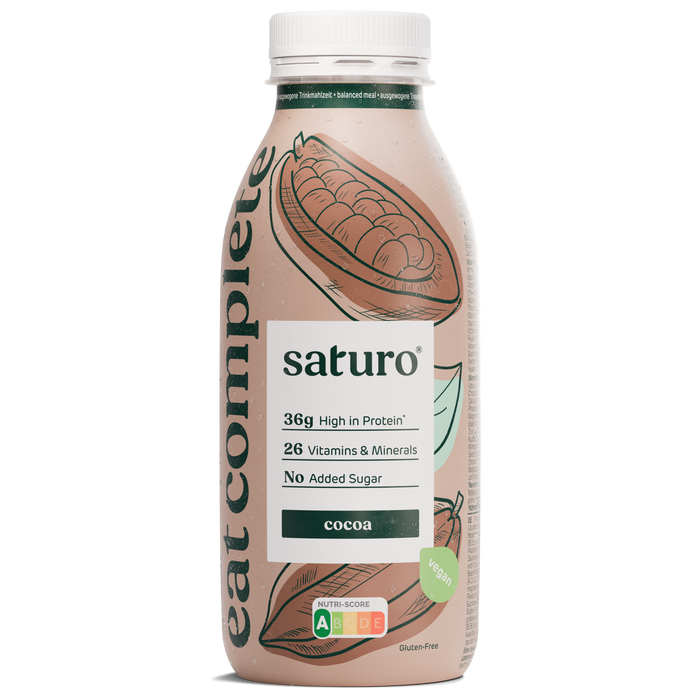
For the days without chewing, a drinkable meal is the simplest solution: liquid, cold from the fridge, no cooking, and unlike broth or apple purée, a complete meal with protein, fat, carbohydrates, fibre and micronutrients. Unlike a protein shake, it replaces a whole meal, and unlike medical nutritional drinks, it's a normal food. Check the protein content per bottle, drink it cold or at room temperature and, on the day of treatment with a numb lip, from a glass. One bottle replaces the meal where spooning is too much effort; after a root-end resection, it can be two in the first week.
Drinkable meal: a complete meal in a bottle
36 g protein and 400 kcal per bottle, plus 26 vitamins and minerals, vegan. Protein contributes to the maintenance of muscle mass. Reference intake for protein: 50 g per day (NRV). Drink it cold or eat it with a spoon: no chewing, no kitchen, straight from the glass on treatment day.
Pain, warning signs, apicoectomy and crown
A tooth that reacts to pressure for a few days is part and parcel of root canal treatment. What's not normal is pain that increases after day 3, a swollen cheek, or a tooth that's the first to touch when you bite down. This list helps you tell one from the other.
Root canal treatment: pain afterwards and what's normal
The most important figure is already above: on the day after treatment, 40% have pain, after a week 11%, and the intensity drops from 24 to 5 out of 100 points. The AAE describes it as mild discomfort for a few days that improves within three to five days.
For the pain, ibuprofen 600 mg is well supported by evidence (meta-analysis 2017). Combining it with 1,000 mg paracetamol also works, but wasn't clearly better. For acute pain after procedures, 400 mg ibuprofen plus 1,000 mg paracetamol halved the pain in 73% of people, ibuprofen alone in 52% (Cochrane). Your dental practice will sort out dose and duration. An antibiotic almost never comes into it: according to the ESE position paper, it's not indicated for inflamed pulp or localised abscesses, and two Cochrane reviews found no benefit. It's reserved for fever, extensive swelling and weakened immunity. A flare-up with swelling (8 in 100) is treated with another irrigation.
Go to your dental practice today if the pain gets worse from day 2, or if you have swelling, fever, a tooth that bites too high, or a temporary filling that has broken out. Go to A&E or call 112 if you have trouble swallowing with fever, difficulty breathing, or swelling towards the neck or eye. Always mention blood thinners, diabetes or weakened immunity.
Eating after an apicoectomy: banana, chocolate, ice cream
After an apicoectomy, the DGZMK rules for surgical wounds apply: once the anaesthetic has worn off, eat soft, not-too-hot food on the other side for a few days, avoid alcohol, coffee, cola and black tea for 24 hours, don't smoke for a few days, and cool your cheek with something cold and damp. This is a real wound with stitches; with a microscope, the procedure succeeds in 94% of cases. Banana is ideal from the day of surgery, chocolate is fine if it melts (no nuts), ice cream without chunks is fine too, and dairy is harmless (chapter 4). Until the stitches come out after about a week, nothing crumbly near the wound, then gradually back to normal.

Crown after root canal treatment: why your tooth needs it
Your tooth needs the crown because it's missing substance: according to the DGZMK, decay, access and cleaning make it more prone to fracture, a large filling plus access cavity takes away 63% of its stiffness, and when you bite down, 300 to 600 newtons act on the cusps. That's why the ESE has recommended a crown or partial crown for back teeth within four months since 2021. According to a review, root-treated teeth survive at a rate of 86 to 93% over two to ten years, and the crown is one of four factors behind that. Until it's fitted, nothing hard and nothing sticky on that tooth.
Lockjaw and trouble swallowing
If your mouth doesn't open as well for a day or two after a long session, your chewing muscles are overworked. Warmth and soft food help, and it passes by itself. It's different after an apicoectomy or with an infection that's spreading: if your mouth opens a little less each day, that's a warning sign. How to still get full with lockjaw is covered in its own article. Trouble swallowing with fever and swelling towards the neck is an emergency, because the infection can spread into the soft tissue of the neck. For trouble swallowing without these warning signs, the rule is: soft, lukewarm, high in protein.
Frequently asked questions about eating after root canal treatment
How long should you avoid eating after root canal treatment?
Until the anaesthetic has worn off, usually two to three hours in the lower jaw and often one to two in the upper jaw, and until the temporary filling has hardened for an hour. With a numb lip, you can bite it without noticing. After that, eat lukewarm, soft food on the other side. Fasting doesn't help the tooth.
What can you eat after root canal treatment with a temporary filling?
Almost everything, just not on that tooth. Soft and normal food on the other side is fine from day one. Off limits until the final filling or crown: chewing gum and anything sticky, because it pulls out the cement, and anything hard on the tooth, because it breaks off corners.
Is smoking allowed after root canal treatment?
A 24-hour rule doesn't protect the tooth. Studies show that smoking worsens healing at the root tip over months: 2.8 times more inflammation, 3.4 times as many root-filled teeth extracted. At the very least, don't smoke until the anaesthetic has worn off and the temporary filling has set, not while the tooth is open, and not for several days after an apicoectomy. After that, as little as possible.
Why no coffee after root canal treatment?
Because of the heat, not the caffeine. With anaesthetic, you can scald yourself without noticing, and hot drinks on an irritated tooth hurt. Lukewarm coffee is fine from the evening, hotter once the tooth is no longer sensitive. Only after an apicoectomy does the DGZMK rule apply: no coffee, black tea or cola for 24 hours.
How long should you avoid alcohol after root canal treatment?
As long as you're taking painkillers or an antibiotic, since ibuprofen, paracetamol and most antibiotics don't mix well with alcohol. There's no wound that alcohol could irritate after a normal root canal treatment. After an apicoectomy, avoid it for at least 24 hours, ideally until the swelling has gone.
Can I eat dairy products and ice cream after root canal treatment?
Yes, from the day of treatment. The ban on milk comes from tooth extractions: a 2022 review found no harm, and two randomised studies from 2025 and 2026 found no difference in wound healing. Ice cream without nuts or brittle is allowed, and the treated tooth no longer feels the cold. Only with tetracycline antibiotics should you keep milk and medication apart.
When can I eat normally again after an apicoectomy?
Gradually after the stitches come out, usually after a week. Until then: once the anaesthetic has worn off, soft, not-too-hot food on the other side, nothing crumbly on the wound, no alcohol, coffee, black tea or cola for 24 hours, and no smoking for a few days. Banana, ice cream without chunks and dairy are fine from the day of surgery.
Should I eat before root canal treatment?
Yes, have a normal meal one to two hours beforehand. Afterwards, the anaesthetic and hardening mean two to three hours until you can eat again, and painkillers sit worse on an empty stomach. Nothing heavy, no alcohol. If you're getting a sedative or sedation, follow your practice's fasting instructions.
Sources · 46 sources anzeigen
- German Society for Dental, Oral and Maxillofacial Medicine (DGZMK), German Society for Endodontology and Dental Traumatology (DGET): Patient information on root canal treatment. As of 01/2020.
- Bavarian State Chamber of Dentists (BLZK): Root canal treatment. Patient information on zahn.de.
- National Association of Statutory Health Insurance Dentists (KZBV): Statistical Yearbook 2025, Tables 4.1 and 4.3 (individual service statistics, root canal fillings BEMA 35).
- German Society for Dental, Oral and Maxillofacial Medicine (DGZMK), German Society for Oral and Maxillofacial Surgery (DGMKG): Guidelines for behaviour after surgical procedures in the mouth and jaw area. Patient information, as of 07/2016.
- Central Dental Quality Assurance Office (BZÄK/KZBV): Patient information on apicoectomy. As of 02/2009.
- American Association of Endodontists (AAE): Root Canal Post Treatment Care. Patient information.
- American Association of Endodontists (AAE): Root Canal Explained; Root Canal Pain: What to Expect. Patient information.
- Hersh E. V., Moore P. A., Papas A. S. et al.: Reversal of soft-tissue local anesthesia with phentolamine mesylate in adolescents and adults. Journal of the American Dental Association 2008; 139(8): 1080–1093.
- Naoum H. J., Chandler N. P.: Temporization for endodontics. International Endodontic Journal 2002; 35(12): 964–978.
- Webber R. T., del Rio C. E., Brady J. M., Segall R. O.: Sealing quality of a temporary filling material. Oral Surgery, Oral Medicine, Oral Pathology 1978; 46(1): 123–130.
- Balto H.: An assessment of microbial coronal leakage of temporary filling materials in endodontically treated teeth. Journal of Endodontics 2002; 28(11): 762–764.
- Paulo S., Abrantes A. M., Xavier M. et al.: Microleakage Evaluation of Temporary Restorations Used in Endodontic Treatment: An Ex Vivo Study. Journal of Functional Biomaterials 2023; 14(5): 264.
- American Association of Endodontists (AAE): Endodontic Diagnosis. Endodontics: Colleagues for Excellence, Fall 2013.
- Ruparel N. B., American Association of Endodontists: Management of Endodontic Emergencies: Pulpotomy Versus Pulpectomy. Endodontics: Colleagues for Excellence, Fall 2017.
- Scottish Dental Clinical Effectiveness Programme (SDCEP): Management of Acute Dental Problems: Acute apical abscess.
- Weine F. S., Healey H. J., Theiss E. P.: Endodontic emergency dilemma: leave tooth open or keep it closed? Oral Surgery, Oral Medicine, Oral Pathology 1975; 40(4): 531–536.
- Pak J. G., White S. N.: Pain prevalence and severity before, during, and after root canal treatment: a systematic review. Journal of Endodontics 2011; 37(4): 429–438.
- Tsesis I., Faivishevsky V., Fuss Z., Zukerman O.: Flare-ups after endodontic treatment: a meta-analysis of literature. Journal of Endodontics 2008; 34(10): 1177–1181.
- Smith E. A., Marshall J. G., Selph S. S., Barker D. R., Sedgley C. M.: Nonsteroidal Anti-inflammatory Drugs for Managing Postoperative Endodontic Pain in Patients Who Present with Preoperative Pain: A Systematic Review and Meta-analysis. Journal of Endodontics 2017; 43(1): 7–15.
- Derry C. J., Derry S., Moore R. A.: Single dose oral ibuprofen plus paracetamol (acetaminophen) for acute postoperative pain. Cochrane Database of Systematic Reviews 2013; 6: CD010210.
- ratiopharm GmbH: Summary of Product Characteristics for Ibu-ratiopharm 400 mg/600 mg/800 mg film-coated tablets, Section 4.4 (Alcohol). As of June 2026.
- ratiopharm GmbH: Summary of Product Characteristics for Paracetamol-ratiopharm 500 mg tablets, Sections 4.2 and 4.4 (Alcohol, Liver). As of December 2024.
- Segura-Egea J. J., Gould K., Şen B. H. et al.: European Society of Endodontology position statement: the use of antibiotics in endodontics. International Endodontic Journal 2018; 51(1): 20–25.
- Cope A. L., Francis N., Wood F., Chestnutt I. G.: Systemic antibiotics for symptomatic apical periodontitis and acute apical abscess in adults. Cochrane Database of Systematic Reviews 2018; 9: CD010136.
- Agnihotry A., Thompson W., Fedorowicz Z., van Zuuren E. J., Sprakel J.: Antibiotic use for irreversible pulpitis. Cochrane Database of Systematic Reviews 2019; 5: CD004969.
- Pinto K. P., Ferreira C. M., Maia L. C., Sassone L. M., Fidalgo T. K. S., Silva E. J. N. L.: Does tobacco smoking predispose to apical periodontitis and endodontic treatment need? A systematic review and meta-analysis. International Endodontic Journal 2020; 53(8): 1068–1083.
- Cabanillas-Balsera D., Segura-Egea J. J., Jiménez-Sánchez M. C. et al.: Cigarette Smoking and Root Filled Teeth Extraction: Systematic Review and Meta-Analysis. Journal of Clinical Medicine 2020; 9(10): 3179.
- Cabanillas-Balsera D., Segura-Egea J. J., Bermudo-Fuenmayor M. et al.: Smoking and Radiolucent Periapical Lesions in Root Filled Teeth: Systematic Review and Meta-Analysis. Journal of Clinical Medicine 2020; 9(11): 3506.
- Guo S., DiPietro L. A.: Factors Affecting Wound Healing. Journal of Dental Research 2010; 89(3): 219–229.
- Ng Y.-L., Mann V., Gulabivala K.: Tooth survival following non-surgical root canal treatment: a systematic review of the literature. International Endodontic Journal 2010; 43(3): 171–189.
- Aquilino S. A., Caplan D. J.: Relationship between crown placement and the survival of endodontically treated teeth. Journal of Prosthetic Dentistry 2002; 87(3): 256–263.
- Pratt I., Aminoshariae A., Montagnese T. A., Williams K. A., Khalighinejad N., Mickel A.: Eight-Year Retrospective Study of the Critical Time Lapse between Root Canal Completion and Crown Placement: Its Influence on Tooth Survival. Journal of Endodontics 2016; 42(11): 1598–1603.
- Sedgley C. M., Messer H. H.: Are endodontically treated teeth more brittle? Journal of Endodontics 1992; 18(7): 332–335.
- Reeh E. S., Messer H. H., Douglas W. H.: Reduction in tooth stiffness as a result of endodontic and restorative procedures. Journal of Endodontics 1989; 15(11): 512–516.
- Gu Y., Bai Y., Xie X.: Bite Force Transducers and Measurement Devices. Frontiers in Bioengineering and Biotechnology 2021; 9: 665081.
- Mannocci F., Bhuva B., Roig M., Zarow M., Bitter K.: European Society of Endodontology position statement: The restoration of root filled teeth. International Endodontic Journal 2021; 54(11): 1974–1981.
- Setzer F. C., Shah S. B., Kohli M. R., Karabucak B., Kim S.: Outcome of endodontic surgery: a meta-analysis of the literature, part 1: Comparison of traditional root-end surgery and endodontic microsurgery. Journal of Endodontics 2010; 36(11): 1757–1765.
- Seyedi Moghaddam S., Neff A.: Avoidance of milk and dairy products after oral surgery: is such a recommendation still valid? A cross-sectional study among German and international oral and maxillofacial surgeons and dental practitioners with review of the literature. Oral and Maxillofacial Surgery 2022; 26(4): 563–573.
- Otto T., Dittmann J. A., Stake J. et al.: Impact of postoperative dairy consumption on oral wound healing: critical analysis from a prospective, randomized and controlled trial. Head & Face Medicine 2025; 21: 40.
- Aliu A., Kübler N. R., Depprich R. et al.: Influence of milk and dairy products on wound healing after wisdom teeth removal: a prospective clinical study. BMJ Nutrition, Prevention & Health 2026; 9(1): e001432.
- Weimann A., Braga M., Carli F. et al.: ESPEN practical guideline: Clinical nutrition in surgery. Clinical Nutrition 2021; 40(7): 4745–4761.
- German Nutrition Society (DGE): Reference values for nutrient intake, protein (derived 2017).
- German Nutrition Society (DGE): Reference values for nutrient intake, vitamin C.
- German Nutrition Society (DGE): Reference values for nutrient intake, zinc.
- German Nutrition Society (DGE): Reference values for nutrient intake, energy (guideline values by age, sex and physical activity).
- U.S. Department of Agriculture, Agricultural Research Service: FoodData Central, SR Legacy Release (2018). Protein and energy content per 100 g.
Writing for Saturo since 2019 about nutrition, nutrients and how good nourishment actually works in everyday life.
Hat diesen Artikel am 15. September 2026 auf fachliche Richtigkeit geprüft. This content doesn't replace medical advice.
Eating after wisdom tooth surgery: when, what and for how long
Numbness, blood clot, swelling: what you can eat and when, whether ice cream, coffee and dairy products are allowed, and how to get enough protein without chewing.
Weiterlesen · 15 Min
New from the guide
New articles, updates and tips straight to your inbox. Easy to understand, expert-checked, no spam.
Danke! Bitte bestätige die Anmeldung in deinem Postfach.