
Histamine intolerance: symptoms, testing and what you can eat
Red face after red wine, headache after a salami pizza, stomach cramps after yesterday's leftovers? Then your body may not be keeping up with breaking down histamine, and no blood test can prove it. Which symptoms fit, how diagnosis works and what you can eat.


Aktualisiert 29 October 2026 · 15 Min. Lesezeit · 32 Quellen

The key points in 30 seconds
Symptoms linked to food show up within minutes to four hours. According to the guideline, anything that comes later usually has a different cause.
In a sample of 1,051 people, almost one in two was below the lab threshold, with no link to symptoms. The blood test proves nothing.
That's how long the guideline recommends the low-histamine phase, followed by up to six weeks of testing. Permanent ban lists are explicitly not the goal.
No blood, stool or urine test proves the intolerance. Diagnosis comes from your symptoms, a food diary and how things develop once you change your diet.
What is histamine intolerance?
Histamine intolerance means: after eating, there's more histamine in your body than it can break down in that time. Histamine is a messenger substance that your body makes itself and that's also found in food, especially in matured, fermented and long-stored foods. In the gut, the enzyme diamine oxidase (DAO) intercepts histamine from food, and inside cells a second enzyme (HNMT) helps. If that's not enough, you get symptoms that look like an allergy. Other names: histamine sensitivity, histaminosis.
Histamine intolerance or histamine allergy?
"Histamine allergy" isn't a medical term, it's everyday language. In a true allergy, the immune system forms IgE antibodies against a protein, for example from peanut, and releases histamine itself in the process. In histamine intolerance, the immune system doesn't react; the problem is a lack of breakdown capacity. The World Allergy Organization classes it as a non-allergic food hypersensitivity. The practical difference: an allergy reacts to traces, an intolerance to amounts. To be honest, even "intolerance" is disputed: the German guideline only speaks of "intolerance to orally ingested histamine", because an enzyme deficiency as the cause has never been cleanly proven.
Flushing, a racing heart and diarrhoea after eating have four quite different explanations that feel similar but are tested and treated differently. The guideline says to rule out the other three first:
What's behind it? Four causes for the same symptoms
Same symptoms, four mechanisms. Only the first column is an intolerance; the other three belong in a doctor's hands.
| Histamine intolerance | Food allergy | Fish poisoning | Mast cell activation | |
|---|---|---|---|---|
| What happens | Breakdown can't keep up | Immune system forms IgE against a protein | Spoiled fish with a lot of histamine | Mast cells release histamine for no reason |
| Trigger | Amount of histamine, alcohol, freshness | Even traces, e.g. peanut, milk, egg | Tuna, mackerel, sardine without a cold chain | Stress, heat, medicines, some foods |
| Who reacts | Only sensitive people, depending on the day | Only sensitised people | Everyone | Rarely, often with mastocytosis |
| Time | Minutes to 4 hours | Minutes | Minutes, gone after 24 hours | In episodes, even without eating |
| Test | Diary and diet change | IgE in blood, skin test, challenge | Histamine in fish over 100 mg per 100 g | Tryptase in blood during an episode |
| Dangerous | Unpleasant, not dangerous | Can be life-threatening | Usually harmless, rarely affects circulation | Can trigger severe episodes |
Classification based on the S1 guideline 2021 (AWMF 061-030), MSD Manual (fish poisoning 2025, mast cell activation 2024) and van Odijk 2023. If you have difficulty breathing or swelling in your throat, always call the emergency services.
Histamine intolerance symptoms
Symptoms appear within minutes to four hours after eating and often affect several organs at once. The classic ones according to the guideline: sudden facial flushing, itching and redness on the body, plus nausea, vomiting, diarrhoea and stomach pain. Less common, but described: a runny or blocked nose, headache, dizziness, racing heart and a drop in blood pressure. Typically, the same meal causes symptoms one day and not the next, depending on the amount, freshness and what else you've had with it.
Histamine intolerance in the face and on the skin
On the face, histamine shows up as a flush: a sudden, blotchy redness of the cheeks, forehead and neck with a feeling of heat, often with itching, sometimes with hives or swelling around the eyes and lips. It comes on minutes to a few hours after eating and goes away by itself. People with rosacea or hives (urticaria) know the same redness, and so do people after alcohol, even without a histamine problem. For chronic hives, the 2026 international guideline even explicitly warns against diagnosing histamine intolerance too quickly, because it leads to unnecessary diets.
Swelling of the lips, tongue or throat, difficulty breathing, tightness in the chest, dizziness to the point of collapse: these are signs of a severe allergic reaction, not a question of intolerance. Call 112, even if you only suspect histamine.
Weight problems due to histamine intolerance?
Not directly: no study shows that histamine intolerance makes you put on weight or stops you losing it. The opposite effect is documented. If you cut out more and more foods for fear of symptoms, you eventually eat too little; the literature describes a case where supposed anorexia was in fact histamine intolerance, and the weight went back up on a low-histamine diet. A bloated belly after eating looks like weight, but it's gas and water. That's why the dietary change is aimed at a few weeks of elimination, not a permanent diet.

In surveys, people affected often report tiredness, sleep problems and “brain fog”, but the guideline doesn't list them as key symptoms. Many women find their symptoms get worse before their period, which is documented; that the menopause triggers histamine intolerance, on the other hand, is only a conjecture without a study behind it. For children the data is thin, and any diet there belongs in a paediatrician's hands.
What happens in the body
Three stops from plate to red face. Once you know them, you'll understand why freshness matters more than any list and why a blood test proves nothing.
Histamine comes in
Bacteria form histamine from the amino acid histidine: when cheese and sausage mature, during fermentation, and when fish or meat sit around too long. Your body also makes its own histamine, for example in mast cells during allergies.
DAO in the gut intercepts it
Diamine oxidase (DAO) in the gut lining breaks down histamine from food before it reaches the blood; inside cells, the enzyme HNMT takes over. DAO needs copper. No blood value can tell you how much DAO your gut has.
The bucket overflows
If more histamine arrives than DAO and HNMT can handle, it acts on blood vessels, skin, gut and nerves: flushing, cramps, palpitations. Alcohol, some medicines and other biogenic amines occupy the same enzymes and lower the threshold.
Causes: why do you suddenly have histamine intolerance?
Honest answer: in most cases the cause can't be proven. The guideline doesn't even consider it proven that a DAO deficiency is behind it, because controlled studies are missing. What can be shown are factors that slow down breakdown or weaken the gut lining, and they often come together: a gut infection, a new medication, more alcohol, more ready meals. That's why it starts “suddenly” for many people.
Diamine oxidase (DAO): the enzyme that breaks it down
Diamine oxidase, formerly histaminase, is produced in the lining of the small intestine, in the kidneys and in the placenta, and works outside the cells: it breaks down histamine from food, plus related amines such as putrescine. The enzyme needs copper, so a copper deficiency can slow it down. More than 50 variants that change its activity are known in the AOC1 gene; in a German study of 484 people, however, they weren't linked to symptoms. Genes alone don't explain it. The second breakdown enzyme, HNMT inside the cells, usually goes unmentioned in the discussion.
Damage to the gut lining has a similar effect: coeliac disease, chronic inflammatory bowel diseases, a severe stomach bug or bowel surgery lower DAO, often together with lactase. That's why histamine intolerance and lactose intolerance are often suspected together.
Medications that slow down histamine breakdown
For a number of active ingredients, lab tests have shown that they inhibit DAO: acetylcysteine (cough medicine), metamizole and diclofenac (painkillers), verapamil (heart), metoclopramide (for nausea), metronidazole and clavulanic acid (antibiotics), amitriptyline. The guideline calls the data on this older and contradictory; whether these drugs really trigger symptoms isn't proven. By some estimates, around one in five people in Europe regularly takes a DAO-inhibiting medication. Alcohol also inhibits breakdown, because it keeps the same enzymes busy.
If you take a medication from this group and suspect histamine, talk to your doctor's surgery about it. Only stop or change the dose on medical advice; with blood pressure, heart or psychiatric medication, that's more dangerous than any flush.
Histamine liberators: what's behind them
Histamine liberators are supposed to be foods that contain little histamine themselves but get the body's mast cells to release their own histamine: citrus fruits, strawberries, tomatoes, nuts, cocoa, egg white, additives. The guideline is clear: there is no reliable evidence for this, neither for their existence nor for their clinical relevance. The lists come from anecdotal reports; the only review found just a few animal studies. Practical consequence: during the test phase, try them one by one instead of avoiding them across the board. If you tolerate strawberries, you don't have to cut them out just because they're on a list.
Histamine intolerance test: how diagnosis works
There is no test that proves histamine intolerance. That's what the 2021 guideline says, and nothing has changed since. The diagnosis comes in three steps: first, other causes are ruled out; then you keep a food and symptom diary for two to four weeks; then the three-stage dietary change (chapter 6) shows whether histamine really plays a role. What labs offer can at best add to that.
DAO level in the blood: what it tells you
Not much. The guideline puts it bluntly: measuring DAO activity in serum has no diagnostic value, because the blood value says nothing about the enzyme in the gut lining. In a Swedish population study of 1,051 people, 44% were below the lab threshold of 10 U/ml, and the value wasn't linked to whether someone tolerated high-histamine foods badly. A low DAO value is therefore common and explains nothing on its own. The same goes for histamine in stool (gut bacteria produce it themselves) and methylhistamine in urine (it rises with a high-protein diet). Labs offer these tests anyway, mostly at your own expense.
Self-tests from the chemist and the internet
Chemists and online labs sell kits that measure DAO in blood, histamine in stool or gene variants. According to the guideline, all three measure something that tells you nothing about your tolerance: the DAO blood value is "too low" in almost one in two people, stool histamine often comes from gut bacteria, and in the largest study the gene variants weren't linked to symptoms. An abnormal result can put you on a diet you may not need. The honest home test is the diary: what you ate, how fresh it was, how much, what you drank with it, and when which symptoms appeared.

Which doctor tests for histamine intolerance?
Your first port of call is the GP surgery. They rule out anything that looks similar: allergies, lactose and fructose intolerance, coeliac disease, chronic inflammatory bowel diseases, thyroid problems and, if you get flushing, mastocytosis. Depending on your symptoms, you may be referred on to allergy, gastroenterology or dermatology. The guideline was written by allergists and nutrition therapists; health insurers generally subsidise nutrition counselling prescribed by a doctor. DAO tests and stool and urine histamine tests aren't covered by insurance. Because there's no reliable lab test, a detailed conversation is the most important part of the diagnosis.
Tests compared: what each one tells you
Sorted by what the result tells you about yourself, according to the guideline. Not a rating of brands or labs.
| What it measures | How meaningful it is, according to the guideline | Who pays | |
|---|---|---|---|
| Food and symptom diary | Food, freshness, amount, what you had alongside it and symptoms over 2 to 4 weeks | High: the basis of every diagnosis | Costs nothing |
| Three-phase dietary change | Symptoms during elimination, test phase and build-up | High: the actual proof, ideally with nutrition counselling | Counselling: insurer usually pays part with a doctor's prescription |
| Histamine challenge | Rising doses of histamine under medical supervision | Medium: not a routine procedure, healthy people react too; often not reproducible when blinded | Specialist centres only |
| DAO activity in blood | Amount of enzyme in serum | None: says nothing about DAO in the gut, 44% of healthy people come out "too low" | Self-pay (IGeL) |
| Histamine in stool or urine | Histamine or methylhistamine | None: gut bacteria make histamine themselves, urine value depends on protein intake | Self-pay (IGeL) |
| Gene test (AOC1) | Variants in the DAO gene | None: variants weren't linked to symptoms | Self-pay |
| Histamine prick test | How long the wheal stays on the skin | None: says nothing about breakdown in the gut, no follow-up studies | Rarely offered |
| Self-test kit from the chemist or internet | Depending on the kit, DAO in blood, stool or genes | None: measures the same as above, without a doctor's interpretation | Self-pay |
Assessment based on the 2021 S1 guideline (AWMF 061-030), van Odijk 2023, Maintz 2011, DAAB and the consumer advice centre. Not a rating of brands or labs.
Low-histamine diet: what can you eat?
Almost everything that's fresh. A low-histamine diet doesn't mean a ban list, it means three phases: 10 to 14 days of cutting back, up to six weeks of testing, then eating long term in the way you tolerate. That's what the guideline recommends, and it states the goal explicitly: away from blanket, needlessly strict restrictions and towards a personal list.
From suspicion to everyday eating: the three-phase plan
-
Days 1 to 14
Elimination
Fresh, vegetable-focused mixed diet with enough protein and fat. Leave out anything matured, fermented or stored for a long time, plus everything marked red in the histamine table, and alcohol too. Keep a diary. If your symptoms clearly improve, histamine is a candidate.
-
Up to week 8
Test phase
Reintroduce foods one at a time and in increasing amounts, keeping each one for two or three days: yellow first, then red. Note down stress, your cycle, medication and alcohol too, as they shift your threshold. That's how you find out what you really need to avoid.
-
Long term
Your own list, not a ban list
Only leave out what demonstrably causes symptoms and eat the rest in amounts you tolerate, enough to meet your needs and with enjoyment. After a few months, test the foods you couldn't tolerate again, as your sensitivity can decrease.
-
Any time
Back to the GP surgery
No improvement after two weeks of elimination, weight loss, blood in your stool, diarrhoea at night or shortness of breath: that's one for your GP surgery, not the next list. With children, never go it alone.
What shouldn't you eat with histamine intolerance?
During elimination, three groups. First, foods high in histamine, meaning anything matured, fermented, smoked or stored for a long time: red wine, sparkling wine, beer, Parmesan, mountain cheese, Camembert, salami, raw ham, sauerkraut, tinned fish, smoked fish, soy sauce, wine vinegar. Second, anything that slows breakdown: alcohol in any form; energy drinks, black tea and green tea appear on the lists, but no histamine was measured in them. Third, the so-called liberators: citrus fruit, strawberries, tomatoes, nuts, cocoa. The third group is based on experience, hardly on studies; in the test phase it's the first to come back. For every individual food, see the histamine table in chapter 7.
Fresh beats any list
Histamine forms when bacteria convert the amino acid histidine, and that happens during storage: in fresh meat, fish, egg and milk, histamine couldn't be detected in market samples, while tinned sardines had up to 657 mg/kg. Once it has formed, it can't be destroyed by cooking or freezing. So: use meat and fish on the day you buy them or freeze them straight away, only eat mince that was freshly minced, and cool and freeze leftovers quickly instead of leaving them in the fridge for days. With fried potatoes from the day before, heating isn't the problem, it's the time they stood around beforehand. Keeping the cold chain also means: don't let your shopping get warm in the trolley.

What to eat with histamine intolerance: breakfast and dinner
Breakfast: porridge oats with milk or almond drink, apple and blueberries; or bread made without long dough proofing with butter, cream cheese, cucumber and egg; with herbal tea or decaf coffee. Lunch and dinner: rice, potatoes, millet or pasta with freshly cooked chicken, beef or frozen white fish and plenty of vegetables such as courgette, pumpkin, carrots, broccoli and peppers, seasoned with salt, herbs and turmeric. In the evening, keep it light and eat early, not because histamine works differently at night, but because symptoms disturb your sleep. Snacks: apple, grapes, rice cakes, pistachios, quark with honey. Sweet: white chocolate instead of dark, jam made from fruit you tolerate.
Instead of … have …
- +Young Gouda, mozzarella, cream cheese, quark: unaged, no histamine in 20 market samples
- +Freshly cooked roast, boiled ham: cooked meat averages 0.3 mg/kg
- +Pepper, pumpkin or courgette sauce: histamine not detectable
- +Frozen white fish, cooked on the day it's defrosted: averages 1 mg/kg
- +Salt, herbs, turmeric, a little spirit vinegar: no maturation
- +Water, herbal tea, decaf coffee: no wine is histamine-free, and alcohol slows down the breakdown
- −Parmesan, mountain cheese, Camembert, aged Gouda: matured, up to over 200 mg/kg
- −Salami, cured ham: dry-cured sausage averages 22 mg/kg, peaks above 400
- −Tomato sauce, ketchup: little histamine measured, but suspected histamine liberator
- −Tinned tuna, smoked salmon, matjes herring: up to 657 mg/kg measured
- −Soy sauce, miso, wine vinegar, balsamic: fermented, up to 730 mg/kg
- −Red wine, sparkling wine, beer: histamine plus alcohol, which ties up the same enzymes
Measured values from Spanish market samples (Sánchez-Pérez 2021, Comas-Basté 2020), with wide variation. Intended for the elimination phase; check each food individually during the test phase.
For days without cooking: a powder you mix up has a practical advantage during the elimination phase, because you mix each portion fresh and nothing is stored. The Natural flavour of the Balanced Powder contains no soya, cocoa, fruit, coffee, sweeteners or flavouring; the protein sources are pea and rice. There's no histamine measurement for it, just as for hardly any food; the test phase will show whether you tolerate it.
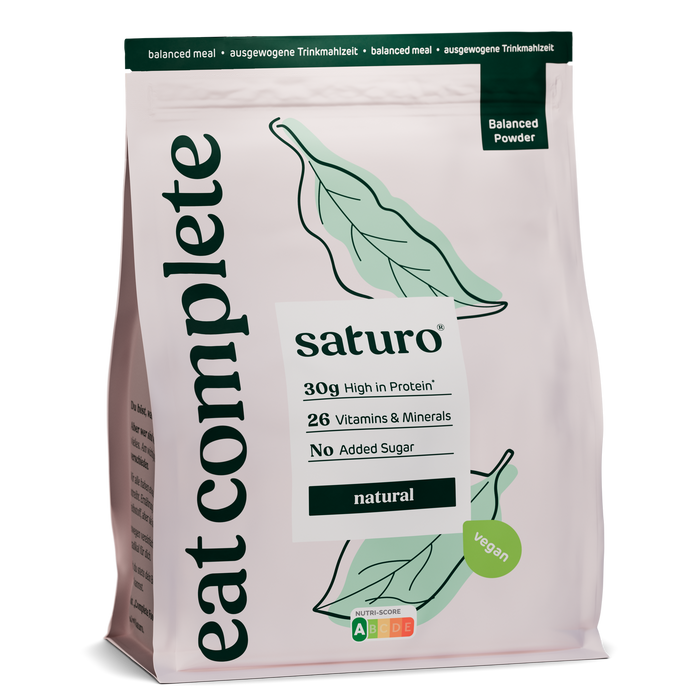
Balanced Powder: a meal you mix up, soya-free
Powder made from oats, pea protein, flaxseed and rice protein. One 100 g serving provides 400 kcal, 30 g protein, 9.9 g fibre and 26 vitamins and minerals, including folic acid, iodine and calcium. The Natural flavour has no sweeteners or flavouring. Contains oats (gluten).
Histamine table: how well is … tolerated?
The table below rates 160 foods for the elimination phase. It's based on measured values from market samples and the guideline's classification, not on an association's list of anecdotal experience: Red is anything matured, fermented or stored for a long time, or that measurably contains histamine; Yellow is where the sources contradict each other or only experience speaks; Green is what's fresh and was measured without histamine.
Foods high in histamine
Foods high in histamine are almost always products where bacteria were given a long time to work: matured cheese (up to just under 400 mg/kg in market samples, blue cheese over 1,000 in individual values), dry-cured sausage such as salami (peaks above 400 mg/kg), tinned fish and smoked fish (up to 657 mg/kg in tinned sardines), sauerkraut (average 44 mg/kg), fermented soya products such as soy sauce and miso (up to 730 mg/kg), red wine and beer. Among fresh plants, only spinach (average 32 mg/kg) and aubergine (39 mg/kg) stand out. The ranges are huge: the same cheese can come in under 0.1 or at 2,000 mg/kg. That's why the food group counts, not the number.
Which cheese is low in histamine?
The shorter the ripening, the less histamine. Cream cheese, quark, cottage cheese, ricotta, mascarpone and fresh mozzarella had no detectable histamine in 20 market samples, and young Gouda and Butterkäse are considered well tolerated. The level rises with every week of ripening: Emmental, Cheddar, Parmesan, mountain cheese, aged Gouda, Camembert and blue cheese don't belong on your plate during the elimination phase, and feta sits in between with a measured value of 85 mg/kg. Lactose-free cheese doesn't help here. Ripening is the issue, not milk sugar. If you have both, you'll find the right cheese table in our article on lactose intolerance.
Coffee and histamine
Coffee contains practically no histamine; analyses of brewed coffee found only traces of biogenic amines, mostly from low-quality beans. The claim that caffeine inhibits DAO appears on lots of advice sites, but in no study we could find; caffeine is missing from the overview of proven DAO inhibitors. What is true: caffeine stimulates your gut and nerves and can make palpitations or diarrhoea worse, which are among the typical symptoms anyway. In practice: stick to decaf coffee or herbal tea during the elimination phase, then try an espresso in the testing phase. Black and green tea appear on the lists as DAO inhibitors, but no histamine was measured in them.
Soya and histamine
Two different worlds: soy sauce, miso and tempeh are fermented and, at up to 730 mg/kg, are among the foods highest in histamine of all. Soya beans, tofu and soya drink are unfermented, and no histamine was detectable in market samples. The fact that experience-based lists also class them as poorly tolerated comes from the unproven suspicion that pulses act as histamine liberators. For soya protein isolates, as used in shakes, there are neither measured values nor a rating. In practice: leave out fermented soya during the elimination phase, and check tofu and soya drink early in the testing phase. Usually they're fine.
What helps with histamine intolerance?
The most effective treatment is the three-step dietary change from chapter 6, ideally with dietary counselling. According to the guideline, everything else, from DAO capsules to vitamin C, is unproven or at best worth a time-limited trial. What honestly helps: tackle the causes, meaning your gut, medication, alcohol and freshness, and keep your list of forbidden foods as short as possible.
DAO capsules: what they can do
DAO supplements provide the enzyme from pig kidneys. They're approved in the EU as food supplements or as dietary foods for special medical purposes, and are taken before a meal. The evidence is thin: a blinded study with 39 participants showed fewer symptoms than with placebo, but missed its main goal because the symptoms weren't reproducible; in 100 migraine patients, attacks got a good hour shorter, while their number and severity stayed the same. The guideline says: effectiveness not proven, not recommended. A court has banned the advertising claim that DAO tablets support histamine breakdown as impermissible. If you try them, treat it as a trial, not as therapy.
The best therapy is a short list. If you test systematically after two weeks of elimination, you'll usually end up eating almost everything again, just fresher.
Joerg Hauke, Nutrition expert, expert reviewer of this article
Antihistamines, vitamin C and healing clay
Antihistamines such as cetirizine block the effect of histamine; there is no placebo-controlled study for the intolerance, and the guideline considers a time-limited trial acceptable, under medical supervision and not as a long-term solution. Vitamin C, copper and vitamin B6 are thought to help with breakdown; the only thing proven is that DAO needs copper, and there's no study on B6 in histamine intolerance. Supplementing is worth it if you have a confirmed deficiency, otherwise not. Healing clay, zeolite and probiotics haven't been studied; some lactic acid bacteria even produce histamine themselves.

Can histamine intolerance be cured?
It isn't described as curable, but it's rarely permanent. If the weak breakdown is down to a cause that can be fixed, such as a gut infection, treated coeliac disease, a medication you've stopped or less alcohol, your tolerance often recovers. The guideline states that tolerance to histamine can increase through the three-step change, and recommends retesting foods you couldn't tolerate after a few months. What doesn't help: a strict long-term diet. It makes your list longer, your choice smaller and your life no better. The aim is a short, personal list.
Common questions about histamine intolerance
What lowers histamine immediately?
Nothing reliable. There's no remedy that “flushes” histamine out of your body. Symptoms fade by themselves within hours; drink plenty, rest, and keep your next meal fresh and light. If you have difficulty breathing or swelling in your throat, call the emergency services. That's not an intolerance.
What should you eat in the evening with histamine intolerance?
Freshly cooked and light: rice, potatoes or millet with vegetables such as courgette, pumpkin or carrots, plus chicken, beef or frozen white fish from the same day. No leftovers from the day before, no wine. Histamine doesn't work any differently in the evening, but symptoms at night disturb your sleep.
Which doctor diagnoses histamine intolerance?
Your GP first rules out allergies, lactose, fructose, coeliac disease and gut conditions, then you see an allergy specialist or gastroenterologist. The diagnosis is based on a diary and dietary change, not on a lab value; health insurers usually subsidise dietary counselling prescribed by a doctor.
How much does a histamine intolerance test cost at the GP?
Your health insurer pays for the consultation and the tests to rule out other causes. A DAO blood test and stool or urine histamine tests are self-pay, because the guideline attributes no diagnostic value to them. You save money by skipping them and keeping a diary for two weeks instead.
Can histamine intolerance appear suddenly?
Yes, often after a stomach bug, a new medication, a bowel condition, or during stretches of lots of alcohol and ready meals. Often your threshold was already low and only gets crossed once an extra factor comes in. Any new symptoms should be checked by a doctor.
Can you eat yoghurt and oats with histamine intolerance?
Oats are fine. Yoghurt is fermented, and measurements range from undetectable to 13 mg/kg: leave it out during the elimination phase and check it early in the test phase. Fermented foods like sauerkraut, kefir or kimchi, which are recommended for your gut flora, stay off the menu during the elimination phase.
Does it make sense to take cetirizine long term for histamine intolerance?
No. Antihistamines block the effect, not the cause, and there are no studies on their use for the intolerance. The guideline allows a time-limited trial under medical supervision. Better long term: find out the causes, eat fresh and use the test phase to keep your own list short.
Can histamine intolerance go away again?
Often yes, if the cause goes away: after a gut infection, after stopping a medication that inhibits DAO, or once the gut lining heals. Even without a clear cause, sensitivity drops for many people, so test foods you couldn't tolerate again after a few months.
Sources · 32 sources anzeigen
- Reese I. et al.: Guideline on management of suspected adverse reactions to ingested histamine (S1 guideline, AWMF register 061-030, DGAKI/ÄDA/GPA/SGAI/ÖGAI). Allergol Select 2021; 5: 305–314.
- Reese I. et al.: German guideline for the management of adverse reactions to ingested histamine. Allergo Journal International 2017; 26(2): 72–79.
- Comas-Basté O. et al.: Histamine Intolerance: The Current State of the Art. Biomolecules 2020; 10(8): 1181.
- Sánchez-Pérez S. et al.: Low-Histamine Diets: Is the Exclusion of Foods Justified by Their Histamine Content? Nutrients 2021; 13(5): 1395.
- Sánchez-Pérez S. et al.: Biogenic Amines in Plant-Origin Foods: Are They Frequently Underestimated in Low-Histamine Diets? Foods 2018; 7(12): 205.
- Linares D. M. et al.: Factors Influencing Biogenic Amines Accumulation in Dairy Products. Frontiers in Microbiology 2012; 3: 180.
- van Odijk J. et al.: Determination of Diamine Oxidase in a Population Based Study. Nutrients 2023; 15(13): 2887.
- Maintz L. et al.: Association of single nucleotide polymorphisms in the diamine oxidase gene with diamine oxidase serum activities. Allergy 2011; 66(7): 893–902.
- Maintz L., Novak N.: Histamine and histamine intolerance. American Journal of Clinical Nutrition 2007; 85(5): 1185–1196.
- Hrubisko M. et al.: Histamine Intolerance – The More We Know the Less We Know. A Review. Nutrients 2021; 13(7): 2228.
- Jochum C.: Histamine Intolerance: Symptoms, Diagnosis, and Beyond. Nutrients 2024; 16(8): 1219.
- Jackson K. et al.: Evidence for Dietary Management of Histamine Intolerance. International Journal of Molecular Sciences 2025; 26(18): 9198.
- Nazar W. et al.: Histamine Intolerance in Children: A Narrative Review. Nutrients 2021; 13(5): 1486.
- Schnedl W. J. et al.: Evaluation of symptoms and symptom combinations in histamine intolerance. Intestinal Research 2019; 17(3): 427–433.
- Schnedl W. J., Enko D.: Histamine Intolerance Originates in the Gut. Nutrients 2021; 13(4): 1262.
- Komericki P. et al.: Histamine intolerance: lack of reproducibility of single symptoms by oral provocation with histamine. Wiener klinische Wochenschrift 2011; 123(1–2): 15–20.
- Izquierdo-Casas J. et al.: Diamine oxidase (DAO) supplement reduces headache in episodic migraine patients with DAO deficiency: A randomized double-blind trial. Clinical Nutrition 2019; 38(1): 152–158.
- Zuberbier T. et al.: The International Guideline for the Definition, Classification, Diagnosis and Management of Urticaria. Allergy 2026.
- Vlieg-Boerstra B. J. et al.: Mastocytosis and adverse reactions to biogenic amines and histamine-releasing foods: what is the evidence? Netherlands Journal of Medicine 2005; 63(7): 244–249.
- U.S. Food and Drug Administration: Fish and Fishery Products Hazards and Controls Guidance, Chapter 7: Scombrotoxin (Histamine) Formation.
- Ruiz-Capillas C., Herrero A. M.: Impact of Biogenic Amines on Food Quality and Safety. Foods 2019; 8(2): 62.
- Nerurkar P. V. et al.: Medium Roasting and Brewing Methods Differentially Modulate Global Metabolites, Lipids, Biogenic Amines, Minerals, and Antioxidant Capacity of Coffee. Metabolites 2023; 13(3): 412.
- Restuccia D. et al.: Brewing effect on levels of biogenic amines in different coffee samples as determined by LC-UV. Food Chemistry 2015; 175: 143–150.
- R-Biopharm: What to consider when producing histamine-free wine. Food & Feed Analysis, 26 October 2017.
- AGES, Austrian Agency for Health and Food Safety: Biogenic amines. Retrieved 29 October 2026.
- MSD Manual Professional Edition: Fish poisoning and shellfish poisoning. Last updated April 2025.
- MSD Manual Professional Edition: Mastocytosis and mast cell activation syndrome. Last updated September 2024.
- German Allergy and Asthma Association (DAAB): Histamine intolerance.
- Verbraucherzentrale: Supplements for histamine intolerance: What do DAO products actually do? As of 13 August 2025.
- Verbraucherzentrale NRW: Unlawful advertising claims about histamine breakdown for Daosin. Frankfurt am Main Regional Court, case no. 3-12 O 28/22. As of 20 March 2024.
- Swiss Interest Group Histamine Intolerance (SIGHI): Food compatibility list DE, histamine. As of 29 August 2024. Experience-based ratings, listed as recommended reading.
- SIGHI: Information sheet on a low-histamine diet. Version of 17 November 2021.
Has been writing for Saturo since 2019 about nutrition, nutrients and how to get well nourished in everyday life, in practice.
Hat diesen Artikel am 29. Oktober 2026 auf fachliche Richtigkeit geprüft. The content does not replace medical advice.

Lactose intolerance: symptoms, test and what you can eat
Often suspected alongside histamine, but a different enzyme and a real test: H2 breath test, 12 g rule and a lactose table for over 100 foods.
Weiterlesen · 12 Min

News from the guide
New articles, updates and tips straight to your inbox. Easy to understand, expert-checked, no spam.
Danke! Bitte bestätige die Anmeldung in deinem Postfach.