
Vitamin E deficiency: symptoms, causes and treatment
Unsteady on your feet, tingling in your toes, weak muscles? Vitamin E deficiency is rare, and almost always there's a disrupted fat absorption behind it. Find out which symptoms really fit, which blood value counts and where you'll find vitamin E.


Aktualisiert 1 October 2026 · 16 Min. Lesezeit · 59 Quellen

The key points in 30 seconds
This much vitamin E a day has applied to everyone aged one and over since 2024, including pregnant women; for breastfeeding women it's 13 mg. The old 11 to 15 mg figures are outdated.
Adults carry large vitamin E stores in their fatty tissue. Even with disrupted fat absorption, case series showed it took over five years for nerve damage to appear.
Alpha-tocopherol in serum below 5 mg/l (11.6 µmol/l) counts as deficient. With high blood fats, the ratio to total lipids matters: below 0.8 mg per gram.
30 g of sunflower seeds provide 10.6 mg of vitamin E, more than the estimated value. A tablespoon of sunflower oil gives you 4.1 mg, a handful of almonds 7.7 mg.
Vitamin E deficiency symptoms: how to recognise it
Vitamin E sits in every cell membrane and catches free radicals there before they destroy the membrane's fatty acids. If you go without it for a long time, the tissues with the longest and fattiest cells suffer first: nerves, retina, muscles. A true deficiency is very rare in adults in Germany and almost never comes from what you eat, but from impaired fat absorption or a genetic defect. Dry skin, tiredness or weight gain are not signs of deficiency, more on that below. The checklist sorts out what fits.
Vitamin E deficiency and the nervous system: nerves, balance, muscles
Almost all the proven symptoms are neurological. It starts subtly: reflexes get weaker, the vibration sense in your feet fades, and your walk becomes unsteady in the dark because the feedback from your legs is missing. Later, ataxia (uncoordinated movements of the trunk and limbs), tingling and numbness, muscle weakness and speech problems follow. The MSD Manual describes exactly this picture, and the DGE names ataxia as the typical deficiency symptom. Muscle pain in everyday life isn't part of it: what's proven is weakness caused by myopathy, not pain. Chapter 3 explains why nerves, retina and muscles in particular suffer: their cells are long and rich in fat, and that's exactly where the membrane protection is missing.
Eyes and vision: retina and eye movement
Vision problems are among the proven signs, but only after a long, severe deficiency. The retina is especially rich in fat and loses visual cells without protection: night vision suffers first, and in the late stage case reports describe retinal damage up to blindness. There's also an eye movement disorder that makes it hard to look upwards, as well as drooping eyelids. Dry eyes, on the other hand, don't fit: a 2026 review found not a single study on vitamin E, and according to Cochrane it doesn't help against cataracts either. Dry eyes are more of a topic for vitamin A deficiency.

Vitamin E deficiency and skin symptoms: what's true?
Dry skin, wrinkles or slow-healing wounds are not a proven symptom of vitamin E deficiency. Neither the MSD Manual nor the NIH nor the DGE lists skin in their symptoms, and after EFSA's review the EU did not authorise the claim “vitamin E for healthy skin, hair and nails”. In an overview of six studies, vitamin E cream for scars did no better than doing nothing, and sometimes irritated the skin. Dry skin has other causes: heated air, age, eczema, and rarely a zinc deficiency or vitamin A deficiency. The vitamin in the cream is cosmetics, not a deficiency issue.
Vitamin E deficiency symptoms in women
There are no female-specific symptoms; nerves and muscles react the same way in everyone. What differs is the requirement: since 2024, the same estimated value of 8 mg applies to women, men and pregnant women, and only breastfeeding women need 13 mg, because vitamin E passes into breast milk. The questions women google about this are mostly not about deficiency: menopause (small studies show an effect of supplements on hot flushes, clearly weaker than hormones), hair loss (only one pilot study with tocotrienols) and trying to conceive (Cochrane: very weak evidence). Tiredness and muscle pain fit iron deficiency or vitamin D better.
Vitamin E and weight gain: what's true?
No. Neither a deficiency nor a supplement has been shown to make your weight go up. No medical reference lists weight gain as a symptom, and a meta-analysis of 24 controlled studies found no extra weight, higher BMI or larger waist circumference among people taking vitamin E supplements. The only real link is the calories in the sources: one tablespoon of oil provides around 90 kcal, a handful of nuts 180. If you lose vitamin E because of a fat absorption disorder, you're more likely to lose weight than gain it. If your weight rises for no obvious reason, take a look at your thyroid (iodine deficiency), your sleep and any medication.
Vitamin E deficiency and mental health: what's true?
Depression caused by vitamin E deficiency is not proven. A severe deficiency damages nerves, not mood; concentration and memory only suffer at a late stage, alongside ataxia and loss of vision. The meta-analysis on vitamin E supplements for depression itself calls its result “not clear-cut”, and for anxiety it found no effect. Lack of drive, irritability and forgetfulness have other nutrient suspects: vitamin B12, folic acid, vitamin D and iron. That's why vitamin E sits under “possible” in the table, with a question mark.
What really fits vitamin E deficiency
The fifteen complaints people search for most often, and what the sources say about them: proven (reference work or case series with a real deficiency), possible (hints from supplement studies), unproven (no primary source).
| What the studies say | Rating | |
|---|---|---|
| Unsteady walking, ataxia | Typical deficiency symptom according to DGE and MSD, most common finding on examination | Proven |
| Tingling, numbness, reflexes | Peripheral neuropathy with loss of vibration sense and reflexes (MSD, NIH) | Proven |
| Muscle weakness | Myopathy in severe deficiency, listed in all reference sources | Proven |
| Vision problems, eye movement | Retinal damage, night vision problems and eye movement disorder after long-term deficiency | Proven |
| Anaemia in premature babies | Haemolytic anaemia caused by unstable red blood cells, only in premature babies (DGE, MSD) | Proven |
| Prone to infections | NIH mentions a weakened immune response in deficiency, with no everyday data | Possible |
| Low mood | Meta-analysis on supplements “not conclusive”, no link to deficiency | Possible |
| Menopause symptoms | Small supplement studies on hot flushes, weaker than hormones | Possible |
| Dry skin, wrinkles | Not in any deficiency source; EU claim on skin, hair and nails rejected | Unproven |
| Weight gain | Meta-analysis of 24 studies with no effect on weight, BMI or waist | Unproven |
| Tiredness | Not in any deficiency source; EU claim “energy and vitality” rejected | Unproven |
| Muscle pain | Only lab values after exercise; pain is not a deficiency symptom | Unproven |
| Hair loss | One pilot study with tocotrienols (38 people), no link to deficiency | Unproven |
| Eczema | Cochrane: no convincing benefit of supplements for eczema | Unproven |
| Dry eyes | 2026 review without a single vitamin E study | Unproven |
Rating based on the sources in chapter 8 (MSD Manual, NIH ODS, DGE, StatPearls, Emami 2021, Lee 2022, Feduniw 2022, Bath-Hextall 2012, EU register). As of 30 September 2026.
How quickly does a vitamin E deficiency develop?
In adults it takes years, often decades. Vitamin E is stored in body fat, and the reserves are big: in one case series, nine adults with a fat absorption disorder had a severe deficiency for more than five years before measurable nerve damage appeared; two patients only fell ill more than 20 years after their digestive disorder began. In children it happens faster because the stores are small: with the hereditary form AVED, symptoms usually begin between the ages of 5 and 20, and premature babies have no reserves from birth. So one low-fat week won't cause anything, but an untreated fat absorption disorder over several years can.
New unsteadiness when walking, numb feet or vision problems always need a medical check-up, whether vitamin E is the cause or not. If you have a known fat absorption disorder or have had bowel or stomach surgery: ask for your vitamin E level and blood fats to be tested too.
Vitamin E deficiency causes: who's really at risk
A vitamin E deficiency can come about in three ways: the fat doesn't get through because your gut, pancreas or gall bladder aren't playing along; the liver can't distribute vitamin E, a rare genetic defect; or the store is empty from the start, as in premature babies. Too little in your food is practically never the reason in Germany. If none of these applies to you, there's no need to worry about a deficiency.
Gut, pancreas, liver and bile: when fat doesn't get through
Vitamin E is only absorbed together with fat, and fat needs bile and enzymes from the pancreas. That's why the most common causes here are conditions with fat malabsorption: Crohn's disease, untreated coeliac disease, cystic fibrosis, chronic pancreatitis, bile duct obstruction, short bowel syndrome and severe liver disease. According to the guideline, 10 to 35% of children with cystic fibrosis lack fat-soluble vitamins despite taking supplements. Usually all four are affected at once: A, D, E and K. After a gastric bypass the risk rises, though clinical signs are rarely documented. Two medicines measurably slow absorption: the fat blocker orlistat (43 to 60% less absorption) and the bile acid binder colestyramine.
Inherited: AVED and abetalipoproteinaemia
Two rare genetic defects cause a deficiency despite normal digestion. In AVED (ataxia with vitamin E deficiency), the transport protein alpha-TTP is missing, which the liver uses to build vitamin E into blood fats; the vitamin is absorbed and then straight away excreted again. It affects 1 to 9 in a million people, the ataxia usually begins between ages 5 and 20 and is often mistaken for Friedreich's ataxia. In abetalipoproteinaemia, the particles that carry fat in the blood are missing, and neuropathy and retinal damage develop in the first two decades of life. Both forms need high doses for life under neurological care; if you start early, a lot can be halted.
Premature babies, children and very low-fat diets
Premature babies under 1,500 g are born with almost empty stores because vitamin E only crosses the placenta in small amounts; they're the only group in which haemolytic anaemia from vitamin E deficiency occurs, and they're looked after in neonatal care. Full-term babies need nothing extra; breast milk and infant formula are enough. A very low-fat diet over a long time can reduce the intake of all fat-soluble vitamins, because oils, nuts and seeds are the main sources; even so, a clinical deficiency in healthy people has not been described. In older age, intake drops slightly, but a higher requirement hasn't been proven.
How vitamin E works in the body
Three stages from the oil on your plate to the cell membrane. Once you know them, you'll understand why a deficiency takes years, why your liver has more say over your blood level than your diet does, and what vitamin E actually does in the body.
Absorption: only with fat and bile
Vitamin E is fat-soluble. In the small intestine, bile acids package it with dietary fat into tiny droplets, and it's passed through the intestinal cells into the lymph. Without fat, little happens: from a fortified apple, test subjects absorbed 10% of the vitamin E when breakfast was fat-free, and 33% when a fifth of the calories came from fat. If bile or pancreatic enzymes are missing, the vitamin ends up in the stool. That's why salad needs oil and every vitamin E capsule needs a meal.
Liver: sorts, stores, distributes
In the liver, the transport protein alpha-TTP picks out RRR-alpha-tocopherol and builds it into the blood fats; other forms such as gamma-tocopherol are broken down faster, and synthetic vitamin E counts for only half. From there it moves into fatty tissue, which holds the large store. In AVED, exactly this protein is missing, so the vitamin is lost. And because the liver actively limits the blood level when there's a surplus, a high value says little about your supply; only a low one counts.
Effect: a protective shield in every cell membrane
What does your body need vitamin E for? It sits in the membranes of all your cells among the unsaturated fatty acids and gives free radicals an electron before they can start a chain reaction. After that it's a radical itself, harmless and short-lived, and vitamin C makes it ready for action again; selenium enzymes clear away the resulting fat peroxides. This is the only effect the EU recognises: protecting cells from oxidative stress. Nerves, retina and muscles depend on it most, because their membranes are long and rich in fat.
Diagnosing vitamin E deficiency: test and blood value
Whether you're short of vitamin E shows up in one blood value: alpha-tocopherol in serum. Below 5 mg/l (11.6 µmol/l) counts as a deficiency in adults; a university lab in Rostock gives 5 to 18 mg/l as the normal range. The measurement is simple, the interpretation isn't, because the value depends on your blood fats.
Vitamin E in the blood: threshold and lipid ratio
Vitamin E travels in the blood inside fat particles. If you have high blood fats, you automatically have more vitamin E in your serum without being better supplied; with very low blood fats, the value looks deficient even though your cells have enough. That's why, when blood fats are abnormal, the ratio of alpha-tocopherol to total lipids counts: below 0.8 mg per gram of lipid is a deficiency; in cystic fibrosis, the guideline goes by the ratio to cholesterol. The DGE openly says that status can only be assessed roughly, because the liver caps the level and fatty tissue hides the store. A high value proves nothing, a low one does. If a deficiency is suspected, health insurance covers the test.

Vitamin E deficiency test: what home tests are worth
Not much. Manufacturers' online self-tests add up tiredness, dry skin and stress, which are exactly the signs that don't belong to a deficiency, and they end in a buying recommendation. Finger-prick home tests deliver a small sample with no blood fat reference and no medical interpretation; the consumer advice centre (Verbraucherzentrale) generally recommends caution with self-tests. If you have no risk factor, you'll almost certainly measure a normal value: in the US population study, only about 0.1% of adults were below the deficiency threshold, even though most ate less than recommended. If you suspect a problem, the sensible test is the one at the doctor's surgery, together with vitamins A, D and K.
Fixing a vitamin E deficiency: treatment and duration
Treatment always has two parts: tackling the cause and topping up vitamin E in a dose set by your doctor, usually as tablets, or in a water-soluble form for a severe fat absorption disorder. Without a proven deficiency, there's nothing to treat, and above a certain amount, supplements become a risk themselves.
Medical treatment and how long it takes
The doses are far higher than anything food provides, and they belong in a doctor's hands. For deficiency caused by malabsorption, the MSD Manual gives 15 to 25 mg per kilogram of body weight daily. For cystic fibrosis, the European guideline recommends 100 to 400 IU a day with a high-fat meal and enzymes. For AVED, it's 800 to 1,200 mg for life, because symptoms come back within days of stopping. Blood levels normalise within weeks. The nerves need months: in case reports, walking and sensation only improved months after levels normalised, and not everything comes back. The earlier, the better.
With vitamin E, the order is different from most nutrients: first ask about fat digestion, then check your blood level together with your blood fats, then think about a supplement. If you've got oil, nuts or seeds on your plate, you don't need a capsule. And if you really do have a deficiency, you need a doctor's dose, not one from the chemist.
Joerg Hauke, Nutrition expert, technical review of this article
Too much vitamin E: symptoms of an overdose
You can practically never overdose through food. The question only arises with supplements. Acute symptoms are rare and non-specific: nausea, diarrhoea, tiredness, muscle weakness. The real risk is blood clotting: high doses inhibit platelets and work against vitamin K. That's why EFSA confirmed the upper limit of 300 mg a day in 2024 and named bleeding as the critical endpoint. In the large trials with 400 IU daily, there were more haemorrhagic strokes (+22% in the meta-analysis), more heart failure in people with vascular disease, and more prostate cancer in men over 50. Whether high doses raise mortality is disputed. No study has found a benefit for healthy people.
There's almost a forty-fold gap between the DGE's estimated value and EFSA's upper limit, and the usual capsules from the chemist sit right in between. The steps show where each number comes from.
From need to too much: vitamin E in numbers
-
1
Estimated value8 mg
DGE 2024 for everyone from age one; 13 mg for breastfeeding women. Covers your daily losses. You get there with one tablespoon of sunflower oil and 15 g of almonds.
-
2
Reference intake12 mg
The value on labels (NRV), which percentages are based on. One bottle of drinkable meal provides 2.9 to 3.0 mg, which is 24 to 25% of it.
-
3
Maximum for supplements30 mg
BfR proposal for the daily dose of a food supplement (2021), based on SELECT and brain haemorrhages. If you take more, let your doctor know.
-
4
Upper limit300 mg
EFSA's tolerable upper intake level (confirmed in 2024), critical endpoint bleeding. Doesn't apply to people on anticoagulants. A 400 IU capsule, at 180 to 268 mg, sits just below it.
DGE/ÖGE reference values 2025, Reg. (EU) 1169/2011, BfR 2021, EFSA 2024. Conversion: 1 IU natural vitamin E = 0.67 mg, 1 IU synthetic = 0.45 mg; so 400 IU is 268 or 180 mg respectively. The US upper limit is 1,000 mg.
Is vitamin E a blood thinner? Be careful with anticoagulants
Yes, in high doses. Vitamin E inhibits platelets from clumping together and works against vitamin K. In a study with 1,000 IU daily, the marker for vitamin K deficiency rose markedly after twelve weeks. For healthy people, this is irrelevant at the amounts you get from food. It becomes critical with Marcumar, warfarin, DOACs or aspirin: EFSA expressly excludes people on anticoagulants from the 300 mg limit, because for them even less is enough. One small warfarin study found no rise in INR, but the data is thin. The same goes for before surgery. More on clotting in the vitamin K article.
If you take Marcumar, warfarin, a DOAC or daily aspirin, only take vitamin E supplements after talking to your doctor, even the 200 IU capsule from the chemist. Stop before surgery and tell the surgical team.
Vitamin E foods: where you'll find the most
Vitamin E is found mainly in vegetable oils, nuts and seeds, and the oils go off the scale: per 100 g, wheat germ oil provides forty times as much as the best vegetable. That's why the bars show the oils separately from everything else. Animal foods hardly play a role; eel, roe and egg yolk are the exceptions. All values are for alpha-tocopherol, the form your body uses.
Vitamin E per 100 g: top 10 oils and top 10 nuts, seeds, vegetables and fruit
Values per 100 g of oil, USDA FoodData Central SR Legacy 2018. One tablespoon (10 g): wheat germ oil 14.9 mg, sunflower oil 4.1 mg, rapeseed oil 1.7 mg, olive oil 1.4 mg. The German Federal Food Code (BLS) gives 59 mg for sunflower oil and only 20 mg for hazelnut oil. Hardly any alpha-tocopherol: linseed oil, walnut oil, sesame oil, coconut oil.
Vitamin E oil: wheat germ, sunflower, rapeseed, olive
Wheat germ oil is, at around 150 mg per 100 g, the strongest food of all. One tablespoon covers almost double the estimated value, but because of the taste it's more of a take-it-by-the-spoonful oil. In everyday cooking, sunflower oil is what counts, with 41 to 59 mg depending on the database, followed by almond, safflower and grapeseed oil. Rapeseed oil (17.5 mg) and olive oil (14.4 mg) give 1.4 to 1.7 mg per tablespoon, so it's the mix that does the job. Linseed oil and walnut oil contain almost no alpha-tocopherol, but they do contain gamma-tocopherol, which by today's definition doesn't count as vitamin E. And one more thing: frying at 170 °C destroyed 77 to 100% of the tocopherols in olive oil. Salad oil stays salad oil.
Which nuts have the most vitamin E?
Sunflower seeds (35 mg per 100 g) and almonds (26 mg), well ahead of hazelnuts (15 mg). A handful of sunflower seeds gives you 10.6 mg, which is more than the estimated daily value. A handful of almonds gives 7.7 mg, and almond butter or sunflower seed butter gives around 4.6 to 4.8 mg per tablespoon. Pine nuts, peanuts and peanut butter follow with 8 to 9 mg. The surprise: walnuts (0.7 mg), cashews (0.9 mg), pumpkin seeds, linseeds and chia give you almost nothing, because they contain gamma- rather than alpha-tocopherol. In one nut study, roasting cost around 38% of the alpha-tocopherol, so raw or lightly roasted is better than dark roasted.

Fruit, vegetables and fish: vitamin E beyond oils and nuts
The amounts are smaller, but the portions are bigger. Among vegetables, spinach leads (200 g cooked: 4 to 7 mg), followed by kale, asparagus and broccoli (around 3 mg per side portion each) and red peppers. An avocado gives 3 mg per fruit. Fruit is weak. The exceptions are kiwi (1.5 mg per fruit), mango and dried apricots, while apples, bananas and oranges come in under 0.3 mg. Among animal sources, it's almost only oily fish that counts: eel (8 mg), trout (4 mg per fillet), prawns and herring, plus egg yolk and butter with small contributions. Meat, milk and cheese give you practically nothing. Cooking in water hardly does any harm, and cooking vegetables actually makes the vitamin E more available.
Vitamin E deficiency: what to eat? With fat, gently, every day
Three rules are enough. First, always with fat: vitamin E from a salad or a fortified product hardly gets absorbed without fat, so put oil in your dressing, nuts in your muesli and avocado on your bread. Second, oil raw or mild: drizzle sunflower or rapeseed oil over the finished plate, not into a 200-degree pan. Third, one building block every day: a tablespoon of sunflower oil (4.1 mg) plus 15 g of almonds (3.8 mg) gets you to 8 mg; if you only eat bread, pasta, cheese and apples, you end up at 5 to 6 mg. With a genuine fat absorption disorder, no plate of food replaces treatment; then water-soluble supplements and enzymes are the basis.
of the vitamin E from a fortified apple reached the bloodstream when the meal was fat-free
with a fifth of the calories from fat: a good three times as much; even 6% fat doubled absorption to 20%
On days without oil, nuts or seeds, that one building block is often exactly what's missing. A drinkable meal with defined nutrient amounts is easy to plan around: one bottle of Saturo (400 ml) contains 2.9 to 3.0 mg of vitamin E depending on the flavour. That's 24 to 25% of the 12 mg reference intake and a good third of the DGE estimated value. You also get the other 25 vitamins and minerals and 18 g of fat, which your body needs to absorb the vitamin. It replaces neither the oil in your salad nor the treatment of a deficiency.
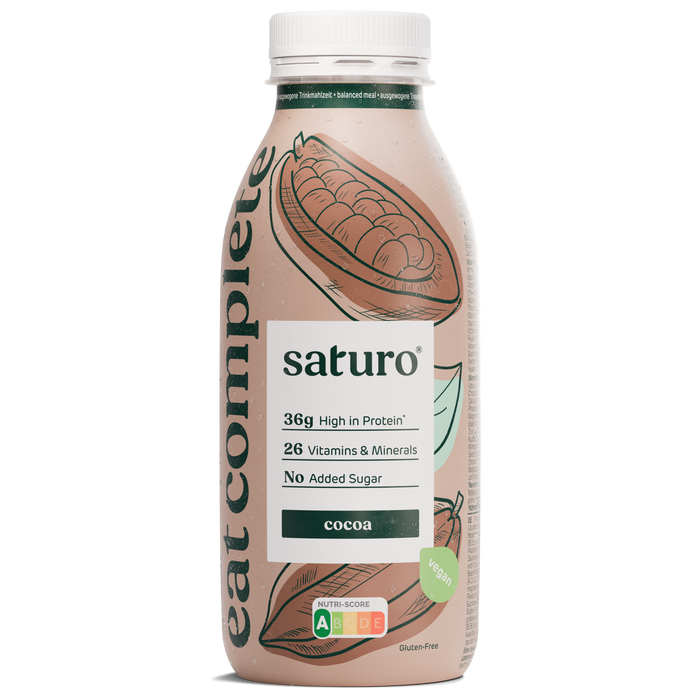
Drinkable meal: a complete meal in a bottle
26 vitamins and minerals, including vitamin E, vitamin C and selenium, plus 18 g of fat per bottle to help you absorb fat-soluble vitamins. Reference intake for vitamin E: 12 mg per day (NRV).
Atopic eczema, pregnancy, children: what else you should know about vitamin E
Four questions come up in almost every Google search on vitamin E, and none of them is about deficiency: atopic eczema, pregnancy, babies and old age. Here's what the studies say, no promises.
Vitamin E for atopic eczema and the skin: what the studies say
For supplements in existing atopic eczema there is no convincing evidence: the Cochrane review on supplements for atopic eczema, including vitamin E with selenium and with vitamin D, found no benefit and advises against recommending them. Taking it and putting it on your skin are two different questions: vitamin E in creams is a cosmetic ingredient that stabilises the formula as an antioxidant; for scars, one review showed no benefit and, in individual cases, contact eczema. If you have atopic eczema, don't buy vitamin E capsules as a treatment; stick to basic skincare and medical treatment. A deficiency hasn't been described in atopic eczema.

Vitamin E in pregnancy, while breastfeeding, for children and in old age
Pregnant women no longer need an extra allowance since the recalculation: 8 mg like everyone else, and EFSA also sees no increased requirement. Supplements don't help: the Cochrane review with over 22,000 women found that vitamin E with vitamin C gave no protection against pre-eclampsia, premature birth or stillbirth, but did lead to premature rupture of membranes more often; the upper limit of 300 mg applies here too. Breastfeeding women need 13 mg, because vitamin E passes into breast milk. Children from one year: 8 mg, with smaller stores and faster symptoms if they have fat absorption disorders. Older adults: same estimated value; intake falls slightly from 65, a higher requirement hasn't been proven, and high blood levels mostly just reflect higher blood fats.
Frequently asked questions about vitamin E deficiency
How do I notice a vitamin E deficiency?
In your nerves, not your skin: unsteady walking in the dark, weak reflexes, tingling and numbness in the feet, muscle weakness, later vision problems. This almost only happens with impaired fat absorption or a genetic defect, and in adults it takes years. Your blood level gives you certainty.
Where is the most vitamin E found?
In wheat germ oil, with around 150 mg per 100 g; one tablespoon covers your daily requirement almost twice over. Next come sunflower oil (41 to 59 mg), sunflower seeds (35 mg), almonds (26 mg) and hazelnuts (15 mg). Among vegetables spinach leads, among fruit kiwi and avocado.
Is vitamin E good for atopic eczema?
Not proven as a supplement: the Cochrane review on supplements for atopic eczema found no convincing benefit, not even for vitamin E with selenium. In creams, vitamin E is a cosmetic ingredient, not a treatment. Basic skincare and medical therapy remain the foundation.
What effect does vitamin E have on the mind?
None that's proven. A severe deficiency damages nerves and muscles, and depression caused by vitamin E deficiency hasn't been described. Studies on supplements for depression describe their own results as inconclusive, and for anxiety they found no effect. If your mood is low, think of B12, folate, vitamin D and iron first.
What does vitamin E do in the body?
It's the most important fat-soluble antioxidant: it sits in every cell membrane and catches free radicals before they destroy the membrane's unsaturated fatty acids in a chain reaction. Vitamin C then regenerates it. The EU recognises exactly this effect: protection of cells from oxidative stress.
What's the maximum amount of vitamin E per day?
EFSA sets 300 mg a day from all sources as the tolerable upper limit, and the BfR recommends no more than 30 mg per daily dose for food supplements. The DGE's estimated value is 8 mg. If you take anticoagulants, only use supplements after talking to your doctor.
How many mg is 400 IU of vitamin E?
That depends on the form: 400 IU of natural vitamin E (RRR-alpha-tocopherol) is 268 mg, 400 IU of synthetic (all-rac) is 180 mg, because 1 IU equals 0.67 and 0.45 mg respectively. Both are far above the estimated value of 8 mg and just under the EFSA upper limit of 300 mg.
Is it safe to take selenium and vitamin E together?
In food, yes, the two work together in cell protection: vitamin E stops the chain reaction, selenium enzymes clear away the fat peroxides. As a high-dose combination, no: in the SELECT trial the combination didn't protect against cancer, and vitamin E alone raised the risk of prostate cancer by 17%. No deficiency, no supplement.
Sources · 59 sources anzeigen
- German Nutrition Society (DGE): Reference values for nutrient intake, vitamin E. Estimated values for adequate intake, derivation as of 2024 (8 mg RRR-alpha-tocopherol, breastfeeding women 13 mg).
- DGE: Press release “New reference values for iodine and vitamin E published”, 3rd edition of the reference values for nutrient intake, 2025.
- DGE: Frequently asked questions about vitamin E (deficiency, risk groups, status assessment, tocopherol equivalents outdated), as of 10.09.2025.
- EFSA NDA Panel: Scientific Opinion on Dietary Reference Values for vitamin E as alpha-tocopherol. EFSA Journal 2015; 13(7): 4149 (AI 13 mg men, 11 mg women).
- EFSA NDA Panel: Scientific opinion on the tolerable upper intake level for vitamin E. EFSA Journal 2024; 22(8): e8953 (UL 300 mg, bleeding as critical endpoint).
- German Federal Institute for Risk Assessment (BfR): Maximum level proposals for vitamin E in foods, including food supplements, 15.03.2021 (30 mg per daily dose).
- BfR: Updated maximum level proposals for vitamins and minerals in food supplements and fortified foods. Opinion 006/2024 of 22.02.2024.
- Regulation (EU) No 1169/2011 (Food Information Regulation), Annex XIII: nutrient reference value for vitamin E 12 mg, significant amount 15%, or 7.5% for drinks.
- Commission Regulation (EU) No 432/2012: authorised health claim “Vitamin E contributes to the protection of cells from oxidative stress”.
- European Commission: EU Register on nutrition and health claims made on foods (unauthorised vitamin E claims on skin, hair, nails, heart, energy, immune system, cognition).
- National Institutes of Health, Office of Dietary Supplements: Vitamin E, Fact Sheet for Health Professionals (deficiency symptoms, IU conversion, interactions, US UL 1,000 mg).
- MSD Manual, Professional Version: Vitamin E deficiency (Johnson L. E., reviewed August 2024, updated April 2025).
- MSD Manual, Professional Version: Vitamin E toxicity (reviewed August 2024, updated July 2025).
- MSD Manual, Consumer Version: Vitamin E deficiency (symptoms in children and adults, premature babies).
- Kemnic T. R., Coleman M.: Vitamin E Deficiency. StatPearls, NCBI Bookshelf, updated 4 July 2023 (stages, causes, 0.1% of US adults).
- Traber M. G.: Vitamin E inadequacy in humans: causes and consequences. Advances in Nutrition 2014; 5(5): 503–514.
- Traber M. G., Stevens J. F.: Vitamins C and E: beneficial effects from a mechanistic perspective. Free Radical Biology and Medicine 2011; 51(5): 1000–1013.
- Ursini F., Bindoli A.: The role of selenium peroxidases in the protection against oxidative damage of membranes. Chemistry and Physics of Lipids 1987; 44(2–4): 255–276.
- Satya-Murti S. et al.: The spectrum of neurologic disorder from vitamin E deficiency. Neurology 1986; 36(7): 917–921 (more than five years until nerve damage).
- Harding A. E. et al.: Spinocerebellar degeneration secondary to chronic intestinal malabsorption: a vitamin E deficiency syndrome. Annals of Neurology 1982; 12(5): 419–424.
- Howard L. et al.: Reversible neurological symptoms caused by vitamin E deficiency in a patient with short bowel syndrome. American Journal of Clinical Nutrition 1982; 36(6): 1243–1249.
- Orphanet: Ataxia with vitamin E deficiency (ORPHA:96), prevalence 1 to 9 per 1,000,000, onset 5 to 20 years.
- Baso G. et al.: Ataxia With Vitamin E Deficiency Syndrome and a Novel TTPA Variant: A Paired Case Report. Neurology Genetics 2026; 12(3): e200399.
- Agarwal A. et al.: Ataxia with Vitamin E Deficiency: A Never to be Missed Treatable Ataxia. Annals of Indian Academy of Neurology 2023; 26(6): 1011–1012 (800 to 1,200 mg/day).
- Wilschanski M. et al.: ESPEN-ESPGHAN-ECFS guideline on nutrition care for cystic fibrosis. Clinical Nutrition 2024; 43(2): 413–445 (10 to 35% deficiency despite supplementation, 100 to 400 IU/day).
- Sherf-Dagan S. et al.: Vitamin E status among bariatric surgery patients: a systematic review. Surgery for Obesity and Related Diseases 2021; 17(4): 816–830.
- Nuermaimaiti K. et al.: Vitamin and trace elements imbalance are very common in adult patients with newly diagnosed Celiac disease. Scientific Reports 2025.
- Melia A. T., Koss-Twardy S. G., Zhi J.: The effect of orlistat, an inhibitor of dietary fat absorption, on the absorption of vitamins A and E in healthy volunteers. Journal of Clinical Pharmacology 1996; 36(7): 647–653.
- Elinder L. S. et al.: Probucol treatment decreases serum concentrations of diet-derived antioxidants (cholestyramine lowers vitamin E by 7%). Arteriosclerosis, Thrombosis, and Vascular Biology 1995; 15(8): 1057–1063.
- Universitätsmedizin Rostock, Central Laboratory: laboratory catalogue, vitamin E (serum, HPLC), adult reference range 5 to 18 mg/l.
- Verbraucherzentrale: Which vitamin deficiency tests make sense? As of 6 January 2026.
- Verbraucherzentrale: Vitamin E for protection against heart attack and cancer? As of 4 December 2025.
- Klein E. A. et al.: Vitamin E and the risk of prostate cancer: the Selenium and Vitamin E Cancer Prevention Trial (SELECT). JAMA 2011; 306(14): 1549–1556.
- Lonn E. et al.: Effects of long-term vitamin E supplementation on cardiovascular events and cancer (HOPE and HOPE-TOO). JAMA 2005; 293(11): 1338–1347.
- Schürks M. et al.: Effects of vitamin E on stroke subtypes: meta-analysis of randomised controlled trials. BMJ 2010; 341: c5702.
- Miller E. R. et al.: Meta-analysis: high-dosage vitamin E supplementation may increase all-cause mortality. Annals of Internal Medicine 2005; 142(1): 37–46.
- Curtis A. J. et al.: Vitamin E supplementation and mortality in healthy people: a meta-analysis of randomised controlled trials. Cardiovascular Drugs and Therapy 2014; 28(6): 563–573.
- Booth S. L. et al.: Effect of vitamin E supplementation on vitamin K status in adults with normal coagulation status. American Journal of Clinical Nutrition 2004; 80(1): 143–148.
- Kim J. M., White R. H.: Effect of vitamin E on the anticoagulant response to warfarin. American Journal of Cardiology 1996; 77(7): 545–546.
- Tanaydin V. et al.: The Role of Topical Vitamin E in Scar Management: A Systematic Review. Aesthetic Surgery Journal 2016; 36(8): 959–965.
- Beoy L. A., Woei W. J., Hay Y. K.: Effects of tocotrienol supplementation on hair growth in human volunteers. Tropical Life Sciences Research 2010; 21(2): 91–99.
- Lee A. R. Y. B. et al.: Vitamin E, Alpha-Tocopherol, and Its Effects on Depression and Anxiety: A Systematic Review and Meta-Analysis. Nutrients 2022; 14(3): 656.
- Emami M. R. et al.: Can vitamin E supplementation affect obesity indices? A systematic review and meta-analysis of twenty-four randomized controlled trials. Clinical Nutrition 2021; 40(5): 3201–3209.
- Feduniw S. et al.: The Effect of Vitamin E Supplementation in Postmenopausal Women, A Systematic Review. Nutrients 2022; 15(1): 160.
- Kim M. et al.: Can Low-Dose of Dietary Vitamin E Supplementation Reduce Exercise-Induced Muscle Damage and Oxidative Stress? A Meta-Analysis of Randomized Controlled Trials. Nutrients 2022; 14(8): 1599.
- de Ligny W. et al.: Antioxidants for male subfertility. Cochrane Database of Systematic Reviews 2022; 5: CD007411.
- Bath-Hextall F. J. et al.: Dietary supplements for established atopic eczema. Cochrane Database of Systematic Reviews 2012; 2: CD005205.
- Heidari H. et al.: The Efficacy of Oral Vitamin Supplementation in Dry Eye Disease: A Systematic Review. 2026.
- Mathew M. C. et al.: Antioxidant vitamin supplementation for preventing and slowing the progression of age-related cataract. Cochrane Database of Systematic Reviews 2012; CD004567.
- Rumbold A. et al.: Vitamin E supplementation in pregnancy. Cochrane Database of Systematic Reviews 2015; 9: CD004069.
- Brion L. P., Bell E. F., Raghuveer T. S.: Vitamin E supplementation for prevention of morbidity and mortality in preterm infants. Cochrane Database of Systematic Reviews 2003; 3: CD003665.
- Max Rubner-Institut: National Consumption Study II (Nationale Verzehrsstudie II), Results Report Part 2 (2008), Chapter 5.6.3 Vitamin E (median 13.7 and 12.0 mg, intake falls with age).
- Bruno R. S. et al.: Human vitamin E requirements assessed with the use of apples fortified with deuterium-labeled alpha-tocopheryl acetate. American Journal of Clinical Nutrition 2006; 83(2): 299–304 (10, 20, 33% absorption depending on fat).
- Jeanes Y. M. et al.: The absorption of vitamin E is influenced by the amount of fat in a meal and the food matrix. British Journal of Nutrition 2004; 92(4): 575–579.
- Kmiecik D. et al.: Effect of Heating Temperature of High-Quality Arbequina, Picual, Manzanilla and Cornicabra Olive Oils on Changes in Nutritional Indices of Lipid, Tocopherol Content and Triacylglycerol Polymerization Process. Molecules 2023; 28(10): 4247.
- Schlörmann W. et al.: Influence of roasting conditions on health-related compounds in different nuts. Food Chemistry 2015; 180: 77–85 (alpha-tocopherol minus 38%).
- Kim H. J. et al.: Effect of different cooking method on vitamin E and K content and true retention of legumes and vegetables commonly consumed in Korea. Food Science and Biotechnology 2023; 32(5): 647–658.
- U.S. Department of Agriculture, Agricultural Research Service: FoodData Central, SR Legacy Release (2018), Vitamin E (alpha-tocopherol) per 100 g.
- Max Rubner-Institut: German Nutrient Database (Bundeslebensmittelschlüssel, BLS) 4.0, Version 2025, Vitamin E (alpha-tocopherol).
Has been writing for Saturo since 2019 about nutrition, nutrients and how to get what your body needs in everyday life.
Hat diesen Artikel am 1. Oktober 2026 auf fachliche Richtigkeit geprüft. This content is not a substitute for medical advice.

Vitamin A deficiency: symptoms, causes and treatment
The second fat-soluble vitamin that runs short when fat absorption is impaired: why your eyes notice the deficiency first, which blood value counts and where vitamin A is found.
Weiterlesen · 16 Min

Latest from the Guide
New articles, updates and tips straight to your inbox. Easy to understand, expert-checked, no spam.
Danke! Bitte bestätige die Anmeldung in deinem Postfach.