
Saturated and unsaturated fatty acids: the difference
Butter or oil, cheese, eggs, coconut oil: which fats are healthy? What matters isn't cutting fat out, but swapping. Here's what the difference is, which foods and oils do well and how much fat a day is right.


Aktualisiert 15 October 2026 · 14 Min. Lesezeit · 42 Quellen

The key points in 30 seconds
of energy at most, say the German Nutrition Society (DGE) and WHO. At 2,000 kcal, that's around 22 g a day. In Germany, intake is 14 to 17%.
is what the DGE recommends for low activity levels, which is 30% of energy. It's not the amount that matters, but which fatty acids are in it.
fewer cardiovascular events when saturated fatty acids are reduced (Cochrane 2020). The bigger the swap, the bigger the effect.
instead of cutting out: replace butter, sausage and coconut fat more often with rapeseed, olive or walnut oil, nuts and fish. Swapping in white flour and sugar gets you nowhere.
What are fatty acids?
Fat is made of fatty acids: chains of carbon atoms attached to a glycerol molecule. Whether a fatty acid is called saturated or unsaturated depends on whether the chain contains double bonds. This tiny structural detail decides whether a fat is solid or liquid, how it behaves when you fry it and how it affects your blood fats.
Which fatty acids are there?
Three groups, sorted by double bonds: saturated fatty acids with no double bond (butter, coconut fat), monounsaturated with one (olive oil, rapeseed oil) and polyunsaturated with two or more (linseed oil, walnuts, oily fish). Trans fatty acids are unsaturated but built differently, so they're a special case (chapter 8). Then there's chain length: short-chain fatty acids are mainly produced in the gut from fibre, medium-chain ones are found in coconut and MCT oil, and most dietary fats are long-chain.
Essential fatty acids
Your body can't make two fatty acids itself: linoleic acid (omega-6) and alpha-linolenic acid (omega-3). Both are polyunsaturated and have to come from your food; the German Nutrition Society (DGE) calculates with 2.5% and 0.5% of energy. They form cell membranes and are the starting material for messenger substances that regulate inflammation. Fat also carries the fat-soluble vitamins A, D, E and K: without fat on your plate, your gut absorbs them less well.

Straight chain, one kink, many kinks
Three structures, one principle: every double bond puts a kink in the chain. The kink decides whether a fat is solid or liquid, how sensitive it is to heat and how it affects your LDL cholesterol.
Straight chain: saturated
No double bond, the chains pack tightly: butter, lard, coconut and palm fat are solid at room temperature. Your body can make saturated fatty acids itself and doesn't need them from food. In excess, they raise LDL cholesterol.
One kink: monounsaturated
One double bond, one kink, the chains pack more loosely: olive oil, rapeseed oil, avocado and almonds are liquid or soft. The main representative is oleic acid. Heat-stable and good for blood fats when it replaces saturated fatty acids.
Many kinks: polyunsaturated
Two or more double bonds: linseed oil, walnuts, sunflower oil, oily fish. This is where you find the essential fatty acids linoleic acid and alpha-linolenic acid, as well as EPA and DHA. Sensitive to heat and light; the best evidence is for using them to replace saturated fatty acids.
Difference between saturated and unsaturated fatty acids
The difference lies in the chemistry and shows in the kitchen: saturated fatty acids have no double bond and make fats solid, while unsaturated ones have at least one and make them liquid. For your health, what matters most is how the four groups affect your LDL cholesterol.
What are saturated fatty acids?
Saturated fatty acids are fatty acids without a double bond, which is how EU food law defines them. They're found mainly in butter, cream, cheese, sausage and fatty meat, and in plant foods like coconut fat, palm oil and cocoa butter. Your body makes them itself. Above 10% of your energy intake, they raise LDL cholesterol, which the DGE says is backed by convincing evidence. In Germany, intake is 14 to 17%.
What are unsaturated fatty acids?
Unsaturated fatty acids have at least one double bond in the chain. They're the main component of plant oils, nuts, seeds, avocado and oily sea fish and are liquid at room temperature. According to the Nordic recommendations, they should make up at least two thirds of all the fatty acids in your diet. Depending on the number of double bonds, we distinguish between monounsaturated and polyunsaturated.
Saturated, monounsaturated, polyunsaturated and trans compared
Four groups, five questions. On mobile, you can scroll the columns.
| Saturated | Monounsaturated | Polyunsaturated | Trans | |
|---|---|---|---|---|
| Double bonds | none | one | two or more | at least one in trans form |
| At room temperature | solid | liquid, cloudy in the fridge | liquid, sensitive to light and heat | semi-solid to solid |
| Typical sources | butter, cheese, sausage, coconut and palm fat | olive oil, rapeseed oil, avocado, almonds, hazelnuts | linseed oil, walnuts, sunflower oil, salmon, herring | fried food, puff pastry, partially hydrogenated fats; small amounts in milk fat |
| Effect on LDL | raises | lowers when they replace saturated | lower the most when they replace saturated | raise LDL, lower HDL |
| Recommendation | 7 to 10% of energy (DGE), WHO: no more than 10% | the rest, in practice 10 to 15% | 7 to 10% of energy, of which omega-3 at least 0.5% | under 1% of energy |
Definitions according to Regulation (EU) 1169/2011. LDL effect according to Mensink/WHO 2016 and DGE fat guideline 2015. Reference values from DGE guideline 2015 and WHO 2023.
Monounsaturated fatty acids
Monounsaturated fatty acids have exactly one double bond, and the main one is oleic acid (omega-9). Olive oil is around three quarters oleic acid and rapeseed oil just under two thirds, and you'll also find it in avocado, almonds, hazelnuts and macadamia. Your body can make them itself, but they're still the best everyday swap for saturated fatty acids: for every 1% of energy you swap, LDL cholesterol drops by 0.042 mmol/l on average. The DGE leaves the rest of your fat intake to them, which after deducting saturated and polyunsaturated fats is usually 10 to 15%.
Polyunsaturated fatty acids
Polyunsaturated fatty acids have two or more double bonds. They include the two essential fatty acids linoleic acid (omega-6) and alpha-linolenic acid (omega-3), as well as the long-chain omega-3 fatty acids EPA and DHA from fish. You'll find them in linseed oil, walnut oil, sunflower oil, walnuts, linseeds, salmon and herring. As a replacement for saturated fatty acids, they lower LDL the most (0.055 mmol/l per 1% of energy) and, with probable evidence, the risk of coronary heart disease. DGE reference value: 7 to 10% of energy. Because they oxidise easily, they need vitamin E as protection, which is found in the same oils and nuts.
Are saturated fats unhealthy?
The honest answer: saturated fatty acids aren't poison, but in the amounts people eat here, they're a proven risk factor. What the debate of recent years really tells us comes down to one question: what replaces them?
Saturated fatty acids and cholesterol
That saturated fatty acids raise LDL cholesterol has been measured in dozens of controlled studies. If you replace 1% of your energy from saturated fatty acids with polyunsaturated ones, LDL drops by 0.055 mmol/l; with monounsaturated ones, by 0.042; with carbohydrates, by only 0.033 mmol/l, and with white flour and sugar, triglycerides go up instead. At 5% of energy, around 11 g on 2,000 kcal, swapping for plant oil makes a difference of about 10 mg/dl of LDL. Observational studies that acquit saturated fat mostly compare it with sugar and white flour as the replacement, and those don't help you.
Then there's the food matrix: in a Danish study, cheese raised LDL less than butter with the same fat content, probably because of the calcium and protein, and dairy products as a whole are neutral in cohort studies. A group around nutrition researcher Arne Astrup is therefore calling for an end to limits on full-fat dairy. The WHO, the German Nutrition Society (DGE) and the American Heart Association are sticking with the 10% cap, and both sides agree on one thing: what you swap it for decides the outcome.
Nobody has to banish butter. If you swap it for rapeseed oil, nuts or fish more often in everyday life, you've achieved more than with any amount of going without.
Joerg Hauke, Nutrition expert, expert review of this article
Do eggs contain saturated fat?
Yes, but not much: one egg provides around 1.3 g of saturated fat, plus 3.7 g monounsaturated and 1.5 g polyunsaturated. Since 2024, the DGE has given a guideline of one egg per week, explicitly not because of cholesterol, but because that's the amount its calculation model for the recommendations produces. The cholesterol in eggs has little effect on blood levels in most people; if yours are raised, you'll save more by cutting back on sausage, cheese and pastries than on eggs.
Coconut oil and palm oil: how healthy are they?
Coconut oil is around 90% saturated fat, more than butter. In 16 controlled trials, it raised LDL cholesterol by an average of 10 mg/dl compared with other vegetable oils; no effects on inflammation, blood sugar or body fat were found. Palm oil is about 50% saturated. The DGE classes coconut, palm and palm kernel fat, like animal lard, as not recommended.
The main fatty acid in coconut oil is lauric acid, with twelve carbon atoms. MCT oil from sports nutrition contains shorter chains (C8, C10) and is a different product; even then, a meta-analysis found it brings only half a kilo of weight loss on average.
Unsaturated fats: foods with healthy fats
The best sources of unsaturated fats are plant-based: oils, nuts, seeds, avocado and olives. The second group is oily sea fish, the only everyday food with meaningful amounts of EPA and DHA. Values per 100 g, portions in the note:
Unsaturated fats per 100 g: nuts, seeds and oily fish
Monounsaturated plus polyunsaturated fats per 100 g, raw or dry roasted, USDA FoodData Central SR Legacy. A handful (30 g) of walnuts provides 16.8 g of unsaturated fat, of which 2.7 g is alpha-linolenic acid; 30 g of almonds provides 13.2 g. Brazil nuts have the highest saturated share at 16 g per 100 g. For comparison: avocado 11.6 g, green olives 12.6 g per 100 g.
Which nuts have the most unsaturated fat?
Pecans, macadamias and walnuts lead with over 56 g of unsaturated fat per 100 g. For everyday eating, walnuts are the best choice: they're the only nut with lots of alpha-linolenic acid (9 g per 100 g), so a handful almost covers the DGE's estimated value for omega-3 on its own. Hazelnuts and almonds mainly provide oleic acid. The DGE recommends a small handful of unsalted nuts every day.

Which cheese has the least saturated fat?
The leaner, the less: fat-free quark has practically none (0.03 g per 30 g), grainy cream cheese with 20% fat in dry matter has 0.7 g, light mozzarella 1.7 g, Edam with 30% fat in dry matter 3.0 g. A slice of 48% Gouda, on the other hand, brings 6.8 g of saturated fat, more than 10 g of butter. So cheese doesn't have to leave your plate, but the fat level is worth a look. The same logic applies to ready-made meals: if you don't have a kitchen at lunchtime, a drinkable meal with rapeseed oil as its only fat source is an example where the swap is already done for you.
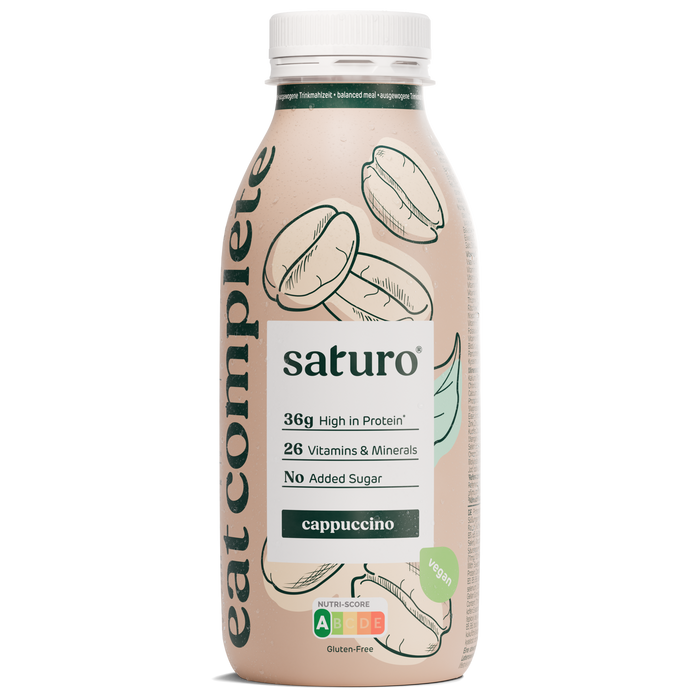
Drinkable meal: 400 kcal with rapeseed oil as the only fat
The only fat ingredient is rapeseed oil, the oil with the lowest share of saturated fat. Each bottle has 18 g of fat, of which 1.2 to 2.9 g is saturated. Replacing saturated fats with mono- and/or polyunsaturated fats in the diet contributes to the maintenance of normal blood cholesterol levels.
Which oil is healthy?
No oil is best for everything, but one comes close. The fatty acid profile shows why: what matters is little saturated fat, plenty of monounsaturated fat for heat, and enough alpha-linolenic acid for your omega-3 supply. Tap a row to see what the oil is good for.
Fatty acid profile: 12 oils and fats compared
Share of fatty acids in per cent, sorted by saturated fat share. On the right, the ratio of omega-6 to omega-3.
- saturated
- monounsaturated
- polyunsaturated
- Rechts je Zeile: Omega-6 to omega-3
-
2 : 1saturated 7,5 %, monounsaturated 64,1 %, polyunsaturated 28,5 %
The DGE's (German Nutrition Society) No. 1 everyday oil: the least saturated fat, lots of oleic acid, 9 g alpha-linolenic acid per 100 g. Refined for frying, cold-pressed for salads.
-
0.3 : 1saturated 9,4 %, monounsaturated 19,4 %, polyunsaturated 71,2 %
Omega-3 champion with 53 g alpha-linolenic acid per 100 g. Use cold only, store cool and dark, and use up within a few weeks.
-
5 : 1saturated 9,6 %, monounsaturated 23,9 %, polyunsaturated 66,5 %
Lots of linoleic acid and 10 g alpha-linolenic acid per 100 g. For salads and dips, don't heat it.
-
hardly any omega-3saturated 10,8 %, monounsaturated 20,4 %, polyunsaturated 68,8 %
Rich in linoleic acid, with practically no alpha-linolenic acid. High-oleic varieties are over 80% oleic acid and are the frying-oil option.
-
46 : 1saturated 13,6 %, monounsaturated 29,0 %, polyunsaturated 57,4 %
Lots of linoleic acid, hardly any omega-3. Neutral in taste and found in many ready-made products.
-
13 : 1saturated 14,2 %, monounsaturated 75,0 %, polyunsaturated 10,8 %
Three quarters oleic acid, and extra virgin also contains polyphenols. Suitable for sautéing and frying at medium heat, but provides hardly any omega-3.
-
2 : 1saturated 14,9 %, monounsaturated 57,8 %, polyunsaturated 27,3 %
Modern rapeseed oil margarine: significantly less saturated fat than butter. Industrial trans fats have been capped at 2 g per 100 g of fat since 2021.
-
7.5 : 1saturated 16,3 %, monounsaturated 23,7 %, polyunsaturated 60,0 %
Rich in linoleic acid, with 7 g alpha-linolenic acid per 100 g. Often found in margarine and ready-made products.
-
10 : 1saturated 41,0 %, monounsaturated 47,2 %, polyunsaturated 11,7 %
A good two fifths saturated, but lots of oleic acid. Heat-stable, but not recommended by the DGE.
-
hardly any omega-3saturated 51,6 %, monounsaturated 38,7 %, polyunsaturated 9,7 %
Around half saturated (palmitic acid). Found in spreads, baked goods and ready-made products; the DGE advises against it.
-
6 : 1saturated 65,6 %, monounsaturated 30,5 %, polyunsaturated 3,9 %
Two thirds of the fatty acids are saturated, so 10 g gives you 5 g of them. Fine for flavour, but swap it for oil as your everyday fat.
-
hardly any omega-3saturated 91,1 %, monounsaturated 7,0 %, polyunsaturated 1,9 %
Over 90% saturated, more than butter. In studies it raises LDL by around 10 mg/dl compared with vegetable oils.
Shares of the recorded fatty acids, USDA FoodData Central SR Legacy (rapeseed oil = canola, sunflower oil high in linoleic acid, margarine with a rapeseed oil recipe and 80% fat). The Bundeslebensmittelschlüssel 4.0 differs for sunflower oil (more oleic acid) and butter (73% saturated). Omega-6 to omega-3 = linoleic acid to alpha-linolenic acid.
Rapeseed oil: why the criticism?
Rapeseed oil gets criticised on social media as a seed oil, but the sources we checked don't back that up. It has the lowest share of saturated fat of all common oils, lots of oleic acid and, at 2 : 1, the best omega-6 to omega-3 ratio; the DGE names it as the first-choice oil. The worry about omega-6 doesn't hold up either: in 19 studies with higher omega-6 intake, there was no sign of harm, and if anything fewer heart attacks. For frying, refined rapeseed oil with a smoke point above 200 °C is a good fit; cold-pressed belongs in the cold kitchen.
Olive oil: healthy every day?
Yes, at around a tablespoon. In two US cohorts followed for 28 years, people who had more than 7 g of olive oil a day had a 19% lower risk of death than people who didn't use any; compared with other vegetable oils, there was no difference. The PREDIMED study found 31% fewer serious cardiovascular events with a Mediterranean diet plus extra virgin olive oil, but that was as a dietary pattern, not the oil alone. Olive oil brings lots of oleic acid and polyphenols, but hardly any omega-3: adding linseed oil or rapeseed oil rounds out the profile.
Refined rapeseed oil, high-oleic sunflower oil or olive oil at medium heat. The consumer advice centre gives 130 to 140 °C as optimal for frying and 160 to 170 °C for deep-frying; above 200 °C any oil breaks down, so pour away oil that's smoking. Never heat linseed oil, walnut oil or cold-pressed oils.
Butter or margarine?
On fatty acids, rapeseed oil margarine wins: 15 to 22% saturated fat instead of 66 to 73% in butter, plus alpha-linolenic acid and no cholesterol. The old worry about trans fats is out of date since the EU limit came in in 2021; according to the DGE, margarine supplies well under 10% of trans fat intake. In three US cohorts, swapping 10 g of butter a day for vegetable oil was linked to 17% lower mortality, which is an observation, not proof. With one tablespoon of spread a day, the DGE says taste can decide; if you use more, rapeseed oil margarine is the better choice.

Omega-3 and omega-6: the right ratio
Omega-3 and omega-6 are the two families of polyunsaturated fatty acids, named after the position of the first double bond. You need both, and in the body they use the same enzymes. That's where the idea of an ideal ratio came from.
The DGE's estimated values of 2.5% of energy for linoleic acid and 0.5% for alpha-linolenic acid work out at 5 : 1. In Germany the ratio is around 7 : 1 to 9 : 1. But the DGE guideline itself considers the knowledge about the ratio too limited, the 2023 Nordic recommendations see no sufficient evidence for a target ratio, and EFSA hasn't set one. More important than the ratio are the absolute amounts: enough alpha-linolenic acid from rapeseed, linseed and walnut oil, and 250 mg of EPA and DHA a day, which the DGE recommends getting from one to two fish meals a week. Without fish, plants can only make up for this to a limited extent, because the body converts only a small share of alpha-linolenic acid (roughly under 1 to 5%) into EPA and even less into DHA.
Linoleic acid: unhealthy?
No. Linoleic acid is the most important omega-6 fatty acid and it's essential; EFSA sets 4% of energy, the DGE 2.5%. The claim that omega-6 promotes inflammation wasn't confirmed by the Cochrane review of 19 studies: more omega-6 changed nothing for mortality and cardiovascular events, heart attacks tended to be less frequent, and cholesterol went down. Sunflower or maize germ oil, however, supply almost only linoleic acid; if you use them as your main oil, you'll get too little omega-3. That's why rapeseed oil is the better base, not because linoleic acid is harmful.
Oleic acid and omega-9
Oleic acid is the most important monounsaturated fatty acid and is called omega-9 because the double bond sits at the ninth carbon atom. It isn't essential, as the body makes it itself, so nobody needs omega-9 capsules. Olive oil, rapeseed oil, avocado and hazelnuts all provide plenty of it. Its value lies in the swap: when oleic acid replaces saturated fat, LDL goes down; the EU permits exactly this statement as a health claim.
Trans fats: why they're harmful
Trans fatty acids are unsaturated fatty acids in which the double bond is in trans form, so the chain stays straight, like in saturated fats. They're produced industrially when vegetable oils are partially hydrogenated and when fat is heated strongly and repeatedly, and in small amounts naturally in the rumen of cattle and sheep. No useful function in the body is known for them: they raise LDL, lower HDL and promote inflammation. For every 2% of energy from trans fats, the risk of heart attack and cardiac death rises by 20 to 32% in observational studies. The DGE and WHO set the limit at under 1% of energy, which is around 2 g at 2,000 kcal.
Which foods contain trans fats?
In the past, mainly margarine, puff pastry, deep-frying fat, croissants, doughnuts, biscuits and fast food. Since the EU limit came in, levels have dropped sharply. As early as 2013, average intake in Germany was 0.66% of energy, and still 1 to 2% for a tenth of the population. What's left comes from deep-frying fat that has been heated several times, imported baked goods and snacks made outside EU rules, plus milk fat and beef, which contain small amounts of natural trans fats.
Spotting trans fats
They don't appear in the nutrition table, as the EU doesn't require them to be listed. Two clues help: "hardened" or "partially hardened" in the ingredients list, and a total fat figure that doesn't add up against the "of which saturates" figure. What matters more in practice is your kitchen: don't reheat frying oil again and again, never use smoking fat, and make puff pastry, crisps and fast food the exception rather than the rule.
How much fat a day?
The DGE recommends 30% of your energy from fat, up to 35% if you do physically heavy work or a lot of sport. With little activity, that's 60 to 80 g a day; the EFSA allows 20 to 35%. Choose your energy requirement (you can work it out with the calorie calculator) and the calculator will show you the gram limits for total fat, saturated fat and polyunsaturated fat.
How much saturated fat a day?
No more than 10% of your energy, around 22 g at 2,000 kcal; the DGE guideline says 7 to 10%, and the WHO recommends staying nearer the lower end. For perspective: 30 g Gouda and 10 g butter at breakfast already add up to 12 g, and one bratwurst has 10 g. The pack gives a reference intake of 20 g, but that's a labelling value for 2,000 kcal, not a free pass. If your LDL cholesterol is raised, the lower limit of 7%, around 15 g, is worth aiming for, in agreement with your doctor.
Replacing saturated fat: here's how
Don't cut it out, swap it. That's the advice from the WHO and DGE: replace saturated fat with polyunsaturated fat (strongly recommended), with plant-based monounsaturated fat, or with high-fibre carbohydrates such as wholegrains and pulses. The table shows what a single swap saves per portion.
Instead of ... try: saturated fat per portion
Your habit on the left, the swap on the right, and how much saturated fat it saves per portion.
| Better swap | Saturated fat before → after | |
|---|---|---|
| Butter on bread (10 g) | Rapeseed oil margarine (10 g) or half an avocado | 5.1 g → 1.2 to 1.6 g |
| Whipping cream in a sauce (30 g) | 3.5% yoghurt (30 g), stirred in at the end | 6.9 g → 0.7 g |
| Gouda 48% (30 g) | Cottage cheese (30 g) or light mozzarella | 6.8 g → 0.7 to 1.7 g |
| Croissant (60 g) | Porridge oats with 30 g walnuts | 7.0 g → 1.8 g |
| Coconut oil for frying (10 g) | Rapeseed oil (10 g) | 8.3 g → 0.7 g |
| Bratwurst (100 g) | Salmon fillet (150 g), plus 3.2 g EPA and DHA | 10.0 g → 3.6 g |
| Milk chocolate (25 g) | A handful of almonds (30 g) | 4.6 g → 1.1 g |
Saturated fat per portion according to USDA FoodData Central SR Legacy and the German Nutrient Database (BLS) 4.0 (butter, cheese, yoghurt). Half an avocado (75 g): 1.6 g. Margarine: USDA 1.2 g, BLS 1.6 g per 10 g.
Two swaps a day, such as butter for margarine and Gouda for cottage cheese, save around 10 g of saturated fat, almost half of the daily limit. If you don't have a kitchen at lunchtime, you can replace a meal with a drinkable meal that uses rapeseed oil as its fat source and get the same result without any maths. What swapping for carbohydrates does and doesn't achieve is covered in the article Carbohydrates.

Frequently asked questions about saturated and unsaturated fatty acids
Which is healthier, saturated or unsaturated fatty acids?
Unsaturated ones. They lower LDL cholesterol when they replace saturated fatty acids, and they're linked to fewer cardiovascular events. Saturated fatty acids are fine in small amounts; the limit is 10% of energy, around 22 g at 2,000 kcal. What matters is what you replace them with.
What do fatty acids do in your body?
They provide energy (9 kcal per gram), build the membranes of every cell, carry the fat-soluble vitamins A, D, E and K, and are the starting material for messenger substances that help control inflammation, blood pressure and clotting. Your body has to get linoleic acid and alpha-linolenic acid from food.
What happens if you don't eat any fat?
Your gut can barely absorb the fat-soluble vitamins A, D, E and K any more, and the essential fatty acids needed for cell membranes and messenger substances run short. A true deficiency is rare and only happens with a long-term fat-free diet or severe bowel disease. EFSA advises against going below 20% of energy from fat.
Does butter contain unsaturated fatty acids?
Yes, but not much: about a third of the fatty acids in butter are unsaturated, almost all of them oleic acid, and the rest are saturated. 10 g of butter provides around 5 g of saturated fatty acids. Rapeseed oil margarine or oil flips that ratio around.
Is 30 g of fat a day too little?
For adults, yes, in the long run. At 1,800 kcal, 30 g is only 15% of your energy; EFSA gives 20% as the lower limit, and the DGE (German Nutrition Society) gives 30% as a guideline. Below that, you lack energy, fat-soluble vitamins and essential fatty acids. Even when you're losing weight, the rule is: improve the quality of your fat rather than cutting it out.
Which oil is the healthiest for frying?
Refined rapeseed oil: low in saturated fatty acids, high in oleic acid, with a smoke point above 200 °C, and recommended by the DGE and the consumer advice centre (Verbraucherzentrale). Alternatives are high-oleic sunflower oil and olive oil at medium heat. Linseed oil, walnut oil and cold-pressed oils belong in cold cooking, and coconut oil isn't a good choice because of its saturated fatty acids.
Which is healthier, omega-3 or omega-6?
You need both, and neither is healthier. Omega-6 (linoleic acid) lowers cholesterol and, according to Cochrane, does no harm; omega-3 (alpha-linolenic acid, EPA, DHA) is more likely to be lacking in the German diet. In practice: use rapeseed oil instead of sunflower oil as your main oil, add walnuts or linseed oil, and eat oily fish once or twice a week.
Do crisps contain trans fats?
Hardly any in the EU: since 2021 there has been a maximum of 2 g of industrial trans fats per 100 g of fat, and crisps are mostly fried in sunflower, rapeseed or palm oil. Their issue is more the amount of fat and, with palm oil, the high share of saturated fatty acids.
Sources · 42 sources anzeigen
- European Parliament and Council: Regulation (EU) No 1169/2011 on the provision of food information to consumers, Annex I (definitions of fatty acids), XIII (reference intakes) and XIV (conversion factors). Official Journal L 304, 22.11.2011.
- German Federal Institute for Risk Assessment (BfR): Health assessment of fatty acids. Topic page, Berlin.
- German Nutrition Society (DGE), ÖGE, SGE: Reference values for nutrient intake, fat and essential fatty acids (derivation as of 2000), 3rd edition 2025.
- German Nutrition Society (DGE): Evidence-based guideline on fat intake and the prevention of selected diet-related diseases, 2nd version 2015, Chapter 13: Implementing the guideline (guideline values for saturated, polyunsaturated and trans fatty acids).
- German Nutrition Society (DGE): Fat intake guideline 2015, Chapter 12: Summary of results (evidence assessment on LDL, CHD, trans fatty acids).
- German Nutrition Society (DGE): Fat intake guideline 2015, Chapter 9: Fat intake and the prevention of coronary heart disease (n-6 to n-3 ratio).
- Dinter J., Bechthold A.: Fat intake in Germany. In: DGE fat intake guideline 2015, Chapter 2 (National Nutrition Survey II, n-6 to n-3 ratio, trans fatty acids).
- German Nutrition Society (DGE): Fat in the diet: facts about the importance of fat for the body. DGE blog 2023.
- German Nutrition Society (DGE): Oils and fats. DGE nutrition circle.
- German Nutrition Society (DGE): Eating and drinking well: the DGE recommendations (food-based dietary guidelines, March 2024).
- German Nutrition Society (DGE): Frequently asked questions and answers on the food-based dietary guidelines (eggs, dairy products).
- German Nutrition Society (DGE): trans fatty acids and health. Technical information, as of July 2016.
- World Health Organization (WHO): Saturated fatty acid and trans-fatty acid intake for adults and children: WHO guideline. Geneva 2023.
- Mensink R. P.: Effects of saturated fatty acids on serum lipids and lipoproteins: a systematic review and regression analysis. World Health Organization, Geneva 2016.
- European Food Safety Authority (EFSA): Dietary Reference Values for nutrients. Summary report (fats table: total fat 20 to 35%, linoleic acid 4%, alpha-linolenic acid 0.5%, EPA and DHA 250 mg). Version 4, 2017.
- Nordic Council of Ministers: Nordic Nutrition Recommendations 2023, chapter Fat and fatty acids. Copenhagen 2023.
- FAO/WHO: Fats and fatty acids in human nutrition. Report of an expert consultation. FAO Food and Nutrition Paper 91, Rome 2010.
- Hooper L., Martin N., Jimoh O. F., Kirk C., Foster E., Abdelhamid A. S.: Reduction in saturated fat intake for cardiovascular disease. Cochrane Database of Systematic Reviews 2020; (8): CD011737 (pub3).
- Hooper L., Al-Khudairy L., Abdelhamid A. S. et al.: Omega-6 fats for the primary and secondary prevention of cardiovascular disease. Cochrane Database of Systematic Reviews 2018; (11): CD011094.
- Abdelhamid A. S., Brown T. J., Brainard J. S. et al.: Omega-3 fatty acids for the primary and secondary prevention of cardiovascular disease. Cochrane Database of Systematic Reviews 2020; (3): CD003177.
- Sacks F. M., Lichtenstein A. H., Wu J. H. Y. et al.: Dietary Fats and Cardiovascular Disease: A Presidential Advisory From the American Heart Association. Circulation 2017; 136(3): e1–e23.
- Astrup A., Magkos F., Bier D. M. et al.: Saturated Fats and Health: A Reassessment and Proposal for Food-Based Recommendations. Journal of the American College of Cardiology 2020; 76(7): 844–857.
- Hjerpsted J., Leedo E., Tholstrup T.: Cheese intake in large amounts lowers LDL-cholesterol concentrations compared with butter intake of equal fat content. American Journal of Clinical Nutrition 2011; 94(6): 1479–1484.
- Guo J., Astrup A., Lovegrove J. A. et al.: Milk and dairy consumption and risk of cardiovascular diseases and all-cause mortality: dose-response meta-analysis of prospective cohort studies. European Journal of Epidemiology 2017; 32(4): 269–287.
- Neelakantan N., Seah J. Y. H., van Dam R. M.: The Effect of Coconut Oil Consumption on Cardiovascular Risk Factors: A Systematic Review and Meta-Analysis of Clinical Trials. Circulation 2020; 141(10): 803–814.
- Mumme K., Stonehouse W.: Effects of medium-chain triglycerides on weight loss and body composition: a meta-analysis of randomized controlled trials. Journal of the Academy of Nutrition and Dietetics 2015; 115(2): 249–263.
- Koh A., De Vadder F., Kovatcheva-Datchary P., Bäckhed F.: From Dietary Fiber to Host Physiology: Short-Chain Fatty Acids as Key Bacterial Metabolites. Cell 2016; 165(6): 1332–1345.
- Zhang Y., Chadaideh K. S., Li Y. et al.: Butter and Plant-Based Oils Intake and Mortality. JAMA Internal Medicine 2025; 185(5): 549–560.
- Guasch-Ferré M., Li Y., Willett W. C. et al.: Consumption of Olive Oil and Risk of Total and Cause-Specific Mortality Among U.S. Adults. Journal of the American College of Cardiology 2022; 79(2): 101–112.
- Estruch R., Ros E., Salas-Salvadó J. et al.: Primary Prevention of Cardiovascular Disease with a Mediterranean Diet Supplemented with Extra-Virgin Olive Oil or Nuts (PREDIMED, republication). New England Journal of Medicine 2018; 378(25): e34.
- Mozaffarian D., Aro A., Willett W. C.: Health effects of trans-fatty acids: experimental and observational evidence. European Journal of Clinical Nutrition 2009; 63 Suppl 2: S5–S21.
- European Commission: Regulation (EU) 2019/649 amending Annex III to Regulation (EC) No 1925/2006 as regards trans fats other than those naturally occurring in fat of animal origin. Official Journal L 110, 25.4.2019.
- Federal Institute for Risk Assessment (BfR): The current level of trans fatty acid intake in Germany is not a health concern. Opinion No. 028/2013 of 6 June 2013.
- Plourde M., Cunnane S. C.: Extremely limited synthesis of long chain polyunsaturates in adults: implications for their dietary essentiality and use as supplements. Applied Physiology, Nutrition, and Metabolism 2007; 32(4): 619–634.
- Burdge G. C., Calder P. C.: Conversion of alpha-linolenic acid to longer-chain polyunsaturated fatty acids in human adults. Reproduction Nutrition Development 2005; 45(5): 581–597.
- Verbraucherzentrale: Cooking oils: which are suitable for what? (smoke points, frying and deep-frying temperatures).
- Federal Centre for Nutrition (BZfE): Rapeseed oil: from shop to kitchen.
- Verbraucherzentrale: How much fat a day belongs in a healthy diet? As at 8 November 2025.
- European Commission: Regulation (EU) No 432/2012 establishing a list of permitted health claims made on foods (monounsaturated and polyunsaturated fatty acids, oleic acid). Official Journal L 136, 25.5.2012.
- European Parliament and Council: Regulation (EC) No 1924/2006 on nutrition and health claims made on foods, Annex (conditions for claims on saturated and unsaturated fatty acids).
- U.S. Department of Agriculture, Agricultural Research Service: FoodData Central, SR Legacy Release (April 2018). Fatty acids per 100 g.
- Max Rubner-Institut: Bundeslebensmittelschlüssel (BLS), Version 4.0, German Nutrient Database. Karlsruhe 2025.
Has been writing for Saturo since 2019 about nutrition, nutrients and how to get good nutrition into everyday life in practice.
Hat diesen Artikel am 15. Oktober 2026 auf fachliche Richtigkeit geprüft. This content does not replace medical advice.
Fibre: how much you need, what it does and high-fibre foods
The DGE recommends 30 g a day, and most people get about two thirds of that. Find out which foods really deliver a lot, and how to reach 30 g without bloating.
Weiterlesen · 15 Min

New from the guide
New articles, updates and tips straight to your inbox. Easy to follow, fact-checked, no spam.
Danke! Bitte bestätige die Anmeldung in deinem Postfach.