
Two bottles of Vanilla and one each of Cocoa, Natural, Strawberry and Cappuccino. One-off purchase, no subscription.
$35.00$5.83 per meal · $1.46/100 mlFree delivery in Germany and Austria

Medical nutritional drinks from the pharmacy, or an over-the-counter drinkable meal? High-calorie nutritional drinks pack a lot of energy into very little liquid, but not every product suits every situation. Which product delivers what, how many bottles make sense and when the health insurer pays.


That's how dense medical nutritional drinks are; normal food has around 1 kcal per gram. A 125 ml bottle holds the energy of a small meal.
27% of patients in German hospitals are malnourished, and among the over-70s it's 43%. The most important warning sign: losing weight without meaning to.
plus 30 g of protein a day on top of your meals, for at least a month: that's how the European society ESPEN uses nutritional drinks for malnutrition.
Nutritional drinks only work on top of your meals. If you drink the bottle instead of lunch, your balance by evening is the same as before and you won't gain weight. So: in between, not instead.
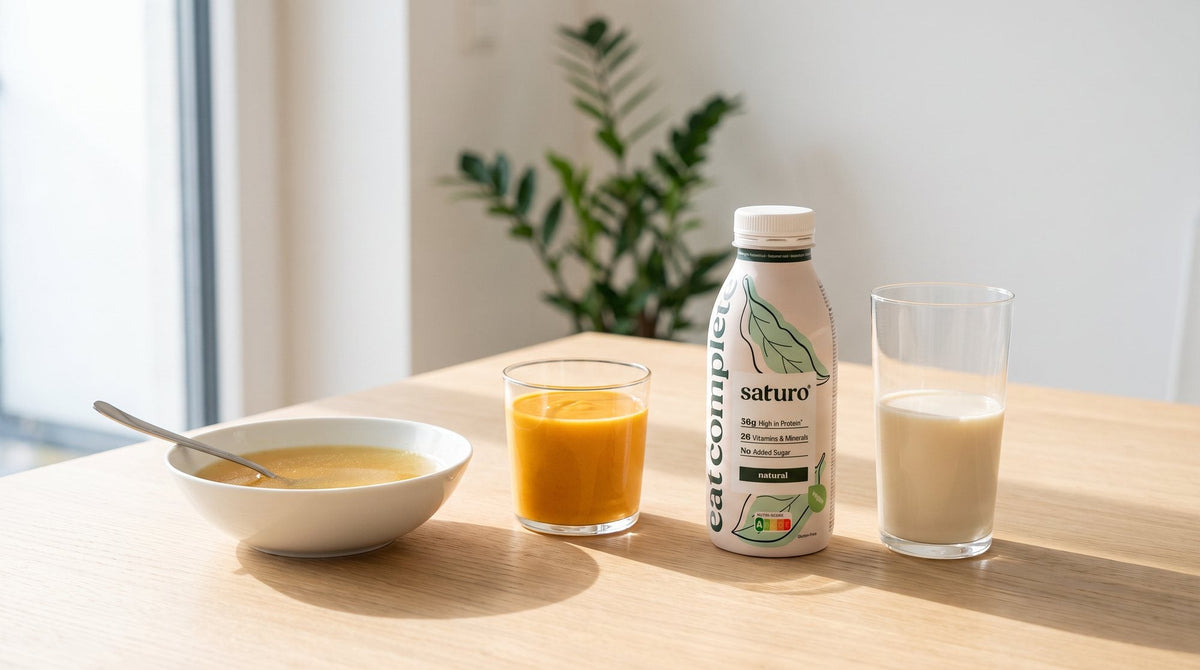
Vegan, low in sugar, with 26 vitamins and minerals. Ready to drink, no recipe needed, as an extra meal alongside your food.
Two bottles of Vanilla and one each of Cocoa, Natural, Strawberry and Cappuccino. One-off purchase, no subscription.
Or go straight for your flavour in a 6‑pack:
Alle Preise inkl. MwSt., zzgl. Versand. Free delivery in Germany and Austria from 2 packs.
High-calorie nutritional drinks pack energy into a small volume, for people who no longer eat enough: after an operation, during chemotherapy, in old age without an appetite, with chewing and swallowing problems. They're measured in calories per millilitre: normal food provides about 1 kcal per gram. According to the DGEM society, nutritional drinks count as normocaloric at 1.0 to 1.2 kcal/ml and as high-calorie above that; products range from 1.5 to 3.2 kcal/ml.
Three kinds of product go by the name nutritional drinks. Medical nutritional drinks (Fresubin, Fortimel, Resource and others) are a food for special medical purposes: for people who can't get enough nutrition from normal food, usually nutritionally complete and only prescribable in that case. The drinkable meal is a normal food: a complete meal with 400 to 500 kcal, all vitamins and minerals, and normocaloric at around 1 kcal/ml; the Saturo drinkable meal provides 400 kcal and 36 g of protein per 400 ml bottle. The protein shake (20 to 25 g of protein, hardly any energy, no vitamins) tops up a meal and doesn't replace one. Weight-gainer powders are high-calorie, but neither nutritionally complete nor prescribable.

Who it makes sense for, the guidelines state clearly: nutritional drinks are step three, after fortifying your food and eating snacks between meals. They help with illness-related malnutrition (cancer, chronic bowel, lung and kidney diseases, dementia, after major operations), with chewing and swallowing problems, with loss of appetite in old age and for people who are healthy but want to gain weight; for that last group, a medical product is usually the wrong choice (chapter 5). Three questions show which chapter matters for you.
For the people they're made for, yes, and measurably so: a Cochrane analysis of older, malnourished or at-risk people shows that energy and protein supplements bring around 2% weight gain and fewer complications, and mortality fell among the undernourished. For healthy people at a normal weight they're not unhealthy, just unnecessary: energy your body doesn't need, with 6 to 15 g of sugar per bottle depending on the flavour, because sweetness helps when you have no appetite. If you want to gain weight without a medical reason, you're better off with a proper meal that fills you up and contains less sugar.
Lost more than 5% of your weight unintentionally in three to six months, a BMI under 20 (under 22 if you're over 70), barely eaten for five days? Then see your doctor first, and nutrition drinks second; after a long period of hunger there's a risk of refeeding syndrome (chapter 7).
The best nutrition drink depends on your situation, not on the brand. Medical products differ in energy density, protein, volume and taste, not in principle: all are nutritionally complete, all fall under the same regulation, all are sold in pharmacies. The over-the-counter drinkable meal is also a nutrition drink, just without a prescription and without a medical purpose: less dense, but a complete meal with more protein and fibre.
Per millilitre, the compact products: 2.4 to 3.2 kcal, so 300 to 400 kcal in 125 ml. The 2 kcal ranges come in at 200 kcal per 100 ml, the standard ranges at 150, a drinkable meal at around 100. What counts, though, is what arrives per bottle, and there the products are closer together than the density suggests. The bars show energy and protein per bottle according to manufacturer data, as of September 2026.
One typical product from each of the two market leaders per range, manufacturer data per serving, September 2026. Per 100 ml: Compact 3.2 kcal 320, Compact Protein 245, Compact 2.4 kcal 240, 2 kcal range 200, standard ranges 150, drinkable meal 100, build-up powder in water 78, whole milk 61.
Hardly at all, in principle: Fresubin (Fresenius Kabi) and Fortimel (Nutricia) offer the same building blocks, a standard range with 1.5 kcal/ml and around 300 kcal per 200 ml, a 2 kcal range, a compact range in 125 ml, high-protein variants with 18 to 20 g of protein, fibre and diabetes variants, and clear juice-style variants. Both are nutritionally complete and prescribable. The difference that matters is personal taste: studies show that it isn't the brand that decides success, but whether the product actually gets drunk. So try two to three flavours from a trial pack, then choose by taste, protein content and pharmacy price.
If your appetite is small, go for the 125 ml bottle; if you're thirsty, the 200 ml bottle. Both deliver 300 kcal. The question is which one is easier to finish, and there's data on that: in a review of 46 studies with over 4,300 patients, the share of nutrition drinks actually drunk averaged 78%, and it was higher the more energy-dense the product was. For people who feel full quickly, the compact bottle is therefore the better choice.
Standard bottle: more liquid, more sips, quenches thirst too
same energy in a third less volume; according to studies, denser products are more likely to be finished
Medical nutrition drinks without any sugar at all don't exist: part of the energy comes from carbohydrates, and standard products contain 6 to 15 g of sugar per bottle depending on the flavour (manufacturer data 2026). Diabetes variants rely on slowly available carbohydrates, but aren't prescribable. If you're gaining weight healthily and want to avoid sugar, a low-sugar drinkable meal like the Saturo drinkable meal, with 1 to 1.5 g of sugar per bottle, is the right fit. Almost no medical products are vegan (milk protein, mostly low in lactose); many drinkable meals are also milk-based, but the Saturo drinkable meal is vegan. Savoury options come as soups and creamy soups.
At the pharmacy, in store or online; with a prescription you only pay the co-payment there. Rossmann doesn't stock medical nutrition drinks, either on the shelf or online. dm doesn't have them in its stores, but sells mixed cartons online through its partner pharmacy dm-med (as of September 2026). Before you buy, work out the price per 100 kcal and per gram of protein, and then 125, 200 and 400 ml bottles become comparable.
Manufacturers change recipes, pack sizes and prices. All third-party figures come from the manufacturers' websites as of September 2026; if you spot outdated information, let us know at support@saturo.com.
Three levers decide whether nutritional drinks work for you: how dense the energy is, whether there's enough protein, and whether the bottle adds to your food or pushes it out.
Your stomach signals fullness by volume, not by calories. A litre of soup fills you up, a tablespoon of oil doesn't, even though it has 90 kcal. Fat provides 9 kcal per gram, carbohydrates and protein 4. High-calorie nutritional drinks use exactly that: lots of fat and carbohydrates in very little liquid, so the energy gets in before you feel full.
If you're gaining weight, you want strength, not just kilos. Without protein, the surplus goes into fat tissue and your muscles stay as they are. The ESPEN society recommends at least 1.0 g of protein per kilogram of body weight a day for older adults, and at least 30 g extra with nutritional drinks; with strength training, the need rises to around 1.6 g per kilogram.
Nutritionally complete means: all vitamins and minerals are in there in proportion, so in theory the bottle could feed you on its own. In practice, timing decides: drunk between meals, it adds 300 to 400 kcal on top. Drunk with a meal or instead of one, it pushes out your food, and your daily balance stays where it was.
Most mistakes with nutrition drinks are usage mistakes: too much at once, at the wrong time, as a replacement instead of an addition, or stopped after a week because the scales show nothing. The goal is an energy surplus your body can sustain over weeks.
One to two bottles on top of your food. For malnutrition, the European guideline sets a target of at least 400 kcal and 30 g protein extra per day, and the German guideline at least 300 kcal and high in protein: one to two bottles of medical nutrition drink or one Saturo drinkable meal with 400 kcal and 36 g protein. More than two to three bottles on top start to push out your food; as your only source of nutrition, five to seven bottles are only an option under medical supervision. A drinkable meal is a food with no upper limit, but still: one bottle on top, not three instead of eating.
Normal food, as long as it works: it gives you chewing, taste, company and a fullness that no bottle replaces. Nutrition drinks are the tool for the energy that no longer gets in through food. So "how much normal food does a bottle replace?" is the wrong question: 300 kcal is roughly a cheese sandwich or a small portion of pasta, and if the bottle replaces the sandwich, you've gained nothing. It only works on top of your food, as the sums show:
Your daily balance stays the same, and so does your weight
the surplus that builds weight over weeks
The best time is between meals, at least an hour before the next one: mid-morning, afternoon, bedtime snack. Most people find nutrition drinks taste better chilled, and sipping them slowly over half an hour is easier on the stomach. If you can't finish a bottle, split it and keep the rest sealed in the fridge until the evening. Don't combine the bottle with medication that you take on an empty stomach.
For as long as the reason exists. For malnutrition, the guidelines recommend nutrition drinks for at least one month, followed by a check of weight, appetite and strength. If your values improve, you cut back step by step; if the cause remains, for example a chronic illness, nutritionally complete drinks can be part of your diet for months and years. A drinkable meal is like any other food: fine long term, but not as your only meal, because variety and chewing are part of good nutrition. The typical course:
Half a bottle between two meals, chilled, in small sips. Try two to three flavours, including a savoury or clear one. If you get bloating or diarrhoea, switch to a fibre-free or lactose-free option.
Always at the same time, for example 4 pm, so you don't forget it and it doesn't push out dinner. Weigh yourself once, in the morning on an empty stomach, as your starting value. Also enrich your meals (chapter 6).
If the scales show nothing after two weeks, add a second portion. Weigh yourself weekly, no more. If you can, do strength exercises two to three times a week so the surplus turns into muscle.
The target is 0.25 to 0.5% of your body weight per week, which at 60 kg means 0.5 to 1 kg in the first month. If there's a medical reason, get a check-up at your practice; if it's working, reduce slowly; if you've stalled, find the cause instead of doubling the dose.
Serve it colder, switch flavours, mix it up. Cold (ice cubes, freezer) dampens sweetness and the milky taste. Coffee, cocoa and nut flavours are less sweet and tire your palate more slowly than vanilla. You can mix it with espresso, cocoa powder, cinnamon, mashed banana or berries, or stir it into porridge, semolina pudding and custard. Savoury soup-style options should be lukewarm, never boiled, or the protein will curdle. If you don't like the milky texture, go for the clear, juice-style options: they taste like fruit juice, and the energy comes from the carbohydrates. And if nutrition drinks feel like a punishment, say so: enriched food that tastes good is better than a half-full bottle.

Most people reading this aren't ill. They're slim, feel like they eat plenty and still don't gain weight, or they lost weight after an illness or a stressful period and want it back. You don't need a pharmacy for that, but a plan with three parts: surplus, protein, strength training.
A realistic rate is 0.25 to 0.5% of your body weight per week, which at 60 kg is 150 to 300 g; five kilos in two weeks is water and wishful thinking. A surplus of 10 to 20% of your needs, usually 300 to 400 kcal a day, over several weeks is enough; if you take in more, you gain faster, but mostly fat. One bottle of drinkable meal, or one to two bottles of medical nutrition drinks on top of your food, delivers this surplus more reliably than a resolution to eat more. What slows it down: water, soup or salad before eating, and long runs.
A calorie surplus on its own builds fat. For the weight to arrive as muscle, your body needs resistance and building material: strength training two to three times a week, even at 75, plus protein. According to a meta-analysis of 49 studies, protein improves muscle gain during training up to 1.6 g per kilogram of body weight, and more doesn't help. For 60 kg, that's around 100 g spread over four to five servings. This is where the Saturo drinkable meal parts ways with medical nutrition drinks: 36 g protein per bottle versus 11 to 20 g, a third of your daily requirement versus a tenth.
A nutrition drink is a tool, not a replacement for food. If you put the bottle between your meals and train your strength as well, you gain muscle, not just weight.
Joerg Hauke, Nutrition expert, expert review of this article
Being underweight without illness (BMI under 18.5, but fit, with a normal appetite and no symptoms) doesn't need an assessment for malnutrition. Do get a blood count, thyroid and iron levels checked once, though, because an unnoticed cause can otherwise block weight gain. After that, the plan applies: surplus, protein, strength, and patience over three months. If you've lost weight unintentionally, suffer from loss of appetite or exhaustion, or drop below a BMI of 17, you belong at the doctor's, not in an online shop.
For healthy people who want to gain weight, the Saturo drinkable meal has three advantages over medical nutrition drinks: it's a complete meal with fibre, it delivers up to three times as much protein per bottle with 36 g, and it contains hardly any sugar (1 to 1.5 g). The downside: 400 ml volume at 1 kcal per millilitre. If you have an appetite, you'll manage it. If illness leaves you full after three sips, the compact medical version works better for you. Rule of thumb: healthy and slim, drinkable meal on top of your food; ill, no appetite, unintentional weight loss, medical nutrition drink on prescription.
Before the bottle comes the kitchen. The guidelines put two steps first: fortify your food and add two to three small snacks, such as yoghurt with nut butter, a cheese sandwich or a banana shake. That works when your appetite is small but there. If it's not enough, nutrition drinks come in as well. According to the German guideline, they're a supplement, not something you wait for until everything else has failed.
Fortifying raises the energy density of your food: studies with older people show a few hundred extra calories a day this way. In any kitchen: one tablespoon of olive oil (88 kcal) in soup, mash or salad; butter or cream in vegetables and sauce (2 tbsp cream 100 kcal); nut butter in yoghurt and porridge (1 tbsp 90 kcal); cheese over anything hot (20 g Parmesan 84 kcal); whole milk instead of water for porridge and cocoa. Rule of thumb: three fortifications per meal, three meals, adds up to 300 to 400 kcal a day, as much as one bottle of nutrition drink.

No pharmacy needed: 250 ml whole milk (150 kcal, 8 g protein), one ripe banana (100 kcal), 2 tbsp peanut butter (180 kcal, 7 g protein), 40 g fine rolled oats (150 kcal, 5 g protein) and two pitted dates (60 kcal), blitzed for 30 seconds in the blender. That makes around 640 kcal and 22 g protein in 400 ml, as much as two bottles of standard nutrition drink. With a spoonful of protein powder or 100 g skyr, the protein goes up to over 30 g. If you can't tolerate milk, use oat or soy drink and 3 tbsp nut butter. Drink it chilled, in two portions, one in the morning and one in the afternoon.
High-calorie yoghurt: 150 g Greek yoghurt (full-fat, 145 kcal) with 1 tbsp nut butter, 1 tsp honey and 20 g chopped nuts makes around 400 kcal and 15 g protein. Savoury: a cup of cream soup with 2 tbsp cream, 1 tbsp oil and 20 g Parmesan delivers 350 kcal instead of 120, and scrambled eggs with cream and cheese come to 350 kcal for two eggs. If you fortify for weeks, think about vitamins: homemade isn't nutritionally balanced, so one nutritionally complete drinkable meal or medical nutrition drink a day secures your micronutrients.
Homemade shakes keep in the fridge for one day, and an opened nutrition drink also keeps for 24 hours, chilled and sealed. Nut butter, oil and cream have the best ratio of calories to volume, so if you can only manage a little, start with those.
When a doctor prescribes them, and that's only possible under the conditions of the Pharmaceuticals Directive of the Federal Joint Committee (Section I, §§ 18 to 26): in cases of a missing or limited ability to eat enough normally, when changing your diet and fortifying with butter, cream, whole milk or oil isn't enough. Nutritionally complete standard products are prescribed; special products for diabetes, geriatrics or cancer patients and products under 1.0 kcal/ml are excluded. Typical cases: malnutrition with cancer, after major surgery, with dementia, swallowing disorders after a stroke, chronic bowel diseases. Drinkable meals, protein shakes and all normal foods can't be prescribed, so if you want to gain weight healthily, you pay for it yourself.
With age, appetite drops, taste fades, teeth and swallowing cause problems, and many people eat alone. At the same time, protein needs go up, because muscle is broken down faster than it's built. The European guideline therefore recommends at least 1.0 g of protein per kilogram of body weight and around 30 kcal per kilogram a day. If there's malnutrition or a risk of it, it recommends nutritional drinks with at least 400 kcal and 30 g of protein on top, for at least a month. For relatives: note down their weight every month, get the GP involved if they lose weight without meaning to, enrich their food, and put the bottle between meals. In care homes, screening is mandatory, so ask for the result.
With cancer, the aim is to stop weight loss, because malnutrition makes treatment harder to tolerate and worsens the prognosis. The German oncology guideline works on 25 to 30 kcal and 1.2 to 1.5 g of protein per kilogram of body weight a day. If food isn't enough, the next steps are nutritional counselling, food enrichment and nutritional drinks. For nausea, changes in taste and inflamed mouth lining, cool, mild, non-acidic flavours help, as do small amounts throughout the day and switching between sweet and savoury. A metallic taste is easier to bear with a plastic spoon and cold products. Standard nutritional drinks can be prescribed, special tumour products can't. Your first port of call is the oncology nutrition team.

With diabetes, standard nutritional drinks (6 to 15 g of sugar per bottle) push up your blood sugar. Diabetes-specific versions can't be prescribed, and if you inject insulin, ask your diabetes care team. Healthy people with diabetes who want to gain weight have an easier time with a low-sugar drinkable meal like the Saturo drinkable meal (under 2 g of sugar). With swallowing disorders (stroke, Parkinson's, throat surgery), thin nutritional drinks are thickened or served as a pudding. The level is set by speech and language therapy (IDDSI 0 to 4). Read more in the article on swallowing difficulties. Children have their own products (Frebini, Fortini). Adult products and drinkable meals aren't for them. The paediatrician prescribes, and there's no co-payment.
Barely eaten for ten days, a BMI under 16, or lost over 15% in three to six months? Then don't start with full portions: carbohydrates make phosphate, potassium and magnesium plunge, which is dangerous for your heart and breathing. Build up only under medical supervision, with blood tests.
As a supplement, one to three bottles a day between meals. The guideline sets a target of at least 400 kcal and 30 g of protein on top. As your only nutrition, you need five to seven bottles, and that should be medically supervised. The amount is stated on the prescription, based on your weight and condition.
On paper, yes: a bottle with 300 to 400 kcal has the energy of a small meal and, because it's nutritionally complete, a proportionate share of all vitamins and minerals. But it shouldn't do that if you want to gain weight: if you drink the bottle instead of lunch, you end the day with the same balance. It works between meals.
Yes, if you drink it on top of your food and the surplus is 10 to 20% of your needs. Then 0.25 to 0.5% of your body weight per week is realistic. For healthy people, a drinkable meal like the Saturo drinkable meal (400 kcal, 36 g of protein) is usually the better choice, combined with strength training.
For healthy underweight (BMI under 18.5 with no symptoms), yes, as part of a plan with a surplus, protein and strength training. Get your blood count, thyroid and iron checked first. With unintentional weight loss, loss of appetite or a BMI under 17, your nutrition belongs in medical hands, not least because of the refeeding risk.
When your food no longer covers your needs and enriching it plus snacks between meals isn't enough: with illness-related malnutrition, chewing and swallowing problems or loss of appetite in older age. In that case, you'd get medical nutritional drinks on prescription. If you're healthy and want to gain weight, have a drinkable meal on top of your food. If you eat normally and maintain your weight, you don't need one.
Four numbers per bottle: calories (300 to 400), protein (standard ranges 11 to 12 g, protein versions 18 to 20 g, Saturo drinkable meal 36 g), sugar (standard products 6 to 15 g, Saturo drinkable meal 1 to 1.5 g; manufacturer data 2026), and whether the product is nutritionally complete, meaning it contains all vitamins and minerals.
Foods with a high energy density in a small volume: olive oil (884 kcal per 100 g, USDA), butter (717), walnuts (654), peanut butter and dark chocolate (598 each), almonds (579), Parmesan (420), cream (340), honey (304), dates (277). These are the ingredients that make your food denser without making the portion bigger (chapter 6).
Not with bigger portions, but with denser food: three enrichments per meal (oil, cream, nut butter, cheese) add 300 to 400 kcal. Add two snacks, like high-calorie yoghurt (400 kcal) and a shake (640 kcal, chapter 6). Together, that's over 1,000 kcal more than normal food, without chewing any more.
Has been writing for Saturo since 2019 about nutrition, nutrients and how to get good nutrition into everyday life in practice.
Hat diesen Artikel am 16. September 2026 auf fachliche Richtigkeit geprüft. The content does not replace medical advice.
Medical drinkable nutrition, astronaut food or drinkable meal? The differences in composition, nutrient profile and price.
Weiterlesen · 15 Min

New articles, updates and tips straight to your inbox. Easy to understand, expert-reviewed, no spam.
Danke! Bitte bestätige die Anmeldung in deinem Postfach.


