
Calcium deficiency: symptoms, causes and treatment
Tingling around the mouth, cramps in your hands, brittle nails? Your body quietly compensates for calcium deficiency in food from your bones for years. Which symptoms belong to it, why there's no self-test, and how to reach 1,000 mg.


Aktualisiert 30 September 2026 · 16 Min. Lesezeit · 69 Quellen

The essentials in 30 seconds
DGE reference value for adults, also during pregnancy and breastfeeding. Teenagers aged 13 to 18 need 1,200 mg, because bone is being built up during that time.
Of roughly one kilogram of calcium in your body, almost all of it sits in the skeleton. If calcium is missing from your food, your body takes it from there without you noticing anything.
Below this, doctors speak of hypocalcaemia. The blood level is regulated so strictly that it stays normal even with a nutritional deficiency. If it drops, there's usually a hormone behind it.
Vitamin D controls how much calcium your gut absorbs. Without it, even the best food won't reach your bones. That's why vitamin D deficiency is the most common cause of a genuine calcium deficiency.
Calcium deficiency symptoms: how to recognise it
A calcium deficiency in the medical sense, hypocalcaemia, is present when blood calcium drops below 2.2 mmol/l: nerves and muscles become overexcitable, there's tingling around the mouth, hands cramp up. If you simply eat too little calcium, you won't get these symptoms, the body keeps the blood level stable for years by drawing on the bones. If it drops, it's almost always the regulation itself that's disrupted.
Early signs: tingling, cramps, tiredness
Tingling around the lips, fingertips and toes, where nerves are densest, is almost always the first sign. Then come muscle cramps in hands and feet, longer lasting and hard to stretch away. A reliable test in practice: a blood pressure cuff pumped up for three minutes brings the hand into a carpopedal spasm. Twitching at the corners of the mouth when tapping the facial nerve, on the other hand, occurs in up to 10% of healthy people too. Tiredness is part of it, but if tiredness is all you have, you rarely have a calcium deficiency.
Calcium deficiency symptoms: eyes
The eyes react last with calcium deficiency, not first. What's proven is cataracts: in people whose parathyroid glands permanently produce too little hormone, cataract risk was quadrupled in a Danish registry study, and even higher in a Turkish study the longer the condition had lasted. Calcium and phosphate deposit in the lens when their ratio is shifted over years, not from too little milk. Eyelid twitching also occurs. There's no evidence for dry eyes or blurred vision as an early sign.

Calcium deficiency neurological symptoms
Because calcium calms the nerves, almost all symptoms of a genuine deficiency are neurological, in this order: paraesthesia (tingling, numbness) on the lips, tongue, hands and feet, then tetany up to carpopedal spasm, laryngeal spasms with shortness of breath, and with severe deficiency, seizures (ten times more common in the Danish registry study). If the level stays low for years, the basal ganglia in the brain calcify. Special case: panic. Rapid breathing makes the blood alkaline, free calcium drops, and there's tingling around the mouth even though the total level is normal.
Calcium deficiency symptoms: women
The symptoms are the same in women and men, but the paths into deficiency differ. According to a dietary survey, 55% of women don't reach the recommendation, and among girls aged 14 to 18, it's 74%. During menopause, absorption in the gut drops as oestrogen falls (chapter 7). After thyroid surgery, more common in women, the level temporarily drops in one in four people. Hair loss, weight gain or water retention are not calcium symptoms; then check thyroid and iron instead.
Calcium deficiency symptoms: mental health
Irritability, inner restlessness, anxiety and depressive mood are well documented with chronic hypocalcaemia: after thyroid surgery with failed parathyroid glands, depression risk was doubled in the Danish registry study. But: psychological symptoms are practically never the only sign, and the connection often runs backwards: anxiety causes hyperventilation, hyperventilation causes tingling, tingling causes more anxiety. Without physical signs, a calcium deficiency is unlikely, and a supplement won't lift your mood. If in doubt, still get calcium checked, along with thyroid, vitamin D and B12.
Tingling around the mouth plus cramps in the hands, especially after thyroid surgery, with kidney disease or while taking osteoporosis medication: get to a doctor promptly, with calcium, albumin, magnesium, vitamin D and ECG checks. Call 112 in the event of a seizure, breathing difficulties or persistent heart rhythm disturbances.
Skin, hair, nails and teeth
Dry, flaky skin, brittle nails and coarse hair are only described in the literature with chronic hypocalcaemia, not as an early warning; in otherwise healthy people, it's almost always iron, thyroid, or zinc behind it. When it comes to teeth, there's a persistent myth: that the body pulls calcium from the teeth when it's deficient. But tooth enamel is no longer remodelled after it erupts, so the body draws on the skeleton instead. Only children whose teeth are still forming can get enamel defects with hypoparathyroidism.
Calcium deficiency self-test: Can you do this at home?
No. No test strip, no app and no drugstore kit measures your calcium level; self-tests usually measure vitamin D or magnesium. Calcium is determined from blood serum, at any GP practice, together with albumin (chapter 4). What you can check at home: Are you getting 1,000 mg a day from your food? The daily building block chart in chapter 6 shows you that. If you regularly land under 500 mg there, you have a calcium deficiency in the dietary sense, without any symptoms, and it goes straight to your bones.
Calcium deficiency causes: where the deficiency comes from
The body contains around one kilogram of calcium, 99% of it in the skeleton. That's why there are two types of deficiency. Dietary deficiency is common, 46% of men and 55% of women don't reach the recommendation, and it stays silent: the body draws on the bones. Hypocalcaemia is rare and occurs when regulation fails. First question: how much do you need?
Too little calcium in your diet
The main sources are milk, dairy products and cheese, followed by mineral water. If you cut both, you lose most of your intake: with lactose intolerance, a vegan diet without fortified products, dieting, or reduced appetite in old age. The body quietly compensates from the bone, and the bill arrives decades later as osteoporosis. EPIC-Oxford, 17 years, 55,000 people: vegans had a 2.3-fold higher risk of hip fracture, and the difference shrank once calcium intake was factored out. Vegan isn't the problem, too little calcium is.
Vitamin D deficiency: the most common reason calcium doesn't get absorbed
Without vitamin D, the gut only absorbs a fraction of the calcium. Vitamin D is made in the skin from sunlight, and most people in Germany lack it. A severe deficiency lowers calcium in two ways: less absorption in the gut and more parathyroid hormone, which breaks down bone; in children this is called rickets, in adults osteomalacia. That's why vitamin D is always checked first with any low calcium level, and why the osteoporosis guideline prescribes both together.
Parathyroid, magnesium, kidney
The low blood level almost always has a hormonal cause. The four parathyroid glands behind the thyroid produce parathyroid hormone, which raises the calcium level; if they fail, usually after thyroid surgery, this is called hypoparathyroidism. Magnesium is the silent partner: without magnesium, no parathyroid hormone is released, so severe magnesium deficiency (alcohol, diarrhoea, acid blockers) pushes calcium down too. The kidney activates vitamin D and retains calcium; with kidney weakness, both fail. Other triggers: pancreatitis, sepsis, large blood transfusions, coeliac disease, Crohn's disease.
Calcium deficiency from medication
- Acid blockers (proton pump inhibitors): lower stomach acid, which calcium carbonate needs to dissolve, and cause magnesium deficiency in 19% of cases with long-term use (13.5% without acid blockers).
- Bisphosphonates and denosumab for osteoporosis: stop bone breakdown and therefore the blood's calcium source; in dialysis patients, the level dropped dangerously in 41% with denosumab.
- Loop diuretics (furosemide): flush calcium out via the kidney.
- Anti-epileptics, rifampicin and long-term cortisone: speed up vitamin D breakdown or slow absorption.
How your body keeps calcium in balance
Three stages from plate to bone. Once you know them, you'll understand why the blood level stays normal even with a nutritional deficiency, why vitamin D matters more than the amount of milk, and why a low level is almost always a hormone problem.
Absorption in the gut
Out of 1,000 mg of calcium from food, adults' small intestine absorbs about a quarter, and the gut excretes the rest again. How much gets absorbed is decided by vitamin D: it builds the transporters that shuttle calcium through the gut wall. With small portions, the uptake rate is best; from 500 mg at once, it flattens out. Oxalic acid and phytic acid from the same meal bind part of it.
Bone as a savings account
99% of your body's calcium sits in the skeleton – about one kilogram. Bone isn't a static rock but a construction site: every year, part of it is broken down and rebuilt, with net gains up to about age 30, then net losses. If calcium is missing from food, the body withdraws from the account to keep the blood level stable. Nobody notices until, decades later, the account is empty: osteoporosis.
Parathyroid glands and kidneys regulate the blood level
Only one gram of calcium floats in your blood, and this one gram is controlled to the minute. If it drops, the four parathyroid glands release parathyroid hormone: it releases calcium from bone, makes the kidneys excrete less and produce more active vitamin D, which in turn boosts absorption in the gut. Without magnesium, this chain doesn't work. That's why a low blood level almost never comes from your plate, but from the regulation system.
Calcium level too low: how a calcium deficiency is diagnosed
The calcium level is determined from blood serum, in millimoles per litre (2.2 mmol/l equals 8.8 mg/dl). Normal is 2.2 to 2.6 mmol/l.
The three stages of calcium deficiency
-
1
Mild1.9–2.2 mmol/l
Usually without symptoms, often an incidental finding. Correct for albumin, check vitamin D, magnesium and parathyroid hormone, clarify the cause. Treatment with oral calcium and vitamin D, follow-up after one to two weeks.
-
2
Moderate1.75–1.9 mmol/l
Tingling and cramps become likely, the QT interval on an ECG can lengthen. Treat medically, and even in this range give calcium intravenously if there are symptoms; correct magnesium first if it's lacking.
-
3
Severe< 1.75 mmol/l
Tetany, laryngeal spasm, seizures and heart rhythm disturbances are a risk. Emergency: calcium gluconate intravenously under ECG monitoring in hospital, followed by continuous infusion until the cause is treated.
Classification according to the emergency guideline of the British Society for Endocrinology (2016) and the MSD Manual: under 1.9 mmol/l or with symptoms, any hypocalcaemia counts as an emergency, tetany typically occurs below 1.75 mmol/l. Values assume normal albumin; some labs set their own reference ranges, in which case the lab's own values apply.
The raw value has a catch: almost half of calcium is bound to the protein albumin and is inactive. If you have low albumin, for example due to liver disease or malnutrition, your result will show as too low even though calcium isn't actually lacking. Doctors correct for this mathematically or measure ionised calcium, the free portion (normal range 1.15 to 1.3 mmol/l). The lab isn't testing an organ value here, but a regulatory loop.
What else the lab checks: albumin, vitamin D, parathyroid hormone, magnesium
Is the value correct? That's what albumin or ionised calcium is for. Is vitamin D lacking? A value below 30 nmol/l explains most mild cases. What does parathyroid hormone tell us? Low means the parathyroid glands aren't working; high means they are working, and the problem lies with vitamin D, the kidneys, or the gut. Also tested: magnesium, phosphate, creatinine and an ECG (QT interval). There's no blood test for bone reserves, only bone density scanning and questions about diet.

Calcium deficiency test: who should get their level checked
Not everyone. In healthy people without cause, the value is almost always normal. Testing makes sense when tingling and cramps coincide with a risk situation: thyroid surgery, kidney disease, coeliac disease or Crohn's disease, osteoporosis medication, anticonvulsants, long-term acid blockers, severe vitamin D deficiency, or alcohol dependence. If you want to know whether your bones are getting enough, you don't need a blood test — you need your vitamin D level and the balance from the daily building-block plan in chapter 6.
Don't take calcium or vitamin D supplements on spec in the days beforehand, as they'll mask the cause. Bring your medication list, including acid blockers and supplements. Don't let the tourniquet stay on too long during the blood draw, or the value will appear falsely high.
Fixing a calcium deficiency: what actually helps
Treatment has two levels. For dietary deficiency without symptoms, the therapy is food: 1,000 mg a day plus enough vitamin D, with supplements according to DGE and the osteoporosis guideline only if intake can't be reached otherwise. For hypocalcaemia, the cause counts: replenish vitamin D, correct magnesium, review medications, and with failed parathyroid glands, permanent calcium plus calcitriol. If you only top up calcium while vitamin D or magnesium is lacking, you're filling a bottomless bucket.
What helps quickly with a calcium deficiency?
It depends on the type of deficiency. For an acute low blood level with symptoms, only one thing works fast: calcium gluconate given intravenously in hospital, under ECG monitoring, followed by a continuous infusion until the cause is treated. For a mild deficiency without symptoms, oral calcium and vitamin D work within days to weeks. For a dietary deficiency, there's no "quick fix": bone only rebuilds over years, with 1,000 mg daily, vitamin D and exercise. What you can do straight away: milk or soy drink at breakfast, cheese on your bread, calcium-rich water.
If you're getting tingling and cramps, you don't need a calcium tablet from the chemist – you need four blood values: calcium, albumin, vitamin D and magnesium. And if you simply eat too little calcium, you won't feel anything at all. That's the tricky part: the deficiency you notice doesn't come from your diet, and the one that does come from your diet, you don't notice.
Joerg Hauke, Nutrition expert, technical review of this article
Calcium tablets: when they make sense, and when they don't
Supplements make sense when food isn't enough: with lactose intolerance and no cheese, a vegan diet without fortified products, reduced appetite in old age, under osteoporosis medication, and always with hypoparathyroidism. A 2010 meta-analysis found 31% more heart attacks with calcium without vitamin D, while a later study with 63,000 women found no effect. According to Verbraucherzentrale, there's no reliable recommendation to add vitamin K2. Side effects: kidney stones (plus 17% in a study of 36,000 women) and constipation (13% instead of 9%). None of these warnings apply to food: plate first, then mineral water, then the supplement.
Taking calcium correctly: dose, timing, spacing
Four rules get the most out of a supplement. First, max 500 mg per dose: two doses of 500 mg do more than one dose of 1,000 mg.
Second, the form: calcium carbonate is cheap but needs stomach acid and should be taken with food; if you take acid blockers or are older, calcium citrate works better for you. Third, add vitamin D – the guideline recommends 800 units a day. Fourth, spacing: calcium binds thyroid hormone, iron, tetracyclines, quinolones and bisphosphonates in the gut; in one study, TSH levels rose noticeably when L-thyroxine and calcium were taken together. Leave several hours between them, and always take bisphosphonates on an empty stomach, alone.
If you've had kidney stones, an overactive parathyroid gland, sarcoidosis or chronic kidney disease, only take supplements after talking to your doctor; calcium from food remains fine. The same goes for high-dose vitamin D. Taking a lot of calcium carbonate for heartburn can lead to calcium-alkali syndrome with kidney failure.
Calcium-rich foods: what contains a lot of calcium
Dairy products and cheese provide around 40% of calcium intake in Germany, mineral water and other drinks about a quarter, and everything else contributes hardly anything according to the national consumption study. The ranking shows the densest sources per 100 g, as eaten (USDA database). Exception: spinach – lots of calcium, but only about 5% is usable, because oxalic acid binds it in the gut.
Calcium per 100 g: top 10 plant-based and animal sources
Values per 100 g dry or cooked, USDA FoodData Central SR Legacy. Seeds lead the way because they contain hardly any water; per portion: 10 g poppy seeds 144 mg, 1 tbsp sesame 98 mg, 100 g firm tofu 683 mg (only with calcium sulphate, 282 mg with nigari), 150 g kale 225 mg, 3 dried figs 65 mg. Spinach provides 136 mg, of which only about 5% is usable due to oxalic acid.
Getting to 1,000 mg is easier than it sounds: a quarter-litre of milk and two slices of Emmental already provide more, according to the DGE.
If you don't drink milk, combine yoghurt, cheese, kale, calcium-rich mineral water and a spoonful of sesame. Two things boost absorption: spreading intake across the day, because your gut absorbs proportionally more from small portions, and vitamin D, which increased absorption by 65% in one study. Tap what you eat on a normal day.
How much calcium is in oats, eggs, fruit?
Less than you'd think. Oats provide 52 mg per 100 g, so 26 mg per portion; the calcium in muesli actually comes from the milk. An egg provides 30 mg, and that calcium sits in the shell. Tomatoes (10 mg), apples (6 mg) and bananas (5 mg) are practically calcium-free. Among fruit, only dried figs stand out (162 mg, 65 mg for three).
What boosts absorption and what slows it down
With calcium, what matters less is the amount on your plate and more what's next to it. Isotope studies show big differences.
- +Vitamin D: with a blood level of 86 instead of 50 nmol/l, the gut absorbed 65% more calcium from the same portion
- +Small portions throughout the day: up to 64% is absorbed from very small amounts, versus just 29% from 500 mg taken at once
- +Kale, broccoli, pak choi: low in oxalic acid, 41 to 53% absorption, better than milk (27 to 32%)
- +Calcium-rich mineral water from 150 mg per litre: absorption as good as, or better than, milk, without the calories
- +Tofu with calcium sulphate and soy drinks with calcium carbonate: absorption similar to cow's milk (21%), tricalcium phosphate performs worse (18%)
- −Oxalic acid in spinach, chard and rhubarb: binds calcium in the gut, only 5% gets through from spinach
- −Phytic acid in wheat bran and raw wholegrains: reduces absorption, even from milk eaten alongside; sourdough and yeast break it down, so bread isn't a problem
- −High salt intake: every 2.3 g of sodium (about 6 g of table salt) causes the kidneys to excrete around 40 mg of extra calcium
- −Acid blockers over years: without stomach acid, calcium carbonate barely dissolves; after a year of use, hip fracture risk was 44% higher in a British study
- −Calcium itself slows iron absorption: 300 to 600 mg with a meal halves iron absorption. If you need both, keep iron supplements and dairy products apart
Sources: Heaney 1988 to 2003, Weaver 1991, Zhao 2005, Böhmer 2000, Greupner 2017, Nordin 1993, Yang 2006, Hallberg 1991 (full source list at the end). Coffee costs so little calcium per cup that a splash of milk makes up for it; cola harms bones mainly because it replaces milk.
Calcium-rich vegan foods
Eating vegan isn't a problem for your bones – too little calcium is. In the EPIC-Oxford study, the increased fracture risk disappeared once vegans took in at least 525 mg of calcium a day. That's why the DGE lists calcium as a critical nutrient and names four ways to get it: fortified plant-based drinks (120 mg per 100 ml, like milk, absorbed just as well when fortified with calcium carbonate), tofu made with calcium sulphate (listed as E 516 on ingredients), green vegetables low in oxalic acid (kale, broccoli, pak choi, rocket), and calcium-rich mineral water. What's not enough on its own: oat drink without added calcium, spinach, or nuts alone.

Lactose intolerance: Aged cheeses like Emmental, Parmesan and Gouda contain practically no lactose and, at 700 to 1,200 mg per 100 g, are the densest calcium source of all; yoghurt is generally well tolerated according to the DGE, and lactose-free milk provides the same amount of calcium. If you avoid dairy completely: calcium-rich vegetables and mineral water, not nuts.
From 150 mg per litre, water can be labelled "calcium-rich"; many varieties contain 300 to over 500 mg. Your body absorbs it just as well as calcium from milk; a litre a day covers a third to half of your daily requirement.
Calcium in everyday life: drinkable meals
On days without breakfast, cooking or a cheese sandwich, your main source is simply missing. A drinkable meal reliably fills part of the gap: a bottle of Saturo provides 200 to 208 mg of calcium depending on the flavour, 25 to 26% of the reference intake of 800 mg, plus vitamin D. That's as much as a small glass of milk – not a treatment for a diagnosed deficiency, but a reliable contribution on coffee-and-a-roll days. EU-approved claim: calcium is needed for the maintenance of normal bones and contributes to normal muscle function.
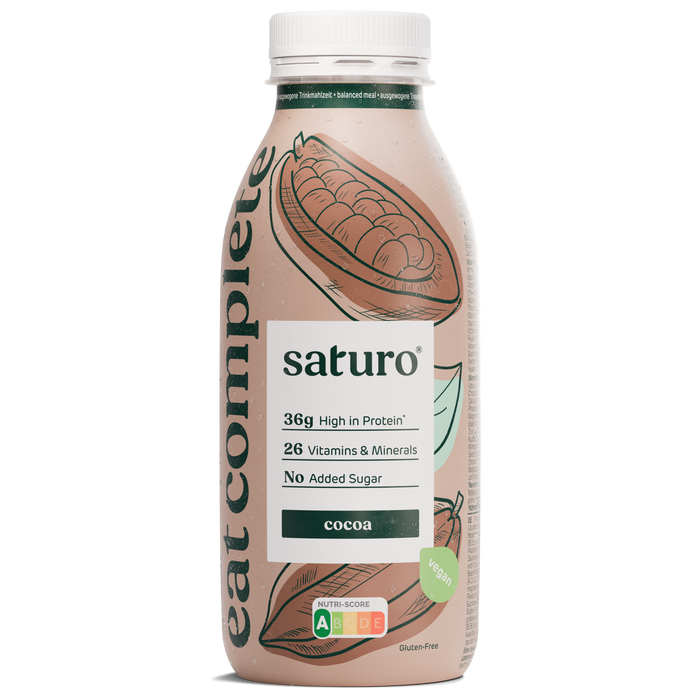
Drinkable meal: a complete meal in a bottle
26 vitamins and minerals, including calcium, vitamin D and magnesium. Calcium is needed for the maintenance of normal bones and contributes to normal muscle function. Reference value for calcium: 800 mg per day (NRV). For days when cooking isn't on the agenda.
Menopause, pregnancy, children, over 65: who needs to pay extra attention
Calcium requirements stay almost the same throughout life, but intake doesn't. The curve shows what girls and women in Germany actually take in (Robert Koch Institute, Max Rubner Institute). The gaps appear exactly where bones can least afford it: during puberty, when bone is being built, and in old age, when it's being broken down.
Calcium deficiency during menopause
Oestrogen holds bone together: it slows down bone-breaking-down cells and helps the gut absorb calcium. According to the SWAN study of almost 2,000 women, bone loss begins about a year before the final period, and over the surrounding ten years the lumbar spine loses 10.6% of its density. What helps is unspectacular but proven: 1,000 mg of calcium a day, vitamin D all year round, strength training, and a bone density scan from age 50 if you have risk factors. In eight studies, calcium plus vitamin D reduced hip fractures by 30%; calcium alone barely helps.

Calcium deficiency during pregnancy and breastfeeding
A baby is born with around 30 g of calcium in its skeleton. Even so, the DGE and EFSA recommend the same 1,000 mg as usual: during pregnancy, the gut doubles its absorption, and during breastfeeding, the body temporarily borrows from the mother's own skeleton. That's why calcium deficiency symptoms don't occur during breastfeeding on a normal diet; tiredness, hair loss and cramps have other causes. Only with very low intake do calcium supplements of 1 g or more halve the risk of pre-eclampsia, according to Cochrane.
Children and teenagers: The bone mass a person has at 30 is built up during childhood and puberty. That's why the highest requirement, 1,200 mg, falls between ages 13 and 18 – and that's exactly where the gap is biggest: according to EsKiMo II, only 12.7% of girls aged 12 to 17 reach the recommendation. In young children, a severe calcium or vitamin D deficiency causes rickets, which vitamin D drops in the first year of life prevent.
From age 65, three things come together: the gut absorbs calcium less well, appetite drops, and the list of medications grows: acid blockers, cortisone, diuretics. If you need a supplement, take citrate if you're low on stomach acid, otherwise carbonate with food, always alongside vitamin D. Without a tablet: cheese on bread, calcium-rich water instead of a third cup of coffee.
From 2.6 mmol/l upwards, it's called hypercalcaemia. It almost never comes from food, but from an overactive parathyroid gland, cancer, or too much vitamin D; signs include thirst, frequent urination, constipation and kidney stones. The EU upper limit of 2,500 mg applies to food and supplements combined.
Frequently asked questions about calcium deficiency
How does calcium deficiency show up?
A blood level that's too low (under 2.2 mmol/l) makes nerves overexcitable: tingling around the mouth, muscle cramps, and with severe deficiency, carpopedal spasm, heart palpitations and seizures. If you simply eat too little calcium, you won't notice anything: your body keeps blood levels stable by drawing on your bones, and the result, decades later, is osteoporosis.
What robs your body of calcium?
Salt is the best-documented factor: for every 2.3 g of sodium, the kidneys excrete around 40 mg of extra calcium. Oxalic acid and phytic acid bind calcium in the gut, but only from the same meal. Acid blockers, cortisone and loop diuretics cost calcium. Coffee costs so little that a splash of milk makes up for it.
How long does it take to fix a calcium deficiency?
With treatment, blood levels normalise within days to two weeks, provided the underlying cause is treated too; vitamin D stores take two to three months to rebuild. If the parathyroid glands have failed permanently, the deficiency is managed for life. Bone takes years, and measurable gains stay small.
Is it good to take calcium every day?
From food, yes. As a supplement, only if intake can't be achieved any other way: with lactose intolerance and no cheese, a vegan diet without fortified products, under osteoporosis medication, or with failed parathyroid glands. The BfR recommends a maximum of 500 mg a day from food supplements.
When shouldn't you take calcium?
Don't take supplements without medical advice if you have kidney stones, chronic kidney disease, an overactive parathyroid gland, sarcoidosis, or elevated calcium levels. Don't take them at the same time as thyroid hormone, iron supplements, tetracycline or quinolone antibiotics, or bisphosphonates, as calcium binds them in the gut: leave several hours between doses. And never more than 500 mg at once.
What does calcium have to do with cholesterol?
Not much. In a study of 223 postmenopausal women, HDL cholesterol rose by 7% with 1 g of calcium citrate, while LDL didn't drop significantly. The debate over whether calcium supplements calcify blood vessels concerns high-dose tablets without vitamin D, never calcium from food.
What role does calcium play in diabetes?
Calcium plays a role in insulin release, and in observational studies, people with high calcium and vitamin D intake had an 18% lower risk of type 2 diabetes. That's an association, not proof. The normal recommendation of 1,000 mg applies to people with diabetes too.
Which fruit is high in calcium?
Fruit isn't really a source of calcium, with one exception: dried figs at 162 mg per 100 g (three figs about 65 mg). Next come dates (64 mg), raisins (62 mg) and oranges (40 mg). Bananas, apples and berries contribute practically nothing.
Sources · 69 sources anzeigen
- German Nutrition Society (DGE): Reference values for nutrient intake, calcium. D-A-CH reference values, derivation 2013.
- German Nutrition Society (DGE): Selected questions and answers on calcium. Bonn, June 2013.
- German Nutrition Society: New Reference Values for Calcium. Annals of Nutrition and Metabolism 2013; 63(3): 186–192.
- Klug A. et al., German Nutrition Society: Re-evaluation of the DGE position on vegan diets. Position paper, Ernährungs Umschau 2024; 71(7): 60–84.
- EFSA NDA Panel: Scientific Opinion on Dietary Reference Values for calcium. EFSA Journal 2015; 13(5): 4101.
- EFSA NDA Panel: Scientific Opinion on the Tolerable Upper Intake Level of calcium. EFSA Journal 2012; 10(7): 2814.
- Federal Institute for Risk Assessment (BfR): Proposed maximum levels for calcium in foods including food supplements. Statement 2021, confirmed 2024.
- Max Rubner Institute: National Nutrition Survey II, Results Report Part 2. Karlsruhe 2008, Chapter 5.7.3 Calcium and Table A.48.
- Mensink G. B. M. et al.: EsKiMo II, the nutrition study as a KiGGS module. Project report, Robert Koch Institute, Berlin 2020.
- Rabenberg M. et al.: Vitamin D status among adults in Germany: results from DEGS1. BMC Public Health 2015; 15: 641.
- Mineral and Table Water Ordinance (MTVO), Annex 6: Information on mineral waters ("contains calcium" from more than 150 mg/l).
- Commission Regulation (EU) No 432/2012: List of permitted health claims, Annex (Calcium).
- German Umbrella Association for Osteology (DVO): Guideline on the diagnosis and treatment of osteoporosis in postmenopausal women and men aged 50 and over, version 2.2, 2023, short version.
- Lewis J. L.: Hypocalcaemia. MSD Manual, Professional Edition.
- Lewis J. L.: Hypercalcaemia. MSD Manual, Professional Edition.
- Turner J., Gittoes N., Selby P.; Society for Endocrinology: Emergency management of acute hypocalcaemia in adult patients. Endocrine Connections 2016; 5(5): G7–G8.
- Pepe J. et al.: Diagnosis and management of hypocalcemia. Endocrine 2020; 69(3): 485–495.
- Bollerslev J. et al.; European Society of Endocrinology: Clinical Guideline: Treatment of chronic hypoparathyroidism in adults. European Journal of Endocrinology 2015; 173(2): G1–G20.
- Khan A. A. et al.: Evaluation and Management of Hypoparathyroidism: Summary Statement and Guidelines from the Second International Workshop. Journal of Bone and Mineral Research 2022; 37(12): 2568–2585.
- Zivin J. R. et al.: Hypocalcemia: a pervasive metabolic abnormality in the critically ill. American Journal of Kidney Diseases 2001; 37(4): 689–698.
- Edafe O. et al.: Systematic review and meta-analysis of predictors of post-thyroidectomy hypocalcaemia. British Journal of Surgery 2014; 101(4): 307–320.
- Armstrong C. M., Cota G.: Calcium block of Na+ channels and its effect on closing rate. PNAS 1999; 96(7): 4154–4157.
- Macefield G., Burke D.: Paraesthesiae and tetany induced by voluntary hyperventilation. Brain 1991; 114(1B): 527–540.
- Hujoel I. A.: The association between serum calcium levels and Chvostek sign: a population-based study. Neurology: Clinical Practice 2016; 6(4): 321–328.
- Underbjerg L. et al.: The Epidemiology of Nonsurgical Hypoparathyroidism in Denmark: A Nationwide Case Finding Study. Journal of Bone and Mineral Research 2015; 30(9): 1738–1744.
- Underbjerg L. et al.: Postsurgical hypoparathyroidism: risk of fractures, psychiatric diseases, cancer, cataract, and infections. Journal of Bone and Mineral Research 2014; 29(11): 2504–2510.
- Koçer A. M. et al.: Quantitative investigation of the effect of surgically induced hypoparathyroidism on cataract development. Journal of Bone and Mineral Metabolism 2022; 40(1): 92–100.
- Goswami R. et al.: Prevalence and progression of basal ganglia calcification and its pathogenic mechanism in patients with idiopathic hypoparathyroidism. Clinical Endocrinology 2012; 77(2): 200–206.
- Cusano N. E. et al.: The effect of PTH(1-84) on quality of life in hypoparathyroidism. Journal of Clinical Endocrinology and Metabolism 2013; 98(6): 2356–2361.
- Gallacher A. A., Pemberton M. N., Waring D. T.: The dental manifestations and orthodontic implications of hypoparathyroidism in childhood. Journal of Orthodontics 2018; 45(1): 46–50.
- Srinutta T. et al.: Proton pump inhibitors and hypomagnesemia: a meta-analysis of observational studies. Medicine 2019; 98(44): e17788.
- Bird S. T. et al.: Severe Hypocalcemia With Denosumab Among Older Female Dialysis-Dependent Patients. JAMA 2024; 331(6): 491–499.
- Tong T. Y. N. et al.: Vegetarian and vegan diets and risks of total and site-specific fractures: results from the prospective EPIC-Oxford study. BMC Medicine 2020; 18: 353.
- Appleby P. et al.: Comparative fracture risk in vegetarians and nonvegetarians in EPIC-Oxford. European Journal of Clinical Nutrition 2007; 61(12): 1400–1406.
- Heaney R. P., Weaver C. M., Recker R. R.: Calcium absorbability from spinach. American Journal of Clinical Nutrition 1988; 47(4): 707–709.
- Heaney R. P., Weaver C. M.: Calcium absorption from kale. American Journal of Clinical Nutrition 1990; 51(4): 656–657.
- Heaney R. P. et al.: Absorbability of calcium from Brassica vegetables: broccoli, bok choy, and kale. Journal of Food Science 1993; 58(6): 1378–1380.
- Heaney R. P., Weaver C. M., Fitzsimmons M. L.: Influence of calcium load on absorption fraction. Journal of Bone and Mineral Research 1990; 5(11): 1135–1138.
- Heaney R. P., Dowell M. S., Hale C. A., Bendich A.: Calcium absorption varies within the reference range for serum 25-hydroxyvitamin D. Journal of the American College of Nutrition 2003; 22(2): 142–146.
- Heaney R. P., Recker R. R., Stegman M. R., Moy A. J.: Calcium absorption in women: relationships to calcium intake, estrogen status, and age. Journal of Bone and Mineral Research 1989; 4(4): 469–475.
- Weaver C. M., Heaney R. P., Martin B. R., Fitzsimmons M. L.: Human calcium absorption from whole-wheat products. Journal of Nutrition 1991; 121(11): 1769–1775.
- Weaver C. M. et al.: Bioavailability of calcium from tofu as compared with milk in premenopausal women. Journal of Food Science 2002; 67(8): 3144–3147.
- Zhao Y., Martin B. R., Weaver C. M.: Calcium bioavailability of calcium carbonate fortified soymilk is equivalent to cow's milk in young women. Journal of Nutrition 2005; 135(10): 2379–2382.
- Böhmer H., Müller H., Resch K. L.: Calcium supplementation with calcium-rich mineral waters: a systematic review and meta-analysis of its bioavailability. Osteoporosis International 2000; 11(11): 938–943.
- Greupner T., Schneider I., Hahn A.: Calcium bioavailability from mineral waters with different mineralization in comparison to milk and a supplement. Journal of the American College of Nutrition 2017; 36(5): 386–390.
- Heaney R. P.: Effects of caffeine on bone and the calcium economy. Food and Chemical Toxicology 2002; 40(9): 1263–1270.
- Heaney R. P., Rafferty K.: Carbonated beverages and urinary calcium excretion. American Journal of Clinical Nutrition 2001; 74(3): 343–347.
- Nordin B. E. et al.: The nature and significance of the relationship between urinary sodium and urinary calcium in women. Journal of Nutrition 1993; 123(9): 1615–1622.
- Yang Y. X., Lewis J. D., Epstein S., Metz D. C.: Long-term proton pump inhibitor therapy and risk of hip fracture. JAMA 2006; 296(24): 2947–2953.
- Hallberg L. et al.: Calcium: effect of different amounts on nonheme- and heme-iron absorption in humans. American Journal of Clinical Nutrition 1991; 53(1): 112–119.
- Recker R. R.: Calcium absorption and achlorhydria. New England Journal of Medicine 1985; 313(2): 70–73.
- Straub D. A.: Calcium supplementation in clinical practice: a review of forms, doses, and indications. Nutrition in Clinical Practice 2007; 22(3): 286–296.
- Singh N., Singh P. N., Hershman J. M.: Effect of calcium carbonate on the absorption of levothyroxine. JAMA 2000; 283(21): 2822–2825.
- Bolland M. J. et al.: Effect of calcium supplements on risk of myocardial infarction and cardiovascular events: meta-analysis. BMJ 2010; 341: c3691.
- Lewis J. R. et al.: The effects of calcium supplementation on verified coronary heart disease hospitalization and death in postmenopausal women: a collaborative meta-analysis of randomized controlled trials. Journal of Bone and Mineral Research 2015; 30(1): 165–175.
- Jackson R. D. et al.; Women's Health Initiative Investigators: Calcium plus vitamin D supplementation and the risk of fractures. New England Journal of Medicine 2006; 354(7): 669–683.
- Prince R. L., Devine A., Dhaliwal S. S., Dick I. M.: Effects of calcium supplementation on clinical fracture and bone structure: results of a 5-year, double-blind, placebo-controlled trial in elderly women. Archives of Internal Medicine 2006; 166(8): 869–875.
- Tai V., Leung W., Grey A., Reid I. R., Bolland M. J.: Calcium intake and bone mineral density: systematic review and meta-analysis. BMJ 2015; 351: h4183.
- Weaver C. M. et al.: Calcium plus vitamin D supplementation and risk of fractures: an updated meta-analysis from the National Osteoporosis Foundation. Osteoporosis International 2016; 27(1): 367–376.
- Greendale G. A. et al.: Bone mineral density loss in relation to the final menstrual period in a multiethnic cohort: results from SWAN. Journal of Bone and Mineral Research 2012; 27(1): 111–118.
- Hadji P., Esterberg E., Obermüller D., Bartsch R.: Bone evaluation study-2: update on the epidemiology of osteoporosis in Germany. Archives of Osteoporosis 2024; 19(1): 26.
- Kovacs C. S.: Maternal Mineral and Bone Metabolism During Pregnancy, Lactation, and Post-Weaning Recovery. Physiological Reviews 2016; 96(2): 449–547.
- Hofmeyr G. J., Lawrie T. A., Atallah Á. N., Torloni M. R.: Calcium supplementation during pregnancy for preventing hypertensive disorders and related problems. Cochrane Database of Systematic Reviews 2018; 10: CD001059.
- Munns C. F. et al.: Global Consensus Recommendations on Prevention and Management of Nutritional Rickets. Journal of Clinical Endocrinology and Metabolism 2016; 101(2): 394–415.
- Pittas A. G., Lau J., Hu F. B., Dawson-Hughes B.: The role of vitamin D and calcium in type 2 diabetes: a systematic review and meta-analysis. Journal of Clinical Endocrinology and Metabolism 2007; 92(6): 2017–2029.
- Reid I. R. et al.: Effects of calcium supplementation on serum lipid concentrations in normal older women: a randomized controlled trial. American Journal of Medicine 2002; 112(5): 343–347.
- Patel A. M., Goldfarb S.: Got calcium? Welcome to the calcium-alkali syndrome. Journal of the American Society of Nephrology 2010; 21(9): 1440–1443.
- U.S. Department of Agriculture, Agricultural Research Service: FoodData Central, SR Legacy Release (2018). Calcium content per 100 g.
- Verbraucherzentrale: Is vitamin D better with vitamin K2? FAQ, as of 15 July 2026.
Writing for Saturo since 2019 about nutrition, nutrients, and how good nutrition actually works in everyday life.
Hat diesen Artikel am 23. September 2026 auf fachliche Richtigkeit geprüft. This content does not replace medical advice.

Vitamin D deficiency: symptoms, causes and treatment
The door-opener for calcium: why almost everyone lacks vitamin D in winter, what symptoms it causes, and how much you really need.
Weiterlesen · 15 Min

New from the guide
New articles, updates and tips straight to your inbox. Easy to understand, expert-reviewed, no spam.
Danke! Bitte bestätige die Anmeldung in deinem Postfach.