
How the right diet for gout actually works
Offal, beer and soft drinks push up uric acid, dairy products and vegetables don't. Here you'll find the list of foods to avoid, the purine values of over 130 foods, the drinks check, and an honest answer on how much diet really helps with gout.


Aktualisiert 24 September 2026 · 16 Min. Lesezeit · 52 Quellen

The essentials in 30 seconds
From around this value (about 400 µmol/l), uric acid in the blood can start forming crystals. Under treatment, the target is below 6 mg/dl, and often below 5 for people with gout tophi.
According to IQWiG estimates, only around a third comes from food. Even a strictly low-purine diet therefore lowers the level by at most about 30 per cent.
This is how much the risk rose per 355 ml of beer daily in a cohort of 47,150 men. For spirits it was 15 per cent, while wine showed no effect in this study.
The S3 guideline on gout recommends less meat, more plant-based food, less alcohol and less fructose. It explicitly does not recommend a special gout diet with strict avoidance lists.
What gout is, and why diet is only half the story
Gout is a metabolic disease: there's too much uric acid in the blood, and above a certain concentration it crystallises in the joints, triggering a fierce inflammatory response from the immune system, the gout attack. Uric acid is the end product of purine metabolism; purines are found in every cell, and in meat, fish, offal and yeast.
However, most of the uric acid doesn't come from food but from the breakdown of the body's own cells; IQWiG estimates around 70 per cent. That's why even a strictly low-purine diet only lowers the level by about 30 per cent, and the S3 guideline on gout states explicitly: there's no solid evidence for a special gout diet.
Gicht Symptome: so fühlt sich ein Anfall an
Ein Gichtanfall beginnt typisch nachts oder frühmorgens, ohne Vorwarnung, mit Schmerzmaximum innerhalb von 24 Stunden: Das Gelenk schwillt an, wird rot bis bläulich und heiß, schon die Bettdecke tut weh. Beim ersten Anfall ist es meist das Großzehengrundgelenk, die Medizin nennt das Podagra. Unbehandelt dauert ein Anfall laut Leitlinie 3 bis 14 Tage. Fieber, Schüttelfrost oder mehrere gleichzeitig entzündete Gelenke gehören nicht zum Standardbild und müssen ärztlich abgeklärt werden, weil eine bakterielle Gelenkinfektion ähnlich aussieht.

Harnsäure zu hoch: ab welchem Wert wird es kritisch?
Kritisch wird es ab der Löslichkeitsgrenze von etwa 6,8 mg/dl (rund 400 µmol/l): Darüber kann Harnsäure auskristallisieren. Bei diagnostizierter Gicht gilt unter Therapie ein Zielwert unter 6, bei Gichtknoten unter 5 mg/dl; im Anfall ist der Wert oft falsch niedrig, gemessen wird etwa zwei Wochen danach. Das Risiko hängt stark vom Wert ab: In vier US-Kohorten mit fast 19.000 Personen bekamen innerhalb von 15 Jahren 1,1 Prozent derjenigen unter 6 mg/dl Gicht, aber 49 Prozent derjenigen ab 10 mg/dl.
Uric acid too high: at what level does it become critical?
It becomes critical from the solubility limit of about 6.8 mg/dl (around 400 µmol/l): above this, uric acid can crystallise. With diagnosed gout, the target under treatment is below 6, and below 5 mg/dl for those with tophi; during an attack the value is often falsely low, so it's measured around two weeks afterwards. The risk depends heavily on the level: in four US cohorts with almost 19,000 people, 1.1 per cent of those below 6 mg/dl developed gout within 15 years, but 49 per cent of those at 10 mg/dl or above did.
The gout avoid list: what you really should avoid
Strictly speaking, there isn't a strict list of foods to avoid with gout. What counts is the total purine intake over the day, and anything that further drives up uric acid or slows its excretion: alcohol, fructose, being overweight. However, a handful of foods deliver as much in a single portion as a whole day's worth; those are listed on the left.
The table follows the current evidence, not the old purine tables: vegetables, legumes and wholegrains are listed on the right, even though they contain purines, because in the cohort behind almost all guidelines, men with the highest intake of purine-rich vegetables had no increased gout risk, while meat increased the risk by 41 per cent and seafood by 51 per cent.
Avoid, occasionally, freely: the gout avoidance list at a glance
Sorted by food group. You'll find purine values per 100 g in chapter 4 for reference.
| Avoid | Occasionally, small portion | Freely | |
|---|---|---|---|
| Meat | Offal, meat extract, stock cubes | Beef, pork, lamb, game, poultry: 100 to 150 g, not daily | Eggs and dairy products as a substitute |
| Sausage | Salami, bacon, liver sausage, bratwurst | Cooked ham, frankfurters in small amounts | Cheese, cream cheese, hummus as a topping |
| Fish | Sardines, anchovies, tinned sardines in oil, tinned fish | Cod, coley, salmon, trout, herring: 100 to 150 g, once or twice a week | None of this is purine-free, portion size counts |
| Seafood | Mussels, prawns, crab, fish milt | Scallops, squid in small amounts | Salmon caviar (ikura) at 4 mg |
| Drinks | Beer, including alcohol-free; spirits; cola, lemonade, energy drinks | Wine and sparkling wine: one small glass, not daily; fruit juice | Water, coffee, tea, milk, sugar-free soft drinks |
| Sweets | Sugary drinks, fructose syrup, large amounts of dried fruit | Chocolate, cake, biscuits, ice cream: sugar is the issue, not purine | Fresh fruit in normal portions |
| Vegetables & mushrooms | Nothing | Nothing; spinach, asparagus, mushrooms and broccoli don't increase the risk either | Everything, in any amount |
| Legumes & nuts | Nothing | Nothing; cooked lentils and beans come in at 10 to 60 mg | Lentils, beans, chickpeas, tofu, nuts, seeds |
| Milk & eggs | Nothing | Nothing | Milk, yoghurt, quark, cheese, eggs: these tend to lower uric acid |
| Bread & sides | Nothing | Wheat germ, rice bran as an addition | Potatoes, rice, pasta, bread, oats |
| Seasoning | Yeast extract, stock cubes, umami powder, anchovy paste | Soy sauce, mustard, ketchup | Herbs, spices, lemon, vinegar, oil |
Classification based on the S3 guideline on gout (DGRh 2024), the DGE information sheet "Eating and drinking with gout" (2023), and the cohorts from Choi 2004 (NEJM, Lancet), Choi 2008 (BMJ) and Teng 2015 (Arthritis Rheumatol). Purine values from Kaneko 2014/2020 and the USDA purine database 2025.
The front-runners are offal, small oily fish, mussels, fried sausage and anything made with yeast: chicken liver (312 mg) or fresh anchovies (304) deliver, per 100 grams, as much as the Japanese gout guideline names as the upper limit for an entire day, and yeast extract comes in at 847. Eggs (0 mg), milk, yoghurt, quark and cheese (1 to 13 mg) contribute practically nothing.
Forbidden vegetables for gout: spinach, asparagus, mushrooms, legumes
This list comes from old purine tables and is outdated. Yes, spinach (51 mg), asparagus tips (55), button mushrooms (50) and broccoli (70) contain more purines than cucumber or carrot; no, they don't trigger gout attacks. In the cohort of 47,150 men, purine-rich vegetables weren't linked to gout risk, animal purines from the previous two days increased attack risk 2.4-fold, plant purines only 1.4-fold, and in Singapore soy and legumes lowered it by 14 to 17 per cent. Cooking also causes a quarter to a third of the purines to leach into the water.

Low-purine diet: what it actually means
In German dietary guidance, low-purine means: at most 500 mg uric acid a day and 3,000 mg a week (rationalisation scheme of the professional societies, 2004); the German Gout League works with 400 mg uric acid, the Japanese guideline with 400 mg purines. The rheumatology guidelines from Germany, Europe and the US no longer give a figure, instead saying: less meat, more plants, less alcohol, less fructose. So counting purines isn't a must, but portion size counts: 5 g of parsley delivers 14 mg, 200 g of steak 350. That's what the building-block tool shows.
From plate to crystal: the path of purines
Three stages decide whether a steak turns into a gout attack. You can influence two of them through what you eat, the third only to a limited extent.
Purines become uric acid
Purines are building blocks of genetic material and are found in every cell, in your own as well as in meat, fish or yeast. The liver breaks them down into uric acid via the enzyme xanthine oxidase. Around 70 per cent of this uric acid comes from your own cell turnover, the rest from food. Fructose and alcohol additionally speed up the breakdown.
Kidneys and gut excrete it
About two-thirds of uric acid leaves the body via the kidneys, a third via the gut. For most people with gout, this is where the problem lies: the kidneys excrete too little, often for genetic reasons, made worse by alcohol, diuretic tablets or declining kidney function.
It precipitates from 6.8 mg/dl
If the concentration in the blood exceeds the solubility limit, needle-shaped crystals form, first where it's cool and the tissue is already damaged: in the big toe joint. The immune system recognises the crystals as foreign bodies and triggers a fierce inflammation via the messenger substance interleukin-1 — the gout attack.
Chocolate, coffee, tomatoes, cheese: what can I eat with gout?
The most common Google questions about gout revolve around a single food. That's why there's a reference guide here with over 130 foods and their purine content, followed by answers to the most frequent questions.
Chocolate and gout
You're allowed to eat chocolate. It delivers around 8 mg of purines per 100 g, so two squares of dark chocolate come in under 2 mg, and the theobromine from the cocoa isn't broken down into uric acid. The real issue is sugar: milk chocolate, chocolate-hazelnut spread, cake and jelly sweets deliver fructose, and that drives uric acid up. Dark chocolate in small amounts is fine, but a whole bar of milk chocolate every day isn't, because of the 25 grams of sugar.
Bananas, kiwi, pineapple, lemon: fruit and gout
Whole fruit is fine with gout: bananas contain 3 mg of purines per 100 g, while kiwi, strawberries, pineapple and citrus fruits contain 2. The worry is about fructose, and that's justified for juices, soft drinks and dried fruit, but not for apples, whose fructose arrives slowly thanks to the fibre. The same goes for lemon.
Tomatoes (7 mg) are seen as a trigger in forums: in one survey, 20 percent of those affected named them as a trigger, but uric acid measurably rose by only 0.66 µmol/l per extra portion per week. No guideline advises against them; if you reproducibly notice symptoms, you can simply leave them out.
Cheese and eggs with gout
Both are fine. Depending on the type, cheese contains between 1 and 13 mg of purines per 100 g, eggs come in at zero; the "no more than three eggs a week" rule comes from the cholesterol debate, and in 2023 the DGE explicitly named eggs as a basis of the recommended ovo-lacto-vegetarian diet. Dairy products also boost uric acid excretion, and butter is purine-free.
Legumes with gout
You can eat lentils, beans and chickpeas. Dried, they contain 170 to 220 mg of purines per 100 g, but nobody eats dry lentils: cooked, they're down to around 60 mg, chickpeas sit at 11, and tinned kidney beans at 23. More importantly, the studies show no risk: in the cohort of 47,150 men, purine-rich plant foods didn't increase the risk, and in Singapore, soy and legumes lowered it by 14 to 17 percent. The reason: plant purines are mostly made up of adenine and guanine, while animal purines contain hypoxanthine, which drives uric acid up the most.
The key question isn't whether spinach has 50 milligrams of purines, but whether your beer, your soft drink and your sausage roll get replaced with something you actually enjoy eating. If you only focus on what's forbidden with gout, you'll last six weeks. If you see dairy, eggs, legumes and vegetables as a win, you'll keep it up for years.
Joerg Hauke, Nutrition expert, technical review of this article
Which meat and fish are okay?
No meat and no fish is purine-free, so it's all about portion size and frequency: 100 to 150 grams, two to three times a week, and skip meat broth, skin and offal. The lowest-purine options are pork belly (76 mg), schnitzel (91), lamb (94), turkey (96) and beef fillet (98); chicken breast (141), minced meat (161, up to 250 when fried) and steak (174) are higher. With fish, cod is the top choice at 98 mg, salmon ranges from 119 to 250, herring sits at 140, and trout at 181; sardines, anchovies and mussels at 210-plus are rightly on the DGE's avoid list.

Drinks and gout: beer, wine, cola, coffee and water
With drinks, purines, alcohol and fructose all add up: beer brings purines plus alcohol, which slows down uric acid excretion, soft drinks bring fructose, which releases uric acid in the liver, coffee and milk bring neither.
How much beer is allowed with gout
As little as possible. In the cohort of 47,150 men, gout risk rose by 49 percent per beer a day (355 ml), by 15 percent per spirit, while wine showed no measurable effect. Beer provides around 8.5 mg of purines per 100 ml, dark beer 13.5; half a litre of pilsner delivers a good 40 mg plus alcohol, which holds back the purine load from sausage and steak in the kidney. Acutely, more than one to two alcoholic drinks in 24 hours raises the risk of an attack by 36 to 51 percent.
What each drink does to your uric acid
Purines per 100 ml from the USDA purine database 2025 and Kaneko 2024; effects based on the cohorts of Choi 2004 to 2010 and Neogi 2014.
| Purines per 100 ml | Effect on uric acid | Verdict | |
|---|---|---|---|
| Beer (pilsner, lager) | 8.5 mg | Purines plus alcohol: risk per beer a day plus 49 percent | Avoid |
| Dark beer, export | 10.7 to 13.5 mg | More original gravity, more purines, same alcohol | Avoid |
| Wheat beer | 8.1 mg | Same as pilsner | Avoid |
| Alcohol-free beer | 2.9 mg | A third of the purines, raises uric acid acutely by 4.4 percent (beer: 6.5) | Occasionally, small amount |
| Shandy | 3.6 mg | Half the alcohol, plus sugar from the lemonade | Avoid |
| Wine, red or white | 1.6 mg | Hardly any purines; no effect on gout risk, but acute attack risk from two glasses | One small glass, not daily |
| Spirits | 0.2 mg | Purine-free, but alcohol slows excretion: risk per drink plus 15 percent | Avoid |
| Cola, lemonade | 0 mg | Around 10 g sugar per 100 ml, half of it fructose: two glasses a day almost double the risk | Avoid |
| Diet cola, zero/light | 0 mg | No sugar, no purines, no link to gout in two cohorts | Fine |
| Fruit juice, orange juice | 1.1 mg | 6 g fructose per 100 ml: one glass a day plus 41 percent risk in women | Occasionally |
| Tart cherry juice | about 2 mg | Cherries over two days: 35 percent fewer attacks in an observational study, no effect in a trial with concentrate | Can do, not essential |
| Coffee, including decaf | under 1 mg | 4 to 5 cups a day: 40 percent less gout in men, similar in women | Fine |
| Black tea, green tea, herbal tea | under 2 mg | No link to gout risk | Fine |
| Milk, buttermilk | 0.2 mg | Supports excretion; highest milk intake: 44 percent less gout | Fine |
| Water | 0 mg | Dilutes urine, supports the kidneys; 2 to 3 litres recommended by the DGE and gout association | Basis |
Purine values: USDA purine database 2025 (beer, average of 38 samples), Kaneko 2024 (wine, juice, tea), Kaneko 2014 (spirits). Effects: Choi 2004 (Lancet), Choi 2007, 2008, 2010, Neogi 2014, Yamamoto 2002, Zhang 2012, Stamp 2020.
Alcohol-free beer and wine with gout
Alcohol-free beer is better than beer, but not neutral: according to the USDA purine database it contains on average 2.9 mg purines per 100 ml, a third of regular beer, and the DGE still counts it among purine-containing drinks. One glass with a meal, yes; a crate in the cellar, no. Wine comes in at 1.6 mg, red or white, and showed no raised gout risk in the cohort, but in the 24-hour study raised acute risk from the second glass onward: a small glass with a low-purine meal, yes; a bottle with steak, no.
Cola with gout: zero too?
Sugary cola and lemonade contain no purines, but around 10 grams of sugar per 100 ml, half of it fructose. In the cohorts, men with two soft drinks a day had an 85 percent higher gout risk, women a 2.4-times higher risk. Diet cola and other light drinks weren't linked to gout in either study. Fruit juice is liquid fructose: one glass a day raised risk in women by 41 percent, two glasses nearly doubled it.
Coffee with gout
You're allowed to drink coffee, and the data actually speaks in its favour: men with four to five cups a day had a 40 percent lower gout risk, 59 percent from six cups on, women with more than four cups 57 percent. Decaf coffee had a similar effect, tea and caffeine alone had none; chlorogenic acids are suspected, as caffeine isn't broken down into uric acid. This is observational data though, no guideline recommends coffee as treatment.
IQWiG sums up the research like this: more than one to two alcoholic drinks in 24 hours raise the risk of an attack. One drink means a small bottle of beer (0.33 l), a small glass of wine (0.1 l), or a double spirit (4 cl).
How much should you drink? Two to three litres a day, unless there's a medical reason not to, say the gout association and the DGE: plenty of fluid dilutes the urine and protects against kidney stones; the benefit for attack risk is barely proven. Water, unsweetened tea and coffee count, soft drinks and beer don't; with heart or kidney weakness, the amount should be decided in practice.
Lowering uric acid: what really works and what doesn't
"Lowering uric acid" is the second most common search around gout. The honest order based on the evidence: the biggest impact comes from cutting out alcohol (up to 1.6 mg/dl) and slowly losing weight if overweight. Next comes the eating pattern: less meat, more plants, dairy instead of sausage, no sugar in your glass. The DASH diet lowered uric acid by 0.35 to 1.3 mg/dl in a randomised trial and was linked to 32 percent less gout in a cohort of 44,444 men. Home remedies come last. Above all stands the S3 guideline: for many, diet isn't enough, and then medication isn't a failure; allopurinol at target dose lowers uric acid by 2 to 4 mg/dl.
Losing weight lowers uric acid, but slowly
After genetics, being overweight is the strongest driver, and losing weight acts like a medication in a small dose: in a systematic review, uric acid fell by up to 2.8 mg/dl with weight loss, and attacks decreased in six out of eight studies; losing 5 kilos brought 1.1 mg/dl. The pace matters: crash diets, fasting and the weeks after stomach surgery trigger attacks because ketone bodies block excretion. Half a kilo a week is the measure (more in the article Weight loss, on shakes in the article Meal replacement).
Home remedies to lower uric acid: cherries, apple cider vinegar, baking soda, lemon checked
Cherries are the only home remedy with data: in an observational study of 633 gout patients, attack risk was 35 percent lower in the two days after eating cherries, and 75 percent lower with allopurinol; the randomised trial with tart cherry concentrate showed no effect. Apple cider vinegar: zero studies. Baking soda makes urine more alkaline, which is used medically for uric acid kidney stones, but doesn't lower blood uric acid. Lemon water: one small, non-randomised observation. Ginger, turmeric: no solid studies. Vitamin C lowers it by 0.23 mg/dl, clinically irrelevant; the guideline advises against supplements.
You can't lower uric acid instantly, and it wouldn't be wise to: rapid swings in the value, up or down, trigger attacks because crystals release from deposits. That's why allopurinol starts at a low dose, with attack prevention for the first three to six months.
When diet isn't enough: allopurinol and co.
The S3 guideline recommends permanent uric acid-lowering treatment after more than one attack a year or with gout tophi; the American guideline already after the first attack if kidneys are impaired, values are over 9 mg/dl, or kidney stones are present. Allopurinol is the drug of choice, started at 100 mg and increased until the value is under 6 mg/dl; febuxostat is the alternative, used with caution in heart disease. Diet and medication aren't alternatives: doing both often means needing a lower dose and having fewer attacks. With diet alone, IQWiG says it "sometimes" works.
What a low-purine day that still fills you up looks like is shown in an example with three meals: under 120 mg purines, around 85 grams of protein, not a single gram of meat, as recommended by the DGE.
Breakfast: porridge with milk, yoghurt, berries and walnuts (31 mg purines, 24 g protein). Lunch: baked potatoes with herb quark and oven vegetables (62 mg, 32 g). Dinner: shakshuka with two eggs, feta and wholemeal bread (23 mg, 29 g). Together around 116 mg purines and 1,680 kcal.
The hardest moment of a change isn't dinner at home, but lunch at the office or a motorway service station: that's when the meatloaf roll ends up on the plate, because nothing else is on hand.

If you keep a meal in the fridge for such days that needs no meat, fish or sausage, and no sugar in the drink, you've closed the gap where ban lists usually fail.
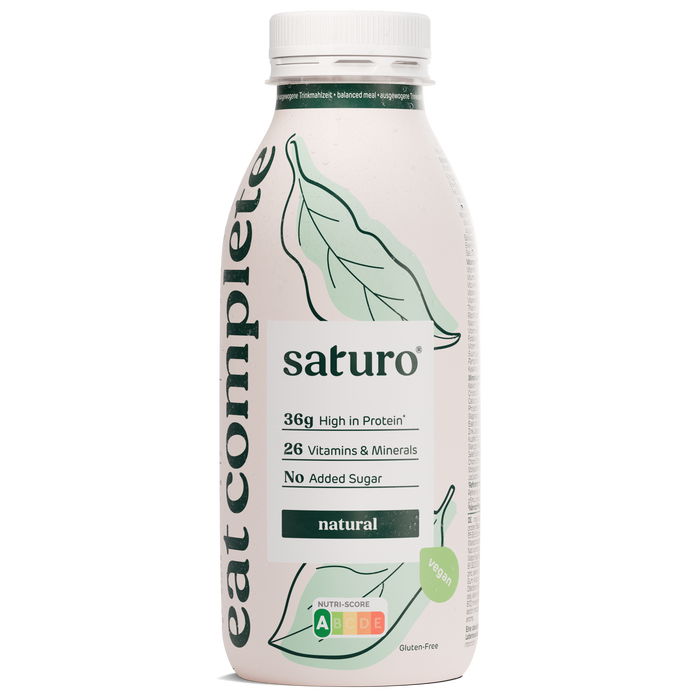
Drinkable meal: a complete meal without meat and without sugar
Every bottle delivers 400 kcal, 36 g protein from fava beans and soy, 26 vitamins and minerals, and depending on flavour just 1.0 to 1.4 g sugar, with no meat, fish, sausage, offal or yeast extract on the ingredients list. Cold from the fridge, no kitchen needed, ready to go. There's no purine value for the product, so we won't make any promises about that.
Gout attack: what to do, what to eat, what to avoid
When the joint is burning, no ban list helps: an acute gout attack is inflammation, and you treat inflammation with anti-inflammatories. The S3 guideline names three equally ranked first-choice options: low-dose colchicine, NSAIDs like ibuprofen, and cortisone, usually prednisolone 30 mg for five days; your doctor decides which one.
What to do during a gout attack: the first hours
Rest the joint, elevate it, cool it: an ice pack wrapped in a towel, 20 to 30 minutes, several times a day, the only non-medication measure with study evidence (a randomised trial showed less pain with ice). Drink plenty of water or unsweetened tea, skip alcohol, and take a prescribed attack medication right away; otherwise see your doctor today or call the medical out-of-hours service (116 117). If nothing improves within 24 to 72 hours, the guideline says to go back to your doctor.
Cool or warm, move or rest?
Cool, and rest during an attack. The S3 guideline recommends immobilising, elevating and cooling with grade B recommendation, as does the American guideline; heat belongs in the time between attacks, when a joint is stiff. The inflamed joint doesn't want to be loaded, and overexertion is among the self-reported triggers. After the attack, regular exercise is again part of the lifestyle recommended by all guidelines; however, no study has shown that exercise prevents attacks.
No aspirin as a painkiller, it can raise uric acid; but don't stop low-dose aspirin prescribed for the heart. Don't stop ongoing uric acid-lowering medication, fluctuations can trigger attacks themselves. Only take colchicine as instructed: at most 2 mg a day and 6 mg per attack, overdoses are life-threatening.
Gout attack diet: what to eat while it hurts
During an attack, the strict version of the ban list applies: no meat, no fish, no sausage, no broth, no alcohol, no sugary drinks. What's left is still plenty: potatoes, rice, pasta, bread, vegetables, fruit, dairy, eggs. According to a study of 633 people affected, the purine load of the previous two days is the strongest short-term trigger. Since appetite is often low, keep it simple: porridge, mashed potatoes with quark, omelette, vegetable soup without meat broth.
How long does a gout attack last?
Untreated, 3 to 14 days, according to the S3 guideline, usually over after 7 to 10 days; with medication started early, often just a few days. The problem is the next attack: without uric acid-lowering treatment, a classic follow-up study found another attack within a year in 62 percent of cases and within three years in 84 percent.
When to see a doctor, and which one?
Your first point of contact is your GP: they treat the attack, measure the uric acid level and start long-term therapy. According to the guideline, they refer to rheumatology if joints other than the toe or foot are affected, treatment isn't working, or the diagnosis is uncertain. The diagnosis is confirmed by crystals in the joint fluid; ultrasound and a special CT scan can also show deposits, while an X-ray only shows changes at a late stage.
Häufige Fragen zur Ernährung bei Gicht
What should you absolutely avoid eating with gout?
There's no absolute list, but here's a short one: offal like liver, kidney and sweetbread, anchovies, sardines, mussels, yeast extract, stock cubes and brewer's yeast all deliver over 200 mg purines per 100 g. Add beer, including alcohol-free, spirits and sugar-sweetened drinks. Everything else is a matter of portion size.
Which drink lowers uric acid?
Coffee and milk. Men with four to five cups of coffee a day had 40 percent less gout in one cohort, decaf included; the highest milk intake was linked to 44 percent less gout. There's no drink that measurably lowers uric acid instantly.
Are bananas allowed with gout?
Yes. Bananas contain 3 mg purines per 100 g and, like almost all fresh fruit, count as a free food. The fructose in whole fruit is released slowly and wasn't linked to gout in cohort studies, unlike fruit juice and soft drinks.
Can I eat tomatoes with gout?
Yes. Tomatoes have 7 mg purines per 100 g. In a survey, 20 percent of those affected named them as a trigger, but the measurable effect on uric acid was just a hundredth of a milligram per decilitre per portion. No guideline advises against them.
Are eggs good for uric acid levels?
Yes. Eggs are practically purine-free and were linked to lower uric acid in a meta-analysis of 16,760 people. There's no upper limit because of gout; the old "three eggs a week" rule comes from the cholesterol debate. The DGE lists eggs as part of the recommended ovo-lacto-vegetarian diet.
Which sweets are allowed with gout?
Almost all are low in purines, from gummy bears to cake. What matters is the sugar, since fructose releases uric acid in the liver. A small portion a day is fine, sugary drinks and fructose syrup aren't. Dark chocolate, unsweetened popcorn and pretzel sticks come out best.
Can apple cider vinegar lower uric acid levels?
There isn't a single study for that, nor for baking soda, ginger or turmeric; for lemon water there's only one small, non-randomised observation. What's proven is cutting out alcohol, losing weight, a plant-based eating pattern, and medication like allopurinol. Apple cider vinegar doesn't hurt in small amounts, but it doesn't lower anything either.
Is exercise or rest better for gout?
During an attack, rest is key: protect the joint, keep it elevated, cool it down – that's what both the German and American guidelines recommend. Between attacks, regular exercise is part of a healthy lifestyle, which also lowers uric acid if you're overweight. There aren't any studies showing that exercise prevents gout attacks.
Sources · 52 sources anzeigen
- Deutsche Gesellschaft für Rheumatologie (DGRh): S3-Leitlinie Diagnostik und Therapie der Gicht, AWMF-Register 060-005, Version 2.1, 27.08.2024
- FitzGerald JD et al.: 2020 American College of Rheumatology Guideline for the Management of Gout. Arthritis Care Res 2020;72:744-760
- Richette P et al.: 2016 updated EULAR evidence-based recommendations for the management of gout. Ann Rheum Dis 2017;76:29-42
- IQWiG, gesundheitsinformation.de: Gicht, Stand 12.01.2022
- IQWiG, gesundheitsinformation.de: Was kann ich selbst tun, um Gichtanfällen vorzubeugen?, Stand 12.01.2022
- Deutsche Gesellschaft für Ernährung (DGE): Essen und Trinken bei Gicht, 3. Auflage 2023, Pressemeldung
- Deutsche Gichtliga e. V.: Ernährungstipps bei Gicht
- Kaneko K et al.: Total purine and purine base content of common foodstuffs for facilitating nutritional therapy for gout and hyperuricemia. Biol Pharm Bull 2014;37:709-721
- Kaneko K et al.: Determination of total purine and purine base content of 80 food products to aid nutritional therapy for gout and hyperuricemia. Nucleosides Nucleotides Nucleic Acids 2020;39:1449-1457
- Kaneko K et al.: Daily Amount of Purine in Commonly Recommended Well-Balanced Diets in Japan and Overseas. Nutrients 2024;16:4066
- Kaneko K et al.: Purine contents of soybean-derived foods and selected Japanese vegetables and mushrooms. Nucleosides Nucleotides Nucleic Acids 2008;27:628-630
- USDA Agricultural Research Service, NIH Office of Dietary Supplements: USDA and ODS-NIH Database for the Purine Content of Foods, Release 2, März 2025, Dokumentation
- Wu B et al.: Availability and quality of published data on the purine content of foods, alcoholic beverages, and dietary supplements. J Food Compos Anal 2019;84:103281
- Choi HK et al.: Purine-rich foods, dairy and protein intake, and the risk of gout in men. N Engl J Med 2004;350:1093-1103
- Choi HK et al.: Alcohol intake and risk of incident gout in men: a prospective study. Lancet 2004;363:1277-1281
- Choi HK et al.: Obesity, weight change, hypertension, diuretic use, and risk of gout in men. Arch Intern Med 2005;165:742-748
- Choi HK, Willett W, Curhan G: Coffee consumption and risk of incident gout in men. Arthritis Rheum 2007;56:2049-2055
- Choi HK, Curhan G: Coffee consumption and risk of incident gout in women. Am J Clin Nutr 2010;92:922-927
- Choi HK, Curhan G: Soft drinks, fructose consumption, and the risk of gout in men. BMJ 2008;336:309-312
- Choi HK, Willett W, Curhan G: Fructose-rich beverages and risk of gout in women. JAMA 2010;304:2270-2278
- Choi HK, Gao X, Curhan G: Vitamin C intake and the risk of gout in men. Arch Intern Med 2009;169:502-507
- Stamp LK et al.: Clinically insignificant effect of supplemental vitamin C on serum urate in patients with gout. Arthritis Rheum 2013;65:1636-1642
- Zhang Y et al.: Purine-rich foods intake and recurrent gout attacks. Ann Rheum Dis 2012;71:1448-1453
- Zhang Y et al.: Cherry consumption and decreased risk of recurrent gout attacks. Arthritis Rheum 2012;64:4004-4011
- Neogi T et al.: Alcohol quantity and type on risk of recurrent gout attacks. Am J Med 2014;127:311-318
- Yamamoto T et al.: Effect of beer on the plasma concentrations of uridine and purine bases. Metabolism 2002;51:1317-1323
- Gibson T et al.: Beer drinking and its effect on uric acid. Br J Rheumatol 1984;23:203-209
- Teng GG et al.: Food sources of protein and risk of incident gout in the Singapore Chinese Health Study. Arthritis Rheumatol 2015;67:1933-1942
- Messina M, Messina VL, Chan P: Soyfoods, hyperuricemia and gout: a review of the epidemiologic and clinical data. Asia Pac J Clin Nutr 2011;20:347-358
- Flynn TJ et al.: Positive association of tomato consumption with serum urate. BMC Musculoskelet Disord 2015;16:196
- Major TJ et al.: Evaluation of the diet wide contribution to serum urate levels: meta-analysis of population based cohorts. BMJ 2018;363:k3951
- Juraschek SP et al.: Effects of the Dietary Approaches to Stop Hypertension (DASH) diet and sodium intake on serum uric acid. Arthritis Rheumatol 2016;68:3002-3009
- Rai SK et al.: The Dietary Approaches to Stop Hypertension (DASH) diet, Western diet, and risk of gout in men. BMJ 2017;357:j1794
- Nielsen SM et al.: Weight loss for overweight and obese individuals with gout: a systematic review of longitudinal studies. Ann Rheum Dis 2017;76:1870-1882
- Dalbeth N et al.: Relationship between serum urate concentration and clinically evident incident gout: an individual participant data analysis. Ann Rheum Dis 2018;77:1048-1052
- Campion EW, Glynn RJ, DeLabry LO: Asymptomatic hyperuricemia. Risks and consequences in the Normative Aging Study. Am J Med 1987;82:421-426
- Stamp LK et al.: Serum urate as surrogate endpoint for flares in people with gout: a systematic review and meta-regression analysis. Lancet Rheumatol 2022
- Annemans L et al.: Gout in the UK and Germany: prevalence, comorbidities and management in general practice 2000-2005. Ann Rheum Dis 2008;67:960-966
- Engel B et al.: Treatment options for gout. Dtsch Arztebl Int 2017;114:215-222
- Underwood M: Diagnosis and management of gout. BMJ 2006;332:1315-1319
- Schlesinger N et al.: Local ice therapy during bouts of acute gouty arthritis. J Rheumatol 2002;29:331-334
- Terkeltaub RA et al.: High versus low dosing of oral colchicine for early acute gout flare (AGREE trial). Arthritis Rheum 2010;62:1060-1068
- Zhang Y et al.: Low-dose aspirin use and recurrent gout attacks. Ann Rheum Dis 2014;73:385-390
- Ohashi Y et al.: Urate transporter ABCG2 function and asymptomatic hyperuricemia: two-thirds of urate is excreted renally. Sci Rep 2023;13:93
- Kramer HJ et al.: The association between gout and nephrolithiasis in men. Kidney Int 2003;64:1022-1026
- Roddy E: Revisiting the pathogenesis of podagra: why does gout target the foot? J Foot Ankle Res 2011;4:13
- Hak AE et al.: Menopause, postmenopausal hormone use and risk of incident gout. Ann Rheum Dis 2010;69:1305-1309
- Abhishek A et al.: Triggers of acute attacks of gout, does age of gout onset matter? PLoS One 2017;12:e0186096
- Universitätsklinikum Freiburg, Klinik für Rheumatologie und Klinische Immunologie: Trotz Gicht Hülsenfrüchte essen: Empfehlungen und Tipps (Patienteninformation, PDF)
- Stiftung Ernährung und Gesundheit, ernaehrung.de: Gicht (Hyperurikämie), Purinobergrenzen nach dem Rationalisierungsschema 2004
- Kluthe R et al.: Das Rationalisierungsschema 2004. Aktuel Ernaehr Med 2004;29:245-253
- USDA FoodData Central, SR Legacy (April 2018): Energie und Protein des purinarmen Beispieltags
Gregor Aßlaber schreibt seit 2019 für Saturo über Ernährung. Für diesen Artikel hat er die S3-Leitlinie Gicht 2024, die Leitlinien aus Europa und den USA, die Purintabellen von Kaneko und der USDA sowie über 40 Studien ausgewertet und die Purinwerte für 130 Lebensmittel zusammengetragen.
Joerg Hauke, Ernährungsexperte, hat die Inhalte am 23. September 2026 auf fachliche Richtigkeit geprüft: Purinwerte, Studienzahlen, Leitlinienempfehlungen und die Einordnung der Hausmittel. Die Inhalte ersetzen keine ärztliche Beratung. Bei Verdacht auf einen Gichtanfall, bei Fieber oder mehreren entzündeten Gelenken bitte ärztlich abklären lassen; eine dauerhafte Harnsäuresenkung und ihre Dosis legt die Praxis fest.
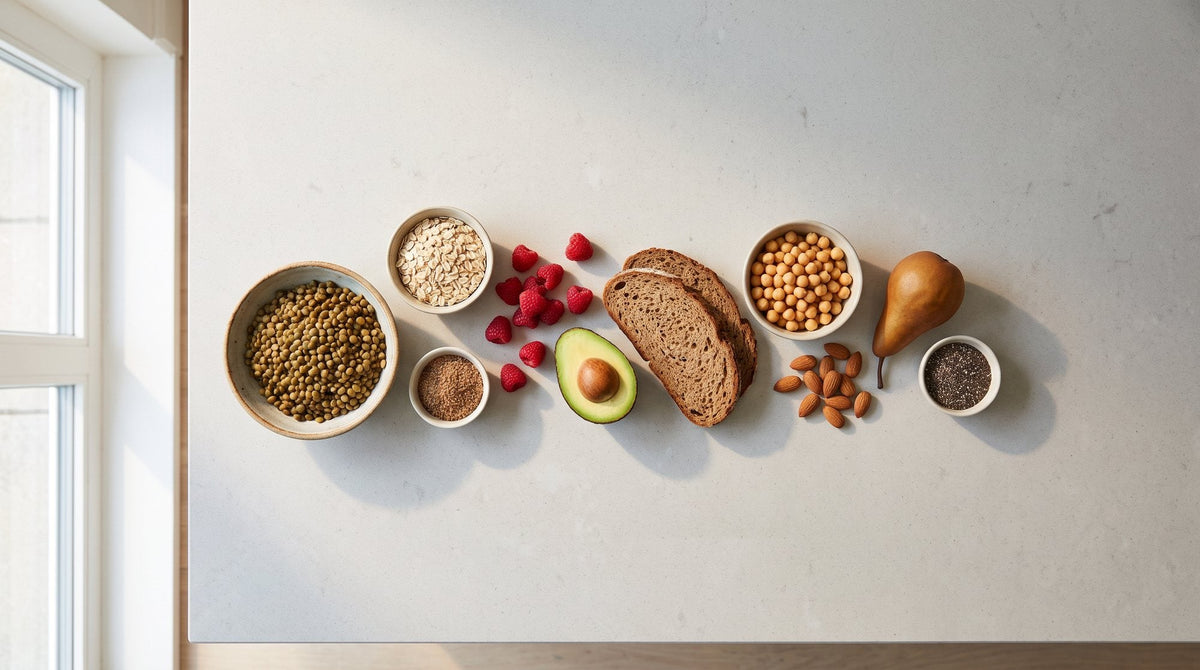
Fibre: how much you need, where to find it, and what it does
Wholegrain, legumes and vegetables are the basis even with gout. How to reach 30 grams a day without your stomach rebelling.
Weiterlesen · 15 Min
New from the guide
New articles, updates and tips straight to your inbox. Clear, expert-checked, no spam.
Danke! Bitte bestätige die Anmeldung in deinem Postfach.