
Manganese deficiency: symptoms, effects and overdose
Tired, thinning hair, mood in the gutter, and manganese is supposedly to blame? A manganese deficiency has not been described in healthy people, and too much manganese is the more common problem. What's actually evidenced, which blood value counts and where manganese is found.


Aktualisiert 1 October 2026 · 15 Min. Lesezeit · 59 Quellen

The key points in 30 seconds
That's how much manganese you need per day as a teenager or adult, including if you're pregnant or breastfeeding. The German average is 2.8 mg; wholegrain, nuts and tea make the difference.
The gut lets no more through than that, and it adjusts: when intake is low the rate goes up, when it's plentiful it goes down. That's why neither a wholegrain day nor a white-flour day shows up in your blood.
In healthy people, no study has yet documented a manganese deficiency caused by diet. What is evidenced: an experiment with seven men and a gene defect in 16 patients worldwide.
200 g of wholegrain pasta provides 2.6 mg of manganese, 50 g of rolled oats 1.8 mg, a handful of hazelnuts 1.9 mg. Two slices of white bread give you 0.5 mg, 150 g of chicken breast 0.03 mg.
Manganese deficiency symptoms: what's proven in humans
Like chromium and molybdenum, manganese (Mn) is a trace element, not to be confused with magnesium. Your body holds only 10 to 20 mg of it and needs just a few milligrams a day, which wholegrains, nuts, pulses and tea provide. A manganese deficiency caused by diet has still not been described in healthy people. The symptom lists online come from animal studies and retailer sites. Here's what studies actually show, and when too much manganese is more likely the issue.
Manganese deficiency symptoms in humans
Only signs from two experiments and one hereditary condition are evidenced. In the only depletion study, seven young men received 0.11 mg of manganese a day for 39 days, one twentieth of the normal intake: five developed a fleeting skin rash, and their cholesterol dropped from 170 to 142 mg/dl. Both went away with a normal diet. A single case from the 1970s showed flaky skin and loss of hair pigment, alongside a vitamin K deficiency. And in the rare SLC39A8 gene defect, with 16 known patients worldwide, the manganese transporter is missing: seizures, short stature, hearing loss. The research doesn't offer any more signs of deficiency.

Manganese deficiency symptoms in women
Women are, if anything, less at risk than men. From the same meal they absorb almost three times as much manganese (3.6 vs 1.4%), because their iron stores are on average smaller, and iron and manganese use the same transporter in the gut. If you have an iron deficiency, you absorb even more. Higher needs haven't been shown: the DGE and EFSA give the same values for pregnant and breastfeeding women. The only study in women (ten participants) found slightly more premenstrual mood and pain symptoms at 1 mg a day instead of 5.6 mg, and it was never repeated. Period problems, hair loss or tiredness caused by manganese deficiency: not proven.
Manganese deficiency and mental health
Depression caused by manganese deficiency is not proven: in a meta-analysis of 75 studies, blood manganese in people with depression was unchanged, and in the US population study with 16,572 people there was no link. The opposite is proven. Too much manganese affects the mind: manganism often starts with irritability, lack of drive, sleep problems and memory problems, historically described as “manganese madness”, before the movement disorders set in (chapter 5). If you're wondering which nutrients could be behind low moods, vitamin B12, folate, vitamin D and iron are better places to look. “Manganese makes you happy” never passed the EU review.
Skin and hair: what manganese has to do with it
The skin is the only organ that reacted in the experiments: a fine, scaly rash after weeks on almost no manganese, which cleared up on a normal diet. That tells us nothing about everyday dry skin. For hair, there is exactly one case of pigment loss, alongside a vitamin K deficiency; reddish hair colour or greying due to manganese deficiency appears in no source. Hair loss is not proven: no study has tested manganese for it, and the cosmetics sites that promote manganese “for the hair follicles” cite none. Hair loss is linked to iron deficiency, zinc deficiency, the thyroid and genetics.
For hair loss, tiredness or low moods, it's worth getting a blood count with ferritin, vitamin B12, vitamin D and thyroid levels, not manganese. A manganese test makes sense if you have tremors, unsteady walking or irritability after taking supplements, or if you have liver disease, well water or do welding work. In those cases it's about too much.
Nervous system, muscles, eyes: what isn't proven
Muscle pain doesn't appear in any deficiency study, but it does show up as an early sign of manganese overload. Eyes: there isn't a single human study on manganese deficiency and vision; squinting only occurs with the gene defect. Nervous system: low blood levels have been seen in people with epilepsy, but whether that's cause or effect has been unresolved since 2006, and giving manganese hasn't been shown to reduce seizures. Dizziness, weight loss, joint pain, fertility: all animal studies or retailer lists. The table sorts the 15 most common search terms by strength of evidence.
What really points to manganese deficiency
The fifteen complaints people search for most often, and what the sources say about them: evidenced (depletion study, case report or gene defect in humans), possible (observation or very small study), not evidenced (no human data).
| What the studies say | Rating | |
|---|---|---|
| Skin rash, flaky skin | In 5 of 7 men after 39 days on 0.11 mg a day, went away with a normal diet | Evidenced (experiment only) |
| Low cholesterol | Dropped from 170 to 142 mg/dl in the depletion study, not noticeable as a symptom | Evidenced (experiment only) |
| Seizures, short stature, hearing loss | Only with the SLC39A8 gene defect, 16 patients worldwide, blood manganese not measurable | Evidenced (genetic only) |
| Mood before periods | One study with ten women on 1 mg a day, never repeated | Possible |
| Bone density | Observations contradict each other, study only with a combination supplement | Possible |
| Blood sugar | Animal study; no difference in humans in the meta-analysis | Possible |
| Epilepsy | Low blood levels observed, cause or effect unclear | Possible |
| Tiredness, exhaustion | In no deficiency source; EU claim on tiredness rejected | Not evidenced |
| Hair loss, hair growth | No human study; only a single case with pigment loss alongside vitamin K deficiency | Not evidenced |
| Depression | Blood manganese unchanged across 75 studies, no link in 16,572 US adults | Not evidenced |
| Osteoarthritis, joint pain | Skeletal damage only in animals; joint study tested a three-ingredient supplement | Not evidenced |
| Muscle pain | In no deficiency study, but an early sign of overload | Not evidenced |
| Dizziness | In no deficiency source; unsteady gait is a sign of overload | Not evidenced |
| Eyes, vision | No human study; squint only with the gene defect | Not evidenced |
| Fertility | Animal study only; manganese in semen unchanged in infertility | Not evidenced |
Rating based on the sources in chapter 8 (Friedman 1987, IOM 2001, Gospe 2025, Penland 1993, Strause 1994, Sanjeevi 2018, Gonzalez-Reyes 2007, Jiang 2023, Meng 2024, Leffler 1999, Chen 2025, EU Register). As of 1 October 2026.
Causes of manganese deficiency: who can actually be affected
The honest answer: almost nobody. Neither the DGE, EFSA, the US National Academies nor the ESPEN nutrition specialists name a risk group for manganese deficiency from food. What does exist are things that slow absorption, plus a few medical situations. And there's a more important question: how much manganese actually ends up on your plate?
What inhibits manganese absorption?
The gut only lets through 1 to 5% of the manganese in food anyway, and your body adjusts what gets through: when intake is low, absorption goes up; when it's plentiful, it goes down. In test meals, the main things that reduced absorption were calcium (milk or calcium tablets with the meal) and phytate, found in bran, raw pulses and soy-based foods; without phytate, absorption from soy milk doubled. According to the WHO overview, tannins in tea also inhibit it. For everyday life, that means little: wholegrains and pulses provide the most manganese despite the phytate, and a deficiency caused by inhibitors hasn't been described anywhere.
- +Empty iron stores: with ferritin below 15 µg/l, twice as much as with full stores
- +Low intake: at 0.7 mg a day, the gut absorbs a higher percentage than at 9.5 mg
- +Women: 3.6% vs 1.4% in men, probably via iron status
- +Phytate-free diet: without phytate, 2.3 times as much came through from soy-based food
- +Zinc with a meal: listed as an enhancer in the Nordic overview
- −Calcium: 800 mg as a tablet or in milk almost completely blocked the rise in the blood
- −Phytate: bran, raw pulses, soy formula
- −Full iron stores and iron supplements: weak but measurable effect
- −Tannins from tea: listed as an inhibitor in the WHO overview
- −Plentiful intake: the body reduces absorption and the time manganese stays in the body
Single-meal trials with labelled manganese (Davidsson 1991 and 1995, Finley 1994 and 1999, Freeland-Graves 1991, EFSA 2013). With a wholesome diet, the inhibitors play hardly any role according to EFSA.
Iron: manganese's opposite number
Ask who manganese's opposite number is and there's a clear answer: iron. Both metals use the same transporter in the gut (DMT1) and compete for space. Full iron stores slow manganese absorption, empty stores open it up: in one study, women with ferritin below 15 µg/l absorbed twice as much manganese as women with over 50 µg/l. Conversely, manganese slows iron absorption. Iron supplements lower manganese levels at most slightly, and that doesn't lead to a deficiency. And with an iron deficiency there tends to be more manganese in the body rather than too little, so sort out the iron first.
Intravenous nutrition, gut conditions and a gene defect
The few genuine cases are medical. With intravenous nutrition, manganese is, according to the ESPEN guideline, more a problem of overload than deficiency, because the solutions themselves contain manganese; only 55 µg a day is recommended. After a gastric bypass, blood manganese was actually 14% higher after a year, and for coeliac disease and inflammatory bowel disease there is no deficiency study. That leaves the SLC39A8 gene defect: the transporter is missing, manganese doesn't get into the cells, and the children show symptoms in their first year of life. That's paediatric neurology, not a nutrition question.
Daily manganese requirement: how much you need
For teens and adults, the DGE (German Nutrition Society) gives an estimated value of 2 to 5 mg a day, pregnant and breastfeeding women included. EFSA sets 3 mg, and the US sets 2.3 mg for men and 1.8 mg for women. These are estimates based on usual intake, not requirement values, because nobody knows the threshold below which something goes missing: healthy women showed no signs of deficiency on 0.8 mg over eight weeks. Children need 1 to 3 mg depending on age. The calculator shows where your day lands: wholegrain, nuts and tea make the difference, while meat and milk add almost nothing.
Manganese effects: what manganese does in the body
Three stops from wholegrain bread to bile. Once you know them, you'll understand why a deficiency practically never happens through food, why the liver decides on too much, and what manganese actually does. And just to be safe: manganese is not magnesium. They're two different minerals with similar names.
Absorption: the gut lets only a few percent through
Of the 2 to 5 mg in your food, only 1 to 5% reaches the blood. The rest passes through unused. Manganese uses the iron transporter DMT1 in the gut wall: when iron stores are empty, the gut lets more manganese through; when they're full, less. The body also adjusts to supply: when intake is low, the absorption rate goes up, when it's plentiful, it goes down, and absorbed manganese is excreted faster. That's why neither a wholegrain day with 8 mg nor a white-flour day with 2 mg shows up in your blood.
Effects: a tool in four enzyme families
The body holds only 10 to 20 mg, a quarter to two fifths of it in the bones. Manganese is a building block or activator of enzymes: manganese superoxide dismutase protects against oxidative stress in the mitochondria, arginase breaks down nitrogen in the urea cycle, pyruvate carboxylase helps produce new sugar, glutamine synthetase works in the brain, and glycosyltransferases build cartilage and connective tissue. From this, the EU derives four approved claims: energy metabolism, bones, connective tissue, cell protection. Not approved: tiredness and brain function.
Excretion: the liver decides on too much
The liver sends more than 90% of absorbed manganese back into the gut with the bile, while the kidneys play hardly any role; the half-life in the body is two to six weeks. The system has a weak spot: if you have liver cirrhosis, you excrete it less well, and if you inhale manganese or receive it through a vein, you bypass the brake in the gut. It then builds up in the brain, mainly in the globus pallidus, visible on an MRI. That's how manganism develops, and it explains why too much is the real risk.
Detecting manganese deficiency: what the blood test can do
Manganese can be measured in the blood, but the result barely answers the question of deficiency. There is no recognised biomarker for too little manganese; the labs themselves give occupational exposure, not deficiency, as the reason for the test. For high levels, though, the result is clear.
Manganese in the blood: values, limits and what too high means
It is measured in whole blood (normal range roughly 4 to 15 µg/l, up to 22 µg/l depending on the lab), more rarely in serum (0.3 to 1.1 µg/l), because most manganese sits in the red blood cells. The values vary with iron status and method, correlate poorly with intake, and even the collection tube can contaminate the sample. Hair analysis is not validated for manganese, and the consumer advice centre advises against it. The result to take seriously is a high one: elevated blood manganese in people who weld, have liver disease, take supplements or drink well water is a diagnosis, and a bright signal in the globus pallidus on an MRI fits the picture.

If you still want to know your value, any doctor's practice can do it as a self-pay service. It isn't expensive, but it isn't very informative about deficiency either.
Fixing a manganese deficiency and avoiding too much manganese
There is no manganese therapy for healthy people, because there is no deficiency condition that would need treating. The real question is the other way round: when does manganese become too much, and who is actually affected? Both answers are here, with numbers.
Fixing a manganese deficiency: food instead of tablets
If the daily calculator shows under 2 mg, the solution is a food, not a supplement: wholegrain bread instead of toast adds around 1.6 mg per two slices, oats 1.8 mg per 50 g, a handful of hazelnuts 1.9 mg, a plate of wholewheat pasta 2.6 mg. That puts your day in the estimated range, and you don't need more. Targeted manganese doses exist in only two situations, and only under medical supervision: intravenous nutrition (55 µg a day) and the SLC39A8 gene defect, where two children received high-dose manganese under close blood monitoring. For everyone else, the next section applies.
Manganese as a food supplement: when it makes sense
Almost never. The consumer advice centre considers manganese supplements unnecessary with a normal diet, and the BfR recommends no more than 0.5 mg per daily dose in food supplements and advises against fortified foods altogether. The market ignores this: multivitamins contain 0.5 to 4 mg of manganese, single supplements 5 to 10 mg, which is ten to twenty times the BfR value, and together with food you end up at the 8 mg that EFSA gives as a safe total, or above it. One case report describes a 37-year-old woman with parkinsonism after years on a wrongly dosed bone supplement. If you take manganese, add up the milligrams on all your packs.
Manganese overdose: how much is too much?
There is no documented case of poisoning from food: tea drinkers with 5.5 to 10 mg a day had the same blood manganese as everyone else, and vegan days with 8 to 14 mg come with no reports of harm. That's why EFSA set no upper limit in 2023 and instead gave a safe intake of 8 mg a day; the US names 11 mg. It gets critical when the gut brake is bypassed: by breathing in manganese dust while welding, in mining or in steel production, through heavily contaminated well water, with liver cirrhosis, after years of intravenous feeding, or with the drug ephedrone, which is made using potassium permanganate. The table shows who is affected.
Who is really affected
Six ways in which manganese bypasses the gut brake or the body fails to get rid of it, and food for comparison.
| How much | Who | What to do | |
|---|---|---|---|
| Welding, mining, steel | Dust in the air you breathe, over years | Occupational groups exposed to manganese | Biomonitoring, workplace limit, occupational disease |
| Well water | from 0.2 to 1 mg/l long term | Private wells without manganese removal | Test the water, contact the public health office, protect children |
| Liver cirrhosis | normal intake is enough | People with liver disease and impaired bile flow | Blood level and MRI, no supplements |
| Intravenous nutrition | over 500 µg a day | Long-term patients, children | Dose per ESPEN 55 µg, check whole blood |
| Supplements | 5 to 10 mg per capsule, often for years | Users of bone, joint and multivitamin products | Add up all your packs, stop taking them |
| Ephedrone (drug) | Manganese residues from potassium permanganate | Users, mainly in Eastern Europe | Withdrawal, neurological treatment |
| Tea, vegan diet | 5 to 14 mg a day from food | Tea drinkers, vegetarians | Nothing: no case documented, blood levels normal |
Sources: Gospe 2025, ESPEN 2022, EFSA 2023, NIH ODS, Hope 2006, UBA 2026, Schuh 2016. Not a diagnostic tool.
Too much manganese: symptoms and manganism
Manganism starts unobtrusively with headache, weakness, tiredness, muscle pain and irritability, followed by sleep problems, memory problems and mood swings. Later come movement disorders that resemble Parkinson's: stiff muscles, slowed movements, quiet speech, balance problems and a typical “cock walk” on the balls of the feet. Tremor can occur but isn't typical, and unlike with Parkinson's, levodopa barely helps. The manganese settles in the globus pallidus, visible as a bright signal on an MRI. Treatment means stopping the source, plus chelating agents and iron if needed; the damage can remain and, in ferromanganese workers, kept progressing for ten years after exposure ended.
With manganese, too much is the bigger risk than too little. You practically can't get a deficiency from food, but I see people who take joint capsules and a bone supplement on top of their multivitamin and end up at eight or ten milligrams a day without knowing it. My advice: sort out your iron first, then add up your packs, and get your manganese only from the wholegrain shelf.
Joerg Hauke, Nutrition expert, expert review of this article
Manganese side effects and interactions
Manganese from food has no side effects. With supplements, it's different: manganese slows iron absorption, and calcium and iron slow manganese; if you take iron, take manganese separately, and not without a reason. Be careful with liver disease, because excretion runs via the bile, and with children, whose US upper limit is 2 to 6 mg. Magnesium and manganese don't interfere with each other, but there's no proven shared benefit either. Zinc slightly increases absorption. And the dose makes the difference: a cup of tea with 0.4 mg is food, while a 10 mg capsule is a decision that belongs with your doctor.
Stiff movements, unsteady walking, quiet speech or new irritability in people with liver disease, welding work, well water or manganese supplements: get it checked by a doctor, with whole-blood manganese and an MRI if needed. Time matters, because damage can remain.
Manganese foods: where you'll find the most
Manganese is found in plants: wholegrains, nuts, seeds, pulses, tofu and tea carry the day, while animal foods provide almost none. The bars show both worlds, so it's clear why a diet of white flour, meat and milk ends up at the bottom. All values are per 100 g as eaten.
Manganese per 100 g: top 10 plant-based and top 10 animal-based
USDA FoodData Central SR Legacy 2018. Per portion: 15 g pine nuts 1.3 mg, 30 g hazelnuts 1.9 mg, 50 g rolled oats 1.8 mg, two slices of wholemeal bread 2.2 mg. By everyday portion, the leaders are wholemeal pasta (200 g cooked 2.6 mg), chickpeas (150 g 1.5 mg), brown rice (150 g 1.5 mg), spinach (150 g 1.4 mg) and pineapple (150 g 1.4 mg). The German Federal Food Code (Bundeslebensmittelschlüssel) lists 8.1 mg for pecans and 4.9 mg for rolled oats.
Wholegrain instead of white flour: the biggest lever
Manganese sits in the bran and the germ, and those are exactly what gets removed in milling. Plain white flour (Type 405) contains only about 15% of the manganese of wholemeal flour, polished rice 30 to 40% of brown rice, and white bread and pasta a quarter to a third of the wholegrain version. On your plate: two slices of wholemeal bread give 2.2 mg, two slices of white bread 0.5 mg; a plate of wholemeal pasta 2.6 mg, white pasta 0.6 mg. Cooking, on the other hand, costs little: rice, pasta and pulses keep their manganese, and only vegetables lose roughly a tenth to a third in the cooking water.
Which fruit contains a lot of manganese?
Pineapple is the exception among fruits: 150 g fresh gives 1.4 mg, tinned even 1.7 mg, and a glass of pineapple juice 1 mg. Berries come next: raspberries and blackberries with 0.8 mg per punnet, strawberries 0.6 mg, blueberries 0.4 mg (bilberries clearly more according to the German table). A banana gives 0.3 mg, and everyday fruits like apples, pears, oranges and grapes are under 0.1 mg per piece. Among vegetables, cooked spinach (150 g 1.4 mg), kale (0.8 mg), sweet potato and beetroot lead; potatoes, tomatoes, cucumbers and peppers are at 0.1 to 0.3 mg per portion.

Tea and coffee: drinks as a source of manganese
A cup of black tea (200 ml) contains 0.3 to 0.6 mg of manganese with normal brewing time, and up to 1.3 mg if you brew it for a long time or add lemon; green tea provides 0.4 to 1 mg. Four cups a day add up to 1.3 to 2.5 mg, as much as a plate of wholegrain pasta. The often-quoted "73 mg of manganese in black tea" refers to 100 g of dry leaves, not to a cup. Coffee (0.05 to 0.14 mg), herbal tea and rooibos provide almost nothing, but cocoa does: one tablespoon of baking cocoa has 0.4 mg, and 30 g of dark chocolate has 0.6 mg.
Drinkable meal and manganese: what one bottle gives you
On days without wholegrains, nuts or tea, one building block is often missing. A drinkable meal with defined nutrient amounts makes that easy to plan: one bottle of Saturo (400 ml) contains 0.30 mg manganese, 15% of the reference value of 2 mg, plus the other 25 vitamins and minerals, 36 g protein and 400 kcal. That's a nutritional fact, not a promise: the bottle doesn't replace wholegrain bread, it doesn't treat anything, and on the overdose side it's far below any limit. It's a complete meal where you know what's in it.

Drinkable meal: a complete meal in a bottle
26 vitamins and minerals, including manganese, iron, zinc and copper, plus 36 g protein and 400 kcal per bottle. Reference intake for manganese: 2 mg per day (NRV).
Drinking water, pregnancy, children: what else you should know about manganese
Three questions come up in almost every search, and none of them is about a shortfall on your plate: manganese in water, manganese in pregnancy and in children, manganese for the joints. Here's what the studies say, without any promises.
Manganese in drinking water: the level at which it becomes harmful
The German limit is 0.050 mg/l (50 µg/l). According to the German Environment Agency, it's set for technical reasons: above it, deposits and discolouration build up in the pipework, “long before there is any health concern”. The health thresholds are higher: the WHO gives 0.08 mg/l as a provisional guideline value for bottle-fed babies, and the German Environment Agency sets 0.20 mg/l as an action value for infants and young children and 1.0 mg/l for everyone else. The risk is private wells: there, manganese is dissolved and colourless, you can't see or taste it, and only a lab analysis will tell you. The scale puts your value in context.
Pregnancy, infants and children
According to the DGE and EFSA, pregnant and breastfeeding women don't need more manganese than usual; the US sets 2.0 and 2.6 mg. A supplement isn't necessary: one cohort study found birth weight slightly lower at very low and very high maternal blood manganese, though not significantly, and no benefit from taking it has been shown. Breast milk contains only 3 to 10 µg/l, but around 8% of it is absorbed; a deficiency in breastfed babies hasn't been described. Children need 0.5 to 3 mg depending on age, and their US upper limit is only 2 to 6 mg: children don't get manganese supplements.

Is manganese good for osteoarthritis and bones?
For bones there's an approved claim (“contributes to the maintenance of normal bones”), but no proof that supplements help: the only study with manganese ran for two years, using a combination supplement of calcium, zinc, copper and 5 mg manganese in 59 postmenopausal women, so manganese's contribution can't be separated out. For osteoarthritis, a manganese deficiency as a cause hasn't been proven; the joint study tested glucosamine plus chondroitin plus manganese ascorbate in 34 men. For bones, calcium, vitamin D and exercise have been shown to do more; manganese comes along with wholegrains by itself.
Frequently asked questions about manganese deficiency
Are magnesium and manganese the same thing?
No. Magnesium is a bulk element: your body contains around 25 g of it and needs 300 to 400 mg a day. Manganese is a trace element, with a body store of 10 to 20 mg and an estimated value of 2 to 5 mg. Taking both together doesn't cause problems, but there's no proven benefit either. More in the magnesium deficiency article.
What's the antagonist of manganese?
Iron. Both use the same transporter in the gut: full iron stores and iron supplements reduce manganese absorption, empty stores increase it, and manganese in turn slows iron absorption. Calcium also inhibits it in test meals. In everyday life, your body balances this out through the absorption rate.
What shouldn't you take together with manganese?
With supplements: don't take iron and calcium tablets at the same time, as they block absorption; zinc, on the other hand, increases it. What matters more than the combination is the total: a multivitamin, a joint capsule and a bone supplement together quickly exceed EFSA's 8 mg. If you have a liver condition, avoid manganese supplements altogether.
Do oats contain manganese?
Yes, they're among the best everyday sources: 50 g of oats provide 1.8 mg (USDA) to 2.5 mg (German food composition database, BLS), which is almost the full reference value of 2 mg. 20 g of hazelnuts give you over 3 mg, 70 to 100 times as much as a cornflakes breakfast.
What's the maximum amount of manganese per day?
EFSA gives 8 mg from all sources as a safe level, but it couldn't derive a true upper limit. The US sets it at 11 mg. For supplements, the BfR (German Federal Institute for Risk Assessment) recommends no more than 0.5 mg per daily dose. Overdosing from food hasn't been documented, not even in tea drinkers.
What effect does manganese have on the thyroid?
When should you take manganese?
If you're healthy, you don't need to: food covers your needs, and there's no study on time of day. If your doctor has prescribed a supplement, take it separately from iron and calcium tablets. Targeted manganese only makes sense with intravenous feeding and the rare SLC39A8 gene defect.
How do I get manganese out of drinking water?
With a public water supplier, you don't need to do anything: it removes manganese from the water to below 0.05 mg/l. With a private well, get the water tested first (accredited lab), then hire a specialist firm to install a manganese removal system. Simple tabletop filters aren't made for this. Until then, mix baby food with bottled water.
Sources · 59 sources anzeigen
- German Nutrition Society (DGE): Reference values for nutrient intake, copper, manganese, chromium, molybdenum. Estimated value for manganese 2 to 5 mg/day for adolescents and adults (as derived in 2000).
- Federal Institute for Risk Assessment (BfR): Proposed maximum levels for manganese in foods including food supplements, 2021 (0.5 mg per daily dose, intake data for Germany).
- BfR: Updated proposed maximum levels for vitamins and minerals in food supplements and fortified foods. Opinion 006/2024 of 22 February 2024.
- EFSA NDA Panel: Scientific opinion on the tolerable upper intake level for manganese. EFSA Journal 2023; 21(12): e8413 (no UL, safe level 8 mg/day).
- EFSA NDA Panel: Scientific Opinion on Dietary Reference Values for manganese. EFSA Journal 2013; 11(11): 3419 (AI 3 mg/day).
- EFSA: Summary of Dietary Reference Values, Version 4, January 2017 (AI for manganese by age group).
- National Institutes of Health, Office of Dietary Supplements: Manganese, Fact Sheet for Health Professionals (AI, UL 11 mg, absorption, toxicity).
- Institute of Medicine: Dietary Reference Intakes for Vitamin A, Vitamin K, Arsenic, Boron, Chromium, Copper, Iodine, Iron, Manganese, Molybdenum, Nickel, Silicon, Vanadium, and Zinc. National Academies Press 2001, Chapter 10 Manganese.
- Regulation (EU) No 1169/2011 (Food Information Regulation), Annex XIII: nutrient reference value for manganese 2 mg, significant amount 15% or 7.5% for drinks.
- Commission Regulation (EU) No 432/2012: authorised health claims on manganese (energy metabolism, bones, connective tissue, cell protection).
- European Commission: EU Register on nutrition and health claims made on foods (rejected manganese claims on brain function, ID 340, and tiredness, ID 312).
- Regulation (EC) No 1924/2006 on nutrition and health claims, Annex: condition “source of”.
- Verbraucherzentrale (consumer advice centre): Manganese food supplements: what you need to know. As of 17 August 2026.
- Verbraucherzentrale: Which vitamin deficiency tests make sense? As of 6 January 2026 (hair analyses).
- Sachse B. et al.: Dietary Manganese Exposure in the Adult Population in Germany: What Does it Mean in Relation to Health Risks? Molecular Nutrition and Food Research 2019; 63: e1900065 (2.8 mg/day).
- Kippler M., Oskarsson A.: Manganese, a scoping review for Nordic Nutrition Recommendations 2023. Food and Nutrition Research 2024; 68: 10367.
- Chen P., Bornhorst J., Aschner M.: Manganese metabolism in humans. Frontiers in Bioscience 2018; 23: 1655–1679.
- Finley J. W. et al.: Dietary manganese intake and type of lipid do not affect clinical or neuropsychological measures in healthy young women. Journal of Nutrition 2003; 133(9): 2849–2856 (0.8 mg/day without signs of deficiency).
- Friedman B. J. et al.: Manganese balance and clinical observations in young men fed a manganese-deficient diet. Journal of Nutrition 1987; 117(1): 133–143 (7 men, skin rash in 5).
- Penland J. G., Johnson P. E.: Dietary calcium and manganese effects on menstrual cycle symptoms. American Journal of Obstetrics and Gynecology 1993; 168(5): 1417–1423 (10 women).
- Aschner J. L., Aschner M.: Nutritional aspects of manganese homeostasis. Molecular Aspects of Medicine 2005; 26(4–5): 353–362.
- Park J. H. et al.: SLC39A8 Deficiency: A Disorder of Manganese Transport and Glycosylation. American Journal of Human Genetics 2015; 97(6): 894–903.
- Boycott K. M. et al.: Autosomal-Recessive Intellectual Disability with Cerebellar Atrophy Syndrome Caused by Mutation of the Manganese and Zinc Transporter Gene SLC39A8. American Journal of Human Genetics 2015; 97(6): 886–893.
- Gospe S. M.: Manganese Neurotoxicity and Familial Disorders of Manganese Transport. Annals of the Child Neurology Society 2025; 3: 135–144 (16 patients, manganism).
- Park J. H. et al.: SLC39A8 deficiency: biochemical correction and major clinical improvement by manganese therapy. Genetics in Medicine 2018; 20(2): 259–268.
- Gonzalez-Reyes R. E. et al.: Manganese and epilepsy: a systematic review of the literature. Brain Research Reviews 2007; 53(2): 332–336.
- Sanjeevi N., Freeland-Graves J., Beretvas S. N.: Trace element status in type 2 diabetes: a meta-analysis. Journal of Clinical and Diagnostic Research 2018; 12: OE01–OE08.
- Strause L. et al.: Spinal bone loss in postmenopausal women supplemented with calcium and trace minerals. Journal of Nutrition 1994; 124(7): 1060–1064.
- Leffler C. T. et al.: Glucosamine, chondroitin, and manganese ascorbate for degenerative joint disease of the knee or low back. Military Medicine 1999; 164(2): 85–91.
- Jiang S. et al.: Association between blood manganese levels and depressive symptoms among US adults. Journal of Affective Disorders 2023; 333: 65–71.
- Meng Y. et al.: The Changes of Blood and CSF Ion Levels in Depressed Patients: a Systematic Review and Meta-analysis. Molecular Neurobiology 2024; 61: 5369–5403.
- Chen J. et al.: Associations of semen essential/non-essential elements with the risk of male infertility: a systematic review and meta-analysis. Toxicology Letters 2025; 412: 102–113.
- Berger M. M. et al.: ESPEN micronutrient guideline. Clinical Nutrition 2022; 41(6): 1357–1424, Chapter 9 Manganese (55 µg/day for parenteral nutrition).
- Livingstone C.: Manganese Provision in Parenteral Nutrition: An Update. Nutrition in Clinical Practice 2018; 33(3): 404–418.
- Meyer Mikalsen S. et al.: Essential trace elements in Norwegian obese patients before and 12 months after Roux-en-Y gastric bypass surgery. Journal of Trace Elements in Medicine and Biology 2020; 62: 126650.
- Finley J. W., Johnson P. E., Johnson L. K.: Sex affects manganese absorption and retention by humans from a diet adequate in manganese. American Journal of Clinical Nutrition 1994; 60(6): 949–955.
- Finley J. W.: Manganese absorption and retention by young women is associated with serum ferritin concentration. American Journal of Clinical Nutrition 1999; 70(1): 37–43.
- Davidsson L. et al.: The effect of individual dietary components on manganese absorption in humans. American Journal of Clinical Nutrition 1991; 54(6): 1065–1070 (calcium).
- Davidsson L. et al.: Manganese absorption in humans: the effect of phytic acid and ascorbic acid in soy formula. American Journal of Clinical Nutrition 1995; 62(5): 984–987.
- Freeland-Graves J. H., Lin P. H.: Plasma uptake of manganese as affected by oral loads of manganese, calcium, milk, phosphorus, copper, and zinc. Journal of the American College of Nutrition 1991; 10(1): 38–43.
- Rossander-Hultén L. et al.: Competitive inhibition of iron absorption by manganese and zinc in humans. American Journal of Clinical Nutrition 1991; 54(1): 152–156.
- Hope S. et al.: Influence of tea drinking on manganese intake, manganese status and leucocyte expression of MnSOD and cytosolic aminopeptidase P. European Journal of Clinical Nutrition 2006; 60: 1–8.
- Klepacka J. et al.: Tea as a Source of Biologically Active Compounds in the Human Diet. Molecules 2021; 26(5): 1487 (manganese per infusion).
- Razzak A. et al.: Effect of cooking methods on the nutritional quality of selected vegetables in Bangladesh. Heliyon 2023; 9: e21709 (cooking losses, manganese).
- Synlab Weiden/Nuremberg: Test catalogue, manganese (whole blood, indication “deficiency very rare, intoxication from occupational exposure”).
- Shilnikova N. et al.: Biomarkers of environmental manganese exposure. Critical Reviews in Toxicology 2022; 52(5): 325–343.
- MDI Limbach Berlin: Price list for laboratory tests, valid from 01.04.2024 (manganese €27.49, single GOÄ rate).
- Barceloux D. G.: Manganese. Journal of Toxicology, Clinical Toxicology 1999; 37(2): 293–307 (“manganese madness”).
- Schuh M. J.: Possible Parkinson's Disease Induced by Chronic Manganese Supplement Ingestion. The Consultant Pharmacist 2016; 31(12): 698–703.
- Bouchard M. F. et al.: Intellectual impairment in school-age children exposed to manganese from drinking water. Environmental Health Perspectives 2011; 119(1): 138–143.
- Liu W. et al.: Biomarkers of environmental manganese exposure and associations with childhood neurodevelopment: a systematic review and meta-analysis. Environmental Health 2020; 19: 104.
- Drinking Water Ordinance 2023 (TrinkwV), Annex 3: Indicator parameters, manganese 0.050 mg/l.
- Umweltbundesamt (German Environment Agency): Toxicology of drinking water (manganese limit value technically justified).
- Umweltbundesamt (German Environment Agency): Recommendations for handling deviations under the Drinking Water Ordinance, enforcement of §§ 62 to 68 TrinkwV, as of 11.02.2026 (maximum action values for manganese 1.0 and 0.20 mg/l).
- World Health Organization: Manganese in drinking-water. Background document for development of WHO Guidelines for drinking-water quality, 2021 (provisional guideline value 0.08 mg/l).
- World Health Organization: Manganese in Drinking-water. Background document, 2004 (drinking water levels in Germany, tea).
- Eum J. H. et al.: Maternal blood manganese level and birth weight: a MOCEH birth cohort study. Environmental Health 2014; 13: 31.
- U.S. Department of Agriculture, Agricultural Research Service: FoodData Central, SR Legacy Release (2018), manganese per 100 g.
- Max Rubner-Institut: Bundeslebensmittelschlüssel (BLS) 4.0 (German Nutrient Database), version 2025, manganese.
Has been writing for Saturo since 2019 about nutrition, nutrients and how to get good nutrition into everyday life in practice.
Hat diesen Artikel am 1. Oktober 2026 auf fachliche Richtigkeit geprüft. This content is no substitute for medical advice.
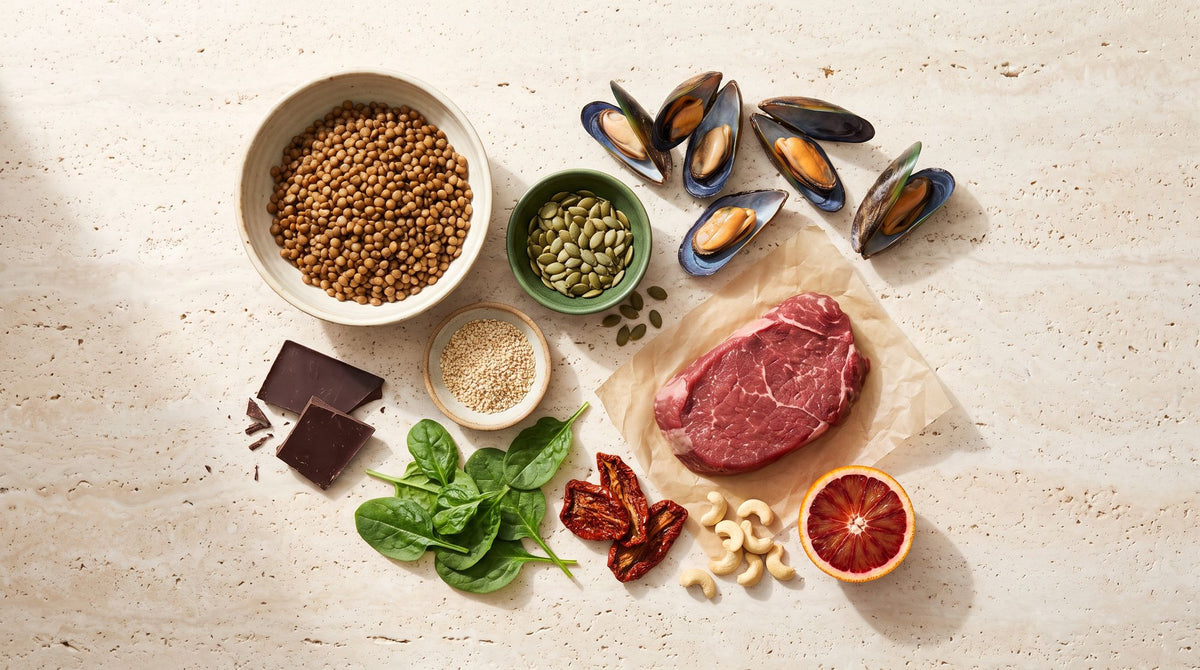
Iron deficiency: symptoms, causes and treatment
Manganese's counterpart and the most common nutrient deficiency of all: which symptoms are typical, which blood value counts and which foods refill your stores.
Weiterlesen · 13 Min
New from the guide
New articles, updates and tips straight to your inbox. Easy to understand, fact-checked, no spam.
Danke! Bitte bestätige die Anmeldung in deinem Postfach.