
Iodine deficiency: symptoms, causes and treatment
Tired, always cold, throat feels tight? Iodine deficiency stays quiet for a long time, until the thyroid grows. Find out which symptoms really belong to it, which test tells you something, and where iodine is found.


Aktualisiert 30 September 2026 · 16 Min. Lesezeit · 55 Quellen

The key points in 30 seconds
Since 2025 the DGE has recommended 150 micrograms a day for everyone aged 13 and over; before, it was 200. Pregnant women need 220, breastfeeding women 230. One egg provides 29, a cod fillet over 300.
That's how many adults fell below the estimated requirement in the Robert Koch Institute's last iodine monitoring (2008 to 2011); among children and teenagers it was 44%. Germany is considered a mild iodine-deficiency area again.
Only this many breads and rolls on sale contain iodised salt, according to the 2025 product monitoring. Five years earlier it was 12.7%, and for organic bread it's 0.5%. The salt shaker at home is your lever.
Mild iodine deficiency usually causes no symptoms. The thyroid grows quietly until you can feel it. Tiredness, feeling cold and weight gain only come once it turns into an underactive thyroid.
Iodine deficiency symptoms: how to spot it
Iodine deficiency is quiet. The thyroid needs iodine for its hormones, and when it's missing, it first compensates through growth: the visible sign is a goitre, often with nodules. Tiredness, feeling cold, dry skin or weight gain only come once the gland can't make enough hormone any more, usually with more severe deficiency. That's why the checklist doesn't just ask about symptoms, but also whether you're getting iodine at all.
Goitre and nodules: the visible sign
A goitre (struma) is an enlarged thyroid, and it's the classic result of even a mild iodine deficiency: the pituitary gland sends out more TSH, the gland grows and forms nodules. Small goitres cause no problems, but larger ones press on the windpipe and gullet: tightness, a lump in the throat, hoarseness, a collar that feels too snug. In the Papillon study of 96,000 working people, one in three had a goitre or nodules. Nodules are usually harmless; the 2025 GP guideline stresses that iodine deficiency doesn't explain them on its own, and genetic predisposition plays a part. An ultrasound can see the gland long before you can feel it (chapter 4).
Iodine deficiency symptoms in women
Women are affected more often: in the Papillon study, 17% of women had nodules compared with 11.5% of men, and an underactive thyroid is around five times as common in women. Two more things only women deal with: cycle problems when the thyroid makes too little hormone, and the higher need during pregnancy and breastfeeding (220 and 230 µg respectively), which is hard to meet without iodised salt and dairy (chapter 7). During the menopause, symptoms overlap with those of an underactive thyroid, so TSH belongs in your blood work. In men, iodine deficiency more often shows up as a goitre without nodules, but otherwise it's the same.

Iodine deficiency and muscle pain: what's behind it
Mild iodine deficiency doesn't cause muscle pain. Only an underactive thyroid can make muscles weak, stiff and prone to cramps: in a study of newly diagnosed underactive thyroids, 79% complained of muscle problems, 38% had measurably less strength and 29% had carpal tunnel syndrome. Typical signs are heavy legs on the stairs, tight neck muscles and cramps. Whether your thyroid is behind it comes down to a single value: TSH. If it's normal, iodine isn't the cause. Night-time calf cramps with no other signs are more likely magnesium deficiency.
Iodine deficiency symptoms in the gut: constipation
Your gut only feels iodine deficiency through the thyroid: when there's too little hormone, gut movement slows down, and constipation is one of the most common signs of an underactive thyroid. Diarrhoea, bloating or stomach ache, on the other hand, aren't proven symptoms, and the reverse doesn't work either: without an underactive thyroid, iodine won't help a sluggish gut. If you've been going to the toilet fewer than three times a week for weeks, check how much you drink and your fibre first, then TSH. A new lump in your throat together with constipation is a reason to see your doctor.
Iodine deficiency symptoms in skin and hair
Dry, cool skin and hair loss are signs of an underactive thyroid, not of mild iodine deficiency: in a Danish study, 63% of those affected had dry skin, and hair loss made an underactive thyroid four and a half times more likely. Hair becomes thin and dull and falls out evenly across the scalp, not in patches. There's no study on brittle fingernails, and none on spots or rashes either. Hair loss has more common causes, above all iron deficiency and zinc deficiency; that's why ferritin, zinc and TSH belong together on the lab sheet.
What really fits iodine deficiency
The most-searched symptoms and what the studies say: proven (guideline, professional society, meta-analysis), possible (only via an underactive thyroid or observation) or unproven (no primary source).
| What the studies say | Rating | |
|---|---|---|
| Goitre, nodules | Classic consequence even of mild deficiency: constantly high TSH makes the gland grow (DGE, MSD Manual) | Proven |
| Tiredness, feeling cold | Signs of an underactive thyroid (81% of those affected are tired), not of mild deficiency | Proven in underactive thyroid |
| Constipation | Common sign of an underactive thyroid (Lancet 2017); diarrhoea unproven | Proven in underactive thyroid |
| Dry skin, hair loss | 63% have dry skin; hair loss makes an underactive thyroid four and a half times more likely | Proven in underactive thyroid |
| Irregular periods, trying to conceive | Proven in underactive thyroid; reduced fertility only in severe deficiency | Proven in underactive thyroid |
| Weight gain | Small and mostly water: hormone therapy lowers weight by 1.4 kg on average (meta-analysis 2026) | Possible, small |
| Muscle pain, weakness | 79% have muscle complaints in overt underactive thyroid; no study for iodine deficiency alone | Possible |
| Joint pain, tingling | Carpal tunnel in 29% of underactive thyroid cases; no data for iodine deficiency | Possible |
| Depression, concentration | Named by the DGE as a sign of an underactive thyroid, not proven for mild iodine deficiency | Possible |
| Children: development | Severe deficiency in pregnancy is proven to cause harm; with mild deficiency there are only indications | Proven in severe deficiency |
| Eyes | Bulging eyes belong to Graves' disease (overactive thyroid), not to iodine deficiency | Unproven |
| Menopause symptoms | Overlap with an underactive thyroid, but no study on iodine deficiency | Unproven |
| Brittle fingernails | Not named as a sign of iodine deficiency in any guideline or review | Unproven |
Rating based on the sources in chapter 8: DGE iodine FAQ 2025, MSD Manual 2025, Zimmermann/Boelaert 2015, Carlé 2014, Chaker 2017, Duyff 2000, levothyroxine meta-analysis 2026. As of 30 September 2026.
The rule of thumb from the table: anything marked “in underactive thyroid” is decided by a TSH value. Anything “unproven” can have many causes, and iodine is rarely the first. And if you have no goitre and normal thyroid values, the cause of your tiredness lies elsewhere, whatever an at-home iodine test says (chapter 4).
Swelling at the front of your neck, a tight feeling, trouble swallowing or new hoarseness: see a doctor soon, for a TSH test and an ultrasound. Go straight away if you're short of breath. And if you have a racing heart, trembling and weight loss, don't take iodine: those are signs of an overactive thyroid (chapter 5).
Iodine deficiency causes: why Germany is an iodine-deficient region again
Iodine deficiency in Germany has a simple cause: the soil is low in iodine, vegetables, fruit and grain provide almost none, and the only naturally iodine-rich foods are sea fish, seafood and seaweed. Everything else relies on two detours: iodised salt, and the feed given to cows and hens. Both have been crumbling since the 2000s, which is why the country that once got rid of goitre is an iodine-deficient region again.
Iodine deficiency in Germany: the numbers
By WHO criteria, Germany once again has a mild iodine deficiency. From 2008 to 2011, the Robert Koch Institute measured a median of 69 µg/l (men) and 54 µg/l (women) in adults' urine; 100 to 199 would be adequate. Calculated from that, 32% of adults fall below the estimated requirement. In children and teenagers, the value fell from 118 µg/l (2003 to 2006) to 89 (2014 to 2017), and 44% are undersupplied. There are no more recent representative measurements.
Less iodised salt in bread and ready-made products
The biggest lever of the last 40 years was iodised salt in bakeries, butchers and industry, and that's exactly what is being lost. The 2025 product monitoring by the Max Rubner Institute found iodised salt in only 9.3% of bread and rolls (2020: 12.7%) and in 33.9% of sausage and meat products (2020: 48.1%); for organic bread, it was 0.5%. The BfR (Federal Institute for Risk Assessment) calculates that without iodised salt, an adult takes in a median of only around 75 µg a day, and the country would only be adequately supplied if 40% of all food were made with iodised salt. Today it's just under 30%.
Vegan, dairy-free, organic milk: who gets little iodine
Milk is only a source of iodine because cows are given mineral feed containing iodine. According to the BfR, organic milk contains only 60 to 85% of the iodine in conventional milk, and the DGE reckons on 15 instead of 30 µg per glass; organic eggs, on the other hand, aren't lower. If you eat vegan, or avoid milk and fish because of an allergy or lactose intolerance, you have the biggest gap: in the BfR study, only 8% of vegans reached the WHO value in their urine, and a third were in the range of severe deficiency. Plant-based drinks are rarely fortified with iodine. Smoking, cabbage or soy only reduce iodine uptake if there's very little iodine to begin with (FAQ).
How iodine works in the body
Three stages from plate to every cell. Once you know them, you'll understand why the thyroid grows with iodine deficiency, why a urine test says little about you, and why older people with nodules need to be careful.
Absorption in the small intestine
Iodine from fish, milk, eggs or iodised salt is absorbed almost completely as iodide in the small intestine. The body keeps hardly any store of it outside the thyroid: whatever the thyroid doesn't catch straight away leaves via the kidneys in the urine, around 90% within a day. That's why iodine has to come daily, and why the supply of whole populations is measured in urine.
The thyroid catches and builds
A transporter pulls iodide from the blood into the gland, where it's built into the hormones T4 and T3; the store lasts a few weeks. It's all controlled by the pituitary gland via TSH: if the hormone level drops, TSH rises, and the gland works harder and grows. That's the whole mechanism of a goitre.
Effect: metabolism, warmth, brain
T4 and T3 set the basal metabolic rate in every cell: warmth, heartbeat, gut movement, alertness. In unborn babies and infants they steer brain development, which is why needs are higher during pregnancy and breastfeeding. Without enough hormone, everything runs on low power: tired, cold, sluggish.
Iodine deficiency test: urine, thyroid values and ultrasound
No test can reliably prove an iodine deficiency in you personally. What can be measured is the result: whether your thyroid is enlarged, has nodules or makes too little hormone. That's why the work-up involves TSH, an ultrasound and a few questions about what you eat, not the iodine level in your urine.
Iodine in urine: what the value tells you
Around 90 % of iodine leaves the body via urine, which is why iodine excretion is the measure science uses. But only for groups: the WHO levels (under 20 severe, 20 to 49 moderate, 50 to 99 mild, 100 to 199 adequate, 300 and above excessive, all in µg/l) apply to the median of a population. In an individual, a spot urine sample varies from 10 to 260 µg/l depending on the previous day and how much you've drunk; in a Danish study, it took twelve samples to classify one person to within 20 % accuracy. So a single value is neither a diagnosis nor an all-clear, and the DGE considers it unsuitable for individuals.

TSH and fT4: the thyroid values
TSH is the first value: it rises as soon as the thyroid produces too little hormone, long before you notice anything. The GP guideline gives an upper limit of 4.0 mU/l (ages 18 to 70), 5.0 up to age 80 and 6.0 above that. If it's raised, fT4 comes next: normal means latent, low means overt underactive thyroid; fT3 is rarely needed. The guideline also warns against overdiagnosis: TSH fluctuates from day to day, and a single slightly raised value is rechecked after a few weeks, not treated. No TSH screening without a reason, no ultrasound “just to be safe”.
Which test tells you what
The tests around iodine and the thyroid, sorted by what they tell you personally.
| What it shows | What it means for you | |
|---|---|---|
| TSH | Signal from the pituitary gland; raised above 4.0 mU/l (up to age 70) | High: first and most important value, spots an underactive thyroid early; if slightly raised, recheck after a few weeks |
| fT4, fT3 | Free thyroid hormones in the blood | High if TSH is raised: separates latent from overt underactivity |
| Ultrasound | Volume (goitre from 18 ml in women, 25 ml in men), nodules, tissue | High for a palpable swelling or nodules; not as a check-up without a reason |
| Thyroid antibodies (TPO) | Sign of Hashimoto's inflammation | High if TSH is raised: decides whether iodine is even the issue |
| Iodine in spot urine | Iodine excretion, WHO levels adequate from 100 µg/l | Low: applies to population medians; in an individual it fluctuates between 10 and 260 µg/l |
| Iodine in 24-hour urine | Daily excretion, approximates intake | Medium: more accurate than spot urine, used in studies; rarely useful in everyday life |
| Home test (urine by post) | Iodine-creatinine ratio from one morning urine sample | Low: a single value, see above; doesn't replace TSH |
| Iodine saturation test (Lugol) | Swallow a high dose of iodine, then measure urine | None: never validated according to the Arbeitskreis Jodmangel (Iodine Deficiency Working Group), and the dose itself is risky |
Limits according to DEGAM S2k “Raised TSH value” 2023, DEGAM S3 Thyroid nodules 2025, WHO 2007, Andersen 2008, DGE iodine FAQ 2025. The reference range on your lab report is what counts.
Iodine deficiency tests for home
Home tests send you a tube for your morning urine and report back the iodine-creatinine value, for 25 to 50 euros. The result is measured honestly and still worth little: it's exactly the kind of single value that varies twentyfold in one person. A low value doesn't prove a deficiency, and a high one doesn't rule out a goitre. If you want to know whether your thyroid is struggling, get your TSH measured; health insurance covers it if you have symptoms. Professional societies advise against the iodine saturation test with Lugol's solution: it has never been validated, and one drop contains ten times the daily upper limit.
Bring three things: whether you use iodised salt, how often sea fish and dairy are on your plate, and whether goitre or thyroid conditions run in your family. Name any supplements containing iodine, seaweed or kelp. That decides whether iodine is even the issue.
Fixing an iodine deficiency: what really helps
The good news: your supply is covered within days, with iodised salt in the shaker, dairy, eggs and sea fish once a week. The less good news: a goitre that has grown over years shrinks only slowly and rarely goes away completely. Tablets are for clearly defined cases, and in two situations they're even risky. The decision tool below sorts that out for you.
Iodine tablets: when do they make sense?
Iodide tablets with 100 or 200 µg are medicines from the pharmacy, no prescription needed. According to the DGE and professional societies, they make sense in three cases: during pregnancy and breastfeeding (100 to 150 µg extra, chapter 7), for diffuse enlargement without nodules in younger people as a therapy under medical supervision, and when your diet permanently provides no source of iodine, for example vegan without iodised salt. For everyone else: iodised salt and food first, then measure. For food supplements, the BfR recommends a maximum of 100 µg per daily dose. Side effects aren't expected at 100 to 200 µg, with one exception (next section).
Why no iodine tablets after 45?
That rule exists, but it's about different tablets: the high-dose potassium iodide tablets for a nuclear emergency. Two of them contain 100 mg of iodine, a thousand times what an iodide tablet has, and they block the thyroid against radioactive iodine. The German Federal Office for Radiation Protection advises people over 45 against taking them, because many in this generation carry undetected hot nodules from the era of iodine deficiency: a dose like that can trigger an overactive thyroid, up to and including cardiovascular failure. They are only taken when the authorities tell you to. For 100 µg of iodide there is no age limit, but the same caution applies: if you're over 45, get your thyroid checked first.
Most people who ask me about iodine tablets need a salt shaker with iodised salt and fish once a week, not a tablet. And the few who really do need iodide, pregnant women for example, should take it after talking to a doctor, not just in case. What I never want to see: Lugol's solution in a glass of water.
Joerg Hauke, Nutrition expert, expert review of this article
Iodine and Hashimoto's: allowed or not?
Allowed in normal amounts. The German Society for Endocrinology tells people with the condition that iodised salt, sea fish once a week and holidays by the sea are harmless, even at the start of the illness. What to avoid are high doses: daily seaweed, lots of sushi, high-dose supplements, because they could speed up its course. Hashimoto's is the most common cause of an underactive thyroid in Germany, and it is not an iodine deficiency: more iodine doesn't improve it, and the GP guideline sees no benefit in iodine or selenium supplements. The society names one explicit exception: during pregnancy and breastfeeding, women with Hashimoto's should also take iodide, as agreed with their doctor.
How long does it take to fix an iodine deficiency?
Two clocks are running. Your supply catches up fast: the thyroid's store fills up within weeks, so if you switch to iodised salt today, you'll be covered next month. A goitre takes months and rarely shrinks completely: the patient information leaflet for iodide expects 6 to 12 months or longer; in the German LISA study with 1,024 adults, thyroid volume fell by 2.5% in one year with iodine alone, by 5.2% with levothyroxine, by 7.9% with both, and nodules by 17%. Something that grew over decades stops growing, but it doesn't disappear. An underactive thyroid is treated with hormones, not with iodine.
From what you need to too much: iodine in numbers
-
1
Daily requirement150 µg
DGE recommendation since 2025 for everyone aged 13 and over, 220 for pregnant women, 230 for breastfeeding women. A cod fillet delivers double that, an egg a fifth, a bottle of drinkable meal a quarter.
-
2
Maximum amount in a supplement100 µg
BfR recommendation for the daily dose of a food supplement, 150 µg for pregnant and breastfeeding women. Iodide 200 from the pharmacy is a medicine.
-
3
Upper limit600 µg
EFSA's Tolerable Upper Intake Level for adults, 500 for 15- to 17-year-olds; the old German figure of 500 is therefore superseded. Hard to reach with iodised salt and fish, instantly reached with brown seaweed.
-
4
One drop of Lugol's6,000 µg
According to the BfR, that's how much iodine is in one drop of 5% Lugol's solution, ten times the upper limit. Not a food, not authorised for sale. The radiation protection tablet is another fifteen times higher.
DGE/ÖGE 2025; BfR maximum level proposals 065/2025; EFSA/SCF (overview 2025); BfR statement 027/2026 on Lugol's solution; SSK leaflet 2024 (130 mg potassium iodide = 100 mg iodine).
Too much iodine: when it does harm
Through iodised salt and fish, too much is practically impossible, even if all salt were iodised, says the DGE. What's dangerous are dried brown seaweeds (kombu, wakame, hijiki, arame with up to 5,500 µg per gram), high-dose supplements, Lugol's solution and iodine-containing contrast agents. A healthy thyroid briefly blocks hormone production when flooded and recovers within days. But if you carry old hot nodules, you can develop an overactive thyroid: racing heart, sweating, trembling, weight loss, heart rhythm disorders, life-threatening in older people. By the way, there's no such thing as an “iodine allergy”: reactions to contrast agents or seafood have other triggers.
Nori sheets for sushi are fine at around 70 µg per sheet. Brown seaweeds like kombu, wakame, arame and hijiki are not: just 1 to 10 g can exceed the upper limit many times over, and the BfR considers products with more than 20 mg of iodine per kg not marketable. Only with a declared iodine content, and never daily.
Foods containing iodine: where you'll find the most
Almost the only naturally iodine-rich foods are sea fish and seafood. Everything else gets it indirectly: milk, yoghurt, cheese and eggs through animal feed; bread, sausage and your cooking at home through iodised salt. Plants grown in German soil provide almost nothing, which is why the second bar says “plant-based and fortified”. Values per 100 g as served, from the German Food Code and Nutrient Database (Bundeslebensmittelschlüssel) 4.0.
Iodine per 100 g: top 10 animal-based and plant-based
150 g of cod delivers 336 µg, more than double the daily requirement, which is why sea fish once a week is enough. An egg gives 29 µg, a glass of milk 28 µg. Salmon only 6 µg per 100 g.
Sea fish and seafood: cod instead of salmon
The lean sea fish are out in front: haddock 328, cod 224, coley 77 µg per 100 g, plus mussels, prawns, sardines and herring. The common mistake is salmon: farmed salmon gives 6 µg, trout 8, pangasius 4, and freshwater fish isn't an iodine source. Coley fish fingers still deliver 47. When you boil or defrost, 10 to 20% ends up in the water, while frying and baking cost you nothing. The authorities' rule of thumb: sea fish once or twice a week, and half of your weekly need is already covered.

Iodine content in yoghurt, cheese and milk
Milk provides around 14 µg per 100 ml, so a glass has 28 µg; samples from the market vary between 9 and 18 depending on feed, season and farm. Yoghurt is slightly lower at about 8 to 14 µg, while skyr at 20 and low-fat quark at 17 are higher because they are more concentrated. With cheese, the type makes the difference: Parmesan at 81 and feta at 78 are real sources, while Gouda (12), Emmental (10) and mozzarella (15) only make a contribution. Organic milk delivers roughly 60 to 88% of the conventional value. For all dairy products, the same applies: they only cover your needs together with iodised salt, not on their own.
Iodised salt: healthy or pointless?
By law, iodised salt contains 15 to 25 µg of iodine per gram, around 20 as measured in shops. The maximum of 6 g of salt a day recommended by the DGE therefore gives you 120 µg, four fifths of what you need, and without eating more salt: the rule is "if salt, then iodised salt", not "more salt". Sea salt brings 0.4 µg per gram, rock salt and Himalayan salt 0.05, and fleur de sel has no measured value; the BZfE says none of them is an alternative. The cooking water counts too: pasta and potatoes take up iodine from iodised salt water, and it's retained when baking and frying. The idea that iodised salt harms the thyroid is a myth, according to the BfR's model calculation.
Vegan iodine: how to get it without fish and milk
Without fish, milk and egg, iodised salt remains the only major source, and it has to be in three places: in the shaker, in your bread (look for "iodised salt" in the ingredients list; organic bread almost never has it) and in the cooking water. Add a plant-based drink with added iodine: 200 ml gives you 45 µg, without it 4. Together, a vegan day comes to roughly 190 µg on paper; if one of the three sources drops out, it falls to 120 to 160, and if all of them drop out, to about 50. If you can't manage that, you're looking at more than 100 µg of iodide; B12 is then usually already sorted, see Vitamin B12 deficiency.
Iodine in everyday life: drinkable meals
On days without fish, dairy or bread made with iodised salt, a drinkable meal with fixed nutrient amounts is a contribution you can plan on: one bottle of Saturo delivers 37 µg of iodine, a quarter of the reference intake of 150 µg, the same in every flavour, plus 26 other vitamins and minerals, including selenium and zinc. The iodine comes from the ingredients, not from an additive. A meal replaces neither iodised salt in your kitchen nor medical treatment.

Drinkable meal: a complete meal in a bottle
26 vitamins and minerals, including 37 µg iodine per bottle, a quarter of the 150 µg reference intake. 400 kcal and 36 g protein per bottle. Not a substitute for medical treatment.
Iodine in pregnancy, breastfeeding and childhood
Iodine in pregnancy and while breastfeeding
The requirement rises to 220 µg (pregnant) and 230 µg (breastfeeding), because the child's thyroid is supplied by the mother and iodine passes into breast milk. The DGE, BfR and the Netzwerk Gesund ins Leben therefore recommend a supplement with 100 (to 150) µg from when you start trying to conceive, in addition to iodised salt and dairy; if you have a thyroid condition, talk to your doctor first. Folic acid comes in the same supplement (see Folic acid deficiency). To be honest about it: severe deficiency is proven to harm development, while for mild deficiency the studies disagree. One large trial found no IQ effect from the tablets, and the GP guideline considers the evidence thin. The recommendation still stands, because Germany is a deficiency region.

Children and teenagers are the group with the biggest decline: urinary iodine fell from 118 to 89 µg/l between the two KiGGS surveys, almost every second child stays below the requirement, and among one- to two-year-olds it's 45% of girls. The requirement is 90 µg (1 to 6 years), 120 µg (7 to 12) and 150 µg from 13; infant formula is legally required to contain iodine, while breastfed babies depend on their mother. In everyday life that means: iodised salt in the family kitchen, milk or yoghurt every day, and fish fingers count too; supplements only after talking to your doctor.
Frequently asked questions about iodine deficiency
Is Germany an iodine-deficient region?
Yes, a mild one by WHO criteria: median iodine excretion was 54 to 69 µg/l in adults and 89 in children, while 100 would be adequate. 32% of adults and 44% of children fall below the requirement. Not an emergency, but a downward trend since the 2000s.
Can iodine deficiency lead to weight gain?
Only via an underactive thyroid, and then not by much: usually 1 to 4 kg, mostly retained water. A 2026 meta-analysis found on average 1.4 kg less under hormone therapy. "Iodine deficiency makes you fat" isn't proven; if you're gaining weight and your thyroid values are normal, look for the cause elsewhere.
Is there iodine in bananas?
Hardly: 3 µg per 100 g, so a banana delivers around 4 µg, which is 2 to 3% of the daily requirement. Fruit overall comes to about 1 µg per 100 g, because soils are low in iodine. Bananas bring potassium; for iodine you need sea fish, dairy, egg or iodised salt.
Does skyr contain iodine?
Yes, around 20 µg per 100 g, so a 150 g tub delivers about 30 µg, a fifth of the daily requirement. Skyr is more concentrated than yoghurt (8 to 14 µg) and, along with low-fat quark (17), comes out on top. The value varies with what the cows are fed, and organic is usually lower.
What inhibits iodine absorption?
Smoking (thiocyanate), very large amounts of cabbage, cress, radish, millet or linseed, as well as perchlorate, compete with iodine for the thyroid. According to the BfR, this only has an effect when there's too little iodine anyway. According to a meta-analysis, soy has no relevant effect. Selenium, iron or vitamin A deficiency make an iodine deficiency worse.
Can you take iodine and folic acid together?
Yes, in pregnancy that's actually standard: combination supplements contain 400 µg of folic acid and 100 to 150 µg of iodine, and the BfR describes both together. They don't affect each other. Only if you have a known thyroid condition should the iodine part be agreed with your doctor beforehand; the folic acid stays in any case.
How much seaweed can you eat per day?
Nori sheets for sushi (around 70 µg per sheet) are fine. Brown seaweeds like kombu, wakame, hijiki and arame are not: 1 to 10 g dried can exceed the upper limit of 600 µg many times over. Stick to products with a declared iodine content, never have them daily, and avoid them completely if you have a thyroid condition.
Can a goitre go away again?
Partly. In younger people with diffuse enlargement, the gland shrinks under iodide or hormone treatment over 6 to 12 months, by 2.5 to 8% a year in the LISA study. An old goitre with nodules doesn't go back; it just stops growing. If it causes symptoms, radioiodine or surgery remain options.
Sources · 55 sources anzeigen
- German Nutrition Society (DGE) / Austrian Nutrition Society (ÖGE): Reference values for nutrient intake, iodine. Status of derivation 2025.
- DGE: New reference values for iodine and vitamin E published. Press release 2025.
- DGE: Questions and answers on iodine. Last updated 15 September 2025.
- Federal Institute for Risk Assessment (BfR): Update (2025): Proposed maximum levels for iodine in foods, including food supplements. Opinion no. 065/2025 of 19 December 2025.
- EFSA: Overview on Tolerable Upper Intake Levels as derived by the SCF and the EFSA NDA Panel. Version 11, August 2025 (iodine: 600 µg/day for adults).
- Regulation (EU) No 1169/2011 (Food Information Regulation), Annex XIII: Reference intakes for daily intake (iodine 150 µg).
- Federal Ministry of Agriculture, Food and Regional Identity (BMLEH): Iodine supply in Germany, results of iodine monitoring in children, adolescents and adults (DEGS1, KiGGS).
- Thamm M. et al.: Iodine supply in Germany, results of iodine monitoring in the German Health Interview and Examination Survey for Children and Adolescents (KiGGS). Bundesgesundheitsblatt 2007; 50: 744–749.
- Johner S. A. et al.: Examination of iodine status in the German population: an example for methodological pitfalls of the current approach of iodine status assessment. European Journal of Nutrition 2016; 55(3): 1275–1282.
- Iodine Global Network: Global scorecard of iodine nutrition in 2025 (Germany: median 89 µg/l, insufficient).
- BfR: Iodine supply in Germany declining again, tips for a good iodine supply. FAQ of 20 February 2020, updated 9 February 2021.
- BfR: Declining iodine intake in the population, model scenarios for improving iodine intake (BfR MEAL study). Opinion no. 005/2021.
- Max Rubner Institute (MRI): Supplementary analyses for product monitoring 2025: Use of iodised salt in bread and small baked goods, sausage products, meat products, soups and instant meals. April 2026.
- MRI: Study on the influence of manufacturing and processing on iodine content when using iodised table salt. Final report, March 2018.
- Federal Centre for Nutrition (BZfE): Salt, if salt, then iodised salt. As of 4 September 2026.
- BZfE: Good iodine supply on vegan and vegetarian diets.
- BMLEH: Questions and answers on iodised salt.
- Verbraucherzentrale (consumer advice centre): Which salt can I use at home? As of 31 July 2026.
- Reiners C. et al.: Prevalence of thyroid disorders in the working population of Germany: ultrasonography screening in 96,278 unselected employees (Papillon). Thyroid 2004; 14(11): 926–932.
- DEGAM: S3 guideline on thyroid nodules in adults in primary care. AWMF register no. 053-058, as of 30 November 2025.
- DEGAM: S2k guideline on elevated TSH levels in GP practice. AWMF register no. 053-046, as of April 2023.
Has been writing for Saturo since 2019 about nutrition, nutrients and how to get good nutrition into everyday life in practice.
Hat diesen Artikel am 30. September 2026 auf fachliche Richtigkeit geprüft. This content does not replace medical advice.
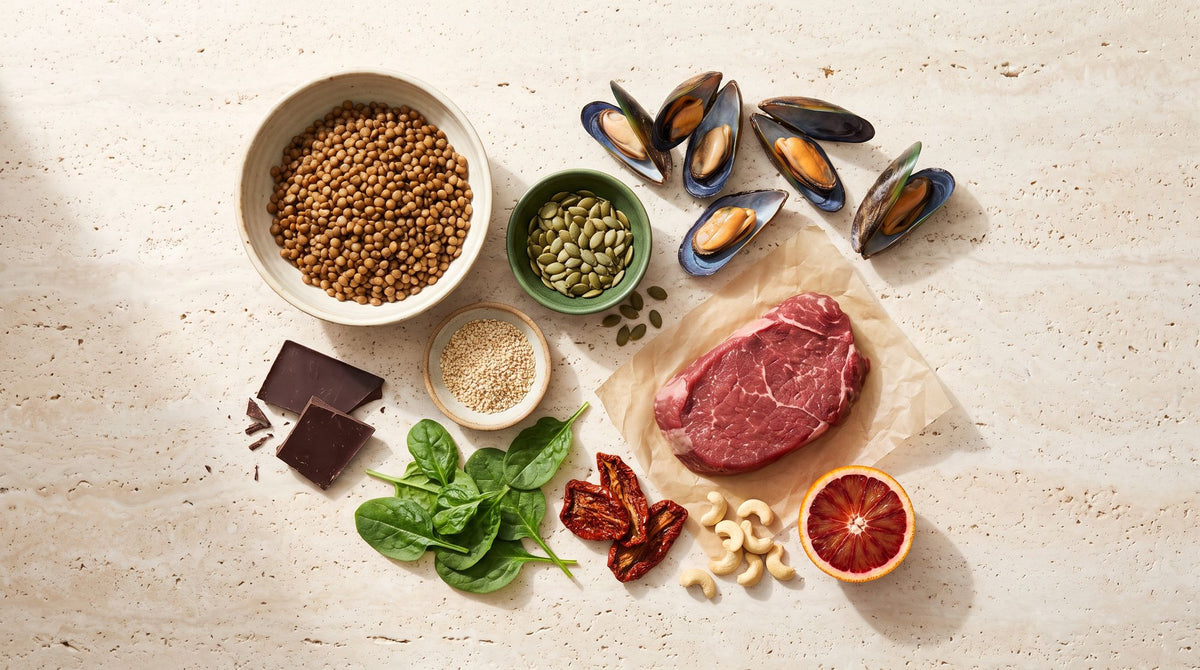
Iron deficiency: symptoms, causes and treatment
The most common deficiency of all, and it makes an iodine deficiency worse: which symptoms come with it, which blood value counts and where to find iron.
Weiterlesen · 13 Min

What's new in the guide
New articles, updates and tips straight to your inbox. Easy to understand, expert-checked, no spam.
Danke! Bitte bestätige die Anmeldung in deinem Postfach.