Basics & nutrientsOne of 13 articles on this topic

Junk food: meaning, examples and what it does in your body

Pizza, doner kebab, crisps: is all of that junk food? Junk food isn't a dish but a lot of energy with few nutrients, and fast food doesn't have to be junk food. What counts as junk food, what it does in your body and what helps against cravings.

Angebissener Burger, Pommes, Cola, Chips, Schokolade und Donut auf einem dunklen Tisch von oben
Burgers, chips, cola, crisps, sweets: lots of energy, few nutrients. You recognise junk food by its composition, not by where you buy it.

The key points in 30 seconds

More calories per day
+508kcal

With freely chosen portions, 20 adults eating a highly processed diet consumed 508 kcal more per day and gained 0.9 kg in two weeks (Hall 2019).

Salt in currywurst with chips
6.4g

More than the DGE guideline value for a whole day (up to 6 g). Calculated for a 400 g portion using the standard recipe from the German Nutrient Database (BLS).

Sugar in 0.5 litres of cola
53.6g

The WHO recommends getting under 10% of your energy from free sugars, which is about 50 g at 2,000 kcal. One bottle of cola uses up that daily budget on its own.

How often junk food is okay
Occasionally

There's no official weekly limit. The DGE says: occasionally, in small amounts, as long as your calorie and nutrient balance is right.

01 Term

Junk food: meaning and definition

Junk food isn't a specific dish, it's a verdict on what's in it: lots of energy, few nutrients. There's no official definition, which is exactly why people argue about whether pizza, döner or muesli bars count. Three terms help sort things out: junk food, fast food and ultra-processed. They mean three different things.

What is junk food?

Junk food is food with lots of calories but little nutritional value: plenty of sugar, fat or salt, and hardly any vitamins, minerals or fibre. The Duden calls it “poor-quality, unhealthy food”, and the DWDS dictionary says “food of low nutritional value but high calorie count”. That's as far as the definition goes: neither food law nor the specialist literature sets a sugar or fat content above which a food counts as junk food. Authorities work with nutrient profiles instead, such as the WHO Regional Office for Europe model, which is only used to restrict advertising to children, or the British abbreviation HFSS for “high in fat, sugar, salt”.

Why is it called junk food?

“Junk” means rubbish, clutter or ttat, and “food” means, well, food. So junk food is literally rubbish food, and the term is meant to be derogatory. The Duden spells it as one word, though “Junk Food” is just as common. It comes from the USA, where it appeared in newspapers by the 1950s at the latest and became popular in the 1970s through the consumer advocate Michael Jacobson. So it's a judgement, not a technical term. That explains why the line stays so blurry.

Fast food Speed

tells you how quickly the food arrives. A falafel in flatbread is fast food with 8.4 g of fibre and 468 kcal.

Junk food Content

tells you what's in it. 50 g of crisps plus a chocolate bar come to 511 kcal and hardly any nutrients, no takeaway needed.

Junk food and fast food: the difference

Fast food describes how food is sold, junk food describes the quality of the food. The Duden defines fast food as a “quick meal”, so food that goes across the counter in minutes. It doesn't say whether it's nutritious. Plenty of fast food is junk food, but not all of it: a gyros in a pitta gives you 43 g of protein and raw veg. And not all junk food is fast food: crisps, gummy bears and fizzy drinks from the supermarket don't need a takeaway. The fact that the Duden still lists fast food as a synonym for junk food just shows how often the two overlap.

Man eats a burger and chips alone at a snack bar counter late in the evening, looking at his phone
Fast food tells you how quickly the food arrives. Whether it's junk food depends on what's in it, not on the counter.
02 Examples

What counts as junk food? Examples and ingredients

The list of examples is long, but the pattern behind it is always the same: high energy density from fat, sugar or both, plus salt, plus little fibre, vitamins and minerals. If you know the three key figures, you can spot junk food even without a list.

Junk food examples: the list

Typical junk food falls into five groups:

  • Takeaway and delivery: burgers, chips, currywurst, chicken nuggets, hot dogs, pizza with lots of cheese and salami, dürüm with a greasy sauce
  • Sweets: chocolate bars, gummy bears, doughnuts, jam doughnuts, biscuits, ice cream
  • Salty snacks: crisps, peanut puffs, coated peanuts, pretzel sticks
  • Drinks: sugary cola and lemonade, energy drinks, sweetened iced tea
  • Ready-made products: instant noodles, frozen pizza, ready-made soups, sweetened breakfast cereals

Döner, falafel and sushi are deliberately not on the list: they're fast food, but depending on what's in them, a decent meal. Whether a product is also ultra-processed is covered by the check in chapter 5.

Sugar, fat, salt: how to spot junk food

Three numbers on the nutrition table are enough. Sugar: the WHO recommends getting less than 10% of your energy from free sugars, which is about 50 g a day on 2,000 kcal; half a litre of cola has 53.6 g. On 14 October 2026, the German federal cabinet set a tax on sugar-sweetened drinks in motion, but the Bundestag hasn't decided yet. Salt: the WHO says under 5 g, the DGE up to 6 g a day; according to the DGE, around two thirds of that comes from processed foods and fast food. Fat: saturated fat should stay under 10% of your energy; industrial trans fats have been capped in the EU at 2 g per 100 g of fat since 2021 and are hardly a problem any more. What's missing is fibre: the DGE recommends at least 30 g a day, and a medium portion of chips delivers 3.7 g. That's what the term “empty calories” stands for.

At a glance

Fast food classics per portion

Calculated standard recipes, portion per row as an assumption, sorted by calories.

kcalSaltSugarProtein
Currywurst with chips (400 g)8686.4 g21.6 g26 g
Pizza Margherita, pizzeria (350 g)8332.4 g5.6 g27 g
Dürüm with chicken (370 g)7445.4 g6.6 g45 g
Döner, veal/beef (350 g)6202.2 g4.1 g39 g
Double cheeseburger (220 g)5063.3 g7.5 g29 g
Gyros in a pitta (300 g)4682.2 g4.2 g43 g
Falafel in flatbread (300 g)4682.4 g5.4 g16 g
Chips, medium (150 g)3581.4 g2.3 g5 g
Hot dog (150 g)3463.0 g4.5 g14 g
Chicken nuggets (6 pieces)2681.4 g0.7 g12 g
Cola (0.5 l)2130 g53.6 g0 g

Values per portion from BLS 4.0 (Max Rubner Institute) and USDA SR Legacy, standard recipes without chain names, portions vary by ±30%. Salt varies widely: döner with chicken 5.5 g, Matjes herring roll 8.7 g. The sugar in the currywurst comes from the curry ketchup.

Döner, burger or pizza: which is healthier?

Per portion, the döner usually comes out best: 620 kcal, 39 g protein, 6 g fibre from the flatbread and raw veg, and salt within reason. A whole pizzeria pizza brings 833 kcal and 15 g saturated fat, but it's really a meal for one and a half people. The burger depends on the meal: a double cheeseburger on its own is 506 kcal, but with medium chips and 0.5 l of cola it's almost 1,100 kcal and over 60 g of sugar. None of these dishes is “healthy” or “unhealthy” in itself. Portion size, side and drink make the difference, and a bigger one than choosing between döner and pizza.

03 Understand

Why junk food tastes so good

Three mechanisms explain why a bag of crisps rarely stays half full. None of them is a lack of willpower. Once you know them, you'll also see why the strategies in chapter 6 focus on your surroundings rather than on bans.

1

Energy density

Junk food packs a lot of energy into a small volume: 50 g of crisps provide 263 kcal, a 180 g apple 104 kcal. Your stomach signals fullness partly through volume. According to the DGE, foods with high energy density lead to a higher energy intake.

2

Fat plus sugar, fat plus salt

These combinations are rare in nature. Researchers call foods that combine them in certain proportions "hyperpalatable": crisps, chocolate bars, chips, pizza. In the US food database, 62% of all entries meet these criteria.

3

Getting used to the reward system

Normal-weight people who ate an extra high-fat, high-sugar snack every day for eight weeks showed stronger brain responses to food afterwards and liked low-fat food less, regardless of weight. Your brain learns before your body gains weight.

04 Consequences

What does junk food do to your body? Consequences and studies

There's a lot of exaggeration here, in both directions. One side talks about 32 diseases, the other about scaremongering. What holds up: observational studies show links with being overweight, type 2 diabetes and cardiovascular disease, and experiments show mechanisms. Only one effect is causally proven: you eat more.

Why is fast food unhealthy?

Because overall it delivers too much energy, salt and saturated fat, with too little fibre. It's not that a single burger does harm. The German Nutrition Society (DGE) reads the evidence like this: people who eat lots of highly processed foods have a "probably" higher risk of being overweight, high blood pressure, type 2 diabetes and cardiovascular disease. In the French NutriNet-Santé cohort, cardiovascular risk rose by 12% for every ten percentage points more ultra-processed food. Those are links, not proof, and the authors themselves consider causality an open question. The best-supported mechanism is energy intake: with ultra-processed food, you eat more before you feel full. Large, fatty meals are also among the typical triggers of heartburn.

Is junk food addictive?

Not in the medical sense: "food addiction" isn't a recognised diagnosis, not even in the DSM-5. The often-quoted 14% of adults comes from a questionnaire that applies the criteria for substance dependence to food; depending on the study, the figures range from 14 to 20%, and are much higher in people with binge eating. Researchers disagree on this: one group sees parallels with addictive substances, especially in products with fat and refined carbohydrates; others consider the evidence for a substance-based dependence weak and prefer to talk about addiction-like eating behaviour. Strong cravings alone are a symptom, not an addiction.

Super Size Me: what science says

The 2004 film is a self-experiment, not a study. According to the film, Morgan Spurlock gained around 11 kg in 30 days on nothing but fast food, his cholesterol and blood pressure rose, and a doctor called his liver "obscene". None of this can be verified, as there's no protocol. A Swedish study of 18 healthy people confirmed the direction in 2008: four weeks of double the calorie intake with two fast-food meals a day and little exercise pushed the liver enzyme ALT from an average of 22 to 97 U/l. The authors put this down to overeating, not to fast food itself. Neither result can be applied to occasional consumption.

What studies show after weeks and years

  1. 2 weeks Eating more without noticing

    20 adults ate 508 kcal more per day on an ultra-processed diet and gained 0.9 kg; on an unprocessed diet, the same people lost 0.9 kg (Hall 2019, randomised).

  2. 4 weeks Liver values rise

    18 healthy people doubled their calories with fast food and barely moved: ALT went from 22 to an average of 97 U/l, with more liver fat. After the study ended, the values recovered (Kechagias 2008).

  3. 8 weeks The brain relearns

    One daily snack high in fat and sugar on top of normal meals: stronger brain response to food, less preference for low-fat foods, with no weight gain (Edwin Thanarajah 2023).

  4. 15 years Weight and insulin resistance

    People who ate at a fast-food restaurant more than twice a week gained 4.5 kg more and developed twice as much insulin resistance as people who went less than once a week (CARDIA, 3,031 participants).

One experiment also shows the limits of blanket judgements: in 2025, 55 adults in England lost weight whether their diet was minimally or ultra-processed, as long as both followed the UK dietary guidelines. With the minimally processed diet, the effect was about twice as big. So composition counts, not just the degree of processing. That's exactly what the next chapter is about.

05 Processing

Ultra-processed foods: NOVA and how to spot them

"Ultra-processed" and "junk food" are often treated as the same thing, but they mean different things. Junk food describes the nutrient profile, while the degree of processing describes how a food is made. The most widely used system for this is called NOVA and sorts foods into four groups; the fourth is known as "ultra-processed food", or UPF for short.

NOVA classification: the four groups

NOVA was developed by Brazilian nutrition scientists and described in a 2019 FAO report. What matters isn't how much sugar or fat a product contains, but which ingredients and processes are behind it. The FAO itself notes that the report is not an assessment of the system; the DGE states that there is no scientific consensus on uniform criteria for degrees of processing. Even so, NOVA is the basis of almost all studies on ultra-processed foods.

The four NOVA groups

  1. 1 Group 1Unprocessed or minimally processed

    Edible parts of plants and animals, at most washed, chopped, dried, chilled, cooked or pasteurised. Fruit, vegetables, pulses, rice, rolled oats, meat, fish, eggs, milk, plain yoghurt, nuts, coffee, tea.

  2. 2 Group 2Processed culinary ingredients

    Obtained from group 1, for cooking and seasoning: vegetable oil, butter, lard, sugar, honey, salt. You hardly ever eat them on their own.

  3. 3 Group 3Processed foods

    Group 1 plus salt, sugar or oil, usually two to three ingredients, and the original food stays recognisable: vegetables in jars, tinned fish, salted nuts, fresh bread and cheese from artisan producers, smoked fish.

  4. 4 Group 4Ultra-processed (UPF)

    According to the FAO, formulations made from ingredients that are mostly used only industrially: soft drinks, snacks, sweets, packaged bread, ready-made pizza, nuggets, sausages, instant soups, sweetened cereals, fruit yoghurt, and also meal replacement shakes.

Classification according to Monteiro et al., FAO 2019, Table 1. The group says nothing about calories, sugar or salt: a pizzeria pizza is group 3 and has 833 kcal.

Spotting ultra-processed foods

The ingredients list is all you need. According to the NOVA authors' rule, a product is ultra-processed as soon as it lists a single ingredient that doesn't appear in any kitchen, or a class of additive meant to make the product tastier. Substances not found in kitchens include maltodextrin, glucose-fructose syrup, dextrose, modified starch, hydrogenated or interesterified fats, protein isolates and isolated fibres. Additive classes include flavourings, flavour enhancers, colourings, emulsifiers, sweeteners, thickeners and gelling agents. Preservatives alone aren't enough. In Germany, according to the DGE, about half of adults' energy comes from processed and ultra-processed foods combined, although the data is from the 2000s. The check shows whether your yoghurt, cheese or crispbread belongs in the group:

Interactive

Is it ultra-processed?

Type in a food or filter by group. The classification applies to the typical supermarket product; for "depends on the product", the ingredients list decides.

  • Oat flakes fine, hearty, wholegrain Group 1Oat kernels only steamed and rolled, nothing added. Instant/melt flakes with sugar or flavouring are Group 3-4.
  • Noodles durum wheat, wholegrain; pasta Group 1Flour and water, shaped and dried; Group 1 according to the FAO. Egg noodles and filled pasta (tortellini with filling, flavouring) can be Group 3-4.
  • Rice brown, basmati, wholegrain rice Group 1Whole or hulled grain, dried, nothing added. Ready-made rice pouches with seasoning/sauce: Group 3-4.
  • Bakery bread rye, sourdough, mixed-flour bread; fresh, unwrapped Group 3 (range 3-4)Flour, water, salt, yeast or sourdough; fermentation and added salt. Depends on the product: baking improvers or emulsifiers used in the bakery make it Group 4.
  • Toast bread sandwich bread, packaged Group 4 (range 3-4)Usually contains emulsifiers, sugar/dextrose and other baking improvers. Depends on the product: varieties made only from flour, water, yeast and salt are Group 3.
  • Crispbread rye, wholegrain Group 3 (range 3-4)Flour, water, salt, dried and baked. Depends on the product: varieties with yeast extract, flavouring or seasoning extracts are Group 4.
  • Muesli unsweetened: flakes, nuts, dried fruit Group 1 (range 1-4)Mix of cereal flakes, nuts and fruit with nothing added. Depends on the product: added sugar = Group 3, crunchy muesli with syrup, flavouring or oil = Group 4.
  • Breakfast cereals cornflakes, chocolate pillows, pops Group 4 (range 3-4)Extruded, sweetened, with flavouring and added vitamins. Depends on the product: cornflakes made only from maize, sugar, salt and malt are Group 3.
  • Baguette / bake-at-home rolls supermarket Group 4 (range 3-4)Baking improvers, emulsifiers and enzymes for bake-off products. Depends on the product: baguette made only from flour, water, yeast and salt is Group 3.
  • Instant noodles cup, block with seasoning mix Group 4Pre-fried noodles, seasoning mix with flavour enhancers and flavouring.
  • Milk fresh milk, UHT milk Group 1Heated or pasteurised milk, nothing added.
  • Natural yoghurt plain yoghurt, no additives Group 1 (range 1-4)Milk plus yoghurt cultures, nothing added. Depends on the product: with milk powder, starch or thickeners it becomes Group 3-4.
  • Fruit yoghurt yoghurt with fruit, sweetened Group 4Sugar, flavouring, starch or thickeners in the fruit preparation. Depends on the product: plain yoghurt mixed yourself with fresh fruit is Group 1.
  • Quark low-fat quark, regular quark Group 1 (range 1-4)Milk with lactic acid cultures and rennet, nothing added. Depends on the product: often also classed as Group 3; with thickener or flavouring it is Group 4.
  • Hard cheese Gouda, Emmental, mountain cheese, Parmesan Group 3Milk, rennet, salt and maturation; added salt and fermentation. Depends on the product: grated cheese with anti-caking agents/mould inhibitors is Group 4.
  • Mozzarella Group 3 (range 3-4)Milk, rennet and salt; scalded, stretched cheese. Depends on the product: grated pizza cheese with anti-caking agents or cheese imitation is Group 4.
  • Processed cheese slices, triangles, spreadable cheese Group 4Melting salts, emulsifiers, milk ingredients and flavouring.
  • Plain cream cheese Group 3 (range 3-4)Milk, cultures and salt; often with thickener. Depends on the product: locust bean gum/stabilisers or flavourings make it Group 4.
  • Butter Group 2Fat extracted from cream, a culinary ingredient.
  • Margarine Group 4Refined or interesterified fats, emulsifiers, flavouring and colouring. Depends on the product: pure vegetable-oil spreads made with just oil, water and salt are rare.
  • Ice cream ice cream, ice lollies Group 4Glucose syrup, emulsifiers, stabilisers and flavouring. Depends on the product: ice cream made from milk, cream, sugar and egg by an ice cream maker can be Group 3.
  • Eggs Group 1Unprocessed, only chilled.
  • Fresh meat chicken breast, steak, minced meat Group 1 (range 1-3)Fresh meat, only cut up, chilled or frozen. Depends on the product: marinated meat with seasoning oil/salt is Group 3-4.
  • Sliced sausage Lyoner, Fleischwurst, mortadella Group 4 (range 3-4)Finely chopped sausage meat with phosphate, dextrose, flavouring and nitrite curing salt. Depends on the product: traditional sausage made only from meat, salt and spices is Group 3.
  • Salami dry sausage, pepperoni sausage Group 4 (range 3-4)Chopped meat, dextrose, starter cultures, antioxidant, flavouring. Depends on the product: salami made only from meat, salt and spices is Group 3.
  • Cooked ham formed ham, sliced Group 4 (range 3-4)Injected with curing brine; phosphates, dextrose, flavour enhancers. Depends on the product: extra cooked ham without additives is Group 3.
  • Raw ham Black Forest, Serrano, Parma Group 3Meat salted, cured and air-dried.
  • Bratwurst / grilling sausage scalded sausage, Wiener Group 4 (range 3-4)Finely chopped sausage meat with spices, phosphate and dextrose. Depends on the product: butcher's bratwurst made only with meat, salt and spices is Group 3.
  • Leberkäse / Fleischkäse Bavarian meatloaf Group 4 (range 3-4)Fine sausage meat made from meat, bacon, nitrite curing salt, phosphate and dextrose. Depends on the product: butcher's version without additives is Group 3.
  • Chicken nuggets poultry nuggets Group 4Formed sausage meat, breadcrumb coating, starch, seasoning mix; pre-fried.
  • Burger from a fast-food restaurant patty, bun, sauce Group 4 (range 3-4)Formed minced meat, bun made with baking aids, sauces with flavouring and thickeners. Depends on the product: a burger made at home with fresh mince and a bakery bun is Group 3.
  • Döner kebab takeaway, döner plate, dürüm Group 4 (range 3-4)Industrially pre-formed meat skewer with a seasoning mix; sauces and flatbread are often ready-made. Depends on the product: a freshly layered skewer from the butcher with no additives is Group 3.
  • Currywurst with chips takeaway Group 4Cooked sausage, curry ketchup with sugar and spice extracts, frozen chips.
  • Fish, fresh or frozen, plain fillet, salmon, trout Group 1Fillet or whole fish, only chilled or frozen. Depends on the product: breaded or marinated fillets are Group 3-4.
  • Fish fingers Group 4 (range 3-4)Breaded fish block, par-fried; breading with starch and flavouring. Depends on the product: varieties made only from fish, flour, water, salt and oil are Group 3; the FAO names fish fingers as an example of Group 4.
  • Smoked salmon Group 3Fish, salted and smoked.
  • Tinned tuna in water or oil Group 3Fish preserved in brine or oil. Depends on the product: salads and sauces with flavouring and starch are Group 4.
  • Sushi supermarket box Group 4 (range 3-4)Ready-made box with a rice vinegar mix, stabilisers and sauces with flavouring. Depends on the product: freshly rolled in a restaurant (rice, vinegar, salt, fish) is Group 3.
  • Fresh fruit, veg, potatoes, salad Group 1Unprocessed, or just washed, cut and chilled.
  • Frozen veg plain, no sauce Group 1Washed, cut, blanched, frozen. Depends on the product: mixes with sauce, butter or seasoned oil are Group 3-4.
  • Tinned beans, chickpeas, lentils tin, jar Group 3 (range 3-4)Pulses preserved in water and salt. Depends on the product: baked beans and beans in sauce with sugar, starch and flavouring are Group 4.
  • Dried fruit dates, apricots, raisins, plain Group 1 (range 1-3)Just dried, nothing added. Depends on the product: with sugar, syrup or vegetable oil (raisins coated in oil) = Group 3.
  • Nuts, plain almonds, walnuts, hazelnuts Group 1Unroasted and unsalted; only shelled or dried.
  • Peanuts, roasted and salted Group 3 (range 3-4)Roasted, with added salt or oil. Depends on the product: seasoned coatings (paprika, chilli) with flavouring and starch are Group 4.
  • Nut butter 100% nuts: almond butter, plain peanut butter Group 1 (range 1-4)Ground nuts, nothing added. Depends on the product: peanut butter with sugar, palm oil and emulsifier is Group 4.
  • Smoothie shop-bought, just fruit purée and juice Group 1 (range 1-4)Blended fruit and juice, pasteurised, nothing added. Depends on the product: with sugar, flavouring, added vitamins or protein powder, it becomes Group 4.
  • Fruit juice 100% not from concentrate Group 1 (range 1-4)Pressed, pasteurised juice with nothing added. Depends on the product: juice with added sugar, nectar or flavouring is Group 3-4.
  • Hummus shop-bought Group 3 (range 3-4)Chickpeas, sesame, oil, lemon, salt. Depends on the product: preservatives, thickeners and flavouring make it Group 4.
  • Potato crisps Group 4 (range 3-4)Fried snack with a seasoning mix, flavouring and flavour enhancers. Depends on the product: salted crisps made only from potatoes, oil and salt are formally Group 3; the FAO counts salty snacks as Group 4.
  • Muesli bar cereal bar Group 4 (range 1-4)Glucose syrup, binders, flavouring, puffed cereal. Depends on the product: a bar made only from dates and nuts is Group 1.
  • Protein bar Group 4Protein isolates, sweeteners, sugar alcohols, glucose syrup, flavouring.
  • Protein powder whey, casein, pea; shake powder Group 4Isolated protein, usually with flavouring, sweetener and thickener. Even a pure isolate with no additives is still an isolate under NOVA (Group 4).
  • Gummy bears fruit gums, wine gums Group 4Glucose syrup, gelatine, flavouring, colourings, glazing agents.
  • Milk chocolate chocolate bar Group 4Sugar, milk powder, the emulsifier lecithin and flavouring.
  • Dark chocolate just cocoa and sugar Group 3 (range 3-4)Cocoa mass, cocoa butter and sugar; only Group 2 ingredients. Depends on the product: with the emulsifier lecithin, vanillin or flavouring, it is Group 4.
  • Croissant supermarket, packaged Group 4 (range 3-4)Baking aids, emulsifiers, flavouring and hardened or interesterified fat. Depends on the product: a bakery croissant with butter, flour, yeast, sugar and salt is Group 3.
  • Ketchup Group 4 (range 3-4)Lots of sugar, spice extracts, thickeners; industrial recipe. Depends on the product: tomatoes, vinegar, sugar and salt without extracts would formally be Group 3.
  • Pizza from a pizzeria freshly baked, stone oven Group 3 (range 3-4)Made fresh from flour, yeast, tomatoes and cheese; few additives. Depends on the product: ready-made dough, cheese imitation or flavoured sauces make it Group 4.
  • Frozen pizza Group 4 (range 3-4)Industrial dough, cheese or cheese substitute, flavouring, stabilisers, seasoning mixes. Depends on the product: a simple margherita made from flour, tomato, cheese and oil can be Group 3.
  • Chips from the freezer oven chips Group 4 (range 3-4)Par-fried, treated with dextrose and a stabiliser (diphosphate). Depends on the product: cut yourself and fried, or baked in the oven with oil and salt, they are Group 3.
  • Ready-made soup packet, tin, cup Group 4Yeast extract, flavouring, flavour enhancer and modified starch.
  • Ready-made lasagne and other frozen ready meals Group 4 (range 3-4)Ready-made sauce and béchamel with modified starch, flavouring, yeast extract.
  • Water, coffee, tea unsweetened Group 1Water, dried or roasted plant parts, infused.
  • Cola and fizzy lemonade sweetened Group 4Sugar or glucose-fructose syrup, flavouring, acidifier, colouring.
  • Zero lemonade / Cola Zero / diet drinks Group 4Sweetener, flavouring, acidifier; no sugar added.
  • Energy drink Group 4Sugar or sweetener, caffeine, taurine, flavouring.
  • Oat milk oat drink Group 3 (range 3-4)Oats broken down with enzymes, with water, oil, salt. Depends on the product: barista versions with gellan, flavouring and vitamins are Group 4.
  • Plain tofu Group 3 (range 1-3)Soya drink curdled with a coagulant (nigari, calcium sulphate) and pressed. Depends on the product: classification in the literature is inconsistent; marinated or smoked with flavouring is Group 4.
  • Veggie burger patty / vegan sausage and schnitzel Group 4 (range 3-4)Protein isolates (soya, pea), methylcellulose, flavouring, colourings. Depends on the product: patties made from vegetables, pulses and rolled oats without isolates can be Group 3.
  • Plant-based yoghurt soya, oat, coconut Group 4 (range 3-4)Starch, thickeners, flavouring, often sugar. Depends on the product: unsweetened with few ingredients can be Group 3.
  • Falafel fresh, from a takeaway or homemade Group 3 (range 3-4)Chickpeas, herbs, spices, flour, deep-fried. Depends on the product: ready-made falafel mix or frozen products with flavouring and starch are Group 4.
  • Drinkable meal / meal replacement shake powder or ready to drink Group 4Protein isolates, maltodextrin, emulsifier, stabiliser, flavouring, sweetener where applicable. This also applies to the Saturo drinkable meal: Group 4 under NOVA, but low in sugar and salt in its nutritional profile.

Is ultra-processed automatically unhealthy?

No. “Whether foods are healthy or unhealthy depends on their nutrient profile, not on their degree of processing alone,” says the chair of the 2025 DGE working group. The Max Rubner Institute considers NOVA too coarse to assess health effects and warns against blanket downgrading. It fits that experts often assign the same product to different groups. Group 4 includes cola as well as wholegrain toast, protein bars, oat milk and drinkable meals, including Saturo's: ultra-processed by NOVA, but with a nutrient profile that is low in sugar and salt and high in protein. The Nutri-Score rates exactly this profile and so measures something different from NOVA; together, the two give a more complete picture. Studies show the biggest risks for soft drinks and ultra-processed sausage products, not for bread.

06 Everyday life

Junk food cravings: causes and what helps

A craving is the moment when knowing better doesn't help. It rarely comes out of nowhere: sleep, stress, long gaps between meals and strict rules all set it up. The good news: the proven levers are pretty mundane, and they mostly come before the craving, not in the moment itself.

Sugar cravings: where they come from

Mostly from the day before. Lack of sleep: after two short nights, one small study saw hunger rise by 24% and the desire for high-calorie food by a third; in another, participants sleeping 5.5 hours ate 221 kcal more in snacks a day. Stress: women whose cortisol rose sharply under stress ate more, and sweeter food, afterwards; others didn't. Bans: a week without chocolate increased cravings and consumption, especially in people who already control their eating strictly. Salty cravings follow the same patterns, just with crisps instead of chocolate. A lack of chromium or magnesium as a cause, on the other hand, is not proven. If a craving comes with shaking, sweating and a racing heart, low blood sugar could be behind it, and then it's a matter for a doctor.

Interactive

What's driving your cravings?

Tap what applies to you today. You'll see how many typical triggers are adding up.

Stopping cravings: what really helps

Little in the moment itself, a lot beforehand. Proven, albeit with small effects: don't skip meals, because with fewer than three meals a day appetite control gets worse, and more than three brings nothing extra. Protein and chewy fibre such as oats, pulses or apples keep you full a little longer. Distraction: a few minutes of Tetris measurably reduced the strength and vividness of cravings. Mindfulness: a seven-week training programme reduced cravings in people with overweight. Environment: if the snack is further away, or not in the house at all, less gets eaten. Not proven: the famous 10-minute rule, the glass of water, and chromium or magnesium tablets.

Man sitting on the sofa in the evening with a laptop, reaching into a bowl of crisps
Screen, tiredness, bowl within reach: cravings come from your surroundings, not from a weak character.

Kicking the junk food habit without banning everything

Bans work badly for most people, and this has been measured: if you strictly forbid yourself certain foods, you develop stronger cravings and eat more the next time you give in. In one survey, flexible eaters who plan in extras instead of banning them overate less often and had fewer weight problems than people with rigid rules. The DGE puts it soberly: sweets and snacks are fine “occasionally in small amounts”, as long as the overall balance is right.

Ban crisps and you'll eat them in secret. Plan for them and you'll eat a handful. Structure beats bans, almost every time.

Joerg Hauke, Nutrition expert, expert review of this article

In practice, that means: set meals with protein and fibre, junk food as a conscious portion instead of a whole bag, no stockpile of favourite snacks at home, and no “forbidden” category. If you drink cola, you can switch to the sugar-free version or a spritzer without giving anything up. What doesn't help: cheat days as a reward for going without. The only study on this found a link between frequent cheat meals and binge eating in young men. Binge eating is also the point where self-help ends.

If binge eating is weighing on you

Regular binge-eating episodes with a loss of control, shame or subsequent fasting aren't a junk food problem but can be a sign of binge-eating disorder, a recognised eating disorder. You can get anonymous help from the advice line of the Federal Institute for Public Health (BIÖG) on 0221 892031 and at any GP surgery.

07 Alternatives

Healthy fast food: quick alternatives

Quick and nutritious aren't mutually exclusive. At the takeaway, three questions decide it: what's the main dish, what comes with it, and what are you drinking? At home, there are meals you can get on the table in 20 minutes that still hold their own on protein.

Healthy fast food: what you can order at the takeaway

Gyros or döner in a pita instead of on a plate: 468 instead of 944 kcal with the same protein. Döner with plenty of raw veg and yoghurt sauce instead of mayonnaise. Falafel in flatbread gives you 8.4 g of fibre, more than any other dish in the table. With a burger: a single instead of a double, small chips instead of medium. With pizza: half a pizza plus a salad, the other half tomorrow. And the drink is the biggest lever: water instead of 0.5 l of cola saves 213 kcal and 54 g of sugar, and a spritzer made with apple juice still saves half of that. Sushi, wraps and bowls are usually the most nutritious options at the counter, as long as sauce and fried food don't dominate.

How often is fast food okay?

There's no official limit, neither from the DGE nor from the WHO. The DGE says “occasionally in small amounts”, which means: if the balance is right, the rest is up to you. The only long-term figure comes from the USA: people who ate at a fast-food restaurant more than twice a week over 15 years gained 4.5 kg more and became twice as insulin resistant as people who visited less than once a week. Between those extremes, the study says nothing. A good rule of thumb: once or twice a week, one portion that counts as a meal, not as an extra. Among teenagers in Germany, 23% get at least a tenth of their energy from fast food.

A döner bowl with chicken, bulgur and vegetables being put together in a bright kitchen
Döner bowl in 20 minutes: 472 kcal, 49 g protein, 1.3 g salt. The takeaway döner pocket has 620 kcal and 2.2 g salt.

Three dishes inspired by takeaway classics that are ready in about 20 minutes. Nutritional values from the German Federal Food Code (Bundeslebensmittelschlüssel), per portion:

Fast food from your own kitchen

1
Döner bowl with chickenhot · 20 minutes · 1 portion
  • 49 g protein
  • 472 kcal
  • 1.3 g salt
Zutaten
  • 150 g chicken breast (raw)
  • 50 g bulgur
  • Tomato, cucumber, red cabbage, red onion, lettuce (a handful of each)
  • 60 g yoghurt 1.5%, lemon juice, garlic
  • 1 tsp rapeseed oil, paprika, cumin, salt
Zubereitung

Bring the bulgur to the boil with twice the amount of salted water and leave to swell for 10 minutes. Cut the chicken into strips, season with paprika, cumin and a little yoghurt, and fry over a high heat for 6 to 8 minutes. Dice the vegetables and shave the red cabbage finely. Stir the yoghurt together with lemon, garlic and salt. Arrange everything in a bowl and pour the sauce over the top.

2
Wholegrain wrap pizzahot · 15 minutes · 2 pieces
  • 22 g protein
  • 544 kcal
  • 14 g fibre
Zutaten
  • 2 wholegrain tortillas (50 g each)
  • 80 g passata, oregano
  • 50 g mozzarella
  • Pepper, mushrooms, onion
  • 1 tsp olive oil
Zubereitung

Preheat the oven to 220 °C (conventional, top and bottom heat). Spread the tortillas with passata and season with oregano. Cut the pepper into strips, the mushrooms into slices and the onion into rings, and lay them on top. Tear the mozzarella over the top. Bake for 8 to 10 minutes until the edge is crispy, then drizzle with olive oil.

3
Oven chips with herb quarkhot · 20 minutes · 1 portion
  • 24 g protein
  • 434 kcal
  • 8.6 g fat
Zutaten
  • 300 g potatoes, unpeeled
  • 1 tbsp rapeseed oil, salt
  • 150 g low-fat quark
  • Chives, parsley, lemon juice
Zubereitung

Preheat the oven to 220 °C fan. Wash the potatoes, cut them into sticks 8 mm thick, toss with oil and salt and lay them side by side on a baking tray. Bake for 16 to 18 minutes, turning halfway. Stir the quark together with lemon juice, salt and chopped herbs. For comparison: takeaway chips have 16 g of fat per 150 g.

Nutritional values added up from raw weights (BLS 4.0, tortilla USDA), times estimated, recipes not test-cooked. The sugar in the bowl and pizza comes from vegetables and yoghurt.

Quick and filling without the junk: a drinkable meal

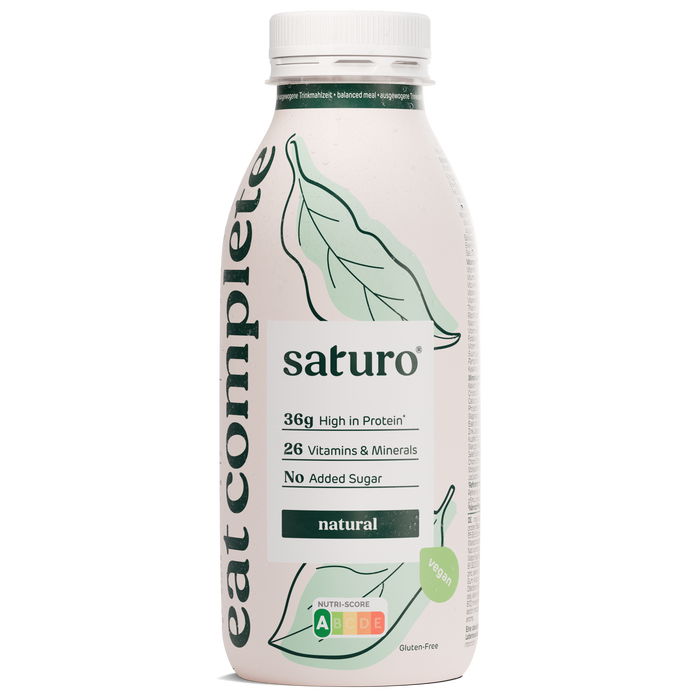
Sometimes you don't even have 20 minutes. Then a drinkable meal is the honest alternative to the takeaway: as quick as fast food, with the nutrient profile of a complete meal. One bottle of Saturo delivers 400 kcal, 36 g protein, 7 to 8 g fibre, 1 to 1.4 g sugar and 0.9 to 1.3 g salt. For comparison: a döner has 4 g of sugar and 2.2 g of salt, and a burger meal with cola has over 60 g of sugar.

Woman drinking a Saturo drinkable meal from the bottle in the office
When the delivery app would otherwise win: 400 kcal, 36 g protein and one gram of sugar, drunk in two minutes.
On protein, the döner leads with 39 g, and that's part of the honest picture. By NOVA, a drinkable meal is group 4; chapter 5 explains why that alone says nothing about quality. What legally makes a meal replacement is covered in its own article.

Ready-to-Drink 6 x 400 ml
From the Saturo range

Drinkable meal: as quick as fast food, as complete as a proper meal

400 kcal, 36 g plant-based protein, 26 vitamins and minerals, fibre from chicory. Low in sugar, low in salt, no takeaway needed. For days when the delivery app would otherwise win.

400kcal
36 gProtein
26Vitamins & minerals
1.0 gSugar per bottlelow sugar, 0.2 g per 100 ml
Choose a flavour
€4,39per meal
Drinkable meal · Natural€4,39 per meal ·
08 Look up

Common questions about junk food

Is pizza junk food?

It depends on the pizza. A margherita from a pizzeria delivers 833 kcal, 27 g protein and 2.4 g salt: lots of energy, but nutrients too, and only NOVA group 3. Frozen pizza with imitation cheese is ultra-processed, and a salami pizza has 18 g of saturated fat. A whole pizza is a meal for one and a half people.

Is döner junk food?

Not really. A döner pocket with veal or beef has 620 kcal, 39 g protein and 6 g of fibre from the bread and raw veg, which makes it a complete meal. What turns it into junk food is greasy sauce, the chicken version with 5.5 g of salt, and the cola that goes with it.

What is the unhealthiest fast food?

Per portion, it's the currywurst with chips: 868 kcal, 6.4 g salt, 21.6 g sugar from the ketchup, 13 g saturated fat and little fibre. Close behind is the burger meal with cola, which reaches over 1,000 kcal and 60 g of sugar, with the sugar coming almost entirely from the drink.

What is the healthiest fast food?

Dishes with protein, vegetables and not much fried food: gyros in a pita (468 kcal, 43 g protein), falafel in flatbread (8.4 g fibre), sushi without too much soy sauce, wraps and bowls. The drink is what counts: water or sugar-free options instead of cola.

What is the lowest-calorie fast food?

Among the classics, a plain hamburger with 228 kcal, six chicken nuggets without a dip (268 kcal) or a sushi box with 252 kcal. They won't keep you full for long. For more fullness per calorie, go for gyros pita and falafel, with their protein and fibre.

Is currywurst with chips healthy?

No, but as an occasional exception it's no drama either. At 868 kcal, the portion covers a good third of your daily needs, and with 6.4 g of salt it gives you more than the DGE guideline value for the whole day. Better: currywurst with a bread roll instead of chips, or oven chips with quark.

Is gyros or döner healthier?

In a pita there's little between them: gyros pita 468 kcal and 43 g protein, döner pocket 620 kcal and 39 g protein, both with around 2.2 g of salt. The difference is in the format: the gyros plate with chips and tzatziki comes to 944 kcal, double the pita.

Which vitamin is missing when you have cravings?

None that's been proven. There's no evidence that a craving for sweet things points to a chromium or magnesium deficiency. Proven triggers are lack of sleep, stress, skipped meals and food bans. If you feel permanently tired despite eating well, get your blood levels checked instead of trying to interpret cravings.

Sources · 53 sources anzeigen
  1. Duden online: Junkfood. Bibliographisches Institut, accessed 14 October 2026.
  2. DWDS, Digital Dictionary of the German Language (BBAW): Junkfood. Accessed 14 October 2026.
  3. Duden online: Fast Food, Fastfood. Accessed 14 October 2026.
  4. WHO Regional Office for Europe: Nutrient profile model, second edition. Copenhagen 2023.
  5. UK Government, Department of Health and Social Care: Nutrient profiling model 2004 to 2005 (HFSS). As of January 2026.
  6. Max Rubner-Institut: Degree of food processing as a health indicator? Scientific assessment, August 2025.
  7. Monteiro C. A., Cannon G., Lawrence M., Costa Louzada M. L., Pereira Machado P.: Ultra-processed foods, diet quality, and health using the NOVA classification system. FAO, Rome 2019.
  8. Monteiro C. A. et al.: Ultra-processed foods: what they are and how to identify them. Public Health Nutrition 2019; 22(5): 936–941.
  9. Braesco V. et al.: Ultra-processed foods: how functional is the NOVA system? European Journal of Clinical Nutrition 2022; 76: 1245–1253.
  10. German Nutrition Society (DGE): How can foods be classified by their degree of processing? Press release 2023.
  11. German Nutrition Society (DGE): How do highly processed foods affect health? Press release 2023 (15th DGE Nutrition Report).
  12. German Nutrition Society (DGE): Highly processed foods: DGE conference sheds light on controversial topic. Press release 2025.
  13. Romero Ferreiro C., Lora Pablos D., Gómez de la Cámara A.: Two Dimensions of Nutritional Value: Nutri-Score and NOVA. Nutrients 2021; 13(8): 2783.
  14. Lane M. M. et al.: Ultra-processed food exposure and adverse health outcomes: umbrella review of epidemiological meta-analyses. BMJ 2024; 384: e077310.
  15. Hall K. D. et al.: Ultra-Processed Diets Cause Excess Calorie Intake and Weight Gain: An Inpatient Randomized Controlled Trial of Ad Libitum Food Intake. Cell Metabolism 2019; 30(1): 67–77.
  16. Dicken S. J. et al.: Ultraprocessed or minimally processed diets following healthy dietary guidelines on weight and cardiometabolic health: a randomized, crossover trial. Nature Medicine 2025; 31: 3297–3308.
  17. Srour B. et al.: Ultra-processed food intake and risk of cardiovascular disease: prospective cohort study (NutriNet-Santé). BMJ 2019; 365: l1451.
  18. Kechagias S. et al.: Fast-food-based hyper-alimentation can induce rapid and profound elevation of serum alanine aminotransferase in healthy subjects. Gut 2008; 57(5): 649–654.
  19. Edwin Thanarajah S. et al.: Habitual daily intake of a sweet and fatty snack modulates reward processing in humans. Cell Metabolism 2023; 35(4): 571–584.
  20. Fazzino T. L., Rohde K., Sullivan D. K.: Hyper-Palatable Foods: Development of a Quantitative Definition and Application to the US Food System Database. Obesity 2019; 27(11): 1761–1768.
  21. Gearhardt A. N. et al.: Social, clinical, and policy implications of ultra-processed food addiction. BMJ 2023; 383: e075354.
  22. Praxedes D. R. S. et al.: Prevalence of food addiction determined by the Yale Food Addiction Scale and associated factors: A systematic review with meta-analysis. European Eating Disorders Review 2022; 30(2): 85–95.
  23. Hebebrand J. et al.: “Eating addiction”, rather than “food addiction”, better captures addictive-like eating behavior. Neuroscience & Biobehavioral Reviews 2014; 47: 295–306.
  • Westwater M. L., Fletcher P. C., Ziauddeen H.: Sugar addiction: the state of the science. European Journal of Nutrition 2016; 55(Suppl 2): 55–69.
  • Gearhardt A. N., Schulte E. M.: Is Food Addictive? A Review of the Science. Annual Review of Nutrition 2021; 41: 387–410.
  • Spiegel K., Tasali E., Penev P., Van Cauter E.: Sleep curtailment in healthy young men is associated with decreased leptin levels, elevated ghrelin levels, and increased hunger and appetite. Annals of Internal Medicine 2004; 141(11): 846–850.
  • Nedeltcheva A. V. et al.: Sleep curtailment is accompanied by increased intake of calories from snacks. American Journal of Clinical Nutrition 2009; 89(1): 126–133.
  • Epel E., Lapidus R., McEwen B., Brownell K.: Stress may add bite to appetite in women: a laboratory study of stress-induced cortisol and eating behavior. Psychoneuroendocrinology 2001; 26(1): 37–49.
  • Polivy J., Coleman J., Herman C. P.: The effect of deprivation on food cravings and eating behavior in restrained and unrestrained eaters. International Journal of Eating Disorders 2005; 38(4): 301–309.
  • Leidy H. J. et al.: The role of protein in weight loss and maintenance. American Journal of Clinical Nutrition 2015; 101(6): 1320S–1329S.
  • Wanders A. J. et al.: Effects of dietary fibre on subjective appetite, energy intake and body weight: a systematic review of randomized controlled trials. Obesity Reviews 2011; 12(9): 724–739.
  • Leidy H. J., Campbell W. W.: The effect of eating frequency on appetite control and food intake: brief synopsis of controlled feeding studies. Journal of Nutrition 2011; 141(1): 154–157.
  • Skorka-Brown J., Andrade J., May J.: Playing “Tetris” reduces the strength, frequency and vividness of naturally occurring cravings. Appetite 2014; 76: 161–165.
  • Alberts H. J., Mulkens S., Smeets M., Thewissen R.: Coping with food cravings. Investigating the potential of a mindfulness-based intervention. Appetite 2010; 55(1): 160–163.
  • Hollands G. J. et al.: Altering the availability or proximity of food, alcohol, and tobacco products to change their selection and consumption. Cochrane Database of Systematic Reviews 2019; 9: CD012573.
  • diabinfo.de (diabetes information portal): Wie erkenne ich eine Unterzuckerung? Accessed 14 October 2026.
  • World Health Organization (WHO): Guideline: Sugars intake for adults and children. Geneva 2015.
  • World Health Organization (WHO): Fact sheet Sodium reduction. As of May 2026.
  • Deutsche Gesellschaft für Ernährung (DGE): Ausgewählte Fragen und Antworten zu Speisesalz. Accessed 14 October 2026.
  • Deutsche Gesellschaft für Ernährung (DGE): Referenzwerte für die Nährstoffzufuhr, Ballaststoffe. Accessed 14 October 2026.
  • Commission Regulation (EU) 2019/649 of 24 April 2019 amending Annex III to Regulation (EC) No 1925/2006 as regards trans fatty acids.
  • World Health Organization (WHO): Saturated fatty acid and trans-fatty acid intake for adults and children: WHO guideline. Geneva 2023.
  • Deutsche Gesellschaft für Ernährung (DGE): Süßes, Salziges und Fettiges – besser stehen lassen. DGE recommendations, accessed 14 October 2026.
  • Pereira M. A. et al.: Fast-food habits, weight gain, and insulin resistance (the CARDIA study): 15-year prospective analysis. The Lancet 2005; 365(9453): 36–42.
  • Murray S. B. et al.: Cheat meals: A benign or ominous variant of binge eating behavior? Appetite 2018; 130: 274–278.
  • Smith C. F., Williamson D. A., Bray G. A., Ryan D. H.: Flexible vs. rigid dieting strategies: relationship with adverse behavioral outcomes. Appetite 1999; 32(3): 295–305.
  • Moosburger R. et al.: Fast food consumption among 12- to 17-year-olds in Germany – Results of EsKiMo II. Journal of Health Monitoring 2020; 5(1): 3–18 (Robert Koch-Institut).
  • Bundesministerium für Landwirtschaft, Ernährung und Heimat (BMLEH): Ernährungsreport 2025 – Deutschland, wie es isst. Berlin, November 2025.
  • Bundesregierung: Zuckergetränkesteuer soll Gesundheitssystem entlasten. Approved by the cabinet, 14 October 2026.
  • Veltman C.: Super Size Me (film review). BMJ 2004; 328(7450): 1266.
  • Nicholson C.: Self-Experimenters: Filmmaker Gained Weight to Prove a Point about Portion Size. Scientific American, 11 March 2008.
  • Max Rubner-Institut: Bundeslebensmittelschlüssel (BLS) Version 4.0, 2025. Nutritional values per portion calculated from the standard recipes.
  • U.S. Department of Agriculture, Agricultural Research Service: FoodData Central, SR Legacy Release (2018). Chicken nuggets, frozen pizza, energy drink, wholegrain tortilla.
  • Gregor Aßlaber
    Gregor AßlaberAuthor · Editor, Saturo

    Has been writing for Saturo since 2019 about nutrition, nutrients and how to get good nutrition to work in practice in everyday life.

    Joerg Hauke
    Joerg HaukeFachliche Prüfung · Nutrition expert

    Hat diesen Artikel am 15. Oktober 2026 auf fachliche Richtigkeit geprüft. The content does not replace medical advice.