
Sodium deficiency: symptoms, causes and treatment
Headaches, nausea, dizziness, suddenly unsteady on your feet? A sodium deficiency almost never comes from too little salt. Usually there's too much water in the body. Which symptoms are typical, which blood value counts and why salt tablets are often the wrong move.


Aktualisiert 24 September 2026 · 16 Min. Lesezeit · 43 Quellen

The key points in 30 seconds
Below this, doctors speak of hyponatraemia. Normal is 135 to 145. It's measured in the blood. Whether it's dangerous depends less on the number than on how fast it drops.
According to the European guideline, that's how many hospital patients have a sodium value that's too low. Outside hospital it's around 5%, and from age 65 more than one in five. Most of the time it goes unnoticed.
Median based on urine measurements, women and men. The recommended maximum is 6 g. The German Nutrition Society is not aware of any sodium deficiency caused by too little salt.
Almost every sodium deficiency is a water surplus: medication, heart, liver, kidney or the hormone ADH hold on to water, or you drink more than the kidney can excrete.
Sodium deficiency symptoms: how to spot it
A sodium deficiency, medically known as hyponatraemia, means the sodium concentration in your blood has fallen below 135 mmol/l. The word is misleading: it's almost never salt that's missing, usually there's too much water. Hyponatraemia is the most common electrolyte disorder: up to 30% in hospital, around 5% outside it, and more than 20% from age 65. The symptoms start in the brain and are often put down to age, stress or an infection.
First signs: headaches, nausea, tiredness
The first signs are unspectacular: tiredness for no reason, lack of drive, dizziness when you stand up, an unsteady gait. The guideline calls nausea, confusion and headaches moderately severe, and vomiting, deep drowsiness, seizures and coma severe. How strong the symptoms are depends less on the number than on the speed: if the value falls within hours, the brain swells, and even 130 mmol/l can be dangerous. If it falls over weeks, the brain adapts, and even 125 only feels like exhaustion. The silent form is the more common one.

Sodium deficiency symptoms in women
The symptoms are the same in women and men, but the risk is higher in women: they have less body water, around 50% rather than 60%, and react more sensitively to the water hormone ADH. In a Swedish study of 159,000 people, 1.04% of women but only 0.57% of men developed a severe sodium deficiency within two years of starting a thiazide water tablet (diuretic). In pregnancy the value is naturally 3 to 5 mmol/l lower, and during labour, oxytocin combined with lots of drinking can push the value down. Women are also affected more often in marathons and on ecstasy.
Sodium deficiency symptoms: mental health
Your brain is the first to feel a sodium deficiency, which is why many symptoms look psychological: lack of drive, irritability, trouble concentrating, feeling slowed down. In older people there can also be new confusion, which is easily mistaken for dementia but goes away once the level is corrected. In a Belgian study, people with mild sodium deficiency were as slow in attention tests as people with 0.06% blood alcohol. The trigger is often a medicine prescribed for a mental health condition: if you've felt more tired and confused instead of better since starting an antidepressant, get your sodium checked.
New confusion, unsteadiness or a fall in older age, or a headache with nausea after a new medicine, a long run or drinking a lot: get your sodium checked promptly. Call 112 for seizures, loss of consciousness, vomiting with confusion or deep drowsiness.
Salt deficiency symptoms: is salt deficiency the same as sodium deficiency?
Almost: salt is sodium plus chloride, 1 g of sodium is found in 2.5 g of salt, and anyone googling “salt deficiency” means sodium deficiency, with the same symptoms. A salt shortage on your plate practically doesn't happen in Germany: the German Nutrition Society (DGE) describes sodium deficiency from low intake as “not known”, and according to urine measurements, men eat a median of 10 g of salt a day and women 8.4 g, while the recommended maximum is 6 g. If your sodium level is low, it's almost never because too little salt went in, but because there was too much water, or because salt and water were lost together.
Low sodium causes: where the deficiency comes from
There are three routes to sodium deficiency, and none of them goes via the salt shaker. First, too much water, which your kidneys can't get rid of fast enough. Second, salt and water are lost together, through vomiting, diarrhoea, sweating or water tablets, and only water goes back in. Third, hormones and organs hold on to water: heart failure, liver cirrhosis, kidney failure or SIADH. Either way, the balance between salt and water tips. How much sodium you need is almost beside the point.
Too much water: dilution
Your kidneys can manage roughly one litre of water per hour, no more. If you drink several litres in a short time, you overwhelm them. The same happens when you eat almost nothing: to get rid of one litre, your kidneys need 50 to 100 mmol of dissolved particles, mainly from protein and salt. If you live on tea and toast for days, or on beer, your body holds on to the water. The most common case, though, is ADH: if the water hormone keeps flowing even though there's enough water, every glass dilutes your level further, for example after operations or while taking certain medicines.
Water intoxication: how much water is too much?
There's no fixed limit. Anything beyond about one litre per hour builds up: four litres spread over the day is no problem for healthy kidneys, but four litres in two hours is. Deaths have been documented after drinking contests and in cases of pathological thirst. In infants, small amounts are enough, such as diluted milk or plain water: in a study of babies under six months with an unexplained seizure, sodium deficiency was the cause in 70% of cases.
Salt and water loss: vomiting, diarrhoea, sweating, sport
The second route: your body loses salt. With vomiting and diarrhoea, sodium and water are lost together, so the concentration initially stays normal. The deficiency only develops when just water goes back in: the loss of volume triggers the release of ADH and your level drops. That's why, with stomach bugs, the rule is: electrolyte solution instead of just water (chapter 6). Sweat contains 10 to 180 mmol of sodium per litre, and food easily covers normal losses. In hours of endurance sport, sweating isn't the problem, overdrinking is: if you reach the finish of a marathon with sodium deficiency, you drank more than you lost.
Sodium deficiency from medicines: thiazides, antidepressants, antiepileptics
Medicines are the most common cause. First on the list are thiazide water tablets such as hydrochlorothiazide for high blood pressure: after two years, just under 9% of new starters have a level below 135, and symptomatic cases appear on average 19 days after starting. Second are antidepressants: among people over 65, 8% on SSRIs or SNRIs develop a sodium deficiency, usually in weeks two to four. Carbamazepine and oxcarbazepine lower the level in 26% and 46% of people treated respectively. Other candidates: ibuprofen, tramadol, proton pump inhibitors, chemotherapy drugs, desmopressin and ecstasy.
Hormones and organs: SIADH, heart, liver, kidney, adrenal gland
The third route runs via the water hormone. In SIADH, ADH keeps flowing even though the body doesn't need to hold on to water; according to the Drug Commission of the German Medical Profession, it is the most common cause. Triggers include medications, lung and brain conditions, operations and tumours, above all small-cell lung cancer. In heart failure and liver cirrhosis, the body retains water, yet the circulation still reports "too little volume": ADH rises and the sodium gets diluted. In kidney failure, the kidney can no longer dilute urine. In adrenal insufficiency (Addison's disease), the salt hormone aldosterone is missing, the kidney loses sodium, and high potassium is often the first clue.
How your body keeps sodium in balance
Three stops from the salt shaker to the brain. Once you know them, you'll understand why the blood value is a ratio and not a store, why the kidney plays the main role and why a fast drop is more dangerous than a low one.
A ratio, not a store
Your body holds roughly 1.3 to 1.5 g of sodium per kilo, around 100 g at 70 kg, much of it in your bones, skin and muscles. The blood only keeps the concentration constant: 135 to 145 mmol per litre. So the value doesn't tell you how much sodium you have, but how much water sits alongside it. And the kidney saves sodium when little comes in: in healthy people, a deficiency caused by diet doesn't happen.
ADH and the kidney
What's controlled isn't the salt, it's the water. Sensors in the brain measure the concentration and regulate thirst and the hormone ADH, which makes the kidney conserve water. If the blood is too dilute, ADH drops and the kidney excretes water, roughly a litre per hour. To do that it needs 50 to 100 mmol of dissolved particles per litre, mainly urea from protein, plus salts. If you drink a lot and eat little, you don't have enough of them. And if ADH keeps flowing for no good reason, after surgery, on certain medication, in SIADH, the kidney holds on to water no matter how much you drink.
The brain and time
If sodium falls quickly, water flows into the brain cells and the brain swells inside the rigid skull: headache, nausea, seizure. If it falls slowly, the brain moves some of its own particles out of the cells within 24 to 48 hours and adapts. That's why the 48-hour line between acute and chronic matters so much. The price of that adaptation: if a chronically low value is raised too fast, by more than 8 to 10 mmol/l a day, the protective sheath around the nerves is damaged. That's why doctors treat it slowly, and why taking salt tablets on your own is not a good idea.
Sodium level: how low sodium is diagnosed
The sodium level is measured from blood serum. Normal is 135 to 145 mmol/l. How urgent a lower value is depends on two questions: Are there symptoms, especially from the brain? And how fast did it drop? 128 for months on a water tablet is something different from 128 after a marathon. The guideline distinguishes three levels by the number, and also separates acute (under 48 hours) from chronic: acute is more dangerous, chronic is more insidious.
The three levels of low sodium
-
1
Mild130–135 mmol/l
The most common finding, often with no noticeable symptoms. Still not harmless: even at this level, the risk of falls and fractures goes up. Find the cause, review medications, look at how much you drink and eat. No treatment just to raise the number.
-
2
Moderate125–129 mmol/l
Nausea, headache, confusion and unsteadiness on your feet are likely. Needs medical treatment, usually with a fluid limit and treatment of the cause; with clear symptoms, a single saline infusion in hospital.
-
3
Severe< 125 mmol/l
Vomiting, deep drowsiness, seizures and coma are possible. An emergency: treatment in hospital with hypertonic saline under close monitoring, slowly, because correcting too fast damages the brain.
Classification based on the European guideline (Spasovski et al. 2014) and the Austrian consensus recommendation 2024. With a seizure, vomiting or impaired consciousness, the symptom counts, not the level. Some labs set their own reference ranges; if so, the ones on your report apply.
Sodium level 133 or 130: what does it mean?
133 is where most results fall: not an emergency, but a result that gets followed up. From 129 downwards, the guideline speaks of a moderate deficiency, which gets treated. Every lab knows two pitfalls: pseudohyponatraemia, where very high blood fats or proteins make the value look too low, and blood sugar, which pulls water out of the cells into the blood; for every 100 mg/dl of glucose above 100, doctors add 2.4 mmol/l. That's why the serum osmolality is measured: only below 275 is the deficiency real.
Hyponatraemia: the three forms
Same blood value, three different situations: the lab tells them apart by urine osmolality, urine sodium and volume status, and the treatment is different for each.
| Too little volume (hypovolaemic) | Normal volume (euvolaemic) | Too much volume (hypervolaemic) | |
|---|---|---|---|
| What happens | Salt and water are lost, only water is replaced | ADH holds on to water even though there's enough | Body retains water, yet circulation still reports a shortage |
| Typical causes | Vomiting, diarrhoea, thiazides, adrenal insufficiency, sweating | SIADH from medications, lungs, brain, tumour, surgery; drinking too much | Heart failure, liver cirrhosis, kidney failure |
| What it looks like | Dry mucous membranes, low blood pressure, dizziness on standing | Unremarkable, no swelling | Swollen legs, fluid in the abdomen, shortness of breath |
| Urine sodium | under 30 mmol/l (kidney conserving), higher with diuretics | over 30 mmol/l | under 30 mmol/l |
| First step | Replace salt and water, saline infusion | Limit fluid intake, stop the trigger | Treat the underlying condition, limit fluid intake |
| What would be wrong | Drinking only water | Eating salt, drinking more | Eating salt, salt tablets |
Based on the 2014 European guideline and the 2016 Drug Commission of the German Medical Profession. Because volume status is hard to judge even for doctors, urine osmolality and urine sodium help decide; along with cortisol, TSH, potassium and the medication list.
Low sodium test: who should get their level checked
Sodium is measured with almost every blood draw, and specifically in three situations. After starting a medication: after a thiazide water tablet, a check after one to two weeks; with antidepressants and carbamazepine, the risk is highest in weeks two to four. With new symptoms in older age: confusion, unsteadiness, falls and tiredness are too often written off as normal ageing. With conditions of the heart, liver, kidney, lung or tumours. There's no home test, and urine strips don't measure a serum value. Bring your medication list to the appointment, including combination products for high blood pressure; and no salt tablets beforehand on a hunch.

Correcting sodium deficiency: what really helps
Treatment has two parts: remove the cause and carefully bring the level back into the normal range. With a mild, chronic deficiency and no symptoms, the guideline doesn't recommend treatment just to raise the number, but instead: stop the trigger, treat the underlying condition. With dilution and SIADH, that means limiting fluid intake, usually to under a litre a day, which is enough in 59% of cases. With loss, the body gets salt and water back.
-
Hour 0
Measure, assess, find the cause
Sodium, osmolality in blood and urine, urinary sodium, medication list. Acute or chronic? For severe symptoms, hypertonic saline straight away under monitoring, target plus 5 mmol/l in the first hour.
-
Days 1–3
Raise it slowly
No more than 10 mmol/l in the first 24 hours, then at most 8 mmol/l per day until you reach 130. Check every six hours. Stop the trigger: fluid intake, thiazide, antidepressant (after talking to your doctor).
-
Weeks 1–2
Treat the cause
SIADH: keep fluid intake under one litre, and if needed use urea or salt plus a loop diuretic. Loss: replace salt and water. Heart, liver, kidney: get the underlying condition under control. Recheck the level.
-
Afterwards
Maintain and monitor
If you take medication long term, have your sodium measured at every blood test. Drink to thirst and eat regularly. From 70, know your level. With SIADH caused by a tumour or a lung condition, treatment lasts as long as the cause does.
What helps quickly with sodium deficiency?
With severe symptoms (vomiting, seizure, deep drowsiness, coma), only one thing helps quickly: an infusion of 3% hypertonic saline in hospital until the level has risen by 5 mmol/l. In all other cases, what helps quickly is mostly not doing the wrong thing: don't keep drinking litres if you're diluted, don't load up on salt if your heart or liver is holding on to water, and pause the triggering medication after talking to your doctor. With a genuine loss, an electrolyte solution or broth helps within hours. Salt tablets off the shelf don't help when the cause is unknown, and with SIADH they usually make the deficiency worse.
With a low sodium level, the first question isn't what you should eat, but where the water is coming from. If you don't clear that up and just add salt, you'll make it worse in most cases.
Joerg Hauke, Nutrition expert, expert review of this article
Sodium deficiency tablets: salt tablets, electrolytes, tolvaptan
There's no tablet you can simply take for sodium deficiency. Salt tablets are an option for the loss type and some cases of SIADH, but then they're prescribed and monitored; with dilution, heart failure and liver cirrhosis they make things worse. Effervescent electrolyte tablets provide a few hundred milligrams of sodium and lots of water, and for diarrhoea the WHO solution is better. Tolvaptan blocks ADH in the kidney, is approved in the EU only for SIADH and is started in hospital because the level can rise too fast. The guideline relies on fluid restriction and urea instead.
How long does it take to correct a sodium deficiency?
At least days, because the pace is limited: going from 120 to 135 takes two to three days, as only 8 to 10 mmol/l per day is allowed. After stopping a water tablet (diuretic), the level recovers in days to weeks, and with urea or tolvaptan over two to seven days. A fluid restriction for SIADH often takes longer. If the cause remains, such as a tumour, heart failure or a medication with no alternative, the deficiency isn't corrected but managed: a stable level around 130, regular checks, a fixed amount of fluid.
Three things not to do with a low level: take salt tablets or electrolyte supplements without knowing the type; cut your fluid intake drastically while you're vomiting or have diarrhoea; stop a medication on your own. Any one of them can turn a mild deficiency into an emergency.
What to eat with sodium deficiency: sodium in food
The most important rule comes before any food: cause first, plate second. With dilution, SIADH, heart failure and liver cirrhosis, more salt does harm, because your body is already holding on to too much water. More sodium is only right if salt has actually been lost: after vomiting and diarrhoea, with adrenal insufficiency, or on medical advice. And sodium is hardly ever found in unprocessed foods: around 90% comes from table salt, mostly via processed products.
Sodium per 100 g: top 10 plant-based and animal-based
Values per 100 g, USDA FoodData Central SR Legacy. None of these foods is naturally high in sodium; everything except chard is salted or fermented. Concentrates are deliberately left out: table salt 38,758 mg, stock cubes 24,000 mg, soy sauce 5,493 mg.
Which fruit and vegetables contain sodium?
Hardly any. Celery (80 mg per 100 g), beetroot (78 mg), cooked chard and spinach (70 to 180 mg) and artichokes (60 mg) are the vegetables highest in sodium, and even they give you only a fraction of what a slice of bread does per portion. Fruit sits at 1 to 5 mg per 100 g. What fruit and vegetables do give you is potassium, sodium's counterpart, and with the dilution type that's no disadvantage: there, treatment means less water and more solid food with protein.

What should you drink with sodium deficiency?
It depends on the type. With dilution, SIADH, and heart and liver failure, the answer is: less, usually under a litre a day. With a genuine loss, the opposite of “just water” applies: an electrolyte solution from the pharmacy made to the WHO recipe replaces sodium and water in the right ratio; as a home remedy, IQWiG suggests four teaspoons of sugar, three-quarters of a teaspoon of salt and a glass of orange juice per litre of water. A cup of broth provides around 650 mg of sodium. Mineral water may be labelled “contains sodium” from 200 mg per litre, while tap water contains 200 mg at most.
is the most sodium tap water may contain, and low-sodium mineral water has under 20 mg. For loss after diarrhoea, it replaces the water but not the salt, and dilutes the level further
Broth made from stock cubes provides sodium. After a genuine loss, a cup of it plus an electrolyte solution replaces salt and water together, just as they were lost.
What should you avoid eating with sodium deficiency?
There are no forbidden foods, but there are three patterns that make a deficiency worse. Drinking without eating: litres of water, tea or beer with hardly any solid food take away the dissolved particles your kidneys need to excrete water. Plain water after losses: after diarrhoea, vomiting or a long run, it dilutes your blood instead of topping it up. And salty food when you have too much water: if you have fluid retention, a heart or liver condition or SIADH, salty pretzel sticks, broth and salt tablets make the swelling worse without raising your level.
It's no free pass: 70% of women and 80% of men eat more than the recommended 6 g of salt a day, and according to EFSA, more sodium raises blood pressure. Healthy people don't need extra salt, because the kidneys conserve sodium when little comes in. If you do use salt, the DGE recommends one with iodine and fluoride.
Sodium in everyday life: drinkable meals and ready meals
Processed foods are the main source of salt: 150 g of Kasseler (smoked pork loin) brings 4 g, a slice of mixed rye bread 0.6 g. With drinkable meals that have a defined recipe, the salt content is a fixed figure: depending on the flavour, one bottle of Saturo provides 0.89 to 1.3 g of salt, which is 356 to 520 mg of sodium. More importantly, a drinkable meal is a meal with 36 g of protein, not a liquid with no substance, and that's exactly what sets it apart from the tea-and-toast pattern. It's no substitute for treatment: if you have heart, liver or kidney failure, it counts towards your agreed fluid allowance too.
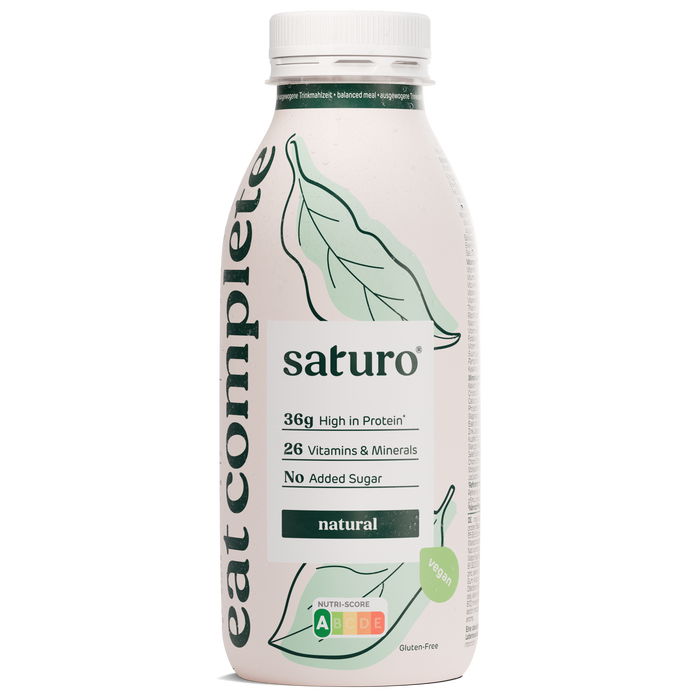
Drinkable meal: a complete meal in a bottle
400 kcal, 36 g protein and 26 vitamins and minerals, including potassium, magnesium and calcium. Salt per bottle is 0.89 to 1.3 g depending on flavour (15 to 22% of the 6 g reference amount). For days when cooking isn't on the agenda.
In older age, during sport, with heart and liver conditions: who needs to take extra care
Sodium deficiency in older age: what to do?
In older age, all the causes come together: the kidneys excrete water less well, ADH rises, and on top of that come a thiazide for blood pressure, the antidepressant, a poor appetite and the advice to drink plenty. More than one in five people over 65 has a level below 135, and in care homes one in two has at least one episode a year. What to do: if there's new confusion, a fall or tiredness, ask for the sodium level to be checked and get the right amount to drink clarified. The specialist society ESPEN recommends 1.6 litres a day for older women and 2 litres for men; with thiazides, SSRIs or SIADH, your doctor decides.
Sport and sweating: drink to thirst
Sodium deficiency in a marathon doesn't come from sweating but from drinking beyond thirst, mostly in runners who are out for more than four hours and drink at every station. In ultramarathons the share is higher, and deaths are documented. Sports drinks change little: sodium in the drink doesn't prevent exercise-associated hyponatraemia if you overdrink. The international consensus is drink to thirst, not to a schedule. If you have a headache, nausea and confusion after a long run and you've gained weight, you belong in the first-aid tent, not at the water station.

Long-term effects of sodium deficiency: what happens if it persists
Even a mild deficiency without symptoms isn't harmless, and the guideline has dropped the “asymptomatic” category. Falls and fractures: in the Rotterdam Study of over 5,000 people aged 55 and over, the 7.7% with a mild deficiency fell more often and had a 39% higher risk of fractures. Osteoporosis: your body draws sodium out of your bones, and in a US survey the risk of hip osteoporosis was almost three times higher. On top of that comes a higher mortality rate, already at 130 to 134. Lasting brain damage only happens with a rapid drop or a correction that's too fast.
Is sodium deficiency fatal?
An acute, severe one can be. If the level crashes within hours, the brain swells inside the rigid skull; untreated, up to half of those affected die, according to the Austrian consensus recommendation. Of 15 previously healthy women who developed a level of around 108 after routine procedures with hypotonic infusions, four died and nine were left severely damaged. Chronic deficiency doesn't kill directly, but through falls, fractures and the underlying illness. The second danger is correcting it too quickly.
If an older person becomes confused, unsteady or drowsy within days, after a new medication, an infection with vomiting or diarrhoea, or advice to drink more: get their sodium measured before anyone says “dementia”. If there's a seizure or impaired consciousness, call the emergency services on 112.
Frequently asked questions about sodium deficiency
What drains sodium from the body?
Genuine losses come from vomiting, diarrhoea, hours of heavy sweating, thiazide water tablets and adrenal insufficiency. More often, sodium isn't lost but diluted: by antidepressants and carbamazepine, heart, liver or kidney failure, SIADH, and drinking more than your kidneys can handle. A low-salt diet isn't a cause in healthy people.
What are the symptoms of sodium deficiency in older people?
Mostly the ones that get put down to normal ageing: tiredness, lack of drive, unsteadiness, falls, trouble concentrating and new confusion that's easily mistaken for dementia. More than one in five people over 65 has a level below 135 mmol/l, mostly because of water tablets, antidepressants or drinking too much.
Which tumour causes sodium deficiency?
The best known is small-cell lung cancer, which produces the water hormone ADH and triggers SIADH. Tumours of the mouth, throat, stomach, pancreas, bladder and prostate, lymphomas and chemotherapy drugs such as cyclophosphamide have also been described. For the vast majority of people affected, the cause is a medication, an infection or a known organ condition.
Does sodium deficiency cause water retention?
Not the deficiency itself, but its cause. With heart failure, liver cirrhosis and kidney failure, the body retains water and the sodium gets diluted. With SIADH and dilution from drinking too much, there's no swelling. If you have swelling plus a low value, more salt is the wrong approach.
Can sodium deficiency cause an urge to urinate?
Not directly: the deficiency itself makes you tired, queasy and unsteady. The urge to urinate comes from the causes. Water tablets make you pass more urine and lower your sodium. If you drink a lot, you need to go often and your blood gets diluted. High blood sugar also makes you need to go and pushes the value down.
At what level does sodium become dangerous?
The guideline distinguishes between mild (130 to 135 mmol/l), moderate (125 to 129) and severe (below 125). But what makes it dangerous is less the number than the speed and the symptoms. A drop to 130 within hours can make the brain swell, while 125 after weeks often just makes you tired.
What is blood pressure like with sodium deficiency?
It depends on the type. With real salt and water loss after vomiting, diarrhoea or adrenal insufficiency, blood pressure is low. With SIADH it's normal. With heart failure and liver cirrhosis, the body is overloaded with water, yet blood pressure is often still low. Many people affected have high blood pressure, because the thiazide they take for it triggers the deficiency.
Is 4 litres of water a day too much?
Spread over the day, it's not a problem for healthy kidneys, which can excrete up to a litre per hour. Four litres in one to two hours is the problem, because then water builds up. It's also riskier if you're eating little, taking medication that makes you retain water, have heart or kidney failure, and for infants.
Sources · 43 sources anzeigen
- Spasovski G., Vanholder R., Allolio B. et al. (Hyponatraemia Guideline Development Group): Clinical practice guideline on diagnosis and treatment of hyponatraemia. European Journal of Endocrinology 2014; 170(3): G1–G47.
- Schwarz C., Lindner G., Windpessl M., Knechtelsdorfer M., Saemann M. D.: Consensus recommendations on the diagnosis and treatment of hyponatraemia from the Austrian Society for Nephrology 2024. Wiener klinische Wochenschrift 2024; 136(Suppl 1): 1–33.
- Adrogué H. J., Tucker B. M., Madias N. E.: Diagnosis and Management of Hyponatremia: A Review. JAMA 2022; 328(3): 280–291.
- Hoorn E. J., Zietse R.: Diagnosis and Treatment of Hyponatremia: Compilation of the Guidelines. Journal of the American Society of Nephrology 2017; 28(5): 1340–1349.
- Bullmann C.: Hyponatriämie. Arzneiverordnung in der Praxis (Arzneimittelkommission der deutschen Ärzteschaft) 2016; 43(4): 188–194.
- Waikar S. S., Mount D. B., Curhan G. C.: Mortality after hospitalization with mild, moderate, and severe hyponatremia. American Journal of Medicine 2009; 122(9): 857–865.
- Mohan S., Gu S., Parikh A., Radhakrishnan J.: Prevalence of hyponatremia and association with mortality: results from NHANES. American Journal of Medicine 2013; 126(12): 1127–1137.
- Miller M., Morley J. E., Rubenstein L. Z.: Hyponatremia in a nursing home population. Journal of the American Geriatrics Society 1995; 43(12): 1410–1413.
- Bergh Fahlén C., Falhammar H., Skov J., Lindh J. D., Mannheimer B.: Thiazides and Risk of Hyponatremia by Age and Sex. JAMA Network Open 2026.
- Barber J., McKeever T. M., McDowell S. E. et al.: A systematic review and meta-analysis of thiazide-induced hyponatraemia: time to reconsider electrolyte monitoring regimens after thiazide initiation? British Journal of Clinical Pharmacology 2015; 79(4): 566–577.
- Zhang Y., Zhang J., Jing R.: Risk of antidepressant-induced hyponatremia in geriatric patients: a systematic review and meta-analysis. BMC Geriatrics 2026.
- Berghuis B., van der Palen J., de Haan G. J. et al.: Carbamazepine- and oxcarbazepine-induced hyponatremia in people with epilepsy. Epilepsia 2017; 58(7): 1227–1233.
- van Dijken G. D., Blom R. E., Hené R. J., Boer W. H.: High incidence of mild hyponatraemia in females using ecstasy at a rave party. Nephrology Dialysis Transplantation 2013; 28(9): 2277–2283.
- Almond C. S., Shin A. Y., Fortescue E. B. et al.: Hyponatremia among runners in the Boston Marathon. New England Journal of Medicine 2005; 352(15): 1550–1556.
- Hew-Butler T., Loi V., Pani A., Rosner M. H.: Exercise-Associated Hyponatremia: 2017 Update. Frontiers in Medicine 2017; 4: 21.
- Noakes T. D., Wilson G., Gray D. A., Lambert M. I., Dennis S. C.: Peak rates of diuresis in healthy humans during oral fluid overload. South African Medical Journal 2001; 91(10): 852–857.
- Thaler S. M., Teitelbaum I., Berl T.: “Beer potomania” in non-beer drinkers: effect of low dietary solute intake. American Journal of Kidney Diseases 1998; 31(6): 1028–1031.
- Farrell D. J., Bower L.: Fatal water intoxication. Journal of Clinical Pathology 2003; 56(10): 803–804.
- Farrar H. C., Chande V. T., Fitzpatrick D. F., Shema S. J.: Hyponatremia as the cause of seizures in infants: a retrospective analysis of incidence, severity, and clinical predictors. Annals of Emergency Medicine 1995; 26(1): 42–48.
- Arieff A. I.: Hyponatremia, convulsions, respiratory arrest, and permanent brain damage after elective surgery in healthy women. New England Journal of Medicine 1986; 314(24): 1529–1535.
- Renneboog B., Musch W., Vandemergel X., Manto M. U., Decaux G.: Mild chronic hyponatremia is associated with falls, unsteadiness, and attention deficits. American Journal of Medicine 2006; 119(1): 71.e1–e8.
- Hoorn E. J., Rivadeneira F., van Meurs J. B. et al.: Mild hyponatremia as a risk factor for fractures: the Rotterdam Study. Journal of Bone and Mineral Research 2011; 26(8): 1822–1828.
- Verbalis J. G., Barsony J., Sugimura Y. et al.: Hyponatremia-induced osteoporosis. Journal of Bone and Mineral Research 2010; 25(3): 554–563.
- Gheorghiade M., Abraham W. T., Albert N. M. et al.: Relationship between admission serum sodium concentration and clinical outcomes in patients hospitalized for heart failure: an analysis from the OPTIMIZE-HF registry. European Heart Journal 2007; 28(8): 980–988.
- Angeli P., Wong F., Watson H., Ginès P. (CAPPS Investigators): Hyponatremia in cirrhosis: results of a patient population survey. Hepatology 2006; 44(6): 1535–1542.
- European Medicines Agency: Samsca (Tolvaptan), Summary of Product Characteristics (Annex I).
- Volkert D., Beck A. M., Cederholm T. et al.: ESPEN guideline on clinical nutrition and hydration in geriatrics. Clinical Nutrition 2019; 38(1): 10–47.
- German Nutrition Society (DGE): Reference values for nutrient intake, sodium. Estimated values for adequate intake, derivation 2016.
- German Nutrition Society (DGE): Selected questions and answers on sodium.
- German Nutrition Society (DGE): Selected questions and answers on table salt. As of March 2020.
- Strohm D., Boeing H., Leschik-Bonnet E. et al. for the DGE: Table salt intake in Germany, health consequences and resulting recommendations for action. Ernährungs Umschau 2016; 63(3): M146–M154.
- Johner S. A., Thamm M., Schmitz R., Remer T.: Current daily salt intake in Germany: biomarker-based analysis of the representative DEGS study. European Journal of Nutrition 2015; 54(7): 1109–1115.
- Klenow S., Mensink G. B. M. (Robert Koch Institute): Sodium intake in Germany. Journal of Health Monitoring 2016; 1(2).
- EFSA Panel on Nutrition, Novel Foods and Food Allergens (NDA): Dietary reference values for sodium. EFSA Journal 2019; 17(9): 5778.
- World Health Organization (WHO): Guideline: Sodium intake for adults and children. Geneva 2012.
- World Health Organization, UNICEF: Oral Rehydration Salts: Production of the new ORS. Geneva 2006.
- Institute for Quality and Efficiency in Health Care (IQWiG): Diarrhoea. gesundheitsinformation.de, as of 8 February 2023.
- Ordinance on natural mineral water, spring water and table water (Mineral- und Tafelwasserverordnung), Annex 6: Information on sodium content.
- Drinking Water Ordinance (TrinkwV 2023), Annex 3 Part I: Limit value for sodium 200 mg/l.
- Regulation (EU) No 1169/2011 (Food Information Regulation), Annex I No. 11 and Annex XIII: salt = sodium × 2.5, reference intake for salt 6 g.
- European Commission: EU Register of nutrition and health claims (carbohydrate-electrolyte solutions, 20 to 50 mmol/l sodium; no authorised claim for sodium).
- NDR Ratgeber Gesundheit: Sodium deficiency can cause dizziness and falls. 9 May 2022.
- U.S. Department of Agriculture, Agricultural Research Service: FoodData Central, SR Legacy Release (2018). Sodium content per 100 g.
Has been writing for Saturo since 2019 about nutrition, nutrients and how to make good nutrient supply work in everyday life.
Hat diesen Artikel am 23. September 2026 auf fachliche Richtigkeit geprüft. The content does not replace medical advice.

Potassium deficiency: symptoms, causes and treatment
Sodium's counterpart: why a potassium deficiency rarely starts on your plate, which blood value counts and why potassium therapy doesn't work without magnesium.
Weiterlesen · 16 Min

Latest from the guide
New articles, updates and tips straight to your inbox. Easy to understand, expert-reviewed, no spam.
Danke! Bitte bestätige die Anmeldung in deinem Postfach.