Bloated, sluggish digestion or unsettled after antibiotics? Your gut bacteria live on what you eat, above all fibre and variety. Which ten foods help, how to build up your gut flora and what's just marketing.
Gregor Aßlaber, Editor, Saturo
· ✓Fachlich geprüft von Joerg Hauke, Nutrition expert
Aktualisiert 15 October 2026 · 15 Min. Lesezeit · 72 Quellen
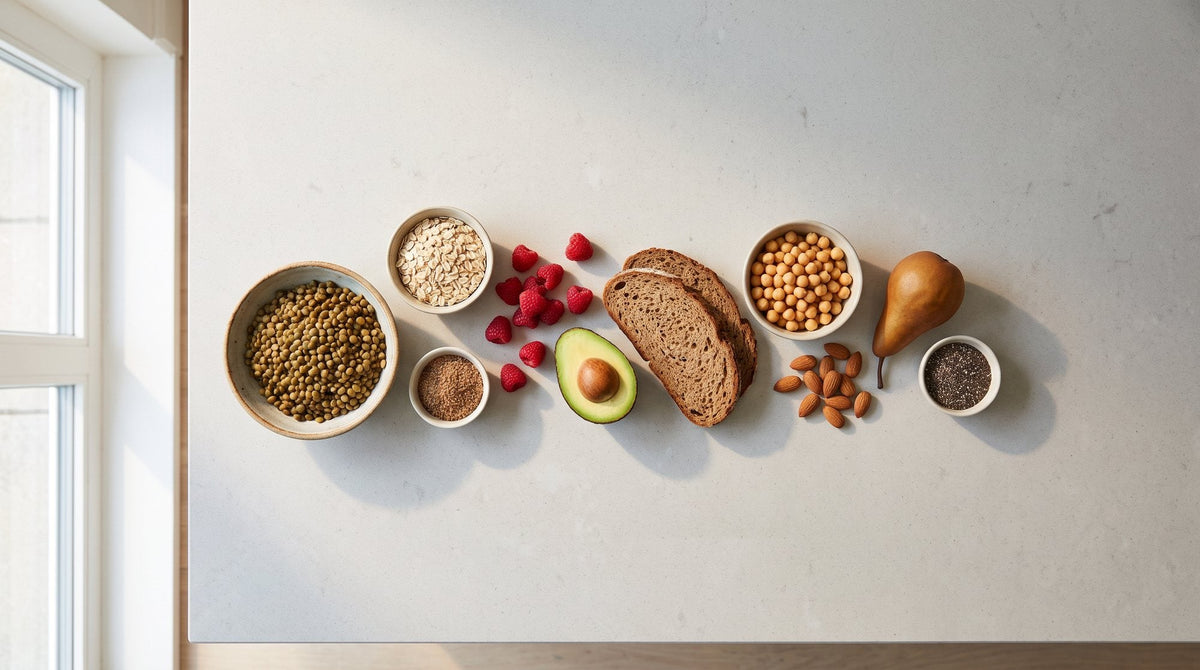
Kefir, oats, berries and raw sauerkraut: live cultures and fibre on one breakfast table.
The key points in 30 seconds
The guideline
30g fibre
That's the minimum the DGE (German Nutrition Society) recommends for adults per day. Fibre is food for your gut bacteria; it comes from wholegrain, pulses, vegetables, fruit, nuts and seeds.
The reality
18–19g a day
That's what adults in Germany eat on average; 75% of women and 66% of men fall below the guideline. This gap is the biggest lever for your gut.
Variety benchmark
30plants per week
In a large observational study, people who ate this many different plant species had the most varied gut flora. Not a limit, but a good target; the counter in chapter 4 helps.
What counts
Variety
More plant species, more bacterial species: there's no definition of a "healthy gut flora", but variety is the marker experts mention most often. Cleanses don't change that, habits do.
01 Foods
10 foods for a healthy gut
Which foods are good for your gut? The ones that feed your gut bacteria or bring live cultures with them: fibre from wholegrain, pulses, vegetables and fruit, inulin from the onion family, resistant starch from cooled potatoes and fermented foods that haven't been heated. The ten below cover all four groups, with portion and value. Not included: nuts as "probiotics" and bananas as an inulin source. Both appear on many lists and both are wrong.
At a glance
The 10 foods and what they give your gut
Fibre per typical portion according to USDA. Live cultures are only found in chilled, unheated products.
What it gives your gut
Portion
Fibre per portion
1 Kefir
Live bacteria and yeasts
1 glass (200 ml)
0 g
2 Plain yoghurt, skyr
Live cultures, if not heated
1 pot (150 g)
0 g
3 Sauerkraut, raw
Lactic acid bacteria plus fibre
2 tbsp (50 g)
1.4 g
4 Kimchi
Live cultures plus fibre
3 tbsp (50 g)
0.8 g
5 Oats
Beta-glucan, soluble fibre
30 g, dry
3.0 g
6 Linseed
Bulking and mucilage fibres
15 g (1.5 tbsp)
4.1 g
7 Lentils, cooked
Fibre, GOS, resistant starch
150 g
11.8 g
8 Jerusalem artichoke, onion, leek
Inulin (fructans)
100 g Jerusalem artichoke
1.6 g*
9 Potatoes, cooled
Resistant starch
200 g with skin
3.6 g*
10 Raspberries, apples with skin
Pectin and polyphenols
100 g raspberries
6.5 g
USDA FoodData Central SR Legacy, cooked or as eaten; sauerkraut as a canned value. *Inulin and resistant starch aren't captured by fibre analysis, which is why Jerusalem artichoke and potatoes appear lower than they are for your gut.
1. Kefir
Kefir is a fermented milk drink with bacteria and yeasts that arrive alive in the chilled, unheated product; the Codex standard requires at least 10 million cultures per gram. Whether that measurably benefits your gut flora is an open question: a systematic review of 16 studies found no reliable evidence, but no safety problems either. Go for unsweetened, one glass (200 ml) at breakfast, and count it as a source of cultures, not a miracle cure.
2. Plain yoghurt and skyr
Plain yoghurt contains live starter cultures, as long as it wasn't heated after fermentation; only then is it allowed to be called "yoghurt" under the Codex. Is skyr probiotic? It's fermented and can contain live cultures, but there's no proof of a probiotic effect, just like with any yoghurt. The only approved health claim: live yoghurt cultures improve the digestion of lactose. One pot (150 g), unsweetened, with oats and berries gives you the fibre too.
3. Sauerkraut, raw rather than from the jar
Is sauerkraut healthy? Raw, yes; from the jar, only half. Raw sauerkraut from the market or the chilled aisle brings live lactic acid bacteria and around 1.4 g of fibre per two tablespoons (50 g). Pasteurised sauerkraut from a jar or tin still has the fibre, but no longer the bacteria. Heating kills them too, so eat it cold or add it to your dish at the very end. A pilot study on irritable bowel syndrome, by the way, found both versions helpful.
Spotting live cultures
Look for chilled, with “not heat-treated” or “unpasteurised” on the label. For sauerkraut and kimchi, never take a jar off the ambient shelf. If the pack says “heat-treated after fermentation”, or the product keeps for months unrefrigerated, the cultures are dead. The table in chapter 4 shows this for 14 foods.
4. Kimchi and other lactic-fermented veg
Kimchi is lactic-fermented vegetables, usually Chinese leaf with radish, chilli and garlic, and when unpasteurised it delivers live cultures plus 0.8 g of fibre per three tablespoons (50 g). The same goes for lactic-fermented gherkins, beetroot or carrots from a fermenting jar. Pickled gherkins don't count: vegetables in vinegar and sugar are pickled, not fermented. Check the ingredients list: water, salt, vegetables, spices, nothing else.
5. Oats and wholegrains
Oats are prebiotic, not probiotic: they contain no live cultures, but they do contain beta-glucan, a soluble fibre that the bacteria in your large intestine ferment. 30 g (four tablespoons) provide 3.0 g of fibre, whether as porridge, overnight oats or stirred into yoghurt. According to an approved EU claim, oat grain fibre contributes to an increase in faecal bulk. The same principle applies to wholemeal bread, wholewheat pasta and brown rice: the whole grain instead of the pale one.
6. Linseed
Linseed swells in the gut and delivers 4.1 g of fibre per 15 g (1.5 tablespoons). In a study of 53 people with constipation, 10 g twice a day eased their symptoms. Ground, it's used better by your body; whole, it often passes through undigested. Important: drink plenty with it, and Germany's BfR (Federal Institute for Risk Assessment) advises no more than 20 g a day because of naturally occurring hydrogen cyanide and cadmium. Chia seeds work in a similar way.
Fermented doesn't automatically mean alive: only raw, unheated sauerkraut and kimchi bring the lactic acid bacteria with them.
7. Lentils, chickpeas, beans
Pulses are on every list, and rightly so: 150 g of cooked lentils provide 11.8 g of fibre, more than a third of the daily reference value, plus galacto-oligosaccharides and resistant starch as food for your bacteria. That's exactly why they make you gassy. What helps: rinse tinned ones, because some of the oligosaccharides pass into the water, and start with small portions until your gut has adjusted.
8. Onion, leek, chicory, Jerusalem artichoke: veg with inulin
Which vegetables are good for your gut? Above all, the ones with inulin. Jerusalem artichoke is 16 to 20% of this fructan, garlic 9 to 17%, onions 2 to 4%; leek, asparagus, chicory, globe artichoke and salsify belong to the same family. Inulin isn't picked up by standard fibre analyses, which is why Jerusalem artichoke ranks so low in tables. It feeds bifidobacteria and makes you gassy accordingly; build up slowly, and if your gut is sensitive, cook it rather than eating it raw.
9. Cooled potatoes and rice: resistant starch
When cooked starch cools, resistant starch forms, which the small intestine doesn't break down and which ferments in the large intestine like a fibre. In rice, the content rose to two and a half times as much after 24 hours in the fridge; according to a 2016 analysis, potatoes show the same trend, with more when cooled than hot, even after reheating. So potato salad, sushi rice and boiled potatoes in their skins from the day before aren't a worse choice, but a better one.
10. Berries and apples with the skin on
Which fruit is good for your gut? Berries and apples with the skin on. Raspberries provide 6.5 g of fibre per 100 g, more than any other common fruit; a medium apple gives you 4.4 g, mainly pectin, which bacteria use well. On top of that come polyphenols, which according to a small cocoa study may promote bifidobacteria. Bananas are well tolerated, but they supply neither inulin nor, when ripe, starch; if you're eating them for your gut, go for firm ones rather than overripe.
02 Basics
Gut health: what makes a healthy gut
Gut health is more than regular bowel movements. It usually means the interplay of the gut wall, immune cells and the trillions of microorganisms in the large intestine, known as the gut flora or microbiome. Both terms mean the same thing: all the bacteria, fungi and viruses that live there. What exactly “healthy” means is less clear than guides and test providers claim.
What is the gut microbiome?
The gut microbiome is the community of all the microorganisms in your gut, up to 1,000 species of bacteria, most of them in the large intestine. For a long time we were told they outnumber our body cells ten to one; a 2016 recalculation arrives at roughly equal numbers. They break down what we can't digest, produce vitamins such as vitamin K2 and train our defences: a large part of the immune system sits in the tissue of the gut wall.
What a healthy gut flora is, research can't yet define. There's no standard value and no list of the right bacteria; healthy people share only about a third of their microbial genes. The marker usually used is diversity: lots of different species keeping each other in check. What is well established is that a plant-based, high-fibre diet with a wide variety of foods goes hand in hand with more diversity in the gut. Whether the gut flora also influences mood and the brain, the gut-brain axis, is an active field of research, mostly with animal data. “Happiness hormone from the gut” is marketing: around 90% of serotonin is indeed made in the gut, but there it controls gut movement, not your mood.
Variety on your plate, variety in your gut: every plant species feeds different bacteria, and it's the best-supported marker we have.
03 Understand
From plate to colon: what your bacteria make of fibre
Three stages that explain why fibre shows up in every chapter of this article and what "food for gut bacteria" actually means.
1
Undigested into the colon
Fibre is plant material that our enzymes can't break down: cellulose, pectin, beta-glucan, inulin, resistant starch. It passes through the stomach and small intestine almost unchanged and arrives in the large intestine, where the bacteria are waiting. What doesn't arrive there can't feed them: white flour, sugar and fat have long since been absorbed in the small intestine.
2
The bacteria ferment
In the colon, bacteria break down the fibres by fermentation. Which species grow depends on the food: inulin feeds bifidobacteria, resistant starch feeds other groups, and variety on your plate means variety in your gut. A by-product is gas, which is why pulses and onions cause bloating until the community has adapted to more fibre.
3
Short-chain fatty acids
Fermentation produces acetate, propionate and butyrate. Butyrate is the main energy source for the cells of the colon, lowers the pH in the gut and influences the connections between the cells of the gut wall, the barrier. Without fibre, bacteria gnaw at the mucus layer in animal studies. These acids are the reason why "building up the gut lining" happens through your plate, not through powders.
Gut-friendly eating has three levers, and none of them is a product: enough fibre, as many different plants as possible, and regular fermented foods with live cultures. Add the habits every health insurer mentions and that still hold true: drinking 1.5 litres, moving, and leaving breaks between meals. Here's how well each one is backed up.
30 plants a week: what's behind it
The number comes from the American Gut Project, an observational study using stool samples from several thousand people. People who ate more than 30 different plant species a week had a more diverse gut flora than those who stayed at 10 or fewer, whether they were vegan or ate a mixed diet. 30 isn't a magic threshold, though. It's simply the top answer category on the questionnaire. It still works as a guide: every variety counts, including nuts, seeds, wholegrains and pulses, while herbs and spices count as a quarter point under the usual way of counting.
Interactive
How many plants are you eating this week?
Tap the plants that end up on your plate in a typical week. Each variety counts once, herbs and spices count a quarter. Two example days are preset.
30 Pts
0 Pts von 30 Pts
Nothing selected yet. Tap your way through a normal week, from breakfast to dinner. Most people land between 10 and 20 the first time they count.
Counting follows common plant-points lists: one point per plant species per week, and a quarter point for herbs, spices, garlic, coffee and dark chocolate. The study (McDonald 2018) counts plant species without a points system. 30 is a guide taken from an observational study, not a limit and not nutritional advice.
Fermented foods: which ones still have live cultures
Fermented means made by microorganisms, not containing microorganisms. Bread, beer, vinegar and soy sauce are fermented but germ-free, and jarred sauerkraut has been pasteurised. Live cultures are found in yoghurt, kefir, most cheeses, raw sauerkraut and kimchi, miso and tempeh. Even then they aren't automatically “probiotic”: the expert consensus says that requires a defined strain, in a proven amount, with a proven effect. A study from Stanford University looked at what fermented foods can do in everyday life.
Nobody eats six servings a day. The study shows the direction, not the dose. In practice, it's enough to plan in one or two fermented foods with live cultures every day, such as yoghurt or kefir in the morning and a spoonful of raw sauerkraut or kimchi with dinner. The table shows how to tell whether the cultures are still alive.
Look-up
Live cultures: yes, no, it depends
All of them are fermented, but only some contain live microorganisms. Here's how to tell in the supermarket.
Live cultures
How to tell
Natural yoghurt
Yes, if not heat-treated
Chilled aisle, cultures in the ingredients list
Skyr, quark
Depends on the product
“Live cultures” note on the packaging
Kefir
Yes, bacteria and yeasts
Chilled, unsweetened, not heated
Buttermilk, soured milk
Depends on the product
Soured with cultures, chilled
Aged cheese
Mostly yes
Not baked or heated
Sauerkraut, raw
Yes
Chilled aisle or market, “unpasteurised”
Sauerkraut from a jar or tin
No
Pasteurised, keeps unrefrigerated
Kimchi
Yes, if unpasteurised
Chilled, “live cultures” on the label
Sour pickles
Only lactic-fermented ones
No vinegar in the ingredients, chilled
Vinegar pickles
No, not fermented
Vinegar and sugar in the ingredients
Sourdough bread
No
Cultures die during baking
Kombucha
Depends on the product
Industrial products are mostly pasteurised
Miso, tempeh
Yes, when raw
Not in boiling soup or a hot pan
Apple cider vinegar
No
Vinegar is germ-free, effect not proven
Classification based on the 2021 ISAPP consensus (Box 1), the Codex standard for fermented milks, consumer advice centres, BZfE and Öko-Test. Whether the cultures survive the stomach alive isn't stated on any packaging.
How much fibre does your gut need?
At least 30 g a day is the DGE reference value for adults, confirmed in the 2025 reference values. On average, women in Germany get 18 g and men 19 g. Three quarters of women and two thirds of men fall below the reference value. A large analysis found the greatest benefit for heart health, metabolism and bowel cancer risk at 25 to 29 g. If you're building up, do it over several weeks and drink more, otherwise your gut will answer with bloating. Which foods provide how much, with a look-up table and a breakfast calculator, is in the article on fibre.
When there's no kitchen within reach, a drinkable meal with fibre helps you keep track of your 30 g a day, but it doesn't replace vegetables.
For days without a kitchen, it's worth checking the nutrition table on a drinkable meal: from 1.5 g per 100 kcal a food can call itself a source of fibre, and from 3 g per 100 kcal high in fibre. So a 400 kcal bottle should bring at least 6 g, otherwise you'll be missing in the evening what lunch would normally have given you. Whey protein shakes have 0 g.
From the Saturo range
Drinkable meal: a fibre source for on the go
Each bottle gives you 400 kcal, 36 g plant protein, 26 vitamins and minerals and, depending on the flavour, 7.3 to 7.7 g of fibre from chicory. Under EU rules that makes it a source of fibre (1.8 to 1.9 g per 100 kcal). Lactose-free, vegan, contains soy. Natural is the only flavour without sweeteners. Percentage based on the DGE reference value of 30 g per day.
36 gProtein
400kcal
26Vitamins & minerals
7.6 gFibre per bottle25% of the DGE reference value
Choose a flavour
111,50 Kčper meal
Choose a flavour
Drinkable meal · Natural111,50 Kč per meal ·
05 Avoid
What harms your gut? Foods and habits
The honest answer first: for individual foods in everyday amounts, there's hardly any proof of harm to your gut flora. Three things are well documented: antibiotics, processed meat and a lack of fibre. Everything else, from sweeteners to red wine, is a hint, not proof.
Which foods aren't good for your gut?
Processed meat tops the list: the International Agency for Research on Cancer (IARC) classes sausage, ham and bacon as carcinogenic and red meat as probably carcinogenic, in both cases with regard to bowel cancer. A Western diet with lots of meat and few plants is also linked to less variety in the gut. Sugar and highly processed products harm less through what they contain than through what they push out: fibre. Alcohol puts strain on the whole digestive tract and irritates the oesophagus, more on that under heartburn; a schnapps after a meal is not a “digestive aid”.
Sweeteners and emulsifiers are the evergreens of gut guides, but the evidence is thinner than the headlines. For sweeteners, one study of 120 healthy people found changed gut bacteria and poorer sugar processing after two weeks of saccharin or sucralose, while other studies found nothing; the DGE and BfR call the evidence “heterogeneous” and “insufficient” respectively. With the emulsifier carboxymethylcellulose, variety dropped in a trial of 16 people, but at 15 g a day, many times the usual amounts. Smoking measurably changes the composition, and alcohol has only been studied in cases of dependence. What all this means for your favourite food is in the look-up.
Interactive
Is it good for your gut?
Type in a food or filter by group. Green: provides fibre or live cultures. Yellow: neutral, individual or unclear evidence. Red: proven downside.
Bananas, ripe bananaEasy to digest, but not the fibre starBanana: 2.6 g fibre per 100 g (USDA, ripeness not specified). According to Monash, ripe bananas are high in fructans; if you have IBS, keep the portion small.
Bananas, green unripeUnripe is easier to tolerate with IBSMonash rates firm bananas as low FODMAP (1 medium = 100 g) and ripe ones as high in fructans.
Eggs hen's eggNeutral: no fibre, no irritants0 g fibre. Neither a benefit nor a drawback for gut flora is proven here; combine with vegetables.
Potatoes jacket potatoes, boiled potatoes, potato saladGood with the skin on, even better cooledBoiled with skin: 1.8 g fibre per 100 g. Cooling increases resistant starch (Raatz 2016); the DGE lists potatoes as a source of fibre.
Rolled oats oats, porridge, muesliHigh in fibre, contains beta-glucan10.1 g fibre per 100 g dry; 30 g gives you about 3 g. Oats count as a prebiotic food (AOK, Onmeda).
Cheese, matured hard cheese, Gouda, ParmesanNo fibre, cultures depend on the typeAccording to ISAPP, most cheeses contain live microorganisms; not once heated (e.g. baked on top). A probiotic effect is not proven.
Yoghurt plain yoghurtLive cultures, if not heat-treatedCodex requires viable starter cultures (min. 10^7 CFU/g), except where heat-treated after fermentation. Choose unsweetened.
SkyrFermented, cultures depend on the productThe BZfE lists skyr as a possible source of live cultures; whether the product contains them isn't reliably stated on the pack.
Quark low-fat quark, plain quarkFermented, cultures depend on the productThe BZfE lists quark as a possible source of live cultures; 0 g fibre. Combine with fruit, rolled oats or linseed.
Coffee filter coffee, espressoTolerance varies, hardly any fibreBrewed coffee provides almost no fibre. Tolerance is individual; with IBS, keep an eye on the amount and how it affects you.
Sugar table sugar, sweetsIn moderation; lots of sugar is rather unhelpfulAccording to a review, high sugar intake can upset the balance of gut bacteria; the data mostly comes from animal studies.
Sweetener sweetening agents, sucralose, aspartameEffect on gut flora unclearBfR: the evidence is insufficient, microbiome data only with reservations. One intervention study found individual microbiome effects.
White bread toast, bread rolls, baguetteLow in fibreWhite bread 2.7 g/100 g (USDA), BLS wheat bread 4.0 g; wholegrain bread 6.0 and 10.0 g respectively. Fine now and then.
Wholegrain bread rye bread, black breadHigh in fibre, a base for your 30 g a dayWholegrain bread 6.0 g/100 g (USDA), wholegrain rye bread approx. 9.6 g (BLS 4.0). Often more with cracked grain and seeds.
Rice, white basmati, long-grainLow in fibre, more resistant starch when cooledCooked: 0.4 g fibre per 100 g. Cooled and reheated, resistant starch rose from 0.64 to 1.65 g/100 g.
Wholegrain rice natural rice, brown riceMore fibre than white riceCooked: 1.6 g fibre per 100 g versus 0.4 g for white rice; an easy swap as a side.
Pasta, whiteLow in fibre, interesting when cooledCooked: 1.8 g fibre per 100 g. In one study, cooling and reheating slightly lowered the blood sugar curve.
Wholegrain pastaTwice as much fibre as white pastaCooked: 3.9 g fibre per 100 g (USDA). An easy swap that noticeably boosts your fibre intake.
Meat, red beef, pork, lambNo fibre, limit the amountIARC classes red meat as probably carcinogenic (Group 2A), especially for bowel cancer. Small portions, with plenty of vegetables.
Processed meat sausage products, ham, salamiProcessed meat: higher bowel cancer riskIARC classes processed meat as carcinogenic (Group 1), above all for bowel cancer. Eat it as rarely as possible.
Fish salmon, troutNeutral for the gut0 g fibre (salmon, USDA). In the sources we checked, neither a benefit nor a drawback for the gut is proven.
Alcohol beer, spiritsStrains the digestive tract, doesn't aid digestionAlcohol affects the whole digestive tract. The AOK calls it a myth that it aids digestion.
Red wine winePolyphenols aren't a free passAlcohol strains the digestive tract regardless of the type. A gut benefit of red wine isn't proven here.
Chocolate milk chocolate, sweetsSugar and fat dominateDark chocolate contains more cocoa (70–85%: 10.9 g fibre per 100 g), but also provides sugar and lots of energy.
Pure cocoa cocoa powder, raw cocoaHigh in fibre and flavanols, unsweetenedCocoa powder: 37.0 g fibre per 100 g; 1 tbsp (5.4 g) gives you about 2 g. Small study: prebiotic effects of the flavanols.
HoneySugar, no relevant fibre0.2 g fibre per 100 g (USDA). Use sparingly like any other sugar; no proven gut benefit.
AvocadoHigh in fibre, but energy-dense6.7 g fibre per 100 g (USDA); half an avocado (approx. 100 g) gives you about 6–7 g.
Apples apple with skinPectin and polyphenols, best with the skin on2.4 g fibre per 100 g; a medium apple (182 g) gives you about 4.4 g. Pectin feeds your gut bacteria.
Citrus fruits orange, mandarin, grapefruitFine, but sometimes not ideal with heartburnOrange: 2.4 g fibre per 100 g. The AOK lists citrus fruits as a possible trigger of heartburn.
Raw veg salad, raw vegetablesHigh in fibre, tolerance variesThe MRI recommends fruit and veg both raw and cooked. If your gut is sensitive, cooked veg may be easier to tolerate.
Cabbage white cabbage, red cabbage, savoy cabbage, broccoliHigh in fibre, can cause bloatingRaw white cabbage 2.5 g, cooked broccoli 3.3 g fibre/100 g. Bloating varies from person to person; increase slowly.
Pulses lentils, beans, chickpeas, peasHigh in fibre, increase slowlyCooked lentils 7.9 g fibre/100 g. Rinse tinned pulses: according to Monash, some of the oligosaccharides pass into the liquid. Stick to small portions.
Nuts walnuts, almonds, hazelnutsFibre plus healthy fatsAlmonds 12.5 g, walnuts 6.7 g fibre/100 g. One walnut study found changes in the gut microbiota.
Chia seeds chiaVery high in fibre, eat with liquid34.4 g fibre/100 g; 15 g provides about 5 g. They swell in the gut, so drink plenty.
Flaxseed crushed, wholeSwelling agents and fibre, max. 20 g a day27.3 g fibre/100 g. In one study, 2 x 10 g a day helped with constipation. BfR: max. 20 g/day (cadmium).
Psyllium husks psylliumSoluble fibre, suggested for IBSThe ACG guideline suggests soluble fibre for IBS; the ACG patient page mentions psyllium. Increase slowly and drink plenty.
Ready meals frozen pizza, instant noodlesUsually low in fibre, highly processedA Western diet high in fat and sugar and low in fibre is linked to unfavourable changes in the microbiome.
Crisps potato crisps, snacksFine occasionally, no gut benefitHigh in fat and low in fibre; a diet of highly processed snacks doesn't fit a gut-friendly way of eating.
Soft drinks cola, lemonade, energy drinksLiquid sugar, zero fibreAOK lists sugary drinks as bad for gut health; some of the data comes from animal studies.
KombuchaLive cultures only if unpasteurisedAccording to the Verbraucherzentrale consumer advice centre, commercial kombucha is mostly pasteurised; it contains an average of 5 g sugar/100 ml. Health effects not proven.
KefirLive bacteria and yeastsFermented milk drink with cultures of bacteria and yeasts; Codex requires viable cultures. Choose unsweetened.
Sauerkraut, fresh unpasteurised, chilled sectionLive lactic acid bacteria plus fibreOnly unpasteurised sauerkraut contains live bacteria. Fibre approx. 2-3 g/100 g (USDA tinned 2.9; BLS raw 2.1).
Sauerkraut from a jar or tin pasteurisedFibre yes, live cultures noPasteurisation kills the lactic acid bacteria (Öko-Test). The 2.9 g fibre/100 g is retained.
KimchiFermented veg, unpasteurised with culturesOnly unpasteurised kimchi contains live bacteria; 1.6 g fibre/100 g (USDA). Tolerance varies.
GingerFlavouring, gut benefit not provenFresh ginger contains 2.0 g fibre/100 g, but you only eat small amounts. As a spice, it counts towards plant diversity.
TurmericSpice, gut benefit not provenAs a spice, turmeric counts towards plant diversity (1/4 point). There's no proven gut effect at usual amounts.
GarlicPrebiotic fructans, can cause bloatingAccording to a review, it contains 9-17% inulin (fresh weight). Onmeda: large amounts may cause bloating.
Onions onion, leek, shallotsRich in fructans, useful but gassyAccording to a review, 2-4% inulin; in the USA, around 25% of inulin intake. Rich in fructans, can cause bloating.
Olive oilNo fibre, a good everyday source of fat0 g fibre. A gut benefit of its own isn't proven in the sources checked; use sparingly, and it works as a swap for butter.
ButterNo fibre, saturated fat0 g fibre. Lab studies point to unfavourable effects of very high-fat diets; whether this applies to humans is still open.
Milk cow's milkFine, unless you're lactose intolerantLactose can cause bloating and diarrhoea if you're lactose intolerant (AOK). No problem if you tolerate it.
Plant drinks oat drink, soya drink, almond drinkHardly any fibre, depends on the typeSoya drink 0.6 g fibre/100 ml (USDA); almond drink approx. 0.13 g (BLS). Oat drink not checked.
Green teaNeutral, possible benefits not confirmedCatechins might support friendly gut bacteria; according to Onmeda, the research isn't finished.
Berries blueberries, raspberries, strawberriesFibre and polyphenolsRaspberries 6.5 g, blueberries 2.4 g fibre/100 g. According to AOK, polyphenol-rich fruit supports beneficial bacteria.
Spinach leafy greens, chard, rocketLots of plant compounds, few caloriesRaw spinach 2.2 g fibre/100 g; leafy greens are low in calories and easy to add to any meal.
Sweet potatoesHigher in fibre than white potatoesBaked in the skin 3.3 g fibre/100 g (USDA), boiled jacket potato 1.8 g.
QuinoaHigher in fibre than rice, gluten-freeCooked 2.8 g fibre/100 g (USDA) vs 0.4 g for white rice.
TofuSource of protein, moderate fibre2.3 g fibre/100 g (USDA). Not fermented, so no live cultures.
TempehFermented, cultures only if uncookedAccording to the ISAPP classification, tempeh contains live microorganisms; frying or boiling probably kills them.
MisoFermented, cultures depend on pasteurisationAccording to the ISAPP classification, miso contains live microorganisms; in boiling soup, probably not any more. High in salt.
Apple cider vinegar vinegarNo proven gut effectVerbraucherzentrale consumer advice centre: digestive benefit not proven. According to ISAPP, vinegar counts as a food without live microorganisms.
Pickled gherkins vinegar gherkins, brined gherkinsOnly lactic-fermented brined gherkins countAccording to ISAPP, gherkins in vinegar aren't fermented. Lactic-fermented gherkins only contain live bacteria if unpasteurised.
Sourdough breadFermented, but cultures die during bakingBread contains no live microorganisms after baking (ISAPP). Fibre content depends on the flour.
Prunes dried plumsHigh in fibre, but energy-dense7.1 g fibre/100 g (USDA); 30 g provides about 2 g. Add a few to your muesli or have them as a snack in small amounts.
ArtichokeHigh in fibre, contains inulinCooked 5.7 g fibre/100 g (USDA); Onmeda mentions inulin and bitter compounds. A medium artichoke weighs approx. 120 g.
Jerusalem artichokeRich in inulin, start with small amountsAccording to a review, 16-20% inulin (fresh weight). Inulin can cause bloating; increase slowly.
Water tap water, mineral waterFibre needs fluidAOK recommends at least 1.5 litres a day, ideally water; fibre only works with enough fluid.
Nothing found. Try a different word, like “bread” instead of “sliced bread”.
Fibre values from USDA FoodData Central SR Legacy, cooked or as eaten, and the German Nutrient Database (Bundeslebensmittelschlüssel) 4.0 where stated; classification according to DGE, ISAPP, IARC and Monash. For guidance only, not nutritional advice; if you have IBS or intolerances, different rules apply.
06 Rebuild
Rebuilding gut flora: what really helps
In practice, rebuilding your gut flora means eating differently for weeks, not buying a course of something. Its composition responds within days to what you eat, and it snaps back just as quickly when you stop; long-term patterns are what count. That applies after antibiotics, after diarrhoea and for anyone who wants to strengthen their gut flora.
Rebuilding your gut flora after antibiotics
Antibiotics hit your gut flora hard, and it usually recovers on its own. In a study using a very strong combination of three antibiotics over four days, the composition was almost back to normal after about six weeks; nine bacterial species were still missing after 180 days. Common drugs such as amoxicillin are milder, and how long recovery takes depends on the drug and on you. What definitely does no harm and fits the DGE recommendation: fibre and a variety of plants as food for the returning bacteria. There is no evidence that any particular diet measurably speeds up recovery; for babies and children, this question belongs with the paediatrician.
After the antibiotic: what happens over weeks and months
While you're taking themDiversity collapses
After just a few days, whole groups of bacteria are missing, and for some people the result is diarrhoea. In children, certain probiotics cut the risk of diarrhoea on antibiotics from 19 to 8%; for adults, the benefit is mainly proven in hospital settings. Keep eating fibre, don't pause it.
First week afterRecovery begins
The composition responds to food within days. What matters now is what reaches your gut: wholegrains, pulses, vegetables, fruit, plus fermented foods with live cultures. In one study, probiotic supplements taken after the course delayed the return of the gut's own flora instead of speeding it up.
After 1 to 2 monthsAlmost back to normal
In the study with the strongest combination, the flora was close to its starting state after about 1.5 months. If you ate plenty of fibre during that time, you gave the returning bacteria their food; there's no guarantee of getting the old picture back.
After 6 monthsWhat's gone is gone
Some species were still missing after 180 days. That's no cause for concern as long as your digestion is fine, but it is a good reason to take antibiotics only when you need them and to make variety on your plate a habit.
Probiotics: when they make sense and who should avoid them
Probiotics are live microorganisms that, in sufficient amounts, bring a proven benefit, according to the definition of the scientific society ISAPP. That's proven for only a few cases: certain strains reduce the risk of diarrhoea on antibiotics in children, and selected strains are recommended in the IBS guideline. "Rebuilding your gut flora" isn't one of them, and in the EU not a single health claim for probiotics is approved; even the word itself counts as a prohibited claim.
After antibiotics, your gut doesn't need a course of anything, it needs food: oats, lentils, vegetables, a spoonful of raw sauerkraut. The bacteria come back when they find something to eat.
Joerg Hauke, Nutrition expert, technical review of this article
Who shouldn't take probiotics? People with a weakened immune system, for example after an organ or bone marrow transplant, the seriously ill, premature babies, and nobody during an acute gastrointestinal infection; if you have an artificial heart valve or a central venous catheter, check with your doctor first. For healthy people they're considered safe; there's just no proven benefit for them, according to the consumer advice centre.
Rebuilding your gut flora with home remedies
The best home remedies are in your fridge and your store cupboard: rolled oats, linseed, lentils, onions, apples, raw sauerkraut, yoghurt, kefir, in other words chapter 1. Add the habits: drink 1.5 litres so the fibre can swell, get moving, leave gaps between meals instead of constant snacking, stop smoking. What doesn't belong here: apple cider vinegar (vinegar contains no live cultures, and an effect on digestion is not proven) and laxative salts such as Glauber's salt: they clear you out, they don't build anything up. The three recipes show what gut-friendly cooking looks like in everyday life.
One lentil stew delivers 21 g of fibre and ten plants in a single meal: more food for your gut flora than most people eat in a whole day.
Three dishes, calculated using USDA values: each provides between 13 and 21 g of fibre, at least six plants and one fermented ingredient. Together over one day that's around 50 g, well above the guideline; if you're at 18 g today, pick one of them and build up over two weeks.
Three gut-friendly dishes
1
Overnight oats with berries and walnutsBreakfast · 5 minutes plus overnight · vegetarian
13 g fibre
520 kcal
6 plants
Zutaten
50 g rolled oats
150 g natural yoghurt
10 g linseed, ground
80 g blueberries
80 g apple with skin, grated
15 g walnuts
Cinnamon
Zubereitung
Stir the oats, linseed and yoghurt together in the evening and chill overnight. In the morning, top with apple, berries, walnuts and cinnamon. The yoghurt provides the live cultures if it hasn't been heat-treated; 17 g of protein too.
2
Chickpea and quinoa bowl with sauerkrautLunch · 20 minutes · vegan
16 g fibre
510 kcal
9 plants
Zutaten
120 g quinoa, cooked
100 g chickpeas (tinned, rinsed)
60 g carrot, grated
50 g red cabbage, finely sliced
30 g spinach, 50 g cucumber
30 g raw sauerkraut
10 g pumpkin seeds
1 tbsp olive oil, parsley
Zubereitung
Cook the quinoa and let it cool, cut the vegetables raw and arrange everything in a bowl. Add the sauerkraut last, cold, so the cultures survive. Use olive oil and a little lemon as a dressing. Rinse the tinned chickpeas, as this makes them easier to digest.
3
Lentil stew with wholemeal breadEvening · 40 minutes · vegan
21 g fibre
500 kcal
10 plants
Zutaten
150 g lentils, cooked (approx. 60 g dry)
50 g onion, 1 clove of garlic
60 g leek
60 g carrot, 40 g celeriac
100 g tomato
1 tbsp olive oil
Cumin, parsley
50 g wholemeal bread
Zubereitung
Sweat the onion, garlic, leek, carrot and celeriac in oil, add the lentils and tomato, cover with water and simmer for 30 minutes. Season with cumin and sprinkle parsley over the top. Serve with a thick slice of wholemeal bread. If you're not used to pulses, start with half a portion.
Nutritional values from USDA FoodData Central SR Legacy per ingredient, cooking losses not taken into account, rounded to 10 kcal. Plants counted using the common method, with herbs and spices as a quarter point: 5.25, 8.25 and 7.75 points.
07 Check
Disrupted gut flora: symptoms, tests and gut cleanses
“Disturbed gut flora”, “dysbiosis”, “leaky gut”: these terms sound like diagnoses, but they aren’t. There is no normal range beyond which gut flora counts as disturbed, and no test that measures it reliably. What does exist are symptoms that have a cause, and warning signs that belong in front of a doctor.
How can you tell if your gut flora is disturbed?
You can’t, not reliably, and that is the answer. Bloating, changing stools, stomach pain and tiredness all occur equally with irritable bowel syndrome, intolerances, infections, stress and thyroid problems. Experts call “dysbiosis” a fuzzy concept, where it’s unclear whether altered bacteria are the cause or the result. Gut flora tests from the internet don’t help: the IBS guideline says they “should not be done”, the DGE (German Nutrition Society) advises against them, and when researchers sent the same stool sample to seven providers, the results differed as much as they would between different people. The table shows what needs to be checked by a doctor.
Warning signs
When bowel symptoms need to be checked by a doctor
Warning signs from the IBS guideline and the German Cancer Information Service. If they apply to you, nutrition is not the first step.
What could be behind it
What to do
Blood in the stool
Haemorrhoids, inflammation, polyps; visible or found in a stool test
See your GP promptly
Unintentional weight loss
Inflammation, malabsorption, tumour
Get it checked, don’t wait
Fever, high inflammation markers
Infection, chronic inflammatory bowel disease
See a doctor; quickly if the fever is high
Symptoms getting worse
Many things, but not IBS
Testing, not dieting
Anaemia
Blood loss in the gut, iron deficiency; tiredness, paleness, breathlessness
Blood count at your GP surgery
New within the last 3 months
Infection, medication, rarely more
Get it checked before you change your diet
Aged 50 or over, no symptoms
Bowel cancer screening
Stool test every two years or colonoscopy, covered by statutory health insurance
Warning signs based on the S3 guideline for irritable bowel syndrome (2021) and the German Cancer Information Service; screening since April 2025 for women and men aged 50 and over. Not a diagnosis: if none of these signs apply, that doesn’t rule out a serious cause.
Gut cleanses, gut detoxes, gut cures: what’s actually backed up
None of these is a medical term, and no method has a proven benefit. “Gut cleansing” covers laxative regimes with Glauber’s salt, bowel flushes, colon hydrotherapy, fasting days and capsule bundles. A systematic review found no reliable studies on bowel cleanses for “health promotion”, but did find reports of bowel injuries, bloody diarrhoea and electrolyte imbalances. The IGeL-Monitor, which rates self-pay medical services, gives colon hydrotherapy a negative rating. Even the medical laxative solution before a colonoscopy only upsets your gut flora temporarily; after about two weeks it’s back. Your gut cleans itself. What changes it is what you eat long term afterwards.
IBS, diverticula, IBD
People with irritable bowel syndrome, diverticular disease, ulcerative colitis or Crohn’s disease have their own medical guidelines. For IBS with bloating and diarrhoea, the guideline recommends a three-phase low-FODMAP diet with dietary counselling; a blanket “more fibre” can make symptoms worse there. This article is aimed at healthy people.
08 Reference
Common questions about gut health
The questions that appear most often on Google alongside “gut health” and “rebuilding gut flora”, answered briefly. You’ll find all the evidence in the list of sources below.
What is extremely healthy for the gut?
Not any single thing, but a pattern: plant-based, high in fibre, varied. Wholegrains, pulses, vegetables, fruit, nuts and something fermented with live cultures every day. According to the DGE, this pattern is consistently linked to greater diversity in the gut. Aim for at least 30 g of fibre a day; most people manage 18 to 19 g.
Why do cardiologists warn against probiotics?
There is no warning from cardiologists or professional bodies; the wording comes from supplier blogs. What is real are rare infections of the heart valves caused by probiotic bacteria in people at risk, for example with an artificial heart valve or a weakened immune system. For healthy people, probiotics are considered safe, it’s just that their benefit isn’t proven.
Are oats probiotic?
No, they’re prebiotic. Oats contain no live cultures, but they do contain beta-glucan, a soluble fibre that gut bacteria feed on; 30 g gives you 3 g of fibre. Live cultures come from yoghurt, kefir, raw sauerkraut and kimchi; combined with oats, that makes a breakfast that covers both.
Which cheese is good for gut flora?
According to expert consensus, matured cheese such as Gouda, Parmesan or mountain cheese usually contains live microorganisms, as long as it isn’t baked or grilled. However, there’s no proven benefit for gut flora, and cheese has no fibre. As a source of cultures, yoghurt and kefir are better backed up; cheese is an extra, not a gut remedy.
Which 3 foods are not good for the gut?
The evidence points to patterns more than individual foods: processed meat such as sausage (IARC: carcinogenic, bowel cancer), alcohol (strains the entire digestive tract) and anything that pushes out fibre: white flour, sugar, soft drinks. Sweeteners and emulsifiers are under suspicion, but the data in humans is contradictory.
How long does it take to rebuild gut flora?
There’s no fixed time. The make-up of your gut flora responds to a change in diet within days, and tips back just as quickly. After a strong combination of antibiotics, the flora was almost back to normal after about 1.5 months, though some species were still missing after six months. What counts is what you eat long term.
What’s better for the gut, quark or yoghurt?
Yoghurt, narrowly. According to the Codex, natural yoghurt must contain live starter cultures as long as it hasn’t been heat-treated. Quark is also fermented and can contain cultures, but that isn’t reliably stated on the pack. Both have 0 g of fibre; with oats, linseeds and berries, both make a gut-friendly breakfast.
What are the 6 warning signs of bowel problems?
The IBS guideline lists these warning signs: blood in the stool, unintentional weight loss, fever or signs of inflammation, anaemia, steadily worsening symptoms, and symptoms that have only been there for under three months. Any one of them belongs in front of a doctor. From 50, bowel cancer screening is covered by statutory health insurance, regardless of symptoms.