
Vitamin B12 deficiency: symptoms, causes and treatment
Tingling in your hands, forgetfulness, constantly tired? A vitamin B12 deficiency develops over years and often hits the nerves before it shows up in the blood. Which symptoms are typical, why the total B12 level alone isn't enough, when tablets are sufficient, and who needs the injection.


Aktualisiert 24 September 2026 · 16 Min. Lesezeit · 19 Quellen

The essentials in 30 seconds
DGE's estimated value for everyone aged 13 and over, 4.5 µg for pregnant women, 5.5 µg for breastfeeding women. The typical mixed diet in Germany provides more, and the deficiency usually starts in the stomach, not on the plate.
This is how many of the 65- to 93-year-olds in the KORA-Age study were below 221 pmol/l. Stomach acid decreases with age, and without it B12 can't be released from food.
That's how long reserves last if supply suddenly stops. That's why the deficiency creeps up, and why it's noticed so late.
Active B12 drops first. Below 25 pmol/l counts as a deficiency, 25 to 70 is a grey zone, and then methylmalonic acid decides. The total B12 level alone misses many cases.
Vitamin B12 deficiency symptoms: how to recognise it
Your body needs vitamin B12 in two places: in the bone marrow for new red blood cells, and in the nerves for the insulating layer around the nerve fibres. That's why a deficiency has two faces: anaemia with tiredness and paleness, and tingling, unsteadiness when walking and forgetfulness. Often the nerves are affected first; the 2024 British guideline states explicitly that a normal blood count does not rule out a B12 deficiency. The list helps you make sense of it, and the overview of vitamin deficiency covers the other vitamins.
First signs: tiredness, tingling, forgetfulness
It usually starts with an exhaustion that sleep doesn't fix: without B12, red blood cells become too large and too few, so your blood carries less oxygen. The nerve symptoms begin in the feet and hands with tingling and numbness (polyneuropathy); if the spinal cord is affected, walking becomes unsteady, especially in the dark (funicular myelosis). In the head, the deficiency shows up as forgetfulness, irritability or low mood, and in older people as confusion that looks like dementia. That's why it's so often overlooked (Mayo Clinic Proceedings): the symptoms are neurological, while the blood count looks normal.

Vitamin B12 deficiency symptoms: eyes
Blurred vision, a blind spot in the centre, paler colours: a B12 deficiency can damage the optic nerve, not the eye itself. The NICE guideline lists visual disturbances from optic nerve damage among the common signs, up to visual field loss and optic nerve atrophy. In practice this is rare and usually follows a long, severe deficiency. Dry or irritated eyes have no proven link to B12. If your vision suddenly gets worse, see an eye specialist; it's worth asking about your B12 level there if you also have tingling or unsteadiness when walking.
Vitamin B12 deficiency symptoms: tongue, skin and hair
The tongue is the symptom you can actually see: it can burn, react sensitively to sour foods and lose its papillae until it looks smooth and glossy red (Hunter's glossitis). The NICE guideline counts tongue inflammation among the common signs. Your skin turns pale because of the anaemia, sometimes slightly yellowish because the oversized blood cells break down faster. Hair loss is reported, but no guideline lists it as a typical sign. If you're losing hair, get your ferritin measured first, because iron deficiency is the far more common cause.
Vitamin B12 deficiency and weight gain
The deficiency doesn't make you gain weight, and neither does vitamin B12. A B12 deficiency is more likely to take away your appetite, and people lose weight, partly because the gut lining suffers. If the scales go up after you start treatment, it's usually just recovery: your appetite and energy come back. There's no evidence that supplements or injections build weight themselves; the vitamin supplies no calories. Water retention is possible in severe anaemia because the heart pumps harder to make up for the lack of oxygen; in that case the anaemia is the problem, not the vitamin. Sweating, especially at night, is also reported, but it isn't a B12 symptom in its own right, just something that comes with any pronounced anaemia.
See your doctor promptly if you have tingling or numbness that won't go away, an unsteady gait, memory problems or vision problems, whatever your blood count says: nerve damage can only be reliably reversed in the first few months. Mention metformin, acid blockers, a vegan diet or stomach or bowel surgery at the appointment right away.
Vitamin B12 deficiency symptoms in women
The symptoms are the same in women and men; unlike with iron, there's no loss through menstruation. Two special cases: the pill lowers total B12 levels without there being a deficiency; the NICE guideline advises that, if in doubt, you measure holo-TC or methylmalonic acid in women who use it. And during pregnancy your needs go up and the total value drops naturally, while a true deficiency hits the baby harder than the mother (chapter 7). If you're vegetarian or vegan and want to get pregnant, get your level checked beforehand.
Vitamin B12 deficiency causes: where the deficiency comes from
Vitamin B12 is found in meat, fish, eggs and milk, and if you eat these, you take in more on average than the DGE recommends: 5.5 to 6 µg for men, 3.7 to 4 µg for women. Yet deficiency is common, because the journey from plate to bloodstream needs stomach acid, a transport protein from the stomach and a healthy final section of the small intestine. Too little intake is the exception, too little absorption the rule.
Pernicious anaemia: when intrinsic factor is missing
The classic cause is autoimmune gastritis: the immune system destroys the parietal cells of the stomach lining, which produce stomach acid and intrinsic factor. The resulting condition was called pernicious anaemia because it was fatal before the vitamin was discovered. Today it's very treatable, but not curable: the parietal cells don't come back, so you need B12 for life that bypasses intrinsic factor, usually as an injection. It runs in families, often alongside Hashimoto's or type 1 diabetes, and is detected through antibodies against intrinsic factor; a negative test doesn't rule it out.
Stomach acid blockers and metformin
Two of the most commonly prescribed medicines lower B12 levels. Proton pump inhibitors such as pantoprazole or omeprazole reduce stomach acid, without which B12 can't be released from the protein in food; in an analysis of almost 26,000 affected people, the risk was 65% higher after two years of use, while weaker H2 blockers such as famotidine raised it by 25%. Metformin, the standard medicine for type 2 diabetes, interferes with absorption in the small intestine: in the DPPOS study, the risk rose by 13% with every year of use, and after five years 19% of the metformin group had low or borderline levels, compared with 10% on placebo.
Vegan, vegetarian, little animal-based food
Plants contain no vitamin B12 that humans can use. If you're vegan, you need a supplement or fortified foods, no exceptions. Do that and you're well covered: in the BfR's RBVD study, 36 vegans, almost all taking a supplement, had the same B12 status as 36 omnivores. For vegetarians, it depends on how much milk, cheese and eggs are on the menu. Eat little of them and you can quickly drop below 4 µg. Your stores bridge the gap for years, which is deceptive: three years without symptoms, then in the fourth your feet start to tingle.
A B12 supplement is only worth it in the right form: cyanocobalamin, methylcobalamin or adenosylcobalamin. The NICE guideline warns that some over-the-counter products contain too little or the wrong form. A quick look at the label is enough.
Age, gut surgery, nitrous oxide: other risk groups
- From 65: The stomach lining produces less acid, so B12 from food is poorly released, while B12 from supplements is still absorbed well.
- After surgery: Gastric reduction, gastric bypass, removal of the stomach or of the last section of the small intestine. According to NICE, B12 is replaced here without testing first.
- Bowel conditions: Crohn's disease in the small intestine, coeliac disease, bacterial overgrowth, fish tapeworm.
- Medication: besides acid blockers and metformin, also colchicine, pregabalin and anti-epileptics such as topiramate or phenobarbital.
- Nitrous oxide: Inhaled as a party drug, it makes the B12 in your body unusable and can cause severe spinal cord damage within weeks, even with a normal blood level.
- Alcohol: Heavy drinking damages the stomach lining and the liver, your B12 store. Vitamin B1 is often low too.
How vitamin B12 gets from your plate to your nerves
Three stages from stomach acid to nerve cell. Once you know them, you'll understand why the deficiency starts in the stomach, why the blood value is called Holo-TC, and why 1,000 µg tablets work even without intrinsic factor.
Release in the stomach
In food, B12 is bound to protein. Stomach acid and pepsin release it, a salivary protein picks it up, and the parietal cells of the stomach supply intrinsic factor, the transport protein for the small intestine. Low acid, as in older age or with acid blockers, means the vitamin stays trapped in the food. From supplements, on the other hand, it's freely available.
Absorption and storage
Only in the last section of the small intestine, the terminal ileum, does the B12–intrinsic factor complex dock onto its receptor. This pathway manages 1.5 to 2 µg per meal, no more; about one percent of each dose also passes passively through the gut wall. In the blood, the vitamin travels bound to transcobalamin, this is the Holo-TC that labs measure. The liver stores 3 to 5 mg, enough for years.
Effect in the cell
Inside the cell, B12 works in two enzymes. One converts homocysteine into methionine, supplying the building blocks for DNA and the insulating layer around nerves. The other clears methylmalonic acid. Without B12, blood cells don't divide properly, the myelin around nerves suffers, and homocysteine and methylmalonic acid build up in the blood. These two substances are exactly what reveal a deficiency when the B12 level is in the grey zone.
Vitamin B12 level: how a deficiency is diagnosed
The standard test measures total vitamin B12 in your serum, and that's exactly the problem: only a fifth of it is the active form. The rest is bound to a transport protein that doesn't supply any cells. The total value drops late, so people with clear nerve symptoms can still land in the normal range. That's why the 2024 NICE guideline defines three levels, including a grey area where a second test decides. Labs report ng/l or pmol/l; pmol/l times 1.36 gives ng/l.
The three levels according to the 2024 NICE guideline
-
1
DeficiencyTotal B12 < 133 pmol/l (< 180 ng/l) or Holo-TC < 25 pmol/l
The deficiency is considered confirmed. Start treatment, investigate the cause, and don't wait for further results if there are nerve symptoms or anaemia.
-
2
Grey zone133–258 pmol/l (180–350 ng/l) or Holo-TC 25–70 pmol/l
Possible deficiency. If symptoms are present, follow up with a methylmalonic acid test; in cases of autoimmune gastritis, after gastrointestinal surgery, during pregnancy, or with nerve symptoms, start treatment already.
-
3
Unlikely> 258 pmol/l (> 350 ng/l) or Holo-TC > 70 pmol/l
A deficiency is unlikely. Look for other causes of the symptoms; if they persist, retest after three to six months.
Thresholds according to NICE NG239 (March 2024). Some labs set their own limits, in which case the lab's limits apply. Don't take a B12 supplement before the test: it raises the value without fixing the deficiency. If you already supplement, get methylmalonic acid measured.
Holotranscobalamin: the active B12 value
Holotranscobalamin, or holo-TC or active B12 for short, is the share of the vitamin that can actually get into your cells. It's the first to drop when intake or absorption falls, even before the total value reacts and long before the blood count does. In 2008, researchers from Saarbrücken described it in the Deutsches Ärzteblatt as the earliest lab marker and recommended testing risk groups with it every two to three years. The NICE guideline treats holo-TC as equal to total B12 as a first test and makes it the first choice in pregnancy. As a self-pay service it costs more than the total value, but it often saves you a second appointment.

Methylmalonic acid and homocysteine: your cells respond
Neither value measures the vitamin itself, but its work. Without B12, your cells can't break down methylmalonic acid. If it rises in your blood, the deficiency has reached your cells. The NICE guideline recommends it as a second test in the grey area when you have symptoms, and as a first test if nitrous oxide could be the cause, because the B12 value is misleading then. Homocysteine rises too, but it also reacts to folate deficiency, vitamin B6 deficiency and weak kidneys. Under treatment, both fall within a few weeks and show whether the therapy is working.
Vitamin B12 deficiency test: who should get tested
Not everyone. In 2022, the IQWiG found no evidence that people over 50 without symptoms benefit from regular B12 testing. The NICE guideline recommends testing when at least one symptom from chapter 1 and one risk factor from chapter 2 come together. With symptoms but no risk factor, the doctor decides case by case. Self-tests usually measure holo-TC from a finger-prick blood sample and are useful if three rules apply: no supplement in the weeks before, you know the pill can skew results, and you get a low result confirmed at a doctor's surgery. If there's a justified suspicion, health insurance covers the total value; holo-TC and methylmalonic acid are often self-pay.
Fixing a vitamin B12 deficiency: tablets, injections, duration
Treatment depends on the cause, not on the value. If your food lacks B12, a supplement at a normal dose plus a change in diet is enough. If absorption is the problem, you need a high oral dose, enough of which gets through the gut wall, or the injection, which bypasses the gut. For autoimmune gastritis and after removal of the stomach or the last section of the small intestine, the NICE guideline recommends lifelong injections. With nerve symptoms or anaemia, treatment starts immediately.
Vitamin B12 injection or tablets?
Both work if the dose is right. The 2018 Cochrane analysis found in three studies with 153 participants that 1,000 µg daily as a tablet normalised blood levels just as well as injections. The data is thin, but clear. The injection remains the first choice when speed matters (nerve symptoms, pronounced anaemia) or when absorption has failed permanently (autoimmune gastritis, stomach removal). In Germany, hydroxocobalamin injections are the usual approach: several in the first one to two weeks, then weekly, then every one to three months for maintenance. With tablets, the rule is: daily and high-dose, not the 3 µg capsule from the chemist's shelf.
With a confirmed deficiency, it's not the form that matters, but the cause. If you can't absorb vitamin B12, you need the high dose or the injection, and permanently, not just until the number looks good again.
Joerg Hauke, Nutrition expert, technical review of this article
How long does it take to fix the deficiency?
Your blood reacts quickly, your nerves slowly. After a week, young red blood cells rise, after six to eight weeks your blood count is usually normal, and tiredness eases accordingly early. The NICE guideline mentions a first improvement within two weeks to three months; at the start, symptoms can temporarily get worse. Nerve symptoms take months, and whatever is still there after six to twelve months often stays. That's why every week counts with tingling and unsteadiness when walking. A first check-up after three months makes sense, or after one month in pregnancy.
-
Week 0
Measure, then start
Blood count, total B12 or holo-TC, methylmalonic acid if needed. With nerve symptoms or anaemia, treat immediately, clarify the cause in parallel.
-
Week 1–2
Blood responds
Young red blood cells rise, methylmalonic acid and homocysteine start to fall. For absorption disorders: injections at short intervals or 1,000 µg daily orally.
-
Week 6–12
Blood count normal, check-up
Anaemia usually resolved, tiredness improved. First check-up: better? Adjust dose, set maintenance plan.
-
Month 3–12
Nerves take time
Tingling and unsteady gait slowly recede. With autoimmune gastritis or after stomach surgery: lifelong maintenance, don't stop.
Vitamin B12 overdose: can you take too much?
Practically no. There's no tolerable upper limit for vitamin B12, neither from the EFSA nor from the EU's former Scientific Committee on Food. Even at over 100 µg a day for years, no harmful effects were observed, and therapeutic doses of 1,000 µg and more are given. What your body doesn't need, it excretes through the kidneys. The BfR still proposes a maximum of 25 µg per daily dose for food supplements, as a precaution and because many people combine several products.
Healthy people without a deficiency get no benefit from high-dose products with 500 or 1,000 µg. A high B12 value without a supplement isn't an overdose but a finding to take to your doctor, because it can come from the liver or from blood formation. And if you take a lot of B12, you skew your test (chapter 4).
High-dose folic acid improves the anaemia caused by B12 deficiency without protecting the nerves: your blood count looks fine while the nerve damage keeps progressing. If you take folic acid and have tingling or an unsteady gait, get your B12 measured before you carry on.
Vitamin B12 foods: what belongs on your plate
Vitamin B12 is found in everything that comes from animals: the most in offal and shellfish, plenty in oily sea fish, a solid amount in beef, eggs, cheese and milk. Plant foods only contain it if it has been added. The ranking shows both sides per 100 g, as it ends up on your plate: meat, fish and shellfish cooked, eggs boiled. The figures come from the US USDA database because it lists preparation methods separately.
Vitamin B12 per 100 g: top 10 animal and fortified sources
Values per 100 g cooked, USDA FoodData Central SR Legacy. Everyday sources are lower but add up: Emmental 3.1, mozzarella 2.3, Gouda 1.5, boiled egg 1.1 (one egg 0.55), plain yoghurt 0.4 to 0.6, milk 0.45 per 100 ml, chicken breast 0.3, liver sausage 13.5.
How many eggs cover your daily requirement?
On paper, seven, because one boiled egg provides around 0.55 µg of vitamin B12. But the maths is misleading: the active pathway absorbs only 1.5 to 2 µg per meal, so seven eggs in one go give you no more than three. And you don't need the 4 µg from a single food: a glass of milk, a yoghurt, two slices of cheese and an egg spread across the day add up to 3 to 4 µg. That's why spreading it out beats any single portion. What really slows absorption doesn't happen on your plate, but between your stomach and small intestine (chapter 2).

Vitamin B12 in everyday life: fortified foods and drinkable meals
If you eat little or no animal food, you get the vitamin where it has been added: plant-based drinks, breakfast cereals, yeast flakes, meat alternatives, not sauerkraut, seaweed or shiitake. A second route is drinkable meals with defined amounts of nutrients: depending on the flavour, one bottle of Saturo provides 0.9 to 1.0 µg of vitamin B12, which is 36 to 40% of the reference intake, plus folic acid and iron for blood formation. It's no substitute for a supplement on a vegan diet, and certainly not if you have an absorption disorder, but it's a reliable contribution on days without fish or dairy.
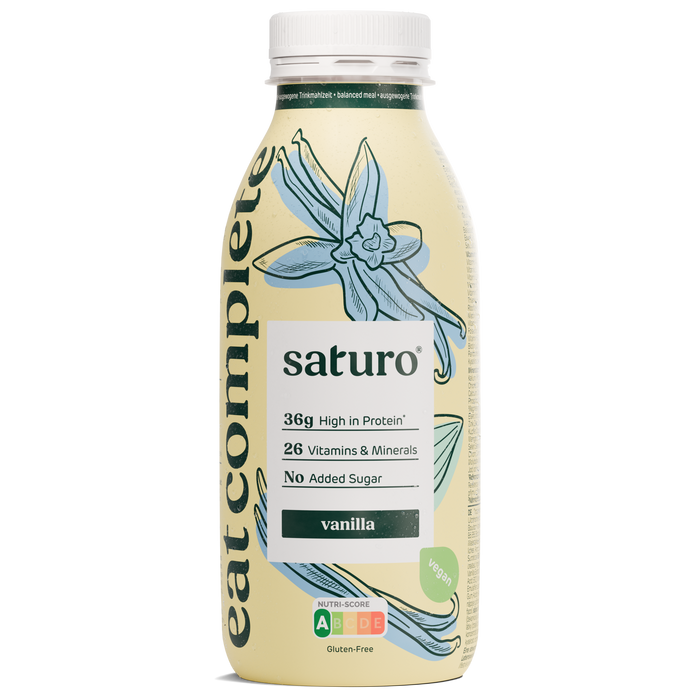
Drinkable meal: a complete meal in a bottle
26 vitamins and minerals, including vitamin B12, folic acid and iron. Vitamin B12 contributes to the reduction of tiredness and fatigue and to the normal function of the nervous system. Reference value for vitamin B12: 2.5 µg per day (NRV). For days when cooking isn't on the plan.
Vegan, pregnant, over 65, diabetes: who needs to pay extra attention
Going vegan without a B12 supplement doesn't work, and the professional societies agree on that; with a supplement, vegans are as well supplied as everyone else (chapter 2). What matters: the right form, taking it regularly, and a holo-TC test every two to three years, and beforehand if you're planning a baby. Children in vegan families need the supplement from the start, and while breastfeeding it reaches them through the mother.

Pregnancy, breastfeeding and infants
In pregnancy the estimated requirement rises to 4.5 µg, and while breastfeeding to 5.5 µg, because the baby builds up its own stores and is later supplied through the milk. Because total B12 levels fall by themselves in pregnancy, the NICE guideline recommends holo-TC as the first test here. The baby is most at risk: infants have no reserves, and a deficiency in the first months of life can cause lasting damage to brain development. That's why in 2024 the IQWiG came out in favour of adding acquired B12 deficiency to newborn screening. If you're breastfeeding on a vegan or very low-meat diet, you take a supplement for your baby too.
From 65: stomach, medication, forgetfulness
In later life three things come together: less stomach acid, often an acid blocker or metformin on top, and symptoms that get put down to normal ageing. One in four people over 65 is below the threshold. The tricky part is how much it resembles other diagnoses: an unsteady gait is seen as frailty, forgetfulness as the start of dementia, low mood as loneliness. The IQWiG doesn't recommend screening without symptoms, but with exactly these symptoms, a B12 test belongs in the work-up before a dementia diagnosis is made. The upside in later life: B12 from supplements is absorbed well even with little stomach acid.
Diabetes and metformin
Metformin is the most prescribed diabetes drug and a silent B12 thief: it interferes with absorption in the small intestine, and the risk grows with dose and years of use. The mix-up is the tricky part: tingling and numbness in the feet are seen in diabetes as diabetic nerve damage, yet the same finding can come from B12 deficiency, which is treatable; in the DPPOS study, nerve damage was more common with metformin. In 2022 the UK medicines regulator published a safety warning on this. In practice: have B12 checked at your yearly review, and straight away if you have foot symptoms. You don't stop the medication; you treat the deficiency alongside it.
Vitamin B12 deficiency consequences: nerves, blood, mind
Left untreated, the deficiency leads to megaloblastic anaemia, which puts strain on the heart, and to progressive nerve damage: polyneuropathy in the hands and feet, damage to the spinal cord pathways with gait problems and bladder problems, optic nerve damage, and in severe cases paralysis. Mentally, the consequences range from irritability and depression to confusion and psychosis; the NICE guideline lists all three. The crucial difference: blood always recovers, nerves only if treated early. That's why with nerve symptoms, it's not the value that counts but the time until the first dose.
Common questions about vitamin B12 deficiency
What are B12 thieves?
Not foods, but medications and circumstances that interfere with absorption: proton pump inhibitors and H2 blockers, metformin, nitrous oxide, heavy drinking, plus autoimmune gastritis, stomach and bowel surgery and chronic bowel diseases. Coffee, tea or vitamin C don't rob you of B12.
How long does it take to replenish B12?
Your blood responds within a week, and the blood count is usually normal after six to eight weeks; NICE cites a first noticeable improvement within two weeks to three months. Nerve symptoms take months. With autoimmune gastritis or after stomach surgery, treatment is lifelong because the cause remains.
What helps quickly with a B12 deficiency?
Injections work fastest because they bypass the gut and are given at close intervals at first. If absorption is intact, tablets of 1,000 µg daily are enough, and according to a Cochrane analysis they raise levels just as well. Food alone isn't fast enough for a confirmed deficiency, because at most 1.5 to 2 µg is absorbed per meal.
How can you tell if you're lacking vitamin B12?
Usually it starts with tiredness that sleep doesn't fix, and with tingling or numbness in your feet and hands. Forgetfulness, irritability, pale skin and a burning tongue can follow. Your nerves often react before your blood does, so your blood count can still look normal. Only a blood test (holo-TC or total B12) gives you certainty, and it needs to be taken before your first tablet.
What shouldn't you take together with B12?
No foods interfere with taking it. Acid blockers reduce absorption from food, but not from supplements. Be careful with high-dose folic acid: it improves the anaemia and so masks the B12 deficiency, while your nerves keep being damaged. And don't take B12 before a blood test, or the result won't be reliable.
Do nuts or yoghurt contain vitamin B12?
Nuts don't, and neither does any other plant food without fortification. Yoghurt does: plain yoghurt provides 0.4 to 0.6 µg per 100 g, so a 150 g pot gives you 0.6 to 0.9 µg. Milk has about 0.45 µg per 100 ml and Emmental around 3 µg per 100 g. For vegetarians, dairy products are the most important source of B12.
What nerve damage can a vitamin B12 deficiency cause?
First comes polyneuropathy, with tingling and numbness in your feet and hands. Then comes funicular myelosis, damage to the spinal cord pathways that causes unsteadiness when walking and falls, and later paralysis and bladder problems. Optic nerve damage, memory problems, depression and confusion are also possible. If it's treated early, the damage usually reverses. After many months, it often no longer recovers completely.
How long can you take high-dose vitamin B12?
For as long as the cause is there. With autoimmune gastritis or after stomach surgery, that means for life. This is considered safe, because no upper limit at which B12 causes harm is known. Without a confirmed deficiency, a high dose doesn't help, as your body excretes the excess. For self-supplementation, the BfR recommends no more than 25 µg per day.
Sources · 19 sources anzeigen
- German Nutrition Society (DGE): Reference values for nutrient intake, vitamin B12 (cobalamins). Estimated values for adequate intake, derivation 2018.
- German Nutrition Society (DGE): Selected questions and answers on vitamin B12. As of 10 September 2025.
- German Federal Institute for Risk Assessment (BfR): Maximum levels for vitamin B12 in foods including food supplements. Opinion 2021.
- EFSA Panel on Dietetic Products, Nutrition and Allergies (NDA): Scientific Opinion on Dietary Reference Values for cobalamin (vitamin B12). EFSA Journal 2015; 13(7): 4150.
- National Institute for Health and Care Excellence (NICE): Vitamin B12 deficiency in over 16s: diagnosis and management. NICE guideline NG239, 6 March 2024.
- Institute for Quality and Efficiency in Health Care (IQWiG): Benefit of regular vitamin screening in older people without symptoms not proven. Press release on HTA report HT20-04, 16 March 2022.
- Conzade R., Koenig W., Heier M., Schneider A., Grill E., Peters A., Thorand B.: Prevalence and Predictors of Subclinical Micronutrient Deficiency in German Older Adults: Results from the Population-Based KORA-Age Study. Nutrients 2017; 9(12): 1276.
- Green R., Allen L. H., Bjørke-Monsen A.-L. et al.: Vitamin B12 deficiency. Nature Reviews Disease Primers 2017; 3: 17040.
- Stabler S. P.: Vitamin B12 Deficiency. New England Journal of Medicine 2013; 368(2): 149–160.
- Herrmann W., Obeid R.: Causes and early diagnosis of vitamin B12 deficiency. Deutsches Ärzteblatt International 2008; 105(40): 680–685.
- Wolffenbuttel B. H. R., Wouters H. J. C. M., Heiner-Fokkema M. R., van der Klauw M. M.: The Many Faces of Cobalamin (Vitamin B12) Deficiency. Mayo Clinic Proceedings: Innovations, Quality & Outcomes 2019; 3(2): 200–214.
- Lam J. R., Schneider J. L., Zhao W., Corley D. A.: Proton Pump Inhibitor and Histamine 2 Receptor Antagonist Use and Vitamin B12 Deficiency. JAMA 2013; 310(22): 2435–2442.
- Aroda V. R., Edelstein S. L., Goldberg R. B. et al.: Long-term Metformin Use and Vitamin B12 Deficiency in the Diabetes Prevention Program Outcomes Study. Journal of Clinical Endocrinology & Metabolism 2016; 101(4): 1754–1761.
- Wang H., Li L., Qin L. L., Song Y., Vidal-Alaball J., Liu T. H.: Oral vitamin B12 versus intramuscular vitamin B12 for vitamin B12 deficiency. Cochrane Database of Systematic Reviews 2018; 3: CD004655.
- Weikert C., Trefflich I., Menzel J. et al.: Vitamin and Mineral Status in a Vegan Diet (RBVD study). Deutsches Ärzteblatt International 2020; 117(35–36): 575–582.
- MSD Manual, professional edition: Vitamin B12 deficiency. Reviewed August 2024.
- U.S. Department of Agriculture, Agricultural Research Service: FoodData Central, SR Legacy Release (2018). Vitamin B12 content per 100 g.
- National Institutes of Health, Office of Dietary Supplements: Vitamin B6, Fact Sheet for Health Professionals (as of June 2023).
- MSD Manual, professional edition: Thiamine deficiency.
Writing for Saturo since 2019 about nutrition, nutrients and how good nutrition works in everyday life.
Hat diesen Artikel am 11. September 2026 auf fachliche Richtigkeit geprüft. This content doesn't replace medical advice.

Iron deficiency: symptoms, causes and treatment
Tired, pale, hair loss: why iron deficiency is the most common nutrient deficiency in the world, which blood value matters and what helps quickly.
Weiterlesen · 13 Min

New from the guide
New articles, updates and tips straight to your inbox. Clear, fact-checked, no spam.
Danke! Bitte bestätige die Anmeldung in deinem Postfach.