
Vitamin deficiency: symptoms, causes and tests
Tired, cracked corners of the mouth, flaky skin? Signs like these can point to a vitamin deficiency, but often it's something else. Which symptom fits which vitamin, who's at risk and which blood test gives you certainty.


Aktualisiert 2 October 2026 · 13 Min. Lesezeit · 38 Quellen

The key points in 30 seconds
Four of them are fat-soluble (A, D, E, K) with stores that last for months, nine are water-soluble and need constant topping up. Every deficiency has its own signs.
That's how many adults are below 30 nmol/l (RKI, standardised). The most common true vitamin deficiency, and more frequent in winter. All the others are rare in healthy people.
That's how few adults have too little folate in their blood, even though 79 to 86% fell short of the intake recommendation at the time. Below the recommendation doesn't mean deficiency.
A standard blood count doesn't measure any vitamins. If you have symptoms, health insurance covers targeted tests; without symptoms, a full check-up achieves little, according to the consumer advice centre (Verbraucherzentrale).
Vitamin deficiency symptoms: the table of all 13 vitamins
A vitamin deficiency almost always starts out vague: tiredness, poor concentration, headaches. None of that tells you which vitamin is missing. Only the specific signs of each vitamin do that: a burning tongue with B12, bruising with K, night blindness with A. The table shows which vitamin deficiency causes which symptoms, with the risk group and the blood test that actually tells you something in each row. For the minerals from iron to zinc, there's the same kind of overview.
Which vitamin deficiency causes which symptoms?
13 vitamins, three columns each. The symptoms are the ones each article classes as proven or typical; myths are left out on purpose. The link takes you to the full article.
| Typical symptoms | Who is at risk | Meaningful test | |
|---|---|---|---|
| Vitamin A deficiency | Night blindness, dry eyes, infections | Impaired fat digestion, stomach surgery, alcohol | Retinol in serum (with CRP) |
| Vitamin B1 deficiency | Tingling in the feet, racing heart | Alcohol, stomach surgery, diabetes, vomiting | Thiamine diphosphate in whole blood |
| Vitamin B2 deficiency | Cracked corners of the mouth, red tongue, flaky skin | Few dairy products, alcohol, bowel disease | EGRAC or vitamin B2 in whole blood |
| Vitamin B3 deficiency | Redness on sun-exposed skin, sore tongue | Alcohol, eating disorder, tuberculosis drugs | No routine test, breakdown products in urine |
| Vitamin B5 deficiency | Tiredness, tingling (from experiments only) | Severe malnutrition, tube feeding | No validated test |
| Vitamin B6 deficiency | Cracked corners of the mouth, tingling, irritability | Alcohol, dialysis, certain medicines | PLP in plasma |
| Biotin deficiency | Scaly rash around the mouth and nose | Raw egg white, anti-epileptics, alcohol | No reliable test, serum biotin unreliable |
| Folic acid deficiency | Tiredness, pallor, burning tongue | Little veg, alcohol, methotrexate | Folate in serum (fasting) |
| Vitamin B12 deficiency | Tingling, unsteady gait, forgetfulness | Vegan diet, over 65, acid blockers, metformin | Holotranscobalamin, then methylmalonic acid |
| Vitamin C deficiency | Bleeding gums, bruising, tiredness | Smoking, one-sided diet, dialysis | Ascorbic acid in plasma |
| Vitamin D deficiency | Muscle weakness, bone pain, calf cramps | Winter, over 65, little sun | 25(OH)D in blood |
| Vitamin E deficiency | Unsteady gait, tingling, muscle weakness | Impaired fat absorption, orlistat, premature babies | Alpha-tocopherol in serum (with blood lipids) |
| Vitamin K deficiency | Bruising, nosebleeds and bleeding gums | Impaired fat absorption, Marcumar, antibiotics | Quick value / INR |
As of October 2026, summarised from the 13 individual articles (sources are listed there). B5: symptoms only from deficiency experiments in the 1950s. Mineral deficiency symptoms as a table: in the mineral overview.
How do you know if you have a vitamin deficiency?
Usually, you don't, at least not straight away. Your stores run down over weeks to years, and you put the first signs down to stress or sleep. A vitamin deficiency becomes more likely when three things come together: a specific sign from the table, a reason for it (diet, medication, illness, age) and a matching blood value. If there's no reason, something else is almost always behind it. The consumer advice centre puts it like this: Germany is not a land of vitamin deficiency.
Vitamin B deficiency: symptoms of the eight B vitamins
When people say “vitamin B deficiency”, they usually mean B12. But there are eight B vitamins, each with its own key symptom: B1 tingling in the feet and a racing heart, B2 cracked corners of the mouth and a red tongue, B3 redness on sun-exposed skin, B5 practically no deficiency possible, B6 mouth corners and tingling, biotin scaly rash around the mouth and nose, folic acid anaemia with tiredness, B12 tingling, unsteady gait and forgetfulness. What they have in common: alcohol is the most common cause, and the corners of the mouth and the tongue react in the same way with several of them.

Which vitamin am I missing? From symptom to nutrient
The question “Which vitamins am I missing?” can't be answered reliably without a blood test. What can be answered: which nutrients fit a sign at all and which don't. That's exactly what the finder does. For every symptom and every life situation, it shows the vitamins our articles have backed up, and below them the minerals, because many signs fit both groups. Every row leads to the full article.
Vitamin deficiency and skin: rash, dry and cracked skin
A skin rash from vitamin deficiency is rare and looks specific: greasy, flaking redness beside the nose and on the eyelids with vitamin B2 and B6, a scaly red ring around the eyes, nose and mouth with biotin, sunburn-like redness on the backs of the hands and the neck with vitamin B3. Dry or cracked skin on the fingers doesn't appear in any of our articles as a proven vitamin sign; the cause is usually eczema, contact allergy or frequent washing. Rough skin with little bumps on the upper arms, on the other hand, is a sign of vitamin C deficiency.
Hair loss and brittle nails from vitamin deficiency
Among the vitamins, little is proven for hair loss. Biotin stands out in a true deficiency, but without a trigger it is almost never the cause according to the biotin article, and a 2019 review calls the data on vitamins “insufficient”. More often the cause is iron (have your ferritin measured), zinc, thyroid, hormones or stress. The same goes for nails: ridges and breakage point to iron and zinc, with biotin only as an accompanying sign. Biotin supplements can also distort lab results.
Tiredness from vitamin deficiency
Tiredness is the most common sign and also the least specific. It's proven as an early sign with B12, folate, vitamin C and B1, but with vitamin D only as an association without proof of cause. The GP guideline on tiredness doesn't measure any vitamin in the basic lab work, but blood count, inflammation marker, blood sugar, liver and thyroid. Most often the cause is depression or an anxiety disorder (point estimate 18.5%), with anaemia at 2.8%.

Cracked corners of the mouth and burning tongue
The corners of the mouth and the tongue react to the same deficiencies: vitamin B2, B6, folate, B12 and iron. A smooth, glossy red, burning tongue is the stronger sign, cracked corners of the mouth the weaker one: in an analysis of 156 cases, only about a quarter had a nutrient deficiency, while the rest had yeast infections, saliva, dentures or lip licking. If testing is done, it should be blood count, ferritin, B12 and folate together, never just one value.
Bruises and bleeding gums
Bruises without a knock, nosebleeds and bleeding gums are the only proven sign of a vitamin K deficiency in adults; swollen, bleeding gums with pinpoint bleeding on the legs are part of scurvy from vitamin C deficiency. Both are rare. Far more often the cause is age, aspirin, blood thinners, too few platelets or gum inflammation. Bleeding without a reason belongs at the doctor's, not at the pharmacy.
Tingling, numbness and an unsteady gait
Tingling in the hands and feet is the core symptom of vitamin B12 deficiency, where the nerves often react before the blood count does. It also fits B1 (on both sides, moving up from the feet), B6 (too little and too much) and vitamin E when fat absorption is impaired. If your gait becomes unsteady, especially in the dark, the spinal cord is affected; then every week counts, because nerve damage is only reliably reversible in the first few months. Tingling with confusion and eye tremor is an emergency.
Vitamin deficiency and mental health
Irritability, low mood and forgetfulness are proven deficiency signs with B12, folate and B1, in older people even up to confusion that looks like dementia. For vitamin D, the picture is this: low levels and low mood often occur together, but supplements don't prevent depression. A vitamin deficiency is rarely the sole trigger. If low mood lasts longer than two weeks, get it checked by a doctor, with or without a blood test.
Tingling or numbness that doesn't go away, an unsteady gait, vision problems, bruises without a reason or anaemia in your blood count: see your doctor promptly. Mention a vegan diet, metformin, acid blockers, alcohol or gastrointestinal surgery at the appointment straight away, so the right value gets measured.
What is a vitamin deficiency?
Deficiencies develop in three steps. Once you know them, you'll see why intake so often looks too low on paper and yet there's no deficiency.
The store empties
Fat-soluble vitamins (A, D, E, K) are stored in the liver and fatty tissue, B12 lasts for years, B1 only for weeks. As long as the store holds, nobody notices anything, even if less comes in than recommended.
The blood level drops
Once the store is used up, the blood level falls below the reference range and the enzymes that depend on it work more slowly. This is latent deficiency (hypovitaminosis): measurable, but still without symptoms.
Symptoms appear
Only now do the specific signs show up: anaemia, nerve disorders, changes to the skin and mucous membranes. This is manifest deficiency; the most severe form is called avitaminosis, such as scurvy or beriberi.
Who's at risk? Causes of vitamin deficiency
A vitamin deficiency can come about in four ways: too little in your food, poor absorption in the gut, increased need, or losses through medication and alcohol. For healthy people eating a mixed diet, the first is rare. The other three make up the risk groups that the finder above shows under “Your situation”. Not to be confused with malnutrition, where energy and protein are lacking; what the individual micronutrients do in your body is explained in the basics article.
Vitamin deficiency on a vegan diet
Since 2024, the DGE has been clear, with no exceptions: if you're vegan, you need to supplement vitamin B12 and have your level checked regularly, because clinical signs often only show up after years. Vitamin B2 (without dairy) is also considered potentially critical, and now vitamin A too, along with the minerals iodine, zinc, calcium, iron and selenium. No problem: B1, B3, B5, B6, biotin, D and K. None of our articles names a vegan risk for those. More in the article on vegan nutrition.
Vitamin deficiency in older age
Two deficiencies are almost everyday in older age: B12, because stomach acid declines and B12 is no longer released from food, and vitamin D, because the skin makes less than half as much and people in care rarely get outdoors. From 65, if you're not getting enough sun, the DGE recommends 20 µg of vitamin D as a supplement. On top of that come a small appetite, medication and alcohol, which mainly affect folic acid, B1 and B6. If you have no symptoms, the IQWiG still doesn't recommend routine screening.
Medicines that rob you of vitamins
The best-known “B vitamin thieves”: Metformin lowers B12, and after five years 19% have low or borderline levels. Acid blockers (pantoprazole, omeprazole) are linked to low B12 after two years of use, as well as low iron and magnesium. Diuretics flush out B1 and electrolytes, antiepileptics lower folic acid, B12, B6, biotin and vitamin D, and methotrexate blocks folate metabolism, which is why a doctor prescribes folic acid alongside it. If you're on long-term medication, get your levels measured rather than supplementing blindly.
The finder shows two more groups: pregnant women need 400 µg of folic acid as a supplement from when they start trying to conceive until the end of week twelve, because only 3 to 4% of women reach the folate level that protects the neural tube. After gastrointestinal surgery, and with coeliac disease, Crohn's disease or cystic fibrosis, B12, folic acid, iron and the fat-soluble vitamins run short first; after bypass surgery, the guideline recommends lifelong supplementation.
Alcohol is the most common cause of genuine vitamin deficiencies in industrialised countries: 30 to 80% of people with alcohol dependence have too little B1, and often too little B6, B3 and folic acid as well. The S3 guideline therefore ties every withdrawal to thiamine.
How common is vitamin deficiency in Germany?
Online, you'll read that 80 to 90% of Germans have a vitamin D deficiency and one in four has too little B12. Neither is true as stated. The figures come from intake studies and subgroups. Real deficiencies are measured in the blood, and the picture there is different.
Which vitamin deficiency is the most common?
Vitamin D: according to standardised RKI data, 15% of adults are below 30 nmol/l, another 41% are between 30 and 50, and in winter one in four is deficient. In older people, B12 follows, with 27% showing low levels. All other vitamin deficiencies are rare in healthy people; the BfR names only vitamin D, folic acid, calcium and iodine as nutrients where subgroups fall below the recommendations. In the German diet, niacin is the best supplied: 98 to 99% meet the recommendation.
How common is it really? Share below the intake recommendation
National Nutrition Survey II (Max Rubner Institute 2008): share of 14- to 80-year-olds whose intake from food, without supplements, was below the D-A-CH recommendation of the time (2005/06). Below the recommendation does not mean deficiency (DGE, BfR).
Below the recommendation doesn't mean deficiency
The DGE reference values include a 20 to 30% margin on top of the average requirement, so that they cover almost all healthy people. If you're below, you don't automatically have too little. In 2024, the BfR wrote that an intake below the recommendation is “not generally equivalent to undersupply, let alone deficiency”. Folic acid is the textbook example: 79 to 86% missed the old intake recommendation, yet in the blood 86% have enough folate and only 3.3% have a clinical deficiency. There's no newer nationwide intake data; the National Nutrition Monitoring only started in April 2026.
Vitamin deficiency diseases: scurvy, beriberi, pellagra, rickets
The classic vitamin deficiency diseases (avitaminoses) are isolated cases in Germany, almost always linked to alcohol dependence, illness or an extremely one-sided diet: scurvy with vitamin C deficiency (bleeding gums, poor wound healing; in 2025 there was a case report of a child who ate only crisps and sugary drinks), beriberi and Wernicke encephalopathy with vitamin B1 deficiency (nerves, heart, confusion), pellagra with vitamin B3 deficiency (skin, diarrhoea, mental symptoms), rickets and osteomalacia with vitamin D deficiency (soft bones; this is why babies are given vitamin D) and night blindness through to keratomalacia with vitamin A deficiency. There are no frequency figures for Germany for any of them.
Diagnosing a vitamin deficiency: test at the doctor's or at home?
Only a blood value tells you whether you're short of a vitamin, and it has to be the right one. A standard blood count doesn't measure any vitamin. At most it shows the consequences: red blood cells that are too large with B12 or folic acid, too small with iron. The table in chapter 1 shows which value counts for each vitamin.
Vitamin deficiency test at the GP: what does health insurance cover?
If there are signs of a deficiency, meaning matching symptoms plus a risk factor, the GP practice orders the test and your health insurer pays. Without symptoms, a vitamin test counts as a self-pay service (IGeL). The IGeL-Monitor rates the vitamin D check without symptoms as "unclear", and the IQWiG finds no proven benefit in screening from age 50. Your GP is the right person to see. If a deficiency is suspected, they will test specifically for B12, folic acid, vitamin D or ferritin, and only refer you to neurology if you have nerve symptoms.
per vitamin if you pay yourself, plus around €10 for the blood draw. Venous blood, lab standard, medical interpretation. If a deficiency is suspected, your health insurer pays.
per value. According to the consumer advice centre, results vary from provider to provider, often with a recommendation to buy something attached. Have a low result confirmed at a GP practice.
How much does a vitamin test cost?
According to the consumer advice centre (as of January 2026), testing a single vitamin costs 20 to 35 euros, plus about 10 euros for the blood draw. A complete vitamin profile costs around 450 euros. The IGeL-Monitor puts lab costs for vitamin D at 27 to 33 euros. The all-round profile rarely makes sense: Germany is not a country of vitamin deficiency, and a value without a clear question creates more uncertainty than answers. Better: one or two values that fit your symptoms and situation.
Home tests: what they're worth
According to the consumer advice centre, send-in tests using capillary blood (20 to 40 euros) give results that vary from provider to provider, often with a recommendation to buy something right alongside. Rapid tests for 5 to 10 euros only give a rough indication, and it advises against hair analyses altogether. Online self-tests are questionnaires. Home tests are useful if three rules apply: no supplements in the weeks beforehand, you know about confounding factors like the pill or inflammation, and you have a low result confirmed at a GP practice. Without symptoms, the honest answer is: the test won't tell you much.

Fix and prevent vitamin deficiency
What should you do about a vitamin deficiency? Measure first, then fix the cause, then top up in a targeted way. If you can't absorb the vitamin (acid blockers, bowel disease, stomach surgery), you need a supplement or an injection. If you simply eat too little, start by changing your diet. The order matters, because a supplement without a diagnosis hides the real cause.
How long does it take to correct a vitamin deficiency?
Weeks to months, depending on the vitamin. With B12, the blood responds after a week, the blood count is normal after six to eight weeks, and nerve symptoms take months and sometimes persist. Vitamin D is usually built up over around two months, followed by a maintenance dose. With folic acid, 95% of levels were normal after three months. Scurvy improves within days with vitamin C. Your practice sets follow-up appointments, usually after three months for B12.
You spot a missing vitamin from a blood value, not from a feeling. So the order is: measure, find the cause, then top up in a targeted way. Multivitamins taken on a hunch rarely fix anything.
Joerg Hauke, Nutrition expert, subject-matter review of this article
Do I need vitamin supplements?
The DGE says healthy people who eat a balanced diet don't need them. Only in certain life situations does a targeted supplement make sense, according to the DGE table: vitamin D (20 µg if your body can't make enough itself, for example from age 65 or in winter without time outdoors), folic acid (400 µg from when you're trying to conceive until the end of week twelve), B12 on a vegan diet, plus iodine during pregnancy and breastfeeding. The BfR warns against high doses from supplements combined with fortified foods, and biotin from 150 µg can distort lab results. Everything else only after a diagnosis.
The best prevention is still varied eating: vegetables, fruit, pulses, wholegrain, nuts, dairy, eggs, fish. If you'd otherwise skip a meal on busy days, you can replace it with a complete drinkable meal that contains all 13 vitamins and 13 minerals in balanced amounts. It doesn't replace therapy or a blood value, but it makes your supply easier to plan.
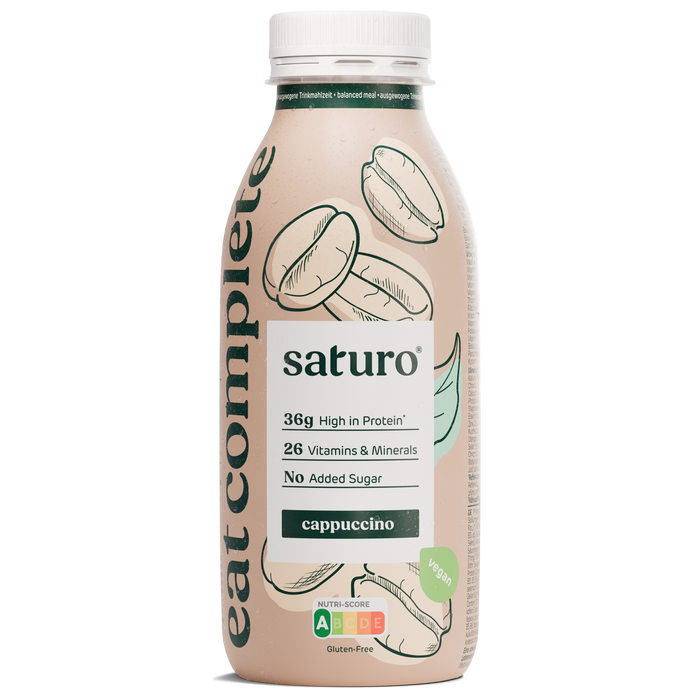
Drinkable meal: 26 vitamins and minerals in one meal
Every bottle delivers all 13 vitamins and 13 minerals in amounts between 20 and 40% of the reference intake, plus 36 g of protein. Vitamin B12 contributes to the reduction of tiredness and fatigue. For days when you'd otherwise skip a proper meal.
Frequently asked questions about vitamin deficiency
Which vitamin deficiency causes which symptoms?
Tingling and an unsteady gait: B12, B1, E. Cracked corners of the mouth and a red tongue: B2, B6, folic acid, B12. Bruising and bleeding gums: K and C. Night blindness: A. Muscle weakness and bone pain: D. Redness on sun-exposed skin: B3. Tiredness on its own fits everything and nothing. The table above shows all 13.
Which vitamin deficiency is the worst?
The dangerous ones are those that cause lasting damage: a B1 deficiency can damage the brain within days as Wernicke encephalopathy (confusion, eye tremors, unsteady gait, an emergency). A B12 deficiency left untreated for a long time causes nerve damage that doesn't fully recover even after many months.
Which vitamins can you get tested at the GP?
All those for which a blood value exists: vitamin D (25(OH)D), B12 (holotranscobalamin), folic acid, B1, B6, A, E, C and K via the Quick value. D, B12, folic acid and ferritin are the ones usually tested for specifically. For B3, B5 and biotin, there is no reliable routine value.
Which doctor is responsible for vitamin deficiency?
Your GP. They assess your symptoms, order the right blood values and treat most deficiencies themselves. For nerve symptoms they refer you to neurology, for bowel diseases to gastroenterology, and for vision problems to an eye specialist.
Can a blood count detect a vitamin deficiency?
No, a standard blood count doesn't measure any vitamin. At most it shows consequences, such as red blood cells that are too large with a B12 or folic acid deficiency. The value has to be requested specifically, for example 25(OH)D for vitamin D or holotranscobalamin for B12.
What are vitamin B robbers?
Medicines and habits that lower B vitamins: metformin and acid blockers (B12), alcohol (B1, B6, B3, folic acid), anti-epileptics (folic acid, B12, B6, biotin), methotrexate (folic acid), water tablets (B1). If you take any of these long term, get the relevant level checked instead of supplementing blindly.
How do I find out which vitamins I'm missing?
Only with a blood test, and only with the value that fits your symptom and situation. The finder in chapter 2 shows which vitamins actually match a given sign. With this list, your GP surgery can test one or two specific values.
What should you eat if you have a vitamin deficiency?
Varied and fresh: vegetables and fruit for C and folic acid, wholegrain and pulses for B1 and B6, dairy for B2, eggs, fish and meat for B12 and D, nuts and plant oils for E, green vegetables for K. Each individual article with a ranking shows which foods deliver the most.
Sources · 38 sources anzeigen
- Max Rubner-Institut: National Consumption Study II (Nationale Verzehrsstudie II), results report part 2. The nationwide survey on the nutrition of adolescents and adults. Karlsruhe 2008 (proportions below the intake recommendation, tables A.34 to A.45).
- German Nutrition Society (DGE): FAQ on reference values for nutrient intake (20 to 30% margin, “not necessarily undersupplied”), as of 07.05.2026.
- German Federal Institute for Risk Assessment (BfR): Updated proposals for maximum levels of vitamins and minerals in food supplements and fortified foods. Opinion 006/2024 of 22.02.2024.
- Rabenberg M. et al.: Implications of standardization of serum 25-hydroxyvitamin D data for the evaluation of vitamin D status in Germany, including a temporal analysis. BMC Public Health 2018; 18: 845.
- Rabenberg M., Scheidt-Nave C., Busch M. A., Rieckmann N., Hintzpeter B., Mensink G. B. M.: Vitamin D status among adults in Germany, results from the German Health Interview and Examination Survey for Adults (DEGS1). BMC Public Health 2015; 15: 641.
- German Nutrition Society (DGE): FAQ on vitamin D (deficiency below 30 nmol/l, own synthesis 80 to 90%, supplement only for risk groups), as of 30.09.2025.
- Mensink G. B. M., Weißenborn A., Richter A.: Folate supply in Germany. Journal of Health Monitoring 2016; 1(2). Robert Koch-Institut.
- Conzade R., Koenig W., Heier M., Schneider A., Grill E., Peters A., Thorand B.: Prevalence and Predictors of Subclinical Micronutrient Deficiency in German Older Adults: Results from the Population-Based KORA-Age Study. Nutrients 2017; 9(12): 1276.
- Institute for Quality and Efficiency in Health Care (IQWiG): Benefit of regular vitamin screening in older people without symptoms not proven. Press release of 16.03.2022.
- Max Rubner-Institut: National nutrition monitoring (nemo) begins. Press release of 07.04.2026.
- Verbraucherzentrale (consumer advice centre): Which vitamin deficiency tests make sense? As of 06.01.2026.
- IGeL-Monitor (Medizinischer Dienst Bund): Early detection testing for vitamin D deficiency, rating “unclear”, created 09.11.2022.
- German College of General Practitioners and Family Physicians (DEGAM): S3 guideline on fatigue, AWMF register 053-002, revised December 2022.
- Klug A., Barbaresko J., Alexy U. et al.: Reassessment of the DGE position on vegan diets. DGE position paper. Ernährungs Umschau 2024; 71(7).
- German Nutrition Society (DGE): FAQ on food supplements (table of life situations: vitamin D, folic acid, vitamin B12, iodine), as of 02.06.2026.
- Verbraucherzentrale (consumer advice centre): Fit in later life, do I need a food supplement? As of 28.08.2026.
- DGPPN, DG-Sucht: S3 guideline on screening, diagnosis and treatment of alcohol-related disorders, AWMF register 076-001, 2020 version, extended 01/2025.
- Drug Commission of the German Medical Profession (AkdÄ): Metformin and reduced vitamin B12 levels. Drug Safety Mail 2022-34 of 25.08.2022.
- Association of Statutory Health Insurance Physicians of Baden-Württemberg: Prescribing Forum 54, proton pump inhibitors (vitamin B12 deficiency as an association), August 2020.
- Katta N., Balla S., Alpert M. A.: Does Long-Term Furosemide Therapy Cause Thiamine Deficiency in Patients with Heart Failure? A Focused Review. American Journal of Medicine 2016; 129(7): 753.e7-753.e11.
- Linnebank M., Moskau S., Semmler A. et al.: Antiepileptic drugs interact with folate and vitamin B12 serum levels. Annals of Neurology 2011; 69(2): 352-359.
- Shea B., Swinden M. V., Tanjong Ghogomu E. et al.: Folic acid and folinic acid for reducing side effects in patients receiving methotrexate for rheumatoid arthritis. Cochrane Database of Systematic Reviews 2013; CD000951.
- German Society for General and Visceral Surgery (DGAV): S3 guideline on surgery for obesity and metabolic diseases, AWMF register 088-001, as of 02/2018 (update in progress).
- German Society for Gastroenterology, Digestive and Metabolic Diseases (DGVS): Updated S2k guideline on coeliac disease, AWMF register 021-021. Zeitschrift für Gastroenterologie 2022; 60: 790-856.
- Sturm A. et al.: Updated S3 guideline on the diagnosis and treatment of Crohn's disease, AWMF register 021-004, as of 09/2024. Zeitschrift für Gastroenterologie 2024; 62: 1229-1318.
- Skin changes in vitamin and mineral deficiency (CME). Die Dermatologie 2022; 73: 647-655.
- Galimberti F., Mesinkovska N. A.: Skin findings associated with nutritional deficiencies. Cleveland Clinic Journal of Medicine 2016; 83(10): 731-739.
- Almohanna H. M., Ahmed A. A., Tsatalis J. P., Tosti A.: The Role of Vitamins and Minerals in Hair Loss: A Review. Dermatology and Therapy 2019; 9(1): 51-70.
- Park K. K., Brodell R. T., Helms S. E.: Angular cheilitis, part 2: nutritional, systemic, and drug-related causes and treatment. Cutis 2011; 88(1): 27-32.
- National Institute for Health and Care Excellence (NICE): Vitamin B12 deficiency in over 16s: diagnosis and management. NICE guideline NG239, 6 March 2024.
- Langan R. C., Goodbred A. J.: Vitamin B12 Deficiency: Recognition and Management. American Family Physician 2017; 96(6): 384-389.
- Holick M. F., Binkley N. C., Bischoff-Ferrari H. A. et al.: Evaluation, Treatment, and Prevention of Vitamin D Deficiency: an Endocrine Society Clinical Practice Guideline. Journal of Clinical Endocrinology and Metabolism 2011; 96(7): 1911-1930.
- German Nutrition Society (DGE): FAQ Vitamin C (scurvy has practically disappeared in industrialised countries), as of 10 September 2025.
- Posch M., Erbis A., Pommerening H.: Scurvy due to malnutrition in autism spectrum disorder. Deutsches Ärzteblatt International 2025; 122: 234.
- German Nutrition Society (DGE): FAQ Thiamine (beriberi, causes in Germany), as of 10 September 2025.
- German Nutrition Society (DGE): FAQ Niacin (pellagra, causes in Germany), as of 10 September 2025.
- Kruse K.: Current aspects of vitamin D deficiency rickets. Monatsschrift Kinderheilkunde 2000; 148: 588-595.
- Severe bilateral keratomalacia (Image and Case, Heidelberg University Eye Hospital). Der Ophthalmologe 2013; 110: 61-64.
Has been writing for Saturo since 2019 about nutrition, nutrients and how to get good nourishment into everyday life in a practical way.
Hat diesen Artikel am 2. Oktober 2026 auf fachliche Richtigkeit geprüft. This content is no substitute for medical advice.

Mineral deficiency: symptoms for every mineral
Calf cramps, heart palpitations, hair loss: which mineral goes with which sign, from iron to zinc.
Weiterlesen · 16 Min

What's new in the guide
New articles, updates and tips straight to your inbox. Easy to understand, expert-checked, no spam.
Danke! Bitte bestätige die Anmeldung in deinem Postfach.